
International Research Journal of Engineering and Technology (IRJET) e-ISSN: 2395-0056
Volume: 12 Issue: 12 | Dec 2025 www.irjet.net p-ISSN: 2395-0072
International Research Journal of Engineering and Technology (IRJET) e-ISSN: 2395-0056
Volume: 12 Issue: 12 | Dec 2025 www.irjet.net p-ISSN: 2395-0072
Ar. Purvi Varshney1 , Dr. Syed Mohammad Noman Tariq 2
1MURP 2nd Year, Department of Architecture
2Associate Professor, Department of Architecture
3Aligarh Muslim University, Aligarh, Uttar Pradesh, 202001, (India)
Abstract - Micro, Small and Medium Enterprise (MSME) clusters in India are largely accommodated within industrial estates governed by state-level planning regulations and statutory master plans. While policy frameworks supporting MSME growth are well established, their spatial translation through planning frameworks at the cluster level remains uneven. This study assesses the effectiveness of existing planningframeworksforMSMEclusterdevelopmentusingthe Talanagri Industrial Estate in Aligarh as empirical evidence. The assessment focuses on prescribed planning standards related to land use, internal circulation, infrastructure provision,logisticssystems,andenvironmentalmanagement, and compares these with on-ground spatial conditions. To contextualize the findings, insights from Indian and international MSME cluster case studies are used to benchmark planning performance. The analysis reveals persistent gaps between regulatory intent and implementation,indicatinglimitationsinestate-levelplanning execution. The study provides planning-oriented evidence on theneedforintegratedandenforceableframeworksforMSME cluster development.
Key Words: MSME clusters, industrial planning, infrastructure gaps, land use, logistics, Talanagri.
MSME clusters constitute an important spatial form of industrialorganizationinIndia,oftenconcentratedwithin designatedindustrialestatesdevelopedbystateindustrial development authorities. These estates are intended to provideplannedland,infrastructure,andservicestosupport small-scale manufacturing activities. However, the effectiveness of such estates depends not only on policy incentivesbutalsoontheadequacyofplanningframeworks governinglanduse,circulation,infrastructurecapacity,and environmentalsafeguards.
In Uttar Pradesh, MSME clusters are regulated through a combination of state industrial area planning regulations and statutory city master plans. While these frameworks prescribe norms related to plot layout, internal roads, buffers, and infrastructure provision, many clusters developedduringearlierphasesexhibitspatialpatternsthat diverge from current planning standards. Over time, industrial intensification, subdivision of plots, and mixed land-use activities have altered original layouts. Talanagri
IndustrialEstateinAligarhrepresentssuchacluster,making it an appropriate case for evaluating how planning frameworksoperateinpracticeandwhereimplementation gapspersist.
1.1 Current Planning and Policy Frameworks for MSME Cluster Development in India
MSME clusters in India are supported through industrialpolicies,planningregulations,andclusterbaseddevelopmentschemes.
TheMSMEDAct,2006andprogramssuchasMSECDP provide institutional and infrastructure support,whilespatialplanningisgovernedbystate authoritiesandmasterplans
Industrial estates are regulated through state planning bye-laws that prescribe norms for plot sizes,roadhierarchy,utilities,andbuffers.
However,planningcontrolisoftenweakbeyondthe initial development stage, leading to incremental growth,congestion,andinfrastructurestress.
This underscores the need to evaluate the effectivenessofplanningframeworksattheMSME clusterlevel
The aim of this research is to assess the effectiveness of planning frameworks for MSME cluster development in Talanagri,Aligarh
1. To examine the planning policies, regulatory provisions,andinstitutionalframeworksthatguide MSMEclusterdevelopmentinIndia.
2. ToanalyzeglobalandnationalMSMEclustercase studies in order to identify planning principles, spatial strategies, and governance practices relevanttoclusterdevelopment.
3. To assess the spatial structure, land-use patterns, infrastructureprovision,andlogisticssystemsofan
International Research Journal of Engineering and Technology (IRJET) e-ISSN: 2395-0056
Volume: 12 Issue: 12 | Dec 2025 www.irjet.net p-ISSN: 2395-0072
MSME cluster as evidence of planning framework performance.
4. To identify gaps between prescribed planning norms and on-ground conditions, and derive planning-orientedinsightsforstrengtheningMSME clusterdevelopment.
2.3
DespitetheeconomicsignificanceofMSMEclusters,many industrialestatesinIndiacontinuetofacechallengessuchas congestion, inadequate infrastructure, inefficient logistics, andenvironmentalstress.Theseissuesareoftenrootednot in the absence of policies, but in limitations of planning implementation and coordination. Existing studies largely focusoneconomicperformanceandpolicyincentives,while comparatively fewer examine how planning frameworks shapeclusterfunctionalityovertime.Afocusedassessment ofplanningframeworksisthereforerequiredtounderstand why several MSME clusters underperform spatially and infrastructurally, and how planning-led interventions can improvetheirlong-termsustainability.
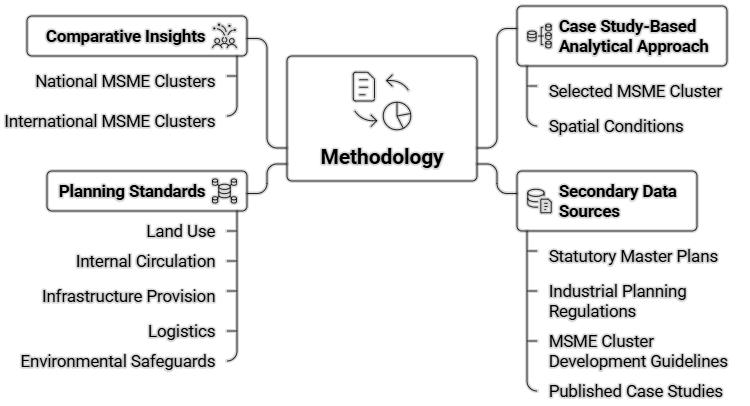
2.4 Methodology
3. LITERATURE REVIEW
ExistingliteratureonMSMEclustershighlightstheeconomic rationale of agglomeration, including reduced transaction costs,laborpooling,andproductionspecialization.However, planning literature increasingly recognizes that these benefitscanbeunderminedwhenspatialorganizationand infrastructure provision fail to keep pace with cluster growth. Studies on industrial estate planning point to congestion, logistics inefficiencies, land-use conflicts, and environmentalstressascommonoutcomesofweakplanning control.
Indian cluster-based studies, such as those on Tiruppur, demonstratehoworganicallygrownMSMEclustersinitially flourish but later encounter severe infrastructure and environmental challenges due to inadequate planning
integration.Conversely,internationalliteratureonindustrial districtsinEmilia-Romagnahighlightstheroleofproactive regionalplanning,institutionalcoordination,andintegration ofindustrialareaswithtransport,housing,andinnovation systems. These contrasting experiences underscore that planningframeworksplayadecisiveroleinshapingcluster trajectories. The literature consistently identifies a gap between planning prescriptions and implementation in traditionalMSMEestates anissuedirectlyexaminedinthis study.
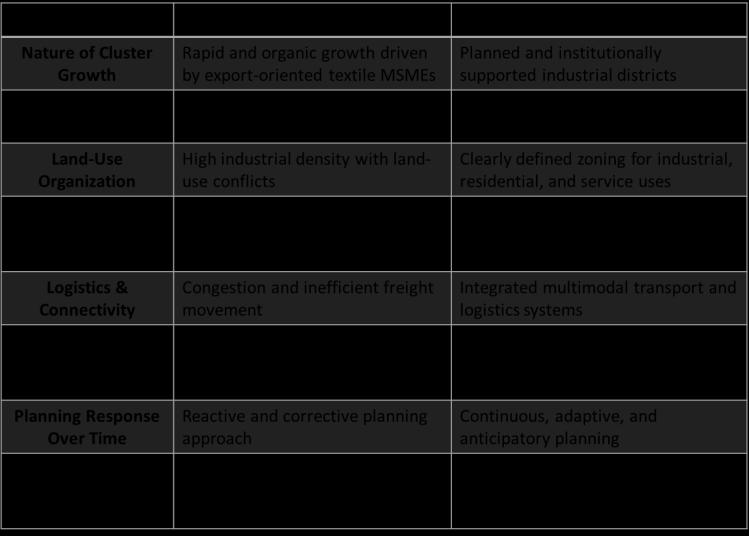
TalanagriIndustrialEstateislocatedinthesouthernpartof Aligarhcityandfunctionsasoneofthecity’sprincipalMSME manufacturingclusters.Theestateprimarilyaccommodates microandsmallunitsengagedinmetalwareproduction,lock manufacturing, building hardware, and allied activities. Theseindustriesaretypicallylabor-intensiveandoperateon compact plots, contributing to high employment density withinalimitedspatialarea.
Theestatehasdevelopedincrementally,resultinginadense andcompactindustrialmorphology.Plotlayoutsareclosely spaced, internal open spaces are limited, and circulation infrastructurehasevolvedinresponsetoimmediateneeds rather than long-term planning. Surrounding land uses include residential neighborhoods and local commercial activities,increasinginterfacepressuresandhighlightingthe importance of effective planning controls. These characteristics make Talanagri a representative MSME cluster for assessing the adequacy of existing planning frameworks.
International Research Journal of Engineering and Technology (IRJET) e-ISSN: 2395-0056
Volume: 12 Issue: 12 | Dec 2025 www.irjet.net p-ISSN: 2395-0072
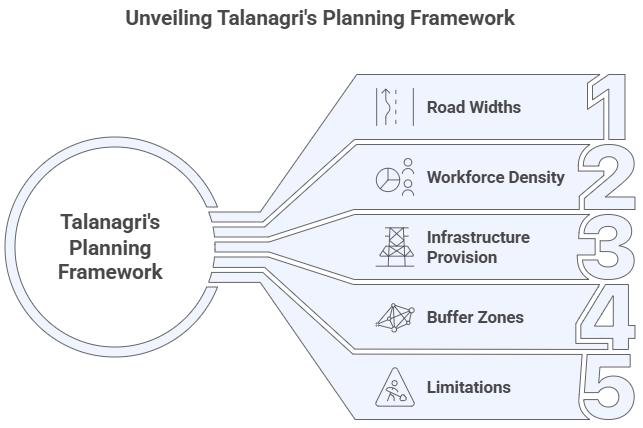
Talanagri is governed by state industrial area planning regulationsissuedbytheindustrialdevelopmentauthority, supplementedbyland-usezoningprovisionsintheAligarh Master Plan. The planning framework prescribes internal roadwidthsrangingfrom12mto24mbasedonroadlength andtrafficdemand.Workforcedensitynormsarelinkedto plotsizetoregulateserviceloadandsafety.Theframework also mandates provision of basic infrastructure such as watersupply,power,drainage,streetlighting, andservice corridors.
Additionally, planning norms recommend buffer zones between industrial and residential uses to mitigate environmental and nuisance impacts. However, these regulations primarily focus on initial layout control and providelimitedguidanceonestate-levelupgrading,logistics integration,oradaptationtoincreasedindustrialintensity overtime.
Field-level observations indicate that internal roads in several parts of the estate operate below prescribed standards, constraining freight movement and emergency access. The absence of a clearly defined road hierarchy resultsinshareduseofinternalstreetsbyheavyvehicles, workers, and informal activities. Designated logistics facilities such as truck parking, loading bays, and storage areas are insufficient, leading to congestion and spillover effects.
Land-use organization within plots is mixed, with production,storage,repair,andinformalservicescoexisting withinlimitedspace.Infrastructureprovisionshowsuneven adequacy,withbasicutilitiesavailablebutlimiteddrainage and environmental infrastructure. Buffer zones between industrial and residential uses are minimal, increasing
exposuretopollutionandnoise.Theseconditionsindicate weaktranslationofplanningnormsintophysicaloutcomes.
Theassessmentrevealsthatwhileplanningstandardsare formallyprescribed,theirimplementationhasbeendiluted byincrementaldevelopment,limitedenforcement,andweak institutional coordination. Infrastructure capacity has not scaled with increased industrial density, and estate-level planning mechanisms for collective upgrading remain absent. The comparison with other clusters suggests that withouttimelyandintegratedplanningintervention,such gapscanintensifyovertime.
This study confirms that existing planning frameworks provideanessentialregulatoryfoundationforMSMEcluster development; however, their effectiveness is significantly constrained by gaps in implementation, coordination, and adaptabilityattheindustrialestatelevel.Theassessmentof planning frameworks through the case of Talanagri IndustrialEstatedemonstratesthatdiscrepanciesbetween prescribed planning norms and actual spatial conditions havedirectimplicationsforclusterperformance.Inadequate internalroadhierarchy,inefficientlogisticsmovement,weak land-use organization, and insufficient environmental infrastructurecollectivelyreducefunctionalefficiencyand increaseoperationalstresswithinthecluster.
The findings further indicate that planning challenges in MSME clusters are not merely technical in nature but are deeply institutional and governance-related. Fragmented responsibilitiesbetweenindustrialdevelopmentauthorities andurbanlocalbodiesoftenresultindelayedinfrastructure upgradesandlimitedenforcementofplanningstandards.As clustersintensifyovertime,staticplanningregulationsfailto respond to evolving production scales, workforce concentration,andservicedemand,leadingtoincremental anduncoordinatedspatialgrowth.
ComparativeinsightsfromIndianandinternationalMSME cluster experiences reinforce the central role of proactive and integrated planning frameworks in sustaining cluster competitiveness. Successful clusters are characterized by continuous planning interventions, coordinated infrastructure provision, and strong institutional mechanisms that align industrial growth with urban development objectives. In contrast, clusters operating under weak or reactive planning regimes face long-term inefficiencies,environmentalstress,anddecliningresilience. verall, the study highlights the need for planning frameworks that move beyond initial layout control and adopt a dynamic, estate-level planning approach.
International Research Journal of Engineering and Technology (IRJET) e-ISSN: 2395-0056
Volume: 12 Issue: 12 | Dec 2025 www.irjet.net p-ISSN: 2395-0072
Strengthening planning implementation mechanisms, integratinglogisticsandenvironmentalinfrastructure,and improving inter-agency coordination are critical for enhancingthesustainabilityandlong-termperformanceof MSME clusters. These findings contribute planning-based evidence to ongoing discussions on MSME cluster development and offer transferable insights for similar industrialestatesinmedium-sizedIndiancities.
1. Singh, R., & Verma, P. (2019). Industrial Clusters and Urban Land-Use Transformation in MediumSizedIndianCities.JournalofUrbanManagement, 8(3),410–423.
2. Kumar, A., & Sharma, S. (2020). Infrastructure Deficits and Environmental Stress in Traditional MSME Clusters of North India. Environment and UrbanizationAsia,11(2),265–281.
3. World Bank. (2020). Enhancing the CompetitivenessofMSMEClustersthroughSpatial Planning.Washington,DC.
4. Directorate of Industries, Uttar Pradesh. (2021). District Industrial Profile: Aligarh. Government of UttarPradesh.
5. Ministry of Micro, Small and Medium Enterprises (MoMSME). (2022). Annual Report 2021–22 GovernmentofIndia,NewDelhi.
6. Government of India. (2006). Micro, Small and Medium Enterprises Development (MSMED) Act, 2006.MinistryofLawandJustice,NewDelhi.
7. Foundation for MSME Clusters (FMC). (2020). Sustainable MSME Cluster Development in India: Planning and Implementation Challenges. New Delhi.
UNIDO.(2018).IndustrialClusterDevelopment:A Guide for Practitioners. United Nations Industrial DevelopmentOrganization,Vienna.
8. NCAER. (2022). Regional Competitiveness and IndustrialGrowthinIndianCities.NationalCouncil ofAppliedEconomicResearch,NewDelhi.
9. Uttar Pradesh State Industrial Development Authority (UPSIDC). (2019). Industrial Area DevelopmentGuidelinesandInfrastructureNorms GovernmentofUttarPradesh.
10. Aligarh Development Authority (ADA). (2011). Aligarh Master Plan 2021. Government of Uttar Pradesh.
11. SIDBI. (2021). MSME Sector Report: Spatial Distribution, Infrastructure Gaps and Growth Constraints.SmallIndustriesDevelopmentBankof India,Lucknow.
12. Planning Commission of India. (2014). ClusterBased Industrial Development and Regional PlanninginIndia.GovernmentofIndia.

Purvi Varshney is a postgraduate student of Urban and Regional Planning, with an academic background in Architecture. Her interestliesinunderstandinghow planning frameworks, land use, andinfrastructureinfluenceMSME clustersandregionaldevelopment inIndiancities.Shehasworkedon case-based studies focusing on industrialestates,spatialplanning, and logistics systems. Her academic interests include regional planning, industrial development, and sustainable urbangrowth.

Dr.SyedMohammadNomanTariq is an Associate Professor in the Department of Architecture at Aligarh Muslim University, specializinginarchitecturaldesign and planning education. He has guidednumerousstudentprojects and research works, contributing to the academic and professional developmentoffuturearchitectsat AMU.