
International Research Journal of Engineering and Technology (IRJET) e-ISSN: 2395-0056
Volume: 12 Issue: 12 | Dec 2025 www.irjet.net p-ISSN: 2395-0072
International Research Journal of Engineering and Technology (IRJET) e-ISSN: 2395-0056
Volume: 12 Issue: 12 | Dec 2025 www.irjet.net p-ISSN: 2395-0072
Vinayak Patil1,Chetan Petnekar1,Ganesh Chougala1,Omkar Sherekar1
1Student, Dept of Electronics & Communication, S.G.Balekundri Institute of Technology, Karnataka,India
2Assistant Professor, Dept of Electronics & Communication, S.G.Balekundri Institute of Technology, Karnataka, India ***
Abstract - The rising need for secure and remotely controlled monitoring systems has raised the significance of intelligent surveillance systems [7]. In this paper, an IoTbased Android-controlled surveillance robot for real-time monitoring systems is discussed and demonstrated. The proposed work uses the ESP32-CAM module to stream realtime video streaming over the internet [1],[3],[6]. The Node MCU ESP8266 enables wireless communication between the robot controller and the Android app interface [2],[5]. The ultrasonic sensor enables the robot to detect barriers and navigate safely to the target destination [7]. The metal detector sensor enables the robot to detect metal objects in the environment and respond accordingly. The GPS module helps to track the real-time location of the robot. The robot can be controlled from any corner of the world using the Android smartphone device. The proposed robot systems can be applied effectively to dangerous and restricted areas [7],[8]
Key Words: IoT, Surveillance Robot, ESP32-CAM, Android Application, Wireless Communication, Obstacle Detection, GPS Tracking.
Recently, the demand for efficient and effective surveillance solutions has risen with increasing security concerns in both public and private sectors [7]. Existing surveillance solutions involve continuous human observation, which may not always be safe and efficient [7],[8], especially at security-critical sites. To overcome these drawbacks, IoT-based surveillance solutions have attracted considerable interest [2],[7]. These solutions supportreal-timeobservationandremotecontrolwiththe help of internets connectivity. Robotics with embedded technology helps perform surveillance tasks at sites that are either difficult to reach or not safe for human entry [1],[6]. Wireless communication and sensing technologies together make the system more flexible and efficient. Visual observation with the help of cameras is an important component for providing vision support for decision-making purposes [3], [5]. Mobile solutions furthermakeuserinteractioneasier,allowingcontroland commandfromanycorneroftheworld.Obstacles-sensing sensors assist safe movements for robotics. Position tracking provides an added benefit of security and accuracy for observation purposes. The proposed system will work on designing an effective and affordable surveillanceroboticssolution.
The need for implementing this system arises out of the fact that in environments where the presence of a human beingmightbedangerous ordifficulttoaccomplish,there is a need for a safe and efficient surveillance system. In fact, the normal system of surveillance done in fixed environments requires a lot of manual observation and is therefore not so reliable or useful in a dynamic or dangerous setting like a surveillance mission or a restrictedareainspectionprocessorinacrisisordisaster scenario where continuous observation might be necessary. With improvements in IOT and mobile technology and its ability to implement intelligent robot platforms with real-time observation and controlling abilities,itispossibletoworkoutalow-costportableand friendlyrobotforsurveillancepurposesasamotivationto thisproject.
Surveillance at a Distance in Dangerous Surroundings
A great need exists for the development of monitoring systems capable of functioning in danger or non-accessible zones with minimal threattohumanoperators.
Real-Time Monitoring and Control Live video streaming with continuous monitoring and control through an android application are necessary for rapid decision-making. CostEffective and Scalable Solution The current stateof-the-art surveillance systems available may be costly; hence, there is a need for development in IoT-based robotic surveillance that is costeffective.
ThisprojectembodiesthedevelopmentofanIoT-based Android-controlledsurveillancerobotthatshallbeableto monitor everything in real time and work remotely with wireless communication. The system shall thus provide live video streaming, safe navigation, accurate location trackingforimprovingefficiencyinsurveillance.Reducing human involvement in risky environments by embedding
International Research Journal of Engineering and Technology (IRJET) e-ISSN: 2395-0056
Volume: 12 Issue: 12 | Dec 2025 www.irjet.net p-ISSN: 2395-0072
hardware, sensors, and mobile application control becomes the ultimate aim of this project to attain reliable andcost-effectiveperformance.
The main goals of the system are:
Itshouldalsobedesignedtoremotelycontrola robotthatiscapableoftransmittinglivevideos byusingIoTtechnology.
To implement obstacle detection and safe navigation for reliable operation in various typesofenvironments.
This includes, but is not limited to, the facilitation of real-time GPS-based location trackingtoeffectivelymonitorandcontrol.
Traditional surveillance systems consisted of fixed cameras [7], providing less coverage and the need for continuous human interaction, thus not appropriate for dynamic conditions. As a solution to the limitations, IoT surveillance systems were developed, allowing remote control using the internet. With the advent of robotics, mobilesurveillance robots were developed to offer better coverage and less human involvement. In some research works, the concept of wireless cameras, ultrasonic sensors, and live video streaming [1],[3],[6], as well as obstacle detection, was explored, but the system was complexandquite expensive.Recently, researchhasbeen done on the usage of the Global Positioning System for locationtracking[6],[7]andcontrolinterfacesonAndroid, but the systems were not fully integrated with various sensing capabilities. From the analysis of various studies, the need for a small, affordable, and multifunctional surveillance robot, capable of video streaming, remote control, obstacle sensing, and location solutions, is required. A solution to the problem has been proposed, incorporating all the sensing capabilities into a single platform.
The proposed approach purely centers on the design and development of an internet of things surveillance robot. Theinternetofthingssurveillancerobotisfullycapableof real-time surveillance and control. The proposed design incorporates embedded controllers, sensors, and wireless communication modules in a mobile robot. Node MCU ESP8266 acts as the key controller with full functionality ofmotorcontrolling,processingofdatafromsensors,and communication with Android applications. The ESP32CAM helps in real-time video streaming from the surveillance robot to the user via wireless connectivity. The command from the user accessed via Android
applicationsisprocessed by thecontroller tomanageand control the movement of the surveillance robot via DC motors. Additional features incorporated in the design include ultrasonic sensors that aid in real-time object detectabilityandensuresafenavigationofthesurveillance robotduringmovement.A GPSand metal detectorsensor helpsinreal-timelocationmonitoring.
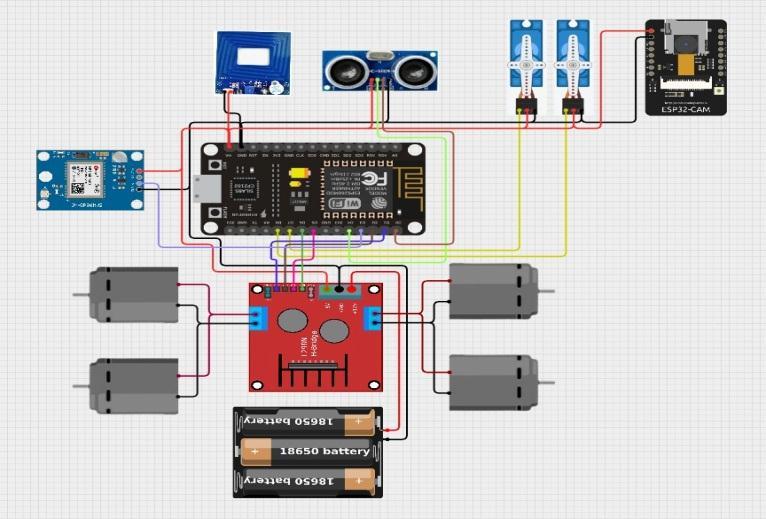
Thesystemdesignoftheproposedsurveillancerobotaims at incorporating hardware components efficiently for the purpose of conducting effective real-time surveillance. This is because the robot is equipped with a mobile platform that facilitates the robot's movement and facilitates the functioning of the different components while the robot is in motion. Additionally, the system is equipped with different components that have been installedintherobotforthepurposeofachievingbalance whiletherobotisinmotion.
TheNodeMCUESP8266is usedasthecontrol unit and is responsible for communication with sensors/motors and Android applications. The communication is carried out viaWi-Fi.AnESP32-CAMmoduleisusedatthefrontofthe robottotransmitlivevideos.Theultrasonicsensorisused forobstacledetection.DCmotorsareusedformovements. Theyarecontrolledusingamotordriver.
Other modules like a GPS receiver module and a metal detectorsensorimprovethemonitoringcapabilitiesofthe system. The GPS receiver module allows for real-time tracking, while the metal detector sensor helps in detecting nearby metal objects. A battery pack provides powerforthefunctionalityofallmodules.Thisbatterycan berecharged,thusfacilitatingcontinuousfunctionality.
2.1
International Research Journal of Engineering and Technology (IRJET) e-ISSN: 2395-0056
Volume: 12 Issue: 12 | Dec 2025 www.irjet.net p-ISSN: 2395-0072
The performance verification of the designed surveillance robotwasdoneunderdifferenttestconditionstocheckits robustness.Thesystemwastestedinindoor,outdoor,and semi-controlled settings like rooms, corridors, and open areas. Different tested surface conditions like smooth, tiled, rough, and cemented floors were considered for analyzing motion performance. The robot was controlled through a Wi-Fi hotspot/router within stable to moderately stable conditions. Testing of the system was done for a longer period of time to check its performance under continuous conditions. Lighting conditions and different ranges separating the user from the robot were also considered under these tests. The system used a rechargeable battery for power, which was tested under continuous conditions. During the test period, the surveillancerobotfunctionedcorrectlyforcommandslike moving forward, backward, left, or right directions with lessdelay.Themotionoftherobot performedwell,and it also behaved correctly while making turns. The braking function performed correctly, which helped the robot to brake properly on command. During continuous tests, it has been observed that there has been less delay in controlling speed and direction. No performance failure hasbeenobserved.
2.2
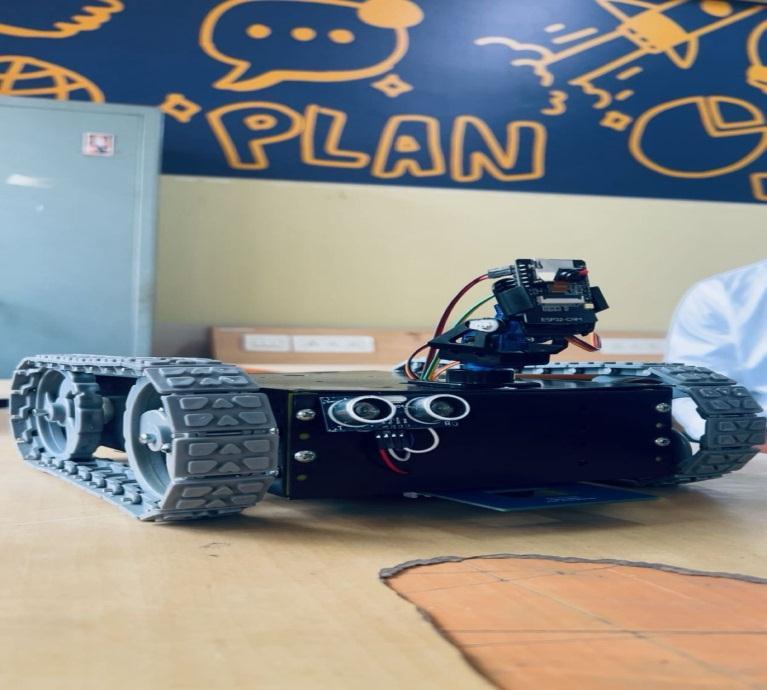
Italsoshowsthecompactnessofcomponentplacementon the robotic platform, a design that minimizes the size for an entire system and further enhances its mobility. The positioning of the camera at an elevated and forwardpointing view in order to create a wider field of view allows for better monitoring. This sensor placement ensures a position that will not obstruct the robot's operation while detection accuracy is maintained. The hardware balance helps to promote smooth motion by avoiding possible mechanical strains to the chassis. This practical assembly approach supports smooth operation and enhances the reliability of the surveillance robot duringreal-timeuse.
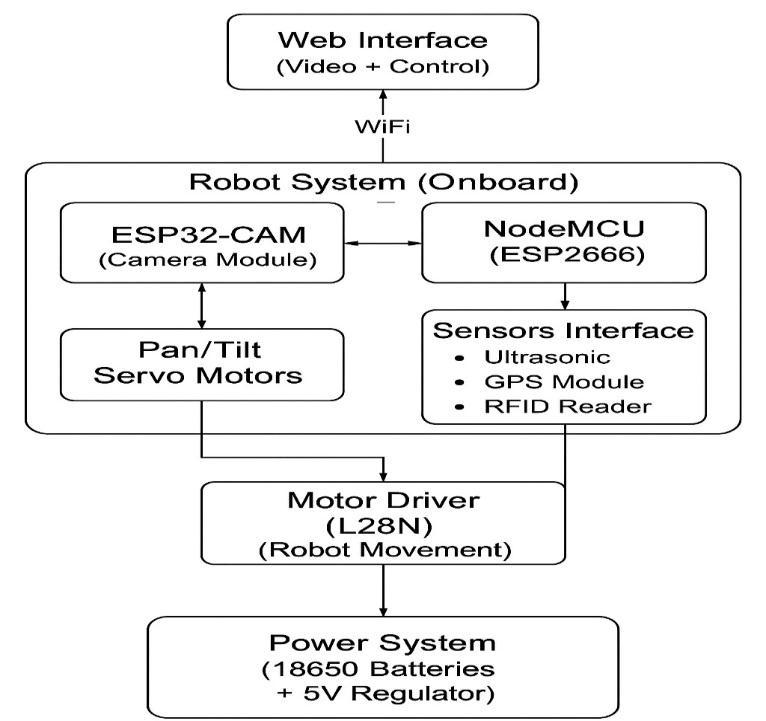
The system architecture of the proposed surveillance robothelpsinunderstandingthecoordinationofdifferent hardwaremodulesandtheuserinterfacethatenablesthe robottohavetheabilityto be controlledin real time. The system architecture, with the help of the block diagram, indicates that the control signals from the Android application are received wirelessly by the Node MCU ESP8266,whichprocessesthesignals,therebycontrolling themovementoftherobotusingthemotordriverandthe DCmotors.Atthesame time,theESP32-CAMhelpsin the live viewing of the surveillance robot, thereby ensuring that surveillance occurs in real time. Signals from the ultrasonic sensor, metal sensor, and GPS sensor help in realizing the capability for obstacle detection, object recognition,andlocationidentificationinrealtime.
3.1 System Block Diagram Of the Proposed Model
The above image clearly emphasizes the physical structureoftherobotandtheplacementofkeyhardware components in the system. The ESP32-CAM module is installed at the front of the robot to perform live streaming, and the ultrasonic sensor is well-installed to detect any obstacles in its way as it travels with its DC motorsandpowersystemunit.
3: Block Diagram of System
International Research Journal of Engineering and Technology (IRJET) e-ISSN: 2395-0056
Volume: 12 Issue: 12 | Dec 2025 www.irjet.net p-ISSN: 2395-0072
Theblock diagramrepresentsthe functional designofthe proposed surveillance robot using the IoT system. The system can be controlled from a distance using a user interface that transmits commands to the Node MCU ESP8266 using wireless communication. The ESP8266 processes the commands and then transmits correspondingsignalstothemotordriverofthesystemto control the speed and rotation of the DC motors. The ESP32-CAM helps perform visual surveillance of the system since it enables live streaming of visuals from the system. Other modules of the system include ultrasonic sensors and GPS modules that aid in surveillance since they assist in tracking and sensing obstacles. The system usesacontrolledpowersupplysystemtoprovideconstant voltagetoallcomponentsofthesystem.
Thesoftwaredesignoftheproposedrobotforsurveillance via programming ensures proper control, real-time observation, and proper interaction between the human controller and the hardware component of the robot. The controlling algorithm is programmed with embedded programming techniques that handle the tasks of robot motion, processing, and communication functions. The Node MCU ESP8266 develops the primary controlling algorithmthatreceivestasksfromtheandroidapplication viaWi-Ficommunication.
Basedontheinputsreceivedfromtheusers,thecontroller provides suitable control signals to the motor driver in ordertocontrolthespeedanddirectionoftheDCmotors. Thedatareceivedfromtheultrasonicmoduleisprocessed in real-time to enable and facilitate the detection of obstacles as well as safe navigation. Location information received from the GPS module is constantly updated and provided to the user for tracking purposes. The ESP32CAM module has a different firmware to enable real-time videostreaming.
The Android application developed is essentially the user interface through which the robot could be controlled fromadistanceanditsvideooutputcouldbedisplayedin real time. The control system design takes a modular approach by which various activities like controlling movements, video streaming, as well as sensor updates, couldbecarriedoutconcurrently.
Additionally, the software has the capability of executing severalprocessesatthesametimewithoutcompromising the performance of the system. Instead, different processesareallocated for motioncontrol,data reception from sensors, and video streaming to facilitate smooth operation. On the control logic part, the strategy placed emphasisonexecutingusercommandsatagiveninstance while continually sensing feedback from sensors to
facilitate safe movement. Communication between the robot and control interface has been optimized to eliminate any form of delay, which enhances quick feedback to user commands. Error-handling functions havealsobeenimplementedtoensurethesystemremains stable even during temporary network disruptions. Additionally, the software has a modular design that facilitates ease of modification and addition of new featuresinthefuture.
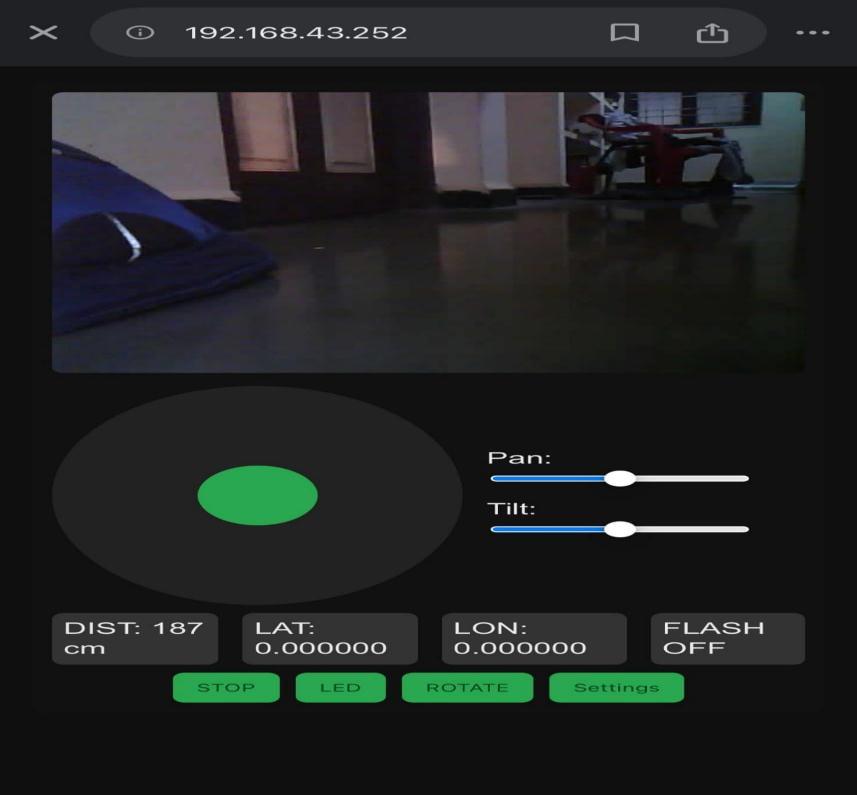
Illustrates the interface used for controlling the surveillance robot as well as the monitoring of the live video output. The interface generates a real-time video feedfromtheESP32-CAMmoduleviaaweb-basedcontrol interface. A joystick interface has been incorporated into the system for moving the robot in various directions, whereas sliders are used for the control of the pan-tilt movement of the camera. The interface further provides datarelatedtothesensorreadingsoftheobstacledistance aswellasthelocationdataobtainedfromtheGPSmodule interface. Control buttons are provided for pausing the robot, control of the lighting system, and system settings. Suchasystemprovidesasmoothcontroloftherobotfrom a distance and indicates a proper integration of software withhardware.
Volume: 12 Issue: 12 | Dec 2025 www.irjet.net p-ISSN: 2395-0072
The software design of the proposed surveillance robot supports effective control and monitoring as well as smooth user and hardware communication. The Node MCU ESP8266 contains the major control program and accepts motion commands from the Android app using Wi-Fi communication. According to the commands accepted by the Node MCU ESP8266, it provides corresponding signals to control the speed and direction of the DC motors using a motor driver. It also processes the sensor values of the ultrasonic sensor in real time to enable safe passage and continuously updates the GPS values for location tracking. The ESP32-CAM works separately with its own firmware to perform the video streaming task. The Android app works as the user interface. The software design performs all the tasks simultaneously,namelymotioncontrol,sensorprocessing, and video streaming. This reduces the response time and ensures stability. The software design also simplifies futuredevelopment.
Thispaperproposedthedesignand implementationofan IoT-based Android-controlled surveillance robot that couldperformreal-timemonitoringandremoteoperation. The system was able to integrate embedded controllers, sensors,wirelesscommunication,andacameramoduleto perform effective tasks related to surveillance. It also enhanced the functionality and reliability with live video streaming, obstacle detection, and GPS-based location tracking.Theexperimentalobservationconfirmedsmooth movements and stable communications along with responsive control in different operating conditions. The modular and cost-effective design makes the proposed system a suitable choice for security monitoring, inspection, and surveillance in environments where human presence can be limited or unsafe. In the end, the results prove that the approach proposed is efficient and practicalformodernapplicationsinsurveillance.
Thedevelopedsystemshowsthatitispossibletocombine IoT and embedded systems for an efficient and mobile surveillance system. The wireless control system reduces human intervention and increases safety and monitoring efficiency. Combining all modules for sensing increases adaptability of the robot to various situations and conditions. Scalability is easy with this system and it can bemodifiedforvarioususes.Themodelcanbeappliedto defense surveillance systems, disaster monitoring systems, and industry inspections with modifications and advancements.
The authors of this paper would like to extend their sincere thanks to all faculty members and Department of Electronics and Communication Engineering for their guidanceandco-operationduringthedevelopmentofthis project.Wearethankfultoourprojectguideforproviding suggestions and ideas to complete this work successfully. We are also grateful to our institution for providing facilities and resources needed to complete this project successfully.Wewouldliketothankourfriendsandwellwishers for their direct or indirect co-operation for completingthisprojectsuccessfully.
The authors would like to extend their most profound appreciationto thefacultymembersoftheDepartment of ElectronicsandCommunicationEngineering for guidance, encouragement, and academic support throughout this project. Our deepest thanks go to our project guide, who provided us with much-valued suggestions, technical insight, and constructive feedback throughout the course of the work, which greatly contributed to shaping the design and successful completion of the project. Their constantsupportandtimelyguidanceplayedacrucialrole in overcoming technical challenges encountered during theimplementationprocess.
We are also thankful to our institution for providing the necessary infrastructure, laboratory facilities, and technical resources related to designing, implementing, and testing of the proposed surveillance system. In fact, the easy availability of the required equipment and a conducive academic environment contributed a lot towards the smooth progress of the work. We would also liketo thank ourclassmatesandfriends who have, in one way or the other, helped us in various phases of the project through continuous assistance, discussions, and motivation. Their valuable suggestions and collaborative effort proved very helpful for improving the quality of work.
Lastbutnotleast,wealsowanttoexpressourgratitudeto everyone who, either directly or indirectly, helped us to carry out this project successfully. It was indeed their support, encouragement, and cooperation that helped us completesthisworksatisfactorilyandintime.
[1] V. Deshpande, D. Zite, S. Bagul & V. Philip, Research Paper on Surveillance Robot Using ESP32-CAM, Int. J. Sci. Res. Sci. Eng. Technol., vol. 12, no. 2, pp. 559–571, Apr. 2025.
[2] IOT Surveillance Robot Using ESP32-WiFi CAM & Arduino, N. Venu, Balaji Institute of Technology and Science,Jul.2022.
International Research Journal of Engineering and Technology (IRJET) e-ISSN: 2395-0056
Volume: 12 Issue: 12 | Dec 2025 www.irjet.net p-ISSN: 2395-0072
[3] Research Paper on Surveillance Robot Using ESP32CAMModule,IJCRT,Apr.2024.
[4] Internet of Things (IoT) Security Alarms on ESP32-CAM, R. B. Salikhov et al., J. Phys.: Conf. Ser. 2096 (2021) 012109.
[5] ESP32-Powered Web-Controlled Surveillance Robot with Live Streaming, P. R. Thulasi et al., Atlantis Press, 2025.
[6]SurveillanceRoboCarUsingESP32CAMModule,Prof. K.Pateletal.,Int.J.Sci.Res.Sci.Eng.Technol.,2025.
[7]Y.P.Chitale,S.S.Gandhi,&R.N.Shinde,ReviewPaper on Surveillance Robot Using IoT, Int. J. Sci. Res. Eng. Trends,vol.10,no.2,Mar-Apr.2024.
[8] Wi-Fi Controlled Surveillance Car Using ESP-32 CAM Module,JETIR,2024.
2025, IRJET | Impact Factor value: 8.315 | ISO 9001:2008
|