
1,2,3,4
Volume: 12 Issue: 12 | Dec 2025 www.irjet.net
International Research Journal of Engineering and Technology (IRJET) e-ISSN: 2395-0056 p-ISSN: 2395-0072


1,2,3,4
Volume: 12 Issue: 12 | Dec 2025 www.irjet.net
International Research Journal of Engineering and Technology (IRJET) e-ISSN: 2395-0056 p-ISSN: 2395-0072
5(HOD, Dept. of Computer Engineering), S.Y.P SHREEYASH COLLEGE OF ENGINEERINGAND TECHNOLOGY (POLYTECHNIC), CHH.SAMBHAJINAGAR , India
Abstract - Blockchaininnovationshavegainedsignificant interestin recentyears.Oneof the most widelydiscussed applicationsisincurrencyexchange;however,blockchain technologyisnotlimitedtodigitalcurrencyaloneandhas thepotentialtoinfluencevariousbusinesssectors.Itoffers greater transparency and efficiency in large-scale transactionsandcanbeeffectivelyusedtodetectcounterfeit products.
In today’s market, a major concern for consumers is determining whether a product is genuine or counterfeit. The widespread presence of counterfeit goods has had a seriousnegativeimpactoneconomicgrowth.Toaddressthis issue,itisessentialtoprovidetransparencyaboutproducts and make this information accessible to consumers. The increasing circulation of counterfeit and unsafe products worldwideisagrowingconcern,andblockchaintechnology represents a significant step toward eliminating this problem.
The use of blockchain can reduce the production and distribution of counterfeit goods, but public awareness is also crucial. By ensuring proper manufacturing and packaging, each product can be assigned a unique digital code that serves as its identity. Through a package implementationprocess,theproductcodeisscannedusing anapplication,whichthenverifieswhethertheproduct is genuineorcounterfeit.
Key Words: Supply Chain Security , Product Verification , Smart Contracts , Secure Identification
1.INTRODUCTION
Blockchain is a technique for storing cryptographically linked records across multiple parties within a shared network, making data tampering extremely difficult. Originally developed to support Bitcoin transactions, blockchaintechnologyhassinceevolvedintoapowerfultool formanyotherapplications.Eachblockcontainsacollection ofverifiedtransactionsorrecords,alongwithatimestamp andacryptographichash.Thishashisgeneratedfromthe contentsofthecurrentblockandthehashoftheprevious block,formingasecureandcontinuouschain.
Modernbusinessesdependheavilyoninformation,andthe speed and accuracy with which data is accessed play a

crucial role in efficiency and decision-making. Blockchain technologyiswellsuitedforthispurposebecauseitenables fast, shared, and transparent access to data stored on an immutable ledger. Access to this data is restricted to
authorizedparticipantswithinthe network.Ablockchainbased system can track orders, payments, documents, manufacturing details, and many other activities. Since all participantsshareasingle,consistentviewofthedata,every stageofatransactioncanbemonitoredfromstarttofinish, increasing trust, improving efficiency, and creating new opportunitiesforoptimization.
Blockchainalsoenablesend-to-endvisibilitywithinsupply chain management. Organizations can digitize physical assetsandrecordthemonadecentralizedandpermanent ledger,allowingassetstobetracedfromproductionthrough delivery and final use by the customer. This increased transparency improves visibility for both businesses and consumers.
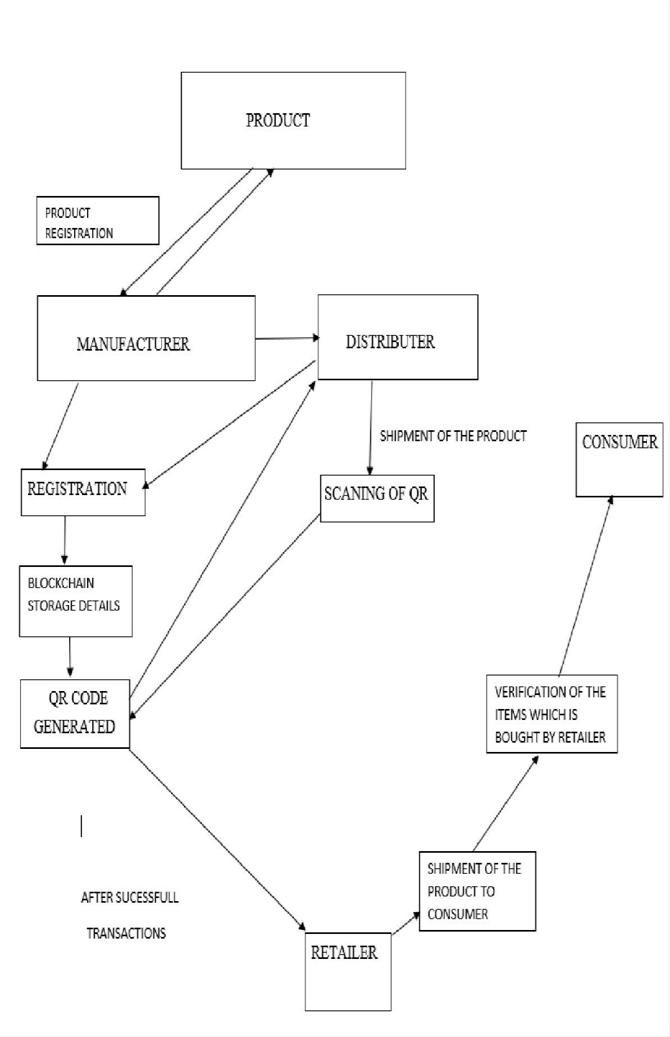
Fig1:SystemArchitecture
In today’s technology-driven world, online shopping has grownrapidlyandhasbecomeanintegralpartofdailylife. Purchasingproductswithoutleavinghomeorsendinggifts across long distances with minimal effort has become commonplace. Although e-commerce has grown

Volume: 12 Issue: 12 | Dec 2025 www.irjet.net
significantly, it still represents a small percentage of total retail activity, indicating substantial room for future expansion.Blockchaincanplayakeyroleinsupportingthis growth by improving trust and security in digital transactions.
One of the major advantages of blockchain is its ability to simplifyoperationalprocessesandreducecostsbyenabling efficient auditing of supply chain data. Tasks that traditionallyrequireweeks,suchasmanualverificationand compliance checks, can be completed much faster using a distributedledgerthatrecordsallrelevantdatainrealtime. Blockchain technology can significantly enhance supply chaintransparency,particularlyforhigh-valuegoodssuchas jewelry and pharmaceuticals. It helps organizations track raw materials and finished products across suppliers, reducing losses caused by counterfeit goods and unauthorized resale.At the sametime, it buildsconsumer trustbyminimizingthecirculationoffakeproductsinthe market.
Additionally, blockchain allows organizations to maintain greater control over outsourced manufacturing and production processes. All participants in a production network can access the same verified data, reducing communicationerrorsanddatainconsistencies.Asaresult, lesstimeisspentvalidatinginformation,andmorefocuscan beplacedonimprovingproductquality,reducingcosts,or achievingboth.
Structurally, a blockchain begins with a genesis block and continuessequentially,witheachblockcontainingaunique hash value. These hash values are commonly generated usingtheSHA-256hashingalgorithm.SHA-256isoneofthe most widely used cryptographic algorithms in blockchain systems.Eachblocktypicallyincludesareferencetothenext block, a transaction counter that records all transactions, andanonce.Thenonce,meaning“numberusedonce,”isa randomlygeneratedvaluethatchangesforeachblockand playsakeyroleinensuringsecurity.Oncedataisaddedto theblockchain,itcannotbealteredwithoutinvalidatingthe entirechain.
SHA-256, or Secure Hash Algorithm 256-bit, is a cryptographic hash function widely used in blockchain systems,includingBitcoin.Itproducesafixed-length256-bit outputregardlessofinputsizeandisappliedtwiceinBitcoin foradditionalsecurity.Beyondblockchain,SHA-256isused inmanysecurityprotocolssuchasSSL,TLS,andSSH,aswell asinoperatingsystemslikeUnixandLinux. ThestrengthofSHA-256liesinitssecurityfeatures.Itallows dataverificationwithoutrevealingtheoriginalinformation, making it ideal for digital signatures and password verification. Instead of storing actual passwords, systems store hash values, which are compared during authentication.Reversingahashtoobtaintheoriginaldata ispracticallyimpossible,andthelikelihoodoftwodifferent inputs producing the same hash is extremely low. These propertiesmakeSHA-256areliableandsecurefoundation forblockchain-basedsystems.
2395-0056 p-ISSN: 2395-0072
Barcodes have long been used for automated product identificationacrossmanyapplications,whilehologramsare commonlyemployedtopreventcounterfeiting.Combining barcodeswithothersecuritymeasurescanenhanceproduct protection.Hologramsofferanadditionallayerofsecurity, making duplication or forgery more difficult. In one approach,unique,user-definedproductidentificationcodes are generated for each item and then converted into QR codes. These QR codes can further be transformed into multidimensionalor3Dimagestoprovidestrongersecurity. HolographicQRcodescanbeimplementedusingcomputergenerated holography techniques, such as those programmed in MATLAB. Decoding the barcode from the hologram retrieves the product’s unique ID, improving security and authenticity verification for products and preventingcounterfeiting.
In addition to product verification, academic research highlightstheroleofbehavioralandenvironmentalfactors instudentperformance.Academicoutcomesareinfluenced by teachers, curriculum, study environment, study hours, infrastructure, and financial conditions. A learner’s behavior includingstudyskills,attitude,andmotivation interactsstronglywithperformanceoutcomes.Teacherscan assess student behavior through observation and questioning, but this becomes challenging in large classrooms. Developing automated tools to monitor and collect behavioral data can help educators create better strategies to support learning without excessive manual effort.
Theriseofcounterfeitgoodsinonlineandofflinemarkets posesasignificantchallengetosupplychains.Government regulations alone are often insufficient to prevent counterfeiting.Blockchaintechnologycanprovideasolution by storing detailed product transaction data in a secure, sharedledgeraccessibletoallauthorizedparticipants.This systemallowsbothproducersandconsumerstoverifythe authenticity of products in real time. Using encryption, customers can confirm product details and check the remainingstockavailablefromsellers.Ablockchain-based supply chain framework can track products from manufacturing to final sale, helping to detect counterfeit goodsandensuregenuineproductsreachendusers. Radio-frequencyidentification(RFID)technologyisanother methodforproductauthentication.RFIDsystemstypically consistoftwocomponents:atagverificationmoduleanda database validation module. The tag verification module confirms product authenticity without exposing sensitive information, allowing customers to inspect tags securely. Thedatabasemoduleensurestheaccuracyoftagstatusand preventsthecirculationofcounterfeitproducts.However, RFIDisgenerallymoresuitableforhigh-valueitemsdueto costconsiderations.
Decentralizedstoragesystemsintegratedwithblockchain, suchasIPFScombinedwithEthereumandattribute-based encryption,addresschallengesintraditionalcloudstorage.
Volume: 12 Issue: 12 | Dec 2025 www.irjet.net
International Research Journal of Engineering and Technology (IRJET) e-ISSN: 2395-0056 p-ISSN: 2395-0072
Thesesystemsallowsecureandverifiablestorageofdigital content,includingbooks,music,andothermedia,ensuring authenticity,originality,andintegrity.Smartcontractsand blockchainrecordsprovidereliablevalidationforuploaded content,whichcanbeextendedtoanytypeofdigitalasset. Tofurtherenhancesupplychainintegrity,blockchain-based frameworkscansupportintelligentqualitymanagementand information resource management in distributed organizations. Counterfeit goods harm both revenue and brandreputation,makingitessentialtocontinuouslyupdate and strengthen authentication methods. Machine learning and image recognition technologies allow consumers to verifyproductsusingsimpledeviceslikesmartphones.By capturing images of product packaging, logos, or accreditation marks, consumers can send requests to a server for processing and receive verification results. In cases of counterfeit detection, these systems can report findingstogovernmentmonitoringplatforms,suchastheEU SafetyGate.
In summary, combining holograms, QR codes, RFID, blockchain,andmachinelearningprovidesamulti-layered approach to product authentication. Each technology contributes to ensuring product authenticity, preventing counterfeiting, and protecting both consumers and businesses. Holographic QR codes, implemented through computer-generated techniques, add an extra layer of securityandprovideareliablemethodforverifyingunique product IDs, enhancing trust and credibility in modern supplychains.
Keywords: Blockchain, QR Code, Hologram, RFID, Anticounterfeiting, Supply Chain Transparency, Product Authentication
Thispaperpresentsasecureandcomprehensiveblockchainenabled anti-counterfeiting system designed to protect products throughout the supply chain. In the proposed model, manufacturers register product and sales-related data on a blockchain platform, where the information remainstransparentandaccessibletoallparticipants.This approachpreventsvendorsfrommanipulatingsalesrecords, as both the total number of items sold and the available inventorycanbeverifiedbyusersatanytime.
Thesystemallowsconsumerstoperformreal-timevendorside product verification using the tools provided by the application, significantly reducing the risk of counterfeit goodsenteringthemarket.Theoverallsystemarchitecture, along with the user interface design, is illustrated in the system diagram to clearly explain the workflow and interactionsamongdifferentcomponents.
Atpresent,thereisnofullyreliablesolutiontoaddressthe problem of product counterfeiting. Conventional identification techniques, such as barcodes, are easy to duplicateand fail to provide strong assurance of product
authenticity.Incontrast,blockchaintechnologyhasemerged asapowerfulsolutionforsecuringandmonitoringsupply chains by maintaining immutable and tamper-resistant records. This enables effective tracking of products from manufacturingtosale,ensuringthatconsumersreceiveonly genuineitems.
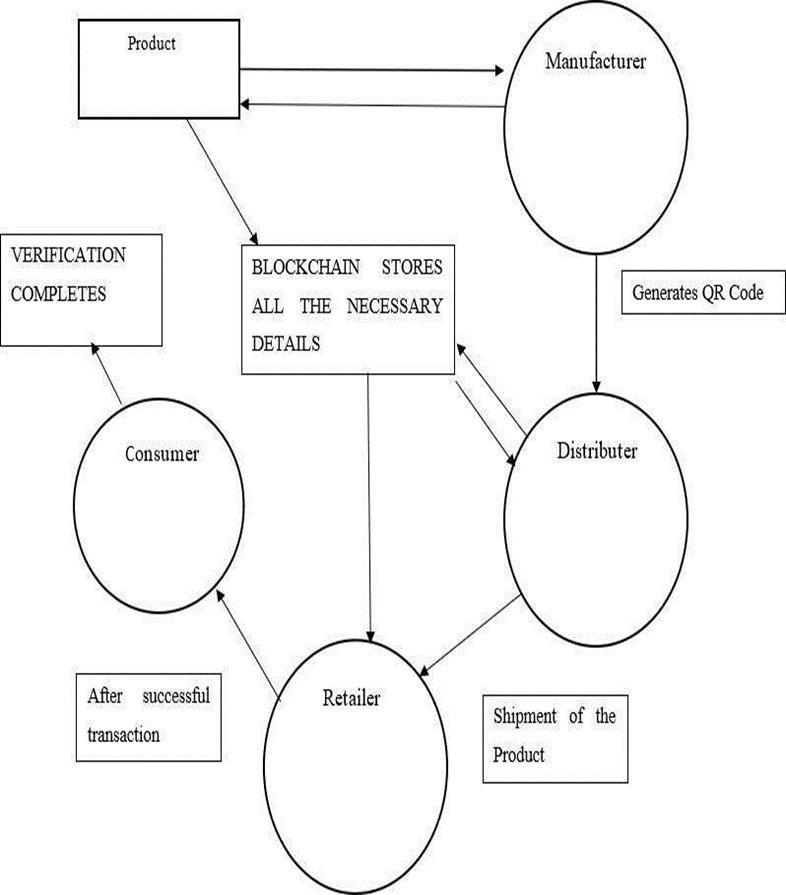
Theprimaryobjectiveofthisprojectistohelpconsumers easilyidentifywhetheraproductisauthenticorcounterfeit at the time of purchase. The proposed solution is implementedasadistributedapplication(DApp)supported by a blockchain network developed using Hyperledger Fabric,anopen-sourceblockchainframework.Thenetwork employs consensus mechanisms such as PBFT/DPoS to ensure reliability, security, and efficient transaction validation.Byleveragingthekeypropertiesofblockchain transparency, decentralization, and immutability the systemdeliversalow-cost,efficient,andtrustworthyanticounterfeiting solution for manufacturers, sellers, and consumers.
Manufacturersregistereachproductonthe blockchainby generatingauniquedigitalidentity.Productdetailssuchas batchnumber,manufacturingdate,andoriginaresecurely stored,ensuringimmutabilityandauthenticity.
International Research Journal of Engineering and Technology (IRJET) e-ISSN: 2395-0056 p-ISSN: 2395-0072
Volume: 12 Issue: 12 | Dec 2025 www.irjet.net
Step-2: QR Code / Unique Identifier Generation
A QR code or unique hash is generated for every registered product. This identifier is linked to the blockchainrecordandisattachedtothephysicalproduct foreasyverification.
Step-3: Blockchain Data Storage
Allproduct-relatedinformation,includingproductionand salesdata,isrecordedontheblockchainledger.Sincethe ledger is decentralized and tamper-proof, unauthorized modificationsareprevented.
Step-4: Supply Chain Tracking
As the product moves through distributors and vendors, each transaction is updated on the blockchain. This provides complete traceability and transparency throughoutthesupplychain
Step-5: Vendor Authentication
Vendors verify product authenticity before selling by accessing blockchain records. This prevents counterfeit productsfromenteringauthorizedsaleschannels.
Step-6: Consumer Verification
ConsumersscantheQRcodeusingtheB-SAFEapplication to instantly check product authenticity. The system retrieves blockchain data and confirms whether the productisgenuineorfake.
Step-7: Fake Product Detection
Ifproductinformationdoesnotmatchblockchainrecords or has been previously verified, the system flags it as suspiciousorcounterfeit.
Step-8: Consensus & Validation
All transactions are validated through the blockchain consensus mechanism (PBFT/DPoS), ensuring data integrityandsecureauthentication.
Step-9: User Interface & Reporting
A user-friendly interface displays verification results and transaction history. Reports can be generated for manufacturers and regulators to monitor counterfeit activity.
This paper presents a blockchain-based framework designed to effectively prevent the circulation of
counterfeit products. The proposed system operates as a fullyfunctionalauthenticationplatformthatallowsusersto verify product legitimacy without incurring any transaction fees. By using this framework, customers can confidently purchase items without the risk of receiving counterfeitgoods.
ThesystemenablesenduserstoscantheQRcodeassigned toaproductandinstantlyaccessdetailedinformationsuch asownershiprecordsandtransactionhistorystoredonthe blockchain.Basedonthistransparentandimmutabledata, userscaneasilydeterminewhetheraproductisgenuineor fraudulent. As a result, the framework provides a reliable solutionforidentifyingcounterfeititemsacrossthesupply chainandenhancestrustamongmanufacturers,sellers,and consumers.
[1] S. Nakamoto, “Bitcoin: A Peer-to-Peer Electronic CashSystem,”2008.
Foundationalpaperintroducingblockchain technologyanddecentralization.
[2] M. Crosby, P. Pattanayak, S. Verma, and V. Kalyanaraman, “Blockchain Technology: Beyond Bitcoin,”AppliedInnovationReview,vol.2,pp. 6–19,2016.
Explains blockchain fundamentals, consensus, and applications beyond cryptocurrencies.
[3] K. Toyoda, P. T. Mathiopoulos, I. Sasase, and T. Ohtsuki, “A Novel Blockchain-Based Product Ownership Management System (POMS) for AntiCounterfeitsinthePostSupplyChain,” IEEE Access, vol.5,pp.17465–17477,2017.
Discusses blockchain for product authentication and anti-counterfeiting in detail.
[4] H. Feng, X. Wang, Y. Duan, J. Zhang, and X. Zhang, “ApplyingBlockchainTechnologytoImproveAgriFoodTraceability:DevelopmentMethods,Benefits, andChallenges,”JournalofCleanerProduction,vol. 260,2020.
Coverssupplychaintraceabilityandproduct verificationusingblockchain.
[5] Reyna,C.Martín,J.Chen,E.Soler,andM.Díaz,“On BlockchainandItsIntegrationwithIoT:Challenges and Opportunities,” Future Generation Computer Systems,vol.88,pp.173–190,2018.
Explains integration of blockchain with IoT devices like QR scanners for product verification.
International Research Journal of Engineering and Technology (IRJET) e-ISSN: 2395-0056 p-ISSN: 2395-0072
Volume: 12 Issue: 12 | Dec 2025 www.irjet.net
[6] E. Androulaki et al., “Hyperledger Fabric: A Distributed Operating System for Permissioned Blockchains,” EuroSys Conference,2018.
Providestechnical insightintoHyperledger Fabric, consensus mechanisms, and secure applications.
[7] Z. Zheng, S. Xie, H. Dai, X. Chen, and H. Wang, “An OverviewofBlockchainTechnology:Architecture, Consensus,andFutureTrends,”IEEEInternational CongressonBigData,2017.
Offers a detailed technical perspective on blockchain architecture and consensus algorithms.
[8] P. K. Sharma, S. Singh, Y. S. Jeong, and J. H. Park, “DistBlockNet: A Distributed Blockchains-Based Secure SDN Architecture for IoT Networks,” IEEE CommunicationsMagazine,vol.55,no.9,pp.78–85, 2017.
Discusses security, IoT, and blockchain integration.
[9] Q. Lu and X. Xu, “Adaptable Blockchain-Based Systems: A Case Study for Product Traceability,” IEEESoftware,vol.34,no.6,pp.21–27,2017.
Focusesonproducttrackingandtraceability usingblockchainsystems.
[10] W. Viriyasitavat and D. Hoonsopon, “Blockchain CharacteristicsandConsensusinModernBusiness Processes,” Journal of Industrial Information Integration,vol.13,pp.32–39,2019.
Discusses blockchain’s business applications and consensus mechanism impactsontrustandauthenticity.
ABOUT THE AUTHORS
MR.OMKAR DESAI
PursuingPoly(Co)
S.Y.P SHREEYASH COLLEGE OF ENGINEERINGAND TECHNOLOGY (POLYTECHNIC)
MR ROHAN CHAVAN
PursuingPoly(Co)
S.Y.P SHREEYASH COLLEGE OF ENGINEERINGAND TECHNOLOGY (POLYTECHNIC)
MR. ANIKET THOMBARE PursuingPoly(Co)
S.Y.P SHREEYASH COLLEGE OF ENGINEERINGAND TECHNOLOGY (POLYTECHNIC)
MR MOHIT GANDE PursuingPoly(Co)
S.Y.P SHREEYASH COLLEGE OF ENGINEERINGAND TECHNOLOGY (POLYTECHNIC)
PROF. ANIL NAIK HOD,Dept.ofComputer Engineering
S.Y.PSHREEYASHCOLLEGE OFENGINEERINGAND TECHNOLOGY(POLYTECHNIC)