
International Research Journal of Engineering and Technology (IRJET) e-ISSN: 2395-0056
Volume: 12 Issue: 12 | Dec 2025 www.irjet.net p-ISSN: 2395-0072
International Research Journal of Engineering and Technology (IRJET) e-ISSN: 2395-0056
Volume: 12 Issue: 12 | Dec 2025 www.irjet.net p-ISSN: 2395-0072
Sheetal Kokatnur1 , Mohan M2 , Ravi U3 , Siddharth K4 , Suraj C5
1Assistant Professor, SG Balekundri Institute of Technology, Belagavi, Karnataka, India 2,3,4,5, Student, SG Balekundri Institute of Technology, Belagavi, Karnataka, India
Abstract - In the modern digital era, organizations are surrounded by massive volumes of customer-generated textual data originating from online reviews, social media platforms, feedback forms, and customer support interactions. While this data holds valuable insights about customer opinions and emotions, manual analysis is inefficient, time-consuming, and often biased. To address this challenge, this project presents the development of an automated sentiment analysis system designed specifically for business-oriented decision-making. The proposed system employs Natural Language Processing (NLP) techniques combined with machine learning–based sentiment scoring approaches such as VADER and Text Blob to classify textual feedback into positive, negative, and neutral categories. A structured preprocessing pipeline is implemented, including text cleaning, tokenization, stop- word elimination, and lemmatization, to improve classification accuracy by reducing linguistic noise.
With the rapid growth of digital platforms, customers continuously express their opinions through reviews, social media posts, surveys, and online discussions. These expressions provide organizations with direct insights into customer satisfaction, expectations, and emerging issues. However, the exponential increase in such unstructured textual data has made traditional manual analysis methods impractical, leading to delays in decision- making and potential misinterpretation of customer intent. Sentiment analysis also referred to as opinion mining, is a branch of Natural Language Processing (NLP) that focuses on identifying and categorizing emotions expressed in text. By automatically determining whether feedback reflects positive, negative, or neutral sentiment, businesses can better understand public perception of their products and services. This capability enables organizations to refine marketing strategies, improve productfeatures,andenhancecustomerserviceresponsiveness.
Theprimaryobjectivesofthisresearchprojectare:
To design an NLP-based system capable of classifying customer feedback into positive, negative, and neutral sentiments.
To construct an efficient text preprocessing pipeline that handles noise removal, tokenization, lemmatization, and normalization.
Tosupportbulkdataprocessingforlarge-scalebusinessdatasetswithoutperformancedegradation.
Togenerateintuitivevisualinsightssuchaspiecharts,bargraphs,andwordcloudsforbetterinterpretation.
1.2
Lexicon-Based Approach
Drawusinghandmovements
Selectcolorsviagestures
Erasespecificparts
Clearcompletecanvas
Controlbrushthickness
Smooth,real-timeoutputonbrowser
Machine Learning–Based Approach
ML-poweredgesturerecognition
International Research Journal of Engineering and Technology (IRJET) e-ISSN: 2395-0056
Volume: 12 Issue: 12 | Dec 2025 www.irjet.net p-ISSN: 2395-0072
FlaskRESTAPIforpredictions
MediaPipe-basedlandmarkextraction
Continuousframe-by-frame processing
The proposed system is designed as a modular, scalable framework that bridges the gap between raw, unstructured customer feedback and actionable business intelligence. The architecture is divided into four distinct layers: Data Acquisition,TextPreprocessing,SentimentEngine,andVisualization/Reporting.
1. System Architecture Overview
Thearchitecturefollowsafull-stack,modulardesigntoensurehighperformanceandeaseofmaintenance.
FrontendLayer:DevelopedusingStreamlet,providinga responsiveandintuitivewebinterfacefornon-technicalbusiness users Backend Layer: Powered by Fast API to manage high- speed asynchronous requests and handle the heavy computational load of NLP processing. Persistence Layer: Utilizes a lightweight SQLite database for local deployments, whichcanbemigratedtoenterprise-gradesolutionslikePostgreSQLforlargerdatasets.
2. Research Methodology
Themethodologyemploysamulti-stagepipelinetotransformrawtextualdataintostructuredemotionalcategories.
A. Data Acquisition and Input
Thesystemisdesignedtoingestmulti-channelfeedback,includingproductreviews,socialmediacomments,andcustomer support transcripts. It supports bulk processing, allowing users to upload datasets containing thousands of records simultaneously.
B. Text Preprocessing and Normalization
To ensure high classification accuracy, raw text undergoes a rigorous cleaning process: Tokenization & Lowercasing: Segmentingsentencesinto individual wordsandstandardizing them tolowercase. NoiseFiltering: Systematic removal of URLs,punctuation,emojis,andsymbolsthatdonotcontributetosentiment.
Lemmatization: Reducing words to their root forms (e.g., "running" to "run") to ensure semantic consistency. Stop-word Removal:Eliminatingcommonwords(e.g.,"the,""is")thatcarryminimalemotionalweight.
C. Sentiment Analysis Engine
Thecoreengineleveragesahybridoflexicon-basedandstatisticalapproaches.ModelImplementation:Thesystemutilizes modelssuchasVADER(ValenceAwareDictionaryandsentimentReasoned)andTextBlob.VADERisparticularlyeffective forsocialmediadataasitunderstandsthenuanceofintensity(e.g.,"good"vs."excellent")andpunctuation.
Classification: Feedback is categorized into three primaries labels: Positive (indicating satisfaction and loyalty), Neutral (factualormixedstatements),andNegative(highlightingcriticalissueslikedelaysordefects).
D. Insight Generation and Visualization
The final stage translates numerical sentiment scores into visual narratives. Visual Analytics: The system generates Pie Charts for distribution, Bar Graphs for category-wise comparisons, and Word Clouds to highlight frequently occurring sentiment drivers. Reporting: Automated summary reports are produced in PDF (for executive presentations) and CSV formats (for further statistical analysis). The architecture remains extensible, allowing for future integration of deep learningmodelslikeBERTormultilingualsupport.
Theeffectivenessofasentimentanalysissystemisfundamentallyrootedinthequalityanddiversityofthedataitprocesses. For business applications, the preparation phase ensures that unstructured customer voices are transformed into a structuredformatsuitableforalgorithmicinterpretation.
International Research Journal of Engineering and Technology (IRJET) e-ISSN: 2395-0056
Volume: 12 Issue: 12 | Dec 2025 www.irjet.net p-ISSN: 2395-0072
The dataset for this project is designed to be multi-channel, reflecting the diverse ways customers interact with modern brands.Dataisprimarilysourcedfrom:
Social Media Platforms:Real-timecommentsandpoststhatcaptureimmediatepublicreaction.
Product Reviews:Detailedfeedbackfrome-commercesitesorinternalreviewsystems.
Customer Surveys:Structuredandsemi-structuredresponsesfromsatisfactionforms.
Support Transcripts:Interactionsfromhelpcentersandserviceticketsthathighlightspecificpainpoints.
Theserawinputsaretypicallyaggregatedintobulkformats,suchasCSVorplaintextfiles,toallowforlarge-scale processing.
Rawtextualdataisinherently"noisy,"containingelementsthatdonotcontributetoemotionaltone.Tooptimizethetextfor thesentimentengine,arobustpreprocessingpipelineisimplemented:NoiseRemoval:Eliminationofnon-textualelements suchasURLs,HTMLtags,specialcharacters,andemojisthatmightinterferewithpatternrecognition.
Tokenization:Segmentinglongblocksoftextintoindividualwordsor"tokens"toanalyzethestructureofeachsentence.
TheimplementationoftheSentimentAnalysissystemisdesignedasamodular,full-stackapplicationthatbridgesthegap between complex Natural Language Processing (NLP) and actionable business intelligence. To ensure the platform is accessibletonon-technicalbusinessuserswhileremainingcomputationallyefficient,thearchitectureisdividedintothree primarylayers:theUserInterface(UI),theBackendProcessingEngine,andtheDataManagementLayer.
1. Technological Stack and Development Environment
2.3 The software is developed using a modern, lightweight tech stack to facilitate rapid deployment and high performance:
2.4 FrontendFramework:BuiltwithReact.jsandstyledusingTailwindCSS,theinterfaceprovidesaresponsive,intuitive dashboardthatallowsuserstouploadfeedbackandviewresultsinreal-time.
2.5 Backend Framework: A Fast API (Python) server handles the logic and NLP workloads, chosen for its high- speed performanceandseamlessasynchronouscommunication.
2.6 Database Management: SQLite is utilized for local data persistence, recording each entry with associated metadata liketimestampsandsentimentlabels.ThearchitectureisdesignedforfuturemigrationtoenterprisesolutionslikePosture SQL.
2.7 NLP Core: The system integrates established libraries such as VADER and Text Blob to assign sentiment scores and classifytext.Theirrootforms(e.g.,"running"to"run")tofocusoncoresentiment-bearingterms.
3.Functional Modules and Workflow
Thesystemfollowsalineardataflowthatensuresconsistencyfrominputtoinsightgeneration:
Input Module:SupportsbulkuploadsviaCSVfiles,allowingbusinessestoprocessthousandsofreviewssimultaneously.
Analysis Engine: Processes thecleaned textthrough theNLP models to categorize sentiments into Positive, Negative, or Neutralclasses.
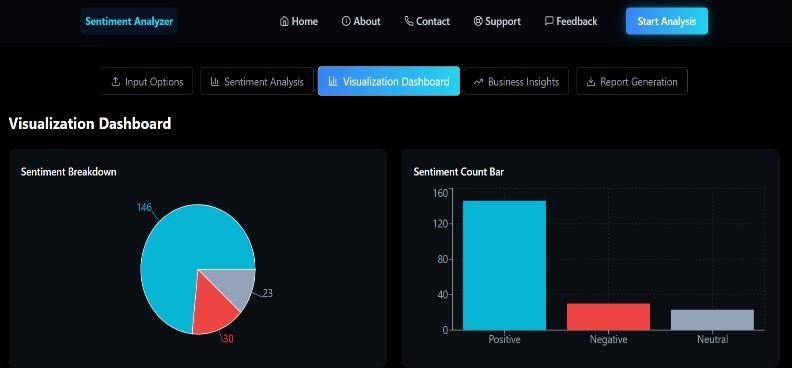
Visualization & Reporting: The system dynamically generates interactive charts, such as pie charts for sentiment distributionandwordcloudstohighlightrecurringsentimentdrivers.
2395-0056
Volume: 12 Issue: 12 | Dec 2025 www.irjet.net p-ISSN: 2395-0072
Theimplementationprioritizesa"plug-and-play"deploymentmodel.UsingNode.jsforfrontendpackagemanagementand Python3.8+forthebackend,thesoftwareiscompatibleacrossWindows,macOS,andLinuxenvironments.Forenterprisegradescaling,themodulardesign.
3.1
The primary objective of this project was to develop and implement a robust Sentiment Analysis Software capable of transformingraw,unstructuredcustomerfeedbackintoactionablebusinessintelligence.Thesystemwasevaluatedusinga diversedatasetcomprisingcustomerreviewssourcedfromonlineplatforms,socialmedia,andinternalfeedbackforms.
Before the final classification, the data underwent a rigorous preprocessing pipeline, including noise filtering, stop-word removal,andlemmatization,ensuringthehighestpossibledataqualityfortheanalysisengine.Thecoreengine utilizing VADERandTextBlob successfullycategorizedtheinputdataintothreedistinctclasses:Positive,Negative,andNeutral
3.2 Performance Metrics and Sentiment Distribution The experimental results demonstrated high system efficiency, with the backend processing typical text inputs withina windowof 2–3seconds. The qualitative distribution oftheresultsissummarizedasfollows:Positive Sentiment(Majority):Asignificant portionoftheanalyzedfeedbackwas classifiedaspositive.Theseresultswerelargelydrivenbycustomerappreciationforproductaffordability,easeofuse,and effectivecustomersupport.
NeutralSentiment(Moderate):Amoderatevolumeoffeedback wascategorizedasneutral,consistingprimarily offactual statements,generalsuggestions,ormixedreviewsthatlackedastrongemotionalpolarity. NegativeSentiment(Minority): Althoughsmallerinvolume,thenegativesentimentcategorywascriticalforidentifyingoperationalfrictionpoints,suchas deliverydelays,pricingconcerns,andpoorserviceresponses.
The performance analysis indicates that the software serves as a powerful strategic asset for organizational growth: Strength Identification: The dominance of positive sentiment validates current business strategies and highlights core strengths that can be amplified in futuremarketingcampaigns. ChurnPrevention:Bydetectingnegative sentimentinreal-time,thesystemallowsbusinessestoaddresscustomerdissatisfactionproactively,reducingtheriskof brand erosion and customer churn. Product Innovation: Neutral feedback proved to be a goldmine for R&D teams, as it often contained specific suggestions and feature requests that could guide future product enhancements. Trend Monitoring:Thesystemdemonstratedtheabilitytotracksentimentpatternsovertime,allowingstakeholderstomeasure theimpactofproductlaunchesorservicechangesthroughempiricaldataratherthanintuition.
While the system achieved high overall accuracy, the performance analysis highlighted certain linguistic challenges inherent in Natural Language Processing: Sarcasm and Slang: The software occasionally struggled with the nuance of sarcasmandinformalslang,whichcansometimesleadtomisclassification.ContextualAmbiguity:Mixedsentimentswithin asinglefeedbackentry(e.g.,"Greatproductbutterribledelivery")occasionallyreducedtheprecisionoftheclassification
International Research Journal of Engineering and Technology (IRJET) e-ISSN: 2395-0056
Volume: 12 Issue: 12 | Dec 2025 www.irjet.net p-ISSN: 2395-0072
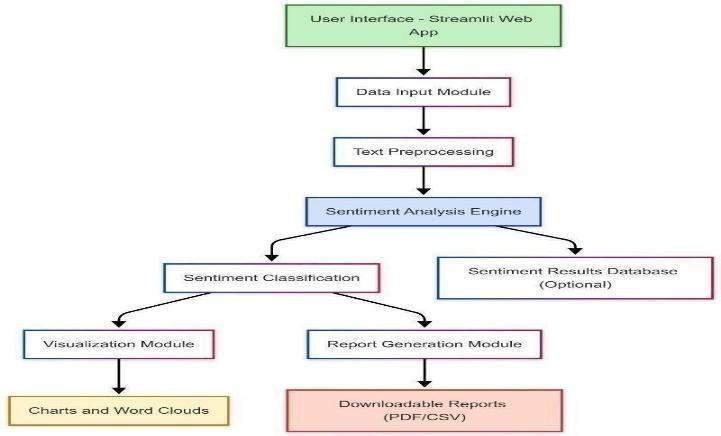
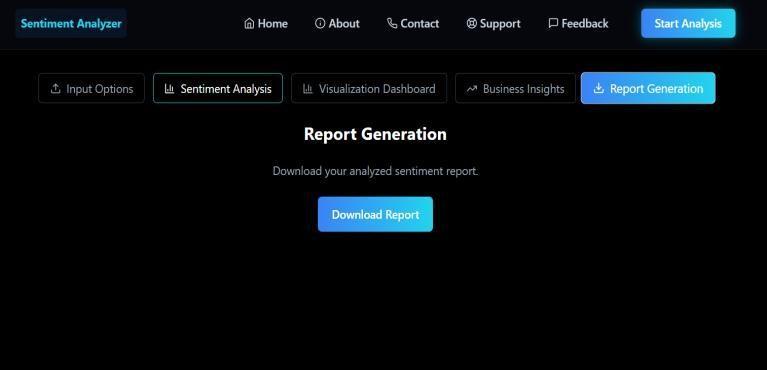
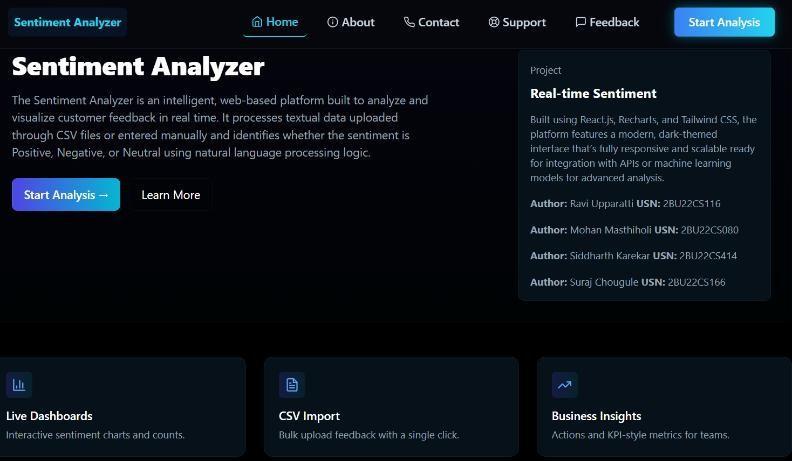
Fig 3: TheSentimentAnalyzerisamodernweb-basedapplicationdesignedtoanalyzeandclassifythesentimentof
International Research Journal of Engineering and Technology (IRJET) e-ISSN: 2395-0056
Volume: 12 Issue: 12 | Dec 2025 www.irjet.net p-ISSN: 2395-0072
3.1: TheReportGenerationmoduleoftheSentimentAnalyzerapplicationenablesuserstocreateanddownload structuredsentimentanalysisreportseffortlessly.
This project demonstrates the successful development of an automated sentiment analysis system for business applications. By leveraging NLP techniques and machine learning models, the system efficiently transforms unstructured customer feedback into actionable insights. The solution enhances operational efficiency, supports strategic decisionmaking, and promotes a data-driven organizational culture. By enabling early detection of negative sentiment and highlightingareasofcustomersatisfaction.
[1] G.Heimerl,V.Vukovic,andG.Kovacs,“Real-timehandgesturerecognitionusingdeeplearningapproaches,” IEEEAccess,vol.8,pp.152768–152780,2020.
[2] F. Zhang, A. Bazarevsky, and Y. Vakunov, “Media Pipe Hands: On-device real-time hand tracking,” GoogleAIBlog,2020.
[3] Zhang, Y., “Hand Gesture Recognition Using Deep Learning Techniques,” Journal of Computer Vision and PatternAnalysis,2022.
[4] Nguyen,T.,“ConvolutionalNeuralNetworksforImageBasedGestureClassification,”InternationalJournalof MachineLearning,2023
[5] Singh, K., “Real-Time Gesture Recognition Using Python Kumar, Y., “Web-Based Visualization Techniques UsingHTML5
Canvas,”WebTechnologiesandApplicationsJournal,2021.
[6] Flask Documentation Team, “Flask: A Lightweight Python Web Framework for APIs,” Flask Official Documentation,2023.
[7] OpenCV Organization, “Real-Time Computer Vision for Human–Computer Interaction,” OpenCV Documentation,2022.
[8] M.Abadietal.,“TensorFlow:Asystemforlarge-scalemachinelearning,”inProc.12thUSENIXOSDI,2016.
International Research Journal of Engineering and Technology (IRJET) e-ISSN: 2395-0056
Volume: 12 Issue: 12 | Dec 2025 www.irjet.net p-ISSN: 2395-0072




MohanMisafinal-yearComputer ScienceandEngineeringstudent. Heiscurrentlypursuinghisdegree atSGBalekundriInstituteofTechnology.
RaviUisafinal-yearComputer ScienceandEngineeringstudent. Heiscurrentlypursuinghisdegree atSGBalekundriInstituteofTechnology.
SiddharthKisafinal-yearComputer ScienceandEngineeringstudent. Heiscurrentlypursuinghisdegree atSGBalekundriInstituteofTechnology.
SurajCisafinal-yearComputer ScienceandEngineeringstudent. Heiscurrentlypursuinghisdegree atSGBalekundriInstituteofTechnology.