
International Research Journal of Engineering and Technology (IRJET) e-ISSN: 2395-0056
Volume: 12 Issue: 12 | Dec 2025 www.irjet.net p-ISSN: 2395-0072
International Research Journal of Engineering and Technology (IRJET) e-ISSN: 2395-0056
Volume: 12 Issue: 12 | Dec 2025 www.irjet.net p-ISSN: 2395-0072
Shivam Kumar1, Suraj Thakur2, Utsav Shukla3 , Vedant Agrawal4 , Prof. Rajeev Raghuwanshi5
1Student, CSE-AIML Department, Oriental Institute of Science & Technology, Madhya Pradesh, India
2Student, CSE-AIML Department, Oriental Institute of Science & Technology, Madhya Pradesh, India
3Student, CSE-AIML Department, Oriental Institute of Science & Technology, Madhya Pradesh, India
4Student, CSE-AIML Department, Oriental Institute of Science & Technology, Madhya Pradesh, India
5Professor, CSE-AIML Department, Oriental Institute of Science & Technology, Madhya Pradesh, India ***
Abstract - In India, agriculture plays a significant role in the growth of the nation’s economy and provides employment to a large population. Farmers often face challenges in selecting suitable crops due to limited knowledge of soil nutrients and changing environmental conditions, which adversely affects crop productivity. To address this issue, this paper presents a machine learning–based system that assists farmers in recommending appropriate crops and estimating crop yield based on various agricultural parameters. The proposed system uses features such as soil nutrients, temperature, humidity, rainfall, and soil pH to generate predictions. Supervised machine learning techniques are applied to analyze agricultural data and provide accurate recommendations. Thesystemisimplementedasaweb-basedapplicationusing a machine learning backend, enabling farmers to adopt a scientific and data-driven approach to farming. This approach can help improve agricultural productivity and supportprecisionfarmingpractices.
Key Words: Agriculture, Crop Recommendation, Crop Yield Prediction, Machine Learning, Random Forest
Many developed countries have adopted modern scientific and technological techniques in agriculture to improve productivityandefficiency.Thesecountriesextensivelyuse data-driven and automated systems to optimize farming practices. In contrast, agriculture in India still largely depends on traditional methods, despite being one of the major contributors to the nation’s economy. Agriculture plays a significant role in employment generation and contributes substantially to the Gross Domestic Product. With rapid population growth and globalization, the demandforfoodproductionhasincreasedconsiderably.
To meet this growing demand, farmers often rely on excessive use of chemical fertilizers to increase crop yield, which may lead to long-term environmental degradation and soil fertility issues. However, if farmers are provided with accurate information regarding suitable crops based onsoilnutrientsandenvironmentalconditions,croplosses can be reduced and agricultural productivity can be improved. The availability of data related to soil
composition, climatic conditions, and rainfall enables a better understanding of crop growth patterns influenced bygeographicalandenvironmentalfactors.
Inthiswork,amachinelearning–basedpredictivesystemis proposed to assist farmers in selecting appropriate crops and estimating expected yield. The system analyzes parameters such as soil nutrients, temperature, humidity, rainfall, and soil pH to generate recommendations. By identifying nutrient deficiencies and unsuitable crop choices, the proposed system helps in minimizing production inefficiencies. The adoption of such a scientific anddatadrivenapproachcansignificantlyenhancefarming practices and support sustainable agricultural development.
Severalresearchworkshavebeencarriedoutinthedomain of crop recommendation and yield prediction using machine learning techniques. Padmakar et al. proposed a crop recommendation system for precision agriculture using soil nutrient data, soil type, and yield information. The system employed ensemble-based machine learning techniques to recommend suitable crops. Algorithms such asRandomTree,CHAID,andSupportVectorMachinewere used to improve prediction accuracy by combining the strengthsofmultiplemodels.
Solankietal.presentedacropcultivationpredictionsystem with the primary objective of reducing the risk associated withincorrectcropselection.Thestudyevaluatedmultiple machine learning algorithms and implemented a k-fold cross validation approach, where the dataset was divided intofivesubsetstoensurereliableperformanceevaluation. The authors concluded that Random Forest achieved superior prediction performance compared to other models, followed by Support Vector Regression using the radialbasisfunctionkernel.
Kumar et al. introduced a supervised machine learning approach for crop yield prediction based on historical agricultural data. Their system analysed previous farming recordstoestimatefuturecropyields.Theproposedmodel supported both qualitative and quantitative prediction of
Volume: 12 Issue: 12 | Dec 2025 www.irjet.net
harvest output and demonstrated effective performance in Fig. -2: Project Framework assisting agricultural planning anddecision-makingprocesses.
Cauvery et al. proposed a crop recommendation system using ensemble learning techniques to enhance crop productivity. Their approach combined predictions from multiple machine learning models to generate accurate croprecommendations.Thesystemfocusedonknowledgebased learning and demonstrated improved precision by integratingresultsfromvariousclassifiers.
Patel et al. presented a machine learning–based crop recommendationandyieldanalysissystemthatfocusedon improving decision-making in agriculture through datadriven techniques. The study utilized soil parameters and climatic factors to train supervised learning models for predicting suitable crops and expected yield. Various classification and regression algorithms were evaluated to analyze their effectiveness on agricultural datasets. The resultshighlightedthatensemble-basedmodelsperformed consistently better due to their ability to handle complex and non-linear relationships among agricultural features, makingthemsuitableforpracticalfarmingapplications.
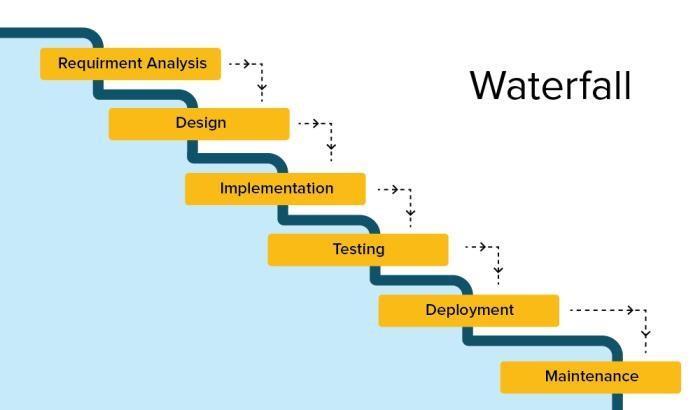
To develop an efficient software application, it is essential to understand the concept of the Software Development Life Cycle (SDLC). SDLC provides a structured framework that helps in planning, designing, developing, and maintaining a software system in an organized manner. It ensures that the system is developed systematically while meetinguserrequirementsandqualitystandards.
In the proposed project, the Waterfall model is adopted as the SDLC approach. The Waterfall model is a simple and straightforward life cycle model that follows a linear and sequential flow of development. In this model, each phase mustbecompletedbeforethenextphasebegins,andthere is no overlap between the stages. The output generated fromonephaseactsastheinputforthesubsequentphase, ensuring a clear flow of information throughout the developmentprocess.
The Waterfall model consists of several stages, including requirement analysis, system design, implementation, testing,deployment,andmaintenance,asillustratedinFig. 1. Each stage plays a crucial role in the successful development of the system. Following this model helps in systematicdevelopmentandreducescomplexity,makingit suitableforprojectswithwell-definedrequirements.
-ISSN: 2395-0072
4. Model Framework Overview
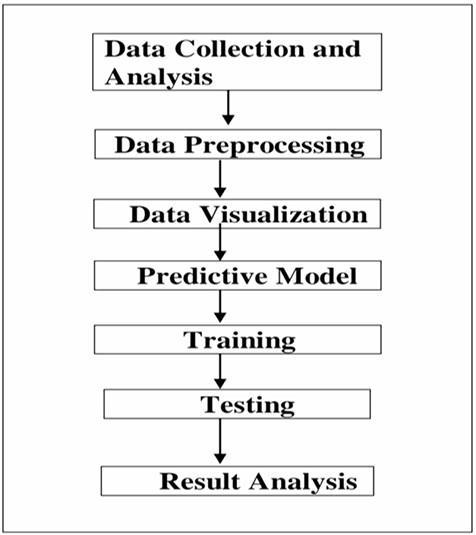
The most important steps involved in building a machine learningbasedpredictivemodelareshowninthefollowing “Fig.2”.
5. System Architecture
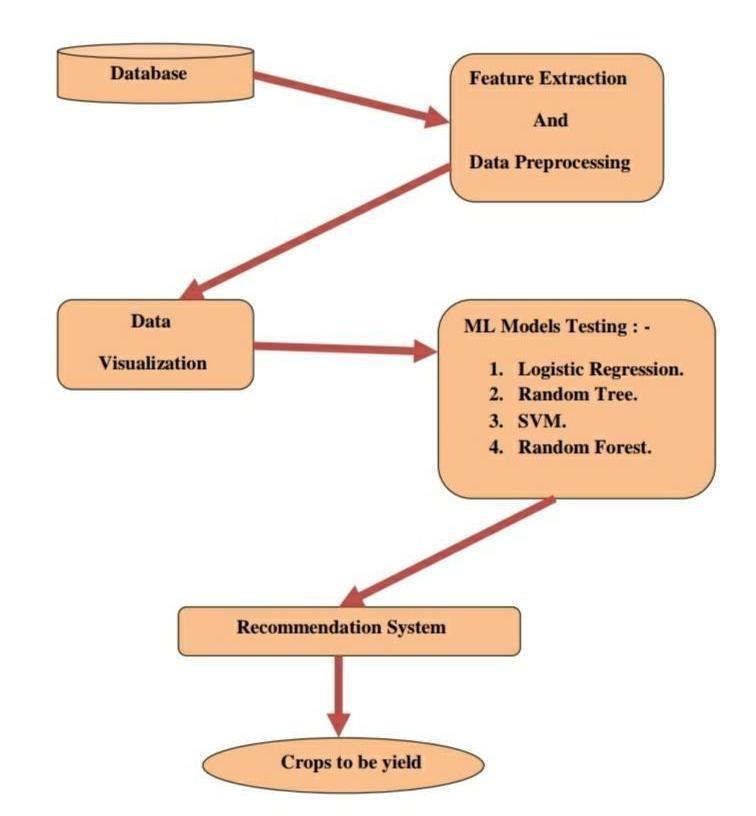
System architecture refers to a conceptual and structured model that defines the organization, components, and operational behaviour of a software system. It provides a clearrepresentationofhowdifferentmodulesinteractwith oneanotherandexplainstherelationshipanddependency between various processes involved in the system. The architecture of a system presents a high-level overview of its internal processes, methods, and stages. It allows developersanduserstovisualizetheworkingofthesystem andunderstandhowdataflowsfrominputtooutput.Inthe
International Research Journal of Engineering and Technology (IRJET) e-ISSN: 2395-0056
Volume: 12 Issue: 12 | Dec 2025 www.irjet.net p-ISSN: 2395-0072
proposed crop recommendation and yield prediction system,thearchitectureisdesignedtointegratedatainput, machine learning processing, and result generation efficiently.Themodulardesign ensuressmooth interaction between data collection, model prediction, and output display, thereby improving system reliability and scalability.
6. Methodology and Implementation
Thissectiondescribesthesequentialstepsfollowedforthe implementation of the proposed predictive system. The overall process is carried out in a sequential manner to ensure proper data handling, model training, prediction, andresultgeneration.
7. Dataset Collection
Dataset collection is the initial step in the development of any machine learning project. The data obtained from onlinesourcesisoftenrawandmaycontaininconsistencies or missing values. In this work, the datasets are collected from an open-source platform, Kaggle. The proposed system utilizes two primary datasets: a soil nutrient dataset containing information on nitrogen (N), phosphorus (P), potassium (K), and soil pH, and a climatic datasetconsisting of parameterssuchasrainfall,humidity, andtemperature.Thesedatasetsarecombinedtoformthe final dataset used for model training and prediction. The consolidated dataset contains approximately 2200 records withmultipleagriculturalattributes.
Dataanalysisisperformedpriortothepreprocessingstage togainaclearunderstandingofthedataset.Inthisstep,the data is carefully examined to identify patterns, relationships, and important features that influence crop recommendation and yield prediction. Understanding the dataset at this stage is essential, as the quality of feature selection directly affects the accuracy of the prediction results.
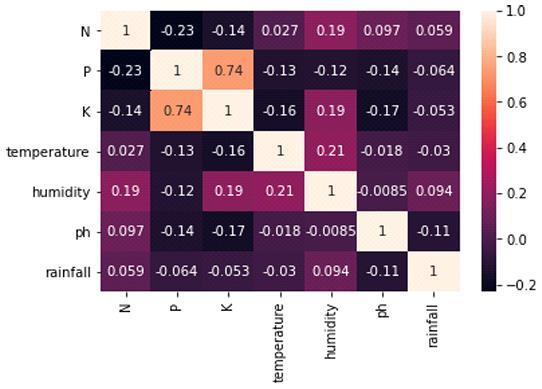
Theanalysisfocusesonstudyingtherelationshipsbetween soil nutrients and environmental factors such as temperature, humidity, rainfall, and soil pH. These parameters are evaluated to determine their influence on crop suitability. Visual techniques such as heatmaps are used to represent correlations among different features, providing insights into how various factors interact with eachother. The heatmap illustrating thisanalysisis shown inFig.5.
Based on the analysis, relevant features are selected for model training. Feature importance provided by ensemble learning methods helps in identifying influential parameters. This analytical process ensures that only meaningful and impactful features are considered, thereby improvingthereliabilityandperformanceofthepredictive system. Basic statistical analysis is performed to identify outliers and variations in the data. This helps in ensuring data consistency and improves the reliability of the predictivemodel.
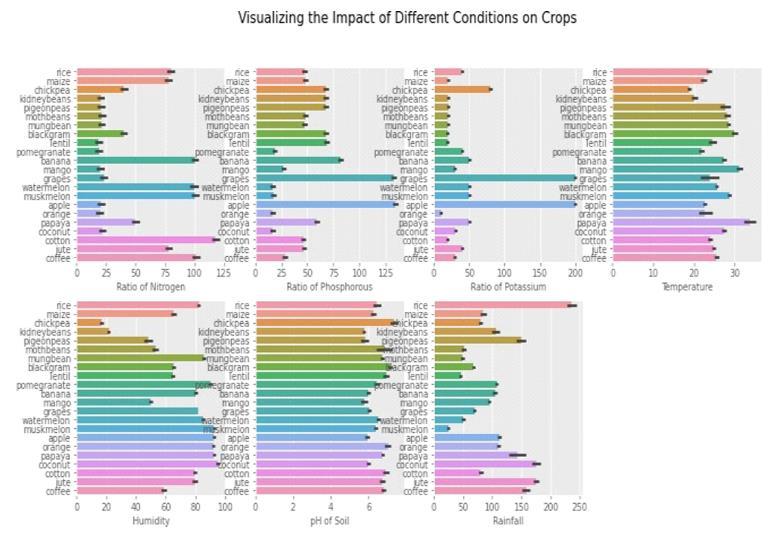
Datavisualizationisusedtorepresentagriculturaldataina graphical form to better understand the effect of various factors on crop production. In this work, the production quantity of different crops is plotted against influencing parameters such as soil nutrients and climatic conditions.
International Research Journal of Engineering and Technology (IRJET) e-ISSN: 2395-0056
Volume: 12 Issue: 12 | Dec 2025 www.irjet.net p-ISSN: 2395-0072
Thesevisualrepresentationshelpinidentifyingtrendsand relationships that affect crop growth and overall productivity. Bar graphs are used to compare crop productionwithrespecttodifferentenvironmentalfactors, asshowninFig.5.
Visualization techniques also assist in understanding key parameters such as nitrogen, phosphorus, potassium, soil pH, temperature, humidity, and rainfall. Correlation plots and distribution graphs help in identifying dominant featuresthatinfluencecropsuitability.Suchvisualanalysis supports feature selection and improves the effectiveness ofthemachinelearningmodels.
Additionally, visual representation of prediction results helps users interpret the system output more clearly. By analyzing graphical outputs, users can gain better insights into recommended crops and expected yield trends. Overall, data visualization enhances system usability and supports informed, data-driven agricultural decisionmaking.
The crop recommendation component of the proposed system is formulated as a classification problem. Multiple supervised machine learning algorithms are trained and evaluated to determine the most suitable model for accuratecropprediction.Theperformanceofeachmodelis assessed based on prediction accuracy, and the algorithm with the best results is selected. Priority is given to achieving higher accuracy to ensure reliable crop recommendations and effective decision support for farmers.
• Algorithm Selection
Various machine learning algorithms have been explored in existing literature for crop recommendation systems, including Decision
Trees, Support Vector Machines, and Logistic Regression. Decision Tree models are simple and interpretable but often suffer from overfitting when applied to complex agricultural datasets. Logistic Regression is effective for basic classification problems but may fail to capture non-linear relationships among soil and climatic parameters. Support Vector Machines provide good accuracy in some cases; however, they require careful parameter tuning and are computationally expensive for large datasets. Based on these considerations and prior research findings, Random Forest was selected as the primaryalgorithmfortheproposedsystemdueto its robustness, ability to handle non-linear data, andsuperiorgeneralizationperformance.
• Random Forest
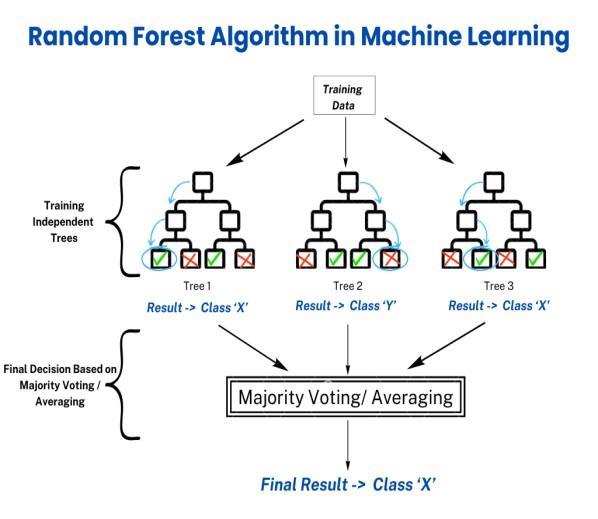
Random Forest is an ensemble-based supervised machinelearningalgorithmthatiswidelyusedfor both classification and regression tasks. It works by constructing multiple decision trees using randomlyselectedsubsetsofthetrainingdataand features. The final prediction is obtained by combiningtheoutputsofallindividualtrees,using majority voting for classification problems and averaging for regression problems. This ensemble mechanism helps in reducing model variance and improvesoverallpredictionaccuracy.
One of the key advantages of Random Forest is its ability to handle non-linear relationships and complex interactions between input features, which are commonly observed in agricultural datasets. Unlike single decision tree models, Random Forest reduces the risk of overfitting by aggregating predictions from multiple trees. It is also robust to noise and missing values, making it suitableforreal-worldagriculturaldata.
In the proposed crop recommendation system, RandomForestisusedtoclassifythemostsuitable crop based on soil nutrient parameters such as nitrogen, phosphorus, potassium, soil pH, along with climatic factors including temperature, humidity, and rainfall. Additionally, a Random Forest regressor is employed for crop yield prediction using historical agricultural data and encodedcategoricalfeaturessuchascroptypeand geographicalregion.
The trained Random Forest models are stored usingthejobliblibraryandintegratedintoaFlaskbased backend. This allows the system to provide real-time predictions through a web interface, enabling farmers to make informed, data-driven decisions. The efficiency, scalability, and reliability
International Research Journal of Engineering and Technology (IRJET) e-ISSN: 2395-0056
Volume: 12 Issue: 12 | Dec 2025 www.irjet.net p-ISSN: 2395-0072
of the Random Forest algorithm make it wellsuitedforprecisionagricultureapplications.
Testingisanessentialphaseinevaluatingtheperformance and reliability of a machine learning system. In the proposed crop recommendation and yield prediction system, the dataset is divided into training and testing subsets to analyze how well the trained models generalize tounseendata.Atrain–testsplitapproachisused,wherea portion of the data is used for training the model and the remainingdataisusedfortestingitsperformance.
The system is developed by integrating multiple functional modules, as described in the system architecture. Each module is tested individually as well as in combination to ensure proper functionality. Different machine learning models were trained and evaluated during the development phase to identifythemostsuitablealgorithm forcropprediction.
Model performance is evaluated using standard evaluation metrics. For crop recommendation, metrics such as accuracy, precision, and classification report are used to assessclassificationperformance.
For crop yield prediction, regression-based evaluation measuresareappliedtoanalyzepredictionaccuracy.These testing procedures help ensure that the selected model performs reliably and provides meaningful predictions for real-worldagriculturalapplications.
Accuracy is one of the most important metrics used to evaluate the performance of a machine learning classification model. It represents the proportion of correctly predicted instances out of the total number of predictions made. Accuracy helps in determining how
effectively the model classifies the input data and whether itissuitableforreal-worldapplications.
Mathematically,accuracyisdefinedas:

Itcanalsobeexpressedusingconfusionmatrixparameters as:

where TP, TN, FP, and FN represent true positives, true negatives,falsepositives,andfalsenegativesrespectively.
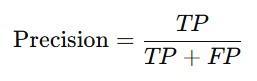
Precision is a performance metric that measures the correctness of positive predictions made by the model. It indicates how many of the instances predicted as positive are actually positive. Precision is particularly important whenfalsepositivepredictionsneedtobeminimized.
Precisioniscalculatedusingtheconfusionmatrixas:
14.
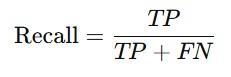
Recall is a performance evaluation metric that measures theabilityofamachinelearningmodeltocorrectlyidentify allrelevantpositiveinstances.Itindicateshowmanyofthe actual positive samples are successfully predicted by the model. Recall is particularly important in applications where missing a positive instance can lead to significant consequences.
Recalliscalculatedusingtheconfusionmatrixas:
The performance of the proposed crop recommendation and yield prediction system is evaluated based on prediction outputs obtained through the web-based application. The trained machine learning models are tested using user provided input values, and the corresponding results are generated in real time. This evaluation helps in assessing the practical applicability, consistency,andreliabilityofthedevelopedsystem.
International Research Journal of Engineering and Technology (IRJET) e-ISSN: 2395-0056
Volume: 12 Issue: 12 | Dec 2025 www.irjet.net p-ISSN: 2395-0072
Forcroprecommendation,thesystemacceptssoilnutrient parameters such as nitrogen, phosphorus, potassium, and soil pH, along with climatic factors including temperature, humidity, and rainfall. These parameters are processed by theRandomForestclassificationmodeltoidentifythemost suitable crop under the given conditions. The recommendation results demonstrate that the system is abletoeffectivelymapenvironmentalandsoilconditionsto appropriate crop choices. Fig. 7 illustrates the crop recommendation webpage, showing the input fields and thepredictedcropoutputgeneratedbythesystem.
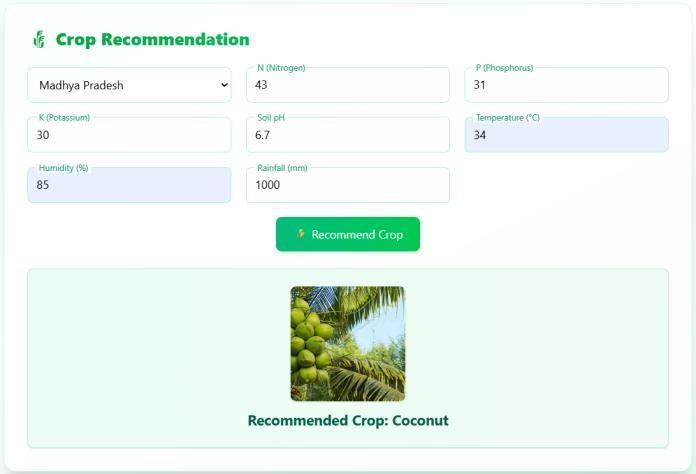
The recommendation module is designed to support informed decision-making by reducing dependency on traditional trial-and-error farming practices. By analyzing multipleparameterssimultaneously,thesystemprovidesa data-driven approach to crop selection, which can help farmersminimizecropmismatchandimproveproductivity. The consistent prediction behaviour observed during testing indicates that the model generalizes well to different input combinations provided through the interface.
In addition to crop recommendation, the system also includes a crop yield prediction module. This module estimates the expected yield based on agricultural and environmental inputs using a Random Forest regression model. Fig. 8 represents the yield prediction webpage, displaying the input parameters and the corresponding predicted yield value. This feature allows users to gain an approximate understanding of potential crop productivity beforecultivation.
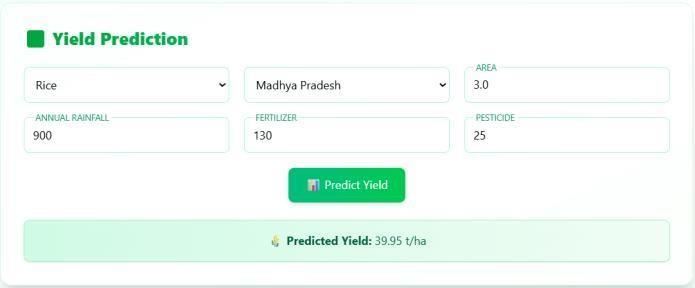
Overall, the results show that the integrated system successfully delivers meaningful predictions for both crop selectionandyieldestimation.Thecombinationofmachine learning models with a Flask-based backend ensures efficient processing and quick response time. The simple and user-friendly interface further enhances usability, making the system suitable as a practical decision-support toolforprecisionagriculture.
In this paper, a machine learning–based crop recommendation and yield prediction system has been proposed to support data-driven decision making in agriculture. The system utilizes soil nutrient parameters and climatic conditions to recommend suitable crops and estimate expected yield using supervised learning techniques. Random Forest algorithms were employed for both classification and regression tasks due to their robustnessandabilitytohandlecomplexagriculturaldata.
The developed system was successfully implemented as a web-based application using a Flask backend, allowing users to interact with the models through a simple interface. Experimental evaluation demonstrated that the system is capable of generating consistent and meaningful predictions based on user-provided inputs. By reducing dependency on traditional trial-and-error farming practices, the proposed approach can assist farmers in improvingcropselectionandplanning.
Overall, the system highlights the potential of machine learning in precision agriculture and provides a practical decision-support tool that can contribute to enhanced agricultural productivity. The proposed solution can serve as a foundation for further advancements in smart and sustainablefarmingtechnologies.
The proposed crop recommendation and yield prediction system can be further enhanced in several ways. Integration of real-time weather data and soil sensor information can improve prediction accuracy and adaptability to changing environmental conditions. The
system can also be extended to support region-specific modelsbyincorporatinglargerandmorediversedatasets.
Inthefuture,advancedmachinelearninganddeeplearning techniques can be explored to capture complex temporal patterns in agricultural data. Deployment as a mobile applicationcanimproveaccessibilityforfarmersinremote areas. Additionally, features such as fertilizer recommendation, irrigation planning, and multilingual support can be integrated to make the system more comprehensiveandfarmer-friendly.
18. References
• Nilesh Dumber, Omkar Chikane, Gitesh Moore, “System for Agriculture Recommendation using Data Mining” , E- ISSN : 2454- 9916 | Volume : 1 | Issue:4|NOV2014.
• Government of India, “Soil Health Card Scheme,” Ministry of Agriculture and Farmers Welfare, Available: https://soilhealth.dac.gov.in/home
• R. K. Solanki, D. Bein, J. A. Vasko, and N. Rale, “Prediction of Crop Cultivation Using Machine Learning Techniques,” International Journal of Computer Applications, vol. 111, no. 6, pp. 1–5, 2015.
• T. M. Mitchell, Machine Learning, McGraw-Hill Education,1997.
• Kaggle,“CropRecommendationDataset,”Available: https://www.kaggle.com/datasets/atharvain gle/crop-recommendation-dataset
• Kaggle, “Yield Prediction Dataset,” Available: https://www.kaggle.com/datasets/akshatgu pta7/crop-yield-in-indian-states-dataset
• S. Pudumalar, E. Ramanujam, R. Harine Rajashree, C. Kavya, T. Kiruthika, and J. Nisha, “Crop Recommendation System for Precision Agriculture,” International Journal of Advanced Research in Computer Science and Software Engineering,vol.7,no.6,pp.32–36,2017.
International Research Journal of Engineering and Technology (IRJET) e-ISSN: 2395-0056 Volume: 12 Issue: 12 | Dec 2025 www.irjet.net p-ISSN: 2395-0072 © 2025, IRJET | Impact Factor value: 7.315 | ISO 9001:2008