
International Research Journal of Engineering and Technology (IRJET) e-ISSN: 2395-0056
Volume: 12 Issue: 11 | Nov 2025 www.irjet.net p-ISSN: 2395-0072
International Research Journal of Engineering and Technology (IRJET) e-ISSN: 2395-0056
Volume: 12 Issue: 11 | Nov 2025 www.irjet.net p-ISSN: 2395-0072
Anushree U1 , Dr. Kavitha AS2 , Anusha A3 , Kritika ShridharNaik4 1,2,3,4 Department of Artificial Intelligence and Machine Learning, East West Institute of Technology, Bangalore-560091, Karnataka, India ***
Abstract— IntersectionAlertSystemisaninnovative, real-timesafetysystemthataimstominimizevehiclecollisions.It combinesasensorfordetectingincomingvehicleswithanTinyML-poweredcameraforobjectclassificationasavehicleor apedestrian.Dependingonclassificationandmovementpatterns,thesystemgivestimely,color-codedvisualwarningona displayboardtoslowdown orstop,directingdrivers.Thealertsseek toenhancetheresponsetimeofthedriver,reduce honking or hard braking, and create safer crossing conditions. Scalable in design, this inexpensive which is best implementation in urban, semi-urban, and rural locations in India.Unlike typical traffic control devices, this system providesdynamicandsituationalalerts,ratherthanfixed-timersignals.IntegrationofTinyMLprovidestheintelligenceto the system, discriminating between harmless movements and possible collision threats at any given instance, reducing false alarms. The project presents an affordable mixture of hardware and AI as a new, different approach to very costly smart-citysurveillancesystems
Roadintersectionsaresomeofthemostdangerouszonesforbothvehiclesandpedestriansbecauseofblindspots,limited visibility, and the absence of timely alerts. Traditional traffic systems often fall short in preventing sudden collisions, especiallyinareaswithoutsignallights.Inresponsetothispracticalproblem,ourprojectintroducesanIntersectionAlert SystemwithPedestrianSafety,whichaimstoreduceaccidentrisksbydetectingapproachingvehiclesandpedestriansand providingreal-timealerts.Thesystemutilizesaradarsensortodetectthepresenceofincomingvehicles,while acamera differentiates between humans and vehicles with high accuracy. This dual detection approach ensures reliable operation andminimizesfalsealarms.
Once a threat is detected, the system triggers an immediate alert through a visual display board installed at the intersection. The board uses color-coded messages and directional arrows to inform drivers about the presence of fastapproachingvehiclesfromspecificdirections,allowingthemtoslowdownorstop.Theentiresetupiscontrolledbyafastprocessing microcontroller like the Arduino, ensuring low latency and quick decision-making. To support sustainable deployment, the system can be powered by solar energy, making it suitable for both urban and rural areas. This project offers an affordable, scalable, and impactful solution to intersection safety, combining smart technology with real-time response to enhance road awareness, reduce collisions, and save lives. The proposed system is a real-time Intelligent IntersectionAlertSystemdevelopedtopreventcollisionsatmulti-roadjunctionsbydetectingandclassifyingapproaching objects like vehicles and pedestrians. This architecture combines low-cost IoT sensors with an embedded AI vision module,enablingreal-timedecision-makingwithoutrelyingoncloudinfrastructure.
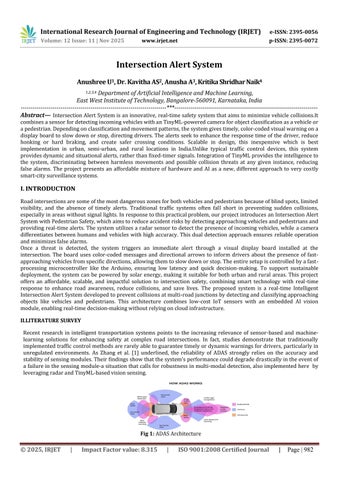
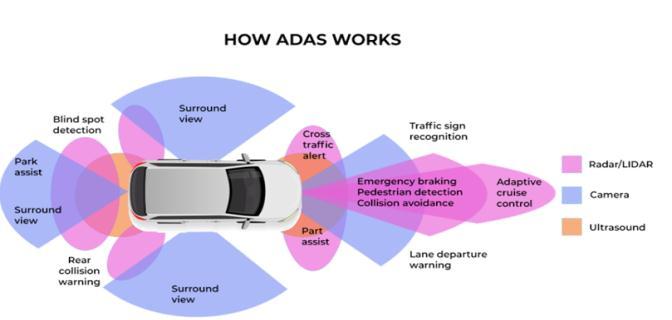
Recent research in intelligent transportation systems points to the increasing relevance of sensor-based and machinelearning solutions for enhancing safety at complex road intersections. In fact, studies demonstrate that traditionally implementedtrafficcontrolmethodsarerarelyabletoguaranteetimelyordynamicwarningsfordrivers,particularlyin unregulated environments. As Zhang et al. [1] underlined, the reliability of ADAS strongly relies on the accuracy and stabilityofsensingmodules.Theirfindingsshowthatthesystem'sperformancecoulddegradedrasticallyintheeventof afailureinthesensingmodule-asituationthatcallsforrobustnessinmulti-modaldetection,alsoimplementedhere by leveragingradarandTinyML-basedvisionsensing.
International Research Journal of Engineering and Technology (IRJET) e-ISSN: 2395-0056
Volume: 12 Issue: 11 | Nov 2025 www.irjet.net p-ISSN: 2395-0072
Applicationofdifferentvehicularcommunicationtechnologiesisalsooneofthewidelyexploredwaysforimprovingthe safetyatintersections.TheworkbyWassoufetal.[2]illustratedthatreal-timeV2VandV2Icommunicationcanfacilitate theissuanceofearlyconflictwarnings andtherebyreducecrashlikelihoodatintersections.Similarly,DhineshKumaret al. [3] validated the benefits brought forth by cooperative communication in IoT-enabled transportation networks. In general,suchsystemsdependonadvancedcommunicationinfrastructureandhigh-speedconnectivity,whichisnormally notavailableinruralandsemi-urbanregionsofIndia.Thislimitationbringsupthemotivationbehindneedingalow-cost, infrastructure-independentalternativesuchastheoneproposedinthisproject.
Another key challenge revolves around shared data reliability. Zhang et al. in [4] studied misbehavior detection for intersectionapplicationsandfoundthatfaultyormaliciousdatacanleadtosafetycompromise.Theirworkemphasizes local decision-making and sensing at the edge, which, together with the system design proposed here, will carry out all risk assessment locally via TinyML processing and verification from radar. Moreover, Yue et al. [5] analyzed the effectiveness of ADAS across diverse roadway conditions and concluded that performance varies with visibility, road geometry, and traffic behavior. These limitations are particularly critical in Indian intersections where blind curves, mixed traffic, and unpredictable movements are common. Therefore, several studies point to the need for externally mountedenvironment-awaresafetysystems.
Recent developments in TinyML and vision-based roadside units have proven their potential for enabling lightweight, on-deviceclassificationwithoutclouddependency.Similarly,radar-basedsensinghasalsobeenveryreliableinlow-light or adverse weather conditions. However, standalone sensors are prone to false alarms and lack contextual understanding.Therefore,theliteratureissupportiveofsensorfusion,thatis,combiningradarwithcameraintelligence, forimprovedaccuracy.Insummary,existingresearchpointstoagap:mostadvancedsolutionsareeitherinfrastructureheavy,expensive,orunreliableinreal-worldmixed-trafficconditions.ThispaperproposestheIntersectionAlertSystem with Pedestrian Safety, which helps to close this gap through the integration of radar detection, TinyML object classification,edgeprocessing,andvisualreal-timealerts.
System Design
The architecture is based on a distributed, modular sensing approach: Perception, processing, and the generation of alertsareseparatedintodedicatedlayerstoenhancereliabilityandreducecomputationalburden.
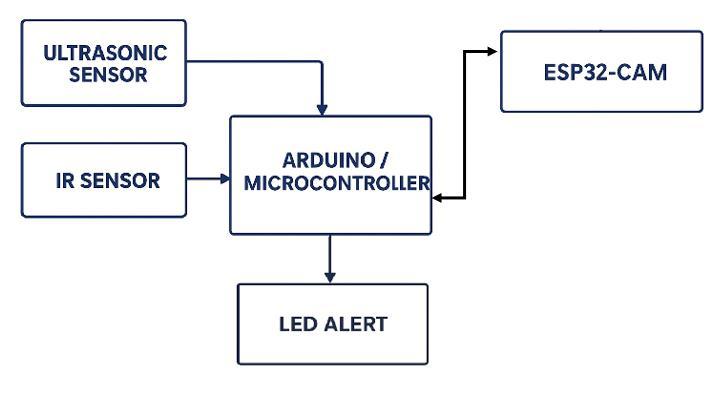
Eachroadunitinvolvestwocomplementarysensors:anultrasonicsensorformeasuringthedistancewithsoundwaves and an IR sensor for object confirmation through infrared reflection. This dual configuration of sensors can facilitate stronginitialscreeningtodismissmanyfalsetriggersresultingfromnoise,changesinlight,orotherdisturbances.
TheESP32-CAMistheintelligencelayerofthesystem.Triggered,itwilltakeapictureandperformprocessingthrougha quantized neural network based on MobileNetV2, optimized for embedded systems. Complementarily to standard classification, this scheme includes a visual anomaly detection module: this analyzes feature embeddings via Gaussian Mixture Models (GMM) to find the unusual objects, those that fall into neither of the car, human, or empty classes-an especiallyhandyaugmentationforreal-worldrobustness.ControlandCommunicationLayer:Eachroad'sArduinoboard is used for decision-making and communication. Once it obtains confirmed detection from the ESP32-CAM, it makes a decision on whether to turn on road indicators and sends out alert messages to other road units. This layer follows an A→B→Cmessageflowto ensure warningsacross the intersectionaresynchronized. Inthis way,theoverall distributed architecture avoids any dependency on cloud services and enables each road unit to act independently while still cooperatingwithotherunitsinrealtime.Theresultisadesignthatcanensurelowinferencelatency,energyefficiency, andhighfaulttolerance-allkeyrequirementsforsafety-criticalapplications.
International Research Journal of Engineering and Technology (IRJET) e-ISSN: 2395-0056
Volume: 12 Issue: 11 | Nov 2025 www.irjet.net p-ISSN: 2395-0072
Working Principle
The system works via multistage of verification in a pipeline, reducing false positives to ensure that alerts are only triggeredwhenthereisactuallyahazardpresent.
Various Stages are:
Stage 1 Continuous Monitoring:
The ultrasonic sensor continuously emits sound waves and measures the time taken by the echo returning. In case the distancevaluefallsbelowthedangerthreshold(e.g.,50cm),itmeansanobjectisenteringthemonitoredzone.
Stage 2 Cross-Verification:
Simultaneously,theIR sensorchecksforanobject by detecting reflectedinfraredsignals.Onlywhen bothsensorsdetect theobjectatthesameinstantdoesthesystemproceedtothenextstage.Thedual-sensorverificationreducesfalsealarms fromrandommovements,environmentalnoise,orlightingchanges.
Stage 3 — Classification Using Artificial Intelligence
Witheverytrigger,theESP32-CAMcapturesanimageoftheobjectandrunsinferenceusingtheTinyMLmodel.Themodel givesanoutputofprobabilitiesforthreeclasses:car,human,andempty. Thesystemconsidersdetectionifthemaximum probabilityexceedsathreshold,whichisusually80%.
Stage 4 Anomaly Detection (Fallback Mechanism):
Iftheclassificationconfidenceislow,theanomalydetectionmoduleevaluatesthecapturedimagetodeterminehowmuch it deviates from the distribution of known training samples. The high anomaly score suggests that the detected object is unfamiliarorunexpectedandistreatedasapotentialhazard.
Stage5 AlertPropagationApositiveconfirmationsendsadigitalHIGHsignalfromtheESP32-CAMtotheArduino.The controller triggers alerts and notifies neighboring roads about the hazard through a first-come-first-serve priority mechanism. This ensures there are coordinated alerts with no conflicting indications across the intersection. This multistageworkflowimprovesthedetectionaccuracy,reducesnuisanceactivations,andguaranteeseffectiveintersection management.
International Research Journal of Engineering and Technology (IRJET) e-ISSN: 2395-0056
Volume: 12 Issue: 11 | Nov 2025 www.irjet.net p-ISSN: 2395-0072
1. MobileNetV2
MobileNetV2isalight-weightconvolutionneuralnetworkthat,forsmallandlow-powerembeddeddevices,isatitsbest. Its inverted residual blocks and depth wise separable convolutions reduce the computational cost at large while maintaininghighaccuracy.ThisarchitectureenablestheESP32-CAMtoclassifycars,human,andempty-roadconditionsin realtime.
2. GMM-Based Visual Anomaly Detection
The anomaly module extracts feature embeddings from intermediate neural layers and models their distribution as Gaussian Mixture Models. During inference, if the probability of a feature lies in a low probability region in the normal distribution,thesystemmarkstheobjectasanomalous.Thisiscrucialfordetectingunexpectedobstaclessuchasanimals, fallenobjects,ordebris.
3. Logical AND Sensor Fusion
These work together with a simple Boolean AND operation: IR and ultrasonic sensors ensure that only valid objects detected by both can make the camera perform any inference, hence significantly reducing false detections and extra computations.
4. Priority-Based Alerting
Thesystemassignshigherprioritytohumandetectionduetosafetyconcerns.Vehicledetectionfollowsnext,andemptyroad readings have the lowest priority. This provides for appropriate response timing as well as proper hazard classification.
5. First-Come-First-Serve (FCFS) Scheduling
Inthecaseof hazarddetectiononseveral roadssimultaneously,theFCFSalgorithmssorttheorderin whichsignalswill propagateusingtheearliesttimestamptopreventoverlapping signalsandmaintainorganizedtrafficflow.
Ultrasonic Distance Measurement (UDM)
Where:
v=SpeedofSound
t=Time
This formula computes the object's distance by measuring the sound-wave travel time. The division by two accounts for the outbound and inbound journey of the sound pulse. If the resulting distance is less than the danger threshold, the systeminitiatesthenextvalidationstep.
International Research Journal of Engineering and Technology (IRJET) e-ISSN: 2395-0056
Volume: 12 Issue: 11 | Nov 2025 www.irjet.net p-ISSN: 2395-0072
Sensor Fusion Logic (D)
Where:
ifultrasonicdetectsanobject,
ifIRdetectsanobject,
triggersimagecapture. Thislogicaloperationstrengthensreliabilitybyrequiringconfirmationfromtwoindependentsensors.
Classification Decision Rule
Where istheminimumconfidencerequired. Ifthisconditionissatisfied,thesystemconsidersthepredictedclassvalid.
Anomaly Score Calculation (A)
Where:
=featurevector,
= likelihood under GMM model.A high anomaly score indicates deviation from known object patterns. If: threshold theobjectisflaggedasananomaly.
FCFS Scheduling Formula priority
Theroadwiththeearliestdetectiontimereceivespriorityin alertdissemination,preventingcontradictorysignaling.
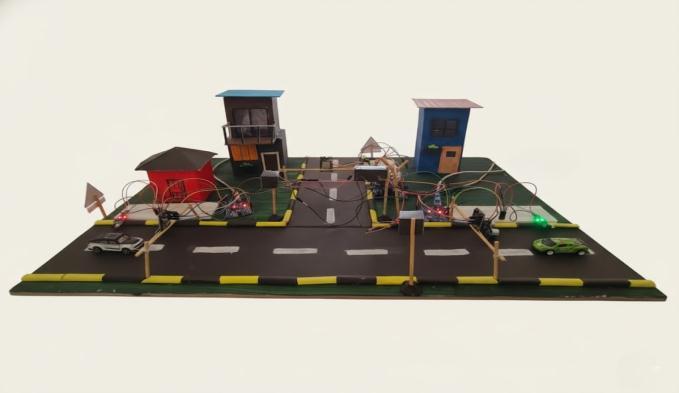
Tests on the proposed Intelligent Intersection Alert System were conducted with various experimental setups involving real-timeobjectdetection,multi-roadcoordination,andon-deviceTinyMLinference.Avarietyofcontrolledconditions have been tested, including object type (toy cars, human figures, and empty road condition), distance (20–80 cm), and lightingenvironments.
Classification accuracy
TheMobileNetV2TinyMLmodeltrainedinEdgeImpulseyieldedhighclassificationaccuracyforthethreeclassestrained: car,human,andempty.
The model performance during validation was:
OverallAccuracy:99.6%
CarDetectionAccuracy:99.3%
HumanDetectionAccuracy:100%
EmptyClassAccuracy:100%
F1-ScoreAcrossClasses:≈1.00
These results confirm that MobileNetV2 is suitable for edge deployment on ESP32-CAM, as there is no significant loss of performanceafterthequantizationwasperformedatint8.
TheGaussianMixtureModel-basedanomalymoduleeffectivelydetectsout-of-distributionobjectslike:
International Research Journal of Engineering and Technology (IRJET) e-ISSN: 2395-0056
Volume: 12 Issue: 11 | Nov 2025 www.irjet.net p-ISSN: 2395-0072
Randomblocks/toys
Non-vehicleobjects
Unexpectedshapesontheroad
The anomalies were detected reliably whenever placed sufficiently close to the camera. Objects partially resembling backgroundpatternsattimesproducedlowanomalyscores,butoverall,thedetectionperformanceremainedconsistent.
PerformancemetricsfromESP32-CAMinferencingwereasfollows:
Metric Value
DSPProcessingTime 14–18ms
ClassificationTime 18–22ms
TotalInferenceLatency ~40ms
RAMUsage ~175KB
FlashConsumption ~117KB
ThissystemransmoothlyinsideESP32-CAM'sresourcelimits,henceestablishingitsreal-timefeasibility.
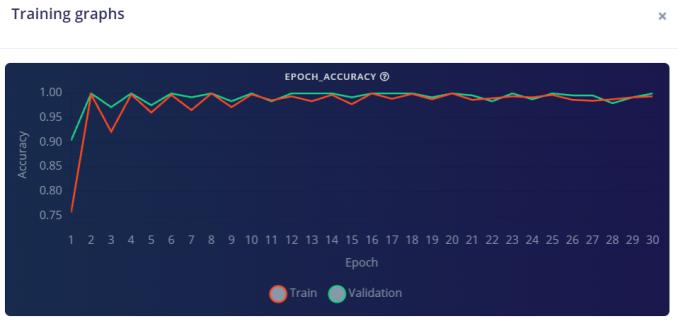
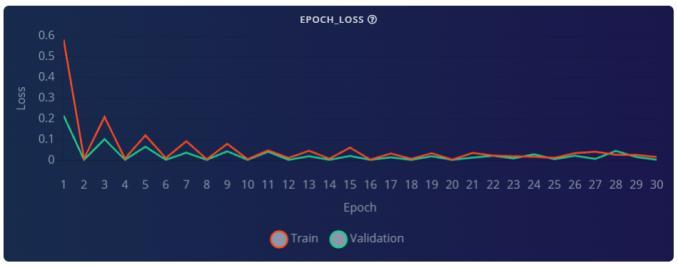
Training and Testing Set:


Thedual-sensorfusionUltrasonic+IRprovedtobeveryreliableinobjectscreening: Falsetriggerswerereducedby~70%comparedtousingasinglesensor.
Thecamerawastriggeredonlywhenbothsensorsvalidatedtheobject,thusavoidingsuperfluousprocessingcycles.
Detectionstabilitywasmaintainedacrossdistancerangesbetween20–70cm.
Multi-RoadCoordination&FCFSScheduling
International Research Journal of Engineering and Technology (IRJET) e-ISSN: 2395-0056
Volume: 12 Issue: 11 | Nov 2025 www.irjet.net p-ISSN: 2395-0072
The inter-road communication was done properly:
WhenseveralRoadsdetectedthesameobjectsimultaneously,FCFSchosetheearliestdetectionwithoutconflict. Cross-roadalertpropagationwaslessthan200ms,ensuringfasthazardnotification. The system remained stable with repetitive triggering and simultaneous inputs. F. Real-World Responsiveness Overall systemresponsetime,includingsensordetection,camerainference,andalertpropagation,remainedbetween0.30to0.45 seconds, which is sufficient for small-scale intersections and prototype demonstrations. The low-latency performance validatestheviabilityofthesystemforreal-timeapplications.
This research proposes a complete Intelligent Intersection Alert System that effectively integrates low-cost IoT sensing with on-device TinyML vision analytics for the improvement of road safety across multi-road junctions. The system successfullydemonstrateshowultrasonicandinfraredsensorscombinedwithESP32-CAM-basedimageclassificationand anomalydetectionenabletheidentificationofhazardsinrealtimewithoutdependencyoncloudprocessing.
TheresultsconfirmthattheTinyMLmodelbasedonMobileNetV2provideshighaccuracyinthedetectionofvehiclesand pedestrians while retaining low memory and computational needs appropriate for edge devices. Including an anomaly detector based on the Gaussian Mixture Model enhances the robustness of the system by identifying unexpected objects notpresentinthetrainingdataset.
Besides,theFCFS-basedalertscheduling mechanismensuresorderlyandconflict-freealertdisseminationintheeventof multiple roads detecting hazards simultaneously. The distributed architecture allows every node to function independentlywhilecommunicatingeffectivelywithotherinterconnectedroadunits.
Thesystem,onthewhole,providesanefficient,cost-effective,andenergy-efficientsolutiontoimproveintersectionsafety. It can be further extended for rural junctions, unmanned crossings, school zones, and low-infrastructure areas. Future scope may be the dataset size for better generalization, trying with V2X communication, and deployment of solarconsideredinintegratingadditionalsensorslikeradar,increasingpoweredmodulesforlong-termfieldusability.
[1] Jiliang Zhang, Rivian “Automotive-Advanced Driver Assistance Systems Reliability odeling” 2025 Annual Reliability and Maintainability Symposium (RAMS) | 979-8-3503-6774-4/25/$31.00 ©2025 IEEE | DOI: 10.1109/RAMS48127.2025.10935244
[2]YazanWassouf,EgorМ.Korekov,VladimirV.Serebrenny–“OptimizingIntersectionSafetythroughNext-GenVehicular Communications: A Simulation-Based Evaluation of Intersection ovement Assist Systems”2023 5th International Youth ConferenceonRadioElectronics,ElectricalandPowerEngineering(REEPE)|979-8-3503-9952-3/23/$31.00©2023IEEE |DOI:10.1109/REEPE57272.2023.10086753
[3] Dhinesh Kumar R, Rammohan A, Hafiz Husnain Raza Sherazi, - “Optimizing Intersection Safety through Next-Gen Vehicular Communications: A Simulation-Based Evaluation of Intersection ovement Assist Systems”2024 3rd International Conference on Artificial Intelligence for Internet of Things (AIIoT) | 979-8-3503-72120/24/$31.00©2024IEEE|DOI: 10.1109/AIIoT58432.2024.10574632
[4] Jiahao Zhang, Ziyi Liu, Ines Ben Jemaa, Francesca Bassi, Fawzi Nashashibi- “On Enhancing Intersection Applications with isbehavior Detection and itigation” 2024 IEEE 100th Vehicular Technology Conference (VTC2024-Fall) | 979-83315-1778-6/24/$31.00©2024IEEE|DOI:10.1109/VTC2024-Fall63153.2024.10757840
[5] Lishengsa Yue, Mohamed A. Abdel-Aty, Yina Wu, and Ahmed Farid – “The Practical Effectiveness of Advanced Driver AssistanceSystemsatDifferentRoadwayFacilities:SystemLimitation,Adoption,andUsage”1524-9050©2019IEEE