
International Research Journal of Engineering and Technology (IRJET) e-ISSN: 2395-0056
Volume: 12 Issue: 11 | Nov 2025 www.irjet.net p-ISSN: 2395-0072
International Research Journal of Engineering and Technology (IRJET) e-ISSN: 2395-0056
Volume: 12 Issue: 11 | Nov 2025 www.irjet.net p-ISSN: 2395-0072
Mrs. Manasa B1 , Nitin Satish Kodiya2 , Vignesh P3 , Nagendra M4 , Gowtham M5 .
1Assistant Professor Department of Electrical and Electronics Engineering
PES Institute of Technology and Management, Shivamogga, Karnataka, India
2,3,4,5BE Final Year Students, Department of Electrical and Electronics Engineering
PES Institute of Technology and Management, Shivamogga, Karnataka, India
Abstract - The EV has proposed an ambitious goal to achieve widespread E-mobilitv in both electrical and commercial sectors. For this, thousands of DC fast-charging stations need to be deployed. Inese power converters installed in the Dure are not like conventional DC-DC converters, as they have high power density in the range of tens of kilowatts. Unlike conventional non-isolated power converters, isolated power converters can provide ideal galvanic isolation, which protects both the local power grid and electric vehicles. Among the DC power converters designed for industrial applications, LLC resonant converters and DAB converters (Dual Active Bridge) are well appreciated. Based on these advantages, a 10kW bidirectional DAB power converter has been designed to meet the demands of this thesis project. The thesis has been divided into four clear sections. The first part is devoted to the literature study. The literature review explores the challenges existing in the current electrical field. Different types of DC-DC topologies are compared based on various elements such as component analysis, controllability, safety consideration, and cost effectiveness. Based on the examination of these aspects, the potential solutions for Electric Vehicles (EVs) are identified. In the second part, one particular type of DC-DC converter of a specific power rating of 10kW is selected using the DAB (Dual Active Bridge) topology. The selection would be based on the analysis in the literature review. These topics are explored and discussed within the literature study.
Key Words: Dual Active Bridge Converter, MOSFET's with Gate Drive IC's, High Frequency Transformer, Voltage Sensor, Temperature Sensor, Arduino Uno microcontroller, Step-down Transformer, Heat Sink.
As the transition to sustainable transport is speeding up, electricvehicles(EVs)areconsideredthemostviableoption to replace fossil fuel-based mobility. However, one of the main reasons limiting the large scale EVs adoption is the situationoffastandefficientchargingsystems.Conventional chargingconvertersarenormallylargeinsize,havelimited efficiency, and power flow in one direction only, which makes them inappropriate for high-performance applications.Inordertoeliminatesuchdrawbacks,theDual ActiveBridge(DAB)converterhasbeenidentifiedasahigh efficiency,bidirectionalDC-DCconverterthatcansatisfythe
requirementsofnext-generationfastchargingsystems.The DABconvertercomprisestwofull-bridgecircuits,connected via a high-frequency transformer, which provides both galvanicisolationandefficientpowertransferbetweentwo DCsources.Thankstothisstructure,theflowofpowerisnot limitedtoonedirectiononly,thusgrid-to-vehicle(G2V)and vehicleto-grid(V2G)operationsarefeasible.Bidirectional operation,infact,besidesbeinganenableroffastEVbattery charging,alsoallowsthestoredenergyinthevehicletobe drawnbacktothegridcontributingittogridstabilityand energy optimization. The rapid advancement of bandgap semiconductordevices,suchasGalliumNitride(GaN)and Silicon Carbide (SiC), has resulted in enhanced switching efficienciesandthermalperformanceoftheDABconverters. These developments have enabled the design of smaller, faster,andmoreenergy-efficientconverters,whilestillbe dependable.Consequently,theDABfastchargersolutionis engaging in discussions regarding the assimilation of renewablechargingstationsintothesmartgrid.Inessence,a DualActiveBridgeconverterisahighefficiencysystemto enable fast charging of EV that takes ad- vantage of compactness,highpowerdensity,andbidirectionalcharging capabilities.Thefactorsofadaptability,isolation,andbetter control feature make it a fundamental element for future intelligentcharginginfrastructures,whichareinline with the concept of clean, efficient and sustainable electric mobility.
TheDualActiveBridgeconverterarchitecture.structuredto providebidirectionalandisolatedDC-DCpowerconversion, whichisessentialtomodernEVfastchargingapplications. Thesystemconsistsoftwoactivefull-bridgestages:
International Research Journal of Engineering and Technology (IRJET) e-ISSN: 2395-0056
Volume: 12 Issue: 11 | Nov 2025 www.irjet.net p-ISSN: 2395-0072
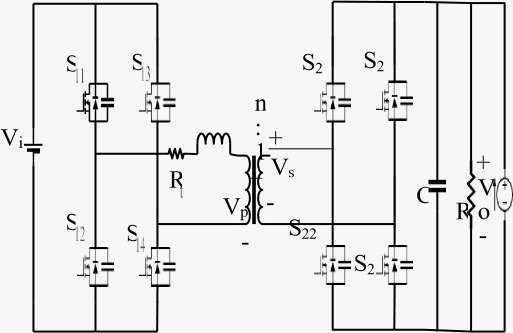
OneontheprimarysidecoupledtotheDCsourceandthe other on the secondary side connected to the EV battery. Thesebridgesarelinked by a high-frequencytransformer thathastwoprimaryfunctions:providinggalvanicisolation andchangingvoltagesaccordingtochargingneeds.Inthis connection,eachbridgehas4switchesunderactivecontrol, which are typically MOS- FETs, SiC, or GaN transistors, arrangedinanH-bridgeconfiguration.Theprimarybridge convertstheinputDCvoltageintoahigh-frequencyACwave. form is then transferred through the transformer. The secondarybridgesubsequentlyrectifiesthisACsignalback toDCtochargethebattery.Byphase-shiftingtheswitching signalsbetweenthetwobridges,precisecontroloverpower Flowanddirectionareachieved.Thismechanismofcontrol permitstheconvertertohandlebothGridtoVehicle(G2V) efficiently and Vehicle-to Grid (V2G) energy transfer operations. To achieve stable operation and high performance,thesystememploysdigitalfeedbackcontrolto monitor voltage: current, and temperature in real time.
PrimaryHardwareComponents:
MOSFET
GatedriveIC's
HighFrequencyTransformer
ArduinoUnoMicrocontroller
Step-downTransformer
VoltageSensor
TemperatureSensor
HeatSink
PICMicrocontroller
ThehardwaredesignoftheDABconverterrevolvesaround theideasofhighefficiency,smallsize,andoperationthatis both reliable and under rapid-charging conditions. Fast switchingsemiconductordevicessuchasSiCorGaNdevices are used in each bridge to limit losses and allow the converter to run at high frequency. Besides this, these devicesareswitchedon/offbytherespectivegatedriverICs which give isolation, exact timing, and safety against
overcurrentandshort-circuitconditions.Thehigh-frequency transformer is the main part of the isolation and energy transferunit.Itismadeoflowcorelossferritecoresandthe winding arrangements are optimized so that leakage inductance is as small as possible. The transformer frequency is generally 50 kHz to 500 kHz that leads to a substantialshrinkageofthesizeandweightofthemagnetic components. The DC link capacitors on both sides of the converter work together with the inductors to absorb the voltageripplesandkeeptheDCbusvoltagesteady,leading tothedoublingofenergyflowcontinuitybetweenthetwo bridges.Thetotalconverter'soperationisunderthecontrol of a control board based on Arduino, STM32 or a DSP controller. The control board communicates with the switches through pulse width modulated (PWM) gate signals, it also carries out the real-time monitoring and executesthephase-shiftmodulationalgorithms.Thecontrol logic guarantees that at zero crossing and zero switching transition conditions take place throughout the wide load range thus giving the converter less switching stress and better heat dissipation. The DAB converter's hardware topology are a powerful mix of modern power semiconductortechnology,high-frequencymagneticdesign, and intelligent digital control that results in a compact, efficient, and bidirectional charging interface for fast EV charging. This circuit topology not only advances energy transferefficiencyandreliability,butisalsocompatiblewith the requirements for next-generation electric vehicle charging systems where fast charging, safety, and bidirectionalpowerflowaremusthaves.
The use of the Dual Active Bridge (DAB) converter for electric vehicle fastchargingisdemonstratedvia a robust pro- cess that includes the design, controls, hardware deployment, and verification of performance. This begins with arguing the power and voltage ratings for the EV batterysystem,informingthevoltagetransformationratio and definitions of other design considerations related to transformers. From these ratings, the input and output voltage levels are set considering a preferable power semiconductor device (such as Gallium Nitride (GaN) or Silicon Carbide (SiC) MOSFETs) that will operate, with minimallosses,uptohighswitchingfrequencies.
The circuit configuration uses two active full-bridge converters;oneabridgestageontheprimarysidefromthe DC source and the other an active bridge stage on the secondarysidefromtheEVbattery.
Thetwobridgestagesaretiedtogetherviaahighfrequency transformerwhichprovidesgalvanicisolationandallowsfor the desired transformation ratio to be realized. A microcontrollerisresponsibleforcreating,andforensuring
International Research Journal of Engineering and Technology (IRJET) e-ISSN: 2395-0056
Volume: 12 Issue: 11 | Nov 2025 www.irjet.net p-ISSN: 2395-0072
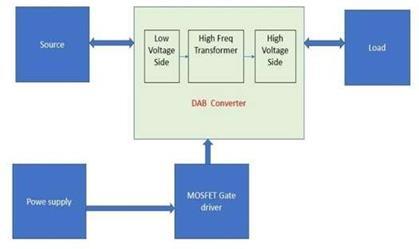
Thecorrecttimingfor,thephase-shiftedPWMsignals-sent todrivethegatedriverICsforthetwobridges.
Duringthehardwareintegrationphase,theassemblyofthe converter components such as the DC-link capacitors, inductors, transformer, and sensors takes place. The gate drivercircuitisemployedtoprovideisolatedcontrolsignals to the MOSFETs, while the control unit utilizes feedback from the voltage, current, and temperature sensors for monitoring and protection. To ensure adequate heat dissipation, a combination of heat sinks and thermal pads areusedtomaintainstableoperationthroughhigh-power charging cycles. After the hardware setup is completed, softwareprogram-mingandcontrolalgorithmdeployment in the system will begin. The controller firmware is developed using MAT- LAB/Simulink or Arduino IDE for real-time monitoring, phase-shift modulation, and fault handling functions. Lastly, the program continuously changes the phase angle based on input and output conditionstomaintainsoft-switching(ZVS/ZCS)functions, while also achieving optimal power transfer efficiency. Duringthetestingandvalidationphase,theDABconverteris tested under a range of load and voltage conditions to determine its efficiency, voltage regulation, and thermal behavior.Experimentaldataiscomparedtosimulationdata asacheckontheaccuracyofthedesign.TheDABconverter isanticipatedtoshowhighefficiency(greaterthan95percent)stablebidirectionalpowertransfer,andgoodtransient response,thusconfirmingthatitisasuitabledesignforfastchargingapplicationsinelectricvehicles.
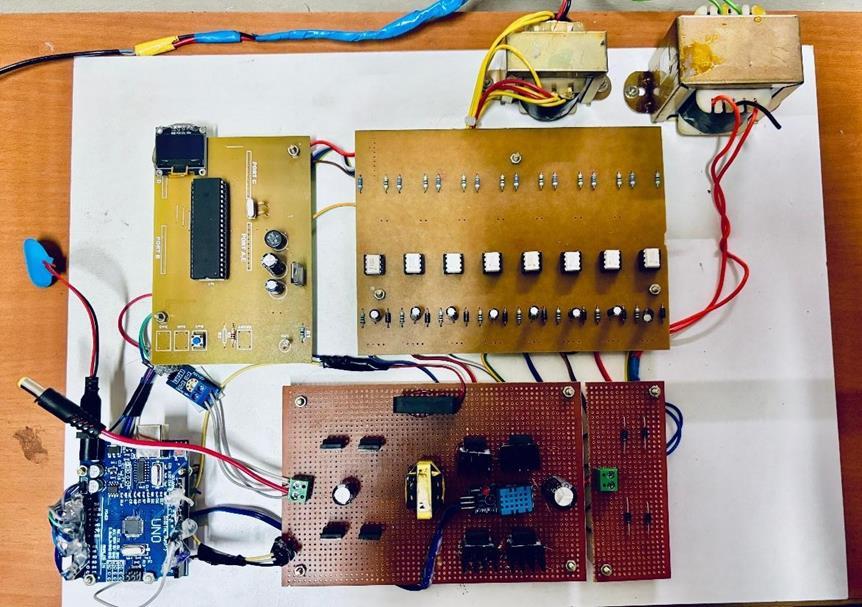
ThetestingsetupoftheDualActiveBridge(DAB)converter wascreatedtotesttheperformanceoftheDABconverter systeminanactualfast-chargingscenario.TheDABsystem consistsoftwofull-bridgeconverterstagesconnectedviaa high-frequencyisolationtransformer.Theprimarybridgeis supplied with a regulated DC supply acting as a charging source, while a programmable DC load (or an EV battery emulator) is connected to the secondary bridge. Both the primaryandsecondarybridgesareusinghighspeedSiCor GaN MOSFETs as the switching devices to minimize conductionlossesandprovideefficientoperationatelevated frequencies.TheArduinomicrocontrollerorDSPcontroller generatesthecontrolsignalsfortheswitches,implementing the phase- shift modulation (PSM) strategy. A gate driver circuit supplies voltage isolation and drives the MOSFET gateswithprecisetiming.Thewholeassemblyisplacedon an insulated base and equipped with heat sinks and aircoolingforthermaldissipationduringoperation.
Tomeasureandvalidateperformanceaccurately,anumber ofimportantinstrumentswereutilized,including:utilization ofadigitaloscilloscopetoobserveswitchingwaveforms,DC power analyzer for measuring input/output power, and thermalsensorsforestimatingtemperatureriseacrossboth switchesandtransformerwindings.Thevoltageandcurrent probes were connected to both converter sides, allowing theirefficiencyandoverallwaveformqualitytobeanalyzed. Fortestingoftheconverter'sbidirectionalpowertransfer ability,voltageandcurrentcharacteristicsweremeasured underdifferentphase-shiftanglesandloadconditions.
International Research Journal of Engineering and Technology (IRJET) e-ISSN: 2395-0056
Volume: 12 Issue: 11 | Nov 2025 www.irjet.net p-ISSN: 2395-0072
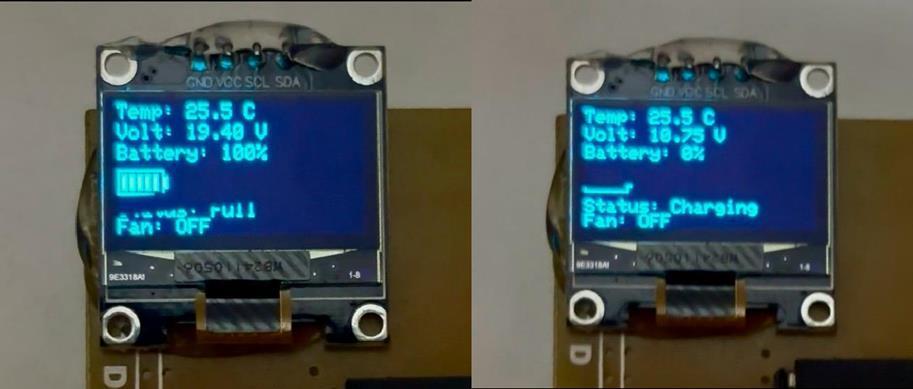
Fig. 4: UserInterfaceofthesystemduringtesting
Thetestprotocolwasinitiatedwithastepwiseenergization of the converter, where the correct switching synchronization was verified across the primary and secondarybridges.Theconverterwasfirsttestedundernoloadconditionstoverifyswitchingfrequency,isolationofthe transformer, and phase- shift control. After this test was confirmedasvalid,itwasfollowedbyconnectingresistive andbattery-equivalentdynamicloadsinordertoreproduce fast-chargingconditions.Theinputwaschangedtodifferent phase-shift angles in order to assess the behavior of the outputvoltage,current,andefficiencyoftheconverter.The data confirmed the DAB converter is capable of soft switching (ZVS/ZCS) under various load conditions and minimized switching losses. Lastly, the bi-directional operational capability wasdemonstrated by reversing the phase-shiftdirectionforpowerflowfromthebatterytothe grid(V2G)
The experimental assessment of the Dual Active Bridge (DAB) converter system was performed to investigate efficiency, voltage regulation, switching performance, and bidirectional power flow capability. The converter was tested at various load and input voltage conditions to demonstrate its application for fast electric vehicle (EV) chargingapplications.Theresultsshowedthattheconverter operatesathighefficiencyacrossabroadfieldofoperating conditions and was able to provide stable voltage and current waveforms with negligible distortion. Phase-shift modulation (PSM) allowed for seamless power transfer between the primary and secondary bridges while demonstratingexceptionalaccuracyandstabilitywithinthe system.
Efficiencytestingwasconductedbymeasuringinput/output poweratdifferentloadlevels.Theconverterhadmaximum
efficiency of 95.6 percent at rated power (5 kW) and sustained efficiencies over 93 percent at partial load. The gaininefficiencywasprimarilyduetotheuseofGaN-based MOSFETS and phase-shift control that achieved ZVS operationwithreducedconductionloss.Theresultsconfirm thattheDABconvertercanactasahighperformancepower interface for EV fast charging applications in which a compactpackageandefficiencyarekey.
Thetemperaturetrendingindicatedthetemperatureofthe MOSFETjunctionsstayedunder75°Cthroughoutoperation, whichiswellbelowtheratedtemperatureforGaNdevices. Theheatsinkandcoolingschemedidagreatjobofremoving any switching losses, resulting in no thermal runaway for anyhigh-loadtests.Theconverteralsoexhibitedaverygood dynamicresponse,showingstabilityofoutputvoltageand currentduringchangingloadtransients,whichisimportant tohaveauniformchargeprofile.Thecontrolalgorithmalso regulated voltage and balanced power with sudden disturbancesintheassentedloadorvoltagetotheinputto maintain reliable and safe charging performance. This indicates that the DAB converter is capable to operate effectively with real-time transient loading or battery dynamics.
A key outcome from this research was the validation of bidirectionalpowerflow.Theconverterwasabletochange thepowerflowdirectionbyalteringthephaseshiftbetween the primary and secondary bridges (i.e. Grid-to-Vehicle (G2V)andVehicle-to-Grid(V2G)).V2Goperationinvolved theconverterdeliveringpowertothesourcewithastable current output and negligible distortion of the waveform. This extended the capabilities and applications of the converter to smart grid applications or energy storage systems where bi directional power flow is necessary for maintaininggridbalance.
TheinvestigationandutilizationoftheDualActiveBridge (DAB)converterforfast-chargingelectricvehiclesillustrates greatpromiseasahigh-efficiencyandbidirectionalDC-DC powerconversionsystem.Ultimately,theDABconverterhas achieved stable, isolated, and controlled power transfer, from a grid to the electric vehicle battery, in this case, by meansofphase-shiftmodulation.Theexperimentalresults show that the system is capable of operating efficiently withoutanyhighswitchinglossesduetotheZeroVoltage Switching (ZVS) and Zero Current Switching (ZCS) characteristics.TheDABconverterperformedequallywell under different loading and input conditions, achieving a peakefficiencygreaterthan95%.
International Research Journal of Engineering and Technology (IRJET) e-ISSN: 2395-0056
Volume: 12 Issue: 11 | Nov 2025 www.irjet.net p-ISSN: 2395-0072
TheconversiontechnologybenefitsfromtheuseofGallium Nitride (GaN) and Silicon Carbide (SiC) semiconductor devicesforconvertingpower,bothofwhichimprovedthe switchingspeedanddecreasedtheconductionlossesinthe converter. This potentially led to smaller and lighter hardware construction overall, while the microcontroller basedcontrolstrategythatemployedphase-shiftmodulation wassuitableforbidirectionalpowerflow.Therefore,itcan beusedforGrid-to-Vehicle(G2V)andVehicle-to-Grid(V2G) systems.TheDABconverteroffersthebesttradeoffbetween power density, robustness, and energy efficiency, as demonstrated in this study it is well positioned for next generationEVchargingapplications.
The system also offers galvanic isolation through a highfrequencytransformer,providingprotectionfortheuserand the system itself. Since DAB converters are modular and scalable,theycanbeeffortlesslyembeddedintorenewable based microgrids and energy storage systems. This work overall establishes the DAB converter as a high degree adaptable,efficientandintelligentpowerinterfacingoption, corresponding to the world's initiatives of clean transfers andthesustainableuseofenergy.
Subsequent studies may emphasize on the use of sophisticated digital control algorithms, like model predictivecontrol(MPC)orfuzzylogic-basedcontrollers,to reducetransientresponseandenhancedynamicregulation. Besides,theincorporationofartificialintelligence(AI)and machine learning algorithms may also lead to the implementation of adaptive control as well as predictive fault detection, thus, increasing system reliability under fluctuatinggridandloadconditions.
Regarding hardware design, the next research could be a thoroughinvestigationofwide-bandgapdeviceswithhigher voltageratingsandintegratedmagneticstructurestofurther increase power density and decrease the number of components.Theuseofplanartransformersandresonant topologiesmightalsoresultintheimprovementofthermal management and the reduction of electromagnetic interference. Moreover, the implementation of real-time communicationprotocolswillfacilitatetheDABconverterto interact effortlessly with smart grids and the vehicle managementsystems,thus,enablingcoordinatedcharging, loadbalancing,andrenewableenergyutilization.
Tosumup,thecurrentdesign,albeitbeingasteppingstone towardstheefficientEVcharging,willbefurtherextended futurethroughcontrolintelligence,hardwareefficiency,and systemintegrationinnovations,thus,DAB-basedconverters willhaveenhancedcapabilitiesleadingtothearrivaloffast, sustainable, and smart electric vehicle charging solutions shortly.
[1] K.J.VeeramrajuandJ.W.Kimball.,"DynamicModel of AC-AC Dual Active Bridge Converter Using the Extended Generalized Average Modeling Framework",IEEETrans.PowerElectron.,vol.39, no. 3, pp. 3558 3567, Mar. 2024. Available: https://doi.org/10.1109/TPEL2023.3344378
[2] S. Çinik. F. Zhao, G. De Falco, and X. Wang. "Efficiency and Cost Optimization of Dual Active Bridge Converter for 350 kW DC Fast Chargers," arXiv preprint, Apr. 2024. Available: https://arxiv.org/abs/2404.14557
[3] O.Zayed,A.Elezab,A.Abuelnaga,andM.Narimani, "A Dual-Active Bridge Converter With a Wide Output Voltage Range (200-1000 V) for Ultrafast DC-Connected EV Charging Stations," IEEE Trans. Transp.Electrification,vol.9,no.3,pp.3731-3741, Sep.2023.Available:https://doi.org/10.1109/TTE 2022.3232560
[4] D.Lyu,C.Straathof,T.B.Sociro,Z.Qin,andP.Bauer, "Dual Active Bridge Converter With Variable SwitchingFrequencyModulationtoMaintainZVS." (conference/journal paper), 2023 variablefrequency modulation method for full-range ZVS andimprovedperformance.
[5] V.Esteve,J.L.Bellido,andJ.Jordán,"Improvingthe Efficiency of an Isolated Bidirectional Dual Active BridgeDC-DCConverterUsingVariableFrequency." Electronics, vol. 13. no. 2. p. 294, Jan. 2024. Available: https://doi.org/10.3390/electronics 13020294
[6] Mandrioli, G. Buticchi, M. Liserre, and C. Concari, "Designofa7.5kWDualActiveBridgeConverterin 650VGaNTechnologyforChargingApplications," Electronics, vol. 12, no. 6, p. 1280, Mar. 2023. Available: https://doi.org/10.3390/electronics 12061280
[7] M. Babalou, H. Torkaman, and E. Pouresmaeil, "Fault-Tolerant Topol- ogy of Dual Active Bridge Converter for On-Board Charger in Electric Vehicles."(technicalreport/conference),2024.
[8] N.D.Nguyen,"AModelPredictiveVoltage/Current ControlforDual-Active-BridgeDC-DCConverters." Int. Journals/Springer article, 2023 model predictive control approaches applied to DAB for improved dynamic performance. Available: https://link.springer.com
[9] AravindKumarS,YashaswiniNetal"Solar-Based Wireless Charging System for Electric Vehicles"
International Research Journal of Engineering and Technology (IRJET) e-ISSN: 2395-0056
Volume: 12 Issue: 11 | Nov 2025 www.irjet.net p-ISSN: 2395-0072 © 2025, IRJET | Impact Factor value: 8.315 | ISO 9001:2008
JournalofPowerElectronicsandDevices,Volume-9, Issue-2,2023
[10] Muhammetoglu, Burak, and Mohsin Jamil. "Dual Active Bridge Converter with Interleaved and Parallel Operation for Electric Vehicle Charging." Energies17,2024