
International Research Journal of Engineering and Technology (IRJET) e-ISSN: 2395-0056
Volume: 12 Issue: 10 | Oct 2025 www.irjet.net p-ISSN: 2395-0072
International Research Journal of Engineering and Technology (IRJET) e-ISSN: 2395-0056
Volume: 12 Issue: 10 | Oct 2025 www.irjet.net p-ISSN: 2395-0072
1M. Tech student, Power System Analysis, Dept. of Electrical and Electronics Engineering, University BDT Collage of Engineering, Davangere, Karnataka, India.
2Assistant Professor, Department of Electrical and Electronics Engineering, University BDT Collage of Engineering, Davangere, Karnataka, India.
Abstract - This study presents the design and simulationofa solar photovoltaic (PV)-based energy conversion system. A 12 kW PV array is modeled under varying sunlight and temperature conditions. A DC–DC boost converter regulates the PV output and maintains a 500 V DC link. A nine-level flying capacitor multilevel inverter (FCMLI) converts DC toAC using space vector PWM (SVPWM).The inverter delivers lowdistortion AC power with balanced capacitor voltages. The system supplies both household loads and a 60 V, 50 Ah EV battery charger. The EV charger operates under a constant current–constant voltage (CC–CV) profile. MATLAB/Simulink simulations confirm efficient energy conversion and stability.
Key Words: Maximum power point tracking (MPPT), Flying capacitor multilevel inverter (FCMLI), Space vector pulse width modulation, MATLAB/Simulink.
1.INTRODUCTION
Renewable Energy and the Role of Solar Photovoltaics,Theglobalenergydemandhasbeensteadily risingduetorapidindustrialization,populationgrowth,and the increasing reliance on electricity in daily life. Conventionalenergysourcessuchascoal,oil,andnatural gas are not only limited but also responsible for severe environmental issues like greenhouse gas emissions and climatechange.Asaresult,renewableenergyhasbecomea cornerstone of modern energy policies, with solar photovoltaic(PV)technologyemergingasoneofthemost promising solutions [1]. Solar PV technology directly converts sunlight into electricity through semiconductor materials.Thesimplicity,scalability,anddecliningcostsof solar panels have made them attractive for applications rangingfromsmallhouseholdsystemstolarge-scalesolar farms. A PV module generates direct current (DC) electricity,whichissuitableforchargingbatteriesbutnot directly compatible with most appliances and power distribution systems that operate on alternating current (AC) [2]. The boost converter is a key power electronic interface that steps up the lower DC voltage from the PV systemtoahigherandmorestablelevel.Thishighervoltage isnecessarynotonlyforefficientoperationoftheinverter butalsotomeetthechargingrequirementsofmodernEV batteries,whichtypicallydemandvoltagesintherangeof
350–500 V[3]. The principle of operation of a boost converterisbasedonenergystorageinaninductorduring the ON state of a switching device (such as an IGBT or MOSFET)andreleasingthatenergytotheloadduringthe OFFstate.Whentheswitchisclosed,currentflowsthrough theinductor,causingittostoreenergyasamagneticfield. When the switch is opened, the inductor attempts to maintaincurrent flow byreleasing energy,whichaddsto the input supply and raises the voltage across the output capacitorandtheload.[4].
Thecontrolstrategyusedinaninverterplaysasignificant role in determining its efficiency, harmonic performance, and output voltage quality. Traditional sinusoidal PWM techniques,thoughsimple,havedrawbackssuchaslimited DC bus utilization and higher harmonic distortion. Space VectorPulseWidthModulation(SVPWM)addressesthese issues and is considered one of the most advanced modulationtechniquesformultilevelinverters.[5].
Fora9-levelinverter,SVPWMgeneratesoptimized switching pulses for the 16 IGBTs in such a way that the output voltage waveform closely follows a sinusoidal reference. This results in smoother voltage, improved powerquality,andbetterperformanceforsensitiveloads like EV chargers [6]. PV-based pumping system with an inductionmotordriveandvectorcontroltoachieveefficient operation under varying solar irradiance [7]. Simulation results demonstrate that the proposed control method maintainsstablemotorperformanceandconsistentwater discharge[8].
Theheart isthe9-levelFlyingCapacitorMultilevelInverter (FCMLI) controlled using SVPWM. Multilevel inverters generate stepped output voltages by combining multiple voltagelevelsfromcapacitorsorisolatedDCsources. [9]. Thesecapacitorshelpindistributingvoltagestressevenly across the switches and also provide inherent voltage balancing. The output of a 9-level inverter ranges from4Vdcto+4Vdc,producingninedistinctlevels.WithSVPWM, the switching is optimized to ensure capacitor voltages remainbalanced,theoutputwaveformisnearlysinusoidal, andTHDisminimized.Theinverterconvertsthe740VDC linkvoltagefromtheboostconverterinto240VAC,which isusedtopowerhouseholdloadsandchargetheEVbattery simultaneously.[10]. The performance of the suggested
International Research Journal of Engineering and Technology (IRJET) e-ISSN: 2395-0056
Volume: 12 Issue: 10 | Oct 2025 www.irjet.net p-ISSN: 2395-0072
systemisassessedinseveralenvironmentalscenariosusing MATLAB/Simulinksimulation.
1.1 Objective
DesignandmodelasolarPVsystemwithaDC–DCboostconverterandnine-levelFCMLI.
Implement SVPWM control for efficient inverteroperation.
IntegratethesystemforresidentialACsupply andEVCC–CVcharging.
EvaluateperformanceinMATLAB/Simulinkfor efficiency, waveform quality, THD, and chargingeffectiveness.
1.2 Proposed Methodology
Thesystemcomprisesasolarphotovoltaic(PV)array,a DC–DC boost converter, a 9-level flying capacitor multilevelinverter(FCMLI)controlledbySpaceVector Pulse Width Modulation (SVPWM), and an electric vehicle (EV) charging interface. The methodology ensuresthateachsubsystemiscarefullymodeledand integratedtovalidatetheoverallsystemperformancein MATLAB/Simulink.
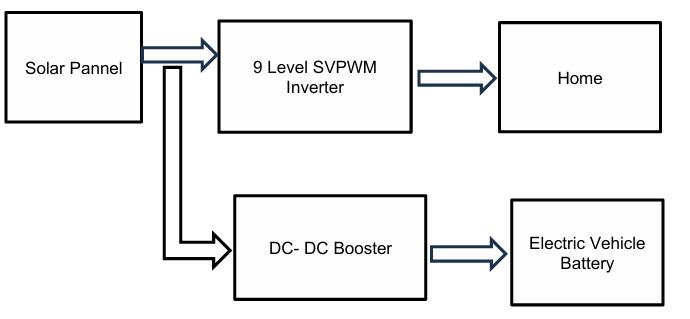
Fig 1.2: Block Diagram
9-level flying capacitor multilevel inverter using svpwm for solar powered EV charging Applications.
Thediagramoftheproposedsystemclearlyshowstheflow ofenergyfromthesolarsourcetotheendapplicationswhile highlightingtheroleofeachsubsystem.SolarPVArrayisthe primaryrenewablesource,consistingof40series-connected modulesof300Weach,deliveringnearly12kW.Itprovides a variable DC voltage (350–500 V) depending on solar irradiationandtemperature.SincethePVoutputfluctuates, aDC–DCBoostConverterisconnectednexttostepupand stabilizethevoltagetoaround400VDC,suitableforinverter operation.TheboostconverteralsoimplementsMaximum PowerPointTracking(MPPT)bydynamicallyadjustingits dutyratiosothatthePVarrayalwaysoperatesatitspeak powerpoint.Theregulatedhigh-voltageDCfromtheboost converter forms the input to the 9-Level SVPWM Flying CapacitorMultilevelInverter(FCMLI).Theinverteremploys 28 flying capacitors, 8 DC bus capacitors, and 16 IGBTs, configuredtogeneratemultiplediscretevoltagelevels.Each capacitor charges and discharges in a controlled manner, producingasteppedoutputthatapproximatesasinusoidal
waveform. The inverter is controlled using Space Vector Pulse Width Modulation (SVPWM), which optimizes the switchingstates,enhancesDCbusutilization,andreduces total harmonicdistortion (THD).Byapplying SVPWM, the invertersynthesizesninedistinctvoltagelevelsrangingfrom –370Vto+370V,whichcorrespondtoacleanACoutputof about 240 V RMS. The AC output from the inverter is supplied directly to residential loads, enabling the use of solarenergyforhouseholdappliances.Simultaneously,part of the generated energy is routed to an EV charging unit, designedtochargea60V,50Ahbatterypack(3kWh).The EVchargerusesabuck-typeDC–DCconvertertostepdown the400VDClinkvoltagetoasafe60Vchargingvoltage.The charging process follows a CC–CV (Constant Current–ConstantVoltage)profile,ensuringsafeandefficientbattery charging.Acentralcontrollersupervisestheentiresystem, continuouslymonitoringPVvoltage/current,DClinkvoltage, andinverteroutput.ThecontrollergeneratesPWMpulses fortheboostconverterandSVPWMswitchingsignalsforthe inverter.Italsoensurescapacitorvoltagebalancinginthe FCMLI, which is essential for stable multilevel operation. Protection functions are integrated into the controller to handle over voltage, over-current, and temperature variations.ThecombinationofPV,boostconverter,inverter, and control unit ensures a high-quality AC output with minimal harmonics. The block diagram also represents bidirectional power flow capability for EV charging/discharging in future upgrades. The modular structureoftheblocksmakesthesystemscalable,allowing forhigherpowerlevelsoradditionalloads.Overall,theblock diagram demonstrates a complete renewable-powered systemthatprovidesreliableACpowerforhouseholduse andcleanDCpowerforEVcharging,optimizedbyadvanced controltechniques.
2. MODELLING OF 9-LEVEL FLYING CAPACITOR MULTILEVEL INVERTER USING SVPWM FORHOUSEHOLD APPLICATIONS.
TheintegratedsystemwassimulatedinMATLAB/Simulink tovalidatethedesignandperformanceofeachsubsystem: Solar PV, DC–DC Boost Converter, 9-Level SVPWM Flying CapacitorInverter,andtheload/EVbatterychargingunit.
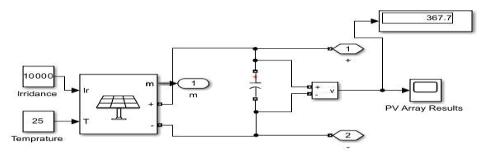
The simulation shows a PV module model (Sim scape Electrical/SimPowerSystemshasaPVArrayblock).Ifyou don’thavethattoolbox,implementthesingle-diodemodel using sources, diode, Rs, Rsh or use user-contributed PV modelfromMathWorksFileExchange. Configuremodule electricalspecsperparameters.m:Isc≈9.5A,Voc≈37.67 V,Imp≈10A,Vmp≈32V. Connect20modulesinseries inside the PV block (string of series PV modules) so that
International Research Journal of Engineering and Technology (IRJET) e-ISSN: 2395-0056
Volume: 12 Issue: 10 | Oct 2025 www.irjet.net p-ISSN: 2395-0072
Vmp_total ~ 640 V. Add measurement points: PV voltage (V_pv), PV current (I_pv), PV power (P_pv = V_pv * I_pv).
➢Optional: addirradianceandtemperatureinputssoyou cansweepirradiation(1000→600W/m²)ortemp(25→ 45°C)duringtests.
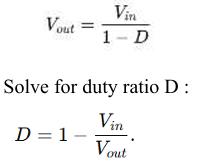
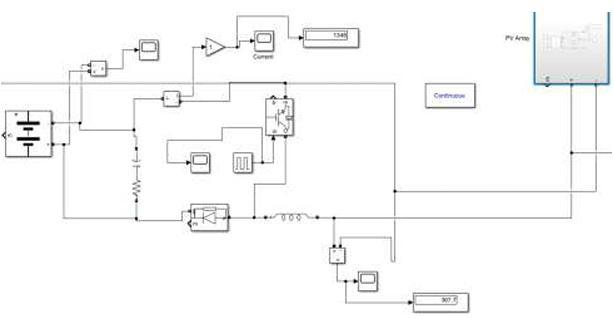
TheboostconverterraisesthePVarrayDC(~400V)tothe DC-link(740V)usedbytheinverterandcharginginterface. Thefollowingdesignequationsandworkedexamplesshow howtoselectdutyratio,inductorandcapacitor.Basicboost relation and duty ratio Assumingidealboostconverter, continuousconductionmode(CCM),steadystate:
2.2 Design and simulation of 9-level SVPWM of flying capacitor:
Fora9-levelFCMLIyoucanimplementmultilevelSVPWM (space vector extension) or use synthesized SVPWM per phasethatmapstomultilevelstates.Thehigh-levelsteps:
➢ Convertthree-phasereferencetoα–β(Clarketransform) ifdoingthree-phase;forsinglephaseyoucansynthesizea two-levelreferenceaswell.
➢ Determine the sector in the extended space vector diagram(multilevelmapstomanymorevectors).
➢ Compute the time durations for adjacent switching vectors to synthesize the reference vector (vector decomposition).
➢ Translatevectortimedurationsintogatingtimingsfor the16IGBTs(thereareredundantswitchingstatestohelp balanceflyingcaps).
If this is complex, you may implement a multi-carrier or phase-shiftedcarrierapproachadaptedtoflying-capacitor levels,butyoustatedyouusedSVPWM implementthe extended SVPWM algorithm for multilevel (there are MATLABexamplesandliterature).
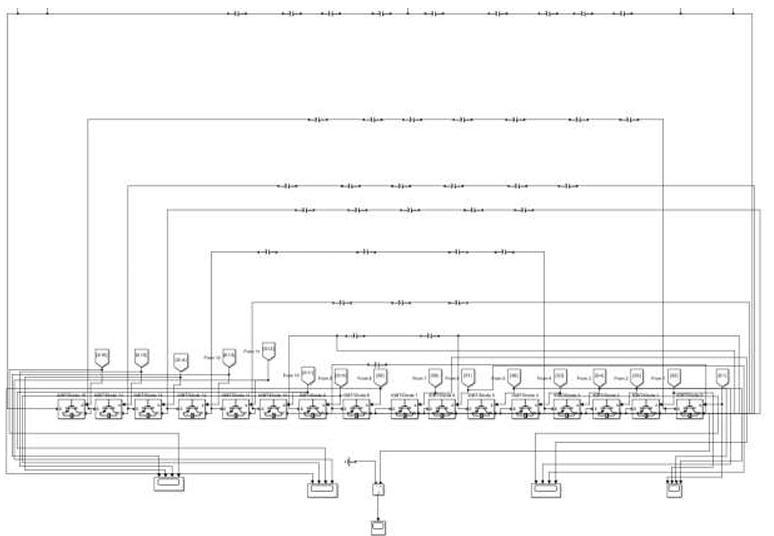
2.3 Simulation setup-step-by-step (exact,reproducible): key design numbers used throughout
Createa newSimulinkmodel folderanda MATLABscript parameters. that defines all global numeric constants (PV panelspecs,Vdc,fs,L,C,D,E,numberofcaps,loadpower, batteryvoltage,etc.).Thismakestuningandre-runningeasy.
InSimulink:File→ModelProperties→Callbackyoucancall parameters.atmodelstart.
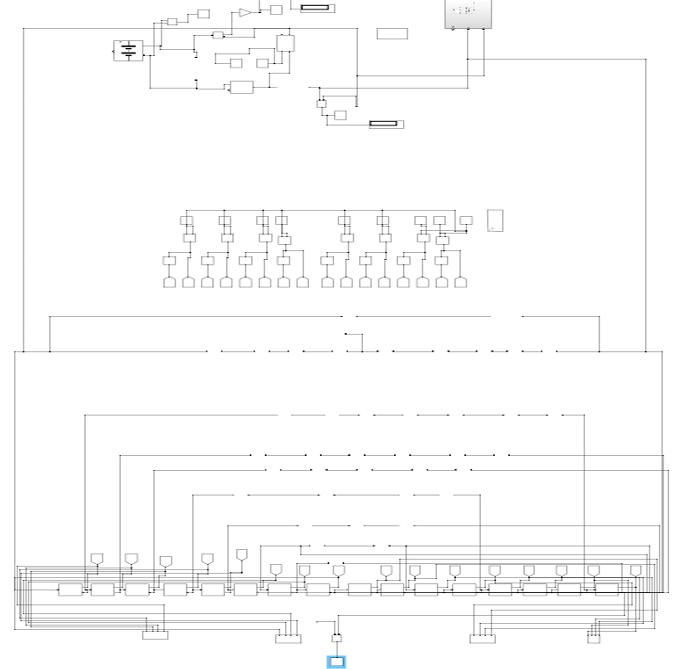
2.3: Simulation Model of 9-level flying capacitor multilevel inverter using SVPWM for Household applications.
Thefollowingsectionsdescribetheresultsindetail.
➢ PVarray:40×300Wmodules→12kW.TypicalVmpper module≈32V,soVmp_total≈640–660V,Imp≈10A.
➢ Boosttarget(DClink):Vdc=400V. ➢ Boostdutyratio (ideal):D≈0.3243.
➢ Boostoutputcurrent(approx):Iout≈9–9.5A.
International Research Journal of Engineering and Technology (IRJET) e-ISSN: 2395-0056
Volume: 12 Issue: 10 | Oct 2025 www.irjet.net p-ISSN: 2395-0072
➢ Switchingfrequency(suggested):fs=10kHz(youmay increasetoreduceL/Csize;watchswitchinglosses).
➢ 9-levelFCMLI:n=9→Nbc=28flyingcaps,Nc=8DCbus caps,Nsd=16IGBTs.
➢ StepvoltageE=Vdc/8=92.5V→levels±4E(±370V). ➢ Load:2kWresistiveat240VAC(I≈8.33ARMS).
➢ EVbattery:60V,50Ah(3kWh);chargingpower~2kW →I≈33.3A.
2.4: MPPT & converter interaction: The DC–DC boost converter should operate in a way that the PV array is maintained at its MPP. Implement MPPT (e.g. Perturb & Observe or Incremental Conductance) to adjust the converter duty cycle so that PV works at Vmp,total . The convertermayalsoneedtohandlepartialshadingorvarying irradiation,andmustberatedtoacceptthePVopencircuit voltage(Voc_total≈20×Voc_p≈20×37.67≈753.4V) hence all PV side components should withstand Voc_total plusmargin.
2.5 EV Battery Capacity, Charging Profile & Converter Interfacing
Batterycapacityandstoredenergy
Givenbatteryspecification:
•NominalvoltageVbatt=60V.
•CapacityCbatt=50Ah
Stored energy: Ebatt=Vbatt×Cbatt=60 V×50 Ah=3000 Wh=3.0kWh.
Thismatchesthepaper’sreported3000Wp(3kWh).(Note: WpisusuallyusedforPV;forbatteryweuseWhorkWh.)
Charging power & current
If CCS2 charger and the simulation use 2 kW charging power:
•Chargingcurrentatbattery:
Icharge=PchargeVbatt=2000W60V=33.3333A. Thusa2kWchargerwillsupplyabout33.33Aat60V. Time to charge from 0% to 100% in ideal conditions: tcharge=EbattPcharge=30002000=1.5hours=90minutes. Inpractice,duetoinefficienciesandCC–CVswitching,real chargetimewillbelonger(accountfore.g.85–95%charge efficiency).
Charging profile (CC–CV)
Lithium-ionchargingcommonlyusesaCC–CVprofile:
➢ Constant Current (CC) phase: batteryischargedat a constantcurrent(e.g.,33.33A)untilbatteryvoltagereaches thetargetmaximum(e.g.,Vmaxperpack).
➢ Constant Voltage (CV) phase: chargerholdsvoltageat Vmaxandchargingcurrenttapersdownuntilasmallend currentthreshold.
Fora60Vpackthechargermustregulatetopack-specific maxvoltage(dependsoncellchemistryandseriescount).If thepackis60Vnominal,atypicalmaximumpackvoltage duringCVmightbee.g.63–67V(dependsoncellcountand cellmaxvoltage).Thechargermustbeprogrammedwith batterymanufacturerrecommendedvalues.
Typical approach for output filter L and C:
1. Choose cutoff frequency fc safely below switching frequency but well above fundamental (e.g., fc≈fs/10 or designfore.g.1–2kHzwithfs=10).
2. Ensure filter damping to avoid resonance with grid/load.
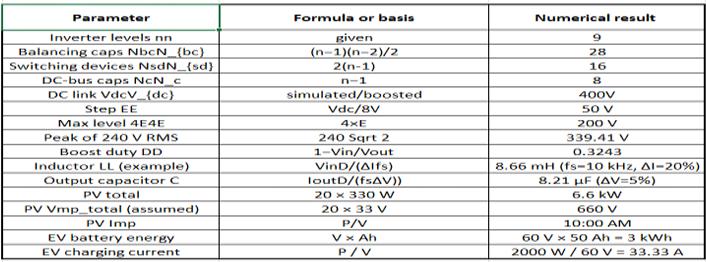
Table 2.5: Overall Parameter values.
9-levelSVPWMflyingcapacitormultilevelinverterwhichis connectedwiththePVarrayandtheelectricvehiclebattery andthehome.ThetotalnumberofKwis12kwsystemis simulated.Theelectricvehiclebatteryisalsochargedfrom thesolarpanelandsolarsystemisalsoprovidespowerto the household as simulated in the Matlab. Pv array is workingin10000irradiationand25°Ctemperature.
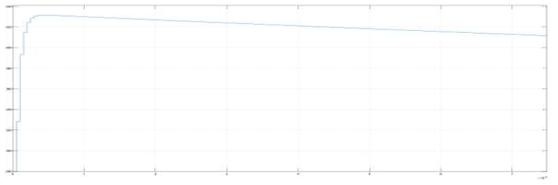
The output of the PV array is 400v. that voltage will be suppliedtothe9-levelSVPWMflyingcapacitormultilevel inverter.
Dcvoltagewillbeconverterintotheacfromtheinverter. Thesolarpanelfeedsthepowertothehomeandalsotothe EV charger to charge the battery. Dc/dc converter is connectedbetweentheEVvehicleandthesolarpanel.
SolarpanelvoltageisboostedfortheEVvehicletocharge thebattery.Theoutputofthesolarsystemis400V.andfrom thedc/dcboostconvertergettheoutputvoltageis400V. and the current is 9.36 amps and the battery will charge fromthesolarpanel.Thefinaloutputofthe9-levelSVPWM flyingcapacitormultilevelinverterofthePVarrayishalfof theinputvoltage.Theinputofthe9-levelSVPWMinverter from the PV array is 400v and the output voltage is 240 Voltage, This is the off-grid system. solar panel installed capacity is 12kw. total consumption of our home is 2kw. totalandEVbatteryconsumptionis3kwIcaneasilyusethe powerofthesolartooperatethehomeandbatterywiththe 9-levelflyingcapacitormulti-levelinverter.
International Research Journal of Engineering and Technology (IRJET) e-ISSN: 2395-0056
Volume: 12 Issue: 10 | Oct 2025 www.irjet.net p-ISSN: 2395-0072
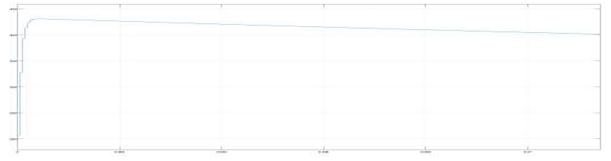
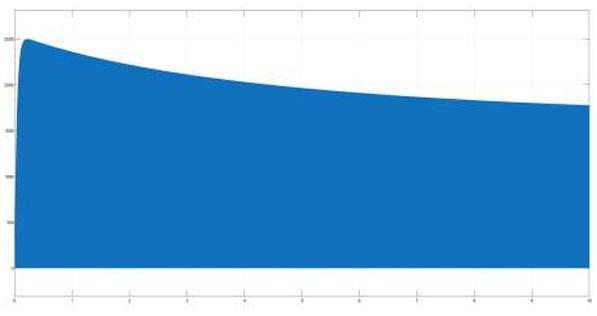
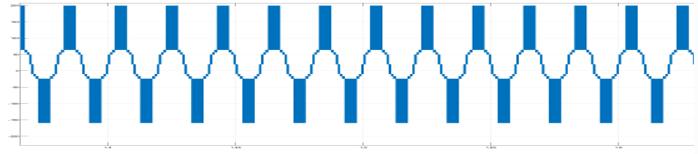
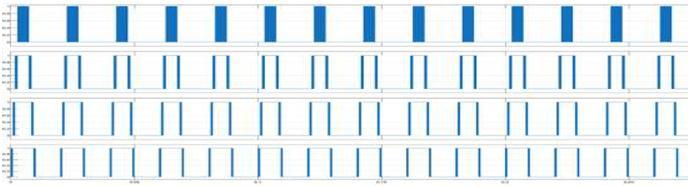
Fig 3.5: Switching pulse of S0,S1,S2,S3 from the inverter

Fig 3.6: Switching pulse of S4,S5,S6,S7 from the inverter
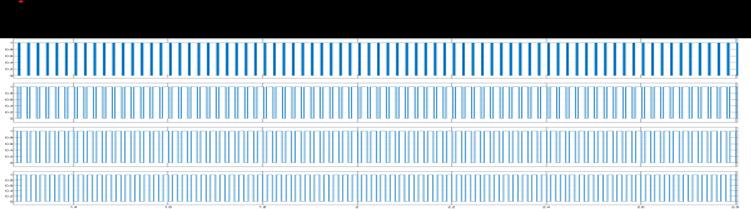
Fig3.7:Switching pulse of S8,S9,S10,S11 from the inverter

Fig 3.8: Switching pulse of S12,S13,S14,S15 from the inverter
ThestudysuccessfullydevelopedasolarPV-integratedninelevel flying capacitor multilevel inverter controlled by SVPWM, offering high efficiency, low harmonic distortion, andstableoperation.Thesystemeffectivelysupportsdual applications EVchargingandresidentialpowersupply while maintaining excellent power quality and DC-link regulation. With its modular design and superior performance,theproposedsystemprovesfeasibleforrealworldrenewableenergyintegration.Futureenhancements like grid connectivity, advanced MPPT, and wide bandgap devicescanfurtheroptimizeitsefficiencyandadaptability forsustainablepowersolutions.
[1] Mohd Rizwan, Suvarna labade “A Review Paper on Electricity Generation from Solar Energy” International Journal for Research in Applied Science & Engineering TechnologyVolume5IssueIX,September(2017).
[2] C.R. Balamurugan “A Review of various multilevel inverter topologies” global journals of advanced research vol-2,pp,142-153(2015).
[3]Nitinpawar,Vijaykumartayal“DesignofFlyingCapacitor MultilevelInverterforSolarEnergyApplications”E3SWeb ofConferencesICMED(2020).
[4]Aanayasinh,ShubhamSanjay“DesignandAnalysisofa Solar-Powered Electric Vehicle Charging Station” MDPI (2021).
[5] Stephen Watkins, l. zhang “Modelling and control of a flying-capacitor inverter” Conference European Power ElectronicsConf.January(2001).
[6]Sayli Khadse “5-Level Single Phase Flying Capacitor Multilevel Inverter” International Research Journal of EngineeringandTechnology(IRJET)Volume:04Issue:02| (2017).
[7] Kamran zeb “A Comprehensive Review of DC-DC ConverterTopologiesandModulationStrategieswithRecent Advances in Solar Photovoltaic Systems” Research gate (2019).