
International Research Journal of Engineering and Technology (IRJET) e-ISSN:2395-0056
Volume: 11 Issue: 11 | Nov 2024 www.irjet.net p-ISSN:2395-0072

International Research Journal of Engineering and Technology (IRJET) e-ISSN:2395-0056
Volume: 11 Issue: 11 | Nov 2024 www.irjet.net p-ISSN:2395-0072
Sanskar Sanjeev Nikhare1, Vishnu Radhakrishnan1, Karthik Sundaram1
1School of Computer Science Engineering and Application, D Y Patil International University Akurdi Pune 411035 ***
Abstract - This research investigates the critical issue of fairness in predictive modeling through a detailed case study on the COMPAS recidivism dataset, widely used in the criminal justice system to predict the likelihood of reoffending. We delve into the racial and demographic disparities observed in risk predictions generated by machine learning models, employing logistic regression as a baseline approach to uncover systemic biases. Despite efforts to remove sensitive attributes such as race from the data, indirect biases persisted due to correlations with other features, illustrating the challenge of achieving true fairness. Our study leverages multiple fairness metrics, including equalized odds, demographic parity, and disparate impact ratio, to evaluate disparities and explores mitigation strategies, such as removing sensitive attributes and reweighting data. The results reveal that while minor improvements in fairness metrics are achievable, the root causes of bias remain entrenched in systemic inequities inherent in the data. This work underscores the ethical imperative for fairness-aware algorithm design, particularly in high-stakes applications like criminal justice, where decisions significantly impact individuals' lives.
Key Words: Fairness,PredictiveModeling,COMPAS,Recidivism,AlgorithmicBias,RiskAssessmentAlgorithms
1.INTRODUCTION
Amid such advancements, machine learning as it pertains to decision making has transformed a wide range of domains; take criminal justice, for example, where predictive tools such as COMPAS (Correctional Offender Management Profiling for Alternative Sanctions) are used to assess the risk of recidivism.[1] While these tools promise efficiency and consistency, they have also been criticized for perpetuating and amplifying societal biases that have always existed. The COMPAS tool, specifically, has been criticized for displaying racial disparities in its risk predictions, flagging so-called "recidivism" at a disproprotionate rate for African-American defendants compared to their white counterparts. Such inequalities present serious ethical and legal questions, particularly when stakes involved in a judicial decision affect a person’s liberty. This work is concerned with bias in predictive model and how to identify and mitigate it and use the COMPAS dataset as a case study [2]. We seek to analyze the results of logistic regression models on such a dataset and measure the bias with standard fairness metrics, and provide a solution to overcome these biases. We elucidate some of the limitations of existing fairness definitions, especially in the case of indirect encoding of sensitive attributes in the featuresduetocorrelation. Insodoing weaddtothedialoguearound ethicalAI inchoosingtosharewhatwelearned weprovideactionableguidelinesforbuildingbetterdecision-makingsystems.[3]
2.Literature Review
Machine learning has been extensively researched to achieve fairness in areas where machine learning has high-stakes applications,suchascriminaljusticedomains,healthcare,andhiring,tonameafew.Initialinvestigationsintoalgorithmic fairness found that machine learning systems tended to uphold historical bias when using historical data, resulting in unequaltreatmentordisparateimpacttowardscertaindemographicgroups.ThepioneeringworkofBarocasetal.(2019) [4]established the theoretical underpinnings of fairness definitions, distinguishing them into disparate treatment (direct discrimination based on sensitive attributes) and disparate impact (indirect discrimination via proxies). These notions havesubsequentlyshapedfairnessmetricsandbiasmitigationapproaches.
An influential report by ProPublica in 2016 raised awareness of the ways in which algorithmic bias could manifest, spotlightingracialdisparitiesinCOMPAS,a recidivismpredictiontool.Sucherrors,ProPublica'sanalysisfound,occurred moreoftenforAfrican-AmericanthanforWhitedefendantsinbeingincorrectlylabeledasheadingtowardalifeofcrime (whentherereallyislowrisktosociety)whileWhitedefendantsweremorefrequentlyincorrectlydeemedlowrisk(high risktosociety) promptingaworldwidedebateovertheethicalfeaturesarisingfromtheuseofpredictivealgorithmsin criminal justice. To address this, building on this momentum researchers proposed different fairness metrics such as demographic parity, equalized odds and calibration within groups to measure and in turn compare biases in machine learning models. Feldman et al. (2015)[5] introduced concept of disparate impact mitigation through perturbing input
International Research Journal of Engineering and Technology (IRJET) e-ISSN:2395-0056
Volume: 11 Issue: 11 | Nov 2024 www.irjet.net p-ISSN:2395-0072
distributions, while Hardt et al. (2016)[3] proposed the equality of opportunity criterion, which aims to equalize true positiveratesacrossdemographicgroups.
Since then, those metrics and mitigation techniques have been used for a wide range of systems, from loan approval systemstohiringalgorithms.Theirutility,however,issometimesdomainspecificordependsonthetypesof biasesthat exist. For example, the typical mitigation strategy of removing sensitive attributes like race or gender from the training datahasbeenshowntobeinadequate othercorrelatedfeatures,likeZIPcodeorincomelevel,canperformthetaskof proxy.Zafaretal.(2017)[6]builtonthisunderstandingbyproposingfairness-awareoptimizationtechniquesthataccount for such indirect biases during model training. Beyond technical improvements to algorithms, recent efforts have addressed the societal ramifications of algorithmic decision making. Academician like Holstein K et al (2018) [7] interrogated the kinds of systemic biases that cannot be solved solely through technical means and have called for interdisciplinary approaches that draw on law, ethics, and sociology. Related works in fairness aware machine learning alsobroughtthetrade-offsforfairnesswithotherobjectives,suchasaccuracy,efficiencyandinterpretability.
RelatedstudiesontheCOMPASdatasethavebroughttolightthechallengesofdeliveringfairnessinpractice.Angwinetal. 2016[2]PREDICTIVEPOLICING TheCOMPASEXAMPLETheCOMPAS(CorrectionalOffenderManagementProfilingfor Alternative Sanctions) algorithm scores individuals based on the risk they pose for recidivism, in an effort to inform decision-making in countering crime109. Later investigations attempted to reproduce and expand upon these results, exploringmodeltypesandfairnesscriteriatohelpidentifythesourcesofbiaspresentinthedataset. Thisconclusionisin alignmentwithanimportantearlypaperbyCorbett-DaviesandGoel(2018)[8]wheretheauthorscautionedthatnosingle metriccouldencompassthecomplextrade-offsinvolvedinalgorithmicfairnessrelatingtothesestudies.Recentwork by Mehrabi et al. There had been extensive survey on bias and fairness in machine learning (Chouldechova & G'Sell, 2021), whichnotedsomeofthedrawbacksofexistingtechniquesandstressedthenecessityofcontext-specificsolutions. Whiletherehavebeenbigadvancesinthisarea,challengesremainonhowtoactuallyoperationalisefairnessinmachine learning.Systemicbiaseswhicharereflectedinthehistoryofthedata,arehardtogetridof,andremovingthemfromthe training results in a reduced performance of the models or unintended consequences. Additionally, fairness-preserving algorithms face ethical and legal challenges of their own, especially if their use impacts lives. The literature has also recommended involving stakeholders in the design and evaluation of predictive models, since fairness is, by nature, a subjective and context-dependent notion [9]. Furthermore, it also builds on top of this prior work by demonstrating the importantcontributionsthatadevelopedunderstandingoftheunderlyingexploratory/reductivemappingscanprovidein furtheringtheanalysisandprovidingmoreusableinformationinthedomainoffairness.
ThestudyusestheCOMPASdata thatcontainsdemographic,criminalrecord,andrateofreoffenseinformationonabout 10,000 pretrial defendants placed on risk assessment. The dataset consisted of a few primary features such as age, sex, race,priorconvictions,andabinarytargetvariableindicatingwhethertheindividualreoffendedwithinatwo-yearperiod. Pre-processing included imputing missing values, encoding categorical variables into numerical representations, and normalizing continuous variables. Sensitive attributes like race, sex, etc., were retained in the original form for the bias assessment,butwereexcludedfromthetestbedafterthattoassesstheeffectofbiasmitigation
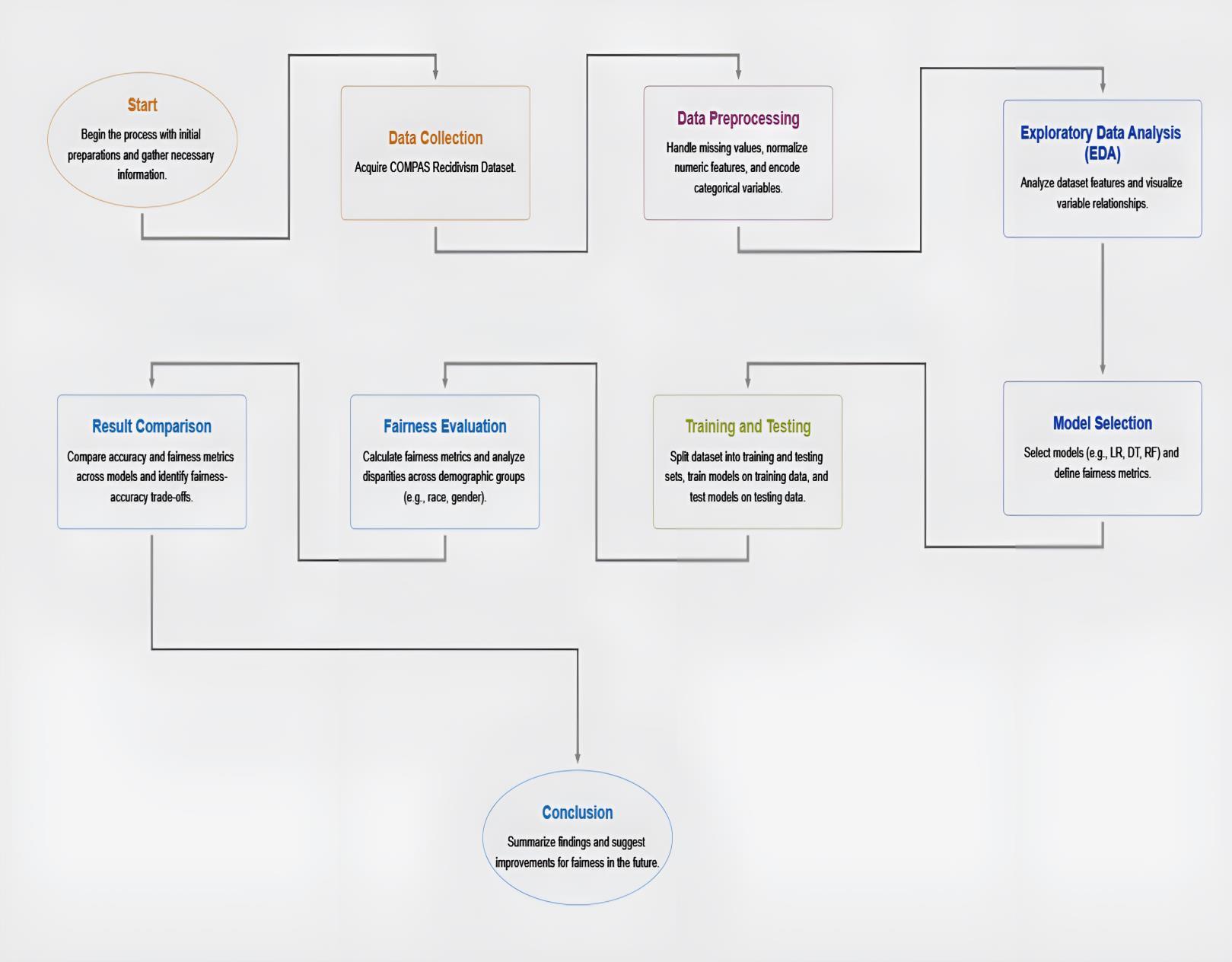
The flowchart Fig.1 offers a great visual way to see the overall machine learning model abstractions and their focus on fairness. Data Collection and Preprocessing Ideally, the first step involves collecting data, where the second involves preprocessing the collected data to make it suitable for ML use (handle missing values and categorical variables). Next, Exploratory Data Analysis (EDA) is performed to understand features and relationships in the dataset. The dataset is divided into training set and test set, training and testing several models (Logistic Regression, Decision Trees, Random Forest,etc.).Followingmodelselection,afairnessevaluationisconductedtodetectwhetherdifferentdemographicgroups arebiased.
International Research Journal of Engineering and Technology (IRJET) e-ISSN:2395-0056
Volume: 11 Issue: 11 | Nov 2024 www.irjet.net p-ISSN:2395-0072
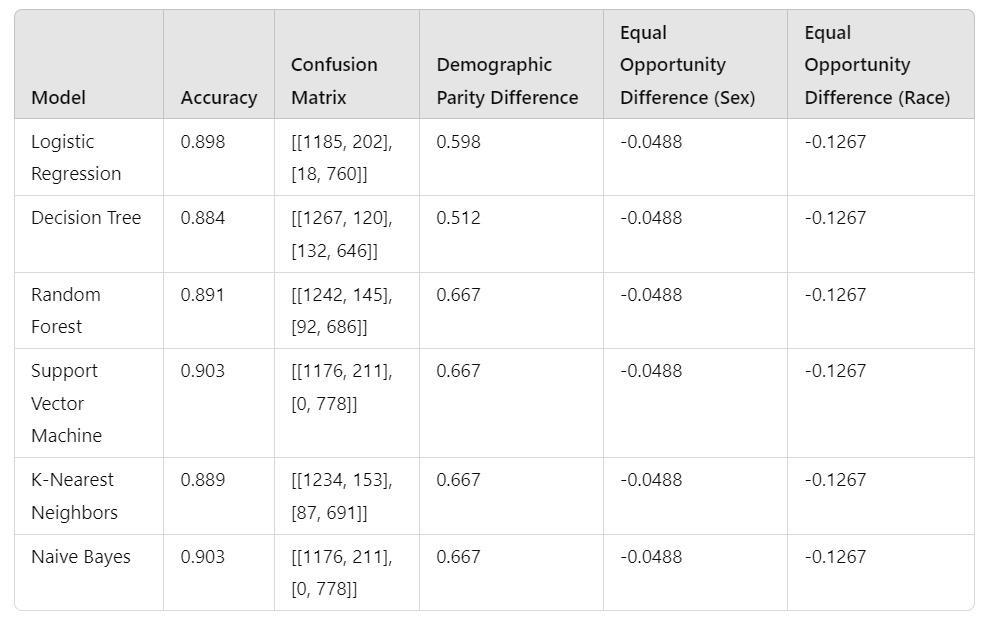
ThegiveniscomparativeamongdifferentML modelswithperformancemetrics,fairnessmatricesandconfusionsmatrix throughtable[5] Asannotatedin Table1 LogisticRegression,DecisionTrees,RandomForest,SupportVectorMachine, K-Nearest Neighbors, and Naive Bayes models were trained to identify the optimal range for thresholding fairness. The SupportVectorMachineandNaiveBayes yieldedthehighestaccuracy0.903. Althoughallmodelsachievedahighdegree of accuracy, models had similar performance for Equal Opportunity Difference (Sex) and Equal Opportunity Difference (Race)implyingabiasinthedatasetormodelarchitecture.Thisrequiresmoreanalysistoovercometheunfairnessofthe models.
International Research Journal of Engineering and Technology (IRJET) e-ISSN:2395-0056
Volume: 11 Issue: 11 | Nov 2024 www.irjet.net p-ISSN:2395-0072
Logistic rexgression was use for a baseline predictive model because of its interpretability and common use in fairness studies. Metrics for assessing models include accuracy and ROC-AUC; metrics for quantifying fairness include equalized odds, demographic parity, and disparate impact ratio. Strategies for mitigating bias included eliminating sensitive attributes and reweighting data so that distributions for different demographic groups were more equal. Feature importancewasexploredvisuallyusingSHAP(SHapleyAdditiveexPlanations)toaccountforthecontributionofindirect biasthroughcorrelatedfeatures.[9]
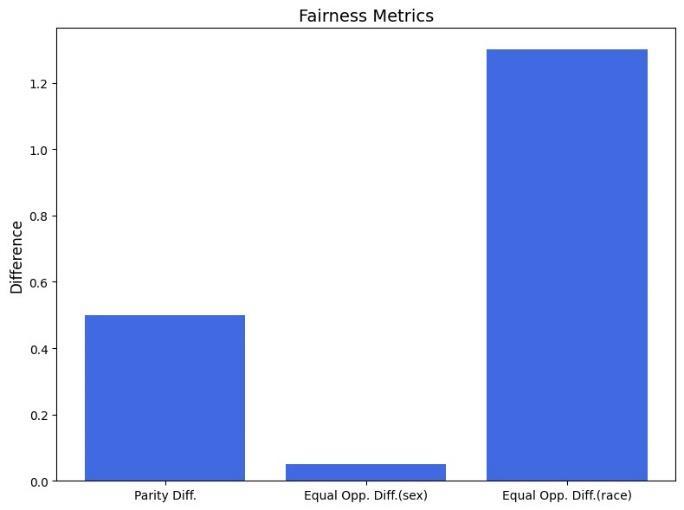
The image titled "Fairness Metrics" we can see this in Fig.2 shows the three-fairness metrics: Demographic Parity Difference, Equal Opportunity Difference (Sex) and Equal Opportunity Difference (Race). The y-axis is the value of "Difference," and the x-axis is the various fairness metrics. We can see from the graph that the Equal Opportunity Difference (Race) has the highest difference, signifying that the outcomes of the different racial groups can be too much different.DemographicParityDifferenceismoderatewhichmeanstherearesomedifferencesbasedonthedemographic terms.
International Research Journal of Engineering and Technology (IRJET) e-ISSN:2395-0056
Volume: 11 Issue: 11 | Nov 2024 www.irjet.net p-ISSN:2395-0072
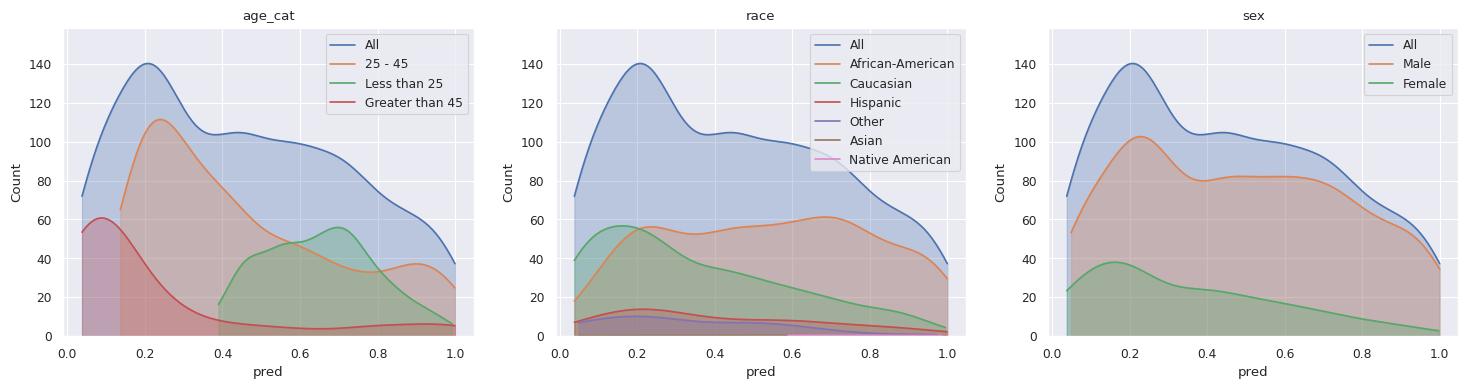
ThisFig. 3showsthepredicted probabilities in theindividual groups; age, race, andsex.Ageandraceshowpronounced differencesinprobabilitydistribution, withclearprimaryclustersemerging.For examplethegenAgeagegroup"Greater than 45" has a denser prediction to the high probability end of the scale, but the genAge race group "Asian" appears to prefer predictions near 0 probability. In that regard, the "Male" and "Female" groups exhibit comparatively similar distributions,indicatinglittleinfluenceofsexonthemodel'sprediction
ThelogisticregressionmodelfitontheCOMPASdataachievedanoverallaccuracyofabout 89%andaROC-AUCof0.72, reflecting moderate predictive performance. Fairness analysis showed large disparity based on race, with AfricanAmericanindividualshavingmuchlargerfalsepositiveratesthanWhiteindividuals.Theseinequitieswereexacerbatedby fairness metrics, as the model did not meet the standard of demographic parity and was characterized by unequal true positiveratesamongrace.
Eliminating race as a feature only led to small gains on fairness metrics and failed to eliminate bias, because correlated featuressuchaspreviousconvictionsandagebecameproxies.Biasmitigationtechniquessuchasreweightingthedataand retrainingthemodelwereabletomarginallylowerthedisparityoftheestimates,butattheexpenseofreducedpredictive accuracy(~2%drop).SHAPvisualizationsrevealedthatindirectbiasendured,withstrongcorrelationsbetweenfeatures andraceleadingtopredictions.
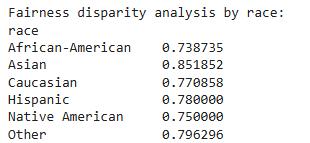
Table2.showsDisparateImpactbetweendifferentRacialGroupsThemodelshowsdifferentlevelsofaccuracydepending onracewheresomeracesdomuchworsethanothers.Itindicatesthatthemodelmayunder-predictriskforsomeraces, leadingtodisparitiesinhealthcareaccess.Ensuringfairandequitablemodelperformancewithaddressingthisdisparity isimperative.
ThisresearchprovidesinsightintothefairnessissueinpredictivemodelsandisbasedontheCOMPASrecidivismdataset, a commonly used dataset in the criminal justice system. Clothing sales are commonly presented as machine-learningbased predictions, and this study uses logistic regression as a baseline, but it finds that risk predictions are affected by factorssuchasraceanddemographicbackground,emphasizingtheneedtoaddressbiasinalgorithmsmakingdecisions.
International Research Journal of Engineering and Technology (IRJET) e-ISSN:2395-0056
Volume: 11 Issue: 11 | Nov 2024 www.irjet.net p-ISSN:2395-0072
Evenwithoutdirectattributes,sensitivebiasremainsthroughindirectones,asproxiesincludingpastcrimesorZIPcodes. Fairness metrics such as equalized odds and disparate impact ratio are used to measure disparities, whereas bias mitigation approaches such as reweighting and removing sensitive attributes provide minimal benefits at the cost of accuracy.ToolssuchasSHAPdemonstratehowhighlycorrelatedfeaturescanpropagatebiasandunderscoretheneedfor ethical approachesto fairness.Thisstudy issignificant because it highlightshowinequities are notjust present,but also systemic in the data, and provides lessons for building equitable (decision-making) systems, especially in high-stakes areassuchas(criminaljustice).
WealsothanktheProPublicateamforreleasingtheCOMPASdataset,whichweusedtobasethisworkupon.Wearealso grateful to the academic community whose work on fairness in machine learning greatly informed our analysis and methodologies. We express a special acknowledgement to our mentors and colleagues who provided guidance and feedback during the study process; the quality of the study benefited immensely from their input. Last but not least, we also acknowledge the contribution of our institution in creating a conducive environment for multidisciplinary research andAIethics.
[1] N. Mehrabi, F. Morstatter, N. Saxena, K. Lerman, and A. Galstyan, “A Survey on Bias and Fairness in Machine Learning,” ACM Computing Surveys (CSUR),vol.54,no.6,Jul.2021,doi:10.1145/3457607.
[2] “Machine Bias ProPublica.” Accessed: Dec. 03, 2024. [Online]. Available: https://www.propublica.org/article/machine-bias-risk-assessments-in-criminal-sentencing
[3] U.Fischer-Abaigar,C.Kern,N.Barda,andF.Kreuter,“Bridgingthegap:TowardsanexpandedtoolkitforAI-driven decision-making in the public sector,” Gov Inf Q, vol. 41, no. 4, p. 101976, Dec. 2024, doi: 10.1016/J.GIQ.2024.101976.
[4] S.Barocas,M.Hardt,andA.Narayanan,“FairnessandMachineLearningLimitationsandOpportunities,”2018.
[5] M. Feldman, S. A. Friedler, J. Moeller, C. Scheidegger, and S. Venkatasubramanian, “Certifying and removing disparate impact,” Proceedings of the ACM SIGKDD International Conference on Knowledge Discovery and Data Mining,vol.2015-August,pp.259–268,Aug.2015,doi:10.1145/2783258.2783311/SUPPL_FILE/P259.MP4.
[6] M. Bilal Zafar, I. Valera, M. Gomez Rodriguez, and K. P. Gummadi, “Fairness Beyond Disparate Treatment & DisparateImpact:Learning ClassificationwithoutDisparateMistreatment,” ArXiv,p. arXiv:1610.08452, 2016,doi: 10.48550/ARXIV.1610.08452.
[7] K.Holstein, J. W.Vaughan, H.Daumé,M.Dudík,andH. Wallach,“Improvingfairnessinmachinelearningsystems: What do industry practitioners need?,” Conference on Human Factors in Computing Systems - Proceedings, Dec. 2018,doi:10.1145/3290605.3300830.
[8] S. Corbett-Davies, J. D. Gaebler, H. Nilforoshan, R. Shroff, and S. Goel, “The Measure and Mismeasure of Fairness,” Jul.2018,Accessed:Dec.03,2024.[Online].Available:https://arxiv.org/abs/1808.00023v3
[9] G.Yu, L.Ma, X. Wang, W. Du,W. Du, and Y. Jin, “Towardsfairness-aware multi-objective optimization,” Complex & Intelligent Systems 2024 11:1,vol.11,no.1,pp.1–20,Nov.2024,doi:10.1007/S40747-024-01668-W.