A Novel approach for Weed Identification and Classification in Vegetable Plantation
A Venkata Srinivasa Rao1 , M Harshini2 , V Puneeth3 , G Padmasri4 , K G NagaPriya51 Department of ECE, Sasi Institute of Technology & Engineering, Tadepalligudem, W.G.Dist, India. adabalala@gmail.com
2,3,4,5UG Student, Department of ECE, Sasi Institute of Technology & Engineering, Tadepalligudem, W.G.Dist, India ***
Abstract - Oneofthekeyaspectsofagriculturethataffects crop productivity is weed . Since traditional weed management methods entail burning, pesticides, manual removal, crop loss, and reduced soil fertility, they also involvetheuseoftrowels.Thisstudysuggestsatechniqueto lessen the impact of weeds on agriculture by fusing deep learningwithimageprocessing.Inordertorecogniseweeds in agricultural settings, centerNet models and RegionalbasedConvolutionalNeuralNetworks(RCNN)areused.In contrasttothetwo-stageRCNNtechnique,whichisutilised forbothdetectionandclassification,theCenterNetmodelis aone-stageobjectdetector.
Key Words: Binarization, Complementary of the image, Image documentation, Threshold, local method
1. INTRODUCTION
InIndia,wherebasicagriculturalactivitiesarethemajority ofpeoples'occupation.Morethanhalfofthepopulationof India is involved in Agriculture and related activities. Weedscontributetoourcountry'sdecliningeconomyand createsevereyieldlossesinthefoodproducingindustry.A plantthatgrowswhereitisnotwantediscalledaweed.A weed is a plant that grows where it is undesirable and another plant ought to grow because it is unattractive, useless, and harmful. A plant that has more potential for damagethanforgoodisalsoconsideredaweed.Allweeds are undesirable plants, yet not all undesirable plants are necessarilyweeds.Duetotheunevenspacingoftheplants, weedidentificationinvegetableplantationsismoredifficult thanweedidentificationincrops.Toboostcropproductivity and decrease weed-related economic loss every farmer shouldpractiseweeding.Oneofthemostcrucialpractisesin manycropsisweeding.Weedscompetewithmaincropsfor resourceslikewater,sunlight,soilnutrients,andspace,so weedingisimportant.Vegetableyieldisdecreasedbyweeds, buttheirqualityisalsodecreased.Soweedshasanimpact on the growth of vegetables. In addition to lowering vegetableyield,weedscanlowertheirquality,whichhasan impactontheirgrowth.Therearemanytraditionalmethods of weed control like Herbicides, Transplants , mulching , handremoval,flamingetcbutthosetechniqueshavemany disadvantages.Someofthemarelistedbelow:
DisadvantagesofTraditionalmethodsofWeeding:
(i)Herbicides
Herbicides promote to pollution of the air, water, and soil. It may poison the soil, and subsequent pollution of the waterways will result from the chemicals being spread by precipitation to other locations.
The majority of herbicides are toxic.Because they have a larger quantity of acetic acid, which can seriously harm the eyes and skin, even organic herbicideshavehazards.
Herbicides have a negative impact on people's health, including farmers, gardeners, and even consumersoffoodcultivatedwiththem.
(ii)Handremoval
Heavyworkandstressonthelabourforce
Difficultifthesoilsurfaceisnotmoistandloose
Expensive(ifwagesarehigh)
Difficult to recognise and eradicate some grassy weeds in their early stages (e.g. weedy rice, Echinochloaspp.).Suchweedsmustbeeliminated fromthefieldwhentheyareinbloom.Ifpulledand thrownintostandingwater,weedsmightlive.
(iii)Transplanting

Highlabourcosts
Takeshightimeforrecoveryaftertransplanting,
plants develop more slowly than when they are grown directly from seed. Harvesting is also delayed.
(iv)Mulching
Years of heavy mulching may cause soil to accumulateoverthecrownareaofplants.
Onedisadvantageofextensivemulchingmaybethe priceofsomematerials.
Certainmulchtypesarealsohardtogetby. Whenwoodchipsandsawdustareusedasmulch, nitrogenfaminecanoccasionallyhappen.
(v)Flaming
Tree trunks and leavesthat are dead or brown surroundingtargetweedmightcatchfire.
Your feet could get caught in the crossfire, or if curiouskidsorbelovedpetsapproachtooclose,a medicalissuecouldhappen.
XiaojunJinetal.[1]devisedamethodtoidentifyweedsin vegetablefarmsusingdeeplearningandimageprocessing. Therepresentationofthealgorithmconsistedoftwophases. A CenterNet model was trained to recognise vegetables. Thus,the remaining greenobjects thatwerevisible in the colourimagewereclassifiedasweeds.Todistinguishweeds from the background, a colour index was created and evaluated using genetic algorithms (GAs) in line with Bayesianclassificationerror.
Faisal Ahmed et al.[2] used support vector machine to implementamodelforclassifyingcropsandweedsinchilli cropsusingdigitalimagesandevaluateditsperformancein an automated weed control system. To form the feature vector,theproposedmodelemploysacombinationofsize androtationinvariantshape,colour,andmomentfeatures.
MuhammadHamzaAsadetal.[3]implementedatwo-step manual labelling process in data processing and high resolution RGB images of canola fields at two different growthstagesofcropsusingaquadmountedcamera,aswell as weed detection and mapping in canola fields using Semanticsegmentation.ASemanticsegmentationconsistsof two main blocks,one for encoding and the other for decoding.Encoding is a downsampling block that extracts featuresoutofimageswhereasdecodingblockisusedfor samplefeaturespacetoimagedimensions.
HusrevMennanetal.[4]developedcovercropsinresponse toweedherbicideresistanceandastrongdesirefororganic vegetable cultivation. Even though there are several alternativestousingherbicides,covercropsarethebetter choice for weed control. Cover crops such as cereals, legumes, and brassicaceae are widely used in a variety of croppingsystems.Acovercrop'smechanismofactionhas been assumed to be competition and allelopathy. A cover cropwithahighbiomassproductionrateismorelikelyto haveagoodphysicaleffectonweeds,resultingineffective weedsuppression.Covercrops'early-seasontotalbiomass accumulationreducestheriskofweedemergence.
Kavir Osorio et al. [5] presented three methods for weed estimations . These methods included Mask R-CNN for instancesegmentationofeachindividual,Youonlylookonce
(YOLOV3)forobjectdetection,andSupportvectormachine (SVM) using histograms of Oriented gradients (HOG) as featuredescriptors.SVMsaremathematicalmodelswhose main goal is to identify the best line that separates two distinctclasses.Inordertodeterminetheshapeofaplant withawelldefinedgeometry,HOGwasusedtoextractthe feature in each image object based on the magnitude and orientation of the gradient from a particular set of pixel boxes.
RohitVad[6]utilisedtheANNmodel,theCNNmodel,anda LogisticRegressionmodeloncropandweedphotographsto successfullyidentifyandclassifyweedsinsoyabeancrops. For classification, a logistic regression model with hyperparametertuningandanSGDclassifierareemployed, while ANN, CNN, and tasks involving data processing are used for feature extraction, image recognition, and other tasks.
Srinivasa Rao Madala et al. [7] employed sophisticated featureselectionalgorithmsincludingtheGABORfilterand deeplearningtechniqueslikeCNN.Atrainedalgorithmwas used on the datasets to create the border boxes overlay across thevegetableandweedleaves.Usingsophisticated detectingtechniques,theremainingareathatwasoutsideof theoverlayboundaryboxeswillberecognisedasweed.With this strategy, the algorithm focuses just on detecting vegetables,avoidingcontrollingavarietyofweedtypes.A segmentationtechniquebasedonthecolourindexwasused toeliminateweedsfromthebackdrop.
Pedrao Jarvier Herrera et al.[8]published a method for separatingmonocotanddicotweeds.AColor-indexbased segmentation,morphologicaloperations,well-knownshape descriptors and classifiers, and a number of fundamental imageprocessingoperationssurpasstheSVM,CFI,SFI,and DES combined decision-making approaches. When the weeds are still in the early stages of development, this strategy works well. A greenness measure was created to distinguish between vegetation and non-vegetation, and adjectivesthatsuccessfullycharacteriseregionswerechosen todiscriminatebetweenweedspecies.
Evan Shelhamer et al. [9] suggested fully convolutional networksasavariedfamilyofmodelsthatperformavariety of pixelwise tasks. FCNs for semantic segmentation significantlyimproveaccuracythroughthetransferofpretrained classifier weights, the combining of various layer representations,andend-to-endlearningonentireimages. End-to-end, pixel-to-pixel action simultaneously makes learningandinferenceeasierandfaster.
According to Azam Karami et al. [10], plant location and counting are crucial for both production agriculture and plantbreedingexperiments. Incontrasttolocation,which offers details on the related diversity within a plot or geographicregionofafield,standcountreflectsthegeneral
emergence of plants relative to the quantity of seeds that wereplanted.Recentadvancesinavailablehardwareenable deeplearningapproachestoincreaseaccuracy, speedand reliability.AFew-shotlearning(FSL)usingCenterNetmodel is used for detection of maize plant centre locations and counting.
There are four sections to the paper. The first section provided a brief overview of the introduction, literature review, and problem definition. The second section discussed the algorithm for cleaning the noisy documents. The third section discussed the experimental results.Sectionfourdiscussesthefindingsandthescopeof futurework.
2. METHODOLOGY
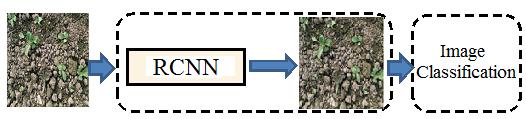
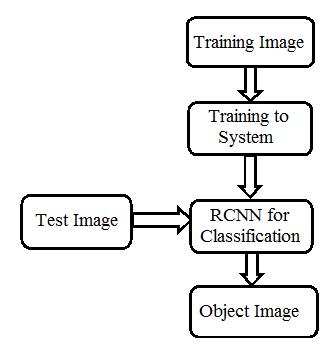
Wepresent(Fig-1)atechniquefor Objectdetection,isthe processoffindingandclassifyingobjectsinanimage.One deeplearningapproach,regionswithconvolutionalneural networks(R-CNN),combinesrectangularregionproposals withconvolutionalneuralnetworkfeatures.R-CNNisatwostagedetectionalgorithm.Thefirststageidentifiesasubset of regions in an image that might contain an object. The secondstageclassifiestheobjectineachregion.
Step-I ASystemistrainedwithasetoftrainingimages.
Step-IIATestingimageisselectedfromthesetoftraining images.
Step-III AnRCNNalgorithmisappliedtothetestingimage.
Step-IV An object image occurs as an output after classification.
Aresultofthisaction,thenoiseintheimage'sbackgroundis removed..
3. RESULTS AND DISCUSSIONS
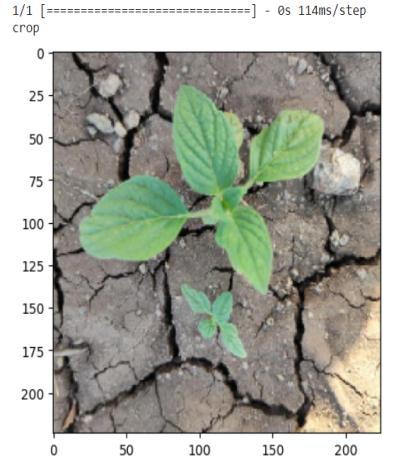
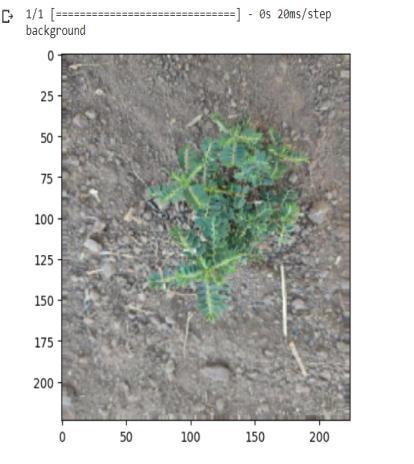
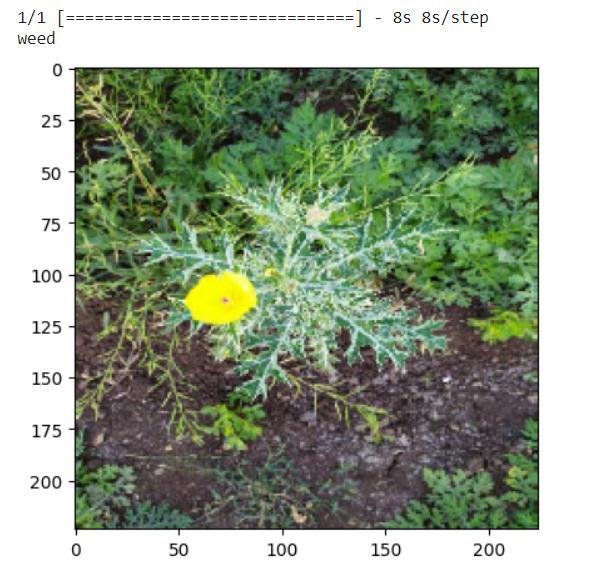
The proposed approach was examined using a variety of samplescollectedfromtheNET.Wetrainedoursystemwith adatasetconsistingof300images.Aftertrainingthesystem with the training images a random image is given as an input.Theinputimageispre-processedusingBinarization techniques. The RCNN algorithm we trained classifies whetherthegiveninputimageisBackground/Crop/Weed asfollows:
WhenaRCNNmodelisappliedtodatasettotrainthemodel.
4. CONCLUSIONS
Since Weeding plays a major role in the agriculture, the mainObjectiveofmodernWeedidentificationistoincrease the Crop production , Economy of our country and to overcomethelossofcropcausedbytraditionalmethod of weedinglikeherbicides,burning,trowelsetc.
5. FUTURE SCOPE OF THE WORK
Theproceduredescribedabovecouldbeextendedtonoisefreesamplesthataremanuallycontaminatedwithvarious noisesatvariouslevels,suchaspepper,Gaussiannoise,and soon.Thenoisydocumentsarethencleanedusingadefined algorithmandothermethods,andquantitativemetricsfor identifyinginformationlossduringthecleaningprocessare established.
REFERENCES
[1]XiaojunJin,JunCheandYongChen,”WeedIdentification Using Deep Learning and Image Processing in Vegetable Plantation”, Digital Object Identifier 10.1109/ACCESS.2021.3050296
[2]F.Ahmed,H.A.Al-Mamun,A.S.M.H.Bari,E.Hossain,and P. Kwan, ‘‘Classification of crops and weeds from digital images: A support vector machine approach,’’ Crop Protection,vol.40,pp.98–104,Oct.2012.
[3]M.H.AsadandA.Bais,‘‘Weeddetectionincanolafields using maximum likelihood classification and deep convolutionalneuralnetwork,’’Inf.Process.Agricult.,vol.7, no.4,pp.535–545,Dec.2020.
[4]H.Mennan,K.Jabran,B.H.Zandstra,andF.Pala,‘‘Nonchemical weed management in vegetables by using cover crops:Areview,’’Agronomy,vol.10,no.2,p.257,Feb.2020.
[5] K. Osorio, A. Puerto, C. Pedraza, D. Jamaica, and L. Rodríguez,‘‘Adeeplearningapproachforweeddetectionin lettucecropsusingmultispectralimages,’’AgriEngineering, vol.2,no.3,pp.471–488,Aug.2020.
[6] Rohit Vad,”Weed Detection in Soyabean Crops using RegressionAnalysisandDeepLearning”,…..
[7] M.SrinivasaRao,”An Advanced Weed Detection Using Deep Learning techniques”, Nat. Volatiles & Essent. Oils, Vol.8(6),pp.1273-1280
[8]P.Herrera,J.Dorado,andÁ.Ribeiro,‘‘Anovelapproach forweedtypeclassificationbasedonshapedescriptorsanda fuzzydecision-makingmethod,’’Sensors,vol.14,no.8,pp. 15304–15324,Aug.2014.
[9]Long,E.Shelhamer,andT.Darrell,‘‘Fullyconvolutional networks for semantic segmentation,’’ in Proc. IEEE Conf. Comput.Vis.PatternRecognit.(CVPR),Jun.2015,pp.3431
3440,doi:10.1109/CVPR.2015.7298965.
[10]Karami,M.Crawford,andE.J.Delp,‘‘Automaticplant counting and location based on a few-shot learning technique,’’IEEEJ.Sel.TopicsAppl.EarthObserv.Remote Sens.,vol.13,pp.5872–5886,2020.