
Enhancing Compressive and Flexural Strength of High Strength Concrete using Steel and Polypropylene Fibers
Er. Mandeep Kaur1 , Dr. Harpal Singh2, Dr. Harvinder Singh3Abstract - High strength concrete (HSC) is a key material usedinconstruction for its superior mechanicalproperties. In recent years, the addition of fibers to HSC has been shown to further improve its performance. This study aims to investigate the effect of using steel fiber in proportions of 0.5%, 1%, and 1.5%, and polypropylene fiber in proportions of 0.25%, 0.50%, 0.75%, and 1% on the compressive and flexural strength of HSC. The research methodology involves preparing HSC specimens with varying fiber content and subjecting them to compressive and flexural strength tests. The results showthat the additionofsteel fibers improves the compressive and flexural strength of HSC. Moreover, the increase in steel fiber content leads to an increase in the strength of HSC. Similarly, the addition of polypropylene fibers enhances the flexural strength of HSC. The study also demonstrates that the combined use of steel and polypropylene fibers further enhances the mechanical properties of HSC. The findings of this study can be useful for designing HSC structures with improved mechanical properties.
Key Words: High strength concrete, compressive strength, flexural strength, steel fibre, polypropylene fibre.
1.INTRODUCTION
Concrete is a widely used construction material due to itsgoodcompressiveandflexuralstrengths,durability,and lowcost.Itisanengineeredmaterialthatcansatisfyvarious performance specifications and is produced in large quantities worldwide. Strength and durability are the key parameterstobeconsideredwhilediscussingconcrete,and the choice of cement type significantly affects these parameters. The development of concrete can be divided into four stages - normal strength concrete, high strength concrete, high-performance concrete, and triple blended concrete.
In thecontext of concrete,it is crucial to consider both itsstrength(abilitytobearload)anddurability(resistance todeterioratingagents).Theseagentscanbechemical,such as sulphates, chlorides, CO2, acids, or mechanical, like abrasion, impact, and temperature. To ensure strong and durable concrete structures, several steps are required, including structural design and detailing, proper mix
proportion and workmanship, quality control at the site, and the selection of appropriate concrete ingredients. The type ofcement used is one such ingredient that plays a significantroleindeterminingthestrengthanddurabilityof concrete.
Depending on the conditions in which a concrete structure will be used, it may be subjected to varying levels of load and exposure. To meet the necessary performance standards, cements with varying strength anddurabilitycharacteristicsmaybenecessary.
Concretedevelopmentcanbecategorizedintofourstages. The first stage involved normal strength concrete (NSC), which consists of four primary components, namely cement, water, fine aggregates, and coarse aggregates. As the demand for higher strength concrete arose due to the construction of high-rise buildings and long-span bridges, the second stage was the development of high strength concrete(HSC)withinherenthighercompressivestrength. However, it was later realized that high compressive strength was not the only crucial factor for concrete mix design.Otherparameters,suchasdurability,permeability, andworkability,werealsoessential.Thisrealizationledto the development of high-performance concrete (HPC) at the end of the last century. The final stage aimed to maximize all these properties in an economical and environmentally friendly way, which introduced the conceptoftripleblendedconcretes.
2.LITERATURE REVIEW

Inordertofulfiltheaimsandobjectivesofthepresentstudy followingliteratureshavebeenreviewed.
Akbarietal.(2018)conductedaresearchstudyonthe effects ofpolypropyleneandsteel fibers onthemechanical properties and durability of high-strength concrete. The studyinvolvedpreparingconcretemixeswithdifferentfiber contents and testing their mechanical properties and durability characteristics. The results showed that the addition of both polypropylene and steel fibers improved the mechanical properties of high-strength concrete. However, the increase in fiber content had a greater effect on the mechanical properties of polypropylene fiber reinforced concrete (PFRC) as compared to steel fiber reinforcedconcrete(SFRC).
Gao et al. (2017) conducted an experimental study on high-strength concrete to evaluate the impact of polypropylene fiber content and aspect ratio on compressivestrengthandflexural behavior.Theyfound that polypropylene fiber significantly improves the mechanicalpropertiesofhigh-strengthconcrete,andthe optimal fiber content and aspect ratio can be determinedthroughtesting.
Akbari et al. (2015) investigated the impact of polypropylene and steel fibers on the mechanical properties and durability of high-strength concrete. The resultsshowed that the addition of fibers improved the mechanical properties and durability of concrete. Polypropylene fibers showed better performance in terms of durability compared tosteelfibers.
Zhang et al. (2016) conducted an experimental study to investigate the mechanical properties and spalling resistance of Steel Fiber Reinforced Concrete (SFRC) at high temperatures. The research showed that the addition of steel fibers significantly improved the spallingresistanceofSFRCathightemperatures,aswellas the mechanical properties such as compressive strength andflexuralstrength.Theresultsofthisstudycanprovide guidance for the design and application of SFRC in hightemperature environments, such as tunnels and fireresistantstructures.
Wang et al. (2019) conducted an experimental studytoinvestigatetheeffectofsteelfibervolumefraction on the mechanical and thermal properties of steel fiber reinforced concrete (SFRC) at elevated temperatures. The study involved subjecting SFRC specimens with varying fibervolumefractionsto temperaturesranging from20°C to 1000°C. The results showed that the addition of steel fibersimprovedthemechanicalandthermalpropertiesof SFRC,andthattheoptimalfibervolumefractionwas1.5%.
Yanetal.(2020)conductedanexperimentalstudy to investigate the effect of polypropylene fiber content on the spalling resistance of steel fiber reinforced concrete (SFRC) at high temperatures. The study revealed that the addition of polypropylene fibers enhanced the spalling resistance of SFRC, and the optimal content of polypropylenefiberswasfoundtobe0.2%byvolume.The study also concluded that the combination of polypropylene and steel fibers resulted in further improvementsinthespallingresistanceofSFRCcompared tousingsteelfibersalone.
SiddiqueandMehta(2014)investigatedtheeffect of steel fibers on the strength and behavior of highstrength concrete. The study involved adding steel fibers indifferentpercentages(0.5%,1%,1.5%,and2%)tohighstrength concrete and testing the compressive strength, split tensile strength, and flexural strength. The results showed that the addition of steel fibers increased the
strength and toughness of high-strength concrete, with the bestperformanceobservedat1.5%steelfibercontent.They also observed that the post-peak behavior of the concrete was improved with the addition of steel fibers. The authors concluded that steel fiber reinforcement can be an effective methodtoenhancethemechanicalpropertiesanddurability of high-strength concrete. Additionally, the post-peak behavior of the concrete was observed to improve with the incorporation of steel fibers. The study concluded that steel fiberreinforcementisapromisingmethodforenhancingthe mechanical properties and durability of high-strength concrete.
3.MATERIALS USED
3.1 CEMENT:
Cement is an essential component of advanced concrete mixtures that utilize steel and polypropylene fibers. These fibers are added to concrete to improve its mechanical and durability properties, including compressive and flexural strength, toughness, impact resistance, and crack control. Cement plays a critical role in binding the fibers to the matrix and ensuring their properdispersionthroughoutthemixture.
3.2 FINE AGGREGATE
The locally available sand has been utilized as a fineaggregate.Ithasbeenensuredthatthesandis freeof organicimpurities,salt,andclaycontent.Thepropertiesof sand, including bulk density and specific gravity, have been tested following the guidelines of IS 2386-1963(28). Thegrainsizedistribution ofthesand isinline withzone 1ofIS383-1970(29).
3.3 COARSE AGGREGATE:
Machine crushed angular granite metal used locally as coarse aggregate. This material is free from impuritiessuchasdust,clayparticles,andorganicmatter. Various properties of the coarse aggregate were also tested, including specific gravity and fineness modulus, which were found to be 2.64 and 7.14, respectively. Additionally, the bulk density of the coarse aggregate was determinedtobe1700kg/m³.
3.4 ADMIXTURE
Superplasticizer is used as an admixture to increasetheworkabilityandfluidityoftheconcretemix.It helpsinachievingahigherslumpvaluewhilemaintaining therequiredstrengthoftheconcrete. Theyconsist mainly of naphthalene or melamine sulphonates, usually condensedinthepresenceofformaldehyde.
3.5 POLYPROPYLENE FIBERES
Polypropylene fibers are commonly used as reinforcement in concrete to improve its mechanical properties and durability. The addition of polypropylene fibers can enhance the tensile strength and toughness of concrete, reduce shrinkage and cracking, and improve resistance to impact, fatigue, and abrasion. Polypropylene fibers are added in proportions of 0.25%, 0.50%, 0.75%, and 1%. The study measures the compressive and flexural strength of the concrete with differentfibercombinations.
3.6 STEEL FIBRES
The use of steel fibers in advanced concrete testing has been widely studied for their ability to enhance the mechanical properties and durability of concrete. Steel fibers are typically added to concrete in small proportions, ranging from 0.5% to 2% by volume. These fibers are made from high-strength steel wires that are cut into short lengths and mixed with the concrete different proportions of steel fibers (0.5%, 1%, 1.5%) on the compressive and flexural strength of high-strength concrete.
The ultimate tensile strength of steel fibre ranges from 1200MPa, whereas the length is 50 mm, the aspect ratio (length/diameter) is 50 and the young’s modulus is 205 MPa.
4. RESULTS & DISCUSSIONS
4.1
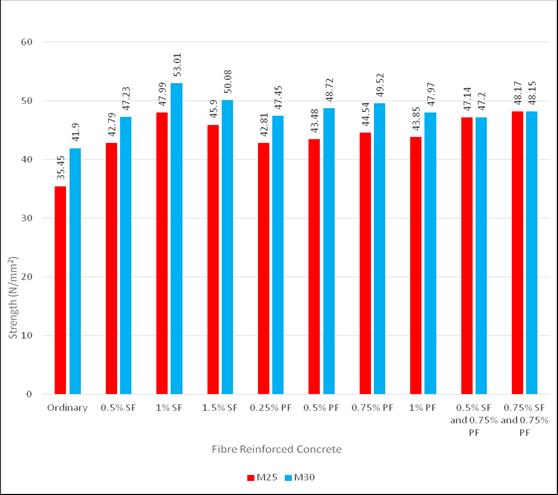
The reduction in compressive strength with the addition of polypropylene fibers can be attributed to the fact that the fibers are relatively softer and weaker than steel fibers. The presence of polypropylene fibers in the concrete mixture creates voids which can reduce the strengthofconcrete.Moreover,thebondingbetweenthe polypropylene fibers and the cement matrix is also not verystrong,whichcanfurtherreducethestrengthofthe concrete.Therefore,itcanbeconcludedthattheaddition of steel fibers is more effective in improving the compressive strength of high-strength concrete than polypropylenefibers.

4.3 Cost Comparison of Various
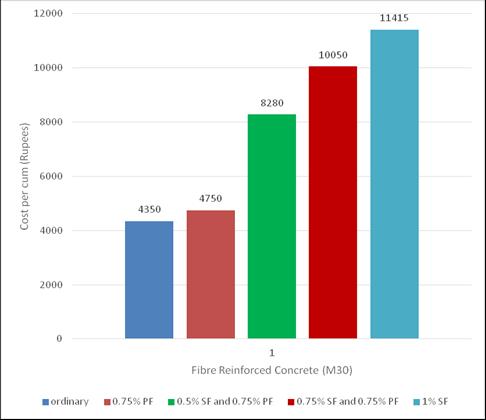
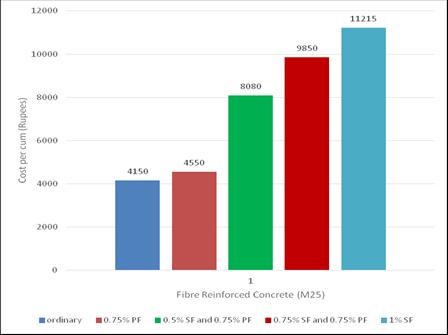
The As the objective of the Study is to Obtain a strong, tough and durable concrete without appreciable increase in the cost , the increase in the cost with the addition of fibres were analysed and it is found that there is a huge increaseincostofconcretewhenonlyoptimumquantityof steel fibres (1% in this case) were added. Least escalation of cost is reported in case when an only polypropylene fibreisadded.Withthedecreaseinvolumefractionofsteel fibresaddedthereisnoticeabledecreaseinthecostofthe concrete.
Discussions:
Compressivestrengthresults:
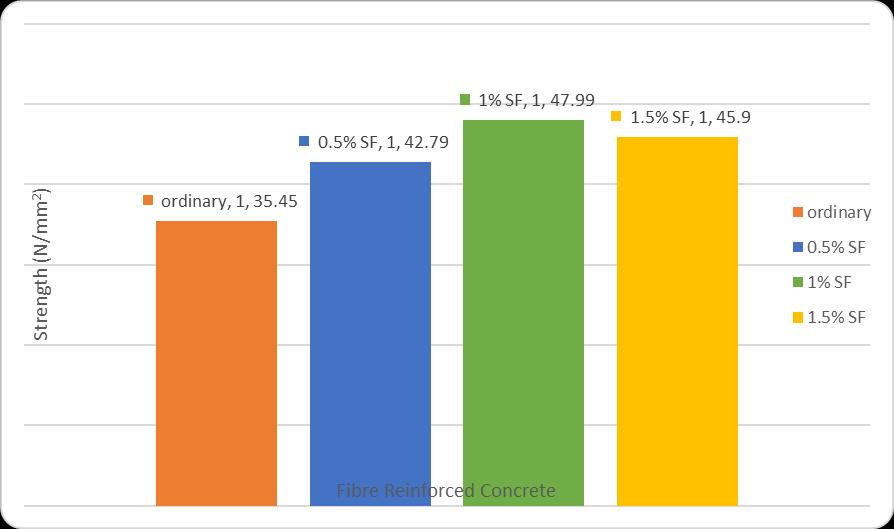
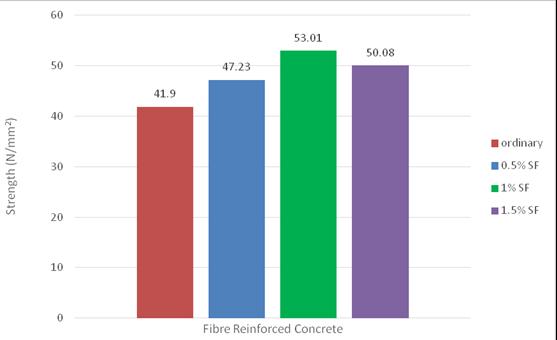
TheForM25SFRC,thecompressivestrengthincreasedas the volume fraction of steel fibers increased. The highest compressive strength of 45.9 N/mm2 was obtained for a volume fraction of 1.5%, which represents a 29.48% increaseinstrengthcomparedtoplainconcrete.Asimilar trend was observed for M30 SFRC, with the highest compressive strength of 50.08 N/mm2 obtained for a volume fraction of 1.5%, representing a 19.52% increase instrengthcomparedtoplainconcrete.
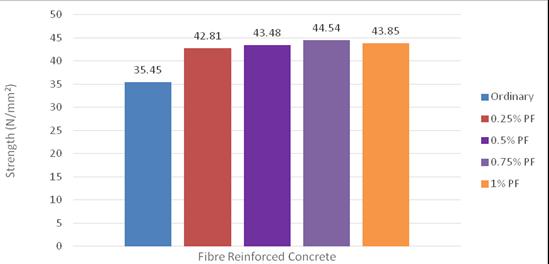
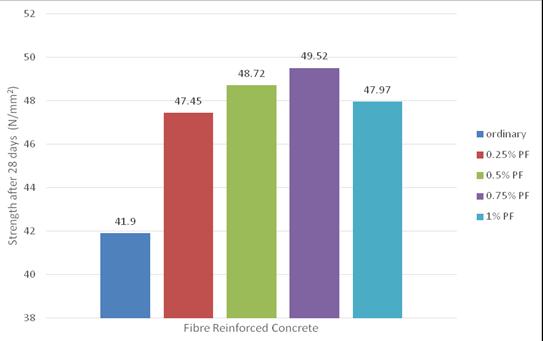
ForM25PFRC,thecompressive strength alsoincreased as thevolume fraction of polypropylene fibers increased. The highest compressive strength of 43.85 N/mm2 was obtained for a volume fraction of 1.00%, representing a 24% increase in strength compared to plain concrete. A similartrendwasobservedforM30PFRC,withthehighest compressive strength of 49.52 N/mm2 obtained for a volumefractionof0.75%,representingan18.19%increase instrengthcomparedtoplainconcrete.
The results show that the addition of steel or polypropylene fibers significantly improves the compressive strength of concrete, with the highest strength achieved at the highest volume fraction of fibers tested. The % increase in strength is also higher for SFRC comparedtoPFRC,whichsuggeststhatsteelfibershavea stronger reinforcing effect on concrete compared to polypropylenefibers.
Flexuralstrengthresults:
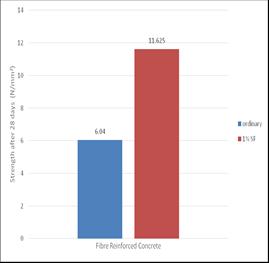
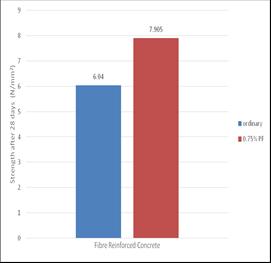
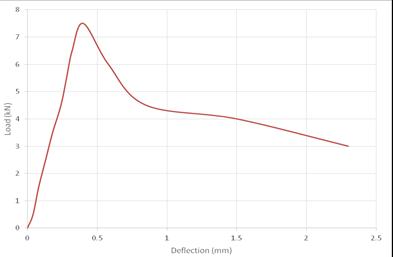
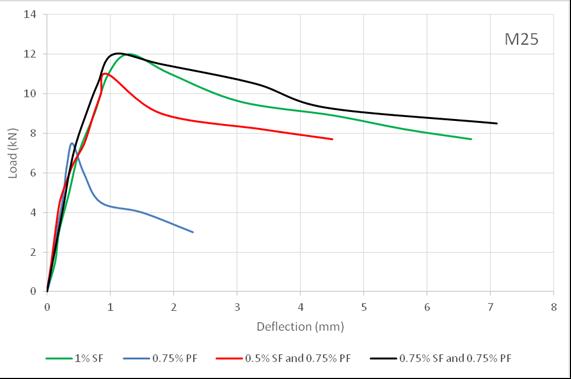
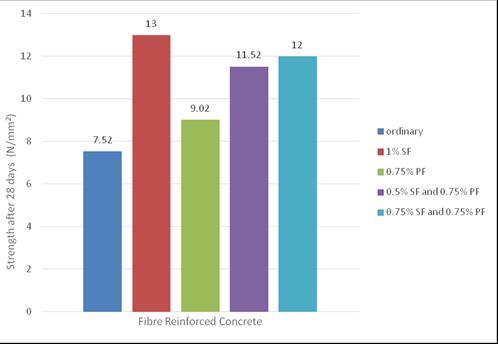
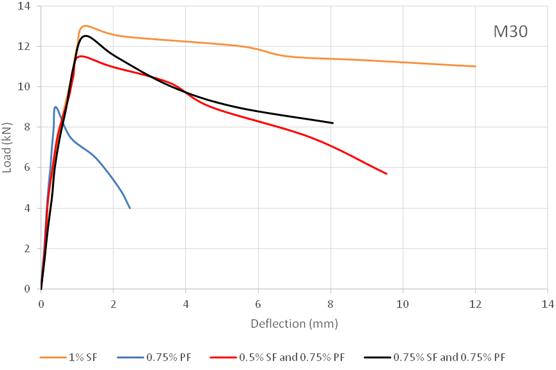
According to Fig-4.4 & Table-4.5 , it is observed that flexural strength of combined FRC increases with increasing fiber content. At a volume fraction of 0%, the flexural strength was 4.03 N/mm2, while at a volume fraction of 1.00%, it increased to 5.61 N/mm2, representing a 39.45% increase. The figure also demonstrates that the flexural strength of combined FRC increased with an increase in the fiber volume fraction, indicating that the fiber content is a vital factor affecting the flexural strength of the FRC. Overall, the results indicate that the combined FRC can provide enhanced flexuralstrengthandcanbeusedinstructuralapplications whereresistancetobendingisessential.
Compressivestrengthresults:
Thecompressive strengthresults(tables2, 3,4)aregiven for 3 fibre percentages and various percentages of silica fume and fly ash considered. In general it is found that compressive strength is getting reduced with fly ash replacement and getting increased with silica fume replacement.Withsteel fibrespresentinthemix,itisalso observedthatthereismarginalincreaseinthecompressive strength.
Costanalysisresults:
The study proposes the use of a combination of steel and polypropylenefibers,withalowervolumefractionofsteel fibers (0.5% steel and 0.75% polypropylene), to attain desirable properties such as workability, strength, and durability at a reasonable cost. This combination of fibers resulted in an increase in compressive and flexural strength comparable to that of steel fibers but with a less harshconcreteandhigherworkability.
In addition to the cost analysis, the study also evaluated theperformanceofthedifferentFRCsintermsofstrength, ductility, crack width, abrasion resistance, and permeability.Theresultsshowedthattheadditionofsteel fibers resulted in an increase in compressive and flexural strength, but a large volume of steel fibers made the concreteharshwithreducedworkability.
Overall,thestudyrecommendstheuseofacombinationof steel and polypropylene fibers with a lower volume fraction of steel fibers to attain desirable properties of workability,strength,anddurabilityatareasonablecost.
5. CONCLUSIONS
BasedThefollowingaretheconclusionsfromthestudyon theadditionofsteelandpolypropylenefiberstoconcrete:
1. The compressive strength of concrete increases with the addition of steel fibers, but a further increase in volumeto1.5%resultsinadecreaseinstrengthdueto ballingoffibers.
2. The flexural strength of concrete increases significantly with the addition of both steel and polypropylene fibers, resulting in reduced width of flexuralcracksandhigherductility.
3. Large volume of steel fibers tends to make the concreteharshwithreducedworkability.
4. The addition of polypropylene fibers results in an increase in strength up to a certain volume (0.75%), but a further increase in volume to 1.0% results in a decreaseinstrength.
5. The combination of steel and polypropylene fibers (withareductioninsteelfibers)resultsinanincrease in compressive and flexural strength comparable to that of steel fibers alone, but with a less harsh concretewithhigherworkability.
6. The resistance to abrasion of concrete increases significantly with the addition of both steel and polypropylene fibers, and it is more resistant to wear thanplainconventionalconcrete.
7. The addition of steel and polypropylene fibers decreases the permeability of concrete, with samples containing 0.5% steel and 0.75% polypropylene showingmaximumresistancetowaterflow.
8. Cost analysis shows that adding steel fibers appreciably increases the cost of concrete, while adding only polypropylene fibers does not achieve desirable strength properties. Thus, a combination of 0.5% steel and 0.75% polypropylene fibers is proposed as the best option for achieving desirable propertiesatareasonablecost.
6. REFERENCES
[1]IS:516–1959:“IndianstandardMethodsofTests forstrengthofConcrete”–BureauofIndianStandards
[2]IS : 4037 – 1988 : “Indian standard methods of physicaltestforHydrauliccement”–BureauofIndian Standards
[3]IS : 1344 – 1968 : “Indian standard specifications forpozzalonas”-BureauofIndianStandards
[4]IS : 2386 – 1963 : “Indian Standards methods for aggregates of concrete” – Bureau of Indian standards, NewDelhi
[5]IS:380–1970:“Indianstandardspecificationsfor coarse and fine aggregates (natural)” - Bureau of IndianStandards(revised)
[6]IS : 7869 (part 2) – 1981 : Indian standard specificationsforadmixturesinconcrete
[7]IS : 456 – 2000 : Plain and reinforced concrete Indianstandardspecifications
[8]A.M Neville (1998) : “Properties of concrete” Englishlanguagebooksociety
[9]N. Krishnaraju : “Design of concrete mix” – CBS publisher–1985
[10]M.SShetty:“ConcreteTechnology”–2006
[11]P.K Mehta and J.J.M Paulo : “Concrete micro structure and properties and materials”- McGraw Hill publishers–1997
[12]Rafat Siddique – “ Special Structural concretes” –GalgotiaPublications-2000