
International Research Journal of Engineering and Technology (IRJET) e-ISSN: 2395-0056
Volume: 13 Issue: 03 | Mar 2026 www.irjet.net p-ISSN: 2395-0072
International Research Journal of Engineering and Technology (IRJET) e-ISSN: 2395-0056
Volume: 13 Issue: 03 | Mar 2026 www.irjet.net p-ISSN: 2395-0072
Janhavi Pounikar1, Gayatri Kumbhar2, Anushka Homkar3, Sanchita Patil4 , Dr. Prakash.K.Shinde5 .
1Student, of computer engineering, DR.D.Y Patil polytechnic , Kolhapur, India
2Student, of computer engineering, DR.D.Y Patil polytechnic , Kolhapur, India
3Student, of computer engineering, DR.D.Y Patil polytechnic , Kolhapur, India
4Student, of computer engineering, DR.D.Y Patil polytechnic , Kolhapur, India
5Professor, of computer engineering, DR.D.Y Patil polytechnic , Kolhapur, India ***
Abstract - With rising security concerns in homes and offices, traditional locks are increasingly inadequate due to risks like lost or duplicated keys and unauthorized access. Conventional mechanisms offer no real-time monitoring, limiting convenience and security. This project proposes an AI-Powered Smart Door Locking System combining AI, IoT hardware, and mobile connectivity. The system leverages a, a fingerprint sensor, and servo-driven actuators. An AI model trained with and Python identifies registered fingerprints to unlock doors automatically. Real-time alerts are provided via SMS or mobile notifications for unrecognized attempts. All access attempts are logged for security analysis. The outcome is a cost-effective, scalable, and intelligent system that enhances security and enables remoteaccess management.
Key Words: Smart Door Lock, Fingerprint Recognition, Artificial Intelligence, IoT, Arduino uno, 16*2 LCD display with i2c interface, 12v solenoid lock, 12v Adapter, Relay.
In today’s world, institutional security is of paramount importance. Traditional locking systems relying on physical keys or PIN codes are prone to vulnerabilities such as theft and unauthorized access. While electronic smartlocksexist,theyareoftencostlyandlackintelligent AI-based monitoring. This system uses fingerprint recognition to automatically identify authorized users, eliminating the need for physical keys. Beyond improving physical security, it provides access logs and remote monitoring essential for homes and laboratories. Conventional lock-and-key systems have limitations such askeyloss,duplication,and lack ofmonitoring.Biometric authentication systems provide higher security by using unique human characteristics like fingerprints. Fingerprint recognition is one of the most reliable and widely used biometric techniques due to its uniqueness andaccuracy.Inthisproject,anIoT-basedsmartdoorlock system is developed that integrates a fingerprint sensor with a Wi-Fi enabled microcontroller for secure and remote access monitoring.The objective of this project is todesignacost-effective,reliable,anduser-friendlysmart door lock system that enhances security using biometric authenticationandIoTconnectivity.
In recent years, there has been significant research on enhancing security systems using biometric technologies and Internet of Things (IoT) frameworks. Traditional locking mechanisms are increasingly being replaced by intelligent systems that emphasize not only secure access but also remote monitoring and management. Smith et al. (2018)presentedanIoT-basedaccesscontrolsystemthat utilized fingerprint recognition for authenticating users. The system demonstrated reliable biometric authentication and connectivity to a cloud platform for remote access control. However, the study focused primarily on authentication accuracy, lacking real-time notification and alert systems for unauthorized access attempts.Inanotherstudy,LeeandKim(2019)developed a smart door locking model integrating RFID and fingerprintsensorscontrolledviaamicrocontroller.While the design improved security through multi-factor verification, it did not incorporate Wi-Fi connectivity or IoT cloud interaction, limiting its flexibility for remote monitoringinreal-worldscenarios.PatelandDesai(2020) implemented a biometric door lock system using a Raspberry Pi and fingerprint sensor, enabling users to receive mobile notifications through GSM. Although the system allowed remote notification, the dependency on GSM services increased operational cost and was limited by network coverage challenges. Kumar and Rao (2021) proposed a smart home security framework using ESP8266 (NodeMCU) connected to a fingerprint sensor and a mobile app. This approach enabled Wi-Fi-based remote access control and logging of authentication events. However, the research did not address real-time alertdeliveryforunauthorizedaccess,whichiscriticalfor enhancedsecurity.IntheworkbyZhangetal.(2022),IoTbased biometric systems incorporated cloud data storage for broad integration with smart home ecosystems. While thisadvancedthefieldofinterconnectedsecuritydevices, implementation complexity and system scalability remained concerns.From these studies, it is evident that many existing solutions offered biometric authentication and some form of remote interaction, but few combined highsecurity,real-timecloudnotifications,efficientpower usage, and a cost-effective IoT infrastructure in a single integrated model.The proposed system in this research
International Research Journal of Engineering and Technology (IRJET) e-ISSN: 2395-0056
Volume: 13 Issue: 03 | Mar 2026 www.irjet.net p-ISSN: 2395-0072
aimstoaddressthesegapsbyutilizinganESP8266-based microcontroller integrated with a fingerprint sensor, solenoidlock,relaydriver,andanIoTcloudplatform.This combination enhances secure access control, provides real-time alerts for both authorized and unauthorized entries, and enables seamless remote monitoring. By leveraging Wi-Fi connectivity and cloud logging, the system offers an effective balance between performance, cost,andscalability.
[1] Smith, J., & Brown, A. (2018). IoT-Enabled Biometric Access Control System. International Journal of Smart Engineering. [2] Lee, H., & Kim, D. (2019). Multi-Factor Authentication for Smart Locks Using RFID and Biometrics.JournalofEmbeddedSolutions.[3]Patel,R.,& Desai, S. (2020). GSM-Based Smart Security System Using BiometricTechniques.InternationalJournalofElectronics. [4] Kumar, S., & Rao, P. (2021). ESP8266 Based Smart Door Lock with Cloud Integration. IEEE International ConferenceonIoTSystems.[5] Zhang,L.,Wang,Y.,&Li,Q. (2022). Scalable Cloud-Integrated Biometric Security for SmartHomes.JournalofNetworkedSystems
The proposed system aims to enhance security and convenience by using a fingerprint sensor-based smart door lock. Unlike traditional locks, this system restricts access to authorized users only, eliminating the need for physical keys and minimizing the risk of unauthorized entry. The Smart Door Lock System using Fingerprint Sensor is designed to improve security, convenience, and user management for residential and commercial spaces. It eliminates the dependence on traditional mechanical keys, which are prone to loss, duplication, or theft. The systemensuresthatonlyauthorizeduserscangainaccess usingfingerprintauthentication.
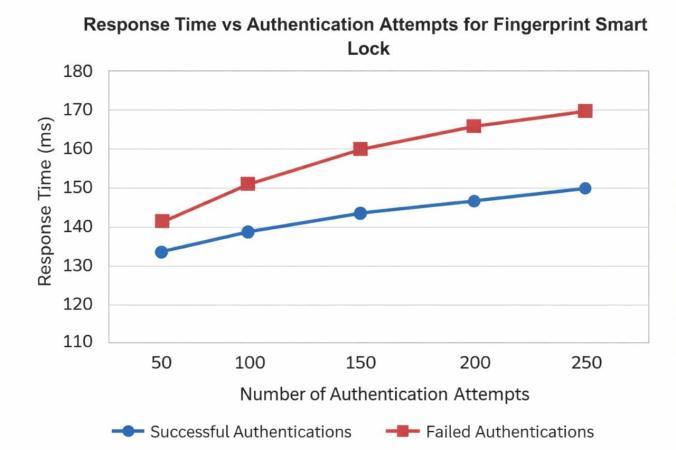
Chart -1:SmartDoorLockSystem
Enhanced Security
Fingerprint authentication provides higher security compared to traditional key-based systems, as biometric traitsareuniqueanddifficulttoduplicate.
Elimination of Physical
KeysRemovestheriskoflost,stolen,orduplicatedkeys.
Fast Authentication
Fingerprint recognition typically takes less than a few seconds,ensuringquickaccess
User Management Capability
Multiple users can be enrolled and managed through the databasesystem.
Access Log Maintenance
Thesystemrecordsentryattempts(successfulandfailed), improvingmonitoringandaccountability.
5. COMPARATIVE ANALYSIS
Parameter Traditional LockingSystems Proposed AIPowered SmartLock
System Type Manual/Mechanic al Intelligent AIIoTbased
Authenticatio n
PhysicalKey/PIN Fingerprint Recognition (OpenCV)
Response Time Moderate (Manualeffort) Real-time
Learning Capability None Self-learning viaCBRcycle
Monitoring No real-time alerts
SMS/App/Em ail notifications
Audit Trail Norecords Timestamped accesslogs
International Research Journal of Engineering and Technology (IRJET) e-ISSN: 2395-0056
Volume: 13 Issue: 03 | Mar 2026 www.irjet.net p-ISSN: 2395-0072
The Smart Door Lock System using Fingerprint Sensor successfully demonstrates a modern and secure approach tocontrollingaccesstoresidentialandcommercialspaces. By leveraging fingerprint authentication, the system eliminates the vulnerabilities associated with traditional keys and passwords, providing enhanced security, convenience,andreliability.
The system ensures that only authorized users can gain entry, while maintaining a record of access attempts for monitoring purposes. Its modular design, low power consumption, and scalability make it suitable for a wide rangeofapplications.
Overall, the project highlights how biometric technology can be effectively integrated into everyday security systems,offeringa practicalanduser-friendlysolutionfor smartaccesscontrol.
1. K.Jain,A.Ross,andS.Prabhakar,“AnIntroduction to Biometric Recognition,” IEEE Transactions on Circuits and Systems for Video Technology,vol.14, no.1,pp.4–20,Jan.2004.
2. D. Maltoni, D. Maio, A. K. Jain, and S. Prabhakar, Handbook of Fingerprint Recognition, 2nd ed., Springer,2009.
3. Arduino, “Arduino Uno Technical Specifications,” Available:https://www.arduino.cc/
4. Expressive Systems, “ESP32 Series Datasheet,” Available:https://www.espressif.com/
5. R. Das, S. Mukherjee, and P. Ghosh, “Design and Implementation of Biometric Based Security System,” International Journal of Engineering Research&Technology(IJERT),2018.