
International Research Journal of Engineering and Technology (IRJET) e-ISSN: 2395-0056 P-ISSN: 2395-0072

Volume: 12 Issue: 12 | Dec 2025 www.irjet.net

International Research Journal of Engineering and Technology (IRJET) e-ISSN: 2395-0056 P-ISSN: 2395-0072
Volume: 12 Issue: 12 | Dec 2025 www.irjet.net
Hemashree H C1 , Adil Ahmed2 , Sumanth P Bellad 3 , Vijayalakshmi S4 , Spoorthi G R5
1Assistant Professor, Information Science and Engineering, Bapuji Institute of Engineering and Technology, Davangere, affiliated to VTU Belagavi, Karnataka, India.
2,3,4,5,Bachelor of Engineering, Information Science and Engineering, Bapuji Institute of Engineering and Technology, Davangere, affiliated to VTU Belagavi, Karnataka, India.
Abstract - Falls are a major health risk for elderly individuals, leading to injuries, hospitalization, and reduced independence. Traditional walkers provide physical support but lack intelligence for fall monitoring and alerting. This work proposes an IoT-enabled smart walking assistant equipped with accelerometer– gyroscopesensors for falldetection, along with heart rate, SpO₂, body temperature, obstacle detection, and live caregiver alerts. The system uses ESP32 and LoRa communication to support real-time tracking and emergency notification, aiming to reduce injury severity and improve elderly safety.
Key Words: Smart walking assistant, elderly safety, internet of things, fall prevention, physiological sensors.
1.INTRODUCTION
Theglobalelderlypopulationisgrowingrapidly,withthenumberofindividualsaged60andaboveprojectedto reach2.1 billion by 2050 [1]. While increased longevity is a positive societal achievement, it also presents significant challenges, especiallyintherealmofhealthcare.Amongthesechallenges,fallsrepresentoneofthemostsevererisksfortheelderly. Statisticsshow thatoneintenfallsleadstoaninjurythatcausesolderadultstolimittheiractivitiesforatleasta dayor seekmedicalattention[2].
Theglobalelderlypopulation(60+years)isexpectedtoreach 2.1 billion by 2050,increasingtheriskandimpactoffalls. Oneintenfallsresultsininjuryrequiring medical support. Wearable and ambient systems have helped, but discomfort, privacyissues,andindoorlimitationsrestrictusability.IoT-basedhealthsolutionsenable continuous remote monitoring andtimelyalerts.Thispaperpresentsasmartwalkingassistantthatimprovesmobility,detectsFallsinstantly,andnotifies caregiversthroughamobileapp
Therapidadvancementoffalldetectiontechnologieshasledtoawidearrayofmethodsaimedatenhancingelderlysafety andreducinghealthcare burdens.Theliteraturegenerallycategorizesfall detection methodsintomanytypes[3],[4],[5]. Eachmethodoffersuniquebenefitsandfacesspecificchallenges,asdiscussedbelow.Fall-detectionsystemsemployseveral methods, each with distinct advantages andlimitations.Wearablesensor–based approachesofferhighaccuracyandenable precisemotion tracking, but they often face challenges related to user compliance. Ambient sensorsystems eliminatethe need for wearable devices, making them more comfortable for users; however, they are typically limited to indoor environments and raise privacy concerns. Vision-based methods provide very accurate pose estimation and fall recognition,yettheyrequirecostlycamerasetupsandalsoinvolvesignificantprivacyissues.Morerecently,machinelearning combinedwithIoThasenabledintelligentfall predictionandfasteremergencyresponsebyautomaticallysendingalertsto caregivers,althoughthisapproachreliesheavilyoncloudinfrastructureandlargevolumesofdata.Whilemachinelearning significantlyimprovesmotionclassificationaccuracy,itsperformancestronglydependsonthediversityandqualityofthe trainingdataset.
Wearablesensorssuchasaccelerometersandgyroscopesarethemostcommonlyusedtoolsforfalldetectiondueto Their portability and ability to capture real-time motion data [6]–[11]. Studies show that combining these sensors enables accuratediscriminationbetweenfallsandnormal movements. For example, Wu et al. [12] achieved high accuracy using quaternion-based motion analysis, while Siregar et al. [13] reported 93.75% accuracy with an Arduino-based alerting system. Ahn et al. [14] demonstrated 100% sensitivity in pre-impact fall detection using angular velocity and trunk inclination.
International Research Journal of Engineering and Technology (IRJET) e-ISSN: 2395-0056
Volume: 12 Issue: 12 | Dec 2025 www.irjet.net
P-ISSN: 2395-0072
Machinelearningtechniquesfurtherimproveperformance.Albert et al. [18] achieved 98% fall-type classification accuracy using SVM and logistic regression. Kalman filteringenhancessignalreliabilitybyreducingnoise[15]. Rakhmani et al. [20] obtained93.3%accuracyusingsmartphone-basedclassifiers,andensemble/data-fusionmethodsalsohelpminimizefalse alarms [16]. However, despite high accuracy, user compliance remains a challenge as these systems require continuous wearingforreliablemonitoring.
2.2 Ambient sensor-based fall detection.
Ambient fall detection systems utilize environmental sensors such as pressure mats, microphones, and infrared or proximitysensorstodetectfalleventswithoutrequiring userstoweardevices[17],[21].VallabhandMalekian[8] showed that these systems can differentiate falls from regular daily activities, but they are limited by high installation and maintenance costs and lack portability. Mozaffari et al. [22] demonstrated that vibration and sound-based sensing can triggeralertsviaIoTnetworks,makingthemsuitablemainlyforindoorenvironments.
Keyadvantagesincludenon-intrusivemonitoringandzerouserinteraction.However,theyarepronetohighfalsepositives caused by pets, moving objects, or common household activities. To improve reliability, Ambient Assisted Living (AAL) systemsintegratemultiple environmental sensors for continuousmonitoringandfastercaregiver response [23].Despite improvements,outdoorusabilityandaccuracyremainongoingchallenges
2.3 Vision-based fall detection.
Vision-basedfalldetectionreliesoncamerasandcomputervisionalgorithmstoanalyzehumanpostureanddetectabnormal movements[24].DuetoadvancesinartificialneuralnetworksandCNN-basedpose recognition,thesesystemsofferhigh detectionaccuracyevenunderpartialocclusions.Mrozeketal.[25]demonstratedthatedge-cloudprocessingenablesrealtimefallidentificationwhilereducinglocalcomputationalload.
However, continuous video monitoring raises privacy concerns, and performance can degrade under poor lighting or camera angle variations. Additionally, limited dataset diversity affects robustness in real-world environments. While primarily suitable for controlled indoor areas, hybrid solutions that combine camera data with wearable or ambient sensorscanimproveaccuracyandreliabilityindynamicsettings[24].
2.4 Machine learning and IoT integration in fall detection.
Machine learning has significantly improved the performance of wearable and vision-based fall detection systems by identifying complex patterns that threshold- based methods often misclassify [19], [22], [25],[28]. Rakhmani et al. [20] showedthatdecisiontreesandneuralnetworksappliedtosmartphonesensordatacanreliablydistinguishfallsfromdaily activitieswithreducedfalsealarms.IntegratingmachinelearningwithIoTfurtherenhancesfalldetectionefficiency.Wuet al. [13] proposed a cloud- connected system combining wearable sensors and analytics for real-time monitoring. IoT frameworks using edge–fog–cloud layers support scalable data processing, reduce latency, and minimize network load, enablingfasterandmoreaccurateemergencyresponse[22].
Thesmart walkingassistantisdesignedasanIoT-based safetysystemthatcontinuouslymonitorstheelderlyuser’shealth andmovementwhiledetectinghazardsandfalls.
3.1 System architecture
Thesystemincorporatessensorstomeasureheartrate,SpO₂,bodytemperature,andmotionacrossX,Y,andZaxesforfall detection.Adistancesensoridentifiesnearby obstacles and triggers audible warnings for safe navigation. Duringnormal operation, the device displays real-time health data, while emergencies automatically prompt alerts to caregivers. If abnormalvitalsignsorafallisdetectedandtheuserdoesnotrespond,thesystemimmediatelysendsanalerttocaregivers containingtheeventtime,userlocation,andlastrecordedposture.Thisensures quick assistance andreducesrisksfrom delayedintervention.
3.2
International Research Journal of Engineering and Technology (IRJET) e-ISSN: 2395-0056
Volume: 12 Issue: 12 | Dec 2025 www.irjet.net
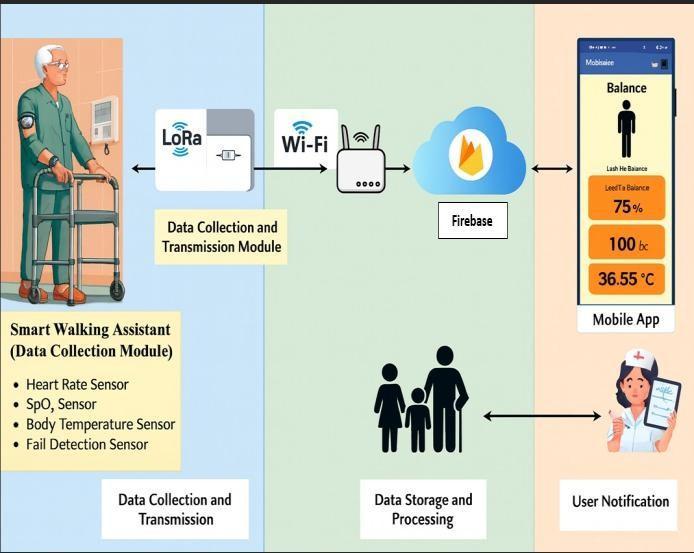
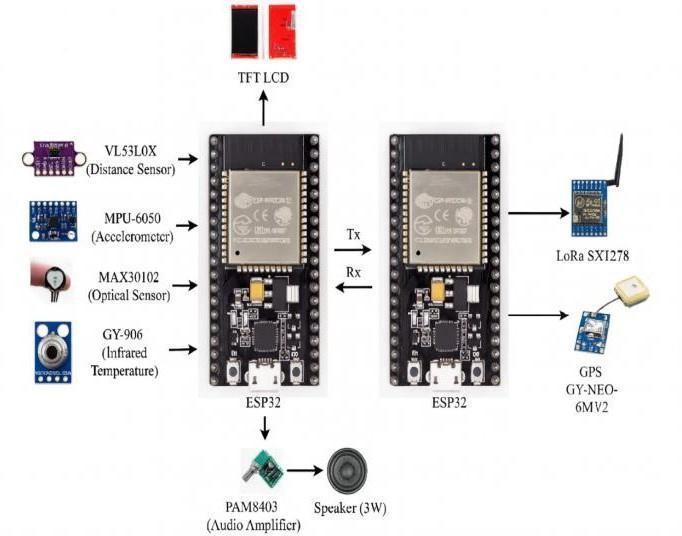
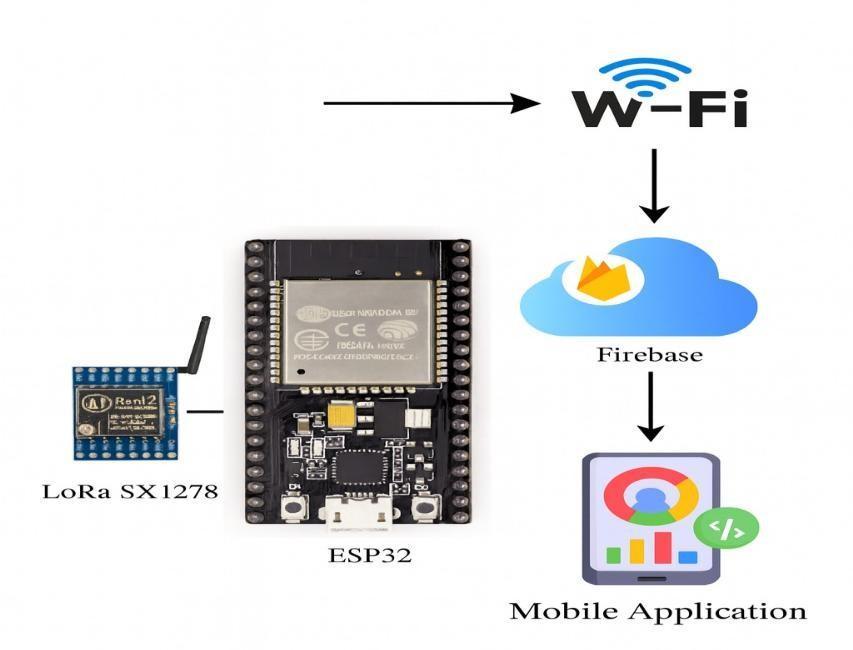
Thesmartwalkingassistantconsistsoftwomodules: (1) adatacollectionmoduleand (2) adatareceptionandtransmissionmodule,enablingcontinuousmonitoringandreal-timealerts.
P-ISSN: 2395-0072
Data Collection Module, is built around an ESP32 microcontroller, which reads physiological and environmental data frommultiplesensorsanddisplaystheinformationona TFTLCDscreen.Itincludesa MAX30102sensorforheartrateand SpO₂measurement,aGY-906infraredsensorfornon-contactbodytemperaturemonitoring,aVL53L0Xdistancesensorfor obstacle detection, and an MPU6050 accelerometer–gyroscope for distinguishing routine movements from falls. In emergencies,a PAM8403-poweredspeaker provides audible alerts. The modulealsointegratesa GY-NEO- 6MV2GPS for transmittingtheuser’spreciselocationwhenafalloccurs.Allcollecteddataaresenttothereceivermoduleusing aLoRa SX1278 wireless module, ensuring long-range, low-power communication for efficient remote caregiver monitoring and assistance.
The data reception and transmission module, basedon an ESP32 controller, receives sensor data via a LoRa receiver, processesit,anduploadsittotheFirebasecloud usingWi-Fiforreal-timemonitoring.Caregiverscanview vital signs, fall alerts,andtheuser’slocationthroughamobileapp,ensuringrapidresponseduringemergencies.Thesystemusesathreetier IoT architecture with dual ESP32 units handling sensing and cloud communication in parallel. FreeRTOS scheduling enablescontinuoussensormonitoringandcommunication,whileadecision-treealgorithmclassifiesfallevents.A10,000 mAhrechargeablebatteryprovidesupto120hoursofoperation,supportedbylow-batteryalertsandvisualindicators.The modular design allows easy component replacement, and the user interface is optimized with large displays and simple controlsforelderlyusers,requiringminimaltechnicalinvolvement.
International Research Journal of Engineering and Technology (IRJET) e-ISSN: 2395-0056
Volume: 12 Issue: 12 | Dec 2025 www.irjet.net
P-ISSN: 2395-0072
ThehardwaresetupusestwocompactPCBs: onefordata collection and one for data reception and transmission. These modulesareenclosedina lightweight control box(12×17.5×5.25cm)thatmountsdirectlyontoawalkingaid, ensuring easyinstallationandusabilityforelderlyindividuals.
Figure 4showstheinternal/external arrangementof thedatacollectionmoduleandthedesignofthereceiverunit, while Figure5displaysthecompletedcontrolboxeswithpowerandWi-Fistatusindicatorsintegratedintothewalkingassistant. Thisstreamlinedlayoutsupportsreliablecommunicationbetweenmodulesandseamlessreal-worldusage
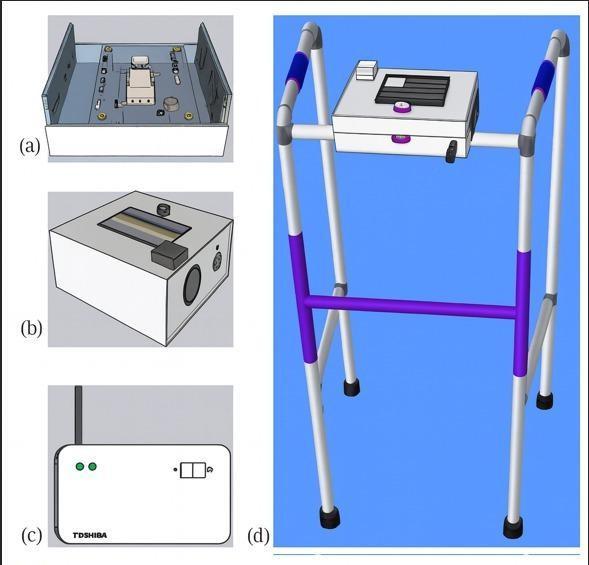
Fig. 4. Hardwaredesignandintegrationofthesmartwalkingassistantsystem:(a,b)internalandexternallayoutofthedata collectionmodule,
(c) designedboxofdatareceptionandtransmissionmodule,and (d) Integrationwithwalkingaid
TheESP32microcontrollercontinuouslyanalyzessensor data to detect health abnormalities and fall events in real time. Heart rate, SpO₂, and body temperature are compared against predefined safe thresholds tailored for elderly users, triggeringalertswhenabnormalvaluesaredetected.Falldetectionusesmotionfeaturesfromthe MPU6050 acceleration andangularvelocity evaluated with threshold rules and a decision-tree classifier to distinguish normal activities from
International Research Journal of Engineering and Technology (IRJET) e-ISSN: 2395-0056
Volume: 12 Issue: 12 | Dec 2025 www.irjet.net
3.5 Experiment design
P-ISSN: 2395-0072
forward, backward, or lateral falls. When a critical event occurs, the system immediately sends alerts to caregivers via Firebase, including the user’s location, time, and last posture, while storing the data for future monitoring and medical analysis.
The system’s performance was evaluated with 10 healthy volunteer students (aged 18–23) under controlled laboratory conditions. Tests were conducted to measure heart rate, SpO₂, body temperature, motion, obstacle detection, and fall detectionaccuracy.HeartrateandSpO₂ readings were taken while participants remained seated, body temperature was measured from a fixed 10 cm distance, and fall detection was simulated in forward, backward, and lateral directions. Obstacledetectionwastestedatdistancesof300mm,500mm,700mm,and900 mm.Eachmeasurementwascalibratedandrepeatedthreetimesforreliability,andallresultswererecordedforanalysis.
4.1 Monitoring of physiological parameters and obstacle detection.
Thesmartwalkingassistantwas evaluatedforitsaccuracy in measuringkey physiological parameters,including heartrate, blood oxygen saturation (SpO₂), and body temperature, as well as its ability to detect obstacles effectively, as shown in Figure 5. Data were collected undercontrolledlaboratoryconditionswithasampleof10young, healthy participants. The averageresultsofthesemeasurements,alongwiththethresholdrangesandobservations,aresummarizedinTable1.
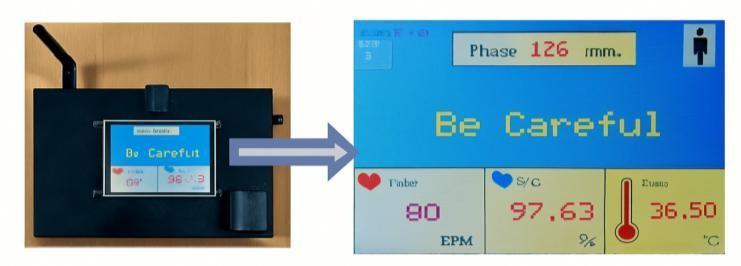
Fig. 5.Resultscapturingphysiologicalparametersandobstacledetectionperformance
Table 1. Averageresultsofphysiologicalparametersandobstacledetectionmeasuredin10participants
4.2 Fall detection and emergency alerts
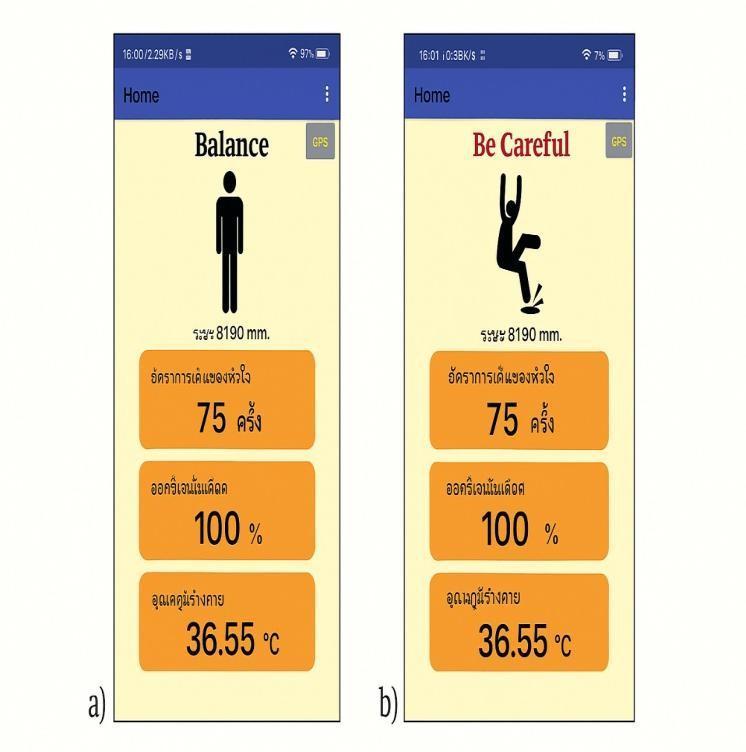
To evaluate the fall detection capabilities of the smart walking assistant, controlled falls were simulated in multiple directions, including forward, backward, and lateral movements. Evaluate fall-detectionperformance, controlled forward, backward,andlateralfallscenarioswereconducted,andthesystemaccuratelydetectedalleventsusingaccelerationand angular-velocitydatafromtheMPU6050,triggeringimmediatealerts.Onceafallwasconfirmed,theuser’sposture,time, and GPS location were automaticallysenttothe mobile appforcaregiver response. The Android-based app provides two modes: a normal monitoringviewdisplaying real-time heart rate, SpO₂,andtemperature,and a fall-alertview indicating emergencystatusandlocationtoensurerapidassistance.
International Research Journal of Engineering and Technology (IRJET) e-ISSN: 2395-0056 P-ISSN: 2395-0072 Volume: 12 Issue: 12 | Dec 2025 www.irjet.net
The smart walking assistant provides a more comprehensive solution than existing systems by combining accurate fall detectionusingtheMPU6050withcontinuousvitalsignmonitoring,obstacleavoidance,andreal-timecaregiveralertswith location tracking via Firebase, improving safetyand responsetime. Whilethis enhances user support compared to prior fall-only or health-only systems, its reliance on fixed thresholds limits personalization, indicating a need for machinelearning-basedadaptationinfuturedesigns.Practicalchallengessuchassmartphonedependencyandalertfatiguemustalso be addressed through alternative notification channels like SMS or automated calls. The system is cost-effective by potentially reducing fall-related healthcare expenses, but further improvements in data security and large-scale testing withelderlyusersinrealenvironmentsarerequired,ascurrentvalidationinvolvedonlyyoungparticipants.
The IoT-based smart walking assistant successfully provides real-time health monitoring, accurate fall detection, and instantcaregiveralerts,improvingelderlysafetyand independence. Testing confirmed reliableperformance indetecting abnormal conditions and fall events. Future work includes machine-learning integration and real-world evaluation with elderly users to improve adaptability and usability. Overall, the system shows strong potential as an effective assistive technology.
7. ACKNOWLEDGEMENT
ThisstudywasmadepossiblebythekindsupportoftheResearchandDevelopmentInstituteofNakhonPathomRajabhat University, and the Creating Innovation for Sustainable Development Research Center, Nakhon Pathom Rajabhat University,NakhonPathom,Thailand.
[1] World Health Organization, “Ageing and health,” 2024. [Online]. Available: https://www.who.int/news room/fact sheets/detail/ageing-and-health[Accessed:Oct.3,2024].
[2] Centers for Disease Control and Prevention, “Facts about falls,” 2024. [Online].Available: https://www.cdc.gov/falls/data-research/facts-stats[Accessed:Oct.1,2024].
[3] A. F. Ambrose, G. Paul, and J. M. Hausdorff, “Risk factors for falls among older adults: a review of the literature,” Maturitas,vol.75,no.1,pp.51–61,2013.https://doi.org/10.1016/j.maturitas.2013.02.009
International Research Journal of Engineering and Technology (IRJET) e-ISSN: 2395-0056 P-ISSN: 2395-0072
[4]B.G.MohammedandD.S.Hasan,“SmarthealthcaremonitoringsystemusingIoT,”Int.J.Interact.Mob.Technol.,vol.17, no.1,pp.141–152,2023.https://doi.org/10.3991/ijim.v17i01.34675
[5] A. Adam, A. Abubakar, and M. Mahmud, “Sensor enhanced health information systems: Issues and challenges,”Int.J. Interact.Mob.Technol.,vol.13,no.1, pp.99–114, 2019. https://doi.org/10.3991/ijim.v13i01.7037
[6]H. Boudlal, M. Serrhini, and A. Tahiri, “A monitoring system for elderly people using WiFi Sensing with channel state information,”Int.J.Interact.Mob.Technol.,vol.17,no.12, pp.112–131,2023.https://doi.org/10.3991/ijim.v17i12.36613
[7]S. Nooruddin, M. M. Islam, F. A. Sharna, H. Alhetari, and M. N. Kabir, “Sensor-based fall detection systems: A review,” JournalofAmbientIntelligenceandHumanizedComputing, vol. 13, no. 5, pp. 2735–2751, 2022. https://doi.org/10.1007/s12652-021-03248-z
[8]P. Vallabh and R. Malekian, “Fall detection monitoring systems: A comprehensive review,” J. Ambient. Intell. Human. Comput.,vol.9,no.6,pp.1809–1833,2018.https://doi.org/10.1007/s12652-017-0592-3
[9] M.Cornacchia,K.Ozcan,Y.Zheng,andS.Velipasalar,“Asurveyonactivitydetectionandclassificationusingwearable sensors,”IEEESensorsJournal,vol.17,no.2,pp.386–403,2017.https://doi.org/10.1109/JSEN.2016.2628346
[10]E. Casilari, M. Álvarez-Marco, and F. García-Lagos, “A study of the use of gyroscope measurements in wearable fall detectionsystems,”Symmetry,vol.12,no.4, p.649, 2020.https://doi.org/10.3390/sym12040649
[11] M.I.Nari,S.S.Suprapto,I.H.Kusumah,andW.Adiprawita,“Asimpledesignofwearabledeviceforfalldetectionwith accelerometer and gyroscope,” in 2016 International Symposium on Electronics and Smart Devices (ISESD), Bandung, Indonesia,2016,pp.88–91.https://doi.org/10.1109/ISESD.2016.7886698
[12] J. Saha, C. Chowdhury, I. Roy Chowdhury, S. Biswas, and N. Aslam, “An ensemble of condition based classifiersfor device independent detailed human activity recognition using smartphones,” Information, vol. 9, no. 4, p. 94, 2018. https://doi.org/10.3390/info9040094
[13] F. Wu, H. Zhao, Y. Zhao, and H. Zhong, “Development of a wearable-sensor-based fall detection system,” InternationalJournalofTelemedicineandApplications, vol.2015,pp.1–11,2015.https://doi.org/10.1155/2015/576364
[14]X.Fuetal.,“RemotemonitoringsystemforlivestockenvironmentalinformationbasedonLoRawirelessadhocnetwork technology,” International Journal of Agricultural and Biological Engineering, vol. 15, no. 4, pp. 79–89,2022.https://doi.org/10.25165/j.ijabe.20221504.6708
[15] R.Ruccoetal.,“Typeandlocationofwearablesensorsformonitoringfallsduringstaticanddynamic tasksinhealthy elderly:Areview,”Sensors,vol.18,no.5, p.1613,2018.https://doi.org/10.3390/s18051613
[16]B.Siregar,U.Andayani,R.P.Bahri,Seniman,andF.Fahmi,“Real-timemonitoringsystemforelderlypeopleindetecting falling movement using accelerometer and gyroscope,” J. Phys. Conf. Ser., vol. 978, p. 012110, 2018. https://doi.org/10.1088/1742-6596/978/1/012110
[17] S.Ahn,J.Kim,B.Koo,andY.Kim,“Evaluationofinertialsensor-basedpre-impactfalldetectionalgorithmsusingpublic dataset,”Sensors,vol.19,no.4,p.774,2019.https://doi.org/10.3390/s19040774
[18] M. V. Albert, K. Kording, M. Herrmann, and A. Jayaraman, “Fall classification by machine learning using mobile phones,” PLoS ONE, vol. 7, no. 5, p.e36556,2012.https://doi.org/10.1371/journal.pone.0 36556
[19] J. He, S. Bai, and X. Wang, “An unobtrusive fall detection and alerting system based on kalman filter and bayes networkclassifier,”Sensors,vol.17,no.6,p.1393,2017.https://doi.org/10.3390/s17061393
[20] A.Z.Rakhman,L.E.Nugroho,Widyawan,andKurnianingsih,“Falldetectionsystemusingaccelerometerandgyroscope based on smartphone,” in 2014 The 1st International Conference on Information Technology, Computer, and Electrical
Volume: 12 Issue: 12 | Dec 2025 www.irjet.net © 2025, IRJET | Impact Factor value: 8.315 | ISO 9001:2008 Certified Journal | Page137
International Research Journal of Engineering and Technology (IRJET) e-ISSN: 2395-0056 P-ISSN: 2395-0072
Volume: 12 Issue: 12 | Dec 2025 www.irjet.net
Engineering,Semarang,Indonesia, 2014, pp. 99–104.https://doi.org/10.1109/ICITACEE.2014.7065722
[21]K.Chaccour, J.Eid, R.Darazi,A.Hajjam el Hassani, and E. Andres, “Multisensor guided walker for visually impaired elderlypeople,”in2015InternationalConferenceonAdvancesinBiomedicalEngineering(ICABME),Beirut,Lebanon:IEEE, 2015,pp.158–161.https://doi.org/10.1109/ICABME.2015.7323276
[22] N. Mozaffari, J. Rezazadeh, R. Farahbakhsh, S. Yazdani, and K. Sandrasegaran, “Practical fall detection based onIoT technologies:Asurvey,”InternetofThings,vol.8,p.100124,2019.https://doi.org/10.1016/j.iot.2019.100124
[23]M.Al-khafajiyetal.,“Remotehealthmonitoringof elderly through wearable sensors,” Multimed. Tools. Appl., vol. 78, no. 17, pp. 24681–24706, 2019. https://doi.org/10.1007/ s11042-018-7134-7
[24] J. Gutiérrez, V. Rodríguez, and S. Martin, “Comprehensive review of vision-based fall detection systems,” Sensors, vol.21,no.3,p.947,2021.https://doi.org/10.3390/s21030947
[25] D. Mrozek, A. Koczur, and B. Małysiak-Mrozek, “Fall detectionin older adults with mobile IoT devices and machine learning in the cloud and on the edge,” Information Sciences, vol. 537, pp. 132–147, 2020. https://doi.org/10.1016/j.ins.2020.05.070
© 2025, IRJET | Impact Factor value: 8.315 | ISO 9001:2008 Certified Journal | Page138