
International Research Journal of Engineering and Technology (IRJET) e-ISSN: 2395-0056
Volume: 12 Issue: 10 | Oct 2025 www.irjet.net p-ISSN: 2395-0072
International Research Journal of Engineering and Technology (IRJET) e-ISSN: 2395-0056
Volume: 12 Issue: 10 | Oct 2025 www.irjet.net p-ISSN: 2395-0072
Govardhan P. Bagul1, Prof. Pramila M. Chawan2
1M. Tech Student, Dept of Computer Engineering, and IT, VJTI College, Mumbai, Maharashtra, India
2Associate Professor, Dept of Computer Engineering, and IT, VJTI College, Mumbai, Maharashtra, India
Abstract - Investor choice is regularly hampered by behavioral biases including loss aversion, impulsiveness, and overconfidence, which are not catered to by conventional portfolio optimization models because of their rationality assumptions.WithdevelopmentsinArtificialIntelligence(AI) and Machine Learning (ML), it now becomes feasible to systematically identify and curb these biases so that more adaptive and tailored investment plans can be made. This paper surveys recent studies on AI technology in behavioral finance and suggests a multi-layered system architecture incorporating behavioral profiling, market data analysis, explainable AI, and continuous learning mechanisms. The proposed framework bridges available gaps in dynamic behavioral modeling and transparency and serves as a basis for intelligent, user-oriented financial advisory systems
Key Words: Behavioral Finance, Investor Biases, Artificial Intelligence, Machine Learning, Reinforcement Learning, Explainable AI, Portfolio Optimization, Adaptive Systems
Financial markets are conventionally described in the EfficientMarketHypothesis(EMH)framework,whereitis assumed that investors are rational maximizers of utility. Behavioral finance refutes this postulate by showing that investorssystematicallydepartfromrationalitybecauseof cognitiveandaffectivebiases.ProspectTheoryresearches byKahnemanandTversky(1979)cementedthatpeopleare disproportionatelyloss-averserelativetoequivalentgainsa phemonemonseenaslossaversion
Asdigitaltradingplatformshavebecomemoreprominent, retail investors create enormous volumes of transactional and behavioral data. Such data offer a chance to study impulsiveness,overconfidence,andherdingpatterns.Atthe sametime,thefinancial sectorisprogressivelyembracing artificialintelligenceforprediction,portfoliomanagement, and risk evaluation. The problem lies in combining behavioral modeling with AI-based decision-making. The majorityofAIinvestmentsystemsmaximizereturnsagainst marketsignals,nottakingintoconsiderationthebehavioral aspect of the enduser. This causes a decoupling between model recommendations and the user's actual decision patterns, which can lower trust and adoption. This study
investigates how AI can help fill this gap by integrating behavioral finance knowledge into financial advisory systems.
This survey discusses representative studies on the use of Artificial Intelligence (AI) in behavioral finance, sentiment analysis, and portfolio management. The chosen papers address:
1. The use of AI and behavioral economics to influence consumerfinancialhealth.
2.Thedetectionofspecificinvestorbiasesusingmachine learning.
3. The development of advanced deep reinforcement learning (DRL) frameworks for high-dimensional portfoliomanagement.
4. The creation of a reinforcement learning framework that adapts to customizable stock pools without retraining
5. Theapplicationofsentimentanalysistopredictmarket behavior.
1. Ben-David, Mintz, and Sade, Working Paper (2020)
AIandBehavioralNudgesforOverdraftFeeReduction
Ben-Davidetal.implementedarandomizedfieldstudywitha large personal financial management platform to examine mechanismsforloweringoverdraftcharges.Theyemployed anAIalgorithmtoclassifyusersaslikelytooverdrafttheir accountsanddispatchedthemreminderalertswithvarying framings.Theresearchrevealedthatsendingareminderwas effective,butitsimpactwasgreatlyincreasedifthemessage was simplified. In addition, a negatively phrased simple message ("Avoid Paying $34.00 Fee") elicited more user activity and had a higher, longer-lasting effect on fee reductionsthanapositivelyphrasedone("Save$34.00").The impacts were largest with users who had medium to high yearlyincomes.
2. Bhorge et al., IJIRT (2024)
FinancialSentimentAnalysisusingTransformerModels
Bhorgeetal.surveyedrecentadvancesinsentimentanalysis forfinancewithanemphasisonsentimentextractionfrom
International Research Journal of Engineering and Technology (IRJET) e-ISSN: 2395-0056
Volume: 12 Issue: 10 | Oct 2025 www.irjet.net p-ISSN: 2395-0072
domainssuchasfinancialnewsandsocialmediatoforecast marketbehavior.Theauthorscomparedtheperformancesof varioussentimentclassificationmodels,includingaclassic NaiveBayesclassifierwithTF-IDFfeatures,astandardBERT model,andFinBERT,anadaptationofBERTpre-trainedona hugedatasetoffinancialdocuments.Theoutcomesindicated that thedomain-specific FinBERT model clearlysurpassed theoverallBERTmodelandtheclassicalNaiveBayesmethod inaccuracy,reaching85%
3. Jiang, Olmo, and Atwi, Global Finance Journal (2024)
DeepReinforcementLearningforHighDimensionalPortfolio Selection
Jiang et al. introduced a state-of-the-art modelfree deep reinforcement learning (DRL) framework to build optimal portfoliostrategiesforintricate,high-dimensionalmarkets suchastheDowJonesIndustrialAverageandS&P100.Their modelintegratesinvestorriskaversionandtradingcostsinto the reward function and utilizes a Twin-Delayed Deep DeterministicPolicyGradient(TD3)algorithmtomanagethe highdimensionalstateandactionspaces.TheproposedRTCCNN-TD3 portfolio showed better performance than conventionalapproaches(MinimumVariance,Max-Sharpe) andcompetingDRLapproaches(PPO,DDPG),withgreater cumulativereturns,Sharperatios,andCalmarratiosonoutof-sampletesting.
4. Zhang et al., WWW (2024)
RL for Customizable Stock Pools using Maskable Representation
Zhang et al. tackled the challenge of using reinforcement learning for portfolio management when investors have adjustablestockpools(CSPs) asituationwhereretraining an RL agent for every slight modification is costly computationally.TheyintroducedEarnMore,amodelthat trains anagent once on a world pool ofstocks. The model employs a new mechanism for masking stocks outside an investor'stargetpoolandlearnsusefulrepresentationsina self-supervisedprocessofmaskingandreconstruction.This enables the agent to adapt dynamically to different CSPs without retraining and substantially outperforms 14 baselinesonavarietyoffinancialmetrics
5. Gupta and Rao, Journal of Informatics Education and Research (2025)
DetectingInvestorBiaswithSupervisedMachineLearning
GuptaandRaoexaminedhowmachinelearningmethodscan detectandanalyzeinvestorbehaviorbiases.Withadataset of transaction records and sentiment analysis, they used randomforest,supportvectormachine(SVM),anddecision treeclassifierstoidentifypatternsrelatedtotypicalbiases. Theirrandomforestmodelhadthebestaccuracy(87.4%),
pinning loss aversion as the most common bias (43% of profiles), followed by confirmation bias (27%) and overconfidence(18%).TheresearchpointsoutthatMLoffers ascalablestructuretosegmentinvestorsbasedonbehavioral characteristics instead of demographics, making personalizationoffinancialadvicemorepossible.
The literature surveyed illustrates a wide variety of AI applicationsinfinance.Theserangefromexplicitbehavioral treatments, as in applying AItimed reminders to avoid consumeroverdrafts(Ben-Davidetal.),topassivedetection ofinherentpsychologicalbiasessuchaslossaversionfrom trading data (Gupta and Rao). Some of the other essential tasks are market forecasting based on sentiment analysis from social media and news (Bhorge et al.) and fully autonomous trading strategy development where Deep Reinforcement Learning (DRL) agents directly control portfoliostomaximizereturns(Jiangetal.,Zhangetal.).
The sources of data are as varied as the tasks, from large proprietaryusertransactionhistoriestopublicstockmarket information (e.g., S&P 500), investor histories, and textual datafromfinancialnews
Methodologically, some major trends are observed: SupervisedLearningmodelssuchasRandomForestandSVM are widely employed to handle classification tasks, for example,identifyingbehavioralbiasesofinvestors.InNatural LanguageProcessing(NLP),thereisadistincttrendtowards domain-specialized transformer models such as FinBERT, which perform by far better than generalized models on finance text. For complicated, sequential tasks such as portfoliooptimization,DeepReinforcementLearning(DRL) is the prevalent, state-of-the-art paradigm, with newer algorithmssuchasTD3beingpreferredduetotheirstability inhigh-dimensionalworlds
3.1
“There is a need for an AI-based investment system that integrates market data with investor behavioral biases to deliverexplainableandadaptiverecommendations.”
TheexistingAI-basedinvestmentplatformsprimarilyfocus on financial metrics and trend analysis but largely ignore behavioral factors that influence real-world investment decisions. Cognitive biases such as overconfidence, loss aversion,andemotionaltradingsignificantlyaffectinvestor actions and decision quality. The proposed framework bridges this gap by combining behavioral profiling with
International Research Journal of Engineering and Technology (IRJET) e-ISSN: 2395-0056
Volume: 12 Issue: 10 | Oct 2025 www.irjet.net p-ISSN: 2395-0072
market analytics through real-time adaptive learning. It emphasizesexplainableAI,enablingtransparentandbiasaware investment suggestions that improve decision accuracy,riskassessment,andinvestortrust.
3.3
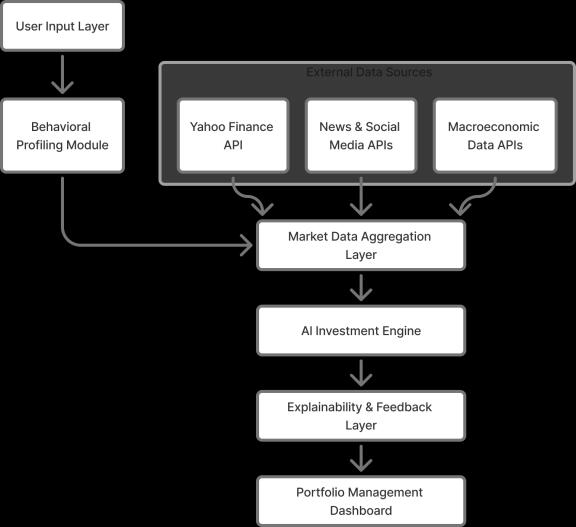
Theintendedmodelcombinesbehavioralfinanceconcepts with reinforcement learning and machine learning algorithmstodevelopaninvestmentadvisorysystemthatis dynamic in nature. The architecture entails seven main layers: Continuous Learning Loop, Portfolio Management Dashboard, Explainability and Feedback Layer, AI Investment Engine, Market Data Aggregation Layer, BehavioralProfilingModule,andUserInputLayer.
3.3.1 User Input Layer
Gathers investor information like financial objectives, investmenttimeframe,andrisktolerance.
Records interaction patterns and emotional signals while usingtheplatform.
3.3.2 Behavioral Profiling Module
Analyzeshistoricaltransactionsandinteractionhistory.
Identifiesbehavioralbiases(overconfidence,lossaversion, impulsiveness,etc.).
Constructs an adaptive risk profile that evolves with new information.
3.3.3 Market Data Aggregation Layer
Combinesreal-timeandpastfinancialinformation.
Sources are stock prices, news sentiment, and macroeconomicdata.
UtilizesAPIslikeYahooFinanceandsocialmediasentiment APIs.
3.3.4 AI Investment Engine
Utilizes machine learning and reinforcement learning techniques.
Optimizes portfolios and provides context sensitive, riskadjustedrecommendations.
3.3.5 Explainability and Feedback Layer
UsesExplainableAI(XAI)techniques(e.g.,SHAP,attention).
Shows rationale for recommendations and collects user feedbackforretraining.
3.3.6 Portfolio Management Dashboard
Offersindividualizedportfoliosummaries,notifications,and behavioralanalysis.
Allowsuserstotrackperformanceandmodifypreferences.
3.3.7 Continuous Learning Loop
Periodically updates models using fresh market and behavioraldata.
Improves forecast accuracy and evolves with altering investorbehavior.
4. SURVEY OF TECHNICAL CONCEPTS
This section discusses the key technical elements of the proposed behavioral finance-inclined investment system, such as behavioral bias identification, reinforcement learning,explainableAI,andadaptivesystems.
4.1 Behavioral Bias Detection
ML models scan transactional data trade frequency, portfolio concentration, and realized gains/losses to identifyinvestorbiaseslike:
Disposition Effect: Tendencytoholdlosingassets fortoolong.
Loss Aversion: Resistancetorealizelosses.
Overconfidence & Impulsiveness: High-frequency tradingandconcentratedinvestments.
Adaptivebehavioralprofilesarecreatedandrefreshedwith useractivity.
International Research Journal of Engineering and Technology (IRJET) e-ISSN: 2395-0056
Volume: 12 Issue: 10 | Oct 2025 www.irjet.net p-ISSN: 2395-0072
RL facilitates dynamic decision-making by engaging with simulated trading conditions, trading off exploration and exploitation.Methodsare:
Q-Learning:Optimizestheselectionofstocks.
Deep RL (DRL): Facilitates dynamic risk managementandassetallocation
These methods enable the system to adapt real-time to marketvolatilityandrisklimits.
4.3 Explainable AI in Finance
XAI enhances AI recommendation transparency and trust through:
Feature Importance: SHAP,LIME.
Attention-Based Models: Identifykeyinputs.
Counterfactual Explanations: Displayalternative outcomesandrisks.
4.4 Adaptive Systems
Online learning and recurrent model updates enable the system to evolve with changing markets and investor behavior, making precise, timely, and individualized recommendationsinthelongrun
Merging AI with behavioral finance involves a number of technicalaswellasethicalissuesthatneedtoberesolvedfor real-worldadoption
5.1 Data Privacy and Ethics
Financial and behavioral information is very sensitive. Regulation compliance like GDPR, along with safe anonymizationandencryption,ismandatory.
5.2 Model Robustness
AI models need to be stable under turbulent market conditions,suchasfinancialcrisesandgeopoliticalshocks, andsubjecttostresstestingandrobustnessvalidation
5.3 Bias Generalization
Overfitting to specific user behavior can restrict generalization.Modelsneedtobalancepersonalizationwith flexibilityacrossdifferentinvestorcohorts.
Deep-learning models are very accurate but not very explainable, whereas less complex models are very transparentbutlessaccurate.Abalancebetweenaccuracy andexplainabilityisessential
5.5 User Adoption and Trust
Trust frominvestorsis extremelyimportant.A human-inthe-loopsystemenablesuserstoverifydecisionsmadebyAI andofferfeedback,increasingtransparency,accountability, anduptake
ThesuggestedAI-basedinvestmentsystemwellcombines behavioral finance concepts with smart decision models. Through the integration of behavioral profiling, market analysis, and explainable AI, it gives adaptive and transparent investment suggestions. This strategy boosts investorconfidence,minimizesbias,andenablesdata-driven financial planning. Future developments will center on adoptingrealinvestordatasets,enhancingprivacycontrols, and enhancing model interpretability without sacrificing accuracy.
[1] Ben-David,D.,Mintz,I.,&Sade,O.(2020).UsingAIand behavioral finance to cope with limited attention and reduceoverdraftfees.WorkingPaper
[2] Bhorge, S., Mhetre, S., Somkuwar, P., & Shivpuje, V. (2024). Financial sentiment analysis. International Journal of Innovative Research in Technology, 11(6), 2433-2437.
[3] Jiang,Y.,Olmo,J.,&Atwi,M.(2024).Deepreinforcement learningforportfolioselection.GlobalFinanceJournal, 62,101016.
[4] Zhang,W.,Zhao,Y.,Sun,S.,Ying,J.,Xie,Y.,Song,Z.,Wang, X., & An, B. (2024). Reinforcement learning with maskable stock representation for portfolio management in customizable stock pools. In ProceedingsoftheACMWebConference2024(WWW '24).ACM.
[5] Gupta,S.,&Rao,V.S.(2025).AIinbehavioralfinance: Understandinginvestorbiasthroughmachinelearning. Journal of Informatics Education and Research, 5(2), 5870-5880.
International Research Journal of Engineering and Technology (IRJET) e-ISSN: 2395-0056


Volume: 12 Issue: 10 | Oct 2025 www.irjet.net p-ISSN: 2395-0072 © 2025, IRJET | Impact Factor value: 8.315 |
GovardhanBagul,M.TechStudent, Dept.ofComputerEngineeringand IT, VJTI College, Mumbai, Maharashtra,India
Prof. Pramila M. Chawan, is workingasanAssociateProfessor in the Computer Engineering Department of VJTI, Mumbai. She has done her B.E.(Computer Engineering) and M.E.(Computer Engineering)fromVJTICollegeof Engineering, Mumbai University. She has 30 years of teaching experienceandhasguided85+M. Tech. projects and 130+ B. Tech. projects. She has published 148 papers in the International Journals, 20 papers in the National/International Conferences/Symposiums