
International Research Journal of Engineering and Technology (IRJET) e-ISSN: 2395-0056
Volume: 13 Issue: 03 | Mar 2026 www.irjet.net p-ISSN: 2395-0072
International Research Journal of Engineering and Technology (IRJET) e-ISSN: 2395-0056
Volume: 13 Issue: 03 | Mar 2026 www.irjet.net p-ISSN: 2395-0072
Raghab Singh1 , Pramesh Baral2
1 , 2 Department of Computer Science University of South Dakota Vermillion,SD ***
Abstract - An Android sketch-controlled robotic locomotion system is presented for safe exploration of hazardous environments. Thesystem integrates an Arduino Uno microcontroller, HC-05 Bluetooth module, L293D motor driver, DCmotors, and an HC-SR04 ultrasonic sensor. A custom Android application is developed using MIT App Inventor, which converts touchscreen sketches into directional commands that are transmitted wirelessly to the robot. The Arduino microcontroller processes the received commands and actuates the motors accordingly. Obstacle detection is implemented using ultrasonic time-of-flight ranging. The proposed system provides a low-cost teleoperated robotic platform suitable for controlled navigation in constrained and hazardous conditions.
Keywords - Android control, Bluetooth module HC 05, Arduino Uno, ultrasonic sensor HC SR04, mobile robotics
Mobileroboticsystemsarenownecessaryforsituationaltaskswherehumaninterventionhasbecomeunsafe,inefficient, oreveninconvenient.Roboticplatformsthatcanbereliedontoprovidemobility,sensing,andcommunicationarerequired in applications like disaster response, structural inspection, industrial surveillance, and search-and-rescue operations. Classicalroboticsliteraturehighlightstheimportanceofperceptionmechanism,controlmechanism,localizationmechanism, andactuationmechanismbeingcloselyinterconnectedinordertomakeasuccessfulmobilesystem[1],[2].Althoughthere hasbeena tremendousimprovementinfullyautonomous robots,the teleoperatedandsemi-autonomoussystemsremain very important in real-life applications owing to less computational load, predictability, and constant human control. The currentAndroidsketchroboticlocomotionsystemisdrivenbythefactthatitisrequiredtohavealow-cost,human-in-theloopexplorationrobot,withprioritiesonoperationalsafetyandaccessibility.
Anotherkeyaspectinthisprojectisthe human-robotinteractionthatiseasytouse.The interfacesusedintraditional formsofteleoperationarebasedondiscretebuttonpresses,joystickcontrols,whichmaylimitintuitiveinteractioncompared withtrajectory-basedgesturecontrolapproaches [3] Suchinterfacesarealsofunctional,buthavecognitiveoverheadand limitationsonnaturaltrajectoryexpression.TheHRIfieldofresearchpointsoutthattheinterfacedesignplaysasignificant role in decreasing the workload of operators and enhancing the performance of the task [4] Gesture interaction in a touchscreencanprovideaviablealternativesincetheuseofsmartphonesisubiquitous.Androiddevicesconsistofwireless communication, processing, and high-resolution input interfaces, which are integrated. Previous investigations have also confirmed the practicability of Android-managed mobile robots on Bluetooth communication-based surveillance and surveillanceapplications [5],[6].Nevertheless,directionalcontrolisanelementarymechanismthatisinplaceonmostofthe systems.Thesuggestedsystemgoesasfarastoaddtothisideabyhavingasketchinputthatenablesuser-drawnmotion patternstobetranslatedintolocomotioncommands,whichenhancestheefficacyofteleoperation.
Theotherneedishigh-qualityshort-rangewirelesscommunications.Introducedinthe2.4GHzportionoftheISMband, Bluetoothtechnologyhaslowpowerconsumption,iseasytopair,andhassufficientspeedofdatatransferincommands.In thecaseofembeddedroboticplatforms,HC-05canbeused,whichsupportsserialcommunicationviaUARTthatiscompatible withmicrocontrollers.IndoorroboticsystemsbasedonBluetoothcontrolarchitectureshavebeentestedasbeingpractical [5], [6] Bluetooth has lowerpower needsand eases the integration ofsystems, so itis appropriate in applications where prototypingeducationalexplorationtasksarecontrolled,andaWi-Ficonnectionisdifficulttoachieve.Sincethesuggested robotisaimedat short-range riskyscenarioslikeconfinedbuildings,Bluetoothinterconnectionisappropriate intermsof operationalfeatures.
Another important project requirement is safe navigation. Obstacle detection is also important even in teleoperated systems, to avoid unwanted collisions and mechanical damage. Mobile robotics has a wide range of perception systems, startingwithsimpleproximitysensors,LiDARs,andvision-basedsystems[2] Ultrasonictimeofflightsensingisacommonly used,cost-effectivemethodofmeasuringshort-rangedistances.Theultrasonicrangingtheoreticalframeworkofcomputing the distance bythe time the echo returnedisdevelopedin the fieldofrobotics [1] Although existence of moreresolution sensingmodalities,theultrasonicsensorsofferanacceptablelevelofprecisionandpowerwithregardstoindoornavigation
International Research Journal of Engineering and Technology (IRJET) e-ISSN: 2395-0056
Volume: 13 Issue: 03 | Mar 2026 www.irjet.net p-ISSN: 2395-0072
ThenecessaryenvironmentalawarenesscanbeachievedbytheuseofHC-SR04sensorintheproposedsystemwithminimum complexityaddedtothecalculations.
Embeddedcontrolarchitectureisanotherrequirement.Microcontroller-basedplatformshavebeenextensivelyusedin prototypingrobotsduetodeterministictiming,lowpowerconsumptionandalsohavethecapabilityofinterfacingwithother modules[2] ArduinoUnoisaplatformbasedonATmega328P,anditiscapableofmanagingdigitalI/O,analoginput,and memory resources, thus performing serial communication, motor control programs, and sensor interfacing. Two independently controlled DC motors and an H-bridge motor driver, such as the L293D, have been shown to constitute a differentialdrivelocomotion,oneofthemostmechanicallyefficientandmostcommonlystudiedmobilityconfigurationsin wheeledrobotics[1].Thisstructureguaranteesflexibilityandmechanicalease,whichmatchesthecost-basedandeducational aimsoftheproject.
Inadditiontodeterministicteleoperation,thecurrentstudyofroboticsappliesmoremethodsofadaptivelearningand evolutionaryoptimizationtoimprovetherobustnessindynamicsettings.Robotscanbuildandoptimizecontrolpoliciesby trialanderrorwiththeirenvironmentusingreinforcementlearningstructures,whichareusefulinreducingperformance indicators, including stability and task completion performance [3] On the same note, evolutionary AI methods search morphological andlocomotor designevolutionin robustexplorationrobots [7] Even though the current systemdoes not adoptlearning-basedautonomy,thepreviousresearchdemonstratesthelargerresearchenvironmentinwhichteleoperated platforms can become intelligent adaptive systems. The designed architecture can thus be used as a platform on which adaptivecontrolstrategiescanbeattachedinthefuture.
A. Foundation of Mobile Robot Locomotion
Theproblemofmobilerobotlocomotionhasbeenwidelyresearchedintermsofkinematicmodelling,motionplanning,and controlstability.Oneofthemostcommonlyusedarchitecturesinmobilerobotsisthedifferentialdrivemechanismswhere two independently actuated wheels are used; the reason being the simplicity and maneuverability of the design. Such nonholonomicsystemshavegoodkinematicandcontrolschemes [8],[9] Tobemoreprecise,thelawsofstabilizationof postureofthewheeledmobilerobotsandthelawsofthetrajectorytrackingcontrolhavebeenanalyzedcriticallytoenable thewheeledmobilerobotstobestableintermsofnavigationwithinalimitedspeedrange[8] Moreover,thequestionnaires concerning the use of motion control techniques identified the tradeoff between implementation and performance in environmentalperturbations[9] Thepresentprojectincludesadifferentiabledrivescheme,whichfitswithintheseexisting frameworks,butisconcernedwithcontrollabilityandmechanicalsimplicityinindoorexploratorytasks.Teleoperationand HumanRobotInteraction.
B. Teleoperation and Human Robot Interaction
Roboticsystemsthatareteleoperatedareessentialinenvironmentsthatarehazardousoruncertain,wherefullautonomyis not dependable. The studies conducted in the context of human- robot interaction (HRI) have highlighted interface transparency,lesscognitiveload,andnaturalmappingofcommandsastheprimaryfactorsthatinfluencetheefficiencyof teleoperations.Theinitialexperimentalreviewsofteleoperationinterfaceshaveindicatedthatcontrolmodalityandfeedback designhaveastronginfluenceonoperatorperformance[10] Moreover,researchonhumansupervisorycontroloverrobots hasshownthatsimplifiedinteractionmodelsenhancereactiontimeandsituationalawarenessintheprocessofnavigation [11] Thisevidenceconfirmsthatalternativeparadigmsofinteractionotherthantheconventionalinputmechanicaljoystick are necessary. When used within the framework of this project, gesture control using sketches will seek to bring the commandstotherobotmotionclosertothehumanmotorintuition.
Wirelesscommunicationtechnologiesplayacentralroleindistributedroboticarchitectures.Performanceevaluationsof Bluetooth-basedembeddedcommunicationconfirmstableserialdataexchangeundermoderateinterferenceconditions[12]. Sincethesuggestedrobotwillbeusedinshort-rangehazardousexplorationandnotlong-rangedeployment,theBluetooth communicationcanmeettheenergyandintegrationneeds.
International Research Journal of Engineering and Technology (IRJET) e-ISSN: 2395-0056
Volume: 13 Issue: 03 | Mar 2026 www.irjet.net p-ISSN: 2395-0072
The mobile robots require environmental perception as a major requirement. Whereassophisticatedsystemsuse LiDAR and vision-based simultaneous localization and mapping (SLAM), low-priced platforms often make use of ultrasonic proximity sensing. The results of experimental investigations of ultrasonic sensors indicate that they can be used with acceptable accuracy when detecting obstacles over a short distance within structured indoor environments [13] The ultrasonic ranging time-of-flight principle is computationally cheap and capable of integration into a microcontroller processor.Eventhoughultrasonicsensorscannotbeusedtomapoutindetail,ithasenoughcollisionavoidancetobeused inteleoperatedsystems.TheimplementationofsensingbasedonHC-SR04inthisprojectisconsistentwiththeprovenlowcostroboticdesignprocesses.
The Android Sketch Controlled Robot Locomotion is modeled such that the hardware integrated into the unit, communication,sensing,andcontrolsoftwarecreatetheabilitytomakearoboticvehiclefollowdirectionalsketchesdrawn byamobiledevice.ThearchitectureoftherobotcomprisesanArduinoUnomicrocontroller,HC-05Bluetooth,L293Dmotor driverIC,twoDCmotorstoactaslocomotors,andanHC-SR04ultrasonicsensortodetectobstacles.TheAndroiddevicewill actasacommandinterfacewithsketchesofdirectionsentviatheBluetoothconnectiontotheArduino,whichthendeciphers themessageandsendsthemotorsintomotion
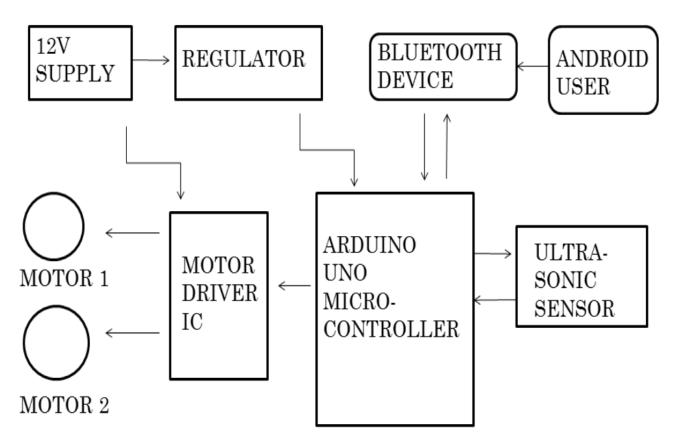
TheBluetoothHC-05moduleallowsthemobiledeviceandrobottocommunicatewirelesslythroughaserialconnection. Thismoduleworksinmaster-slavemode,andtherearecross-connectionsbetweentheTx/RxpinsofthemoduleandRx/Tx pinsoftheArduinotoguaranteeahighlevelofdataintegrity.DirectionalcommandscodedintheAndroidapplicationare sentviaBluetoothandareusedtocontrolthemovementoftherobotsinreal-time
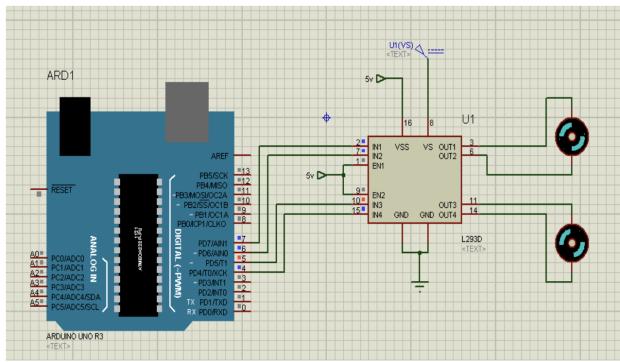
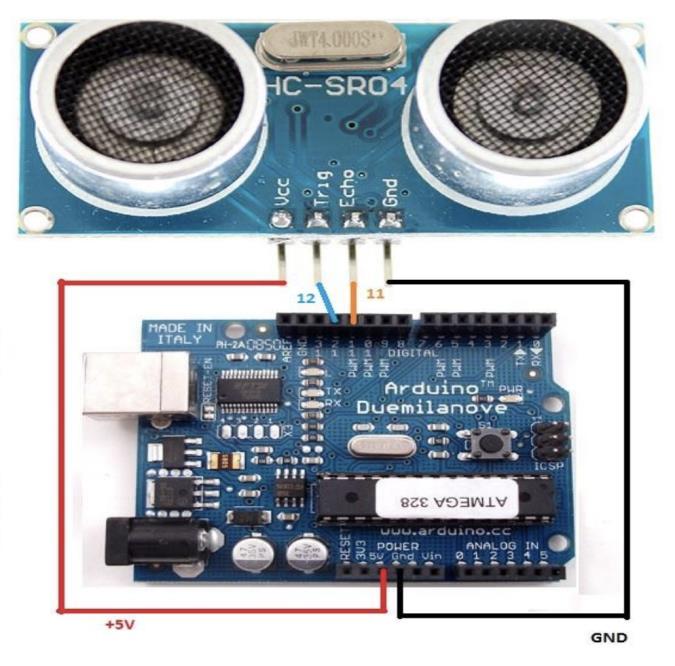
ThelocomotionsystemoftherobotisplacedbytheconnectionbetweentheArduinoUnoandtheL293DmotordriverIC. TheL293DICcanbeusedtocontroltwoDCmotorsinabidirectionalway,andtherotationdirectiondependsontheinput signalsoftheArduino.TheDCmotorstotheoutputpinsoftheICgiveitforward,backward,left,andrightmotion.TheHCSR04 ultrasonic sensor is connected to the Arduino in terms of trigger and echo pins to carry out non-contact distance measurementsothatobstaclescanbedetectedinarangeof2cmto400cm
International Research Journal of Engineering and Technology (IRJET) e-ISSN: 2395-0056
Volume: 13 Issue: 03 | Mar 2026 www.irjet.net p-ISSN: 2395-0072
The Android application is created with the help of MIT App Inventor, which provides a graphical representation of sketchingdirectionandsendsthenecessarycommandstotherobot[14],enablingatrajectory-basedinteractionsimilarto gesture-driven control interfaces used in human-robot interaction systems. The interface contains directional controls, a speedslider,andBluetoothdeviceselectionthroughalistpicker.Sketchinputistranslatedtoserialcommands,whichare used to activate robot movement. Continuous communication and command updates are done by clock logic and control blocks
The control logic is implemented in C/C++ in the Arduino IDE. The setup procedure allows the configuration of communicationinterfaces,pins,andsensorsettings,andconsequently,theloop()procedureconstantlyprocessesincoming Bluetooth commands. Directional inputs create the motor control signals, and the ultrasonic sensor takes the periodic
International Research Journal of Engineering and Technology (IRJET) e-ISSN: 2395-0056
Volume: 13 Issue: 03 | Mar 2026 www.irjet.net p-ISSN: 2395-0072
distancereadingssothatthereisnocollision.Thesystemworksinaclosed-loopapproachwheremotioncommandsandthe obstacledetectorareworkedoutcontinuouslytosupportpropernavigation
The system is able to read the drawing on Android to command the movement of the robot in the four major directions: forward, backward, right, and left. The DC motors are sensitive to the control signals, confirming proper operation of the motordriversandcommandexecution
TheHC-SR04ultrasonicsensorhasahighaccuracyandcanmeasuredistancesrangingbetween2cmand400cm,makingit useful in obstacle detection in order to navigate safely. The sensor is capable of giving effective readings in any ambient lightingconditions.
TheAndroidapplicationcreatesastableBluetoothconnectionwiththerobotandsendsdirectionalcommandswithaminimal delay.Bysketchingdrawings,usersareabletocontroltherobot,basedondrawingstonavigateit,controlitsspeed,andother optionslikecamera rotation.Theapplicationinterface makes iteasyforoperators tocontrolevenwithoutpriortechnical knowledge.
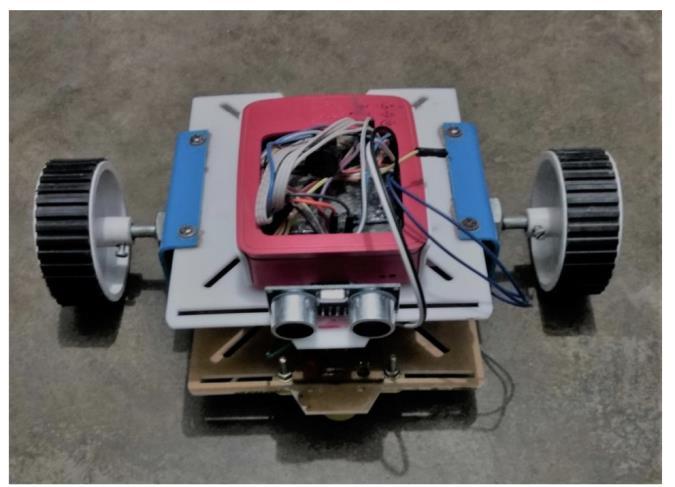
TheBluetoothcommunication,Androidinterface,andArduino-basedhardware integrationoffera propersolutiontothe real-time control of the robot. The draw-based navigation system increases the simplicity of work, and the robot can be controlledwithrespecttoitspositionaccuratelywithoutusingamanualjoystickoracomplicatedcontrolboard.
ThismotordriverIC andDCmotorcombinationenablesbidirectionallocomotion,whichshowsthe sameand repeatable movementinalldirectionscalledon.Theultrasonicsensorprovidestheabilitytodetectobstaclesandprovidecontingent awareness,butonlythedetectionandtheloggingofcommandswerepossible.
The use of Bluetooth communication is an effective medium for transmitting commands inside the building. The system exhibitsahighreactivitytosketchinput,butBluetoothrestrictsitsoperationrange.Theimplementationinthefuturecan haveWi-FiorZigbeemodulestoincreasethedistanceofthecontrolwithoutlosingtheflexibilityofthesystem.
The whole hardware-software structure attains the objective of Android sketch-based locomotion and simple environmental perception. The modular design also supports future development, such as adding GPS, gas sensors, or automated navigation algorithms, without altering the architectural structure that is already developed in the present implementation.
International Research Journal of Engineering and Technology (IRJET) e-ISSN: 2395-0056
Volume: 13 Issue: 03 | Mar 2026 www.irjet.net p-ISSN: 2395-0072
Theprojectdemonstratesthatsketch-basedcontroloffersaninteractivemeansofmovementcontroloftherobot,even without technical knowledge. Hardware and software can be readily combined in a modular way, which allows future upgrades. Dynamic environments enhance operational safety because of real-time user input. The fact that low-cost componentsareusedprovesthatitispossibletocreateagoodroboticsystematalowcost.Allinall,theinterfacecanbe usedtoenablemoresophisticatedsemi-autonomousoradaptiverobotictasks.
In future work, the proposed sketch-controlled robot system can be enhanced by integrating artificial intelligence techniques toimprove gesture recognitionandenable more intelligent robot control.Machine learningand deeplearning modelscouldallowtherobottointerpretcomplexsketch-basedcommands,whileAI-basedperceptionanddecision-making modulesmaysupportautonomousnavigation,obstacleavoidance,andadaptivemotionplanning.Additionally,incorporating wirelesstechnologiessuchasWi-FiorZigbeecanextendoperationalrange,whileintegratingGPSandenvironmentalsensors (e.g., gas, temperature, and obstacle detection) can improve situational awareness, similar to IoT-based monitoring architectures used in sensor network systems [15]Further improvements such as component miniaturization and the additionofadvancedmoduleslikeRFID-basedsecurityorspecializedtoolscouldexpandtherobot’sapplicationsinsafety, surveillance,andindustrialenvironments.
[1] S.R I.R NourbakhshandD.Scaramuzza, Introduction to autonomous mobile robots, MITpress,2011.
[2] S.B.O.Khatib,T.Krögerande.,Springerhandbookofrobotics,Berlin:springer,2008.
[3] R Singh, "Reinforcement learning for robotic singulation: Policy space impact on interactive manipulation," in International Conference on Future Technologies (ICFT),2025.
[4] C J YC,E C,H.andM J Barnes,"Humanperformance issuesanduserinterface designforteleoperatedrobots," in IEEE Transactions on Systems, Man, and Cybernetics, Part C (Applications and Reviews),2007.
[5] J.T.Maria,P.T.Vasumathi,R.LavanyaandS.R.Pandian,"Mobilerobottemperaturemonitoringsystemcontrolledby AndroidapplicationviaBluetooth," International Journal on Advanced Computer Theory and Engineering (IJACTE), vol. 2,no.3,pp.138-142,2013.
[6] B K.R GaikwadandA Rajput,"Wirelesscontrolledsurveillancerobot," International Journal of Advance Research in Computer Science and Management Studies , vol 2,no.2,pp 436-437,2014.
[7] R Singh, "Evolutionary AI for Morphological and Locomotor Design of Resilient Exploration Robots," in 9th International Conference on Computational System and Information Technology for Sustainable Solutions (CSITSS), 2025.
[8] S.C, Control of chained systems application to path following and time-varying point-stabilization of mobile robots, vol 40,IEEEtransactionsonAutomaticControl,2002,pp 64-77.
[9] K.Y.Y.Kimura,F.MiyazakiandT.Noguchi,"Astabletrackingcontrolmethodforanautonomousmobilerobot,"in In Proceedings., IEEE International Conference on Robotics and Automation,1990.
[10] S.andT.,"Humansupervisorycontrolofrobotsystems,"in IEEE International Conference on Robotics and Automation, 1986.
[11] G M AandA C Schultz, Human–robot interaction: a survey, 2008.
International Research Journal of Engineering and Technology (IRJET) e-ISSN: 2395-0056
Volume: 13 Issue: 03 | Mar 2026 www.irjet.net p-ISSN: 2395-0072
[12] B.andJ., A Proposed Framework for Crowd-Sourced Social Network Data Collected over Bluetooth, 2014.
[13] B.J.andY.Koren,"Obstacleavoidancewithultrasonicsensors," IEEE Journal on Robotics and Automation , vol.4,no. 2,pp.213-218,2002.
[14] R.Singh,"GestureRecognitionforRemoteControlSystemsUsingKernelPrincipalComponentAnalysis(KPCA)and TrajectoryNormalization,"in TechRxiv,2025.
[15] K. Khanal, G. Ojha, S. Chataut and U. K. Ghimire, "IoT-Based Real-Time Soil Health Monitoring System for Precision Agriculture,"in International Research Journal of Engineering and Technology (IRJET),2024.