
International Research Journal of Engineering and Technology (IRJET) e-ISSN: 2395-0056
Volume: 12 Issue: 11 | Nov 2025 www.irjet.net p-ISSN: 2395-0072
International Research Journal of Engineering and Technology (IRJET) e-ISSN: 2395-0056
Volume: 12 Issue: 11 | Nov 2025 www.irjet.net p-ISSN: 2395-0072
Kunal Suresh Patil1 , Dr Vinod Kumar Suman2
1Research Scholar, Electronics & Telecomuunincation 2Professor, Sunrise University, Alwar (Rajasthan)
Abstract - High-capacity opticalcommunicationsystemsare being developed to meet the increasing demand for seamless and high-speed data transmission. Advanced modulation techniques, such as Quadrature AmplitudeModulation(QAM), Orthogonal Frequency Division Multiplexing (OFDM), Frequency Shift Keying (FSK), Phase Shift Keying (PSK), and MIMO, are being explored to unlock higher data rates and greater bandwidth utilization. These techniques leverage the inherent capabilities of light to carry data, pushing the boundaries of what is achievable in the realm of optical communication. Optical communication systems have emerged as a cornerstone technology in meeting the escalating data rate demands of the modern digital age. With advancements like wavelength division multiplexing (WDM), optical systems can achieve multi-terabit-per-second data rates, making thempivotalinglobalcommunicationnetworks. As 5G networks roll out and 6G promises are on the horizon, optical communication systems will playanindispensablerole in backhaul and fronthaulconnections,supportinglowlatency andhigh data rates needed for the next generationof wireless communications.
Key Words: High-Capacity Communications, EnergyEfficientOpticalFiber,SignalProcessingInnovations.
In the rapidly evolving landscape of high-capacity opticalcommunicationsystems,thequestforincreaseddata rateshasbecomeparamount.Asthedemandforseamless and high-speed data transmission continues to surge, researchers and engineers are delving into innovative approaches to enhance the efficiency and performance of optical communication systems. Advanced modulation techniques have emerged as a pivotal area of exploration, offering the promise of unlocking higher data rates and greaterbandwidthutilization.Thesetechniquesleveragethe inherent capabilities of light to carry data, pushing the boundaries of what is achievable in the realm of optical communication.Inthiscontext,thisexplorationdelvesinto the fascinating realm of advanced modulation techniques, shedding light on their significance, applications, and the transformative potential they hold for the future of highcapacityopticalcommunicationsystems.
Related Work Mats Skold et al (2010) in his article, investigate the techniques for the highly precise characterizationofopticaldatabyutilisingopticalsampling principles, which are based on a four-wave mixture in a highly nonlinear fiber. This method provides exceptional sensitivity and sub-ps time resolution, which facilitates statisticalanalysisandeliminatesimpulseresponseartifacts. The all-optical approach to characterization of optical waveformsisshowntobeahighlypracticalandcompelling methodforcapturingthedetailsofadiverserangeofdata categories.Furthermore,itistheoreticallycapableofscaling toexceedinglyhightransmissionrates.[4]
JianjunYuetal(2010)analyseandsummariesavarietyof high-capacitytransmissionsystemsthatoperateat100Gper channelandareenabledbyadvancedtechnologies,suchas hybrid EDFA/Raman amplification, digital coherent detectiontechnologies,newlow-lossandlargeeffectivearea fiber,andmultilevelmodulationformats.Heshowthatnovel synthesismethodscanbeemployedtogeneratehigh-speed QPSK,8PSK,8QAM,and16QAMusingonlybinaryelectrical drivesignalsincommerciallyavailableopticalmodulators. Furthermore,heillustratethatdigitalcoherentdetectioncan beemployedtoidentifyeachofthesemodulationformats.In addition, he present most recent research findings on orthogonalDWDMtransmissiontechnologies,whichenable 400Gb/sand1Tb/sperchannel.[5]
Eugen Lach et al (2011) investigates the technological alternativesformodulationformatsthatareappropriatefor serialopticaltransmissionatratesof100Gb/sandhigher.In the initial section, an overview of the diverse modulation formatsfor100Gbit/sispresented.Includedinthiscategory areclassicalbinaryelectronictimedivisionmultiplexed100 Gbit/sNRZsystems,whichoperateatthemaximumspeed, as well as mature product solutions from system vendors that operate at lesser symbol rates. In the receiver, these solutions employ coherent technologies, digital signal processing, polarization division multiplexing, and quaternary phase shift keying. The second section is dedicated to the next generation of transmission systems, whicharecapableoftransmittingdata atchannel bitrates exceeding 100 Gbit/s, including 400 Gbit/s and up to 1 Tbit/s or higher. These systems may utilise higher
International Research Journal of Engineering and Technology (IRJET) e-ISSN: 2395-0056
Volume: 12 Issue: 11 | Nov 2025 www.irjet.net p-ISSN: 2395-0072
constellation M-QAM modulation of a single carrier or multiple electrical subcarriers and optical superchannels, which also comprise a single WDM channel. The paper provides a performance comparison for 100 Gbit/s and higher bitrates in both sections, as well as the major characteristicsofthemodulationformats.Italsodetermines theappropriateapplicationareasoftransporttechnologies forfuturenetworks.[6]
AmrM.Raghebetal(2012)presentanoverviewofthemost promisingNG-PONmodulationsandDSPtechnologies.This encompasses multilayer-based OFDM systems, as well as modulation and optical OFDM methods such as QPSK, MQAM, and MSK. He examine the diverse facets of these technologies,emphasizingthemostsignificantcontributions they have made and the obstacles they encounter in the development of next-generation access networks that are bothcost-effectiveandperformexceptionallywell.[7]
Deva K Borah et al (2012), concludes with hybrid optical wireless/radio-frequency(OW/RF)systems,whichimprove the overall reliability of the system by utilizing a supplementaryRFlink.Theemphasisisonthemethodsof collaboration between the reliable RF subsystem and the broadbandOWsystem.[8]
3.1 Introduction
NonlinearityinducedimpairmentssuchasFWMandXPMin a traditional optical communication link may be compensated for by either allowing the residual local dispersion of the fibre to persist or by appropriately increasingthechannelspacing.
Since dispersion is a linear process, dispersion correction maybeappliedatthereceiverendorsporadicallyacrossthe connection to balance the buildup of dispersion along the transmissionfiber.
However,thismakesthesystemmoredifficultthanthose thatuseopticalfibreswithlowerdispersionvaluestoavoid theneedfordispersioncontrol.
3.1.1
The concept of interference drives Mach-Zehnder modulators,asopposedtoelectro-absorptionmodulators. Thereisaninputcouplerseparatingthetwoincominglight beams.
Aphasemodulatorisusedononeroutetoaccomplishthe regulationofthephasedifferencebetweenthetwooptical beamsbytheappliedvoltagesV1,2. Depending on the phase difference that is produced, this appliedelectricalvoltagemayproduceeitherconstructiveor destructiveinterference,aphenomenoncalledasintensity modulation.
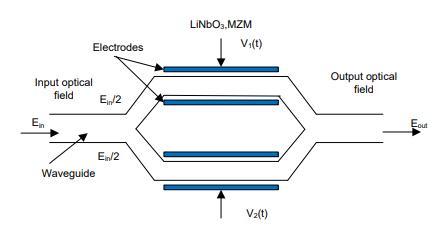
Tochoosethebestmodulationformat,anumberoffactors need to be taken into account, such as power margin, toleranceagainstGVD,SPM,XPM,FWM,andSRS,aswellas spectrum efficiency and tolerance against fibre nonlinear effects.BecausetheNRZformatissosimpletocreate,detect, andanalyze,itisthemostbasicformatthathasbeenwidely utilized in IMDD systems to date. In light of the fact that opticalsystemsareintegratingDWDMandopticalamplifiers to accommodate larger data rates, the NRZ modulation format maynot be the best optionfor bigcapacity optical systemsintherecentpast[25,26].However,becauseofits historicaldomination,widefielddeployment,andsimplicity, NRZwouldbeausefulbenchmark.
The NRZ format is now the most extensively utilised in commercialgoodsduetoitssimplicity.Comparedtophase shiftkeying,itislessvulnerabletolaserphasenoise,hasa smallerelectricalbandwidthfortransmittersandreceivers, andhasthesimplesttransmitterandreceiversetup.Fig.3.2 displaystheNRZcodingformat.
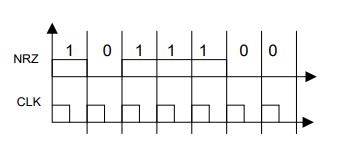
Fig.2:RepresentationoftheNRZcode.
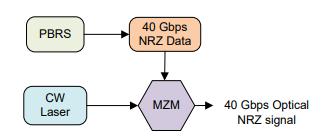
Fig.3: BlockdiagramofNRZtransmitter
Fig.3.3showstheschematic block design forthe40Gbps NRZ transmitter. A 40 GHz NRZ data stream powers the MZMbyON/OFFkeyinganopticalsignalproducedbythe continuous-wave (CW) laser source. The applied electric
International Research Journal of Engineering and Technology (IRJET) e-ISSN: 2395-0056
Volume: 12 Issue: 11 | Nov 2025 www.irjet.net p-ISSN: 2395-0072
field, whose voltage varies according to a preset function, modulates the intensity of the carrier light wave. An electrical NRZ signal is used to drive the MZM at the quadraturepointofthemodulatorpowertransferfunction. NRZ optical transmissions are detected by a simple photodiode at the receiver, which transforms the optical power of the signal into an electrical current. The term "direct detection" describes this. In this thesis, other modulation kinds are also detected using the same direct detection approach, as long as they are not indicated explicitly.
The decreased on-off transitions cause the NRZ pulses to have a limited optical spectrum. Improved dispersion tolerance and enhanced spectral efficiency are made possiblebythenarrowerspectralwidth;still,ISIoccursin betweenthepulses.SinceanNRZmodulatedopticalsignalis less resistant to the fibre nonlinear effect than its RZ equivalent,morestudyisbeingdoneontheRZformat[27].
3.1.4 Return-to-Zero (RZ) Format
Higherdatarates,such40Gbps,haveagreaterinfluenceon non-linearity,andtheRZsignalformatperformsbetterthan theNRZsignalformat.AsshowninFig.3.4,thepowerlevel in RZ format is 0 for the 0 bit continually. After half the duration,itreturnsto0forthelogical1bit.
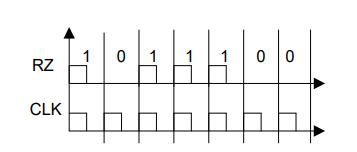
Fig.4: RepresentationoftheRZcode.
3.2 Transmitter Design for Carrier Suppressed Returnto-Zero (CSRZ) Format
ManytransmissionexperimentshaveusedtheCSRZformat, whichisamodificationoftheRZformatandhasasmaller pedestalshapeoftheopticalspectrumthantheoriginalRZ format[27].Itisalsoveryresistanttothecombinedeffects of SPM and GVD. The π phase shift that occurs between successive data points sets the CSRZ signal apart from ordinary RZ. Unlike correlative coding schemes, like duobinary,thesignreversalshappenateverybittransition and are independent of the signal's information-carrying part. When successive bit locations alternate, the fundamentalfrequencycomponentsare loweredtohalfof thedatarate.ForCSRZ,thereisnocarriercomponentasa consequence of this phase shift in the optical domain [28, 29].
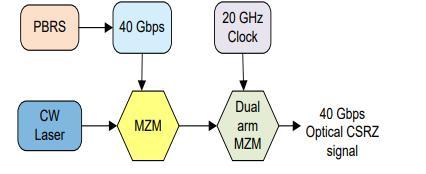
Fig.5: BlockdiagramofCSRZtransmitter
Due to its lower optical power needs, CSRZ can accommodate more multiplexed channels during transmissionandcanwithstandchromaticdispersionmore well. Furthermore, carrier suppression in WDM systems lowers the efficiency of FWM [29]. The CSRZ transmitter setupthatisbeinganalysedisshowninFig.3.5TwoMZMs maybeconcatenatedtocreateaCSRZopticalsignal.Thefirst MZMuses40GbpsNRZdatatocontrollightintensitycoming fromaCWlasersource.TheresultingNRZopticalsignalis then modulated by the second MZ modulator, which is drivenbyaclockoperating athalfbit-rate(20GHzinthis example). An optical signal with CSRZ is produced as a consequenceofthistechnique.
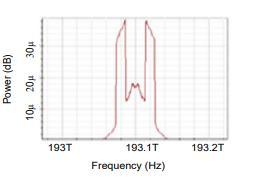
At the transmission minimum, the optical field transfer function of the MZM changes sign, resulting in phase inversions between neighbouring bits. As seen in Fig. 3.6, thiscausesapiphaseshifttobecreatedbetweenanytwo consecutive bits. As a result, the carrier frequency centre peakissuppressedandthespectrumisaltered.
Researchanddevelopmentactivitiesmakeconsiderableuse of Opti System 10.0, a powerful optical communication systemdesignsimulationtoolthatexaminesandsimulates anopticallink[31–33].Ithasbeenusedinthepresentthesis to build and simulate optical communication systems to assesstheirperformancewhiletakingtheproperproperties of system components into account. The fair modelling accuracyandeaseofuseofthisprogrammemakeitsuitable withbothWindowsandUNIXplatforms.Eachblockinthe picturerepresentsasubsystemorcomponentoftheoptical communicationsystem;thesystemisshownasaconnected
International Research Journal of Engineering and Technology (IRJET) e-ISSN: 2395-0056
Volume: 12 Issue: 11 | Nov 2025 www.irjet.net p-ISSN: 2395-0072
collection of blocks. Similar to how actual signals are exchanged in a real-world communication system, the OptiSystem simulation transfers "signal" data between componentmodels.
It offers a range of simulation engines together with corresponding simulation approaches. This allows for the mostflexibilityinthemodellingandsimulationofsystems, suchaslargemetronetworkswithfeedbackloopsandEDFA transients due to the addition and removal of channels, ultra-long-haulDWDMtelecomsystems,andshort-distance data communication links. The data post-processing and displaycapabilitiesofOptisytemprovideaflexibleandeasyto-usegraphicalmeasurementinterfacethatmaybeusedas avirtuallaboratoryinstrumentset.Amongtheinteractive andpost-processingfeaturesthatallowforthesimulationof aprojectonceandthesubsequentanalysisoftheresultsare graph superimposition, correlation graphs, interactive cursor read-out data, peak search, eye-diagram measurements,andBER/Qevaluation.Thesefeatureshelp tosavetimeduringthedesignprocess.
This thesis has constructed three different dispersion compensation systems (pre-, post-, and symmetrical compensation)toadjustfortheaccumulateddispersion.In the pre-compensating situation, DCF acts as a precompensatingfactorfortheaccumulateddispersionofthe transmission fibre. The gain G of the amplifier, which compensatesforthefibrelossintheDCF,maybefoundafter theDCFby:
where L is the DCF's length and ATC is the dispersion compensating fiber's attenuation coefficient. A similar equationappliestothegainoftheamplifierthatcomesafter thetransmissionfibre,where������isthetransmissionfiber's attenuationcoefficient.

(3.2)
Toaccountforthedispersionofthetransmissionfibre,the followingfactorsshouldbeconsideredwhenchoosingthe lineardispersivecompensationlength,orLDCF:
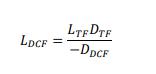
(3.3)
where L is the transmission fiber's length, H is the transmission fiber's dispersion, and D is the DCF's dispersion. The DCF post makes up for the transmission fiber's dispersion in a post-compensating situation. In a symmetrical compensation scenario, the sequence of placement of fibres is transmission fibre, DCF, and transmission fibre [34]. The proposed 32-channel DWDM system, consisting of the transmitter section, optical
receivers,andfibre,isshowninFigure3.7.193.1THzisthe firstchannel'scentralfrequency.Table3.1providesspecifics ontheimplementedsimulationparameters.
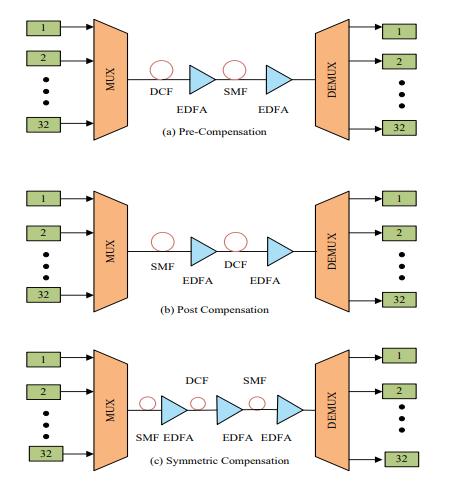
Fig. 7:Schematicofsimulationsetups
Pre-compensation, post-compensation, and symmetrical compensationschemesarethethreetypesofcompensation schemes.BymixingfibreswithnormalandanomalousGVD to create a dispersion map, the transmission link's design maintainsalowaverageGVDwhilepermittingahighlocal GVDacrossthelink'slength[35].Thistechniqueisknownas periodicdispersionmanagement.Toputitanotherway,the DCFandSMFparametersareselectedsoastoguaranteethat thefirst-orderdispersionisaccuratelycompensated(D=0), where D is the associated fiber's first-order dispersion parameter[ps/nm/km]andListhetotallengthoftheSMF orDCFperspan.
Table 1:Simulationparameters
Bitrate 40Gbps
Sequencelength 64
Samples/bit 256
DWDMchannelspacing 50GHz
Centralfrequencyofthe1stchannel193.1THz
Capacity 32-channel40-Gbps
Distance
30KmXNSpans
InputPower -10dBm
International Research Journal of Engineering and Technology (IRJET) e-ISSN: 2395-0056
Volume: 12 Issue: 11 | Nov 2025 www.irjet.net p-ISSN: 2395-0072
TheWDMtransmitterismadeupofanopticalmultiplexer, datamodulators,filters,pseudorandombitsequence(PRBS) generator,andCWlasers.ThePRBSgeneratorgeneratesbit sequencesof27–1bitsata40Gbpsrate.The193.1–194.65 THz frequency range is covered by the equally scattered frequencies emitted by the CW laser, with a 50 GHz frequencyseparationbetweenneighbouringchannels.MZM hasanextinguishingratioof30dB.EachCWlaser'soutput porthasaCSRZtransmitterlinkedtoit,asshowninFig.3.7. An optical multiplexer receives optical signals from 32 of thesedatamodulatorsatits32inputterminals.Toensure linear cross-talk reduction in the frequency domain, each channel is optically filtered using a narrow transmission optical filter prior to multiplexing [28]. In this regard, considerationhasbeengiventoa50GHzbandwidthsecondorderGaussianfilter.Thechannelspacingandoperational wavelengthscomplywithITU-Tregulations.
4.1 Numerical Simulation Model and System Description
Modellingthecreation,propagation,andreceiptofthesent signalisapartofthesignalsimulationprocessinanoptical fibre transmission system. Every simulation involves a trade-off between time and accuracy. Research, development, testing, and refining of the intricate models neededtoconstructanopticalsystemsimulatorusuallytake timeandresources.BecausetheOptisystem10.0simulator is available in commercial optical system simulators that offeraffordableprices,sophisticatedsimulationalgorithms, anduser-friendlygraphicaluserinterfaces,itwasselectedto assessthetransmissioncapabilitiesofawiderangeofphase modulationformats.Withsimulationmodulesforactiveand passivephotoniccomponents,severalfibretypes,integrated digital signal processing modules, time domain and frequencydomainanalysers,electricalsignalsources,filters, andotherrelevantsub-systems,itisawidelyacknowledged standard simulator. Additionally, by using other programming languages, such Matlab®, to communicate with this simulator, users may develop, construct, and integratenewmoduleswithOptisystem.
Initially,DPSKandDQPSKformatswereusedtomaximise performanceona40Gbpssingle-channelopticalconnection. Thechannelnumbersweregraduallyexpandedto32witha channel spacing of 50 GHz in order to reach an aggregate capacity of 1.28 Tb/s. For a range of fibre types, the simulationstudywascarriedoutintheC-band(1530nm–1565 nm) to assess the system's effectiveness for the proposed modulation settings. 193.1 THz is the centre frequency of the first channel in the 32-channel DWDM systemdiagramshowninFig.4.1.Theseformatshavebeen studiedintheliteraturewithalowertransmissiondatarate or with fewerchannelsata 50GHzchannel spacing.Both formats are examined in this study under different
dispersioncompensatingschemes.Thissuggesteddesign's non-linearmitigationperformancehasbeenexaminedviaan analysis of pre-, post-, and symmetric compensation arrangements.Toaccountfordispersionandnon-linearities, a DCF of 10 km is used in the pre-compensation system beforethe50km-longSMF.ThegainoftheEDFAsusedin the connection is 5 dB and 11 dB, respectively. The postcompensationtechniqueemploysaDCFof10kmtomitigate thedispersionbuildupthathappensaftera50kmSMF.In the symmetrical-compensation system, a 10 km DCF is introducedbetweenthe50kmSMF,asshowninFig.4.10. Threein-lineEDFAswithgainsof5.5dB,5dB,and5.5dB areusedinthisexperiment.Consistentwiththeresultsof theliterature,thepostcompensationapproachwasshown to provide the best performance for both the DPSK and DQPSK forms [38]. This tactic was therefore used in the continuing enquiry. The findings are examined in a particular instance utilising the Q value and are startling overseveraltransmissionlengthsupto1600km.
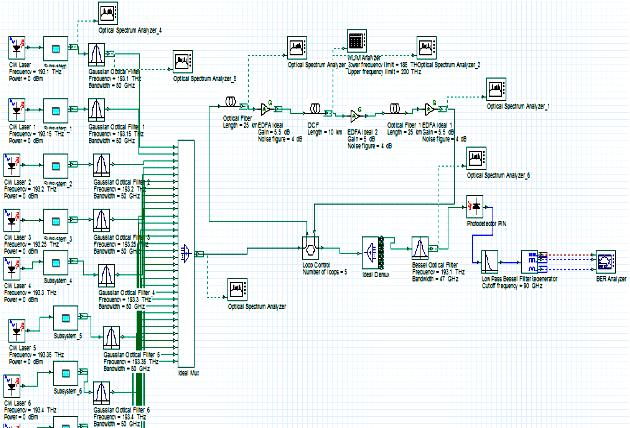
8. Schematicofsimulationsetup
Nspansof60kmeachareusedtoconveythesignaloncethe input voltage has been adjusted. The optical multiplexer, data modulators, filters, CW lasers, and PRBS generator make up the WDM transmitter. CW lasers have uniformly spacedemissionfrequenciesrangingfrom193.1to194.65 THz,separatedbya50GHzchannel.ItisshownthatMZMs haveanextinctionratioof30dB.Adatamodulatorisusedto driveeachCWlaser,asshowninFigs.4.3and4.7forDQPSK and DPSK, respectively. An optical multiplexer's 32 input terminalsreceivethemodulatedopticalsignal.
InDWDMsystems,thereciprocalinteractionofthesignals and the accumulated ASE noise leads to the inevitable impairmentsoflinearandnonlinearcrosstalk.Therefore,it isessentialtoperformanaccuratecomparisonbetweenthe two modulation schemes by optimising the optical and electricalfilteringonboththetransmitterandreceiversides [39]. Because of this, we have used receiver sensitivity to assessthefilter'sefficacyintermsofthereceivedQvalue. The'elevatedcosine'transferfunction,whosecentreisthe signalcarrierfrequency,wasusedtorepresenttheoptical filtersofthemultiplexerandde-multiplexer.
Volume: 12 Issue: 11 | Nov 2025 www.irjet.net
3
4
ThechartclearlyshowsthatevenwiththesamebeginningQ valueastheGaussianfilter,theBesselfiltermayachievea longertransmissionreach.Assuch,theBesselfilterhasbeen includedintoourdesign.BecausethestartingQvalueistoo tinyfortherectangularcase,theproposedconnectionwill not be particularly stable. Furthermore, we evaluated the ideal electrical and optical filter bandwidth required for effective signal transmission. Our results suggest that shorter channel spacing requires a wider electrical bandwidth. Before multiplexing, each channel is optically filteredusingathird-orderGaussianfilter(bandwidthof50 GHz for DPSK format and a fourth-order Bessel filter (bandwidthof50GHzforDQPSKformat)toavoidcrosstalk between neighbouring channels. This is taken into consideration.
When the combined optical signal is sent to the SMF, considerationisgiventothedispersion,stimulatedRaman scattering,unidirectionalsignalflow,andKerr-nonlinearity. The usage of a scalar model for both fibre segments has served to lessen the impact of PMD. The following parameters have been considered: dispersion slope (S) of 0.08ps/nm2/kmat1550nm,attenuation(α)of0.22dB/km, D of 17 ps/km-nm, and nonlinear refractive index (n2) of 2.6×10⁻²⁰ m2/W. The DCF segment used in each span at 1550nmhasthefollowingcharacteristics:α=0.5dB/km,D = -85 ps/km-nm, S = -0.45 ps/nm2/km, n2 = 2.6× 10⁻²⁰ m2/W,andAeff=30μm2.
Thereceiverismadeupofthede-multiplexer,demodulators, filters, and 3R regenerator. To evaluate required filter settings,asimulationofthe32-portdemultiplexer'soutput has been performed. When using a third order Gaussian filter with a bandwidth of 50 GHz for DPSK, the design
performsoptimally;whenusingasecondorderBesselband passfilterwitha3dBbandwidthof50GHzforDQPSK,the designperformsoptimally.Thereceivermodulescoveredin Figs.4.6and4.8areusedforDPSKandDQPSK,respectively. The 3R regenerator, which generates graphs and results including eye diagrams, BER, Q value, and eye opening, is thenlinkedtotheBERanalyser.
In order to model, develop, and simulate the ideal circumstances for a long-haul optical communication connection in order to obtain an optimum propagation length, this thesis covers the theoretical examination and analysis of the optical channel characteristics. Using the analyticalmodelandnumericalsimulationanalysisofthis fibre transmission channel, the designer may choose a design plan and an appropriate solution for different modulationformatswithinthespecifiedoperationallimits. Examining the effects of linear and non-linear phase impairments that happen during pulse propagation in the fibre medium on the design of long-haul fibre optic communicationsystemsisthemaingoalofthethesis.This chapteroutlinespossiblefutureexpansionsoftheintended studyandsummarisestheresultsandcontributionsofthe currentwork.
Enhancingthetransportcapacityandtransmissiondistance of DWDM systems while lowering the cost per carried information bit has become very desirable due to the growing demand for bandwidth. It is clear that new approachestobinarydataencodingovertheopticalcarrier havebeendevelopedasaresultoftheconstraintsplacedon DWDM transmission and the development of optical communication systems. This thesis focused on the difficultiesthese modulationmethodsprovidethroughout various stages of implementation. Generally speaking, the kind of fibre, the pace at which data is sent across the channel, and the wavelength spacing all play a role in determining which optical modulation scheme is best. Service providers may save costs by using most of the current systems with the best modulation formats and innovatingtheircurrentlightwavenetworkwithouthaving tocompletelyupdate.
[1]Karaki,E.Pincemin,D.Grot,T.Guiliossou,Y.Jaouen,R.le BidanandT.leGall,“Dual-polarizationmulti-bandOFDM versus single–carrier DP-QPSK for 100 Gbps long-haul WDM transmission over legacy infrastructure”, 38th European Conference on Optical Communications (ECOC),2012.
[2] Chen, ZY., Yan, LS., Pan, Y.et al.Use of polarization freedom beyond polarization-division multiplexing to support high-speed and spectral-efficient data transmission.Light Sci Appl 6, e16207 (2017).
International Research Journal of Engineering and Technology (IRJET) e-ISSN: 2395-0056
Volume: 12 Issue: 11 | Nov 2025 www.irjet.net p-ISSN: 2395-0072
https://doi.org/10.1038/lsa.2016.207
[3]D.Wang,D.Lu,C.Lou,L.HuoandW.Yu,“Performance comparison of phase modulated formats in 160 Gb/s transmission system”, IEEE Communications and PhotonicsConference,
[4]MatsSkoldetal(2010),All-OpticalWaveformSampling in High-Speed Optical Communication Systems Using AdvancedModulationFormats,pp.3662-3671(2009).
[5]JianjunYu(2016),recentprogressonhigh-speedoptical transmission, https://doi.org/10.1016/j.dcan.2016.03.002.
[6] Eugen Lach (2011), Modulation formats for 100G and beyond,https://doi.org/10.1016/j.yofte.2011.07.012
[7]RaghebandH.Fathallah(2012)"Candidatemodulation schemesfornextgeneration-passiveoptical networks (NG-PONs),"High Capacity Optical Networks and Emerging/Enabling Technologies, Istanbul, Turkey, 2012,pp.226-231,doi:10.1109/HONET.2012.6421469.
[8] Borah, D.K., Boucouvalas, A.C., Davis, C.C. (2012) A review of communication-oriented optical wireless systems. J Wireless Com Network 2012, 91 (2012). https://doi.org/10.1186/1687-1499-2012-91
[9] L. Tao, Y. Ji, J. Liu, A. P. Tao Lau, N. Chi and C. Lu, (2013)"Advanced modulation formats for short reach opticalcommunicationsystems,"inIEEENetwork,vol. 27, no. 6, pp. 6-13, November-December 2013, doi: 10.1109/MNET.2013.6678921.
[10] Jun He et al (2014), a survey on recent advances in optical communications, https://doi.org/10.1016/j.compeleceng.2013.11.017
[11]X.Liu,S.ChandrasekharandP.J.Winzer(2013)"Digital Signal Processing Techniques Enabling Multi-Tbs Superchannel Transmission: An overview of recent advancesinDSP-enabledsuperchannels,"inIEEESignal Processing Magazine, vol. 31, no. 2, pp. 16-24, March 2014,doi:10.1109/MSP.2013.2285934.
[12]Zhong,Kangping,(2015)"ExperimentalstudyofPAM-4, CAP-16, and DMT for 100 Gb/s short reach optical transmission systems."Optics express23.2 (2015): 1176-1189.
[13] Jianjun Yu (2016), recent progress on high-speed optical transmission, https://doi.org/10.1016/j.dcan.2016.03.002.
[14] Jianjun Yu (2016), recent progress on high-speed optical transmission, https://doi.org/10.1016/j.dcan.2016.03.002
[15] Alipour, A. Mir, A. Sheikhi (2016) Ultra high Alan E. Willneretal(2017),Recentadvancesinhigh-capacity free-spaceopticalandradio-frequencycommunications using orbital angular momentum multiplexing, https://doi.org/10.1098/rsta.2015.0439
[16]capacityinter-satelliteopticalwirelesscommunication system using different optimized modulation formats,Optik,Volume127,Issue19,2016,Pages81358143,ISSN 00304026,https://doi.org/10.1016/j.ijleo.2016.06.011.
[17]Badar,N.,Jha,R.K(2017)Performancecomparisonof various modulation schemes over free space optical (FSO)linkemployingGamma–Gammafadingmodel.Opt Quant Electron 49, 192 (2017). https://doi.org/10.1007/s11082-017-1025-4
[18] Rashed, Ahmed Nabih Zaki, (2018)"Transmission performancesimulationstudyevaluationforhighspeed radio over fiber communication systems."Wireless PersonalCommunications103(2018):1765-1779.
[19] Gill, Harpreet Kaur, Gurjot Kaur Walia, and Narwant Singh Grewal (2019) "Performance analysis of mode divisionmultiplexingIS-OWCsystemusingManchester, DPSK and DQPSK modulation techniques."Optik177 (2019):93-101.
[20] Anandkumar, D., Sangeetha, R.G (2020) “A survey on performance enhancement in free space optical communication system through channel models and modulation techniques” Opt Quant Electron 53, 5 (2021).https://doi.org/10.1007/s11082-020-02629-6
[21]Magidi,S.,Jabeena,(2021)A.FreeSpaceOptics,Channel Models and Hybrid Modulation Schemes: A Review. Wireless Pers Commun 119, 2951–2974 (2021). https://doi.org/10.1007/s11277-021-08380-9
[22]AbuJahidetal(2022),Acontemporarysurveyonfree space optical communication: Potentials, technical challenges, recent advances and research direction, https://doi.org/10.1016/j.jnca.2021.103311.
[23]Garg,DeepakandNain,Abhimanyu."Nextgeneration optical wireless communication: a comprehensive review"JournalofOpticalCommunications,vol.44,no. s1,2023,pp.s1535-s1550.https://doi.org/10.1515/joc2020-0254.
[24] Jain, Vishal and Bhatia, Richa (2023) "Review on nonlinearity effect in radio over fiber system and its mitigation"JournalofOpticalCommunications,vol.44, no. s1, 2023, pp. s1661-s1669. https://doi.org/10.1515/joc-2021-0044
[25]MahapatraandE.J.Murphy,“Electro-opticmodulators,” OpticalFiberTelecommunicationsIV,
[26]KaminowandT.Li,Eds.NewYork:Academic,pp.258–294,2002.
[27]T.Matsuda,A.NakaandS.Saito,“Comparisonbetween NRZ and RZ signal formats for in-line amplifier transmission in the zero-dispersion regime,” IEEE JournalofLightwaveTechnology,Vol.16,pp.340-348, 1998.
[28]Rohde,E.Gottwald,A.Teixeira,J.D.Reis,A.Shahpari,K. Pulverer and J S. Wey,” Coherent Ultra Dense WDM Technology for Next Generation Optical Metro and
© 2025, IRJET | Impact Factor value: 8.315 | ISO 9001:2008 Certified Journal | Page585
International Research Journal of Engineering and Technology (IRJET) e-ISSN: 2395-0056
Volume: 12 Issue: 11 | Nov 2025 www.irjet.net p-ISSN: 2395-0072
Access Networks”, IEEE, Journal of Lightwave Technology,Vol.32,No.10,pp.2041-2052,2014.
[29] Hodzik, B. Konrad and K. Petemann,” Alternative modulationformatsinNX40Gb/sWDMstandardfiber RZ-transmission systems”, IEEE Journal of Lightwave Technology,Vol.20,No
[30] Zheng, F. Lu, M. Xu, M. Zhu, Md I. Khalil, X. Bao, D. Guidotti, J. Liu, N. Zhu and Gee-Kung Chang,” A dualpolarization coherent communication system with simplified optical receiver for UDWDM-PON architecture,OpticsExpress,Vol.22,No.26,pp.31735, 2014.
[31]S.V.Kartalopoulos,"IntroductiontoDWDMtechnology: Datainarainbow",JWiley,2001
[32]O.V.Shtyrina,M.P.FedorukandS.K.Turitsyn,"Studyof new modulation data-transmission formats for dispersion-controlled high-bit-rate fibre optic communicationlines",JournalofQuantumElectronics, (IOPScience),Vol.37,No.9,pp885-890,2007.
[33]Sheetal,A.K.SharmaandR.S.Kaler,“Simulationofhigh capacity 40 Gb/s long haul DWDM system using different modulation formats and dispersion compensationschemesinthepresenceofKerr'seffect”, Optik((Elsevier),Vol.121,pp.739-749,2010.
[34] D. Millar, S. Makovejs, C. Behrens, S. Hellerbrand, R. Killey, P. Bayvel and S. Savory, “Mitigation of Fiber Nonlinearity Using a Digital Coherent Receiver,” IEEE JournalofSelectedTopicsinQuantumElectronics,Vol. 16,No.5,pp.1217-1226,September/October2010.
[35]C.RSilveira,D.M.Pataca,M.A.RomeroandM.LRocha, "ACost-BenefitAnalysisonModulationFormatsfor40Gb/s Optical Communication Systems", Fiber and IntegratedOptics,Vol.30,No.2,pp.87-101,2011.
[36]Rohde,E.Gottwald,A.Teixeira,J.D.Reis,A.Shahpari,K. Pulverer and J S. Wey,” Coherent Ultra Dense WDM Technology for Next Generation Optical Metro and Access Networks”, IEEE, Journal of Lightwave Technology,Vol.32,No.10,pp.2041-2052,2014.
[37] Hodzik, B. Konrad and K. Petemann,” Alternative modulationformatsinNX40Gb/sWDMstandardfiber RZ-transmission systems”, IEEE Journal of Lightwave Technology,Vol.20,No
[38]S.K.Ibrahim,StudyofMultilevelModulationFormats forHighSpeedDigitalOpticalCommunicationSystems, Ph.D.thesis,UniversityofPaderborn,Germany,2007.
2025, IRJET | Impact Factor value: 8.315 |