
International Research Journal of Engineering and Technology (IRJET) e-ISSN:2395-0056
Volume:12Issue:11|Nov2025 www.irjet.net p-ISSN:2395-0072
International Research Journal of Engineering and Technology (IRJET) e-ISSN:2395-0056
Volume:12Issue:11|Nov2025 www.irjet.net p-ISSN:2395-0072
1Assistant Professor, 2Undergraduate Students, Department of Civil Engineering, RNS Institute of Technology, Channasandra, Bengaluru, India
Abstract - The growing accumulation of plastic waste presents a significant environmental challenge due to its non-biodegradable nature.Simultaneously,traditionalroad construction techniques face issues of long construction periods, frequent maintenance,andmaterial depletion.This study synthesizes the current research on incorporating plastic waste into road pavements to address both challenges. Plastic waste incorporation occurs via wet and dry processes, enhancing pavement properties like rutting resistance, fatigue performance, moisture resistance, and mechanicalstability.Varioustypesofplastics suchasPET, LDPE, HDPE, and polypropylene have shown improvements in pavement durability and resistance to deformation under laboratory conditions. The systematic reviewindicatesthatplastic-coatedaggregatesimprovethe bonding with bitumen, increasing the stability and lifespan of roads, especially under harsh climatic conditions. However, the impact on fatigue behaviour requires further research. Implementing plastic roads provides a circular economy solution, reducing landfill accumulation and promotingsustainableinfrastructuredevelopment.
Key Words: Bitumen modification, Fatigue performance, Plastic waste, Road pavements, Rutting resistance, Sustainabledevelopment.
1.INTRODUCTION
Plastic waste is a significant environmental challenge in the modern era due to its non-biodegradable nature and long degradation period, which can extend up to thousands of years (Vasudevan et al., 2017). With global plastic production rising exponentially and poor disposal practices,anincreasingvolumeofplasticwasteendsupin landfills or natural environments, contributing to severe ecological problems (Cardoso et al., 2023). Moreover, traditional road construction methods rely heavily on natural resources such as bitumen, aggregates, and mineral fillers, which are becoming increasingly scarce andexpensive(Wangetal.,2022).
The concept of incorporating plastic waste into road pavements emerged as a dual solution to manage plastic pollution while improving the mechanical properties of asphalt mixtures (Shafiq et al., 2016). Two primary methods for plastic incorporation are identified in the literature: the dry process and the wet process. The dry
plasticbeforeaddingbitumen,whichimprovesaggregatebitumen bonding due to enhanced intermolecular interactions (Shaikh et al., 2017). The wet process blends shredded plastic directly with bitumen before combining with aggregates, providing improved high-temperature stability but requiring more sophisticated equipment (Cardosoetal.,2023).
Studies by Vasudevan et al. (2017) demonstrated that plastic-modified bitumen mixes enhance road properties such as rutting resistance, stability, moisture resistance, and durability under harsh climatic conditions. However, some studies report inconsistent effects on fatigue resistance, emphasizing the need for further investigation (Wang et al., 2022). Despite these inconsistencies, the advantages of plastic road construction particularly in regions with extreme weather patterns like India are widely accepted due to the longer life span and reduced maintenancecost(Shafiqetal.,2016).
Therefore, this research builds on prior work (Vasudevanetal.,2017;Cardosoetal.,2023;Shaikhetal., 2017) and evaluates the benefits of incorporating plastic waste into bituminous pavement mixtures using systematic experimental procedures. The objective is to determine the optimum plastic content and mixing method that can maximize performance gains while promoting sustainability and environmental responsibility.
The incorporation of plastic waste into road construction has gained considerable attention in recent years as an effective approach to address environmental challenges while improving pavement performance. Various studies haveanalysedtheuseofdifferenttypesofplasticwastein bituminous mixes and their effects on mechanical propertiessuchasstability,ruttingresistance,andfatigue life.
Vasudevan et al. (2017) explored the use of shredded plastic waste coated onto aggregates before mixing with bitumen. Their study revealed that polymer-coated aggregate-bitumenmixturesenhancebindingstrengthdue to increased molecular bonding between plastic and bitumen.Theresearchdemonstratedimprovedresistance
International Research Journal of Engineering and Technology (IRJET) e-ISSN:2395-0056
Volume:12Issue:11|Nov2025 www.irjet.net
torutting,stripping,anddeformation,especiallyinregions withheavyaxleloadsandvariableclimaticconditions.
Cardoso et al. (2023) conducted a systematic literature review focusing on the effects of plastic waste on rutting and fatigue performance in asphalt mixtures. Their findings indicate that plastic waste generally improves ruttingresistanceacrossvariousmixingmethods(wetand dry) and plastic types (PET, LDPE, HDPE). However, the effects on fatigue performance were inconsistent, requiring more comprehensive research into long-term agingandfieldperformance.
Shafiqetal.(2016)highlightedthepositiveroleofplasticcoatedaggregatesinenhancingpavementpropertiessuch as abrasion resistance and aggregate-bitumen adhesion. Their work emphasized the necessity of finding practical solutionstoplasticwastemanagement,especiallyinIndia where plastic waste constitutes nearly 10,000 tons per day, posing severe environmental challenges. The study confirmed that plastic roads can provide better durability and reduced maintenance costs, particularly in hot and humidclimates.
Wang et al. (2022) reviewed the development of plastic roads and identified two main techniques: adding waste plastics to bitumen and using plastic entirely as a replacement for bituminous mixes. Their study emphasized that such methods not only provide environmentalbenefitsbyreducinglandfillwastebutalso improve road construction efficiency. The use of plasticmodified bitumen increases softening point and reduces penetration,therebyenhancinghigh-temperaturestability andmechanicalstrength.
Shaikh et al. (2017) investigated the practical implementation of plastic waste in road construction through experimental studies. Their research involved preparing bituminous concrete samples with varying percentagesofplasticwaste(5%,10%,and15%).Results showed significant improvements in Marshall stability, tensile strength, and reduction in water absorption compared to conventional mixes. Their study also underscored the importance of optimizing mixing time andtemperaturetoensureuniformplasticdispersionand performanceconsistency.
Several other researchers (Justo et al., 2002; Patel et al., 2014; Rajasekaran et al., 2009) contributed to the understanding of how thermoplastics like PET, LDPE, and HDPE behave when incorporated into asphalt mixtures. These studies commonly reported improved rutting resistance and durability. For example, Patel et al. (2014) observed that adding Ethyl Vinyl Acetate (EVA) to waxy bitumen reduces brittleness and susceptibility to high temperatures, while Rajasekaran et al. (2009) found that
p-ISSN:2395-0072
plastic-coated aggregates improved Marshall mix design characteristicsandtensilestrength.
Despite these positive findings, the literature consistently points out that the effect of plastic incorporation on fatigue life remains ambiguous (Cardoso et al., 2023). Variability in test methods, plastic types, plastic particle sizes, and mixing procedures contribute to inconsistent outcomes across studies, signalling the need for standardizedmethodologiesandlong-termfieldstudies.
Environmental Sustainability:
Allthepapersemphasizetheurgentneedtotackleplastic wastedisposal,acriticalglobalenvironmentalissuedueto the non-biodegradability and long degradation period of plastics (Vasudevan et al., 2017; Wang et al., 2022). Incorporating waste plastics into road pavements offers a practical, scalable solution that diverts large amounts of plastic from landfills and oceans, reducing environmental pollutionandpromotingacirculareconomy.
Enhanced Pavement Performance:
The research shows that plastic waste improves several key mechanical properties of asphalt pavements. Improvementsincludeenhancedruttingresistance,tensile strength, moisture resistance, and reduced water permeability, contributing to longer-lasting road infrastructure (Shaikh et al., 2017; Shafiq et al., 2016). These findings have practical significance, especially in regions with extreme weather conditions, such as high temperature and heavy rainfall, which accelerate road degradation.
Economic and Resource Efficiency:
These studies highlight that using plastic waste as a modifierinasphaltmixturesreducesrelianceonexpensive and depleting natural resources like bitumen and mineral aggregates, Additionally,reducedmaintenancerequirementand longer service life lead to cost savings for governments and infrastructure agencies, supporting more sustainable and economicallyviableroadconstructionpractices.
Technical Insights and Process Innovation:
The reviewed research provides critical technical insights intodifferentmethodsofintegratingplasticwaste:thedry andwetmixingprocesses(Wangetal.,2022;Shaikhetal., 2017). These insights allow researchers and practitioners to better understand the conditions (mixing temperature, plastic percentage, particle size, and type) required to achieve optimal pavement performance while ensuring uniformplasticdispersion.
International Research Journal of Engineering and Technology (IRJET) e-ISSN:2395-0056
Volume:12Issue:11|Nov2025 www.irjet.net p-ISSN:2395-0072
AddressingGapsinKnowledge
One major contribution of Cardoso et al. (2023) is the identification of a significant research gap in the fatigue performance of plastic-modified asphalt. Their systematic review serves as a call for further field investigations and long-term studies to establish the durability and effectiveness of plastic roads under real-world traffic and environmentalconditions.
PolicyImplications
Bydemonstrating the viabilityand effectivenessof plastic roads, these studies provide strong empirical evidence to support policy changes. Governments and urban planners can develop guidelines and incentives to encourage the use of plastic waste in infrastructure projects, thereby aligningpublicpolicywithsustainabilitygoals.
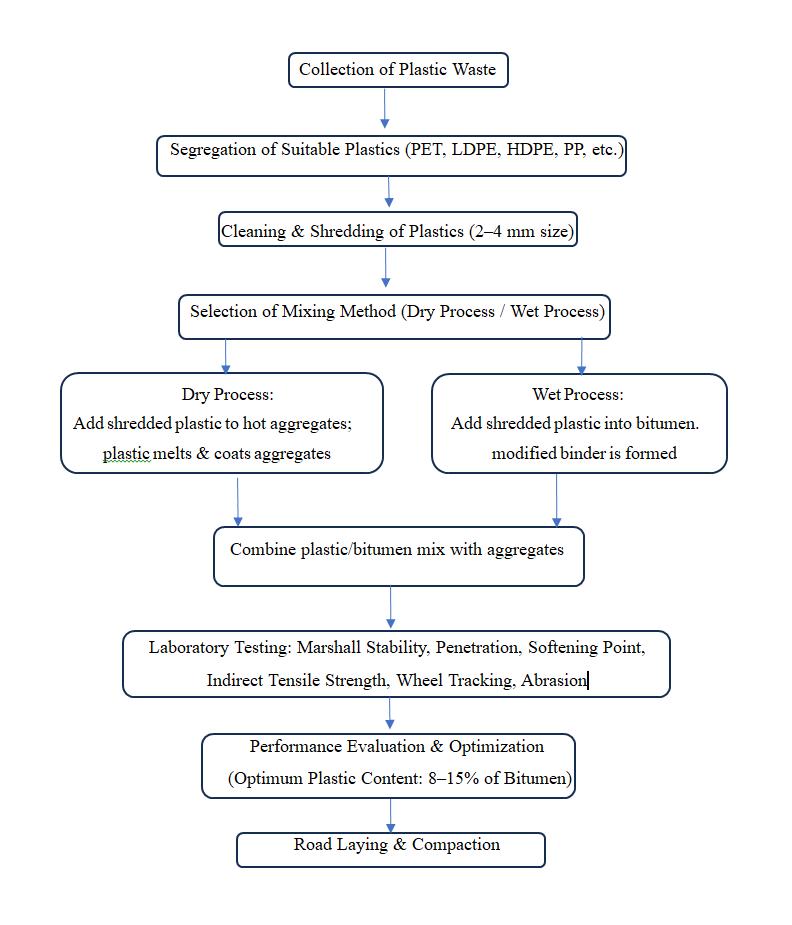
Plastic waste integration into pavement follows two main methods: Dry Process: Plastic waste (flakes, chips, or pellets) is added to hot aggregates before introducing bitumen. The plastic melts and coats the aggregates, improvingtheaggregate-bitumenbond.Cost-effectiveand simple with minimal plant modifications. Wet Process: Plastic waste is blended directly with bitumen before combining with aggregates. Requires sophisticated equipment butimproveshigh-temperaturestabilityofthe binder.
Testingincludes:
-MarshallStabilityTest
-PenetrationandSofteningPointTests
-LosAngelesAbrasionTest
-IndirectTensileStrengthTest -WheelTrackingTest
Findings: Improved rutting resistance, mixed fatigue performance results, reduced water permeability, better aggregate-bitumen adhesion, and longer service life. Optimum plastic content generally between 8-15% by weightofbitumen.
Comprehensive Evaluation of Plastic Waste Utilization
Cardosoetal.(2023)providea systematicandstructured literature review focusing specifically on the fatigue and ruttingperformanceofasphaltmixturescontainingplastic waste. Their use of the PRISMA methodology ensures a transparent and replicable review process, offering comprehensive insight into different types of plastics, mixing methods, and laboratory tests. This enables researchers to clearly understand the existing knowledge baseandidentifyresearchgaps.
DemonstrationofPracticalFeasibility
Shaikh et al. (2017) and Wang et al. (2022) present practical experimental approaches showing that waste plastic can be directly incorporated into bituminous road construction processes. These papers provide real-world test results such as Marshall stability tests, abrasion resistance,and tensilestrength confirmingthatplasticcoated aggregates improve road durability. The experiments demonstrate the feasibility of implementing plastic waste in pavement construction at a commercial level.
SustainabilityandEnvironmentalBenefit
All papers underline that plastic roads contribute significantly to environmental sustainability by reducing plastic waste accumulation in landfills and oceans. They promote a circular economy where waste plastics are
International Research Journal of Engineering and Technology (IRJET) e-ISSN:2395-0056
Volume:12Issue:11|Nov2025 www.irjet.net p-ISSN:2395-0072
effectively repurposed into valuable infrastructure materials.Forexample,Shafiqetal.(2016)emphasizethat this method reduces the environmental footprint of traditional road construction by cutting down the use of virginmaterialsandminimizingharmfulemissionsduring roadlaying.
Improved Mechanical and Performance Characteristics:
Thereviewedstudiesshow consistentadvantagessuchas improved rutting resistance, tensile strength, and moisture resistance when plastics are incorporated into asphalt mixtures (Vasudevan et al., 2017; Shaikh et al., 2017). These advantages contribute to enhanced pavement life, reduced maintenance costs, and better performance in harsh climates (high temperatures and heavyrainfall).
EconomicEfficiency
The research highlights economic benefits as the use of plasticwastereducesdependencyoncostlyrawmaterials like virgin bitumen and aggregates (Wang et al., 2022). Additionally, roads constructed with plastic waste exhibit higher durability, thereby reducing the need for frequent repairsandtheassociatedcosts(Shafiqetal.,2016).
InnovationinRoadConstructionTechniques
The studies offer innovative solutions by systematically testingbothdryandwetmethodsofincorporatingplastic into asphalt mixtures (Cardoso et al., 2023; Wang et al., 2022).Theseinsightsguideindustryprofessionalstoward optimal processes based on cost, technical feasibility, and environmental impact, allowing for easier adoption at the industrialscale.
Identification of Research Gaps and Future Directions
Cardoso et al. (2023) emphasize that while rutting resistance consistently improves with plastic addition, fatigue resistance shows mixed results, highlighting an importantareaforfuturestudy.Thispositionstheirpaper as a valuable reference for future researchers seeking to furtherthefield.
PolicyandPracticalImplications
Theresearchprovidesstrongempiricalsupportforpolicy changes,helpinggovernmentsandinfrastructureplanners develop guidelines and promote incentives for plastic roads. Their demonstration of both environmental and mechanical benefits provides a compelling argument for regulatory frameworks promoting sustainable road construction
SUMMARY
Plastic waste incorporation into road pavements offers a dual solution of sustainable waste management and
infrastructure improvement. Most studies report improvedruttingresistance,betterbonding,andenhanced mechanical properties. However, fatigue performance remains inconsistent across studies, indicating a need for further investigation. Optimum implementation requires precise mixing temperatures, plastic percentages, and well-defined protocols. Plastic roads align with circular economy principles, reducing landfill waste and promoting environmental sustainability, especially in harsh climates like India. Two main implementation techniques are identified: the dry process, where plastic waste is mixed directly with aggregates, and the wet process, where plastic is blended into bitumen. Both methods prove technically feasible and economically viable, promotingcirculareconomy practices by diverting plastic from landfills to infrastructure use. Despite the consistent improvements in rutting resistance, the effect ofplasticwasteonfatigueresistanceremainsinconsistent acrossstudies,signallingtheneedforfurtherresearchand standardizationoftestingprotocols.
Overall, these studies provide strong empirical evidence supporting the use of plastic roads as an innovative, sustainable, and cost-effective approach to infrastructure development, offering significant environmental benefits while meeting technical performance requirements. The research also lays the foundation for policy recommendations aimed at promoting the use of plastic waste in road construction, aligning with global sustainabilitygoals.
Plastic waste incorporation into road pavements offers a dual solution of sustainable waste management and infrastructure improvement. Most studies report improvedruttingresistance,betterbonding,andenhanced mechanical properties. However, fatigue performance remains inconsistent across studies, indicating a need for further investigation. Optimum implementation requires precise mixing temperatures, plastic percentages, and well-defined protocols. Plastic roads align with circular economy principles, reducing landfill waste and promoting environmental sustainability, especially in harsh climates like India. Two main implementation techniques are identified: the dry process, where plastic waste is mixed directly with aggregates, and the wet process, where plastic is blended into bitumen. Both methods prove technically feasible and economically viable, promotingcirculareconomy practices by diverting plastic from landfills to infrastructure use. Despite the consistent improvements in rutting resistance, the effect ofplasticwasteonfatigueresistanceremainsinconsistent acrossstudies,signallingtheneedforfurtherresearchand standardizationoftestingprotocols.
Overall, these studies provide strong empirical evidence supporting the use of plastic roads as an innovative,
© 2025, IRJET | Impact Factor value: 8.315 | ISO 9001:2008 Certified
International Research Journal of Engineering and Technology (IRJET) e-ISSN:2395-0056
Volume:12Issue:11|Nov2025 www.irjet.net p-ISSN:2395-0072
sustainable, and cost-effective approach to infrastructure development, offering significant environmental benefits while meeting technical performance requirements. The research also lays the foundation for policy recommendations aimed at promoting the use of plastic waste in road construction, aligning with global sustainabilitygoals.
CONCLUSION:
This research highlights that Integrating plastic waste in road construction is environmentally responsible and performance-enhancing. It consistently improves rutting resistanceandstabilitybutshowsmixedresultsonfatigue life. Proper mixing protocols and plastic content optimization are key. This solution supports sustainable development and a circular economy, mitigating plastic pollution while providing cost-effective durable pavements.
1. Ashwini, K., and Archana, T. (2014), “Use of Waste Plastic in Construction of Flexible Pavements”, International Journal of Engineering Research and Applications(IJERA),4(10),25–30.
2. Punith, V. S., and Veeraragavan, A. (2011), “Behaviour of Asphalt Concrete Mixtures with Reclaimed Polyethylene Modified Bituminous Binder”, Construction and Building Materials, 25(10), 4281–4288.
3. Fini, E. H., and Kalberer, E. W. (2012), “Chemical CharacterizationofBiobinderfromSwineManureand Its Compatibility with Petroleum Binder”, Journal of MaterialsinCivilEngineering,24(10),1403–1411.
4. Kalantar, Z. N., Karim, M. R., and Mahrez, A. (2012),“A Review of Using Waste and Virgin Polymer in Pavement”, Construction and Building Materials, 33, 55–62.
5. Casey, D., McNally, C., Gibney, A., and Gilchrist, M. D. (2008), “Development of an Innovative PolymerModified Bitumen”, Journal of Materials in Civil Engineering,20(7),441–448.
6. Sureshkumar, M. S., Jayaram, M. A., and Anantha Prasad,M.G.(2014),“ReuseofWastePlasticsinPaving Blocks”, International Journal of Engineering and AdvancedTechnology(IJEAT),4(4),68–72.
7. Al-Hadidy, A. I., and Tan, Y. Q. (2010), “Effect of Polyethylene on the Life of Asphalt Pavements”, ConstructionandBuildingMaterials,24(5),879–886.
8. Gawande, A., Zamre, G., Renge, V. C., Tayde, S., and Bharsakale, G. (2012), “An Overview on Waste Plastic UtilizationinAsphaltingofRoads”,ScientificReviews& ChemicalCommunications,2(2),147–157.
9. Verma, S. S. (2008), “Roads from Plastic Waste”, The IndianConcreteJournal,NovemberIssue,43–44.
10. Gibreil,H.,&Feng,C.P.(2016),“EffectsofHigh-Density Polyethylene and Crumb Rubber Powder as Modifiers on Properties of Hot Mix Asphalt”, Journal of Traffic andTransportationEngineering,3(3),166–173.

Prof. Mahadeva M is working as Assistant Professor in Civil Engineering Department form last 7 years in RNSIT and he also worked as Assistant Professor in SPCE, K S Institute of Technology. He receivedisBE in Civil Engineering and M.Tech with specialization in CAD StructuresfromVisvesvaraya technological university. He is nationaladvisoryboardmemberand ConferenceConvenerfor iternational conferenceandhesecured“ ActiveYoung Research Award” in international journals for his continuouscontributionin research field. He is Indian Institute of remote sensing outreach programcollege coordinator. He is member of AMIE, MIRED, MNG, MISTE.Hisresearchinterest is in the field of soil structure interaction, structural engineering, earthquake engineering.