
International Research Journal of Engineering and Technology (IRJET) e-ISSN: 2395-0056
Volume: 12 Issue: 07 | July 2025 www.irjet.net p-ISSN: 2395-0072
International Research Journal of Engineering and Technology (IRJET) e-ISSN: 2395-0056
Volume: 12 Issue: 07 | July 2025 www.irjet.net p-ISSN: 2395-0072
Ma. Jan Nickole F. Estrada1
1Faculty, Civil Engineering Department, Tarlac State University, Tarlac City, Tarlac, Philippines ***
Abstract – In highly seismic regions, the accurate characterization of seismic input is paramount for the design of earthquake-resistant structures. This study investigatesthe seismic performance of a four-storey reinforced concrete school building with lead rubber bearing base isolation system, specifically focusing on the effect of site-specific spectral accelerations on its response The analysis, executed using Response Spectrum Analysis in SAP2000, used seismic parameters from both Uniform Building Code (UBC 97)’s conventional zonal approach and American Society of Civil Engineer 7 (ASCE/SEI 7)’s more advanced site-specific methodology. Keyperformancemetrics,includingstoreydrifts, floor accelerations, fundamental periods, and base shears, were analyzed. The findings demonstratethatthe ASCE/SEI7 code, incorporating a more site-specific approach, generally predicted lower and more favorable responses compared to UBC 97. There is a significant reduction in seismicdemandson the superstructure: storey drifts, floor accelerations, andbase shears decreased by 25% to 28%. The structure’s fundamental period increased by 3.8%
Key Words: Site-Specific Spectral Accelerations, Lead Rubber Bearing, Base Isolation, UBC 97, ASCE/SEI 7, Response Spectrum Analysis
1. INTRODUCTION
Earthquakesposeasignificantthreattostructures[1],with conventional fixed-base designs often lead to damage or evencollapseduringearthquakes.Toenhancetheseismic performance of these structures, innovative systems like base isolation are employed [2]. The core concept behind base isolation is to place a flexible barrier between the superstructureanditsfoundation,effectivelydecouplingthe buildingfromthepotentiallydamaginggroundmotions[3]. Leadrubberbearingisoneofthecommonlyusedtypesof base isolation devices [4]. The design of base isolation system hinges on the precise characterization of seismic input, traditionally guided by building codes. UBC 97 and ASCE/SEI7representdifferentgenerationsofseismicdesign standards, with ASCE/SEI 7 being a more advanced document.Acriticaldistinctionbetweenthesecodesliesin their approach to defining seismic input, particularly the emphasisonsite-specificspectralaccelerationsinASCE/SEI 7[5].UnlikethegeneralizedseismiczonesutilizedinUBC 97, site-specific spectral accelerations provide a more refined representation of expected ground motions at a particular location. This study aims to quantify how these distinct code philosophies and parameters influence the
predicted seismic performance of a lead rubber bearing base-isolated building, providing insights for optimizing design.
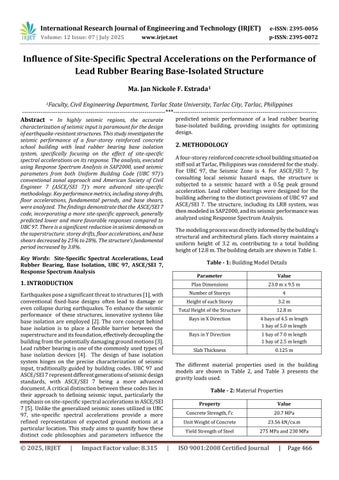
Afour-storeyreinforcedconcreteschoolbuildingsituatedon stiffsoilatTarlac,Philippineswasconsideredforthestudy. For UBC 97, the Seismic Zone is 4. For ASCE/SEI 7, by consulting local seismic hazard maps, the structure is subjected to a seismic hazard with a 0.5g peak ground acceleration. Lead rubber bearings were designed for the buildingadheringtothedistinctprovisionsofUBC97and ASCE/SEI 7. The structure, including its LRB system, was thenmodeledinSAP2000,anditsseismicperformancewas analyzedusingResponseSpectrumAnalysis.
Themodelingprocesswasdirectlyinformedbythebuilding’s structuralandarchitecturalplans.Eachstoreymaintainsa uniform height of 3.2 m, contributing to a total building heightof12.8m.ThebuildingdetailsareshowninTable1.
-
BaysinYDirection 1bayof7.0mlength 1bayof2.5mlength SlabThickness 0.125m
The different material properties used in the building models are shown in Table 2, and Table 3 presents the gravityloadsused.
Table - 2: MaterialProperties
International Research Journal of Engineering and Technology (IRJET) e-ISSN:
Volume: 12 Issue: 07 | July 2025 www.irjet.net
Table - 3: Loadings
TheseismicparametersasperUBC97andASCE/SEI7used arepresentedinTables4and5
Table - 4: SeismicParameters(UBC97)
Thegatheredseismicparametersinformedthepreliminary designoftheLRBisolationsystem,wheretargetproperties were estimated and calculated. Then these are used to determinetheLRBspecificpropertiesanddimensions.Asa result, the following design parameters were obtained, as showninTable6.
Table - 6: LRBDesignParameters
Table - 5: SeismicParameters(ASCE/SEI7)
Thecalculationsyieldaslightlystifferleadrubberbearing forUBC97.
The key performance data extracted from the SAP2000 responsespectrumanalysisincludestoreydrifts(calculated fromstoreydisplacements),flooraccelerations,fundamental period,andbasereactions.Theseresultsareshowninchart1tochart–6tofacilitateunderstandingandcomparison.
Fromchart-1andchart–2,thepeakstoreydriftobtained usingASCE/SEI7is26%lowerthanthatobtainedusingUBC 97.
Fromchart–3andchart–4,thereisa25%to26%reduction inflooraccelerationwhenASCE/SEI7wasused.
Fromchart–5,ASCE/SEI7calculatedaslightlylongerperiod thanUBC97.ThedesignedleadrubberbearingforUBC97is slightlystifferthanthatdesignedusingASCE/SEI7.
Fromchart–6,thegreenbarisforUBC97andthebluebaris for ASCE/SEI 7. ASCE/SEI 7 resulted in a lower calculated baseshearvaluecomparedtoUBC97.Thisrepresentsa28% reduction.
Thesedifferencesshowthatvariationsinseismicparameters betweentheUBC97andASCE/SEI7codes,leadtodifferent storey displacements, floor accelerations, fundamental periods,andbasereactions.
International Research Journal of Engineering and Technology (IRJET) e-ISSN: 2395-0056
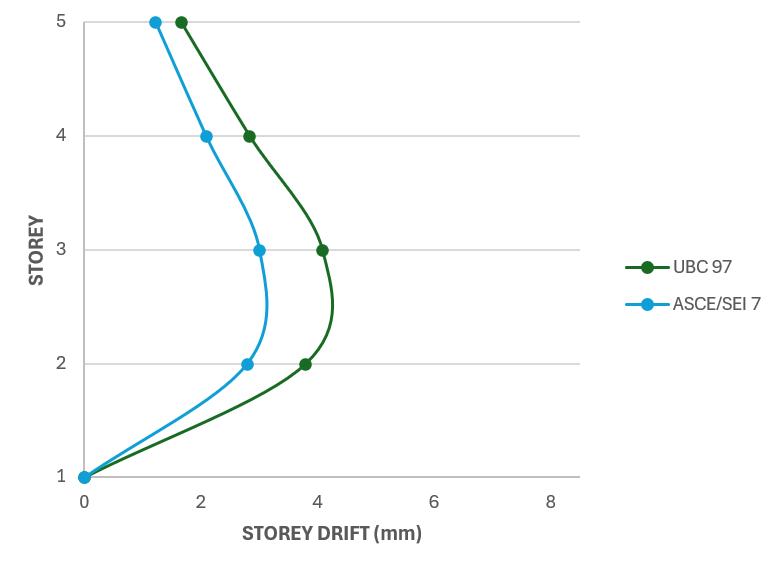
Chart - 1:StoreyDriftinXDirection
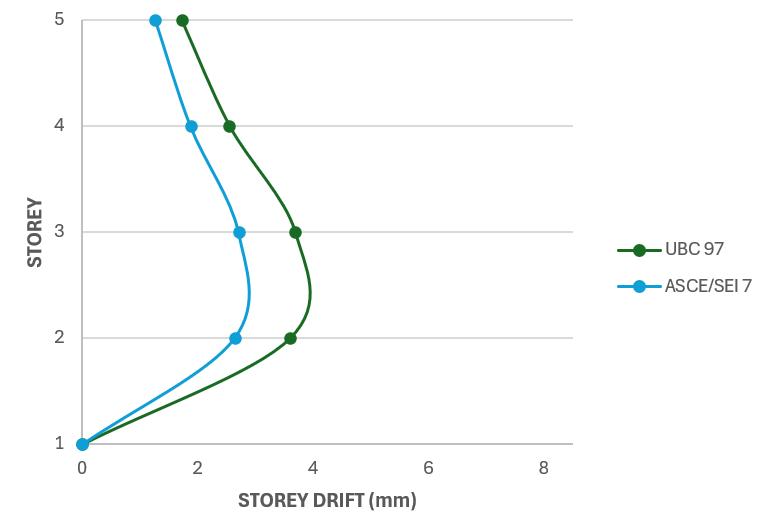
Chart - 2:StoreyDriftinYDirection
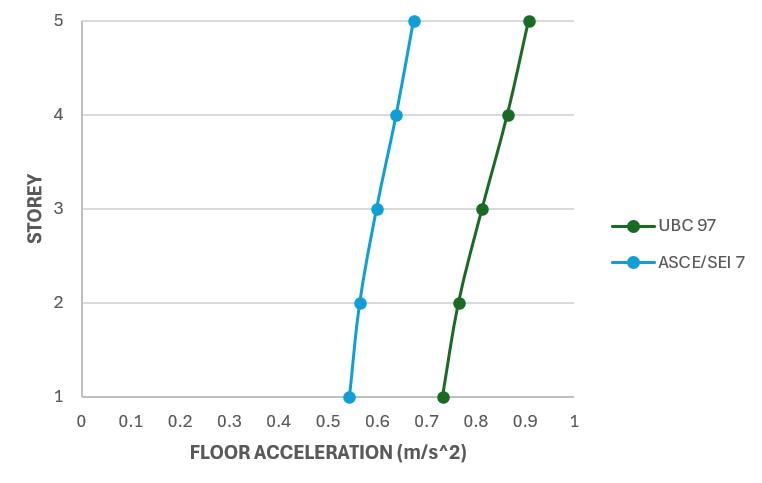
Chart - 3:FloorAccelerationinXDirection
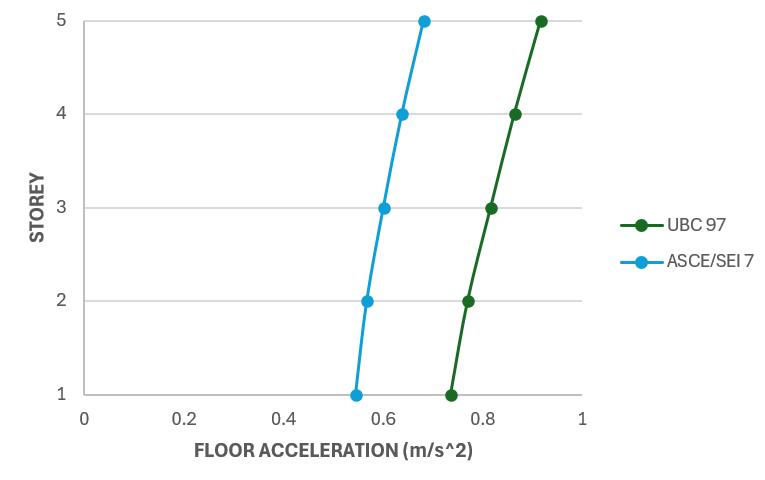
Chart - 4:FloorAccelerationinYDirection
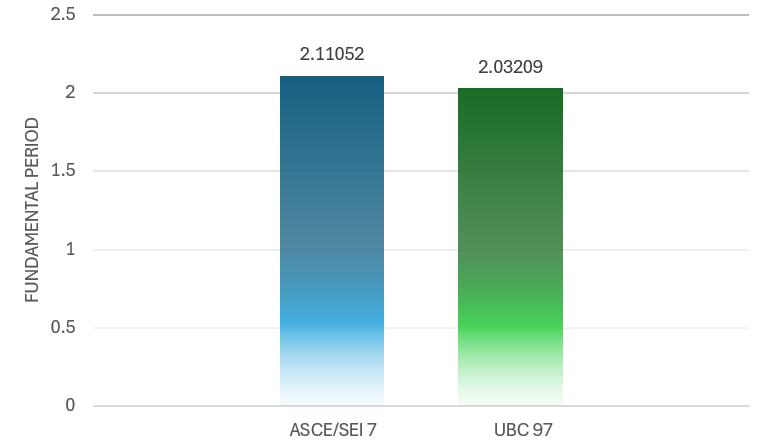
Chart - 5:FundamentalPeriod
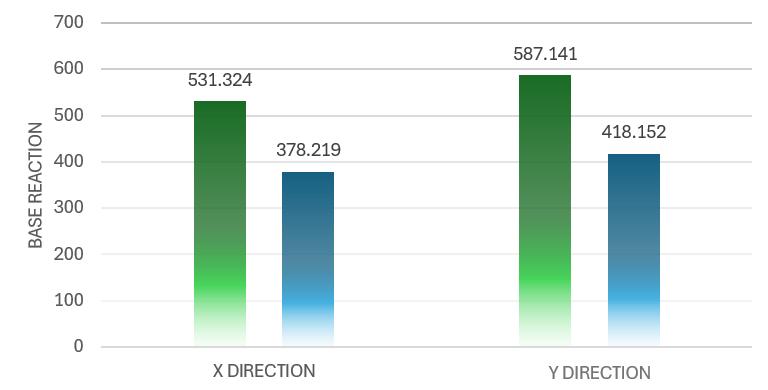
Chart - 6:BaseReactioninXandYDirections
4. CONCLUSIONS
This study investigated the effect of using sitespecificspectralaccelerationsontheperformanceofalead rubberbearingbase-isolatedreinforcedconcretebuilding.
Volume: 12 Issue: 07 | July 2025 www.irjet.net p-ISSN: 2395-0072 © 2025, IRJET | Impact Factor value: 8.315 | ISO 9001:2008 Certified Journal | Page468
International Research Journal of Engineering and Technology (IRJET) e-ISSN: 2395-0056
Volume: 12 Issue: 07 | July 2025 www.irjet.net p-ISSN: 2395-0072
Thebase-isolatedbuildinganalyzedusingASCE/SEI 7exhibitedlowerstoreydrifts,flooraccelerations,andbase shearvaluesthanwhendesignedwithUBC97.Furthermore, ASCE/SEI 7 yielded a slightly longer fundamental period thanUBC97.ThesefindingsindicatethatASCE/SEI7,with itsmorerecentandrefinedsite-specificapproach,tendsto resultindesignsoranalysesthatleadto different seismic demands and improved performance for base-isolated structure
Specificallyforthisstudy,ASCE/SEI7consistently providedalowerseismicresponsecomparedtoUBC97.This suggests that ASCE/SEI 7 offers a more optimized and potentiallylessconservativeapproachtocalculatingseismic designforces,particularlybeneficialwhenincorporatinga baseisolationsystem
[1] M. Madhukumar, Helen SM, Vasugi V, “Performance analysisofleadrubberbearingisolationsystemforlow, medium, and high-rise RC buildings”, Research on EngineeringStructuresandMaterials,2023;9(1):263276
[2] T. Bermany, S. Osman, M. Yatim, “A state-of-the-art analysisofbaseisolationsystemsandfuturedirections for developing a novel multi-directional smart-hybrid isolation system integrated with earthquake early warningsystemforbuildingstructures”,ScienceDirect, ResultsinEngineering,Vol.25,March2025,104501.
[3] S.Khan,R.Khan,C.Gupta,“SeismicPerformanceofRC Structure with and Without Base Isolation System-A Review”, IJTIMES: Research Symposium on “Advancements inEngineering,Science,Management, andTechnology”,Vol.5,SpecialIssue04,April2019.
[4] J.Weisman,G.Warn,“StabilityofElastomericandLead RubberBearingSeismicIsolationBearings”,Journalof StructuralEngineering,138(2):215-223.
[5] S.Shakeel,S.Khan,S.Saqib,M.Khan,M.Moiz,“Seismic performance and cost comparison of RC moment resistinganddualframesusingUBC97andIBC2021”, ScientificReports,14:16349,2024.
[6] S. Munot, P. Autade, “Design of Lead Rubber Bearing Base Isolator System for High Rise Structure”, International Journal of Creative Research Thoughts, Vol.9,Issue7,July2021.
[7] F.Amanollah,N.Ostrovskaya,Y.Rutman,“Structuraland ParametricAnalysisofLeadRubberBearingsandEffects of their Characteristics on the Response Spectrum Analysis”,ResearchGate:ArchitectureandEngineering, Vol.8,2023.
[8] P.Mhatre,S.Mhatre,AshwiniP,S.Stephen,“Earthquake Resistant Structure Using Base Isolation Technique”, International Research Journal of Engineering and Technology,Vol.8,Issue12,December2021.

Ma. Jan Nickole F. Estrada is a candidate for the degree Master of Science in Civil Engineering major in Structural Engineering at Tarlac State University in Tarlac City, Tarlac, Philippines.