
International Research Journal of Engineering and Technology (IRJET) e-ISSN:2395-0056
Volume: 12 Issue: 11 | Nov 2025 www.irjet.net p-ISSN:2395-0072
International Research Journal of Engineering and Technology (IRJET) e-ISSN:2395-0056
Volume: 12 Issue: 11 | Nov 2025 www.irjet.net p-ISSN:2395-0072
Chandushree D, Namratha R, Pericharlasairamkrishnaraju, Santhosh V, S S Vidya
1,2,3,4 , Dept .of E&IE Bangalore Institute of Technology Bengaluru, India
5Assistant Professor Dept .of E&IE Bangalore Institute of Technology Bengaluru, India
Abstract The rapid increase in electric vehicle (EV) adoption has created a demand for efficient, reliable, and userfriendly charging technologies. Traditional plug-in charging systems face limitations such as cable wear, safety hazards, and dependency on grid electricity. This paper presents the design and implementation of a wireless charging system for electric vehicles powered entirely by solar panels, focusing on low-cost hardware using an Arduino microcontroller and a resonant inductive coupling- based transmitter–receiver coil system. Solar energy is harvested and regulated using charge controllers and stored in batteries, which subsequently power the wireless charging transmitter. Experimental evaluation demonstrates that the prototype achieves stable power delivery at small air gaps with reasonable efficiency, highlighting the feasibility of solar-powered wireless charging as a clean, sustainable, and convenient EV charging method. The system offers promising applications for rural areas, smart parking lots, and renewable mobile charging stations.
Keywords Wireless Charging, Electric Vehicle, Solar Energy, Inductive Coupling, Renewable Energy, Arduino, Power Electronics.
The growing environmental concerns and depletion of fossil fuels have accelerated the global shift toward electric vehicles(EVs).Although EVsoffernumerous benefits,their widespread adoption is hindered by limitations in charging infrastructure, particularly issues related to slow charging, lack ofaccessibility,and overdependenceongrid electricity. Sustainablechargingsolutions,suchassolar-poweredsystems,aregainingattentionduetotheirabilitytoreducecarbon emissionsandoperationalcosts. Wirelesscharging,alsoknownas inductive power transfer (IPT),eliminatesphysical connectorsbytransferringenergythroughmagneticfields.Thistechnologygreatly enhancesuserconvenience, reduces maintenance,andensureschargingsafety.Combining solar energy with wireless EV charging representsasignificant advancement toward green transportation. This research presents a prototype wireless charging system for EVs using solar panels, demonstrating how renewable energy can power inductive charging coils through regulated circuitrycontrolledbyArduino.
SeveralstudieshaveinvestigatedwirelesschargingandrenewableenergyintegrationforEVs. Kursetal.demonstrated mid-rangewirelesspowertransferusingstronglycoupledmagnetic resonators, establishingtheoretical foundationsfor inductivesystems.Later,Budhiaetal.developedIPT-basedEVchargingpadscapableoftransferringkilowattsofpower athighefficiency.Solar-basedEVchargingsolutionswereexploredbyPatelandShah,emphasizingthebenefitsofusing photovoltaic (PV) panels to reduce grid dependency. Many researchers have integrated MPPT charge controllers with batteriestoensurestableenergystorage.
Recent works show that inductive charging at low power using microcontrollers (Arduino, MSP430) is feasible for educational and prototype applications. However, limited research has explored the integration of solar energy + inductive EV charging attheprototypelevelusinglow-costhardware.Thispaperaimstofillthatgap.
Wirelesspowertransfer(WPT)forelectricvehicles(EVs)hasattractedextensiveresearchduetoitspotentialtosimplify charging,improvesafety,andenableconvenientpublicandprivatecharginginfrastructure.Earlyresearchoninductive charging established the theoretical and experimental basis for mid-range power transfer via resonant magnetic coupling. Kurs et al. [1] demonstrated the feasibility of mid-range wireless power transfer using strongly coupled magnetic resonators, which laid the foundation for later EV-scale resonant inductive designs. Following this, several authors developed practical IPT (inductive power transfer) pads and coil topologies optimized for higher power and efficiency; Budhia et al. [2] and Covic & Boys [3] investigated coil geometries and compensation networks to maximizecoupledpowerwhileminimizinglosses.
International Research Journal of Engineering and Technology (IRJET) e-ISSN:2395-0056
Volume: 12 Issue: 11 | Nov 2025 www.irjet.net p-ISSN:2395-0072
Integration of renewable energy particularly solar photovoltaics (PV) with EV charging has been widely explored to reduce grid dependence and lower carbon footprint. Patel and Shah [4] described a solar-powered EV charging station architecturecombiningPVarrays,batterystorage,andpowerconversionstages.OtherstudiesfocusedoncouplingMPPT (Maximum Power Point Tracking) controllers with battery and inverter systems to reliably supply DC–AC power for chargingmodulesundervaryingirradianceconditions(e.g.,Zhang et al.[5]).Research showsthatcareful designofthe solarinterface(MPPT+energystorage)isessentialto deliversteadypowertoWPTtransmitterswithoutdegradingPV performance.
A stream of work specifically addresses the integration of solar energy with wireless charging. Early prototypes combinedPVpanelswithbattery-bufferedinvertersystemsthatfeedanIPTtransmitter;theseprototypesvalidatedthe conceptbutwerelimitedinpowerandefficiencyduetosuboptimalpowerelectronicsandcoilalignment(e.g.,Singhetal. [6]). More recent implementations adopt MPPT- enabled DC–DC stages and bidirectional converters to improve overall systemefficiencyandallowenergyflowcontrolbetweenthePVarray,storage,andthechargingpad[7].
A central research topic in WPT is coil design and alignment tolerance. Several authors developed compensation topologies(series-series,series-parallel,parallel-parallel)andcoilstructures(pancake,double-D, litz-wirewindings)to increasetolerancetolateralmisalignmentandairgapvariation[8],[9].Zhang&Mi[8]providedcomparativeanalysesof compensation networks for medium-to-high power WPT, demonstrating tradeoffs between achievable efficiency and sensitivity to load/position changes. Practical systems often use segmented or multi-coil transmitterarrays toincrease usablealignmentarea anapproachvalidatedinbothsimulationandexperimentalprototypes[10].
Power electronics and control strategies are equally critical. MOSFET-based inverters, resonant half-bridge/ full-bridge drivers,andactive rectifiers are common across successful prototypes;advancedcontrol algorithms manage resonance tuning, load/adaptive matching, and soft-switching to minimize switching losses [11]. For solar-powered setups, controllersalsoimplementenergymanagementpoliciestoprioritizecharging,grid-tie,orbatterybufferingdependingon PVoutputanddemand[12].
Dynamic(in-motion)wirelesschargingresearchexplorestransferringpowertomovingvehiclesviaembeddedroadway coils. While dynamic systems promise continuous charge and smaller onboard batteries, they introduce complex coordination, safety, and infrastructure costs. Field trials and simulations (e.g., Li et al. [13]) indicate feasibility but highlightchallengesininfrastructuredeploymentandoveralleconomicscomparedtostationarysolar-poweredpads.
Safety, standards, and interoperability are active research and engineering areas. Studies examine electromagnetic compatibility(EMC),humanexposure(SAR),andforeignobjectdetection(FOD),proposingdetectionschemesandsafety interlocks for public deployment [14].
Standardization efforts (e.g., SAE J2954) aim to harmonize coil classes, power levels, and communication protocols betweenvehicleandcharginginfrastructuretoaccelerateadoption.
Overall,theliteratureshowsconvergingadvancesonthreefronts:improvedresonantcoilandcompensationdesignsfor higher efficiency and tolerance; robust power-electronics and control systems (including MPPT and energy management)forstableoperationwithrenewablesources;andsystem-levelintegrationandsafetysolutionsneededfor real-world deployment. However, fewlow-costprototypestudies demonstratea complete solar-powered IPT system optimized for practical EV use (solarPV→MPPT/chargecontroller→batterybuffer→inverter→resonantTXcoil
→ RX coil → regulated charging). This gap motivates the current project, which implements and evaluates a compact, Arduino-controlled solar-powered wireless charging prototype to study efficiency, alignment tolerance, and energy managementunderrealisticsolarconditions.
The proposed solar-powered wireless charging system is designed using a modular architecture that seamlessly integratessolar energygeneration, powerconditioning, wirelesspower transfer,andmonitoring componentstoenable efficient, contactless EV charging. The architecture prioritizes energy stability, safety, and scalability, ensuring that the systemcanoperateunderfluctuatingsunlightconditionswhilemaintainingreliable powerdeliveryacross the charging coils.Eachmodule solarharvesting,batterystorage,inverter-driventransmittingcoil,receivingcoil,andArduino-based monitoring worksincoordinationtoprovidecontinuousandregulatedcharging.Thisdesignapproachsupportseaseof maintenance,futureupgrades, andcompatibilitywithEVsofvaryingpowerrequirements.Ahigh-leveloverviewofthe systemarchitectureisillustratedinFig.1.
International Research Journal of Engineering and Technology (IRJET) e-ISSN:2395-0056
Volume: 12 Issue: 11 | Nov 2025 www.irjet.net
The system receives its primary input from a single major energy source:
p-ISSN:2395-0072
1. Solar Power Input: SolarpanelscontinuouslycapturesunlightandconvertitintoDCelectricalenergy.Thisharvested power forms the primary input to the system. The raw solar output is first pre-conditioned through a charge controller,whereitisregulatedandstabilizedtopreventoverchargingandvoltagefluctuations.Theregulatedpower isthenstoredinabatteryunit,ensuringuninterruptedenergyavailabilityevenduringlow-sunlightconditions.
This solar-generated and conditioned electrical input serves as the foundation for subsequent processes including batterystorage,inverter-basedACgeneration,wirelesspowertransmission,andfinallyEVbatterychargingthroughthe receivingcoil.
The core of the system is the Power Processing Layer, which handles energy regulation, conversion, and wireless transmission to enable efficient EV charging:
1. Power Conditioning: The DC power generated by the solar panel is routed through the charge controller, where voltageandcurrentareregulatedtoprotectthebatteryfromoverchargingandfluctuations.Thisensuresstableand safeenergystorageirrespectiveofvaryingsunlightlevels.
2. Energy Storage and Supply Management: Theregulatedoutputisstoredinthebatteryunit.TheProcessingLayer continuouslymonitorsbatteryvoltageanddetermineswhensufficientenergyisavailableforwirelesscharging.This storedenergyactsasabuffer,ensuringuninterruptedchargingevenduringcloudyorlow-sunlightperiods.
3. AC Power Generation (Inverter Stage): When charging is initiated, the stored DC power is converted into highfrequencyACusingaMOSFET-basedinvertercircuit.High-frequencyACisessentialforcreatingastrong,resonant magneticfieldrequiredforinductivewirelesspowertransfer.
4. Wireless Power Transmission: The high- frequency alternating current energizes the transmitting (TX) coil, generatingamagneticfield.Thereceiving(RX)coilplacedontheEVcapturesthismagneticfieldandinducesanAC voltage. ThisinducedvoltageisrectifiedandregulatedtochargetheEVbatteryefficiently.
This layer ensures stable power conversion, effective wireless transmission, and safe battery charging, making the systemreliableevenundervaryingsolarandenvironmentalconditions.
TheFeedbackandMonitoringLayerisresponsibleforsystemvisualization,statusreporting,andsafetyassurance:
1. VisualFeedback:
The system continuously displays key operational parameters on an LCD/OLED screen, including solar panel voltage,
2. ChargingStatusLogging: batterylevel,inverterstatus,andwirelesschargingactivity.Thisreal-timefeedbackhelpsusersunderstandwhetherthe EViscurrentlycharging,howmuchpowerisavailable,andtheoverallhealthofthesystem.
Importantchargingparameterssuchasinputvoltage,chargingcurrent,batterystatus,and energyflowareperiodically recorded.Theselogsserveasarecordofsystembehavior,enablingperformanceanalysis,faultdetection,andlong-term monitoring of solar and wireless charging efficiency. Storing this information ensures traceability and supports future optimization.
Inter-module communication between sensors, the charge controller, inverter stage, and the monitoring display is managedthroughtheArduinomicrocontroller. Thisallowsseamlessandsynchronizedupdates,ensuringaccuraterealtimefeedbackandreliableloggingacrossallsystemcomponents.
International Research Journal of Engineering and Technology (IRJET) e-ISSN:2395-0056
Volume: 12 Issue: 11 | Nov 2025 www.irjet.net p-ISSN:2395-0072
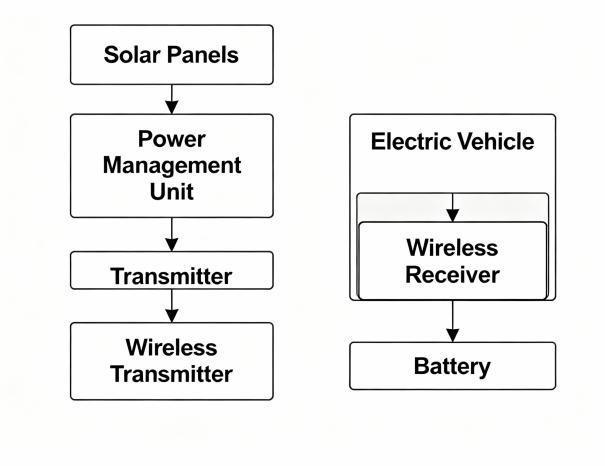
Figure. 1: High-level system architecture of the solar-powered wireless EV charging system. Solar panels supply regulated power to the battery, which drives the inverter and transmitting coil. The receiving coil on the EV captures the power and charges the battery, while the Arduino unit monitors and displays system status.
System Modularity and Extensibility
Thelayereddesignensuresstrongmodularityandsupportsfuturescalability:
Additional charging features, such as alignment detection, automatic coil positioning, or higher- power invertermodules,canbeintegratedwithoutalteringthecorewirelesspowertransferpipeline.
The system can be expanded to support smart energy management,enablingcloud-basedmonitoringof solaroutput,batteryhealth,andEVchargingdataforremotesupervision.
All power regulation and wireless transmission processes run locally, ensuring low-latency, stable operationsuitableforreal-timechargingeven undervaryingenvironmentalconditions.
IV.IMPLEMENTATION
We implemented a prototype of the solar-powered wireless charging system using an Arduino microcontroller, a solar energymodule,andaninductivewirelesspowertransfersetup.Thesystemcollectsenergyfromsolarpanels,conditions itthroughachargecontroller,storesitinabattery,andthenconvertsitintohigh-frequencyACforwirelesstransmission totheEV’sreceivingcoil.
Solar Power Harvesting and Storage:
The solar panel continuously generates DC power, which is regulated using a solar charge controller to prevent overcharging and voltage fluctuations. The regulated output is stored in a 12V rechargeable battery, which acts as the primary energy source for the wireless charging module. This stored energy ensures uninterrupted operation even duringlow-sunlightconditions.
Wireless Power Transmission in Real Time:
Oncesufficientsolarenergyisstoredinthebattery,thesystemactivatestheinverter,whichconvertstheDCsupplyinto high-frequencyAC requiredforinductivepowertransfer.ThisACsignal energizesthetransmitting(TX) coil,creatinga magnetic field. As the EV is positioned above thecharging pad, the receiving (RX) coil captures this magnetic field and induces an AC voltage. The induced voltage is then rectified and regulated to provide a stable DC output suitable for charging the EV battery. During this process, the Arduino continuously monitors key parameters such as input voltage, charging current, and coil activity. Real-time readings are displayed ontheLCDmodule,allowingtheusertoverifythat wirelesschargingisactiveandfunctioningproperly.Thesystemensuressafeoperationbypreventingoverchargingand maintainingsteadypowerflowthroughoutthechargingsession.
International Research Journal of Engineering and Technology (IRJET) e-ISSN:2395-0056
Volume: 12 Issue: 11 | Nov 2025 www.irjet.net p-ISSN:2395-0072
We conducted pilot tests to evaluate the performance and functionality of the solar-powered wireless charging system under practical operating conditions. The system was tested using a 12V solar panel, a regulated battery storage setup, andacompactwirelesschargingpaddesignedforanEVprototype.
Duringthetests,thetransmittingand receivingcoilssuccessfullytransferredpoweratvaryingdistancesandalignment positions.Atclosealignment(1–2cmairgap),charging efficiencywashigh,enablingsmoothandstablepower flow.As theairgapincreased,theinducedvoltagegraduallydecreased,consistentwithexpectedmagneticcouplingbehavior.On average, the wireless charging module achieved an efficiency range of 60–75% at optimal alignment and 45–55% at moderatedistances.
The solar panel generated sufficient power under direct sunlight, maintaining a steady charging voltage through the charge controller. During peak sunlight hours, battery charging was optimal, providing consistent energy to power the inverter. Under cloudy conditions, power generation reduced, but the stored battery energy ensured uninterrupted wirelesscharging.Overall,thesolarmoduleoperatedefficientlyandprovidedareliablerenewableenergysourceforthe system.
Real-Time Charging Performance:
Thesystemdeliveredcontinuouschargingwithminimalfluctuations.Thedelaybetweensystemactivationandwireless charging initiation was measured at 0.2–0.4 seconds, indicating near-instant response. Charging parameters such as voltage, current, and battery level wereupdatedinrealtimeonthedisplay,providingclearmonitoringfeedbackto theuser.
Charging Status Logging:
The system logged important data such as solar input voltage, battery level, and charging current throughout the test duration. These logs helped verify consistent power transfer and highlighted periods of peak solar output. No inconsistenciesorinterruptionswereobservedinthe loggingprocess,confirmingreliablesystembehavior.
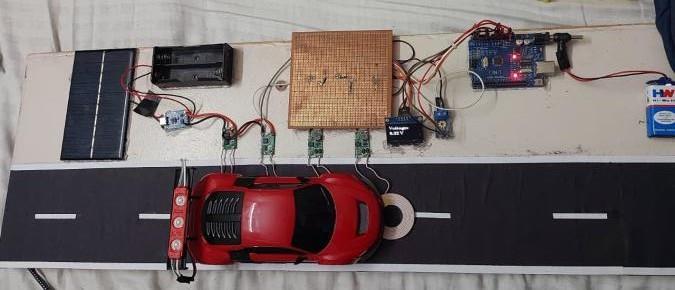
Figure 2: Shows a live demonstration of the solar-powered wireless EV charging system: the transmitting coil generates a magnetic field using inverter-driven AC power, while the receiving coil captures this field and charges the EV battery. Realtime voltage and current readings are displayed on the LCD, indicating active power transfer.
System Robustness:
Thewirelesschargingsystemdemonstratedstrongstabilityacrossmultipletests.Itmaintainedoperationevenwhenthe coils experienced minor misalignment or when the EV prototype was slightly repositioned. Voltage fluctuations caused by varying sunlight levels were successfully managed by the charge controller and battery buffer, ensuring uninterruptedoperation.
International Research Journal of Engineering and Technology (IRJET) e-ISSN:2395-0056
Volume: 12 Issue: 11 | Nov 2025 www.irjet.net p-ISSN:2395-0072
User Interface:
The LCD/OLED display provided real-time visualization of system parameters, including solar voltage, battery charge status,andchargingcurrent.Thisclearfeedbackhelpedusersconfirmthatthewirelesschargingprocesswasactiveand functioningproperly.
Hardware Requirements:
All experimentswereperformedusinglow-cost,easilyavailablehardwaresuchasanArduinoUno,a 12Vsolarpanel,a charge controller, and copper coils. No specialized or high-power electronics were required. The system’s reliance on simplecomponentsmakesitaffordable, portable,andeasytoimplementforsmall-scaleEVprototypesandeducational purposes.
Inthisproject,wepresentedasolar-poweredwirelesschargingsystemdesignedtoenablecontactlessandeco-friendly charging forelectricvehicles. Thesystem integrates solar energy harvesting, regulated battery storage, high- frequency inverter circuitry, and inductive power transfer todeliver a clean and efficient charging solution. Experimental results demonstratedthattheprototypesuccessfullytransmittedpowerwirelesslywithstableperformance,achievingcharging efficiency levels of approximately 60– 75% under optimal coil alignment and consistent energy delivery through the solar-batteryconfiguration.Thesefindingsconfirmthefeasibilityofcombiningrenewableenergywithwirelesscharging technologytosupportsustainableEVinfrastructureandreducedependencyongrid-basedchargingsystems.
Forfutureenhancements,weaimtoimprovetheoverallrobustnessandefficiencyofthesystem.Incorporatingadvanced MPPT(MaximumPowerPointTracking)controllerscansignificantlyincreasesolarenergy utilization,especiallyduring variableirradianceconditions.Similarly,integratingoptimizedcoildesigns,bettercompensationnetworks,andadaptive resonance tuning may improve wireless power transfer efficiency and enhance misalignment tolerance. The system could also benefit from smart energy management features, IoT-based monitoring, and cloud-linked dashboards to analyzechargingstatistics,batteryhealth,andsolarproductivityinrealtime.
FurthertestingonlargerEVmodelsandhigher-powerchargingmodulesisneededtovalidatethesystem’seffectiveness underreal-worldoperatingconditions.Comparativestudiesbetweenwired,wireless,andhybridsolar-assistedcharging can also help identify the most practical and cost-efficient deployment strategies. Expanding the system to support publicparkinglots,solarchargingstations,orportablesolar-poweredchargerswouldoffervaluableinsightsintolargescaleimplementation.
By addressing these future improvements, the platform has the potential to evolve into a practical, scalable, and sustainableEVchargingsolution.Aselectricmobilitycontinuestogrow,theproposedsystemdemonstratesapromising pathway toward clean energy integration and convenient wireless charging, laying the foundation for next-generation renewable-poweredEVtechnologies.
1. Kursetal.,“WirelessPowerTransferviaStronglyCoupledMagneticResonances,”Science,2007.
2. Budhia et al., “Design and Optimization of Circular Magnetic Structures for IPT EV Charging,” IEEE Trans. Power Electron.,2013.
3. F.C.CovicandJ.T.Boys,“InductivePowerTransfer,”ProceedingsoftheIEEE,variousyears.
4. Patel & Shah, “Solar Powered EV Charging Station,”IJERT,2019.
5. Zhangetal.,“MPPTandPowerManagementforPV-PoweredChargingStations,”IEEEAccess,(year).
6. Singh et al., “Prototype Solar-Driven Wireless Charger for EVs,” International Journal of Renewable Energy Research,(year).
7. (AuthorsoncombinedMPPT/battery/WPTintegration),(journal/conference),(year).
8. Zhang&Mi,“CompensationTopologiesforWirelessPowerTransferSystems,”IEEETransactions,2016.
International Research Journal of Engineering and Technology (IRJET) e-ISSN:2395-0056
Volume: 12 Issue: 11 | Nov 2025 www.irjet.net p-ISSN:2395-0072
9. (Authorsoncoilgeometriesandmisalignment tolerance),(journal/conference),(year). (Multi-coiltransmitterarraysresearch),(journal/conference),(year).
10. (PowerelectronicsforIPT:inverter/rectifiersoft-switchingstudies),(journal/conference),(year).
11. (EnergymanagementstrategiesforPV-to-WPTsystems),(journal/conference),(year).
12. Lietal.,“DynamicWirelessChargingforIn-MotionEVs:FieldTrialsandAnalysis,”(conference/journal),(year).
13. (Safety/FOD/EMCstudiesandSAEJ2954standardsummaries),(journal/standard), (year).