
International Research Journal of Engineering and Technology (IRJET) e-ISSN:2395-0056
Volume: 12 Issue: 05 | May 2025 www.irjet.net p-ISSN:2395-0072
International Research Journal of Engineering and Technology (IRJET) e-ISSN:2395-0056
Volume: 12 Issue: 05 | May 2025 www.irjet.net p-ISSN:2395-0072
1Faculty of Engineering, Pine Sattam university, Elkharg, Saudi Arabia.
2Faculty of Technology and Education, Helwan University, Cairo, Egypt.
3Faculty of Engineering, Helwan University, Cairo, Egypt.
4Lecturer, Department of Electrical Power, Faculty of Engineering, Helwan University
Abstract- In this research, we will discuss protection against current transformer saturation. A system was built to simulate the real system of the electrical power production system in the college laboratory, where experiments were conducted on the transformer during the synchronization process with the electrical grid. In these experiments, short circuit faults were intentionally created to study their effects onthe transformer.
To collect data and analyze results, a IN 6009 card was used to gather readings from the system and transfer them to the computer. Then, Lab VIEW software was used to analyze and convert the readings into useful results. These results help to understand how saturation affects the performance of the transformer and to develop effective protection strategies. This research will review the results obtained from the experiments and discuss possible solutions to prevent current transformer saturation and ensure the continuity andsafety of the power productionsystem.
Keywords: Production, transformer, laboratory, software, saturation, current transformer, short circuit, inrush current.
Electric power systems are characterized by continuous flowduringgeneration,transmission,anddistribution,and they are safe and error-free [1]. Due to the many advantages they offer, engineers strive to solve the problem of power flow interruption [2]. One of the issues facing transformers is the problem of saturation [3]. The saturation problem in transformers, in general, and in current transformers, in particular, prevents the flow of electricalpower[4].Therefore,itisnecessarytostudythe saturation problem practically in the laboratory [5], as saturation can result from several causes such as short circuits [6]. Since a short circuit is a real fault and not a transientcondition[7],itrequiresprotectingtheelectrical system from saturation resulting from short circuits [8]. Studies and literature have shown that short electrical faults are among the most damaging factors to power
supply equipment [9]. However, traditional protection methodsstruggletodistinguishbetweenfaults[10-11-12] andalsofaceissueswithcoordinationbetweenprotection zones [13-14]. Protecting the electrical network or delayingfaultdetectioncanleadtointerruptionsinpower supply [15-16]. Therefore, relying solely on traditional protection methods for the saturation problem is inadequate [17-18]. The transformer protection system needs to be adaptable, fast, and protected against saturation [18-19-20]. This paper presents an experimental investigation into a protection algorithm against saturation caused by short circuits, tested in the laboratory using an integrated power system that simulates a real system for fixed-speed wind turbines (a DC motor supplied with constant voltage and a constant current source) [21], an induction generator mechanically connected to a three-phase electrical transformer, and a three-phase-transmission-Line.
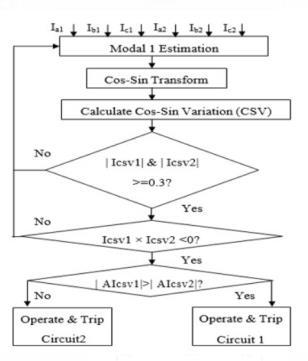
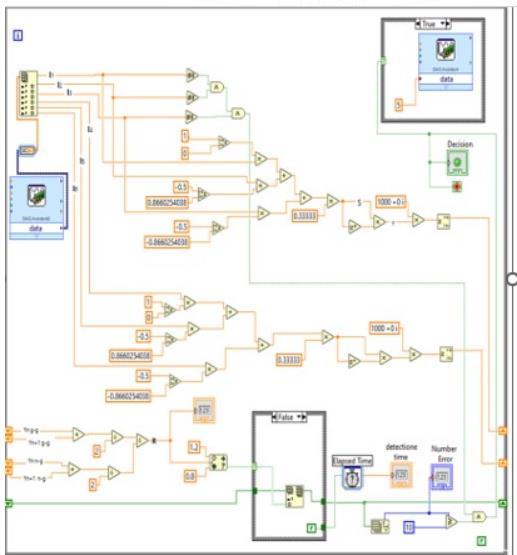
2.1. In this technique, the principles of the proposed technique are illustrated as follows in a quick review. The designed algorithm relies on establishing a relationship between the current signal resulting from the low voltage Iscv1andthehighvoltagesignalIcsv2.
2.2 Reading the three-phase relay current and the fault currentatthebeginningoftheoperation.
2.3. The algorithm verifies the existence of current in two parallel paths: the first path represents the current calculations on the high voltage side, and the second path onthelowvoltageside.
2.4. The program begins performing calculations on the twoparallelpaths.
2.5. Calculatethedifferenceinthevalueof i1- i2thehigh voltage and low voltage, and the concept of differential protection.
Volume: 12 Issue: 05 | May 2025 www.irjet.net
2.6.Use the algorithm condition between and icsv1 and icsv2.
2.7.Thetoleranceratiois0.3asacondition
2.8.The conditionof the productofthetwovalues icsv1 × icsv2 beinglessthanzero.
2.9 Use the concept of sin - cos in protection against saturation
2.10. Decision
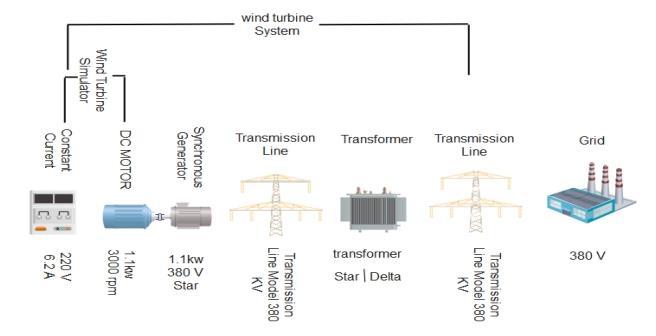
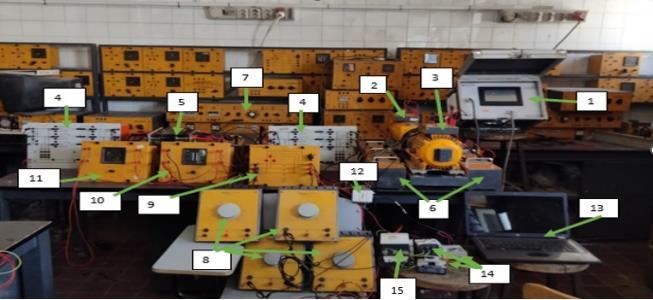
The laboratory system used in this study consists of two aspects,thefirstaspectrepresentsthewindpowersystem and consists of a simulator of a constant-speed wind turbine (a DC motor fed from a constant voltage and constant current source), a wound rotor induction generatorthatismechanicallyconnectedwithaDCmotor, and the excitation terminals of the generator are connected to a controlled DC source, an output of generator is connected to a transmission line, the second endofthetransmissionlineisconnectedtoatransformer, and the second end of the transformer is connected to a second transmission line. The second transmission line is at its end on one side of a circuit breaker responsible for connecting the system to the electrical grid when the synchronizationconditionsaremet.Thesecondsideofthe laboratorysystemistheelectricalgrid,anditisconnected totheotherendofthesynchronizationswitch.TheNi6009 toolisusedtotransfersignalsfromthelaboratorysystem tothelaptopbyusing6currenttransformerstomakethe valuesoftheelectricalsignalsmatchtheNi6009.
International Research Journal of Engineering and Technology (IRJET) e-ISSN:2395-0056
Volume: 12 Issue: 05 | May 2025 www.irjet.net
The Lab-View package is utilized to implement the proposed technique using real measurements as program inputs rather than prodact signals. Lab-View is a sophisticated and versatile tool used to collect measurements, control operations, and analyze stored data. As the G graphical programming language [18], LabViewemploysagraphicalprogramminglanguage.
The software uses a calculation process to find the relationship between the transformer-grid side current and the transformer-neutral side current. Mostly, the relationship should be equal to one. Due to the disturbances resulting from the nature of wind energy, a tolerance ratio of 0.2 was added. Suppose the product of therelationshipisequaltooneinadditiontothetolerance ratio.Inthatcase,thetransformerisinanormalcondition. Ifitisoutsidethisvalue,thereisafaultinthetransformer area due to magnetic saturation caused by a short circuit. Sincethetransformerencounterstransientstates,toavoid faulty disconnections, the program ensures that there are 10consecutivefaultsignals,andwhentheprogramchecks thatthefaultisinternal,itissuesatripcommand.
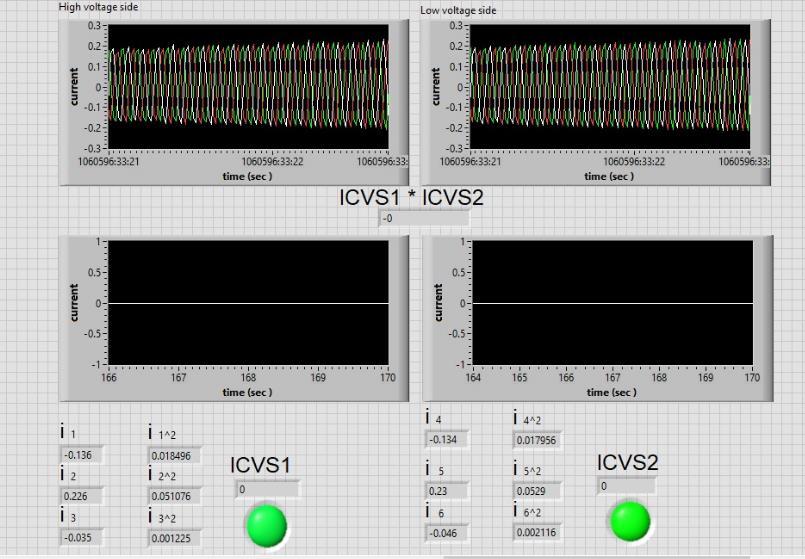
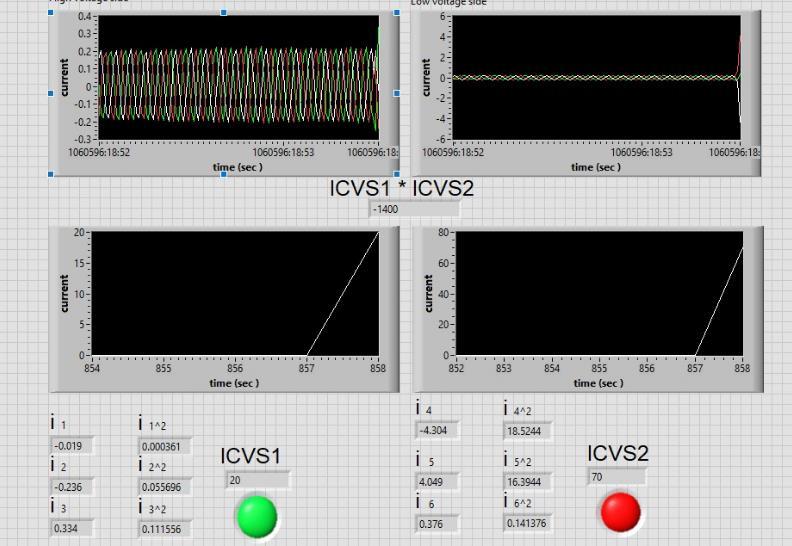
3.1- The performance of the relay under normal operation
RelayPerformanceDuringNormalOperation
The signals operate normally as indicated in Figure (5). When these signals are fed into the computer through a dataacquisitiondevice,itisconfirmedthatthesystemisin anormalstatewithoutanymagneticsaturation.According to the proposed technique, simulated using LabVIEW, the numberofconsecutiveerrorsislessthanten,ensuring no
p-ISSN:2395-0072
faults occur. This demonstrates the relay's ability to distinguishbetweennormalandabnormalconditions..
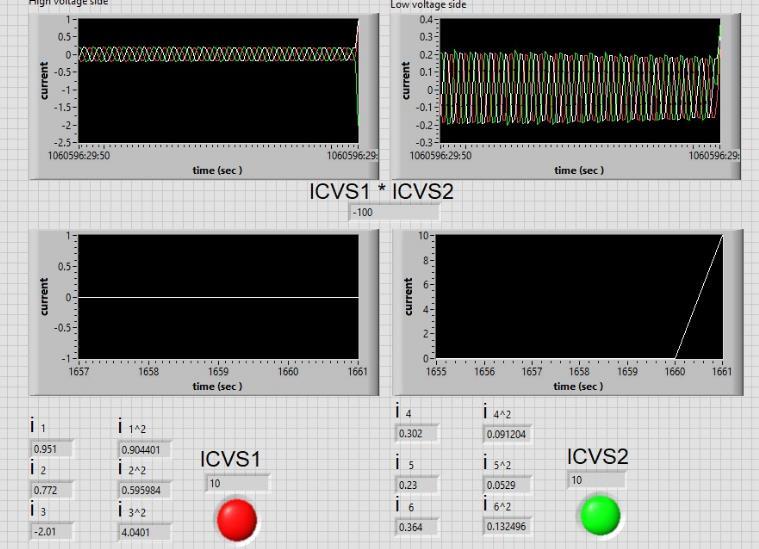
3.2- The performance of the relay during an internal fault
Effect of Short Circuit and Waveform Distortion Due to Magnetic Saturation, and Relay Behavior During Such FaultsontheTransformer:
3.2.1. Impact of Short Circuit:
During an internal short circuit, the transformer currents increasesignificantlyduetothelowresistanceinthefault path.
3.2.2. Waveform Distortion:
The sudden increase in current causes the transformer core to enter magnetic saturation, resulting in waveform distortion.
This distortion appears as an increase in nonlinear components (such as higher-order harmonics) or a deviationfromthenormalsinusoidalshape.
3.2.3. Difference in Currents on Both Sides:
Currents on the high-voltage and low-voltage sides become mismatched due to internal energy losses caused bythefault.
RelayBehaviorDuringSuchFaults:
3.2.3.1. Current Monitoring:
The relay monitors currents on both sides of the transformerusingcurrenttransformers(CTs).
It measures instantaneous changes and abnormal values, suchassuddenincreasesorwaveformdistortions.
International Research Journal of Engineering and Technology (IRJET) e-ISSN:2395-0056
Volume: 12 Issue: 05 | May 2025 www.irjet.net p-ISSN:2395-0072
3.2.3.2. Signal Analysis:
The relay analyzes the waveforms for indicators like magnetic saturation, higher-order harmonics, or asymmetryinthecurrents.
3.2.3.3. Fault Identification:
If abnormal distortions consistent with internal faults, such as significant differences between the currents on bothsides,aredetected,therelayclassifiesitasaninternal fault.
3.2.34. Protection Activation:
The relay sends a signal to disconnect the transformer from the network, protecting it and minimizing damage causedbythefault
Summary: A short circuit causes increased fault current and waveform distortion due to magnetic saturation. The relay detects the fault by analyzing these distortions and activates protection by isolating the transformer from the system
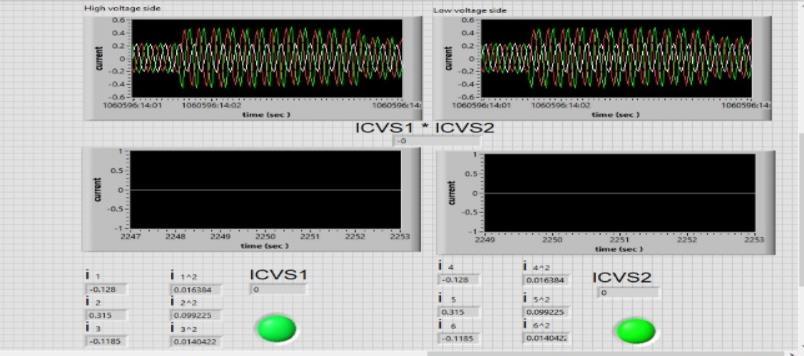
3.3- The Performance of the Relay During an External Fault
When a short circuit occurs on a transformer, it causes a sudden rise in current, potentially leading to magnetic saturationinthetransformercore.Therelay'sbehaviorto protect against this situation relies on various techniques foreffectiveprotection,including:
3.3.1. High Current Detection
Therelaymonitorsthecurrentonbothsides(highvoltage and low voltage). If the current exceeds a certain threshold,itisconsideredanindicationofashortcircuit.
The current is compared between the two sides to detect imbalances (Differential Protection), which indicate an internalfault.
3.3.2. Harmonic Filters
Modern relays use harmonic analysis to detect magnetic saturation.
If the current waveform contains high levels of odd harmonics (such as the third or fifth harmonics), it indicatessaturation.
The relay disregards these currents if they are caused by naturalinrushcurrentsduringtransformerstartup.
3.3.3. Intelligent Time-Delay Relays
Timedelayisusedtoavoidunnecessarytripping.
In the case of inrush currents or temporary saturation, trippingisdelayedtoallowthesituationtostabilize.
If the high current persists, the transformer is disconnectedimmediately.
3.3.4. Digital Analysis
Digital relays utilize signal processing techniques to analyzethecurrentwaveform.
Sudden changes in current caused by short circuits are detected.
Digitalanalysisenablesdifferentiationbetweentrueshortcircuit faults and magnetic saturation or normal conditions.
SOTechnology plays a critical role in protecting transformersfromfaultscausedbymagneticsaturationby improving relay response with precision and speed, minimizing potential damage, and ensuring operational continuity
International Research Journal of Engineering and Technology (IRJET) e-ISSN:2395-0056
Volume: 12 Issue: 05 | May 2025 www.irjet.net p-ISSN:2395-0072
4 Conclusion
the proposed algorithmic investigation conducted in the theoretical section ensured safe and scalable performance incases of magneticsaturationcaused byshortcircuits in power transformers. to explore the performance of the proposedmodelinrealfaultscenarios,itwasemployedin investigations tested under conditions similar to those of magnetic saturation caused by short circuits. the experimental results showed consistency with the simulatedoutcomes.becausetheproposedmodelisbased onauniquecouplingapproach,itissensitivetochangesin magnetic saturation, stable, and reliable, and can be used in real-time applications because the proposed methodology,whichisbasedonauniquecouplingmethod, is stable, reliable, and rapid during the discrimination of internal and exterior faults, magnetizing inrush currents, and switching on internal faults, it can be employed in real-timeapplications.
[1] S. Palnmouttilgeurge and S. Sankarasok, “Adaptive differential protection for transformers in grid-connected windfarms,” Int. Trans. Electr. Energy Syst.,2018,p.e2594, doi:10.1002/elep.2549
[2] J. Krstivojevic and M. Djuric, “A new algorithm for avoiding maloperation of transformer protection caused by the transformer magnetizing inrush current and current transformer saturation,” University of Belgrade, School of Electrical Engineering, Belgrade, Serbia.
Correspondence:j.krstivojevic@etf.rs.
[3] H. Mohammad Pour, R. Dashti, and H. R. Shaker, “New practical approach for discrimination between inrush currentsandinternalfaultsinpowertransformers,”2020.
[4] E. Ali, O. M. Malik, S. Abdelkader, A. Helal, and H. Desouki,“Experimentalresultsofratios-basedtransformer differential protection scheme,” Int. Trans. Electr. Energy Syst.,2019,p.e12114,doi:10.1002/2050-7038.12114.
[5]M.Hossain,L.Leevongwat,andP.Rastgoufard,“Partial operating current characteristics to discriminate internal and external faults of differential protection zones during CTsaturation,” IET Gener. Transm. Distrib.,2017.
[6] Department of Electrical Engineering, University of NewOrleans,2000LakeshoreDr,NewOrleans,USA.
[7] E. Naseri, Z. Kazemi, M. M. Arefi, and E. Farjah, “Fast discrimination of transformer magnetizing current from internal faults: An extended Kalman filter-based approach,”IEEE,2016.
[8] IEEE Publication Policy: "Personal use permitted, but republication requires IEEE permission." Available at: http://www.ieee.org/publications_standards/publications /rights/
[9] S. K. Murugan, S. P. Simon, P. S. Nayak, and K. S. N. P. Prasad, “Power transformer protection using chiplet transform,” IET Journals, The Institution of Engineering andTechnology,2015,doi:10.1049/iet-gtd.2015.1486.
[10] S. Jena and B. R. Bhalija, “Numerical busbar differential protection using generalized alpha plane,” IET Gener. Transm. Distrib., The Institution of Engineering and Technology,2017.
[11] M. Arjendran and V. Perumal, “Saturation analysis on currenttransformers,” Int. J. Pure Appl. Math.,vol.118,no. 18,pp.2169–2176,2018.
[12]A.Tokic,V.Milardic,M.Kasumovic,andD.Demirovic, “Conversion of RMS into instantaneous transformer saturation characteristics implementation in MATLAB/SPS-ST,” Int. Rev. Electr. Eng.,vol.14,no.5,Sep.–Oct.2019,ISSN1827-6660.
[13] B. Kasztenny, N. Fischer, D. Taylor, T. Veprakash, and J. Jallil, “Do CTs like DC? Performance of current transformers with geomagnetically induced currents,” SchweitzerEngineeringLaboratories,2015.
[14] M. Prochazka, “Modeling of current transformers under saturation condition,” Adv. Electr. Electron. Eng., 2017.
International Research Journal of Engineering and Technology (IRJET) e-ISSN:2395-0056
[15] B. Noshad, B. Fakharminagoodarzi, “A new model for current transformer,” J. Basic Appl. Sci. Res., 2013, ISSN 2090-4304.
[16] P. K. Bera, C. Sen, and V. Kumar, “Discrimination of internal faults and other transients in an interconnected system with power transformers and phase angle regulators,” IEEE Syst. J., arXiv:2004.06003v2 (eess.SP), Aug.2020.
[17] A. Fallahi, N. Ramezani, and L. Ahmadi, “Current transformersaturationdetectionandcompensation based on instantaneous flux density calculation,” Automatika, 2017,doi:10.7305/automatika.2017.04.1555
[18] R. Ahmed, M. Vimalraj, and A. Raos, “Saturation analysisofcurrenttransformers,” Int. J. Res. Rev.,vol.2,no. 6,pp.1–6,Jun.2015.
[19] D. Muthumuni, L. Ruchall, and R. Jayasinghe, “Modelingcurrenttransformer(CT)saturationfordetailed protectionstudies,” Manitoba HVDCResearchCenter, Dec. 2011.
[20] S. Opana and C. Koochang, “Mitigation of current transformer saturation on medium voltage switchgears in APR1400 of nuclear power plants,” IEEJ Trans. Electr. Electron. Eng.,vol.15,pp.1630–1640,2020.
[21] F. Romanyuk, I. Novash, Y. Rumiatsev, and P. Wegierek, “Wye-connected current transformers simplified model validation in MATLAB–Simulink,” Przegląd Elektrotechniczny,vol.91,2015,ISSN0033-2097, doi:10.15199/48.2015.11.67.
[22] J. Liao, X. Zhu, and Q. Wang, “Transient current similarity-based protection for interconnecting transformers in wind farms,” IEEE Access, Apr. 2019, doi: 10.1109/access.2019.2909063.
[23] A. Donuk, “A laboratory application for teaching the effect of harmonics on transformer core saturation,” Int. J. Electr. Eng. Educ., vol. 57, no. 3, pp. 191–201, 2020, doi: 10.1177/0020720919837852.
[24] P. Dudhal, H. B. Chaudhari, V. Mishra, and B. Bishnoi, “Numerical differential protection of power transformer using an innovative algorithm,” Int. J. Eng. Adv. Technol., vol.8,no.5S3,Jul.2019,ISSN2249-8958.
[25] S. Sanati and Y. Alinejad-Beromi, “Prevention of current transformer saturation by using negative resistance,” IET Gener. Distrib.,vol.15,pp.508–517,2021.
Volume: 12 Issue: 05 | May 2025 www.irjet.net p-ISSN:2395-0072 © 2025, IRJET | Impact Factor value: 8.315 | ISO 9001:2008
[26] A. Wbadi, S. M. Hosseini, and A. A. Abdoos, “A new restrictedearthfaultrelaybasedonartificialintelligence,” IJE Transactions A: Basics, vol. 32, no. 1, pp. 62–70, Jan. 2019.