
International Research Journal of Engineering and Technology (IRJET) e-ISSN: 2395-0056
Volume: 12 Issue: 04 | Apr 2025 www.irjet.net p-ISSN: 2395-0072
International Research Journal of Engineering and Technology (IRJET) e-ISSN: 2395-0056
Volume: 12 Issue: 04 | Apr 2025 www.irjet.net p-ISSN: 2395-0072
Dr. R Jayachitra1 , Sudharsan C2 , Balaji G K3
1Associate Professor, Department of Mechanical Engineering, PSG College of Technology, Coimbatore, India
2Department of Mechanical Engineering
PSG College of Technology Coimbatore, India
3Department of Mechanical Engineering
PSG College of Technology Coimbatore, India ***
Abstract – The ergonomics of construction equipment assembly lines are pivotal in enhancing worker safety and operational efficiency. This project focuses on designing and implementing manufacturing aids, such as workbenches and lifting tackles, to mitigate biomechanical fatigue identified through the replication of worker postures during product assembly. Utilizing advanced software, a comprehensive biomechanical analysis is conducted, evaluating parameters such as Flexion-Extension compression, L4-L5 compression, moment, and joint shear. The analysis ensures that the compression ratio adheres to the National Institute for OccupationalSafetyandHealth(NIOSH)thestandardlimitof 3433 Nm. Based on method studies and the principle of easy accessibility, customized manufacturing aids are designed to optimize worker posture and reduce biomechanical strain. Post-implementation, a subsequent analysis is performed to assess the effectiveness of these aids in alleviating biomechanical stress and improving worker posture. The results demonstrate a significant reductioninbiomechanical fatigue, validating the efficacy of the designed aids in promoting a safer and more efficient assembly line environment. This study underscores the importance of ergonomic interventions in industrial settings, offering a structured approach to enhancing worker well-being and productivity.
Key Words: Ergonomics, Biomechanical analysis, Manufacturing aids, Posture Optimization, Worker Accessibility.
The construction equipment manufacturing industry is characterized by Inherently complicated assembly tasks tending to make workers take up physically stressful positionsaretypicaloftheconstructionequipmentindustry. Thesetasksenhancetheriskofmusculoskeletaldisorders (MSDs) and biomechanical loading. In order to improve workercomfort,safety,andproductivity,ergonomicsisvital
in solving such issues. One of the main causes of workrelated MSDs, especially in manufacturing industries, is awkwardposturesandimproperlifting,accordingtoNIOSH (NIOSH, 2021) [18]. Repetitive work, heavy lifting, and sustainedawkwardposturesonassemblylinescausehigh biomechanicalstress,especiallyonjoints,muscles,andthe lowerback(L4-L5).Theseproblemsnotonlycompromise workers' health but also affect productivity and general operationefficiency[17].
Thisprojectaimstoaddresstheseconcernsthrough the creation and application of ergonomic production equipment, like workbenches and lifting tackles, to specificallysuitassemblylinesforconstructionequipment. Utilizing sophisticated software, a detailed biomechanical analysis isconducted by simulating the workers' accurate positions when performing assembly tasks. For effective compliancewiththeNIOSHstandardthresholdof3433Nm (NIOSH, 1981), this assessment considers essential parameterssuchasjointshear,moment,compressionofL4L5, and flexion-extension compression [18]. For biomechanicalprotectionandenhancingposture,theresults inform the creation of manufacturing assistance that considersprinciplesofmethodstudyandworkeraccess[7].
Inordertomeasuretheefficiencyofthesuggestedaidsin reducingbiomechanicalstressandimprovingthepostureof workers, a follow-up study is conducted after installation. This constant practice guarantees that the interventions improvegeneralassemblylineproductivitywhileensuring theymeetergonomicrequirements.Thegoalofthisprogram is to design manufacturing aids that are safer, more productive,andmorecomfortableforworkersthroughthe applicationofergonomicconceptstotheirconstruction.This will ultimately improve the welfare of workers and the sustainabilityoftheconstructionequipmentmanufacturing sector.
International Research Journal of Engineering and Technology (IRJET) e-ISSN: 2395-0056
Volume: 12 Issue: 04 | Apr 2025 www.irjet.net p-ISSN: 2395-0072
Themaingoalsofthisresearcharethreefold.Firstly,the research will analyse worker postures during assembly operations and determine biomechanical risks using advancedergonomicssoftware.Thisincludessimulatingthe exactworkerposturesinavirtualsetupandperformingan elaboratebiomechanicalanalysistoassessparameterslike L4-L5 compression, joint shear, and flexion-extension moments [4]. These parameters are contrasted with standard ergonomic criteria, such as the NIOSH lifting equation [19], to determine high-risk postures and tasks. Second,basedontheresultsofthebiomechanicalanalysis, the research seeks to design and implement customized manufacturingaids,suchasadjustableworkbenches,lifting aids,andbettertoolpositions,tomitigatetherisksidentified in Table.4. These aids are customized to facilitate better accessibility for workers and minimize uncomfortable postures.Lastly,theresearchaimstoassesstheefficacyof the implemented aids using a post-intervention biomechanical analysis. The assessment measures the decrease in biomechanical strain and examines improvementsinworkerposturetoensurethatthedesigned aids are ergonomic and enhance worker safety and efficiency.Allofthesegoalsarepartofanintegratedstrategy toreducebiomechanicalrisksandensureasaferandmore productiveworkplaceinconstructionequipmentassembly lines.
Thebiomechanicalanalysiswasconductedusingdigital humanmodelingsoftwaretoevaluateworkerposturesand assess ergonomic risks in the assembly process. The followingmethodologywasadopted:
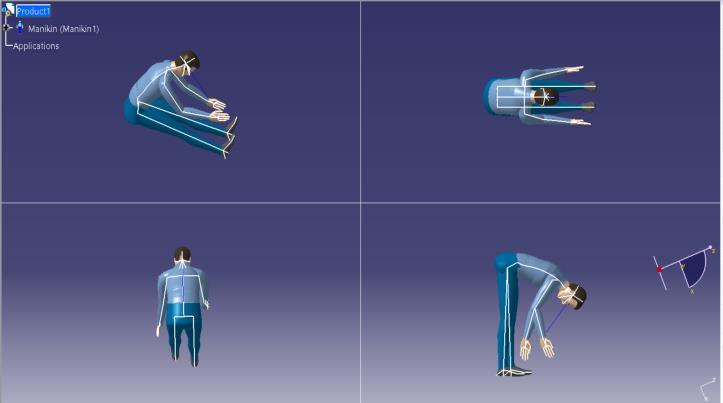
PostureReplication –Theexactposturesofworkers during assembly were replicated in the digital environmentbasedonobservationaldata (seeFig–1) and video recordings. Key joint angles, body positioning, and task constraints were carefully adjustedtoensureaccuracy[17].
Anthropometric Parameter Definition – Thehuman model was configured using anthropometric data relevanttotheworkerpopulation,includingstature, weight, and limb dimensions, to ensure realistic simulationoutcomes.
Task and Environment Setup – The assembly environment was recreated, incorporating workstations, tools, and components [17]. The worker’sinteractionswithobjects,reachzones,and materialhandlingactivitiesweresimulatedtoreflect realworkingconditions.
Biomechanical Analysis Execution – The software’s analytical tools were utilized to calculate key biomechanicalparameters,including:
Flexion-extensioncompression
L4-L5spinalcompression
Jointshearandmomentforces
Abdominalpressureandoverallbody load
These parameters were compared against recommended ergonomicthresholdstoidentifyhigh-riskpostures.
Risk Evaluation and Interpretation – The results were evaluated against established ergonomic guidelinesbyfollowingTable3,suchaspermissible spinalcompressionlimits.Posturesexceedingsafe limits were classified as high-risk, warranting intervention.
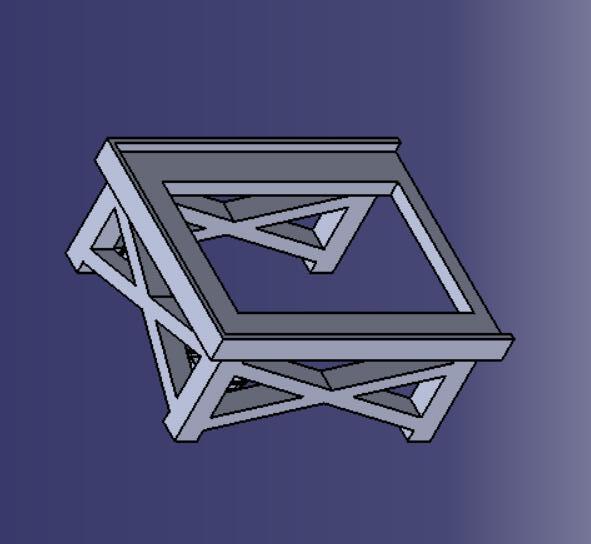
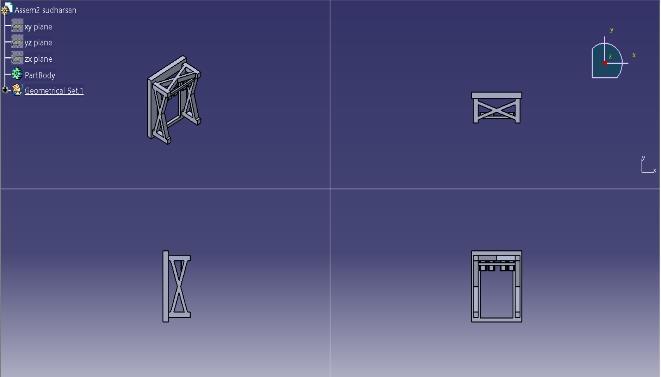
Intervention Design and Validation – Based on the findings,ergonomicsolutionssuchasworkbenches and lifting aids were designed Fig. 3 to minimize strain[7].Acomparativeanalysiswasperformedby reassessingthemodifiedpostureswiththeproposed interventions to quantify improvements in biomechanicalstress.
Final Assessment and Documentation – The effectiveness of the intervention was statistically validated, and a detailed report was generated, summarizing the improvements in ergonomic conditions Table.4 [19]. The results were documented for further refinement and implementationintheassemblyprocess.
To evaluate ergonomic risks in the construction equipment assembly line, a structured data collection approach was followed based on the Table. 1. Initially, photographsweretakentocaptureactualworkerpostures, which were essential for REBA (Rapid Entire Body Assessment)calculationsandforaccuratedigitalreplication. Thesepostureswerethenreplicatedinspecializedsoftware toenableprecisebiomechanicalanalysis.
Thishelpedidentifyhigh-risktasksandpostures,which wereprioritizedforergonomicintervention.Basedonthis analysis, custom manufacturing aids were designed and implementedtoreduceergonomicstress.Updatedpostures were analysed again in the software to validate the effectiveness of these solutions. Finally, a comparison of biomechanical analysis values was made using the NIOSH recommendedlimitof3433Nmtoconfirmimprovements.
International Research Journal of Engineering and Technology (IRJET) e-ISSN: 2395-0056
Volume: 12 Issue: 04 | Apr 2025 www.irjet.net p-ISSN: 2395-0072
Table-1: DataCollectionsteps
Step Outcome
Photographs Capturedreal-worldposturesforREBA calculationandforaccuratereplication.
Replicatingin Software Createddigitalmodelsforprecise biomechanicalanalysis
Biomechanical DataCollection Identifiedhigh-risktasksandpostures.
IdentifyingRisk Areas Prioritizedtasksrequiringergonomic intervention.
Solution Development Designedandimplemented manufacturingaidstailoredtoworker needs.
Updated Posture Analysis Validatedtheeffectivenessofthe solutionsthroughsoftwareanalysis.
Comparison betweenbefore andafter improvements
Comparingvaluesofbiomechanical analysisbasedontheNIOSHstandard value3433Nm
This study follows a structured approach to identify ergonomic risks, analyse worker postures, and develop solutions to improve safety and efficiency in construction equipment assembly. The methodology consists of the followingsteps:
Step1:ProblemIdentificationandDataCollection
Identifying ergonomic problems related to manual materialhandlingintheassemblyprocessistheinitialstep. Observations,timestudies,andemployeefeedbackareused todocumentposture,forceexertion,andtaskduration.This dataservesasthefoundationforfurtherinvestigation.
Step2:BiomechanicalAnalysisandRiskAssessment
Adigitalhumanmodellingtoolisusedtoreplicateactual workerposturesandassessergonomicrisks.Thefollowing keyparametersareanalysed:
L4-L5 Spinal Compression – To determine lower backstrainlevels.
MomentandJointShearForces–Toevaluatestress distributiononjoints.
RULA and REBA Analysis – To quantify postural risks.
NIOSHLiftingEquationCalculations–Toassesssafe liftingconditions.
Postureswithhighergonomicriskscoresareidentified Table 2. The root causes of these risks, such as poor workstation design or excessive bending, are analysed. Based on these insights, ergonomic interventions such as workbenchesandliftingaidsaredesignedFig.3tooptimize workerpostureandreducebiomechanicalstress[7].
The solutions are subsequently evaluated in virtual simulations to measure their efficiency. The improved postures are compared with the baseline conditions to evaluatereductionsinspinalcompression,jointshearforces, andoverallergonomicrisk.
Thefinalstepissummarizingthefindingsandstatingthe impactoftheproposedsolutions.Thestudyconcludeswith recommendations for the improvement of ergonomics in constructionequipmentassemblytoenhancethesafetyand efficiencyoftheworkers.
This stepwise methodology ensures a systematic approachtoidentifying,analyzing,andmitigatingergonomic risksnotedinTable.4.inindustrialsettings.
A posture evaluation needs to be done at every workstation along the assembly line of construction equipment in order to identify which workstation most exposes workers to MSDs with the most hazardous work posture that needs to be corrected immediately. Previous reviews reported that the workers are exposed to high compression and strain in the lumbar region related to flexion.
Additional research and redesign of the work system, especially of manual material handling tasks such as the loaderarmsubassembly,isnecessary.Workpostureanalysis ofassemblylineworkersidentifiedthatsomeactivitieshave mediumtohighergonomicrisk.Onthebasisofanalysisof the REBA score and duration of work, these activities fall underthecategoryofhigh-riskthatneedstobecorrected immediatelyinergonomics.
International Research Journal of
Volume: 12 Issue: 04 | Apr 2025 www.irjet.net
TABLE-2: RebaScoresandTaskDurationforHighRiskTask
–
Theexaminationofthelumbarspine(L4-L5)area encompassedthecalculationoftheparametersspecifiedin Table3:
Table 3:BiomechanicalAnalysisfortheWorkingPosture Summary Data Tab
Therefore,inthesubassemblyprocessoftheloaderarmfor backhoeloadermachines,workersarerequiredtoadopta prolonged forward-bending posture while performing pneumatic fastening tasks. This posture, maintained for approximately 45 minutes across six machines and REBA valueof10detailedinTable2,placessignificantstrainon the lower back and upper limbs [8], increasing the risk of musculoskeletaldisorders(MSDs).Therepetitivenatureof thetask,combinedwithconstrainedworkspaceconditions, furtherexacerbatesergonomicconcerns.Addressingthese ergonomicchallengesiscrucialtoimprovingworkersafety, reducing fatigue, and enhancing overall assembly line efficiency.
Toquantifytheergonomiceffectofthetaskbeing measured,theposturalanglesmeasuredwereemployedto reconstruct the correct posture using ergonomic analysis software. The L4-L5 moment, compressive loads, and biomechanicalloadsoneachbodyregionweredetermined froma25thpercentilehumanmanikin.Theoverallresultis presentedbelow:
Each angle of the joint recorded during the task observation was entered into the ergonomic software to guaranteeaccuratereplicationofposture[17].Theanalysis ofpostureisdepictedinFig 1.
ThesevalueswerecomparedagainstFig.2NIOSHstandard value[19]toassesstheriskoflowerbackstrain[10].
Forces and moments in various regions of the body, i.e., upper body, lower body, and torso, were computed. The bodyloadcompressioncameouttobe282Nandtherewas nocompressionduetoaxialtwist.
International Research Journal of Engineering and Technology (IRJET) e-ISSN: 2395-0056
Volume: 12 Issue: 04 | Apr 2025 www.irjet.net p-ISSN: 2395-0072
Table - 4: RiskIdentified
Parameter
L4-L5Compression
JointShearForce
AbdominalPressure
RepetitiveMotion
SustainedPosture
WorkstationDesign
Risk Identified
Highcompressionloadonthe spine
AnteriorshearforceonL4-L5 joint
Increasedintra-abdominal pressure
Frequentheavylifting(12+ timesdaily)
Prolongedposture(15min-1 hr)
Lackofergonomicliftingaids
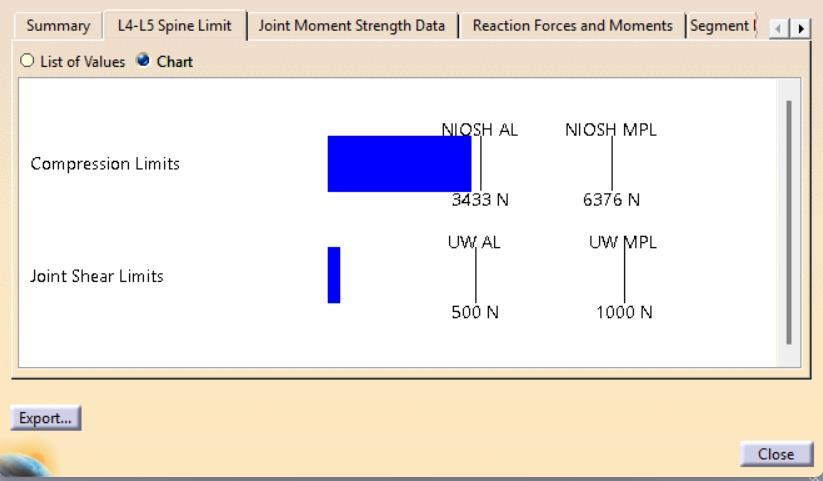
- 2: ComparisonbetweenL4-L5Compression[N]with NIOSHAL
6.4 Ergonomic Risk Assessment
Theresultsshowsignificantflexion/extensioncompression (2964N)andlumbarcompression(3246N),suggestinga significant risk of lower back pain. Table 4 lists the identifiedergonomicrisks[15].Thesefindingssuggestthat inordertolowermusculoskeletalrisks,ergonomicsolutions suchasworkstationredesign,tooladaptations,orposture adjustmentsmayberequired.
The following sections provide a comprehensive examination of these results and their significance for reducing manual material handling tasks on the manufacturing line for construction equipment. Table 3 presentsasummaryofthecomputedvalues.
To assess the risk of lumbar injuries, the biomechanical examination focused on determining the segmental inputs to the overall force at the L4-L5 spinal segment.Accordingtothefollowingequation[2],thetotal
forceatL4-L5(FL4-L5)isthesumoftheforcesfrombody weight,externalload,flexion/extension,andaxialrotation:
FL4-L5=FBodyLoad+FExternalLoad+FFlexion/ Extension+FAxialTwist (1)
Where:
BodyLoadCompression(282N):Representsthe forceexertedbytheupperbodyweightonthe L4-L5segment(NIOSH,1981)[19].
Flexion/Extension Compression (2964 N): Results from bending forward or backward duringthetask;9’.
AxialTwistCompression(0N):Inthiscase,no significant compression was observed due to twisting.
External LoadContribution: Iftheworkerwas holding an external load, its weight would be addedtothetotalforce[18].
Forthisanalysis,thetotalL4-L5compressionforcewas calculatedasfollowedbyEquation(1).
FL4-L5=282N+2964N+0N=3246N
Thus,thetotalL4-L5compressionforcewasdetermined tobe3246N,whichisbelowtheNIOSHrecommended limitof3433N(NIOSH,1981)[19]butstillindicatesa significantbiomechanicalload.
Whenaforceisappliedatadistancefromapivot point, a moment (torque) is created. The subsequent equationisutilizedtocalculatetheL4-L5moment,which isaffectedbypositionandupperbodyweight[10]:
ΣML4-L5=Σ(Fi×di) (2)
Where:
Fi=Forceactingoneachbodysegment.
di=PerpendiculardistancefromL4-L5totheforce applicationpoint.
Fromtheanalysis,theL4-L5momentwascomputedby theEquationno(2):
ML4-L5=178Nm
Thismomentrepresentsthetorqueexertedonthelumbar spineduetotheworker'spostureandtaskdynamics.
International Research Journal of Engineering and Technology (IRJET) e-ISSN: 2395-0056
Volume: 12 Issue: 04 | Apr 2025 www.irjet.net p-ISSN: 2395-0072
Theabilityoftheabdominalmusclestowithstandspinal loadsiscrucial.Thefollowingequationwasusedtocalculate theabdominalforce(Fabdominal)[9]:
Fabdominal=ML4-L5/dab (3)
Where dab is the moment arm of the abdominal muscles. TheanalysisyieldedanabdominalforceofEquation(3):
Fabdominal=97N
Theabdominalpressure(Pabd)wasthencalculatedusing thecross-sectionalareaoftheabdomen(Aabd):
Pabd=Fabdominal/Aabd (4)
TheresultingabdominalpressurewasfromtheEquationno (4):
Pabd=3N/m²
Thelumbarspinecouldbethemainareaofbiomechanical stress, as indicated by the minimal abdominal pressure, whichdemonstratesminimalexertionfromtheabdominal musclesduringtheactivity[10].
7.SOLUTION DEVELOPMENT
Asolutionwasdevelopedtominimizetherisksidentified through the ergonomic risk assessment. A workbench designed for the loader arm subassembly Fig. 3 is the proposedsolution,whichseekstodecreaselabor-intensive manualmaterialhandling[13].
7.1
Theworkbenchwasdesignedwiththefollowingergonomic principlesinmind:
Optimal working height: To reduce excessive bendingandflexionatthelumbarspine.
Adjustablefixtures:Toaccommodatedifferent assembly requirements with minimal worker exertion.
Accessibilityimprovements:Ensuringthattools and components are within reach, reducing awkwardpostures.
7.2 Expected Impact on Ergonomic Risks
Implementingtheworkbenchisexpectedto:
ReduceL4-L5compressionforcesbyminimizing excessivebending.
Lowertheriskofflexion/extensioncompression bysupportingamoreneutralposture.
Improve overall work efficiency and worker comfort
Significantrisksassociatedwiththecurrentmanualmaterial handlingprocesswerefoundbytheergonomicevaluation, particularlywithregardtolumbarcompressionandstrain frombending.
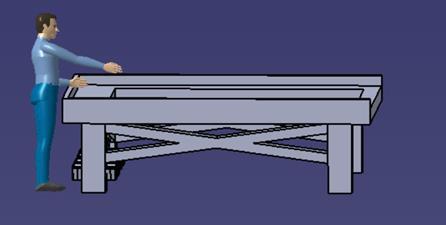
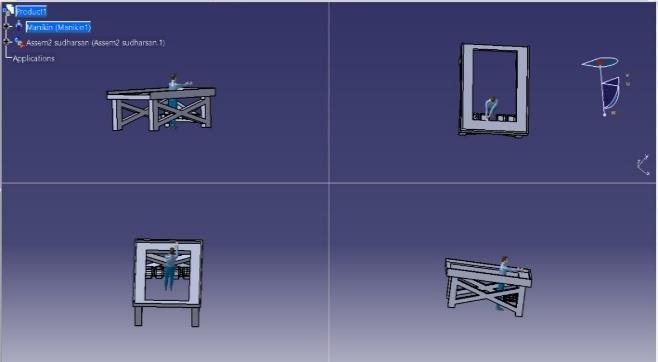
A fresh ergonomic analysis was conducted to evaluate improvements in worker posture following the establishment of the recommended workbench for the loaderarmsubassembly[13].Ergonomicanalysissoftware Fig.5wasusedtomodelthechangedposture,indicatingthat the revised working conditions met optimal ergonomic requirements[19].
International Research Journal of Engineering and Technology (IRJET) e-ISSN: 2395-0056
Volume: 12 Issue: 04 | Apr 2025 www.irjet.net p-ISSN: 2395-0072
8.1 Key Observations:
ReducedLumbarCompression:Theworkbench minimizes excessive bending, significantly loweringL4-L5compressionforces.
ImprovedWorkingPosture:Workersmaintaina moreneutralspinalalignment,reducingtherisk offlexion-relatedstrain.
Decreased Upper Limb Load: The optimized worksurfaceheightensuresthatarmsremainin a comfortable working zone, reducing muscle fatigue.
loadcomparedwithNIOSHALStandardwasshowinFig.7. Therevisedposturewasexaminedwithergonomicsoftware, and the outcomes indicated a notable reduction in compression forces at L4-L5 and strain associated with flexion.
9.1
Reduced Lumbar Compression: The L4-L5 compressionforcewasreducedbyapproximately 43.6%, indicating lower strain on the lower back Table.4.
Lower Flexion/Extension Load: The Flex/Ext compression reduced by 60.4%, suggesting improvedposturewithreducedforwardbending.
Minimized JointShearand Abdominal Stress:The anterior shear force dropped significantly, while abdominal forces and pressure were eliminated, reducingmusculoskeletalrisks.
Table – 5: BiomechanicalAnalysisAftersimulation postureimprovements.
Data Tab
8.2 Validation:
Significant ergonomic improvements were demonstratedwhencomparingtheposturesbeforeandafter implementation. The adjusted working posture with the workbenchisillustratedinFig 5,highlightingthereduced biomechanicalrequirements.
9.RECOMMENDED POSTURAL ANALYSIS
Followingtheexecutionofthesuggestedworkbench,a subsequent biomechanical load analysis at L4-L5 was performed to evaluate enhancements in worker posture analysisvaluelistedinTable5.thenreductionsinlumbar
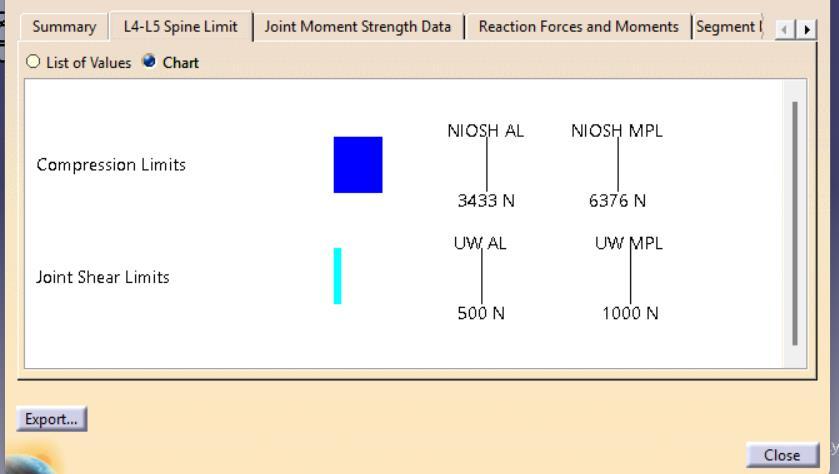
Fig – 7: Compressionloadaftersimulationposture
International Research Journal of Engineering and Technology (IRJET) e-ISSN: 2395-0056
Volume: 12 Issue: 04 | Apr 2025 www.irjet.net p-ISSN: 2395-0072
These results imply that the workstation intervention significantly improved ergonomics. By reducing the biomechanical pressure on the lumbar spine, the better posture helped to reduce ergonomic risks and enhance workersafety.
Theergonomicimprovementsimplementedhaveledto significantreductionsinbiomechanicalstressesonthelower backandabdominalregion.TheL4-L5momentwasreduced from178N·mto70N·m,representinga60.7% reduction Similarly,theoverallL4-L5compressionforcedroppedfrom 3246 N to 1828 N, a reduction of 43.7%. Within this, the flexion/extension compression showed a notable 60.4% decrease,fallingfrom2964Nto1173N.However,bodyload compressionincreasedfrom282Nto354N(anincreaseof 25.5%),andaxialtwistcompression,whichwaspreviously absent,appearedat35N.Thissuggestsaredistributionof load,possiblyduetochangesinpostureandtaskdynamics.
Further improvements were observed in the L4-L5 joint’s shear force, which decreased from 42 N to 7 N anterior, markingan83.3% reduction. Abdominal loading wascompletelyeliminated,withbothabdominalforceand pressure dropping from 97 N and 3 N/m² to zero, respectively,representinga100%reduction.Theseresults clearly indicate that the implemented changes has significantly enhanced ergonomic safety by minimizing spinalloadingandcompletelyremovingabdominalstrain.
Future advancements will focus on simplifying assembly processes, reducing manual handling requirements, and improving ergonomic standards to greatly boost productivity and worker safety in the construction equipment assembly line. Better posture, reducedphysicalstrain,andenhancedproductivitycanbe realized by implementing advanced assembly methods, optimizing workflow arrangements, and refining workstationlayouts.
Furthermore, enhancements in assembly consistency,methodsforhandlingmaterials,andtoolswill help reduce assembly duration and variability in task performance.Sustainedimprovementsinemployeecomfort andproductivitywillbeguaranteedbyimplementingbest practicesandcontinuouslyevaluatingergonomicissues.
To further optimize operations and raise total assemblyefficiency,futureresearchcanlookintoinnovative approaches to workstation automation, digital work instructions,andleanmanufacturingtechniques.
[1] Carnazzo,C.,Spada,S.,Lamacchia,S.,Manuri,F.,Sanna, A., & Cavatorta, M. P. (2024). Virtual reality in ergonomicsbywearabledevices:experiencesfromthe automotive sector. Journal of Workplace Learning, 36(7),621–635.
[2] Chaffin, D. B., Andersson, G. B. J., & Martin, B. J. (2006). Occupational Biomechanics (4th ed.). WileyInterscience.
[3] Fales, C. W. (2021). Accelerations of Trunk and Limb AssessmentSystem(ALTAS):AMonte-Carlosimulation approach to dynamic work evaluation for the agriculturalsector.
[4] Granata,K.P.,&Marras,W.S.(1995).AnEMG-assisted model of trunk loading during free-dynamic lifting. JournalofBiomechanics,28(11),1309–1317.
[5] Harari,Y.,Bechar,A.,Raschke,U.,&Riemer,R.(2017). Automated Simulation-Based Workplace Design that Considers Ergonomics and Productivity. International Journal of Simulation Modelling, 16(1),5–18.
[6] Hadidi,L.A.,Kolus,A.,&AlKhamis,M.(2019).Quality improvement through ergonomics intervention at chemicalplant. Facilities, 37(5/6),266–279.
[7] Lin, J. (2022). Optimal design of manual assembly workbenchbasedonleanproductiontheory.In Lecture notes in electrical engineering (pp.285–293).
[8] Madani,D.A.,&Dababneh,A.(2016).Rapidentirebody Assessment: a literature review. American Journal of Engineering and Applied Sciences, 9(1),107–118.
[9] Marras,W.S.,Lavender,S.A.,Leurgans,S.E.,Rajulu,S.L., Allread,W.G.,Fathallah,F.A.,&Ferguson,S.A.(1993). Theroleofdynamicthree-dimensionaltrunkmotionin occupationally-relatedlowbackdisorders.Spine,18(5), 617–628.
[10] McGill,S.M.(1997).Biomechanicsoflow back injury: Implications on current practice in industry and the clinic.JournalofBiomechanics,30(5),465–475.
[11] McGill, S. M. (2002). Low Back Disorders: EvidenceBasedPreventionandRehabilitation.HumanKinetics.
[12] Mumani, A., Stone, R. T., & Momani, A. M. (2021). An application of Monte-Carlo simulation to RULA and REBA.TheoreticalIssuesinErgonomicsScience,22(6), 673–688.
[13] Niño-Ardila, M. A., & Castro-Maldonado, J. J. (2021). Designofanaccessorydedicatedtothemanipulationof
International Research Journal of Engineering and Technology (IRJET) e-ISSN: 2395-0056
smartphones measured through myoelectric signals. Journal of Physics Conference Series, 2046(1),012032.
[14] Ibrahim, K., Simpeh, F., & Adebowale, O. J. (2023). Benefitsandchallengesofwearablesafetydevicesinthe construction sector. Smart and Sustainable Built Environment.
[15] Siddiqui,L.A.,Banerjee,A.,Chokhandre,P.,&Unisa,S. (2021). Prevalence and predictors of musculoskeletal disorders(MSDs)amongweaversofVaranasi,India:A cross-sectionalstudy. Clinical Epidemiology and Global Health, 12,100918.
[16] Sombatsawat, E., Luangwilai, T., Ong-Artborirak, P., & Siriwong,W.(2019).Musculoskeletaldisordersamong rice farmers in Phimai District, Nakhon Ratchasima Province, Thailand. Journal of Health Research, 33(6), 494–503.
[17] Riley,P.O.,Mann,R.W.,&Hodge,W.(1990).Modelling ofthebiomechanicsofpostureandbalance.Journalof Biomechanics,23(5),503–506.
[18] Waters, T. R., Putz-Anderson, V., Garg, A., & Fine, L. J. (1993). Revised NIOSH equation for the design and evaluation of manual lifting tasks. Ergonomics, 36(7), 749–776.
[19] NIOSH.(1981). WorkPracticesGuideforManualLifting U.S.DepartmentofHealthandHumanServices.
Volume: 12 Issue: 04 | Apr 2025 www.irjet.net p-ISSN: 2395-0072 © 2025, IRJET | Impact Factor value: 8.315 | ISO 9001:2008