
International Research Journal of Engineering and Technology (IRJET) e-ISSN: 2395-0056
Volume: 12 Issue: 11 | Nov 2025 www.irjet.net p-ISSN: 2395-0072
International Research Journal of Engineering and Technology (IRJET) e-ISSN: 2395-0056
Volume: 12 Issue: 11 | Nov 2025 www.irjet.net p-ISSN: 2395-0072
Patil¹, Vighnesh Nilajakar², Sanket Jatrate³, Vinayak Patil´, Darshan Kalkuppiµ
1Assistant Professor, Maratha Mandal’s Engineering College, Belagavi, Karnataka, India 2,3,4,5 Student, Maratha Mandal’s Engineering College, Belagavi, Karnataka, India ***
Abstract – This paperpresents the development ofHOTPIN, acompactwearableassistant designedtoofferreal-timevoice interaction and optional visual analysis using a lightweight hardware platform. The system uses an ESP32-based controller connected to an I²S microphone and digital audio amplifier to process speech requests, while a low-power camera module can be activated only when visual input is needed. User audio is captured, converted to text, and transmitted over Wi-Fi to an edge server that communicates with a locally hosted large-language-model (LLM). The backend processes both text and image inputs and returns a contextual response, which is then converted to audio on the wearable device. This on-demand multimodal approach ensures reduced power consumption while maintaining responsiveness. Experimental evaluation shows efficient performance, with a median latency of around 300ms for voice-only requests and approximately 800ms for combined voice-and-image interactions. Power measurements indicate averagecurrentdrawsof280mAand450mA,enablingseveral hours of operation from a 5V, 2000mAh Li-ion battery. These results highlight the feasibility of integrating local AI processingwith a wearable form factor, providinganenergyawareandflexibleplatformforpersonalambientintelligence.
Key Words: Wearable AI, ESP32-CAM, Multimodal Assistant, Edge AI, LLM, I²S Audio.
Wearable AI devices are evolving rapidly as users increasinglydemandhands-freeinteraction,personalization, and real-time assistance without relying on cloud connectivity. To address these requirements, the HOTPIN wearableassistantcombinesspeechrecognition,contextual processing,andselectiveimagecapturethroughacompact embeddedplatformandalocalLLM-poweredbackend.The objectiveofthesystemistoprovideanefficientmultimodal assistant capable of performing tasks such as question answering, environmental understanding, and interactive guidance, while keeping power consumption and latency low.
TheESP32microcontrollerservesasthecentralcontroller, handling digital audio through an I²S microphone and speakeramplifier.Acameramoduleremainsdisabledduring idleoperationandisactivatedonlywhentheusertriggersa visual query, ensuring minimal standby consumption. Speech data is sent to a local REST API that passes the requesttoanLLM,enablingfastandprivateinference.The
system’sarchitecturereflectsthegrowingtrendofshifting computation from cloud-based services to nearby edge devices, increasing responsiveness and privacy. The prototypedemonstratesthepracticalityofintegratingvoice and vision processing within a small, battery-powered wearableassistant.
TheHOTPINprototypedemonstratesemergingtrendsin embeddedAI,wheremultimodalprocessingisenabledusing acombinationofmicrocontrollersandedge-hostedlanguage models.TheuseofI²Saudiomodulesallowsprecisedigital capture and playback, while the selective activation of the cameraprovidesvisualcontextonlywhennecessary.
However,thelimitationsoftheESP32platformmustbe considered,includingconstrainedmemory,limitedparallel peripheralusage,andoccasionalconflictsbetweencamera and audio drivers. These challenges indicate that while ESP32-baseddesignsaresuitableforearly-stagewearables, achieving seamless multimodal performance may require more advanced microcontrollers or specialized AI-focused hardwareinfutureiterations.
The overall hardware cost of the HOTPIN wearable remains relatively low because it is built using widely available microcontroller components. Despite its modest cost,thesystemdeliversstrongfunctionalbenefits:real-time voiceassistance,optionalimage-basedinteraction,reduced usereffort,andimprovedenergyefficiency.Theon-demand activation of the camera avoids unnecessary power consumption, extending battery life. Although additional work is required to refine monetization and production strategies, the system demonstrates a high value-to-cost ratioforpersonalandexperimentalusecases.
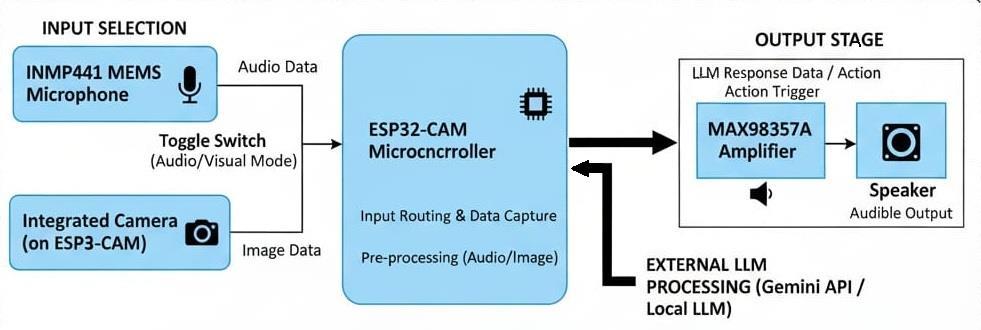
TheHOTPINassistantfollowsalayereddesignconsistingof the Wearable Device Layer, Edge/API Layer, and LLM BackendLayer.
Atthewearablelayer,anESP32moduleinterfaceswithan INMP441 I²S microphone for audio capture and a MAX98357AI²Samplifierforaudiooutput.Acameramodule remainspoweredoffduringidleperiodsandisenabledonly
International Research Journal of Engineering and Technology (IRJET) e-ISSN: 2395-0056
Volume: 12 Issue: 11 | Nov 2025 www.irjet.net p-ISSN: 2395-0072
when the user requests an image-based interaction. This selectiveactivationsignificantlyreducesidlepowerusage.
ThewearableconnectstotheAPIlayerthroughWi-Fiora mobile hotspot. The API server receives JSON packets containing the transcribed audio and, when applicable, an image file. The server maintains conversation context and forwardstherequesttotheLLMbackend,whichprocesses multimodal inputandreturnsstructuredresponses.These responsesarerelayedbacktotheESP32foraudioplayback.
To reduce hardware conflicts and memory strain, I²S and cameradriversareinitializeddynamicallybasedonoperating mode.Additionalmeasuresincludepruningsessionhistoryto preventoversizedpayloadsandoptimizingpowerstatessuch asWi-Fisleepmodes.Thisarchitectureeffectivelybalances performance,modularity,andenergyefficiency.
Performanceevaluationwasconductedundertwoprimary usecases:
1. Voice-onlymode,and
2. Voice-plus-imagemode.
During testing, event timestamps such as microphone activation, HTTP transmission, response reception, and playbackstartwererecorded.Currentdrawwasmonitored usinginlinepowermeasurementtools.
Resultsshowamedianlatencyofaround300msforvoiceonlyinteractions,whichincreasestoapproximately800ms whenthecameraisactivatedduetoadditionalinitialization anduploadoverhead.Powerconsumptionaveraged280mA in voice-only mode and 450mA during image-assisted queries.Ona2000mAhbattery,thesystemprovidedaround 5hoursofvoice-onlyoperationand3–4hoursundermixed usage.
A failure rate of nearly 10% was observed in camera initialization during rapid switching between audio and imagemodes,indicatingperipherallimitationsoftheESP32 platform. A small group of test users found the system intuitive and responsive but suggested improvements to audiovolumeandlong-termconversationmemory.
The firmware coordinates event-driven operation for voicerequests,camera capture,Wi-Ficommunication,and responseplayback.Whentheuserpressestheinputbutton, themicrophonebeginsrecordingashortvoiceclip,whichis encodedandforwardedtotheAPIserver.Forimage-enabled requests, the firmware activates the camera, captures a frame, and uploads it before sending the corresponding query.
The firmware also logs timestamps and current measurements to support performance evaluation. It manages memory allocation carefully to avoid buffer overflowsandalternatesbetweenaudioandcameramodes by dynamically initializing and de-initializing drivers. The systemdemonstratesconsistentperformanceundertypical loads, although occasional camera initialization failures highlight the need for more robust peripheral handling in futuredesigns.
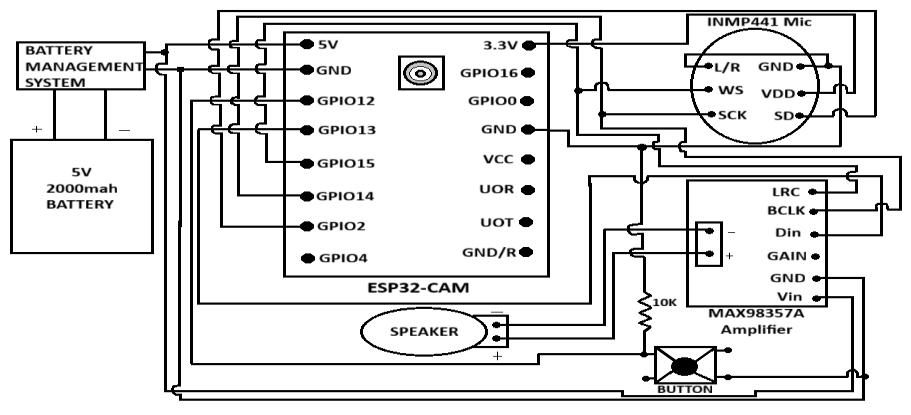
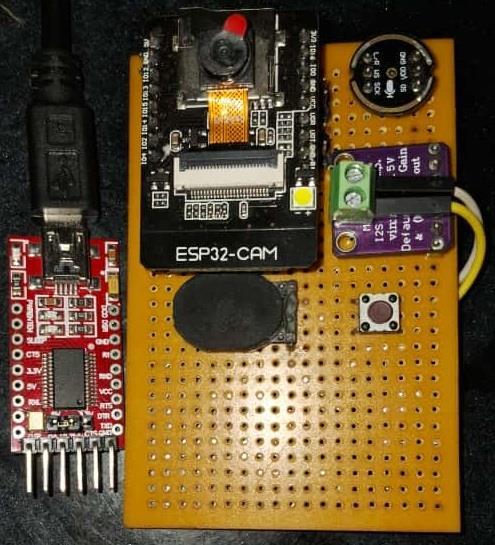
Themethodologyusedinthisprojectcoversthehardware setup, firmware development, API communication, and testing procedures. Hardware integration involved connectingtheESP32totheI²Smicrophone,I²Samplifier, and camera module. The firmware was programmed to handle button-activated events, audio capture sequences, imagecaptureroutines,andJSONdatatransmission.
At the software backend, a REST API was implemented to receiverequests,maintainconversationstate,andforward userinputstotheLLM.Thewearablereceivestextresponses, converts them to audio, and plays them through the I²S amplifier. Testing involved measuring latency, analyzing power usage under different modes, and gathering user feedbacktoassesssystemreliabilityandfunctionality.
International Research Journal of Engineering and Technology (IRJET) e-ISSN: 2395-0056
Volume: 12 Issue: 11 | Nov 2025 www.irjet.net p-ISSN: 2395-0072
TheHOTPINsystemdisplayedstrongperformanceinrealworld testing scenarios. In voice-only mode, the average responsetimewasapproximately310ms,providinganearinstantaneous user experience. When the camera was activated, overall latency increased to around 840ms, primarilybecauseofcamerainitializationandimagetransfer.
Powerconsumptiontrendsalignedwithexpectedbehavior, with 285 mA drawn during voice-only usage and 460 mA duringcombinedoperations.Witha2000mAhbattery,the estimatedruntimerangedfrom3to5hours,dependingon thebalancebetweenvoiceandcamerausage.
A 9% failure rate was observed during rapid switching betweencameraandaudiomodes,underscoringtheESP32’s peripherallimitations.Userfeedbackfromasmallpilotgroup indicatedsatisfactionwiththesystem’sresponsivenessand ease of use, though improvements such as louder audio outputanddeepermemoryretentionweresuggested.
This project demonstrates that a wearable assistant combiningvoiceprocessingandoptionalimagecapturecan beeffectivelyimplementedusinglow-powermicrocontroller hardware and an LLM-based backend. By activating highpowerperipheralssuchasthecameraonlywhenrequired, the system maintains efficient energy usage while still supporting multimodal interaction. Experimental results
showcompetitivelatencyandreasonableoperatingtimeon acompactLi-ionbattery.
Somehardwarelimitations includingoccasionalperipheral initialization failures highlight opportunities for improvement, such as migrating to an upgraded ESP32 variant or employing a dual-MCU design. Overall, the HOTPINwearableprovidesapracticalblueprintforfuture edge-AI devices designed for personal assistance and context-awareinteraction.
[1] Mathew, A., “Humane Ai Pin - InnoGlove AI Embrace,”InternationalJournalforMultidisciplinary Research(IJFMR),Vol.5,Issue6,pp.1-5,2023.
[2] Imran Hussain S,Mehul M S,Mohana Sankaran S., “Design and Implementation of a Smart Speech InterfaceusingOCRandTTSAPIsonESP32-CAM,” InProceedingsoftheInternationalConferenceon TrendsinMaterialScienceandInventiveMaterials (ICTMIM2025),pp.319-324,IEEE,2025.
[3] Bibhakar Das,Kalyan Kumar Halder., “Face Recognition Using ESP32-Cam for Real-Time Tracking and Monitoring,” In 2024 International Conference on Advances in Computing, Communication, Electrical, and Smart Systems (iCACCESS),IEEE,2024.
[4] Umberto Cappellazzo, Minsu Kim, Honglie Chen, Pingchuan Ma, Stavros Petridis, Daniele Falavigna, Alessio Brutti, and Maja Pantic, “Large Language ModelsAreStrongAudioVisualSpeechRecognition Learners,”arXivpreprintarXiv:2409.12319,2024.