
International Research Journal of Engineering and Technology (IRJET) e-ISSN: 2395-0056
Volume: 12 Issue: 04 | April 2025 www.irjet.net p-ISSN: 2395-0072
International Research Journal of Engineering and Technology (IRJET) e-ISSN: 2395-0056
Volume: 12 Issue: 04 | April 2025 www.irjet.net p-ISSN: 2395-0072
Stuti Patil1 , Jari More2, Hajo Khatun3, Tanisha Motibane4, Misbah Multani5 & Rupali Khadtar6
1, 2, 3, 4, 5 Third Year Diploma Civil Engineering Student, AIKTC, AIARKP, Panvel, Navi Mumbai, India 6 Head of the Department, Civil Engineering Department, AIKTC, AIARKP, Panvel, Navi Mumbai, India ***
Abstract - High strength concrete (HSC) refers to the mixture having characteristic compressive strength in the rangeof65MPato100MPa;however,greaterstrengthshave beenachievedandpracticed.Strengthrangesbetween80MPa and100 MPa,sometimesevenhigher,arebeingusedatmany constructionsitesacrosstheworld.HSCfindsitsapplicationin highway works, long-span bridges, columns of RCC skyscrapers, offshore structures, etc. High Performance Concrete (HPC) is a mix, designed to possess special characteristics like improved resistance to harmful environmental effects, abrasion resistance, low water absorption, less permeability, etc. Due to this, HPC obviously leadstodesiredhighstrength. Thispaperthrowslightonthe differentmaterialsusedandvariousconsiderationstakeninto account for producing High Strength High Performance Concrete (HSHPC), through the literature survey.
Key Words: HSC, HPC, UHPC, HSHPC, Silica Fume, Metakaoline, Fly Ash, Slag, Workability, etc.
Concrete,asthemostwidelyusedconstructionmaterialin theworld,playsacrucialroleinthedevelopmentofmodern infrastructure.However,thegrowingdemandsforlongerlasting structures with reduced maintenance costs and better performance have led to the evolution of advanced types of concrete. Among these, High Strength Concrete (HSC)andHigh-PerformanceConcrete(HPC)haveemerged assignificantadvancements.Whentheattributesofbothare combined, the result is a material referred to as High StrengthHighPerformanceConcrete(HSHPC).
Traditional concrete typically achieves a compressive strength of 20–40 MPa. In contrast, HSC exhibits compressive strengths exceeding 60 MPa, while HPC is engineeredforenhanceddurability,workability,andlongterm performance, often independent of strength. HSHPC, therefore,offersahybridsolution marryingthemechanical strength of HSC with the workability, durability, and serviceabilityofHPC.
Thedemandforhigh-risebuildings,long-spanbridges,and complexinfrastructuralelementshasnecessitatedtheuseof concrete with superior properties. The limitations of
ordinaryconcrete suchassusceptibilitytoenvironmental degradation, reduced performance under high loads, and poorworkability canbeovercomewithHSHPC.
KeybenefitsofHSHPCinclude:
Enhanced load-carrying capacity, allowing for slimmerstructuralelements.
Improved durability against aggressive environmentalconditions.
Reducedpermeability,whichimprovesresistance tochemicalattack.
Lowermaintenanceandlifecyclecosts.
Improved aesthetic flexibility, allowing more complexarchitecturalforms.
ThesepropertiesmakeHSHPCidealforprojectssuchas high-risebuildings,marinestructures,nuclearpowerplants andheavilytraffickedbridges.
The development of HSHPC is rooted in material science advancements and the availability of high-quality supplementarycementitiousmaterials(SCMs)suchassilica fume, fly ash, and ground granulated blast furnace slag (GGBFS). Additionally, advancements in chemical admixtures, particularly high-range water reducers (superplasticizers),havemadeitfeasibletoproducehighly workableyetdenseandstrongconcretemixtures.
Theevolutionofconcrete technologyhasbeenmarked by milestonessuchas:
Introduction of HSC in the 1960s, primarily in prestressedstructures.
HPC gaining traction in the 1980s, focusing on durabilityandlong-termperformance.
The 1990s and beyond, where integration of strengthandperformanceledtoHSHPC,drivenby high-profile infrastructure demands and sustainabilitygoals.
International Research Journal of Engineering and Technology (IRJET) e-ISSN: 2395-0056
Volume: 12 Issue: 04 | April 2025 www.irjet.net p-ISSN: 2395-0072
HSHPCisnotdefinedsolelybycompressivestrength.While strengthisamajorcomponent,HSHPCmustmeetmultiple performancecriteriasimultaneously.Thesemayinclude:
Compressive strength exceeding 60–80 MPa or higher.
Highmodulusofelasticityandabrasionresistance.
Verylowpermeabilitytowaterandaggressiveions (e.g.,chloride,sulfate).
Excellent workability, including pumpability and self-compaction(ifself-consolidatingisdesired).
Superior freeze-thaw resistance and long-term durability.
Achieving these characteristics often involves a carefully optimizedmixdesign,tailoredcuringmethods,andstringent qualitycontrolduringproductionandplacement.Concreteis the second most consumed material in the world, after water.Itsusagehasbeenexponentiallyincreasingowingto theinfrastructuredevelopmentprojects.Materialselection andprecisemixdesignarevitalforproducingHSC.Varied range of aggregates can be used to produce HSC. At comparatively lower strength, rounded and/or smooth aggregates show aggregate bond failure. Crushed rock aggregatesof10to20mmsizes,whicharenottooelongated andangulararepreferred.Smallersizeaggregatesresultin to better strength owing to the fact that they have better bondstrength.
ThewaysofproducingHSCaresimilartothatrequiredfor producing Normal Weight Concrete (NWC). However, the (water/binder)ratioforHSCisintherangeof0.25to0.35 or even less than that depending upon the strength to be attained.Usingworkabilitysuperplasticizersforreductionof water content is a must for producing HSC. Obtaining cohesive mix with minimum void contents is a key to developHSC.
Microcracks, known as faults, are already present in the transition zone (aggregate-cement interface), even before the concrete is stressed. When loads get applied, microcracksintransitionzonepropagatequickly,thereby developinglargercracksthanrestoftheconcretemass.The weakest link is the transition zone. (Water/binder) ratio affects the transition zone in low and moderate strength concretes.However,the(water/binder)ratioisnotshowing thesameeffectonHSC,havinglow(water/binder)ratio. For very small decrease in (water/binder) ratio, considerableimprovementinconcretecompressivestrength canbeattainedfor(water/binder)ratiolessthan0.3.Thisis duetothefactthat,atverylow(water/binder)ratio,thereis a considerable strength improvement at transition zone.
Aggregateparameters,otherthanstrength,likegradation, texture,shape,size,etc.influencetheconcretestrength.
Currently, Ready Mixed Concrete (RMC) plants are an integralpartoftheIndianconstructionindustry.
HSC is being produced in RMC plants on a large scale in metropolitan cities. A special care has to be practiced in connection with the mix proportioning, shape and size of aggregates,supplementarycementitiousmaterialuse,silica fume, superplasticizers, etc. HSHPC having 75 MPa compressive strength was first time used for JJ flyover, Mumbaiin2002showninfig.1.1
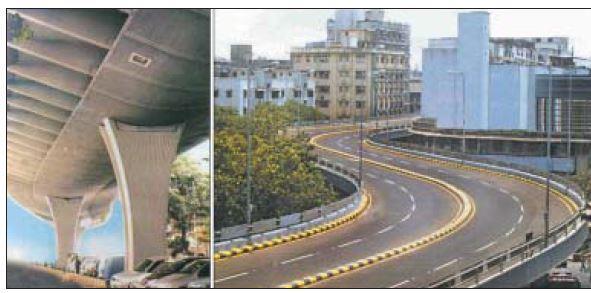
-1:JJFlyover,Mumbai,2002(Courtesy:Gammon IndiaLtd.)
HPC is a concrete which meets required performance specifications.Itexhibitsenhancedfluidity,greaterstrength, higher modulus of elasticity, better dimensional stability, higher density, resistance to aggressive environment, low permeability,etc.AmericanConcreteCommitteelaysdown five criteria for HPC, viz. ease of placement, long-term mechanical properties, early-age strength, toughness and performanceinsevereenvironments.
As per Strategic Highway Research Program (SHRP), HPC hastosatisfyoneamongthecriterialike,4-hourstrengthof 17.5MPa,24-hourstrengthof35MPa,28-daystrengthof70 MPa,durabilityfactor>80%after300freezingandthawing cyclesand(water/binder)ratio≤0.35.
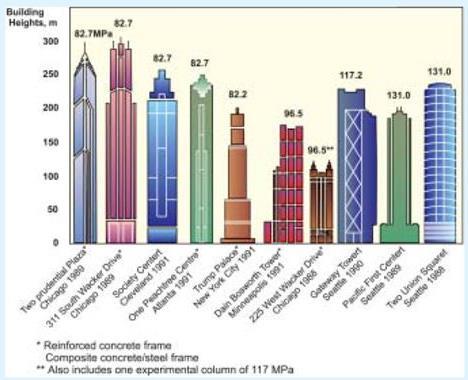
HPCUsedinIconicStructuresacrosstheWorld (Source:Internet)
International Research Journal of Engineering and Technology (IRJET) e-ISSN: 2395-0056
Volume: 12 Issue: 04 | April 2025 www.irjet.net p-ISSN: 2395-0072
The concrete having 15% replacement of cement by metakaolineexhibitedoptimumcompressivestrength[1]. Metakaolinehelpsinincreasingpozzolanicactivity,thereby reducingthecorrosioneffect,especiallyincoastalclimates. Theuseofwasteashesfromthermalpowerplants[2]was studied. It helps in improving workability, strength, durability,etc.Useofmetakaolineasapartialreplacement ofcementresultedinthereductionofplasticdensityofthe mix[3].
Using low water/binder ratio along with addition of metakaoline led to the production of HSHPC having compressivestrengths>100MPa.Theoptimumreplacement of cement by metakaoline was found to be 10%. This is because of the dilution effect created due to partial replacement. Split tensile strength and Young’s modulus wereobservedtobehighestatthisdosage[3].
Concrete exhibited highest strength at replacement of cement by 10% marble powder and 9% metakaoline [4]. With increasing addition of metakaoline, reduction in permeability was observed. Abram’s water/cement ratio basedlawwhichwasproposedfortheconcreteshavingonly cementaspowdercontentisequallyvalidforconcreteswith flyashaddition[5].Replacementofcementbyflyashat30% to35%isbeneficialfortheconcrete. HSHPCwithflyashcan havewater/binderratioof0.34.
Additionofmineraladmixturessuchasflyash,metakaoline andsilicafumealongwithsteelfibresenhancesthestrength properties [6]. HSC cubes exhibit sudden failure under appliedloadandmicrocrackscanbeobserved.Flyashhelps inincreasingtheworkability;however,itisreducedbythe additionofsilicafumeandmetakaoline[6].
Cementreplacementby10%metakaoline,alongwiththe better performing superplasticizer, leads to increased compressive strength, split tensile strength, modulus of elasticityandflexuralstrength[7].
Cementcanbereplacedupto15%bymetakaolineforthe optimumperformanceofconcrete[8].
Silica fume incorporated in the concrete, as a partial replacement of cement, showed desirable effects on the compressiveandtensilestrengthsofconcrete.Ithelpedin improvingtheresistancetoacidattacks[9].Itisavailablein excess and it cannot be disposed off easily, as it requires largearea.Itcancontaminategroundwaterifdisposedinthe openwithoutpropertreatment. Cementcanbereplacedby 10%to30%ofsilicafume[9].Itenhancesconcretestrength significantly.Concretecostreducesbyabout20%to30%by addingsilicafume[9].
With10%usageofmetakaoline,themaximumcompressive strengthobtainedwas78MPa[10].Acompressivestrength of78MPawasachievedwith7.5%slagand7.5%flyash. Fly ash, slag and silica, 5% each resulted in a compressive strengthof79MPa[10].
Thesustainablehighstrengthconcrete(SHSC)with75%of quaternaryblendsand3%nano-silicaexhibitedimproved mechanicalpropertiesat28and91days,reflectingthatthis mixcanattainhighestsustainabilityperformance[11].
TheSHSCmixhaving3%nano-silica and50%quaternary blends could show the maximum strength parameters of 80.7, 6.46 and 10.09MPa for compressivestrength, splittensilestrengthandflexuralstrength,respectively,at 28 days. This SHSC mix could also achieve low water permeability; chloride permeability was observed to be 2.54×10⁻¹¹ (cm/sec)and1370coulombsat28days[11]. Mechanical properties and shrinkage of Ultra-High PerformanceConcrete(UHPC)withmaximumaggregatesize of5mmwasstudied[12].UHPChavingdolomiteandmore than1%volumefractionsofsteelfibresexhibitedstrength values>150MPaafter56days[12].
A green Ultra-High-Performance Glass Concrete (UHPGC) exhibitingacompressivestrengthof220MPawasdeveloped [13]. Its fresh, mechanical and microstructural properties wereinvestigated.Inallthemixes,aPoly-carboxylateEther (PCE)-based high-range water-reducing admixture (HRWRA)havingaspecificgravityof1.09andsolidscontent of40%wasincorporated.Thereplacementofquartzpowder as well as cement by glass powder considerably reduces UHPC cost and decreases the carbon footprint of a typical UHPC[13].
Limestone powder incorporated as a partial cement replacementand partial or completereplacementofsilica powder slightly reduced the mixing time needed to manufactureUHPC[14].
Partialreplacementofcementshowedadesirableinfluence ontheworkability.Replacementofsilicapowderexhibited less influence on the workability [15]. The tensile and compressive strengths of UHPC were determined and comparedwiththatofNormalStrengthConcrete(NSC)for developing a numerical model in order to simulate UHPC behaviourwiththehelpofFiniteElement.
Compressive strength of UHPC was observed to be 3 to 4 timeshigherthanthatofNSC[15].Mechanicalinterlocking forcebetweensteelfibersandconcretecylindersandcubes stayedintactevenafterreachingthefailureload.However, NSCwasseentosplitintolargeconcretepieces[15].
M60gradeHPCwasdevelopedwiththeadditionofflyash andsilicafumewith15%and10%replacementbycement
International Research Journal of Engineering and Technology (IRJET) e-ISSN: 2395-0056
Volume: 12 Issue: 04 | April 2025 www.irjet.net p-ISSN: 2395-0072
mass. Coarse aggregates were partially replaced by ferroslagaggregatesindifferentupto40%[16].
HPC is distinguished by its dense microstructure, which contributestoitsimproveddurabilitycharacteristics,such aslowpermeability,highresistancetochlorideingress,and superiorfreeze-thawresistance[17].
TheintegrationofHSCandHPCleadstothedevelopmentof HighStrength High PerformanceConcrete, which benefits from both high load-carrying capacity and excellent durability. The synergistic use of silica fume and superplasticizers significantly improves the strength and durability of concrete, making it suitable for HSHPC applications[18].
The investigations on the mechanical and durability performanceofHSHPCledtotheconclusions thatitcould achieve compressive strengths above 80 MPa while exhibitingsuperiorresistancetosulfateattackandchloride penetration. Microstructural refinement due to SCMs and chemicaladmixturesplaysacrucialroleintheperformance enhancement[19].
Durability is a key feature of HSHPC. It is often assessed through parameters like water absorption, rapid chloride permeabilitytest(RCPT),acidresistance,andfreeze-thaw resistance. It was demonstrated that concrete containing silica fume and fly ash showed significantly reduced ion permeabilityandimprovedsulfateresistance[20].
The use of high-range water reducers (HRWR) or superplasticizers has been critical in maintaining high workabilitywithoutcompromisingstrength.Advancements inadmixturetechnologyhaveenabledthedevelopmentof self-consolidating high-performance concretes, which combineworkabilitywithstrengthanddurability[21].
In a review paper [22], researchers found out that for resistancetochemicalattackonmoststructures,HPCoffers a much-improved performance. Resistance to various sulfatesisachievedprimarilybytheuseofadense,strong concrete of very low permeability and low water-to cementing materials ratio; these are all characteristics of HPC.ThestudywasdoneaboutHigh-PerformanceConcrete under biaxial and triaxial loads which include tests on varioushigh-performanceconcretes.
HPCshaveuniaxialcompressivestrengthsrangingfrom58 MPato94MPa.Stressratiosofbiaxialcompression-tension, compression-compression and triaxial compression tests werenoted.Servohydraulicjackwithvariablestressratios wereusedtoconductexperiments.Theloadwastransferred tothespecimenbyusingsteelbrushes.Obtainednormalized multi-axialstrengthdecreasedwiththeincreasinguniaxial strength.Theobjectiveofthisstudywastodevelopconcrete with good strength, less porosity, less capillarity, thus the
durability was achieved. M60 grade of concrete was producedusingsilicafumeindifferentpercentages-0%,5%, 10%,15%bythemassofthecement[22].
As per research paper [23], along with mechanical properties, environmental properties of concrete can be improved with efficient use of mineral and chemical admixtures. The research investigated the effect of microsilicaonhigh-strengthconcrete.Thecementcontentin the concrete was replaced by Microsilica in varying percentages.
Differentspecimensofstandardsizesweretestedtocheck compressive, tensile and flexural strength of concrete. To check environmental property of high-strength concrete, waterpermeabilitytestwascarriedoncubespecimens.It wasconcludedthat,useofmicrosilicaincreasesstrengthof concreteforsmallamountofreplacementstocement.With more increase in content of microsilica, the strength of concrete decreases. Along with strength, permeability of concretewasalsoimproved[23].
Authormentionedthecharacteristicsofhighperformance concrete as very low porosity through a tight and refined porestructureofthecementpaste,verylowpermeability, high resistance to chemical attack, low heat of hydration, highearlystrength,continuedstrengthdevelopment,high workability,controlofslumpandlowbleedingandplastic shrinkage [24]. Study was carried out on the methods for achievinghighperformanceconcrete.
The development, properties, and applications of HSHPC, alongside the materials and technological advances that contributetoitsperformancewerestudied[25].Effectsof supplementary cementitious materials, aggregates, fibres, curingmethod,superabsorbentpolymer(SAP),expansionpromoting additive (EPA), shrinkage reducing additives (SRA) and water-to-binder (w/b) ratio on the strength ofHPC werereviewed.
Influences of admixtures including silica fume, fly ash, metakaolin,GGBFS,calcinedclay,limestonepowderandrice huskashwerestudiedandtheirinfluenceonthestrengthof HPC was reported.The strength of HPC was significantly improvedbyadditionofSCMsOptimalreplacementsofOPC by MK, SF, RHA, AAM, CS-LS, NS have generally been reported to be 10%, 10–15%, 20%, 100%, 30% and 0.5–1.5%respectively[25].
ResearchworkonHPC[26]highlightedtheadvancementin concretetechnology,includingthedevelopmentofmaterial that improves the concrete‘s long term performance in aggressive environments. The research paper discussed aboutthecarefulcontrolofthemixdesigntooptimizeboth strengthanddurability.
International Research Journal of Engineering and Technology (IRJET) e-ISSN: 2395-0056
Volume: 12 Issue: 04 | April 2025 www.irjet.net p-ISSN: 2395-0072
Thispaperwasanattempttoreviewsomeoftheliterature availableinconnectionwithHSCandHPC,includingUHPC. Compressive strength is most important for various concreting works. HSC finds its applications in bridges, skyscrapers,structuresbuiltonweaksoils,etc.Keepinglow water/binderratioisakeytoproduceHSC.However,useof superplasticizers is recommended to impart fluidity to concretehavinglowwater/binder.Mineraladmixturessuch asflyash,metakaoline,silicafume,slag,ultra-finematerial, etc.facilitateinimprovingthestrengthtoagreatextent.HSC leadstoreducedmaintenanceand repair. Thesizesof the variousstructuralelementscanbereduced.Thisresultsin economyinformworkmaterialrequirement.
HPC shows enhanced durability, better resistance to chemical attack and desired workability. It shows strong transitionzone.Itfindsitsspecialapplicationsinrepairand retrofitting works. It increases the service life of the structures. HPC facilitates construction in severe and extremeclimaticconditions.
Withsomuchinfrastructurewoksgoingon,useofHSHPCis imperative and beneficial from the point of view of longterm durability and more importantly, the highly desired sustainabledevelopment.
[1] D. Vishwandha Varma, & G. V. Ramarao. Effect of ReplacementofCementbyMetakaolinonPropertiesofHigh Strength Concrete Subjected to Acid Attack. IJCSEIERD, ISSN(P):2249-6866,ISSN(E):2249-7978,Vol.4,Issue5,Oct. 2014,pp.63-72.
[2]NicolaLongarini,PietroGiuseppeCrespi,MarcoZucca, NicolaGiordano, &GiuseppeSilvestro.TheUseofFlyAshin High Strength Concrete Mix Design. 18th Conference on EnvironmentandMineralProcessing.
[3] P.Dinakar, Pradosh K. Shahoo, & G. Sairam. Effect of Metakaolin Concrete on the properties of High Strength concrete. International Journal of Concrete Structures & Materials,Vol.7,No.3,Sept.2013,pp.215-223.
[4]AmritpalKaur,&RajwindraSinghBansal.Strengthand DurabilityPropertiesofConcretewithPartialReplacement of Cement with Metakaolin and Marble Dust. IJERT, ISSN: 2278-0181,Vo.l4,Issue,7July2015.
[5]Arka Saha,Dr.Samaresh Pan,& Soumen Pan.Strength Development Characteristics of High Strength Concrete Incorporating an Indian Fly Ash. International Journal Of Technology Enhancements And Emerging Engineering Research,Vol.2,Issue6,101,ISSN2347-4289.
[6] Malvika Chakravarthy, & Fayaz Shaikh. Experimental InvestigationonM80GradeConcreteUsingSupplementary Cementitious Materials. JLTEMAS, Vol. V, Issue XI, ISSN 2278-2540,Nov.2016.
[7]M.MohammadAshik,&D.Gomathi.StrengthProperties ofConcreteUsingMetakaolin. IJERT,ISSN:2278-0181,Vol. 6,Issue11,Nov.2017.
[8]Sunny Jagtap,MohanN.Shirsath,&SambhajiL.Karpe. EffectofMetakaolinonPropertiesofConcrete. IRJET,Vol. 4 Issue07,July2017.
[9] Vinay Agrawal, Rajesh Gupta, & Ajay Kumar Gautam. StrengtheningEffectinHighStrengthSilicaFumeConcrete. International Journal of Advances in Mechanical and Civil Engineering,ISSN:2394-2827,Vol.3,Issue4,Aug.2016.
[10]Dr.M.VijayShekharReddy,&Dr.M.C.Nataraja.High Strength Concrete Using Supplementary Cementing Materials and Chemical Admixtures. The Masterbuilder, March2015.
[11] Ibrahim Y., HakeemA.,MohammadAlharthaiA. MohamedAminB.,Abdullah M., ZeyadC,Bassam A., TayehD.,Ibrahim Saad, & AgwaB. E. Properties of Sustainable High-Strength Concrete Containing Large Quantities of Industrial Wastes, Nano-Silica and Recycled Aggregates. JournalofMaterialsResearchandTechnology, Vol.24,May–June2023,pp.7444-7461.
[12]SukhoonPyo,Hyeong-KiKim,&BangYeonLee. Effects of Coarser Fine Aggregate on Tensile Properties of UltraHighPerformanceConcrete. JournalofCement&Concrete Composites,Vol.84,2017,pp.28–35.
[13] N. A. Soliman, & A. Tagnit-Hamou. Development of Ultra-High-Performance Concrete Using Glass Powder, TowardsEco-friendlyConcrete. JournalofConstructionand BuildingMaterials,Vol.125,2016,pp.600–612.
[14]JedadiahF.,Burroughs,JayShannon,ToddS.,Rushing Kevin Yi, Quinn B., Gutierrez, & Danny W. Harrelson. Potential of Finely Ground Limestone Powder to Benefit Ultra-High Performance Concrete Mixtures. Journal of ConstructionandBuildingMaterials,Vol.141,2017,pp.335–342.
[15] Mohamadreza Shafieifar, Mahsa Farzad, & Atorod Azizinamini. Experimental and Numerical Study on MechanicalPropertiesofUltra-HighPerformanceConcrete (UHPC). JournalofConstructionandBuildingMaterials,Vol. 156,2017,pp.402–411.
[16] Muthumani Soundararajan,Sridhar Jayaprakash,S. K. Maniarasan,& Ravindran Gobinath. Predicting Strength Properties of High-Performance Concrete Modified with
International Research Journal of Engineering and Technology (IRJET) e-ISSN: 2395-0056
Volume: 12 Issue: 04 | April 2025 www.irjet.net p-ISSN: 2395-0072
Natural Aggregates & Ferro-Slag Under Varied Curing Conditions,19June2023.
[17] Mehta, P. K., & Monteiro, P. J. M. (2014). Concrete: Microstructure,Properties,andMaterials(4thed.).McGrawHillEducation.
[18]Kumar,A.,&Bhanja,S.(2008).“EvaluationofStrength and Durability of Silica Fume Concrete.” Indian Concrete Journal,82(10),34–40.
[19]Patel,P.A.,&Shah,D.B.(2013).“DurabilityProperties ofHighStrengthHighPerformanceConcrete.”International JournalofEngineeringResearch&Technology(IJERT),2(5), 2120–2125.
[20]Bentz,D.P.,etal.(2011).“DurabilityofHigh-VolumeFly Ash Concrete.” Cement and Concrete Composites, 33(7), 825–832.
[21] Walraven, J. C. (2002). “High Performance Concrete: TrendsandChallenges.”StructuralConcrete,3(1),29–35.
[22]AnoppK.Jacob&NivinPlip(2015).“AReviewonHigh PerformanceConcrete”SSRNElectronicJournal.
[23] Jayesh Gosavi & Uttam Aari (2019). Experimental Investigation on Effect of Microsilica on High Strength Concrete. International Journal of Current Advanced Research,Vol.8,Issue8,pp.18335–18338.
[24]M.I.Khan&C.J.Lynsdale(2002).Strength,permeability andcarbonationofhigh-performanceconcrete”,Cementand ConcreteResearch,Vol.32,pp123-131.
[25]AloysDushimimana.ISISE,UniversityofMinho,Azurém, Guimarães4800-058,Portugal
[26] Pierre-Claude Aitcin (2000). “Developments in the application of high-performance concretes”, Construction andBuildingMaterials,Vol.9,pp13-17.