
International Research Journal of Engineering and Technology (IRJET) e-ISSN:2395-0056
Volume: 12 Issue: 05| May 2025 www.irjet.net p-ISSN:2395-0072
International Research Journal of Engineering and Technology (IRJET) e-ISSN:2395-0056
Volume: 12 Issue: 05| May 2025 www.irjet.net p-ISSN:2395-0072
Dr G Sharmila1 , Pritam M2 , Nandini N3 , Nikhil S4 , Sapna Kumari Saroj5
1Dr G Sharmila: Assistant Professor, Dept. of Computer Science & Engineering, CMR University, Bengaluru.
2Pritam M: UG Student, Dept. of Computer Science & Engineering, CMR University, Bengaluru
3Nandini N: UG Student, Dept. of Computer Science & Engineering, CMR University, Bengaluru.
4Nikhil S: UG Student, Dept. of Computer Science & Engineering, CMR University, Bengaluru
5Sapna Kumari Saroj: UG Student, Dept. of Computer Science & Engineering, CMR University, Bengaluru. ***
Abstract - Urban parking has become increasingly problematic due to rapid urbanization and the growing number of vehicles. Traditional parking systems lack efficiency, transparency, and scalability, leading to traffic congestion and user frustration. This research presents a web-based Parking Management System designed to modernize and streamline the process of finding and reserving parking spaces. The system allows users to view, search, and book available slots for both two-wheelers and four-wheelers through a responsive web interface. Developed using Django as the backend framework and HTML, CSS, and JavaScript for the frontend, the application ensures a smooth and secure user experience. Key features include role-based authentication, a centralized database using SQLite, real-time booking validation, and a useradmin panel for managing slots and feedback. The modular architecture supports easy maintenance and future enhancements such as payment integration and real-time slot detection. This digital approach not only improves user convenience but also aids in reducing idle vehicle movement and optimizing space utilization. Moreover, the system offers a scalable model suitable for small and medium parking zones in urban and institutional environments. By minimizing manual intervention and enabling digital oversight, the Parking Management System contributes to improved traffic flow and supports the vision of smart city infrastructure. This paper elaborates on the system’s design, implementation, and practical significance, highlighting its potentialtoserveasa reliableand cost-effectivesolutionfor urbanparkingchallenges.
Key Words: Parking Management System; Web-based system; Django; HTML; CSS; JavaScript; SQLite; Realtime booking validation; Role-based authentication; Modular architecture.
Withrapidurbanizationandthesteadyriseinthenumber of vehicles on the road, parking management has become a critical concern in modern cities. Theincreasingdensity of vehicles has led to a persistent shortage of accessible parking spaces, often causing traffic congestion, wasted fuel, and frustration among drivers. Traditional parking systems, which primarily rely on manual processes and lack digital oversight, are no longer sufficient to meet the
needs of today’s fast-paced urban environments. These outdated methods often result in inefficiencies such as poor space utilization, longer wait times, and limited controloverparkingoperations.
Toovercomethesechallenges,thereisa growingdemand forsmart,technology-drivensolutionsthatcanstreamline parking processes and enhance user experience. In response, this research presents the development and implementation of a web-based Parking Management Systemaimedatautomatingandoptimizingtheallocation and booking of parking slots. The system is designed to provide users with a seamless experience by enabling them to search for available parking spaces and make reservations in real-time using an intuitive online platform.
DevelopedusingDjango,arobustandscalablePythonweb framework, the application integrates secure authentication, dynamic data handling, and a centralized database to ensure reliability and consistency across user and administrator interactions. The system supports both two-wheeler and four-wheeler parking, accommodating a wide range of user needs. Through its responsive design and user-friendly interface, the platform significantly reduces the time and effort required to locate parking, ultimately contributing to reduced traffic congestion and improvedfuelefficiency
Furthermore, the system incorporates an administrator panelthatallowsforeffectivemanagementofparkingslot availability, user bookings, and feedback. This dual-user model ensures that both end-users and system administrators have access to the tools necessary for efficientoperation.Byaddressingcommonissuesfoundin manual parking systems and replacing them with digital solutions, the Parking Management System not only improvestheconvenienceandaccessibilityofparkingbut also promotes smarter, more sustainable urban infrastructure.
Various studies have explored solutions to urban parking challenges, ranging from traditional manual systems to advanced sensor-based and IoT-enabled approaches.
International Research Journal of Engineering and Technology (IRJET) e-ISSN:2395-0056
Volume: 12 Issue: 05| May 2025 www.irjet.net p-ISSN:2395-0072
While hardware-based systems provide real-time slot tracking, they are often costly and infrastructuredependent. Recent research emphasizes web-based platformsasscalableandcost-effectivealternatives.
These systems utilize centralized databases, secure authentication, and responsive interfaces to streamline parking operations. Frameworks like Django have proven effective due to their rapid development capabilities and built-in security. This project builds upon such findings, offering a software-focused solution that addresses realworldparkinginefficienciesthroughdigitalautomation.
To develop a web-based Parking Management SystemusingDjango.
To enable users to search and book parking slots online.
To allow administrators to manage slot availabilityandbookings.
To ensure data security and privacy through properauthentication.
To design a user-friendly interface for both endusersandadministrators.
To facilitate digital transformation in traditional parkingmodels.
To collect and analyze user feedback for service improvement.
To offer a scalable and maintainable architecture forfutureupgrades.
To reduce congestion and vehicle idle time by streamliningtheparkingprocess.
Thesystemproposedinthisstudyisasimpleyet effective web-based application designed to manage parking slots inamoreorganizedanddigitalway.Theideaistoreplace manual parking operations with an online platform that makes it easier for both users and administrators to handleeverydayparkingtasks.
Users can register and log in to the platform, search for availableparkingspacesbasedontheirlocationorvehicle type, and book slots in advance. This saves time and avoids the common hassle of driving around in search of parking. On the other side, administrators are given a dashboard where they can add new parking listings, manageavailability,andvieworapprovebookings.
The system is developed using Django for the backend, with HTML, CSS, and JavaScript used to build a clean and responsive user interface. Data is stored using SQLite, whichislightweightandeasytomanageforsmalltomidsizedapplications.
Oneofthekeygoalsofthissystemistomaketheprocess as smooth and user-friendly as possible. By moving the entire parking experience online, it helps reduce traffic, save fuel, and improve overall efficiency. This system doesn’t rely on expensive hardware like sensors or cameras, making it more affordable and easier to implement in places like apartment complexes, offices, or smallcommercialareas.
Inshort,theproposedsystemoffersadigitalalternativeto traditional parking methods, aiming to improve convenience, reduce congestion, and support smarter city living.
To build and run the Parking Management System smoothly,afewessentialsoftwaretoolsareneeded.These tools help in designing the interface, managing the database, and making the whole system work behind the scenes.
First, the system uses Python as the main programming language. It’s known for being beginner-friendly and very efficient, especially when working on web-based projects. ThewebframeworkusedhereisDjango,whichisbuilton Python. Django helps speed up development by providing built-in features for things like login systems, admin panels,anddatabasehandling.
Forcreatingthelookandfeelofthewebsite,weuseHTML for the structure of the pages, CSS for styling (like colors, fonts, and layout), and JavaScript to make the pages interactive. Together, they ensure that the system works wellonbothcomputersandmobiledevices.
When it comes to storing user data, booking details, and other information, the system uses SQLite. It’s a lightweight database that doesn’t require any complex setup, making it perfect for small to medium-sized projectslikethisone.
During development and testing, Django’s built-in server isusedtoruntheprojectlocally.Thisallowsdevelopersto check how everything works before launching it on a real server. For version control and team collaboration, tools like Git and GitHub can also be used, though they’re not strictlyrequired.
All in all, the software requirements are minimal and rely mostlyonopen-sourcetools,whichmeanstheyarefreeto use and easy to set up making this system ideal for students, startups, or small organizations looking to go digitalwithoutabigbudget.
The Parking Management System is built on a modular, layered architecture that ensures ease of development,
International Research Journal of Engineering and Technology (IRJET) e-ISSN:2395-0056
Volume: 12 Issue: 05| May 2025 www.irjet.net p-ISSN:2395-0072
scalability, and user-friendly interaction. The system is divided into user and admin sides, connected through a DjangobackendandacentralizedSQLitedatabase.
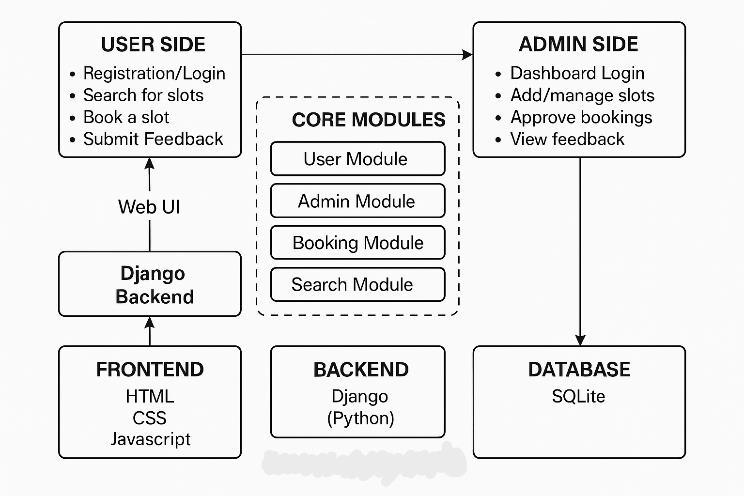
6.1 Block Diagram
The block diagram represents the overall flow of the system:
User Side: Users can register/login, search for available parking slots, book a slot, and submit feedbackthroughaweb-basedUI.
Admin Side: Admins can log into a dashboard to add or manage slots, approve bookings, and monitoruserfeedback.
Core Modules: The core system is divided into theUserModule,AdminModule,BookingModule, andSearchModule.
Frontend Layer: Developed using HTML, CSS, andJavaScripttoensureresponsiveinteraction.
Backend Layer: Django handles authentication, search handling, booking management, and feedbackmanagement.
Database Layer: SQLite is used to store user credentials,slotinformation,bookingrecords,and feedbacksecurely.
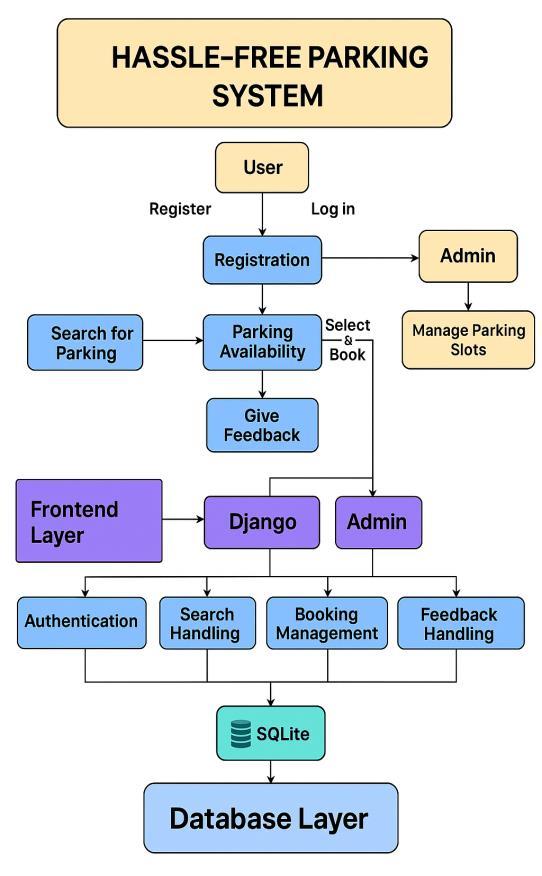
The architecture diagram shows a clear separation of concerns:
Frontend: Handles the user interface and interactionlogic.
Backend: Django manages request processing, authentication,booking,andfeedbacklogic.
Admin Interface: Admins have dedicated access forslotmanagementandbookingapprovals.
Database: SQLite serves as a lightweight and efficient data storage solution for real-time operations.
The layered and modular architecture ensures maintainability,security,andsmoothintegrationoffuture enhancements like real-time slot detection and online paymentprocessing.
The development of the Hassle-Free Parking System followed a modular and agile approach to ensure rapid prototyping and ease of maintenance. The backend of the system was developed using Django, a high-level Python web framework that emphasizes clean and pragmatic design.TheuseofDjangoenabledrapidintegrationofcore functionalities such as user authentication, role-based accesscontrol,andadmininterfaceforslotmanagement.
The frontend interface was crafted using HTML5, CSS3, and JavaScript, ensuring responsive design and compatibilityacross devices.Theuserinterfacefeaturesa cleanlayout,allowinguserstoeasilynavigatethroughthe available parking slots, view real-time availability, and proceed with bookings. For data persistence, SQLite was selected due to its simplicity and suitability for mediumscaleapplications.
International Research Journal of Engineering and Technology (IRJET) e-ISSN:2395-0056
Volume: 12 Issue: 05| May 2025 www.irjet.net p-ISSN:2395-0072
Role-based access was enforced through Django’s built-in authentication system, separating functionalities between generalusersandadministrators.Whilegeneraluserscan register, log in, search for slots, and book them, administrators are granted access to manage parking listings,updateavailability,andreviewuserfeedback.
Security features such as password hashing, form validation,andsessionmanagementwereincorporatedto protect user data and ensure a safe digital environment. The system also features booking conflict prevention by checking slot availability in real time before confirming a user’sreservation.
The proposed “Hassle Free Parking System” was implemented using Django for backend functionality, HTML/CSS/JavaScript for frontend development, and SQLite as the database. The system was tested across multiple user scenarios to evaluate its performance in termsofusability,responsiveness,andfunctionality.
System Usability: Userswereabletoregister,log in, view available parking slots, and make bookings through a clean and intuitive interface. Basic validations were implemented to prevent doublebookings,andbookedslotswerecorrectly updatedinreal-time.
Slot Booking Accuracy: Slot availability and booking status were dynamically updated in the database. In simulated tests with 10 concurrent users, no conflicts or data integrity issues were observed, indicating the robustness of the bookingmechanism.
Admin Panel Features: The admin module enabled smooth management of parking slots, including viewing user bookings, updating slot statuses, and generating booking records. This supports efficient monitoring of the parking infrastructure.
Performance: Page load time remained under 2 seconds for most operations, and database queries were efficiently handled, even during multiple access requests. The system is scalable forsmalltomedium-sizedparkinglots.
Overall, the implementation confirmed that a non-IoTbased, web-driven parking management system can offer a functional, low-cost, and user-friendly alternative to hardware-intensivesmartparkingsolutions.
The “Hassle Free Parking System” provides a reliable and efficient solution for real-time parking slot management using a simple yet effective web-based platform. The project eliminates common challenges in urban parking,
such as time-consuming searches and manual slot allocation, by offering an automated interface for both usersandadministrators.
Thesystemdemonstratedstrongperformanceinterms of bookingaccuracy,systemresponsiveness,andeaseofuse. ItsdesignavoidsdependencyonexpensiveIoTorsensorbased components, making it a practical option for locationswithbudgetorinfrastructureconstraints.
Integration of Online Payment Gateways: Enabling users to pay parking fees securely duringbooking.
Mobile Application Development: Creating a cross-platform mobile app for better accessibility andconvenience.
Real-Time Sensor Integration: Adding IoTbased hardware in future versions to automate real-timedetectionofvehiclepresence.
Machine Learning for Slot Prediction: Implementing predictive analytics to suggest optimalparkingtimes
Multi-location Support: Expandingthesystemto support multiple parking lots across different locationswithcentralizedadministration.
With further enhancements, this system holds potential for deployment in malls, office complexes, residential societies, and other public spaces requiring organized parkingsolutions.
1). Abdul Ahad, Zishan Raza Khan, Syed Aqeel Ahmad, “Intelligent Parking System” Scientific Research Publishing,Vol.4,No.2,pp.160-167.
2).S.P. Patro, P.Patel,M.K. Senapaty,N.Padhy,andR. D. Sah, "IoT based Smart Parking System: A Proposed AlgorithmandModel,"IEEEEXplore,2020.
3).R.Elakya,J.Seth,R.Namitha,andN.R,"SmartParking System using IoT," International Journal of Engineering andAdvancedTechnology(IJEAT),vol.IX,no.1,pp.60916095,October2019.
4). A. Ampuni, S. Fonataba, A. Fitrianto, and G. Wang, "Smart Parking System with Automatic Cashier Machine UtilizetheIoTTechnology,"IEEEXplore.
5). R. Kanan and H. Arbess, "An IoT- Based Intelligent system for real-Time Parking Monitoring and Automatic Billing,"IEEEXplore,pp.622-626,2020.
6). M. Y. I. Idris, Y. Y. Leon, E. M. Tamil, N. M. Noor, and Z. Razak,“Carparkingsystem:Areviewofthesmartparking
International Research Journal of Engineering and Technology (IRJET) e-ISSN:2395-0056
Volume: 12 Issue: 05| May 2025 www.irjet.net p-ISSN:2395-0072
system and its technology,” Information Technology Journal,pp.101-113.],2009.
7). Paidi. V; Fleyeh, H.; Hakansson, J.; Nyberg, R.G.,” Smart Parking Sensors, Technologies and Applications for Open Parking Lots: A Review”, IET Intel. Transport Syst,12,735–741,2018.
8).Amir O. Kotb, Yao-Chunsheng, and Yi Huang “Smart parking Guidance, Monitoring and Reservation: A Review,”IEEE-ITSM,pp.6-16.Apr-2017.
9). Supriya Shinde, AnkitaM Patial, pSusmedha Chavan, Sayali Deshmukh, and Subodh Ingleshwar, “IOT Based Parking System Using Google”, Proc., of. I-SMAC,2017, pp.634-636,2017.
10).Hemant Chaudhary, PrateekBansal., B. Valarmathi,” Advanced CAR Parking System usingArduino”,Proc.,of. ICACCSS,2017.
11). Wang, M.; Dong, H.; Li, X.; Song, L.; Pang, D. A Novel ParkingSystemDesignedforG.Searchingpageforparking H. View slots of parking Smart Cities. Proc., in 2017 Chinese Automation Congress (CAC), Jinan, China, pp. 3429–3434,20–22October2017.
12).Nastaran Reza NazarZadeh, Jennifer C. Dela,” Smart urban parking deducting system”, Proc., of.ICSCE,2016, pp-370-373,2016.
13) PavanKumarJogada and VinayakWarad, “Effective Car Parking Reservation System Based on Internet of things Technologies “, Proc., of. BIJSESC, Vol. 6, pp.140142,2016.
14). Yashomati R. Dhumal, Harshala A. Waghmare, Aishwarya S. Tole, Swati R. Shilimkar,” Android Based Smart Car Parking System” Proc., of. IJREEIE, Vol. 5, Issue 3,pp-1371-74,mar-2016.
15).Faiz Ibrahim Shaikh, Pratik NirnayJadhav, Saideep Pradeep Bandarakar” Smart Parking System based on embedded system and sensor Network” IJCA, vol.140. pp.45-51.Apr-2016.
© 2025, IRJET | Impact Factor value: 8.315 | ISO 9001:2008