
International Research Journal of Engineering and Technology (IRJET) e-ISSN: 2395-0056
Volume: 12 Issue: 10 | Oct 2025 www.irjet.net p-ISSN: 2395-0072
International Research Journal of Engineering and Technology (IRJET) e-ISSN: 2395-0056
Volume: 12 Issue: 10 | Oct 2025 www.irjet.net p-ISSN: 2395-0072
Annapurna A1 , Gayathri C2 , Tehamina3, Babitha B4
1HOD, Dept. of Food Science & Technology, SDMSM Kalasala, Vijayawada, Andhra Pradesh, India
2 & 3 Faculty, Dept. of Food Science & Technology, SDMSM Kalasala, Vijayawada, Andhra Pradesh, India
4Assoc. Prof., Dept. of Food Science, Nutrition & Dietetics, Acharya Nagarjuna University, Andhra Pradesh, India
Abstract - A major contributing factor to the rise in prediabetes and metabolic syndrome worldwide is the use of refined carbohydrates and poor eating habits. Millets are nutrient-dense, ancient cereals that have gained popularity recentlyas functionalfoodsthatcanimprovemetabolichealth andregulate glycemicresponse. Becauseoftheirnutrientslike dietary fiber, bioactive phytochemicals, and slowly digesting starch, theymayhelp control bloodsugar andfat metabolism. Concerning glycemic management and metabolic health in adults with prediabetes or at risk of type 2 diabetes, this review summarizes the most recent research. Consuming millet has been linked to enhanced insulin sensitivity, decreased glycated hemoglobin (HbA1c), and decreased postprandialglucoseexcursionsinnumerousstudies.Bioactive substances that seem to affect oxidative stress, inflammatory pathways, and glucose transport include polyphenols, flavonoids, andresistant starch. Milletsmayalsoimprovelipid profiles by increasing HDL concentrations and decreasing triglycerides and total cholesterol. Diets based on millet have been shown to have potential as a dietary intervention to enhance metabolic health and glycaemic control.
Key Words: Millets, Glycemic response, Prediabetes, Insulin sensitivity, Dietary fiber, Functional foods
1.INTRODUCTION
Withanincreasingincidenceindifferentcountries, prediabetesandmetabolicsyndromerepresentasubstantial and growing global health burden, impacting hundreds of millions of people globally. According to Jean Jacques Noubiapetal.(2022),theprevalenceofmetabolicsyndrome variesbasedonthediagnosticcriteria,rangingfrom12.5% to31.4%worldwide.Metabolicillnessdisability-adjustedlife years (DALYs) have increased 1.6 to 3-fold over the past threedecades,withtheburdenbeinggreatestgeographically in populated nations like as China, India, and the United States (Huai Zhang et al., 2024). With a substantial progressionrisktotype2diabetes,prediabetesisbecoming more widely acknowledged as a diverse disorder (U. Hostaleketal.,2019;L.Sandforthetal.,2025).Toaddress this escalating metabolic health catastrophe, the pattern pointstotheurgentnecessityforinternationalpublichealth initiatives.
Thereisstrongevidencethatdietarycarbohydrates, especiallythosewithahighglycemicindex,increasetherisk ofmetabolicdisorders.Additionally,thereisevidencethat
thequalityofcarbohydratesisrelatedtometabolichealth. High glycemic index (GI) diets have been linked to an elevatedriskoftype2diabetesandcardiovasculardisease, according to numerous studies (S. Rizkalla et al., 2014). Consumingrefinedgrainsandsimplecarbsisconsistently associated with a greater incidence of metabolic diseases, accordingtoepidemiologicalstudies(KristinL.Morrisetal., 2009).Low-GIdietshavebeenlinkedtocertainmetabolic advantages, such as decreased insulin and postprandial glucose responses, improved lipid profiles, a possible decrease in fat production and an increase in insulin sensitivity.Althoughtheresearchindicatesthatthetypeof carbohydrate has a major impact on metabolic health, customizeddietarymethodsmightbethemostsuccessful(E. Blaaketal.,2016).
Milletsareseeingaglobalcomebackasfunctional foods because of their remarkable nutritional profile and several health advantages. The potential of millets to alleviate nutritional issues is constantly emphasized by researchers.Their nutrient densityandclimaticresilience arehighlightedbyRashmiSinghetal.(2023),whileAmadou etal.(2022)describetheirbioactivecomponentsthatmay havedisease-preventionqualities.Thereisstrongevidence that millets, which are high in protein, dietary fiber, minerals, and polyphenols, have the potential to help manage cardiovascular disease, diabetes, and promote gastrointestinal health. The convergence of dietary requirements,climateadaptation,andhealthconsciousness is transforming millets from underutilized crops into possibleglobalfunctionalfoodsolutions.Thisreviewaimsto synthesize current evidence on the effects of millet-based diets on glycemic response, insulin sensitivity, lipid metabolism,andinflammationinadultswithprediabetes.
Millets are termed Nutri-cereals as they are nutrientdense,drought-resistantgrainswithexceptionalnutritional significance, offering a comprehensive profile of essential nutrientsandpotentialhealthbenefits.Theyincludepearl, finger,foxtail,kodo,barnyard,tiny,andprosomillet,which areaclassofgrainswithsmallseeds.Theyareabundantin proteins,dietaryfiber,complexcarbohydrates,vitalminerals, and bioactive substances, including flavonoids and polyphenols.Milletsareloadedwithvitamins,minerals(iron, zinc,andmagnesium),proteins,andcarbs(RajuC.A.etal., 2024). They are also noteworthy for having high levels of
International Research Journal of Engineering and Technology (IRJET) e-ISSN: 2395-0056
Volume: 12 Issue: 10 | Oct 2025 www.irjet.net p-ISSN: 2395-0072
protein,dietaryfiber,andcalcium(BhatSetal.,2018).The bioavailability of minerals (calcium and iron) can be improved by processes like fermentation which is key to lowering micronutrient deficiencies (Annapurna. A. et al., 2024). Millet has a higher nutritional density and a lower glycemic index than processed grains like wheat and rice. Bothconventionalandcontemporaryprocessingtechniques, likeextrusion,roasting,fermentation,anddehulling,might affect their functional qualitiesand nutritional value. Fig1 givesanoverviewofthepotentialhealthbenefitsofmillets, their production (1950-2020) and the challenges in millet utilization(Giridharanetal.,2020).
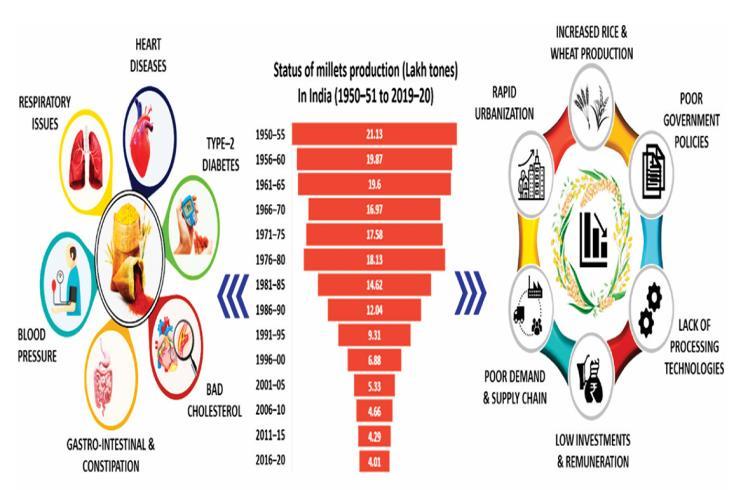
Fig -1:Millets:Healthbenefits,productionandchallenges (Giridharanetal.,2020)
Millets often have a low to moderate glycemic index because of their high fiber content and slowly digested starch.AccordingtoRotelaSetal.(2021)andGaganTripathi etal.(2023),milletshaveantioxidantqualitiesthatcanhelp prevent chronic diseases like diabetes, cardiovascular disorders, and possibly lower the risk of cancer. Soluble fibers and resistant starch help to reduce postprandial spikesbyslowingtheabsorptionofglucose.Thewaystarch is cooked and processed might have an impact on its digestibility.Forinstance,fermentationorlittleprocessing protects bioactive components, but overcooking can raise the glycemic load. Millets are appropriate for dietary treatmentsinpopulationswithprediabetesbecauseofthese qualities.Theyareappropriateforpeoplewithcertain dietary needs because they are gluten-free as well (AnaghaKetal.,2023).GIofdifferentmilletsisgiven inTable1(ShobhanaSetal.,2013)
Milletsprovideantioxidants,flavonoids,andpolyphenolsthat haveavarietyofmetaboliceffects.AccordingtoC.Suniletal. (2024)and P. K. Sadh et al.(2024), millets are specifically richinphenolicacids,flavonoids,carotenoids,andbioactive peptides. These substances exhibit exceptional healthpromotingqualities,suchasanti-inflammatory,anti-cancer, anti-diabetic,andantioxidanteffects(P.K.Sadhetal.,2024).
In addition to lowering oxidative stress and modifying inflammatory pathways, these substances can block the enzymesthatbreakdowncarbohydrates(α-amylaseandαglucosidase). The gut microbiota and millet bioactive compoundscombinetoproducemoreshort-chainfattyacids (SCFAs), which enhance lipid metabolism and insulin sensitivity,accordingtorecentresearch.Certainprocessing techniques may result in lower amounts of bioactive compounds (C. Sunil et al., 2024), but germination and fermentationcanincreasethephenoliccontent(ShanLiang etal.,2019).
Table -1: Glycemic Index of Millets (Shobhana et al., 2013)
Fingermillet 38-45
Foxtailmillet 53
Pearlmillet 67
Sorghum 62-79
Inpeoplewithprediabetesanddiabetes,milleteatinghas beenshowninclinicalandinterventionstudiestoenhance insulin sensitivity, lower HbA1c, and lessen postprandial glucoseexcursions.Positivealterationsinlipidprofiles,such aslowertriglyceridesandtotalcholesterolandhigherHDL cholesterol,arealsoreportedinsomestudies.Innumerous humantrials,milletshavebeenshowntosignificantlylower postprandialbloodglucoselevelsinavarietyofindividuals, demonstratingtheirpersistentpositiveimpactonglycemic response. According to a systematic review and metaanalysis, millet consumers significantly reduced their postprandialbloodsugar(15.1%,p=0.012)andfastingblood sugar (11.8%, p=0.001) (Anitha S et al., 2024). Glycemic indicesforvariousmilletsrangefrom49.64to58,whilerice hasaglycemicindexof77.96.Thesefindingsaresupported by other research, including one by Palanisamy T et al. (2020).Accordingtoclinicalresearch,fingermilletmuffins specifically reduced the glycemic response peaks in prediabetic people (Almaski A et al., 2022). Research has shown that the effect is constant among millet varieties, includingfinger,pearl,foxtail,andothers(NarayananJetal., 2016;LakshmiKumariPetal.,2002).Heterogeneousresults areobtained,though,becausestudydesignsdifferintermsof length,millettype,andmealcomposition.Fig2projectsthe impactofmilletpolyphenolsonvariousdiabeticfactors(Triki etal.,2022).
International Research Journal of Engineering and Technology (IRJET) e-ISSN: 2395-0056
Volume: 12 Issue: 10 | Oct 2025 www.irjet.net p-ISSN: 2395-0072
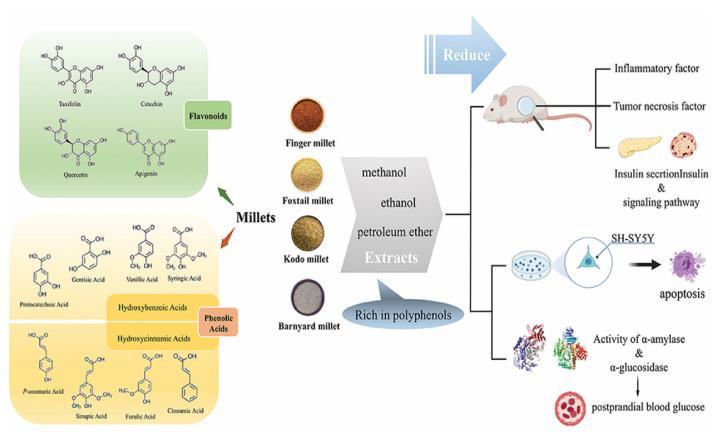
Fig -2:EffectofPolyphenolsinMilletsonDiabeticfactors (Trikietal.,2022)
Researchoffersanunderstandingofthemetabolic advantagesofmillet.Eatingmillethasbeendemonstratedto improvelipidmetabolism,decreaseoxidativestress,increase insulinsignaling,andmodifytheexpressionoftheglucose transporter.Theseinvestigationsalsoassistinidentifyingthe activeingredients,suchaspolyphenolsandresistantstarch fractions,thathaveantidiabeticproperties.NarayananJetal., (2016) study on post prandial glucose levels in type 2 diabetespatientsshowedtheGIoffoxtaildosatobe59.25, whichisconsistentlylessthantheGI(77.96)ofricedosa.Ren etal.,(2018)observedadecreaseinfastingandpost-meal bloodsugarlevelsafterconsumptionof50g/dayoffoxtail millet.Fuetal.,(2020)foundthattheprolaminfromcooked foxtail millet resulted in insulin secretion in mice Other studiesindicateasignificantdecreaseinbloodglucoselevels inratsfedwith5–10%fingerorfoxtailmillet(Shobhanaet al.,2010;Hegdeetal.,2005).
Glycemiccharacteristicsandnutrientcomposition differamongmilletspecies.Foxtailmillet,forinstance,hasa lotofslowlydigestedcarbohydrate,butfingermillethasa lot of polyphenols. Comparative research indicates that certain species have advantages in lipid metabolism and glycemic control. There is yet little proof, but blended or compositemilletproductsmighthavesynergisticeffects.A studybyS.Anithaetal.(2021)foundthatmilledrice(71.7± 14.4)andrefinedwheat(74.2±14.9)haveameanglycemic indexthatis36%higherthanthatofmillets(52.7±10.3). Job's tears, fonio, foxtail, barnyard, and teff millets, in particular, had the lowest mean GI (<55) and 35-79% efficacy in lowering the food glycemic index. According to (ThenmozhiPalanisamyetal.,2020),foxtailmillethadthe lowestglycemicindex,at49.64.Barnyardmillet,tinymillet, pearl millet, and koda millet were next, at 50, 52, and 58, respectively. Among diabetic subjects, long-term consumptiondramaticallyreducedfastingandpostprandial bloodglucoselevelsby12–15%,withanoteworthydecrease inHbA1clevels.
Themetabolicbenefitsofmilletsareprobablycomplex. Oneofthemaincausesistheslowerabsorptionanddigestion ofcarbohydratesbecauseofresistantstarchandhighfiber. ThesynthesisofSCFAandthealterationofgutmicrobiota, thedecreaseofoxidativestressandinflammatorycytokines, and the synergistic impact of bioactive substances on the metabolism of fats and carbohydrates are other factors. AccordingtoRadhaSetal.(2024),milletscanhelpwithlipid profileabnormalities,insulinresistance,andhyperglycemia. Kumar A et al. (2025) identified particular molecular pathways,suchasenhancedinsulinsensitivity,inhibitionof enzymes that break down glucose, and modification of importantsignalingpathwayslikePI3K/AKT.Milletshavea distinct nutritional composition that contributes to their metabolicbenefits.RashmiSinghetal.(2023)emphasized thelowglycemicindex,highfiber,andrichmineralcontentof millets.Furthersupportingmetabolichealth,SinghS.B.etal. (2023)showedthattheprebioticqualitiesofmilletscanhave agoodimpactongutflora.
Milletsdiverseproperties–nutritional,therapeutic, environmental sustainability and economic probability –makethemaninvaluablecropofthefuture. Milletshavea lotofpromiseasfunctionalstaplefoodstohelpprediabetic adults with their glycemic management and metabolic health.Improvedglucoseregulation,lipidmetabolism,and decreasedinflammationareallfacilitatedbytheirhighfiber content,lowglycemicindex,andbioactivesubstances.Itmay be possible to avoid type 2 diabetes and associated metabolicdiseasesinasustainableandculturallyacceptable waybyencouragingmillet-baseddiets.
[1] JacquesNoubiap,J.,RichieNansseu,J.,Lontchi-Yimagou, E., René Nkeck, J., Flore Nyaga, U., Ngouo, A.T., Noelle Tounouga, D., Leonel Tianyi, F., Joyce Foka, A., Laetitia Ndoadoumgue, A., & Joel Bigna, J. (2022). Geographic distributionofmetabolicsyndromeanditscomponents inthegeneraladultpopulation:ameta-analysisofglobal data from28millionindividuals. Diabetes research and clinical practice,109924.
[2] Zhang,H.,Zhou,X.,Shapiro,M.D.,Lip,G.Y.,Tilg,H.,Valenti, L.V., Somers, V.K., Byrne, C.D., Targher, G., Yang, W., Viveiros,O.,Opio,C.K.,Mantzoros,C.S.,Ryan,J.D.,Kok,K., Jumaev, N., Perera, N., Robertson, A.G., Abu-Abeid, A., Misra,A.,Wong,Y.J.,Ruiz-Úcar,E.,Ospanov,O.,Kızılkaya, M.C.,Luo,F.,Méndez-Sánchez,N.,Zuluaga,M.,Lonardo,A., Al Momani,H., Toro-Huamanchumo,C.J.,Adams,L.,AlBusafi, S.A., Sharara, A.I., Chan, W.K., Abbas, S.I., Sookoian,S.,Treeprasertsuk,S.,Ocama,P.,Alswat,K.A., Kong, A.P., Ataya, K., Lim-Loo, M.C., Oviedo, R.J., Szepietowski,O.,Fouad,Y.M.,Zhang,H.,Abdelbaki,T.N., © 2025, IRJET | Impact Factor value: 8.315 | ISO 9001:2008 Certified Journal | Page817
International Research Journal of Engineering and Technology (IRJET) e-ISSN: 2395-0056
Volume: 12 Issue: 10 | Oct 2025 www.irjet.net p-ISSN: 2395-0072
Katsouras,C.S.,Prasad,A.,Thaher, O.,Ali,A.,Molina,G., Sung, K., Chen, Q., Lesmana, C.R., & Zheng, M. (2024). Global burden of metabolic diseases, 19902021. Metabolism: clinical and experimental,155999.
[3] HostalekU,(2019)GlobalEpidemiologyofprediabetes–presentandfutureperspectives, ClinicalDiabetesand Endocrinology5:5https://doi.org/10.1186/s40842-0190080-0
[4] Sandforth, L., Kullmann, S., Sandforth, A., Fritsche, A., Jumpertz-vonSchwartzenberg,R.,Stefan,N.,&Birkenfeld, A.L.(2025).Prediabetesremissiontoreducetheglobal burden of type 2 diabetes. Trends in endocrinology and metabolism: TEM.
[5] Rizkalla, S. (2014). Glycemic index: is it a predictor of metabolic and vascular disorders? Current Opinion in Clinical Nutrition and Metabolic Care, 17,373–378.
[6] Morris, K.L., & Zemel, M.B. (2009). Glycemic index, cardiovasculardisease,andobesity. Nutritionreviews,57 9 Pt 1,273-6.
[7] Blaak,E.E.(2016).Carbohydratequantityandqualityand cardio-metabolic risk. Current Opinion in Clinical Nutrition and Metabolic Care, 19,289–293.
[8] Rashmi Singh, Ritu Singh, Prabhat K Singh, Shivangi, Omkar Singh (2023) International Journal of EnvironmentandClimateChange-Climatesmartfoods: NutritionalCompositionandHealthBenefitsofMillets13 (11):1112-1122
[9] Amadou, I. (2022). Millet Based Functional Foods: Bio‐ChemicalandBio‐FunctionalProperties. Functional Foods
[10] Raju, C. A., Lakshmeesha, R., Pavuluri Yasaswini, Divya, C. and Ashoka, S. (2024) Millets: A Scientific PerspectiveontheirNutritionalandHealthRelevanceJ. Sci.Res.Rep.,30(5):494-509
[11] Bhat,S.,Nandini,C.D.,Tippeswamy,V.,&Prabhaka (2018). Significance of small millets in nutrition and health-A review. Asian Journal of Dairy and Food Research, 37,35-40.
[12] Annapurna, A., Babitha, B., & Andallu, B. (2024). Millet: Key to alleviate micronutrient deficiencies (calcium & iron) among adolescent girls. in Texila International Journal of Public Health, Vol 12, Issue 4 DOI:10.21522/TIJPH.2013.12.04.Art052
[13] Giridharan, B.; Sakthivel, V.; Vedamanickam, R.; Anandan, P.;Bupesh, G.; Vasanth, S.Study ofMillet and Non-Millet Diet onDiabetics and Associated Metabolic
SyndromeAntiinflammatoryDrugsViewProjectStudyof MilletandNon-MilletDietonDiabeticsandAssociated Metabolic Syndrome, Biomedicineonline.Org Biomedicine.2020.
[14] Rotela, S., Borkar, S., & Borah, A. (2021). Health benefits of millets and their significance as functional food:Areview. The Pharma Innovation
[15] Gagan Tripathi, Patel H J, Anchita B, Dibyajyoti N, Hiren D, Swarnika B, Nikita S and Bal V S; (2023) A ReviewonNutritionalandHealthBenefitsofMilletsInt.J. PlantSoilSci.,35(19):1736-1743
[16] Anagha,K.(2023). Millets:Nutritional importance, healthbenefits,andbioavailability:Areview.
[17] ShobanaS,KrishnaswamyK,SudhaV,MalleshiNG, AnjanaRM,PalaniappanL,MohanV.Fingermillet(Ragi, Eleusine coracana L.): a review of its nutritional properties, processing, and plausible health benefits. AdvancesinFoodandNutritionResearch.2013;69:1-39.
[18] Sunil, C.K., Gowda, N.A., Nayak, N., & Rawson, A. (2024).Unveilingthe effect ofprocessingon bioactive compounds in millets: Implications for health benefits andrisks. Process Biochemistry.
[19] Sadh,P.K.,Kamboj,A.,Kumar,S.,Chawla,P.,Kumar, R.,Saharan,P.S.,Kumar,D.,Duhan,S.,Nehra,M.,Goyal,C., Brar, B., Joshi, S., & Duhan, J.S. (2024). Perspectives of milletsfornutritionalproperties,healthbenefitsandfood ofthefuture:areview. Discover Food
[20] ShanLiang&KehongLiang(2019)Milletgrainasa candidate antioxidant food resource: a review, International Journal of Food Properties, 22:1, 16521661,DOI:10.1080/10942912.2019.1668406
[21] AnithaS,TsusakaTW,BothaR,GivensDI,Rajendran A,ParasannanavarDJ,SubramaniamK,BhandariRKand Kane-PotakaJ(2024)Impactofregularconsumptionof milletsonfastingandpost-prandialbloodglucoselevel:a systematic review and meta-analysis. Front. Sustain. FoodSyst.7:1226474.doi:10.3389/fsufs.2023.1226474
[22] Palanisamy, T., & Sree, D.R. (2020). Efficacy Of Millets(Foxtail,Kodo,Small,BayrnyardAndPearlMillet) VarietiesOnPostprandialGlycemicResponseInPatients WithType2Diabetes.
[23] Almaski, A., Coe, S., Lightowler, H., Clegg, M.E., & Thondre, P.S. (2022). Finger millet-based muffin decreases insulin response in individuals with prediabetesinarandomisedcontrolledtrial. The British Journal of Nutrition, 129,650-659.
International Research Journal of Engineering and Technology (IRJET) e-ISSN: 2395-0056
Volume: 12 Issue: 10 | Oct 2025 www.irjet.net p-ISSN: 2395-0072
[24] Narayanan,J.,Sanjeevi,V.K.,Rohini,U.,Trueman,P., & Viswanathan, V. (2016). Postprandial glycaemic response of foxtail millet dosa in comparison to a rice dosainpatientswithtype2diabetes. The Indian Journal of Medical Research, 144,712-717.
[25] Ren,X.;Yin,R.;Hou,D.;Xue,Y.;Zhang,M.;Diao,X.; Zhang,Y.;Wu,J.;Hu,J.;Hu,X.;etal.(2018)TheGlucoseLowering Effect of Foxtail Millet in Subjects with Impaired Glucose Tolerance: A Self-Controlled Clinical Trial.Nutrients,10,1509.
[26] Fu,Y.;Yin,R.;Liu,Z.;Niu,Y.;Guo,E.;Cheng,R.;Diao, X.; Xue, Y.; Shen, Q. (2020) Hypoglycemic Effect of Prolamin from Cooked Foxtail Millet (Setaria italic) on Streptozotocin-Induced Diabetic Mice. Nutrients, 12, 3452.
[27] Shobana S, Harsha MR, Platel K, Srinivasan K, Malleshi NG. Amelioration of hyperglycaemia and its associated complications by finger millet (Eleusine coracanaL.)seedcoatmatterinstreptozotocin-induced diabetic rats. British Journal of Nutrition. 2010;104(12):17871795.
[28] HegdePS,RajasekaranNS,ChandraTS.Effectsofthe antioxidant properties of millet species on oxidative stress and glycemic status in alloxan-induced rats. Nutritionresearch.2005;25(12):11091120.
[29] LakshmiKumari,P.,&Sumathi,S.H.(2002).Effectof consumptionoffingermilletonhyperglycemiainnoninsulin dependent diabetes mellitus (NIDDM) subjects. Plant Foods for Human Nutrition, 57,205-213.
[30] Triki,T.;Tlahig,S.;Benabderrahim,M.A.;Elfalleh,W.; Mabrouk, M.; Bagues, M.; Yahia, H.; Belhouchette, K.; Guasmi, F.; Loumerem, M., et al. Variation in Phenolic, Mineral, Dietary Fiber, and Antioxidant Activity Across SouthernTunisianPearlMilletGermplasm.J.FoodQual. 2022,2022,1–11.DOI:10.1155/2022/1437306.
[31] Radha, S., Mekala, A., Premkumar, K., Bhanu, S., Samraj, K., & Thilagavathi, R. (2024). Therapeutic potential of millets in the management of metabolic syndrome a review. Journal of Research in Siddha Medicine, 7,36-43.
[32] Kumar,A.,Shah,N.N.,Chorawala,M.R.,Kaushik,R., Prajapati, B., & Mehra, R. (2025). Exploring the MolecularPathwaysUnderlyingtheAnti-DiabeticEffects of Millets. Food Safety and Health, 3(3), 300-314. https://doi.org/10.1002/fsh3.70007
[33] Singh, S B; Meena, Ajay Kumar; Sisodia, Brijesh Singh; Sharma, Savita; Sharma, MM; Mansoria, Poornima. From farm to gut: Unraveling the role of
millets in promoting metabolic well-being via gut microbiota. Journal of Drug Research in Ayurvedic Sciences8(Suppl1):pS50-S54,November2023.|DOI: 10.4103/jdras.jdras_192_23