
International Research Journal of Engineering and Technology (IRJET) e-ISSN: 2395-0056
Volume: 12 Issue: 06 | Jun 2025 www.irjet.net p-ISSN: 2395-0072
International Research Journal of Engineering and Technology (IRJET) e-ISSN: 2395-0056
Volume: 12 Issue: 06 | Jun 2025 www.irjet.net p-ISSN: 2395-0072
Kazuo Matsuura1
1Professor, Department of Informatics, Matsuyama University, Matsuyama, Ehime, Japan
Abstract - Accidental hydrogen leakage occurs in various situations. A drone-based airborne sensor is expected to provide a more flexible and faster hydrogen sensing system than current technologies. Historically, quadrotor drones were considered unsuitable for hydrogen leak detection because the propeller airflow prevents the gas from reaching the drone. However, we demonstrate for the first time through experiments and simulations that hydrogen can still be effectively detected even in the presence of propeller airflow, and we reveal the hydrogen transport path from the leak source to the sensor mounted on the drone positioned above it. This enables continuous hydrogen sensing using a quadrotor drone. Hydrogen from the leak source is carried by circulating flows inevitably formed around the drone due to the suction and discharge of air by the propellers, which then transport the hydrogen to the sensor ina stable andeffective manner.
Key Words: Hydrogen Sensing, Drone, Leak, Sensor Array, Flow Circulation, Smoke Visualization, Fire Dynamics Simulator
The use of hydrogen is becoming an increasingly important part of our everyday lives, leading to hydrogen leakage in various scenarios from production to consumption [1]. Given that hydrogen can easily ignite even from minor static electricity, quick and dependable hydrogen sensing is essential. Hydrogen safety is also a vital concern in the aerospace and nuclear industries. Monitoring hydrogen leakage and dispersion is necessary due to factors such as aging infrastructure, human error, andnaturaldisasters.
haveafastresponsetimeofseveralhundredmilliseconds andcanalsoproduceconcentrationdistributions,butthey are limited to quiet and short-distance environments where transmitted and received signals remain clearly distinguishable If a low-cost hydrogen sensor could be installed on a fast-moving vehicle to measure hydrogen with acceptable accuracy, it could introduce a rapid, flexible,andreliablemethod
In recent years, although there are very few cases targeting hydrogen gas, drone-based chemical sensors have been gaining attention, and several review papers have described the trends. These review papers [6–14] provide a more comprehensive list of individual studies. For example, Bartholmai et al. [15] developed a quadcopter system with a 1-meter diameter that can measure O₂, CO, H₂S, NH₃, CO₂, SO₂, PH₃, HCN, NO₂, and Cl₂. Neumann [16] used microdrones to map gas leak sourcesandgasdistributions.Rossietal.[17]developeda fully autonomous board for any unmanned aerial vehicle, featuring a 32-bit MCU, wireless connectivity for data storage, real-time feedback, and a microfabricated MOX (metal oxide) sensor. Fahad et al. [18] developed a chemically sensitive field-effect transistor (CS-FET) platform using a 3.5-nm-thick silicon channel transistor. This platform detected H₂S, H₂, and NO₂ with low power consumption, high sensitivity, and selective multi-gas sensing.Theteamsuccessfullytested the sensor mounted on a palm-sized quadcopter performing vertical movements. Although applicability to hydrogen gas has not been explicitly stated, there are commercially available systems. For example, Boreal Laser Inc. [19] offers a gas detection system called “GASFINDER3-AB” thatusesanunmannedaerialvehiclewithatotallengthof 2 meters. UgCS sells products that enable hyperspectral cameras to be mounted on drones [20]. Such commercial drone sensing systems are featured on various websites, including[21].
Ultrasonic sensors [3-5]
Hydrogen sensing methods typically fall into one of three categories: fixed measurement, portable probing, or remotemeasurement. Each methodhasitsprosandcons. Fixed measurement involves a sensor placed in a set location, which means there is a delay before hydrogen reaches the sensor from the source of the leak. Portable probingbecomeschallenginginareasthat aredifficultfor people to access. Remote measurement employs lasers and ultrasonic sensors Laser-based measurement uses Raman scattering induced by an ultraviolet laser [2], but the necessary optical system is expensive because of the faintness of the scattered light and the difficulty in achieving proper optical focus
The author's group proposed a quadrotor drone system for wireless, high-speed, and continuous detection of hydrogen leaks [22-24] Quadrotor drones generally produce strong downwash, which has been considered unsuitable for chemical detection [25, 26]. However, previous experiments conducted by the authors demonstrated that leaked hydrogen can be reliably detectedbyahydrogensensormountedonthedrone[2224]. Nonetheless, the mechanism behind this successful
2025, IRJET | Impact Factor value: 8.315 | ISO 9001:2008 Certified Journal | Page959
International Research Journal of Engineering and Technology (IRJET) e-ISSN: 2395-0056
Volume: 12 Issue: 06 | Jun 2025 www.irjet.net p-ISSN: 2395-0072
detection remains unclear. To the best of the authors’ knowledge, there have been very few reports on the relationship between the airflow around drones and the distribution of hydrogen gas. Thus, this study aims to elucidate the mechanism, particularly in a quiet, windless environment, by conducting hydrogen leak experiments, visualizingairflow withsmoke,performingcomputational fluid dynamics (CFD) analyses, and directly detecting hydrogentransportaroundthedrone.
The experimental setups and procedures are explained in Section 2, including the proposed drone-based hydrogen sensing system, the hydrogen sensors used, dynamic response tests, hydrogen leak experiments, smoke visualization, and sensor array measurements. Section 3 presents a numerical simulation of unsteady, turbulent hydrogen dispersion around the drone. Section 4 discussestheexperimentalandcomputationalresults,and theconclusionsarepresentedinSection5.
2.1 Drone-Based Hydrogen Sensing System
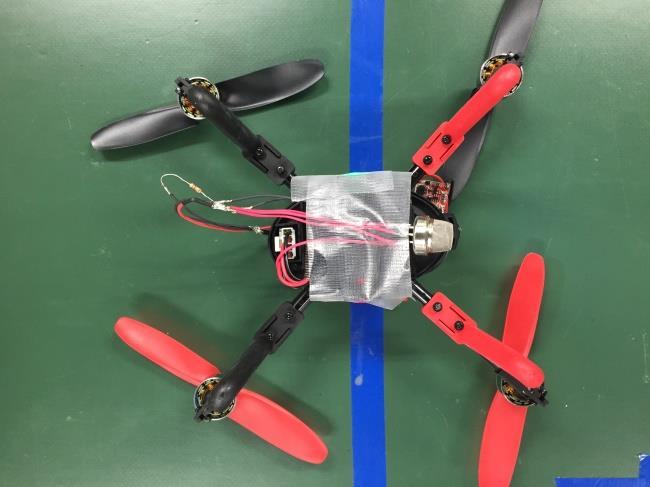
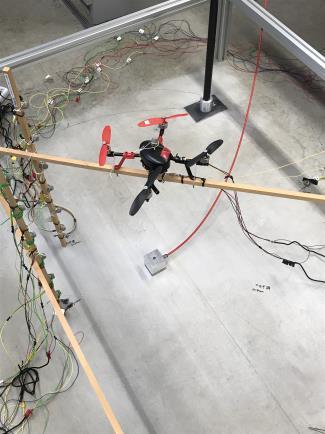
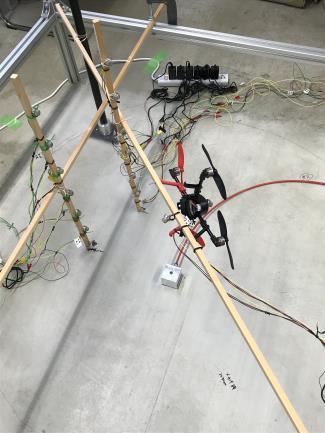
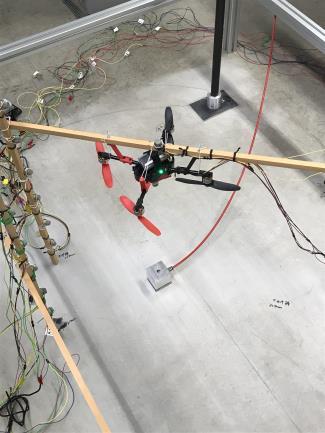
This section describes the drone-based hydrogen sensing system proposed in this study. The sensor system is installedonanRCEYEOneXtremequadrotordronefrom RC Logger. The total length of the drone is 225 mm, and the propeller diameter is 138 mm. The drone is powered by a single LiPo battery. Figure 1 shows the system. An MQ-8 gas sensor from Zhengzhou Winsen Electronics Technology Co., Ltd. is installed on the drone. Whileawirelesssystemcanbeusedtosendsensorsignals toabasestation[22],awiredsystemisusedinthisstudy to focus solely on gas dispersion around the drone. Since the hydrogen concentrations measured in this study are below the lower flammability limit of 4 vol.%, no specific anti-sparking measures were taken for the circuit board, exceptfortheuseofbrushlessmotors.
Two types of hydrogen sensors were used in this study. One was the MQ-8 sensor mentioned previously. This is a semiconductor-based sensor with a detection range of 100–1000ppm,anditsresponsetimeislessthan1second. Theotherwasa μ-CSsensorfromNewCosmosElectricCo., Ltd., which is a catalytic-combustion sensor with a wide detectionrangeof0–40000ppm,coveringvaluesuptothe lowerflammabilitylimit.Its response timeis between0.5 and1.0seconds.TheMQ-8sensorswereusedtomeasure hydrogenconcentrationsonthedrone,onthefloor,andin theair,whilethe μ-CSsensorswereusedasareference.
Generally, both catalytic-combustion and semiconductorbased hydrogen sensors require preheating. The necessarypreheatingdurationswereinvestigatedforboth sensors prior to conducting the drone-sensing experiments [23]. The relationship between hydrogen concentration and sensor output voltage was measured, and the mean values and variances were represented as error bars. Each measurement was repeated three times. After sufficient preheating, well-fitted regression lines wereobtained.
PreheatingtestsoftheMQ-8sensorwereconductedfor2, 4,and6hoursusingdilutedhydrogenatconcentrationsof approximately 0.03–0.12 vol.% [23]. The difference in the y-interceptsoftheregressionlinesbetween4and6hours was found to be less than 0.5 V. Therefore, the experiments were conducted after preheating the sensor for at least 4 hours. A 1 V increase in the sensor’s output voltage corresponded to approximately 0.053 vol.% The output voltage of this sensor in pure air varied slightly between individual devices. For the μ-CS sensor, the variation in output voltage over time was small when preheating times of 10, 30, and 50 minutes were compared. Thus,stableresultswere obtained even with a preheatingtimeasshortas10minutes.Forthe μ-CS,a1V increaseinoutputvoltagecorrespondedtoapproximately 1.8vol.%.
International Research Journal of Engineering and Technology (IRJET) e-ISSN: 2395-0056
Volume: 12 Issue: 06 | Jun 2025 www.irjet.net p-ISSN: 2395-0072
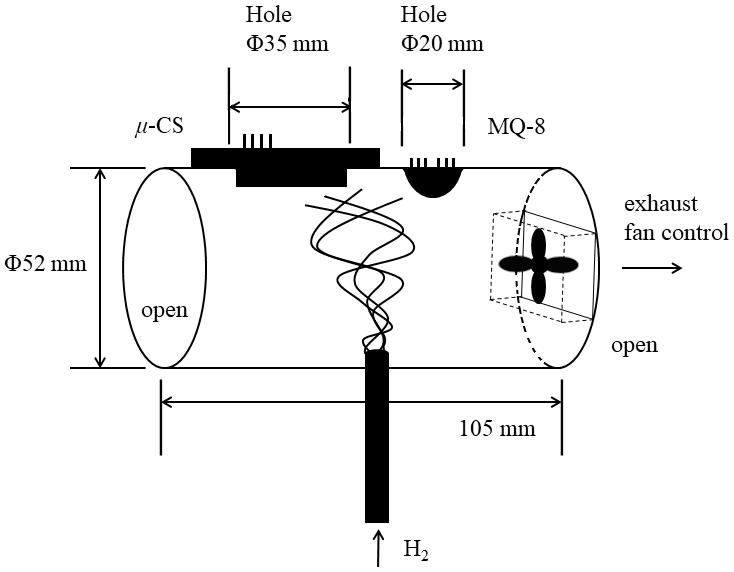
Fig -2: Systemfordynamicresponsemeasurementof hydrogensensors
In addition to the detectable concentration range, the responsetimeofasensorhasasignificantinfluenceonthe spatial and temporal resolution of the airborne sensor system. A fast hydrogen sensor response is also required to clarify hydrogen diffusion over time around the drone Thesensorsusedinthisstudyhadrelativelyfastresponse times compared to existing hydrogen sensors [27]. However, their dynamic performance was not known in advance. Therefore, dynamic tests were conducted to evaluate the sensors’ dynamic response under unsteady flowconditions.
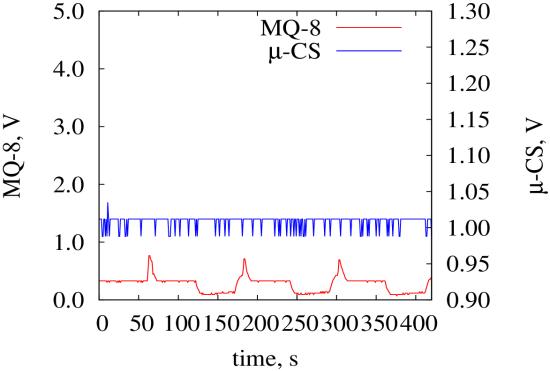
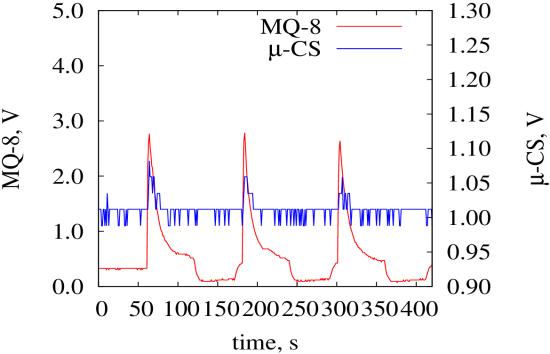
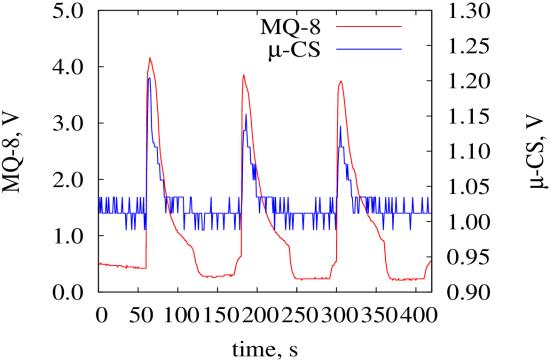
Figure 2 shows the measurement system developed for the tests. The device was shaped like a small tunnel. One endwasopen,andtheotherendwasequippedwithafan to vent gases from inside the tunnel to the outside. The tunnel was made of thin steel plate. A μ-CS sensor and an MQ-8 sensor were mounted side by side on the ceiling, with their sensing elements protruding into the tunnel. A hole was drilled at the bottom of the tunnel to inject hydrogen with a syringe. Three hydrogen concentrations 0.1%,1%, and3% were tested. In each case, a cycle consisted of hydrogen injection, the start of ventilation, and the end of ventilation. Each cycle lasted for 120 seconds. Hydrogen was injected rapidly at the beginning of the cycle, and ventilation started at 60 seconds and stopped at 110 seconds. A total of 20 mL of hydrogen was injected in 0.5 seconds. The cycle was repeatedthreetimes,withthefirstcyclestartingatt=60 s.
Hydrogen leak experiments were conducted with drone operation to clarify the feasibility of hydrogen sensing by the proposed system. The ambient pressure and temperature during the experiment were 1 atm and 20 degrees Celsius, respectively. The leak source was a circular slot with a diameter of 1 cm made on the top surface of an aluminum cube with a volume of 5 cubic centimeters. This cube was placed on the floor. After starting propeller rotation, 100 vol.% hydrogen was released from it with a leak flow rate of 5 L/min for 15 s. Hydrogen was supplied from a high-pressure hydrogen tankthroughadigitalmassflowmeter.Thetimingsofthe startandendofthehydrogenleakwerecontrolledbyaPC. Becauseofthetubelength,thetimingsofthestartandend ofthehydrogenleakattheleaksourcedifferedfromthose of the control signals sent from the PC. In this study, the leak start and end corresponded to hydrogen leaking out from the aforementioned circular slot, and the timings were inferred by considering the delay time for sending control signals from the PC. The drone with a hydrogen sensor was placed 50 cm above the floor. Hydrogen dispersion was measured using 16 sensors. Figure 3 showsthesensorlocations.
The configurations considered were attitude angles of 0° (normal attitude), 90°, and 180° (inverted attitude), and various propeller rotations controlled by a transmitter. Table 1 shows the relationship between throttle inclinationandpropellerrotationspeedmeasuredwithan opticaltachometer.Italsoshowstherelationshipbetween throttleinclinationandpropellerjetspeedmeasuredwith apitotprobenearthecenterofrotation,15cmbelowthe propeller. The increase in rotational speed becomes almost saturated above 75% full-throttle (FT) inclination. The accuracy of the results was confirmed by multiple measurements.
Table -1: Relationshipbetweenthrottleinclination, propellerspeed(measuredusinganopticaltachometer), andjetspeed(measuredusingaPitotprobe15cmbelow thepropellernearthecenterofrotation)
Throttle inclination [%] 0 (standby) 25 50 75 100 (fullthrottle)
Rotational speed[rpm] 1618 5371 8203 8679 8834
International Research Journal of Engineering and Technology (IRJET) e-ISSN: 2395-0056
Volume: 12 Issue: 06 | Jun 2025 www.irjet.net p-ISSN: 2395-0072
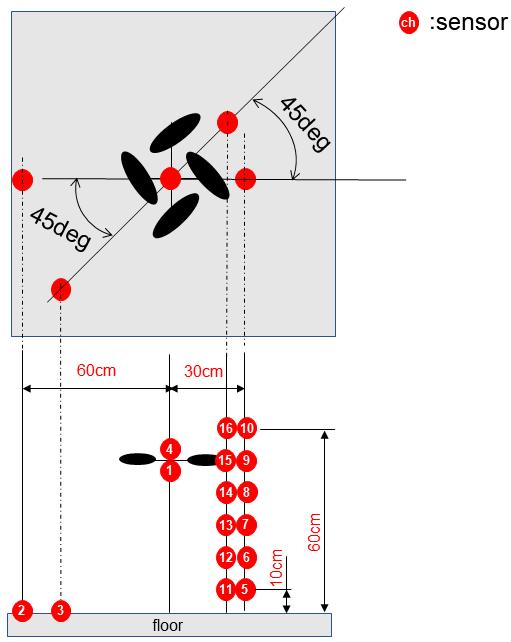
Fig -3: Sensorlocationsforthehydrogenleakexperiment (upper:topview,lower:sideview)
Smoke visualization experiments were conducted to visualizeairflowaroundthedrone.Sincehydrogenitselfis difficultto visualize,airflow wasvisualized instead, based on the assumption that hydrogen behaves as a passive scalar when diluted. Using a fog machine, fog liquid consisting of approximately 45% glycol and 55% water wasevaporatedanddispersedintotheairtocreatealonglastingfinemist.
To clarify the actual path of hydrogen, hydrogen dispersionwasmeasuredwithasensorarrayconsistingof 19 hydrogen sensors. Figure 4 shows the experimental apparatus for the sensor array measurement. Panel (a) shows an overview of the system, including the drone, lattice, and sensors. A drone with an attitude angle of 0° was placed 50 cm above the floor, and sensors were mounted on square bars with a 9 mm × 9 mm cross section,positionedatheightsof10cm,30cm,50cm,and 70 cm from the floor. In Panel (b), red marks indicate hydrogen sensor locations with their numbers, and the blue mark shows the leak source on the floor. The upper andlowerfiguresofPanel(b)showtheside(y–z)andtop (x–y)viewsofthesensorarray.ExceptforthoseonlinesA
and B, sensors are located on a vertical plane passing throughthecenterofthedrone.Threesensorsarelocated on each of lines A and B in the horizontal direction. Onehundred vol.% hydrogen was released from the leak source at a flow rate of 5 L/min for 15 s. The propellers were either on standby or rotating at 50% full throttle (FT).
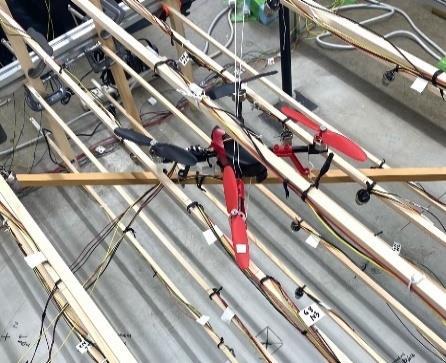
Drone,latticeandsensors
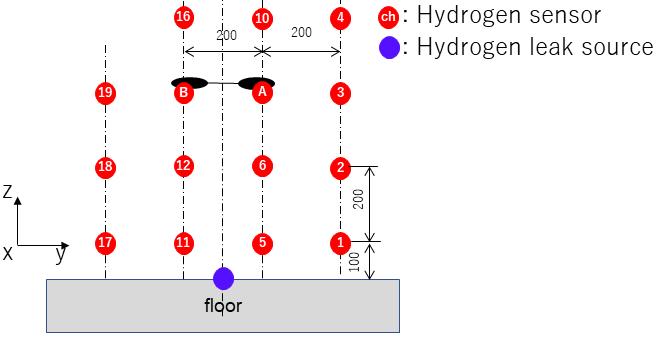
(i) Side (y–z) view (Three sensors are located on linesAandB.)
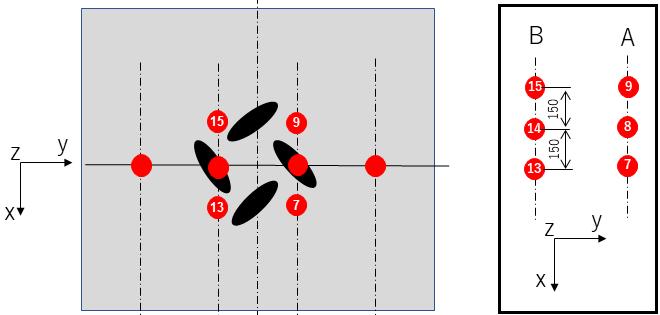
(ii) Top(x–y)view
(b)Hydrogensensorlocations Fig -4:Experimentalapparatusforthesensorarray measurement
International Research Journal of Engineering and Technology (IRJET) e-ISSN: 2395-0056
Volume: 12 Issue: 06 | Jun 2025 www.irjet.net p-ISSN: 2395-0072
To explore the specifics of hydrogen transport from the leak source to the drone, computational fluid dynamics (CFD) analyses were performed on the hydrogen-air mixture flows surrounding the drone, which was positioned in a normal attitude. Different propeller jet speeds were simulated to evaluate how they affect the behaviorofhydrogenemittedfromtheleaksource.Figure 5 depicts the computational mesh. The computational system comprises a quadrotor drone with four propellers and a central body, along with a leak source. These components were modeled as objects within the backgroundspace.
Unsteady turbulent flow simulations were carried out using Fire Dynamics Simulator (FDS) Version 6.7.7 [28]. ThissoftwareisbasedonCartesianmeshesandsolvesthe continuity equation, the compressible Navier-Stokes equations with gravitational force, the energy equation, and the transport equation for the mass fraction of hydrogen. Gasspecies diffuseaccording to Fick'slaw,and the ideal gas law is assumed to close the system of equations.
In the governing equations, the low Mach number assumption filters out acoustic waves while allowing for significant variations in temperature and density. To improve computational stability and account for subgridscale turbulent flow effects, a Smagorinsky-type model [29]isemployed.Furthernumericaldetailsareoutlinedin thesoftware'sreferencemanual.
Inthecurrentstudy,thetimeincrement(Δt)wasnotkept constant and was instead adjusted to maintain the Courant-Friedriches-Lewy(CFL)numberwithintherange of0.8to1.0.TheCFLnumberisdefinedas:
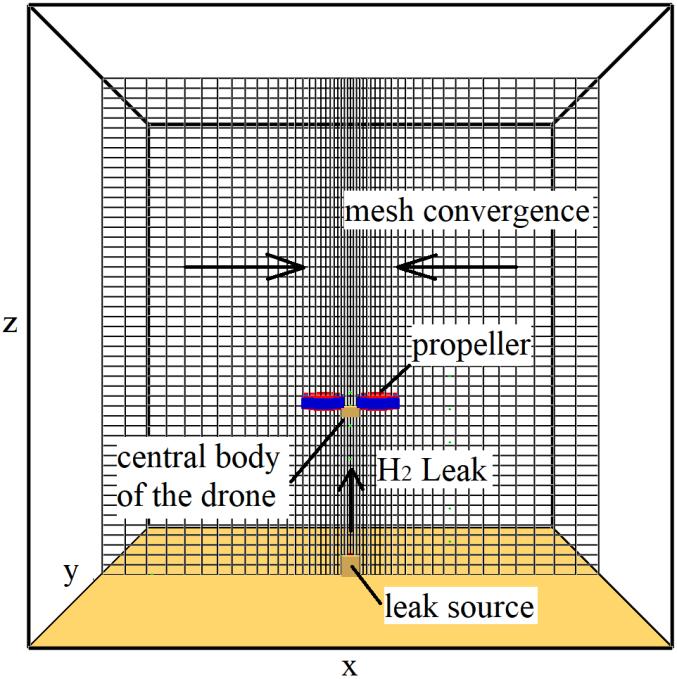
Fig -5: Computational mesh. The mesh distribution is uniforminthe y direction.Thecenteroftheleaksourceis at(x, y)=(0,0).
where u, v,and w representthe x, y,and z componentsofa velocity vector, respectively. This adjustment of Δt was necessary to ensure the numerical stability and accuracy of the simulations. In this study, the minimum Δt was approximately0.0012seconds,whilethemaximum Δt was around0.039seconds.
The current version of Fire Dynamics Simulator (FDS) used in the study has been successfully validated against experimental data on hydrogen dispersion in a hallway model,thoughtheresultsarenotpresentedhere.
Arotatingpropellersucksingasfromthetopsurfaceand expelsitfromthebottomsurface. Tosimulatetheeffectof propeller rotation in FDS, the thin cylindrical volume swept by the propeller (with a diameter of 135 mm) was approximated using a bundle of micro-square columns fullycontained withinit, in accordancewiththeCartesian mesh method. Gas was drawn in from the top surface of each micro-square column and expelled from the bottom surfacewithaspecifiednormalvelocity Wj,corresponding totherotationalspeedofthepropeller.Eachmicro-square column has a base of 15 mm × 15 mm and a height of 20 mm. Eachpropellerregion waspositionedatthevertices ofahorizontalvirtualsquarewithasidelengthof0.16m, located 0.53 m above the floor. The central body of the drone was placed 30 mm below the center of the above virtual square, represented as a rectangular object measuring 60 mm × 90 mm × 20 mm in the x, y-, and zdirections, respectively. The external dimensions of the computationaldomain(backgroundspace)are1.5m×1.5 m × 1.5 m. The outer part of the leak source is a 50 mm cube,andtheoutletisa10mmsquare.
ThesamemeshdistributionasshowninFig.5wasusedin the y direction. The number of mesh points in each directionis50. Thepolynomialmeshtransformationwas used in the x and y directions to refine the mesh around thedroneandtheleaksource. Themeshwidthshould be kept below approximately 20 mm to compute hydrogen dispersion accurately, as confirmed by comparison with experimentaldataforthehallwaymodel[30].Inthisstudy, the mesh width is 8 mm around the leak source. In the
International Research Journal of Engineering and Technology (IRJET) e-ISSN: 2395-0056
Volume: 12 Issue: 06 | Jun 2025 www.irjet.net p-ISSN: 2395-0072
computations, three jet speed cases were considered for Wj=0.5, 1, and 2 m/s, for both suction and ejection. As shown in Table 1, the 2 m/s case corresponds to a propeller rotation speed of 1600 rpm, i.e., the standby condition. The hydrogen leak rate was 6.3 L/min, similar to the experiments. For the computational sequence, propeller rotation started at t=0 s. The hydrogen leak started at t=30 s and ended at t=45 s. The computation wascontinueduntil t=70s.
(a) 0.1vol.%
(b) 1vol.%
(c) 3vol.%
Fig -6: ResultsofthedynamicresponsetestsfortheMQ-8 and μ-CSsensors
Figure 6 shows the results. Periodic sensor responses were observed. Although both sensors detect hydrogen equally quickly, the MQ-8 sensor recovers more slowly to its baseline (i.e., exhibits a slower monotonic voltage decay), taking approximately one minute. In addition, while the catalytic-combustion-type μ-CS is not optimized todetecthydrogenatconcentrationsbelowapproximately 0.1 vol.%, the MQ-8 sensor responds sensitively to such low concentrations The long recovery time is not a disadvantage, as it maintains a high voltage in the presenceofhydrogenandtherebyincreasesthereliability of detection The distinct characteristics of each sensor providecomplementaryinformation.
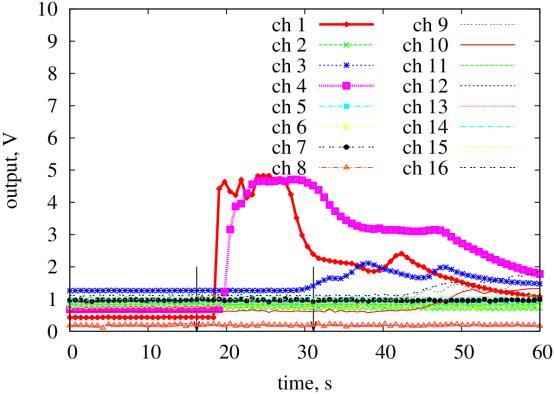
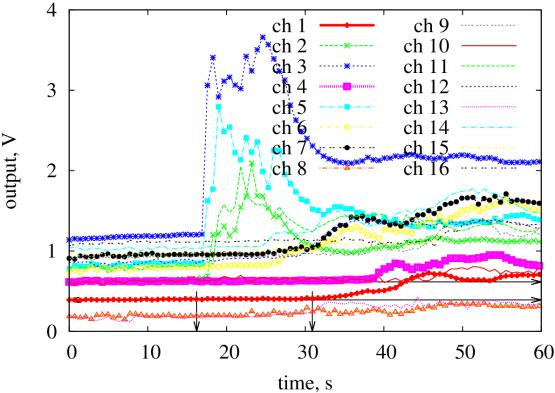
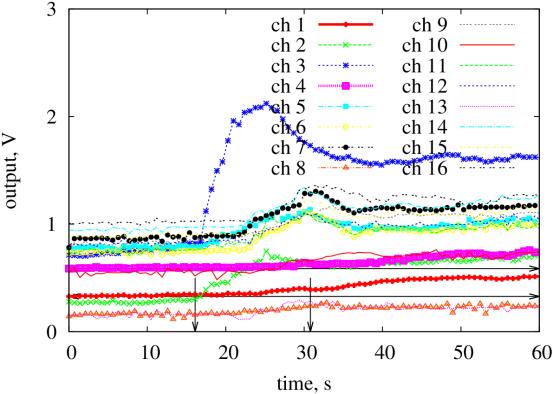
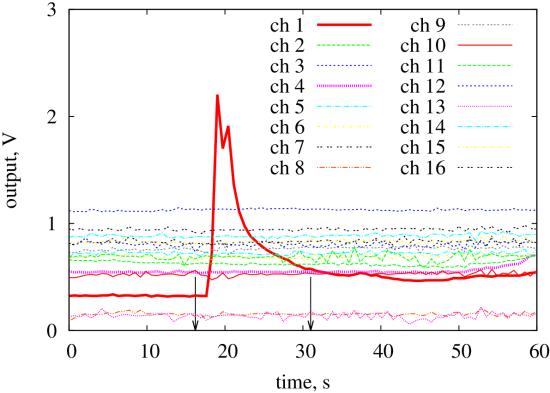
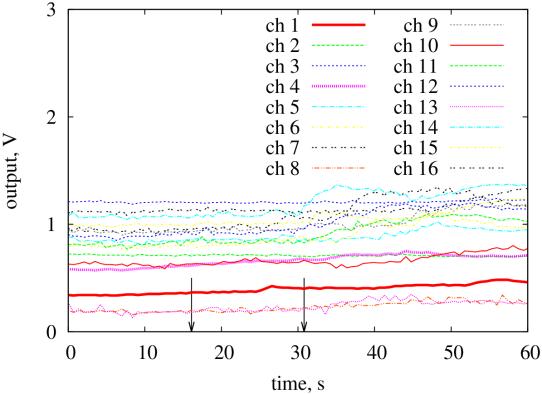
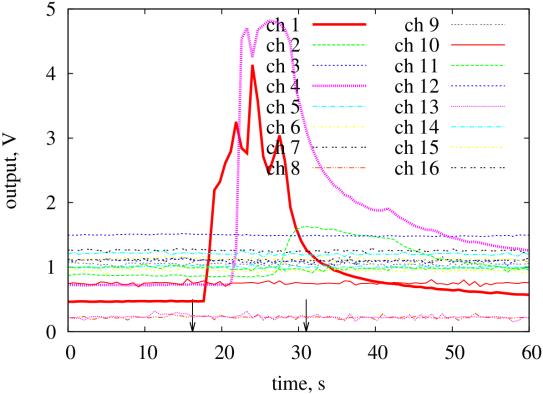
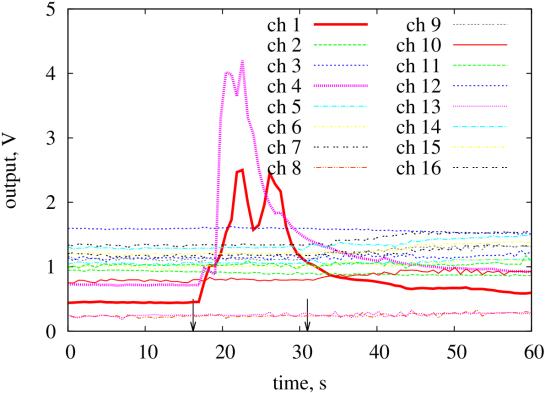
Intheseexperiments,therotationalspeedofthepropeller and the attitude angle of the drone were varied. Figure 7 shows the results at attitude angles of 0°, 90°, and 180°. The two vertical arrows in the figures indicate the start andendofthehydrogenleakattheexitpoint.Eachsensor positionisshowninFig.3.
Panel (a) shows the results for an attitude angle of 0°. Whentherewasnopropellerrotation,hydrogenwasfirst detectedbySensors1and4directlyabovetheleaksource a few seconds after the leak began, and then by Sensor 3 on the floor. When the propeller was in standby mode, hydrogenwasdetectedbySensors2,3,5,and11nearthe floor. About 15 seconds after the leak began, hydrogen was detected by Sensors 6, 7, 12, and 14 at a height of severaltensofcentimetersabovethefloor.Concentrations at Sensors 1 and 4 also began to rise shortly thereafter. Whenthepropellerrotationwassetto50%FT,therisein concentration at the floor surface (Sensors 2 and 3) was slower than in standby mode, while the rise in concentration away from the floor surface, including Sensors 6, 7, 9, 12, 15, and 16, was faster. This is considered to be due to the fact that gas roll-up becomes more dominant than radial dispersion as a result of the higher propeller speed and stronger suction. Concentrations at Sensors 1 and 4 also began to increase shortlyafter.
Panel (b) presentsthe resultsforanattitudeangle of90°. Inthiscase,thedownstreamflowofthepropellerdoesnot impedetheupwardmovementoftheleakinghydrogenjet. As seen from the gradual increase in voltage at most sensor positions, the propeller airflow agitates the hydrogengas,makingiteasiertodetect.
Panel (c) shows the results for an attitude angle of 180°, i.e.,aninvertedorientation.Thearrivalofhydrogenatthe sensors from the leak source is faster than in the 0° case, asindicatedbythesteepincreaseinvoltagesignals.
International Research Journal of Engineering and Technology (IRJET) e-ISSN: 2395-0056
Volume: 12 Issue: 06 | Jun 2025 www.irjet.net p-ISSN: 2395-0072
(ii)
(a) AttitudeAngle:0°
International Research Journal of Engineering and Technology (IRJET) e-ISSN: 2395-0056
Volume: 12 Issue: 06 | Jun 2025 www.irjet.net p-ISSN: 2395-0072
(iii) 50%FT
(b) Attitudeangle:90°
(i) Drone
(ii) Standby
(iii) 50%FT
(c) Attitudeangle:180°
Fig -7: Time histories of sensor output voltages for attitude angles of 0°, 90°, and 180°. “ch” in the legend indicatesthesensornumber.
International Research Journal of Engineering and Technology (IRJET) e-ISSN: 2395-0056
Volume: 12 Issue: 06 | Jun 2025 www.irjet.net p-ISSN: 2395-0072
(a) Attitudeangle:0°
(b) Attitudeangle:90°
(c) Attitudeangle:180°
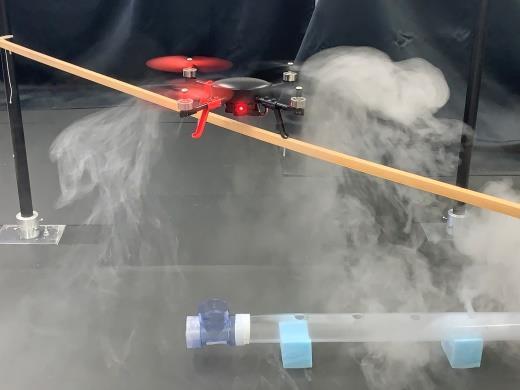
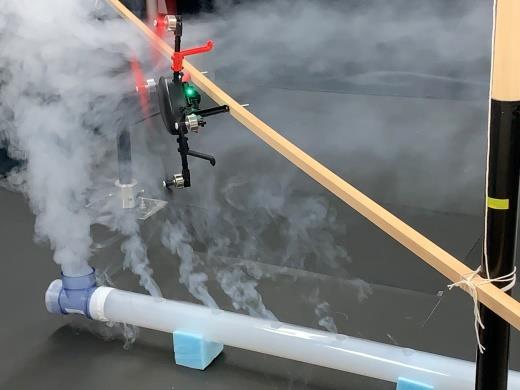
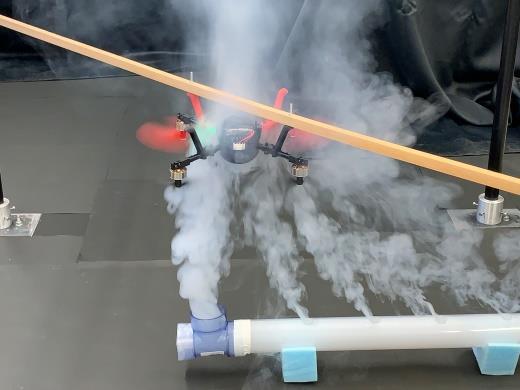
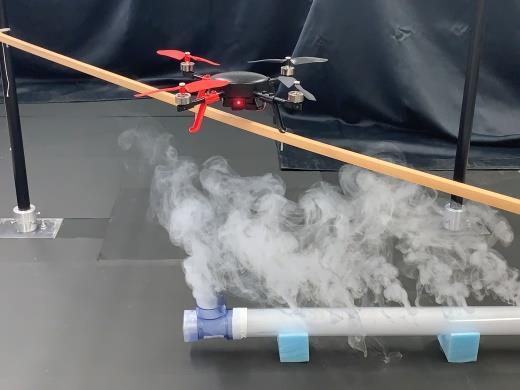
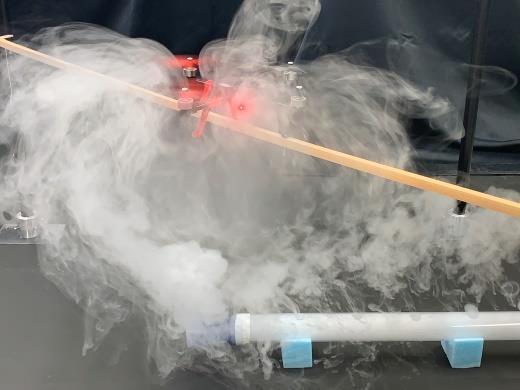
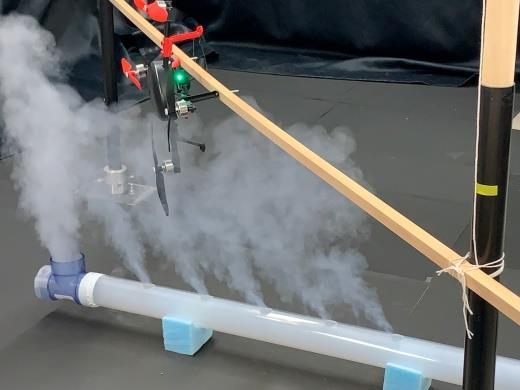
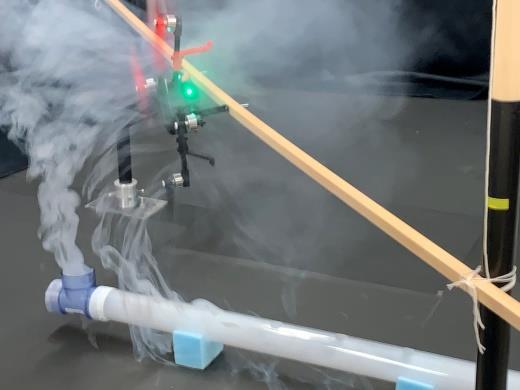
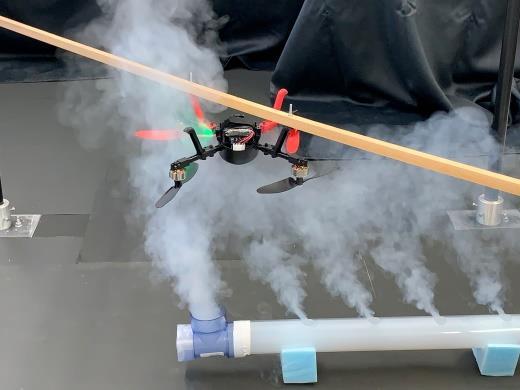
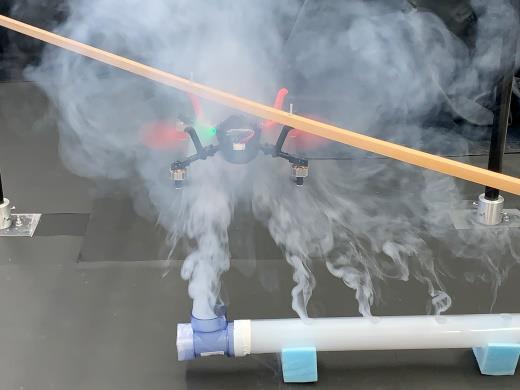
Fig -8: Smokevisualizationofflowsaroundthedroneatvariousattitudeanglesinstandby(timeprogressesfromleftto right).
Figure8showstheflowaroundadroneatvariousattitude angles, as visualized through smoke experiments. Smoke wassuppliedthroughapipewithsmallholes.Toenhance clarity, the smoke emission was stopped after a short period. Panel (a) shows that the smoke from the floor is initially dispersed by the downwash from the propeller, but the suction at the top of the propeller forms a recirculating flow. As shown in panel (b), when the attitudeangleis90°,thepropellerairflowisparalleltothe floor and does not hinder the upward movement of the smoke. As shown in panel (c), when the attitude angle is
180°,thepropellerdrawsinthesmoke,causingittoreach thedronemorequickly.
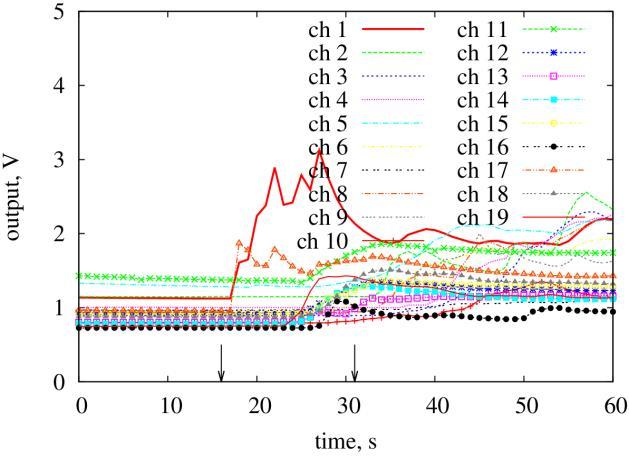
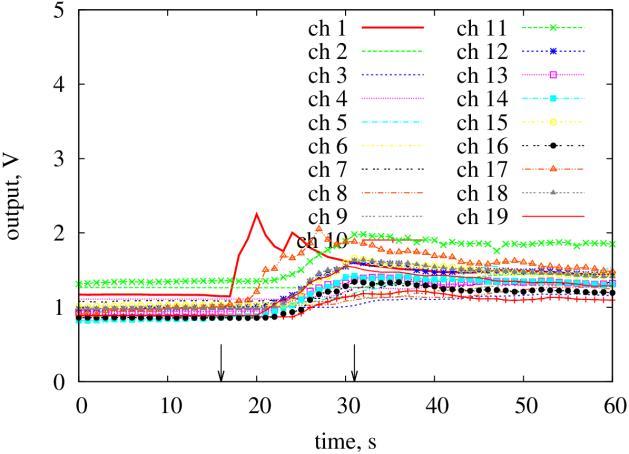
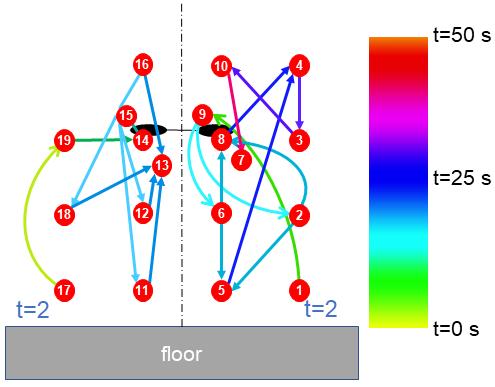
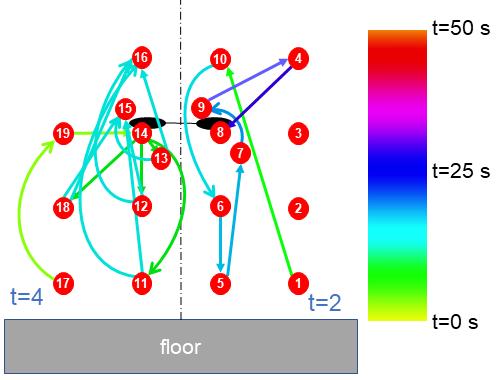
Figure 9 shows the results [31]. Panel (a) presents the time-series data of hydrogen concentrations at each sensor location under standby and 50% FT conditions. Two vertical arrows indicate the start and end of the hydrogen leak. A threshold of 0.01 vol.% (corresponding
International Research Journal of Engineering and Technology (IRJET) e-ISSN: 2395-0056
Volume: 12 Issue: 06 | Jun 2025 www.irjet.net p-ISSN: 2395-0072
toa0.189Vincrease)wasusedtodeterminethehydrogen arrivalateachsensor.
Panel (b) shows the path of hydrogen dispersion constructed based on the sensor data. The order of hydrogen detection isshowninthe directedgraph, which is generally bilaterally symmetric. As shown in Fig. 9(b), hydrogen first arrivesat Sensors 17, 19, and 14, and then diffusestovariousregionsaroundthedrone.Thisorderis clearly resolved by the MQ-8 sensors, which have a responsetimeofabout1second,asshowninSec.2.3.
Hydrogenfromtheleaksourceinitiallyrisestotheregion outside the propeller downwash, then is drawn in and discharged by the propellers. This process is repeated during the proposed continuous hydrogen sensing operation. The results of the sensor array experiment provide the first experimental and direct evidence supporting the mechanism of hydrogen sensing by a quadrotordrone,asproposedinthefinalparagraphofSec. 4.5. This mechanism was originally inferred from smoke visualization and CFD simulations, as discussed later in Sec.4.5.
(a) Timehistoriesofhydrogenconcentrationateach sensor
(b) Pathofhydrogendispersionconstructedbythe sensors
Fig -9: Resultsofthesensorarrayexperiment.
4.5
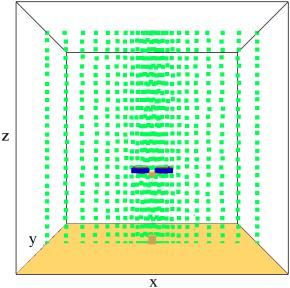
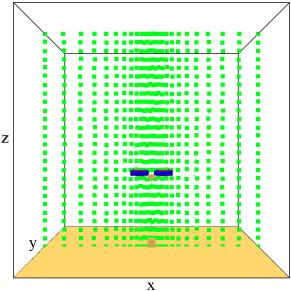
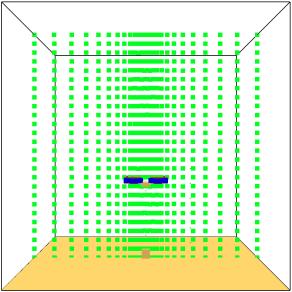
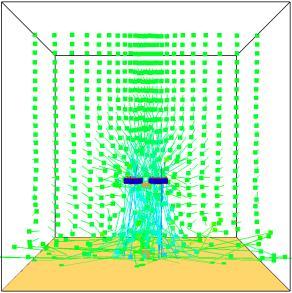
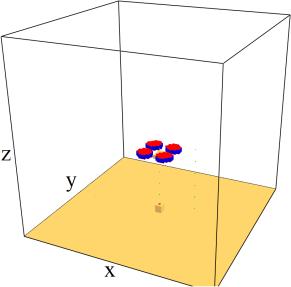
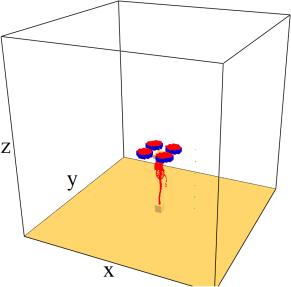
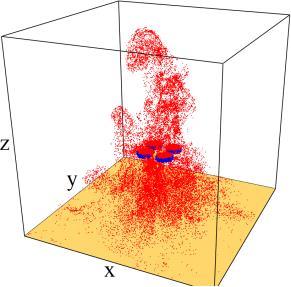
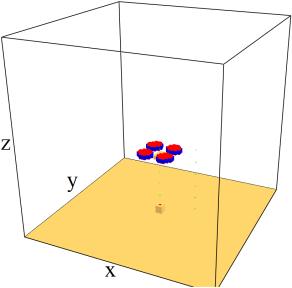
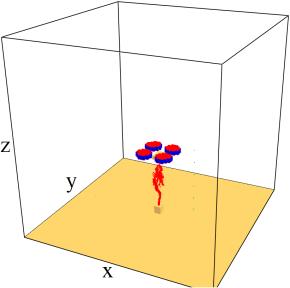
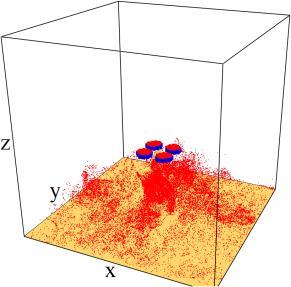
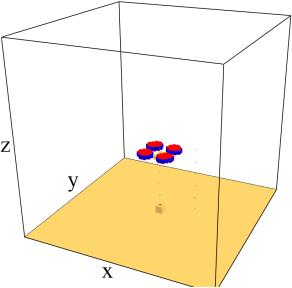
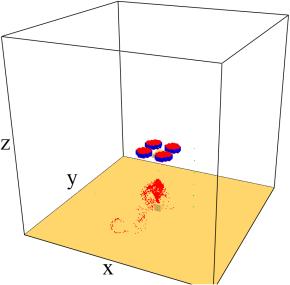
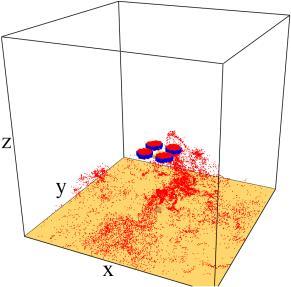
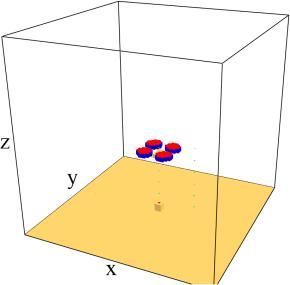
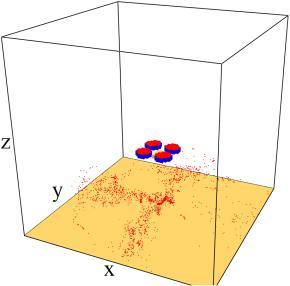
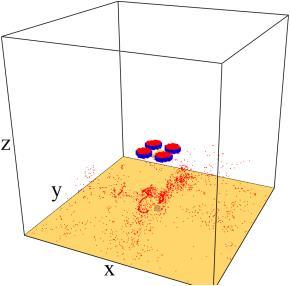
Figure10showsthedistributionofvelocityvectorsand w velocities in the y = 0 plane at t = 0, 31, 45, and 70 s for propeller jet speeds of Wj = 0.5, 1, 2, and 11 m/s, respectively. Figure 11 presents the distribution of masslessparticlesejectedduringthehydrogenleakfrom t =30to45s.
In all cases, downward jets, represented by blue vectors, areemittedfromthepropellers,asshowninFig.10.When Wj=0.5m/s,theleakedhydrogenrisesuptothedrone,as
International Research Journal of Engineering and Technology (IRJET) e-ISSN: 2395-0056
Volume: 12 Issue: 06 | Jun 2025 www.irjet.net p-ISSN: 2395-0072
indicated by the orange velocity vectors above the leak source near x = 0 in Fig. 10, and also by the massless particlesascendingbeyondthedroneinFig.11.
At Wj =1m/s,thehydrogenrisesfromtheleaksourcebut does not ascend significantly beyond the drone height, as it is suppressed by the propeller-induced airflow, as seen inFig.11. When Wj=2m/s,theleakedhydrogeninitially
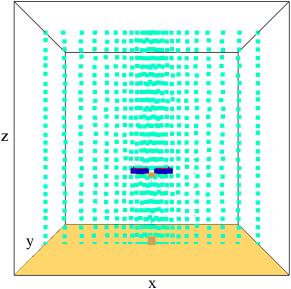
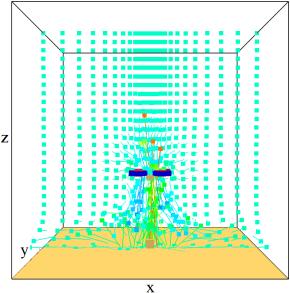
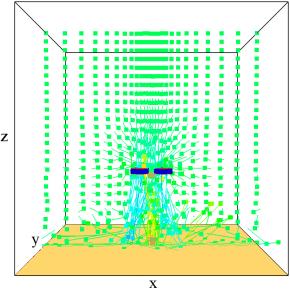
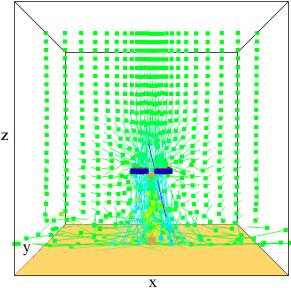
risesonlyneartheleaksourceandthendispersesradially due to strong downward jets from the propeller. It is subsequentlydrawnintothepropellersbystrongsuction. At Wj = 11 m/s, the hydrogen disperses in the radial directionwithminimalverticalrisebecauseoftheintense downward jets. It is then rapidly entrained by the propeller-inducedsuction.
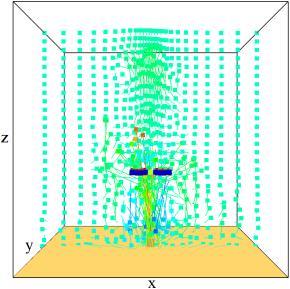
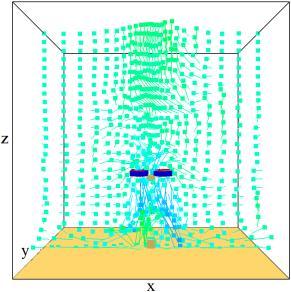
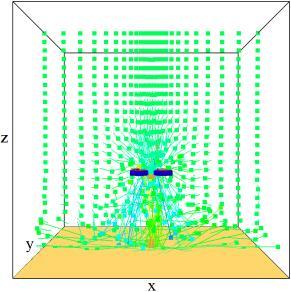
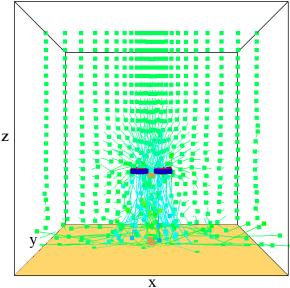
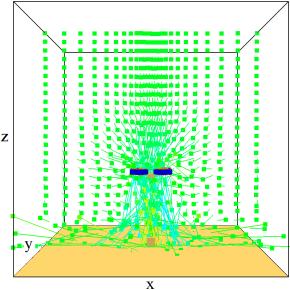
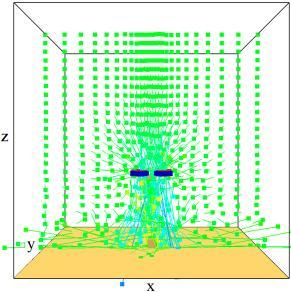
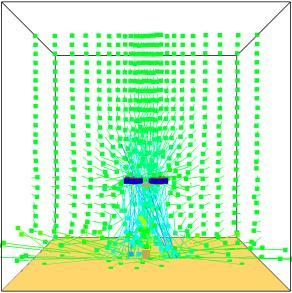
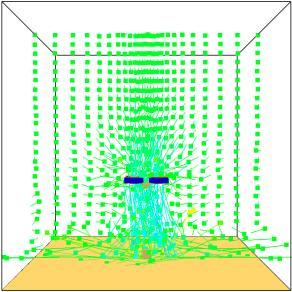
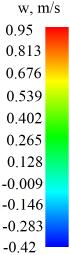
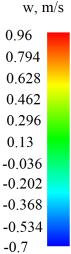
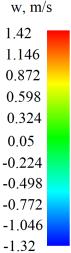
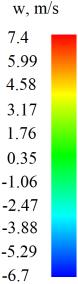
Fig -10:Distributionofvelocityvectorsand w-velocitiesintheplaneof y=0at t=0,31,45,and70s(fromlefttoright)for Wj=0.5,1,2,and11m/s,respectively.Thecolorsrepresentthe w-velocity,andthearrowsrepresentthevelocityvectors.
International Research Journal of Engineering and Technology (IRJET) e-ISSN: 2395-0056
Volume: 12 Issue: 06 | Jun 2025 www.irjet.net p-ISSN: 2395-0072
Wj=0.5m/s
Wj=1m/s
(c) Wj=2m/s
(d) Wj=11m/s
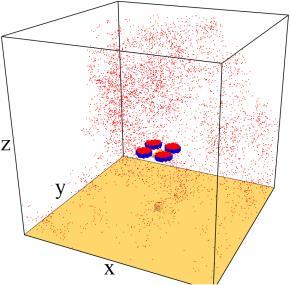
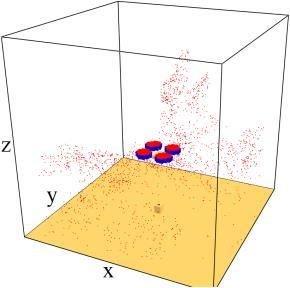
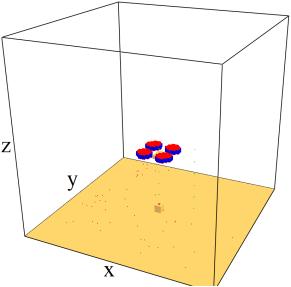
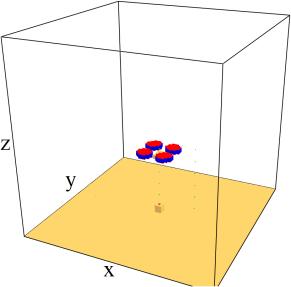
Fig -11:Distributionofmasslessparticlesejectedbetween t=30and45sassociatedwiththehydrogenleakfor Wj =0.5,1, 2,and11m/s,respectively.Thefiguresshowsnapshotsat t=0,31,45,and70sfromlefttoright.
Although not shown in figures, the following findings are obtained from the time histories of hydrogen mass concentrations measured at heights z=0.05–0.55 m at the leak center. When Wj = 0.5 m/s, hydrogen concentrations becomehighatallsensorlocationsafterapproximately t = 30 s, indicating that buoyant hydrogen jets from the leak source directly reach the drone. At Wj=2 m/s, hydrogen
concentrations decrease with height, and the concentration at z=0.55 m is approximately 10⁻¹² times smaller than that at z=0.05 m, indicating that buoyant hydrogen jets do not directly rise to that height. The case of Wj=1 m/s represents an intermediate condition between Wj=0.5and2m/s.
International Research Journal of Engineering and Technology (IRJET) e-ISSN: 2395-0056
Volume: 12 Issue: 06 | Jun 2025 www.irjet.net p-ISSN: 2395-0072
As these results demonstrate, when the propeller airflow isweak,hydrogenfromtheleaksourcecanriseagainstit. However, when the propeller airflow is strong, hydrogen initially rises from the leak source but is pushed downward by the propeller downwash. The hydrogen then moves outside the downwash region and rises again toward the drone,carried bythe circulating flows formed around the propellers. This transition point corresponds approximately to the propeller airflow velocity when the droneisinthestandbycondition.Theseresultsagreewith theexperimentalresultsmentionedinSecs.4.2–4.4.
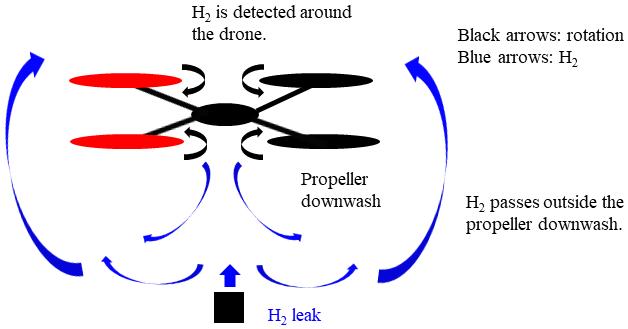
Fig -12: Proposedmechanismofcontinuoushydrogen sensingwithaquadrotordrone.
Figure 12 shows a schematic diagram of the continuous hydrogen sensing mechanism proposed in this study, based on experimental and computational investigations. This circulation is robust because suction and discharge alwaysaccompanythepropellerthrust,andthereliability of hydrogen sensing is enhanced by the flow circulation and hydrogen accumulation within the MQ-8 sensor, which has a long recovery time. Therefore, the present system offers a robust sensing mechanism and enhances hydrogen detection. This mechanism remains effective even with slight changes in the leak source location or dronealtitude,asitentrainsambientgas.Afuturetopicis to investigate how much ambient gas is entrained during cruising, as opposed to hovering (as in this study), or underwindyconditions,asinoutdoorenvironments.
A hydrogen sensing system equipped with a compact semiconductorhydrogensensoronadronewasstudiedto investigate the mechanism by which it detects leaked hydrogen. Specifically, dynamic response tests, hydrogen leakage experiments, smoke visualizations, sensor array experiments, and CFD analyses were conducted to clarify thepathwaysthroughwhichhydrogenfromaleaksource reachesthedrone.
1. The dynamic response tests demonstrated that both the MQ-8 and μ-CS sensors can detect hydrogenrapidly.Althoughthetwosensorsdiffer
inrecoverytime,thischaracteristiccanbeutilized to provide complementary advantages within the sensingsystem.
2. In the hydrogen leak experiments, hydrogen was detected by the drone despite the strong downwash generated by the propellers, under bothstandbyand50%full-thrust(FT)conditions.
3. When the drone’s attitude angle is 0°, hydrogen from the leak source rises directly to the drone whenthepropellerjetvelocityislow.However,at high jet velocity, the hydrogen initially rises slightly, is pushed downward by the downwash, andthenascends again alonga recirculating flow formed around the propeller. This indicates a morphological transition in the hydrogen transport pathway. At an attitude angle of 180°, hydrogen reachesthe drone morequicklythanat 0°.
4. Theprobabilityofhydrogendetectionisenhanced by the flow circulation, hydrogen accumulation around the MQ-8 sensor, and the sensor’s long recovery time, as the propeller thrust continuously induces both suction and discharge flows. As a result, the system provides a robust detectionmechanismandimprovesthe reliability ofhydrogensensing.
This study was supported by the Ministry of Education, Culture,Sports,ScienceandTechnology(MEXT)througha Grant-in-Aid for Scientific Research (C) (No. 15K04759, 2015). The author thanks Prof. Masahiro Inoue, formerly of the Department of Earth Resources Engineering, Kyushu University, for providing the opportunity to conduct hydrogen leak experiments in the early stages of this study. The author also expresses sincere gratitude to Mr.TomoakiIwamiandMr.KengoSuzukiofNewCosmos Electric Co., Ltd. for providing the μ-CS sensors; to Mr. Nozomu Izawa and Mr. Takafumi Suga, former graduate students at Ehime University, for their cooperation in conducting experiments; and to Dr. Jason Floyd of Jensen Hughes in Rockville, Maryland, for visualizing hydrogen dispersionusingmasslessparticlesinFDS.
[1]IEA, Global Hydrogen Review 2024, https://www.iea.org/reports/global-hydrogen-review2024
[2] H. Ninomiya, et al., “Development of hydrogen gas detection techniques,” Proc. of the 24th laser sensing symposium,pp.51-52(2005)
International Research Journal of Engineering and Technology (IRJET) e-ISSN: 2395-0056
Volume: 12 Issue: 06 | Jun 2025 www.irjet.net p-ISSN: 2395-0072
[3] H. Fukuoka, et al., “Gas concentration measurement usingultrasonic,”IEICETechnicalReport,vol.112,no.387, pp.7-12(2013)
[4]T.Hiramatsu,etal.,“Thespecificheatratioofhydrogen and helium measured using ultrasonic wave,” IEICE Tech. Rep.,vol.113,no.439,pp.75–79(2014).
[5] Y. Kato and M. Inoue, “Hydrogen sensing using ultrasound: Gas concentration absolute and non-contact measurement,” Hydrogen Energy Syst., vol. 43, no. 3, pp. 1–8(2018).(inJapanese)
[6] J. Burgués and S. Marco, “Environmental chemical sensing using small drones: A review,” Sci. Total Environ., vol.748,141172,pp.1–20(2020).
[7] G. Dutta and P. Goswami, “Application of drone in agriculture: A review,” Int. J. Chem. Stud., vol. SP-8, no. 5, pp.181–187(2020).
[8] M. P. Stewart and S. T. Martin, “Atmospheric chemical sensing by unmanned aerial vehicles,” Unmanned Aerial Vehicles, N. Barrera, Ed. Nova Science Publishers, ch. 2 (2020)
[9] J. Jorńca, et al., “Drone-assisted monitoring of atmospheric pollution – A comprehensive review,” Sustainability,vol.14,11516,pp.1-31(2022).
[10]A.Francis,etal.,“Gassourcelocalizationandmapping with mobile robots: A review,” J. Field Robot., vol. 39, pp. 1341–1373(2022)
[11] S. Zerafa, “Revolutionising agriculture: A comprehensive review of remote sensing techniques utilizing drones,” Proc. 27th PARIS Int. Conf. Advances in Agricultural,Biological&EnvironmentalSciences(AABES23),Paris,France,Apr.2023.
[12] S. Borazjani, et al., “A review of UAV swarm-based detection of a dynamic contamination plume,” Proc. 25th Int.Congr.Model.Simul.,Darwin,Australia,pp.1–7(2023).
[13] D. B. Marin, et al., “State of the art and future perspectives of atmospheric chemical sensing using unmanned aerial vehicles: A bibliometric analysis,” Sensors, vol. 23, 8384, pp. 1–17 (2023) https://doi.org/10.3390/s23208384
[14]P.Kokate,etal.,“Reviewondrone-assistedair-quality monitoring systems,” Drones Veh. Auton., vol. 1, no. 1, 10005,pp.1-12(2025).
[15]M.Bartholmaiand P.Neumann,“Micro-droneforgas measurementinhazardousscenariosviaremotesensing,” inProc.6thWSEASInt.Conf.RemoteSens.(REMOTE’10), IwatePrefecturalUniv.,Japan,pp.1–4(2010)
[16] P. P. Neumann, “Dissertation,” Fachbereich Mathematik und Informatik, Freie Universität Berlin (2013)
[17] M. Rossi, et al., “Gas-drone: Portable gas sensing system on UAVs for gas leakage localization,” Proc. IEEE Sensors,pp.1–4(2014).
[18] H. M. Fahad, et al., “Room temperature multiplexed gas sensing using chemical-sensitive 3.5-nm-thin silicon transistors,” Sci. Adv., vol. 3, no. 3, e1602557, pp. 1–8 (2017)
[19]BorealLaser,“UAV-basedgasdetector.”
http://www.boreal-laser.com/products/uav-based-gasdetector/
[20] SPH Engineering, “Hyperspectral cameras and drones:Apracticalguide.”
https://www.sphengineering.com/news/hyperspectralcameras-and-drones-a-practical-guide
[21] MFE Inspection Solutions, “Gas detection drone.” https://mfe-is.com/gas-detection-drone/#1
[22] K. Matsuura, et al., “Wireless high-speed continuous sensingofhydrogenleakbyaquadrotordrone,”Proc.3rd Int. Hydrogen Tech. Cong. (IHTEC-2018), Mar. 15–18, pp. 1–3(2018).
[23] K. Matsuura, N. Izawa, and M. Inoue, “Mechanism of continuoushydrogensensingbyaquadrotordrone,”Proc. 15thInt.Conf.HeatTransfer,FluidMech.,Thermodyn.,Jul. 25–28,pp.1–6(2021)
[24] K. Matsuura, et al., “Continuous sensing of a leaked hydrogen by a quadrotor drone,” Book of Abstracts, HypothesisXVI,Nov.8–10,pp.44–47(2021).
[25]A.Szczurek,D.Gonstał,andM.Maciejewska,“Thegas sensing drone with the lowered and lifted measurement platform,” Sensors, vol. 23, 1253, pp. 1–23 (2023) https://doi.org/10.3390/s23031253
[26] F. Marturano, et al., “Numerical fluid dynamics simulation for drones’ chemical detection,” Drones, vol. 5, 69.pp.1-14(2021).
https://doi.org/10.3390/drones5030069
[27]T.Hübert,etal.,“Hydrogensensors–Areview,”Sens. ActuatorsBChem.,vol.157,no.2,pp.329–352(2011).
[28] K. McGrattan, et al., “Fire dynamics simulator, technicalreferenceguide.Volume1:Mathematicalmodel,” Nat.Inst.Stand.Technol.(NIST)Spec.Publ.1018-1,6thed., Nov.2021.
2025, IRJET | Impact Factor value: 8.315 | ISO 9001:2008 Certified Journal | Page972
International Research Journal of Engineering and Technology (IRJET) e-ISSN: 2395-0056
Volume: 12 Issue: 06 | Jun 2025 www.irjet.net p-ISSN: 2395-0072
[29]J.Smagorinsky,“Generalcirculationexperimentswith the primitive equations. I. The basic experiment,” Mon. WeatherRev.,vol.91,no.3,pp.99–164(1963)
[30]K.Matsuura,“Effectsofthegeometricalconfiguration of a ventilation system on leaking hydrogen dispersion andaccumulation,”Int.J.HydrogenEnergy,vol.34,no.24, pp.9869–9878(2009).
[31] T. Suga and K. Matsuura, “Toward the continuous sensing of leaked hydrogen by a quadrotor drone,” Proc. 23rd World Hydrogen Energy Conf., Istanbul, Jun. 26–30, pp.1–4(2022)
BIOGRAPHY

Dr.KazuoMatsuuraisaprofessorin the Faculty of Informatics at Matsuyama University in Matsuyama, Ehime, Japan. He obtained a PhD in 2005 from the University of Tokyo in Japan, specializinginthermo-fluidflows.In 2008, he worked as a postdoctoral fellow at NASA Ames Research Center and later at the Center for Turbulence Research at Stanford University. His research interests includeturbulencetheory,hydrogen safety, computational turbulence modeling such as Large-Eddy Simulation (LES) and Direct Numerical Simulation (DNS), and aeroacoustics.