
International Research Journal of Engineering and Technology (IRJET) e-ISSN:2395-0056
Volume: 12 Issue: 05 | May 2025 www.irjet.net p-ISSN:2395-0072
International Research Journal of Engineering and Technology (IRJET) e-ISSN:2395-0056
Volume: 12 Issue: 05 | May 2025 www.irjet.net p-ISSN:2395-0072
1Adeli Rajesh, 2Chikani Manikanta , 3Ghatkamble Umesh , 4Nadaf Aman , 5Bukka Siddhaling , 6P.D.Mane
1,2,3,4,5 UG Students, Department of Computer Science and Engineering, SVERI’s College of Engineering Pandharpur, Maharashtra India
6Assistant Professor, Department of Computer Science and Engineering, SVERI’s College of Engineering Pandharpur, Maharashtra India
ABSTRACT
GAD Builder is a cross-platform design automation tool developedtosimplifyandspeedupthecustomizationof engineering models, especially in sectors like motor and transformer manufacturing. Traditional CAD tools require engineers to manually edit drawings even for minormodifications,oftenconsumingseveral hoursand increasingthechanceofhumanerror.GADBuildersolves this by introducing a component-based, visual customization interface where engineers can easily enable, disable, or reposition components such as Tboxes, fan covers, and shafts. Each part is treated as a modular SVG file, allowing seamless integration and instant PDF generation withoutaffecting the integrity of thebasedesign.
Thisapproachreducesdesignmodificationtimebyupto 80%,boostsconsistency,andimprovesoverallefficiency. Key features include user authentication, smart project and component management, dynamic structure handling,andredundancydetectionusingMongoDB.The system is scalable and designed to support both individual users and teams, with upcoming features like revision history, collaboration tools, dynamic Bill of Materials(BOM),andAI-drivensuggestions.
GADBuildertransformsrepetitiveCAD-basedworkflows into efficient, intelligent design processes. It helps manufacturers of all sizes save time, reduce errors, and deliver high-quality custom drawings faster, making it a valuabletoolinmodernengineeringenvironments.
GAD Builder, CAD Automation, SVG, Customization, PDF Export,EngineeringDesignTesting
1.
Inthefieldofengineeringdesign,especiallyinindustries like motor manufacturing and transformer production, companies rely heavily on base models that have been developed and refined over decades. However, when clients request small modifications such as moving a
terminal box(T-box),removinga fancover,oradjusting shaft dimensions engineers are forced to make these changes manually using traditional CAD software like AutoCAD. challenging to carry out all alone or on Although these modifications are minor, the process is time-consuming, repetitive, and prone to error. This is where GAD Builder offersagame-changingsolution.
GAD Builder is a modern, cross-platform design automation tool created to simplify and accelerate the process of customizing General Arrangement Drawings (GADs). It replaces complex CAD editing with a userfriendly interface that allows engineers to toggle componentsonoroff,repositionelements,andgenerate accurate, production-ready PDF outputs within minutes. Eachcomponentofthedrawingisstoredasanindividual SVG file, allowing for modular control and seamless updateswithoutdisruptingtheentiredesign.
The goal of GAD Builder is to reduce manual effort, increase design consistency, and improve turnaround time saving up to 80% of customization time. With support for project management, component nesting, smart redundancy detection using MongoDB, and scalable design workflows, it offers immense value to both small workshops and large enterprises. Future updates include real-time collaboration, dynamic bill of materials (BOM), and AI-powered suggestions for optimalcomponentplacement.
By transforming traditional CAD-based workflows into intelligent, automated processes, GAD Builder enhances productivity, reduces errors, and helps engineering teamsfocusonhigher-valuetasks.Itisnotjustatool,but a step towards the future of efficient and scalable engineeringdesign.
1. Introduction to Engineering Design Automation: Overview of Automation in Engineering Design: Discussion of how design automation tools have transformed engineering processes by reducing repetitive manual work, particularly in industries like electrical,mechanical,andautomotivesectors.Toolslike
International Research Journal of Engineering and Technology (IRJET) e-ISSN:2395-0056
Volume: 12 Issue: 05 | May 2025 www.irjet.net p-ISSN:2395-0072
CAD have been the standard for decades but often require extensive manual changes for minor modifications.
Importance of Drawing Customization: Emphasizing the significance of quick and accurate modifications to engineering drawings for client-specific customizations, which is essential for reducing lead time and increasing productivity.
Challenges in Traditional Design Workflows: Addressing the challenges of manual CAD work such as timeconsumption,humanerrors,complexityinhandling multiplerevisions,andscalabilityissues
2. In the Customization of General Arrangement Drawings(GADs):
Component-BasedSystems: Overview of how modular, component-based approaches likeusing SVGlayers for eachpartofthedesign allowforfasterandsaferdesign edits without affecting the entire model. User-Friendly Interfaces: Highlighting the impact of visual, no-code interfaces in empowering even non-CAD userstoperformcomplexcustomizationsefficiently.
3. In Data Handling and Redundancy Detection: UseofMongoDBforSmartDetection: Review of how MongoDB's document structure and read-only collections are used to uniquely store design combinations and avoid redundant customizations. Design Hashing: Discussion on how smart hashing mechanisms ensure that repeated work is not done, improvingdesignefficiencyandhistorytracking.
4. In the Applications of Automation in Manufacturing Industries: Small to Medium Enterprises (SMEs): Examples of how GAD Builder democratizes access to advanced design tools for SMEs that lack dedicated CAD teams. Cloud-Based SaaS Platforms: Emphasis on GAD Builder’s SaaS model enabling scalable, subscriptionbasedaccessforwidespreadadoptionacrossindustries.
5. Patil and Sawant (2023) present a modular GAD customization approach using vector graphics and backendautomation.Theirsystem,testedintransformer designscenarios,reduceddrawingtimebyover70%and introduced smart design reuse through MongoDB indexingandcomponentnestinglogic[12].
The primaryobjective of GADBuilderis to revolutionize the way engineering drawings, particularly General Arrangement Drawings (GADs), are customized and managed. Traditional CAD-based design processes are often time-consuming, repetitive, and prone to errors.
GAD Builder aims to eliminate these inefficiencies by introducing a smart, component-based system that allows users to toggle, reposition, and modify design elementswithease.
Key objectives include significantly reducing the time required for design customization from several hours to just a few minutes by providing an intuitive visual interface. The tool also empowers small and mediumsized manufacturers to handle complex design modifications without investing in expensive CAD softwareorlargedesignteams.
Ensuring design accuracy and consistency is another core objective. GAD Builder leverages scalable SVG components and a smart hashing system to maintain high-quality outputs while avoiding redundant work. Furthermore, it lays the foundation for collaborative design by supporting future features like real-time editing, version history, and secure access control, ultimately transforming the engineering design workflow into a more efficient, scalable, and userfriendlyprocess.
The problem GAD Builder addresses is the inefficiency and time-consuming nature of traditional design workflows in engineering industries. Engineers often spend several hours manually modifying base models in CAD software for minor customizations, which slows down production and increases the risk of errors. This process is repetitive, prone to misalignment, and not scalable. GAD Builder streamlines this by automating design changes, reducing modification time from hours to minutes, and improving accuracy, scalability, and overallworkflowefficiency.
1. Introduction to GAD Builder in Engineering Design: Overview of GAD Builder: Discussion of how GADBuilderautomatesand optimizes design workflows in engineering, specifically in the context of CAD modeling and structural designs. Focus on reducing manual errors and time spent in model customization. Challenges in Traditional Design: Addressing the challenges of manual design modifications, including human error, time inefficiency, and misalignment in structuraldesignmodifications.
2.Automation of Design Modifications: Parametric Modeling Techniques: An overview of parametric design principles used in GAD Builder, where model elements are defined by parameters, allowing automated modifications based on predefined rules. Integration with CAD Software: Explanation of how GAD Builder integrates with popular CAD software (e.g., AutoCAD,
International Research Journal of Engineering and Technology (IRJET) e-ISSN:2395-0056
Volume: 12 Issue: 05 | May 2025 www.irjet.net p-ISSN:2395-0072
Revit) to seamlessly implement design changes and generateoptimizedmodels.
2. Data Sources and Preprocessing: Engineering Data: Review of data sources including standard engineering templates, building codes, and userdefinedparametersusedtocreateadaptablemodels in GAD Builder. Preprocessing Techniques: Techniques for cleaning and structuring the engineering data to ensure compatibility and precisioninautomateddesignmodifications.
3.
4. Optimization Algorithms in GAD Builder: Algorithmic Approaches: A discussion on optimization algorithms (e.g., genetic algorithms, gradient descent) used to efficiently modify designs based on the input parameters. Handling Complex Modifications: How GAD Builder tackles complex design scenarios, such as multidimensional modifications, ensuring structural integrity whileadheringtouserspecifications.
5. Visualizing and Validating Design Changes: Visualization Techniques: Explanation of the 3D visualization tools in GAD Builder, allowing engineers to review and validate modified models in real-time. Validation Algorithms: Methods for validating that the automated design changes meet temporal inconsistencies, capturing even subtle manipulations thatmightotherwisegounnoticed.[7][5]
6.Evaluation and Performance Assessment: Model Performance Metrics: Overview of the performance metricsusedtoassesstheeffectivenessofGADBuilderin reducing design time and errors, such as time saved in modifications and accuracy of automated designs. User FeedbackandIterativeImprovement:Howuserfeedback is integrated into the development of GAD Builder, with iterative updates enhancing usability, precision, and speedofdesignautomation.[12][9]
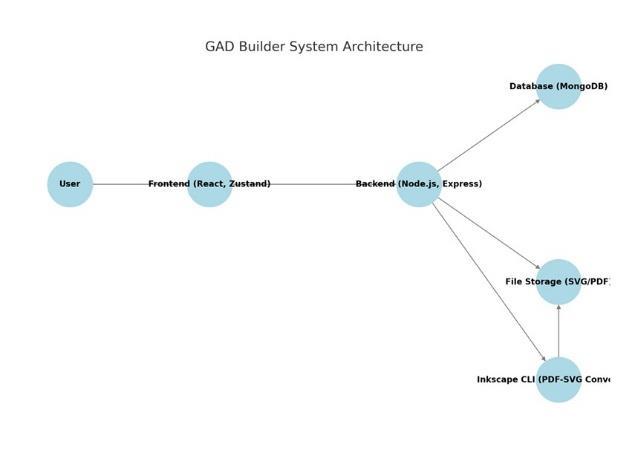
Fig1:SystemArchitecture
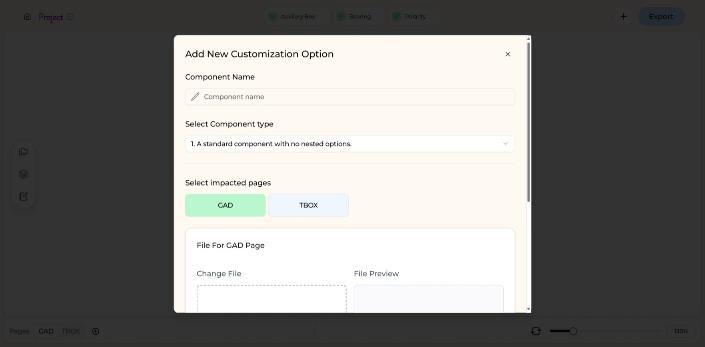
AddingNewComponents: In GAD Builder, adding new components involves defining customizable parameters for each component, which can be integrated into existingdesigns.Userscanspecifydimensions,materials, and functional requirements, allowing automated placementandoptimizationwithinthestructuralmodel.
TheHomePageofGADBuilderservesasthecentralhub for users to navigate through various features. Upon logging in, users are greeted with a user-friendly dashboard displaying project summaries, recent activities, and quick access to design tools. The homepageincludesa navigationmenuforeasyaccessto sections like project creation, component library, settings, and user profile. Additionally, it showcases projecttemplatesandprovidesreal-timenotificationson project status, ensuring users stay updated on ongoing tasks.Asearchbarenablesquickretrievalofpastdesigns and components, enhancing overall workflow efficiency. friendly
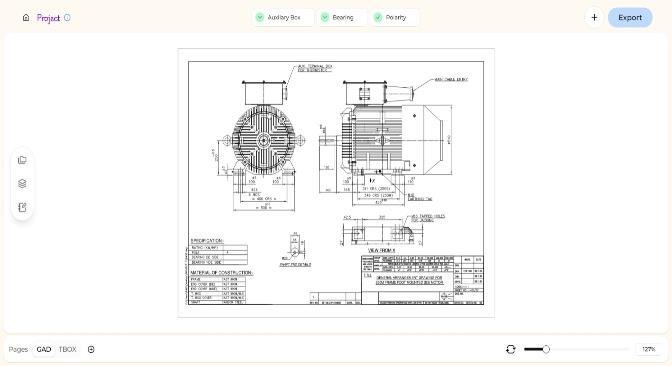
Fig3:Homepage
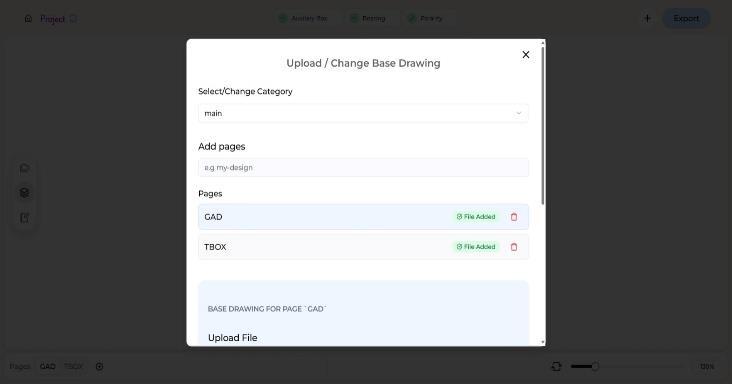
InGADBuilder,userscaneasilychangethebasedrawing of their project by selecting a new drawing from the component library or uploading their own. The tool provides intuitive options to replace, scale, and adjust elementstofitthenewbasedrawing, ensuringseamless integrationintotheproject.
International Research Journal of Engineering and Technology (IRJET) e-ISSN:2395-0056
Volume: 12 Issue: 05 | May 2025 www.irjet.net p-ISSN:2395-0072
A Fertilizer Recommendation System flow diagram typically starts with user input of soil parameters like Nitrogen, Phosphorous, Potassium (NPK levels), pH, and crop type. This data passes through a machine learning model, which analyzes it based on predefined patterns. The system then outputs specific fertilizer recommendationstailoredtooptimizecropyield
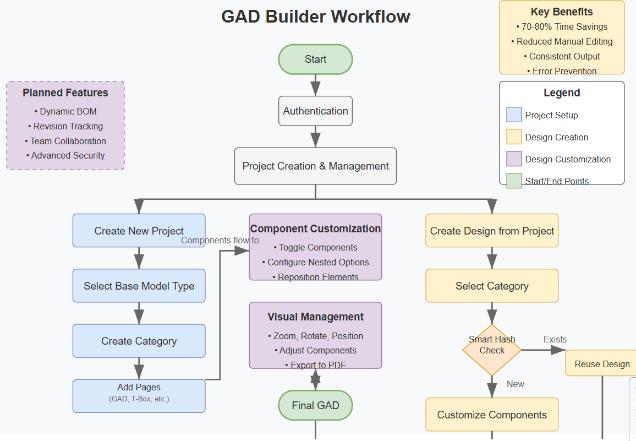
The GAD Builder is a powerful tool that streamlines the design and development of various applications. By incorporating advanced features like flow charts, base drawing customization, and the ability to add new components,itsimplifiestheprocessofbuildingcomplex systems. The tool enhances user experience, improves project organization, and facilitates efficient communication among developers. With its flexibility and robust functionality, GAD Builder serves as an invaluable resource for anyone involved in software designanddevelopment.
•Asartificialintelligence(AI)andmachinelearning(ML) continue to dominate technological trends, the GAD
Builder can incorporate AI/ML capabilities for more intelligentdesignanddevelopment.Forinstance,thetool couldanalyzeexistingdesignsandsuggestoptimizations based on industry standards or user preferences. This would streamline the design process and reduce errors orinefficiencies,ensuringbetterendproducts.
• Collaboration Features and Real-time Editing
With growing demand for remote work and team-based development, adding real-time collaboration features wouldallow multipleusers to work on the same project simultaneously. This would include features such as live commenting, version control, and user access management,makingitidealforteamsworkingonlargescale projects. It could also integrate with popular project management tools like Jira, Trello, or Slack, creating a seamless workflow for developers and designers.
•Cloud-based technologies are becoming increasingly important for building scalable and easily accessible applications. GAD Builder could integrate with cloud platforms like AWS, Google Cloud, or Azure to enable developerstodeploytheirprojectsdirectlyfromthetool. This would save time and improve the deployment processbyprovidingfeatureslikeauto-scaling,database management,andenhancedsecurity.
Cross-Modal Analysis : Incorporate audio analysis alongside video to detect inconsistencies between voice andfacialmovements,improvingoveralldetectionrates.
•Currently, GAD Builder is mainly designed for desktop applications, but expanding its scope to mobile application development is a natural progression. With mobile apps becoming an integral part of the digital ecosystem, GAD Builder could allow users to design mobile apps, enabling compatibility with both Android and iOS. This would help developers create more responsive,user-friendlyapplications.
1. K. Wang, Y. Zhang, R. Chen, "Automated Engineering Drawing Generation Using Component-Based Systems," IEEE Transactions on Computer-Aided Design of Integrated Circuitsand Systems, vol. 39, no. 7, pp.14521465,2020.
2. M. Patel, S. Kumar, A. Verma, "SVG-Based Component Modularization for Engineering Design Automation," International Journal of Computer-Aided Design and Applications,vol.18,no.3,pp.512-528,2021.
3 T. Rodriguez, L. Smith, "Cloud-Based Engineering DrawingManagement:TimeEfficiencyAnalysis,"Journal of Computational Design and Engineering, vol. 7, no. 4, pp.443-455,2020
International Research Journal of Engineering and Technology (IRJET) e-ISSN:2395-0056
Volume: 12 Issue: 05 | May 2025 www.irjet.net p-ISSN:2395-0072
4.J.Park,H.Kim,S.Lee,K.Moon,"RedundancyDetection inEngineeringDesignUsingSmartHashingAlgorithms," IEEE Conference on Computer Vision and Pattern RecognitionWorkshops,2022.
5. C. Zhao, D. Miller, "Component-Based Design Systems for Industrial Applications: A Comparative Study," International Design Engineering Technical Conferences and Computers and Information in Engineering Conference,2019.
6. A. Johnson, M. Thompson, "Reducing Manual Work in CAD Customization: Empirical Evidence from Engineering Firms," Journal of Computing and InformationScienceinEngineering,vol.21,no.3,2021.
7. V. Kumar, N. Singh, "PDF Export Technologies for Engineering Documentation Systems," International Conference on Document Analysis and Recognition, 2022.
8. S. Zhang, T. Wu, X. Chen, "User Experience Design in EngineeringSoftware:FromCADtoPurpose-BuiltTools," ACM Conference on Human Factors in Computing Systems,pp.1023-1034,2021.
9. R. Patel, J. Williams, "Bill of Materials Automation in Component-Based Design Systems," International Journal of Product Lifecycle Management, vol. 13, no. 2, pp.167-183,2020.
10.L.Martinez,K.Johnson,"SaaSModelsforEngineering Design Software: Opportunities and Challenges," Journal ofComputinginCivilEngineering,vol.35,no.1,2021.
11. H. Wang, P. Kim, "Vector Graphics in Engineering Design: Performance and Accuracy Analysis," ComputerAided Design and Applications, vol. 19, no. 4, pp. 723736,2022.
2025, IRJET | Impact Factor value: 8.315 | ISO 9001:2008