
International Research Journal of Engineering and Technology (IRJET) e-ISSN: 2395-0056
Volume: 12 Issue: 11 | Nov 2025 www.irjet.net p-ISSN: 2395-0072
International Research Journal of Engineering and Technology (IRJET) e-ISSN: 2395-0056
Volume: 12 Issue: 11 | Nov 2025 www.irjet.net p-ISSN: 2395-0072
Kamala R1 , Nevitha Teja Choudera2 , Pooja B N3 , Anusha G K4 , Karthik K5
1Assistant Professor, Information Science and Engineering, Bapuji Institute of Engineering and Technology, Davangere, affiliated to VTU Belagavi, Karnataka, India.
2,3,4,5Bachelor of Engineering, Information Science and Engineering, Bapuji Institute of Engineering and Technology, Davangere, affiliated to VTU Belagavi, Karnataka, India.
Abstract - The Bone fractures are among the most frequently encountered orthopedic injuries and require rapid and accurate diagnosis for effective treatment. Conventional radiographic interpretation depends on manual assessment by radiologists, which is time-consuming, subjective, and prone to diagnostic variability, especially in high-workload clinical environments. This paper proposes an automated bone fracture detection system using Convolutional Neural Networks (CNNs) to classify Xray images into fractured and non-fractured categories. The system integrates both a custom CNN architecture and transfer learning models, including ResNet-50, DenseNet-121, and EfficientNetB3, to enhance diagnostic accuracy. Pre-processing steps such as Contrast Limited Adaptive Histogram Equalization (CLAHE), Gaussian filtering, and data augmentation techniques are applied to improve feature extraction and reduce noise.
The implementation is supported by a Flask-based clinical interface enabling secure image upload and real-time prediction for practical usability. The custom CNN model achieved an overall accuracy of 92.5%, demonstrating reliable baseline performance. The EfficientNetB3 transfer learning model outperformed other architectures with an accuracy of 96.2%, sensitivity of 98.7%, and specificity of 94.1% on the test dataset. These results indicate superior fracture localization capability and reduced false-negative rates, which are critical for clinical adoption.
The study highlights that ensemble transfer learning significantly enhances prediction performance when compared to traditional machine learning and standalone CNN approaches. The proposed system reduces radiologist workload, accelerates diagnostic turnaround time, and supports computer-aided diagnosis (CAD) in orthopedic imaging. This research further demonstrates the potential for deployment in resource-limited settings where access to expert radiologists is scarce. Standardized fracture detection, automation of routine evaluation, and an accessible web- based tool contribute to improved healthcare delivery.
Key Words: Bone Fracture Detection, Convolutional Neural Networks (CNN), Transfer Learning, Deep Learning, Medical Image Analysis, Computer-Aided Diagnosis (CAD)
Bonefracturesoccurinmillionsofpeopleworldwideeveryyear,anddiagnosisoftenreliesheavilyonimaging(X-rays,CT scans, or MRIs). Historically, assessing fractures has relied on the expertise of radiologists. Due to heavy dependence on radiologists to assess images and reach a diagnosis, this practice can create a bottleneck in emergency departments or imaging centers. Evidence suggests radiologist error rates can range from 10-25% in detecting fractures (especially in subtle or complicated cases). The availability of radiologists is often limited in developing nations, leading to increased waittimesforpatientsandincreasedmorbidityandmortality.
Artificial Intelligence (AI) and deep learning have improved the capability of medical professionals to analyze medical images, and convolutional neural networks (CNNs) have outperformed humans in many visual pattern detection tasks and have achieved comparable, or better, diagnostic accuracy in various other tasks. Recent literature(20232025) reports that CNNs can detect fractures with 95-99% accuracyacrossdiversedatasets.CNNsbenefit fromtransfer learning, which uses a CNN retrained on the Imagine dataset, dramatically reducing the amount of time and computationalpowerneededtotrainthemodel.
ThisprojectpresentsanautomatedBoneFractureDetectionSystemusingacustomCNNandtransferlearning(ResNet-50, DenseNet-121, and EfficientNetB3) to provide binary classification (fractured/non-fractured) of bone fractures and provide performance metrics for clinical practice. One significant innovative aspect was the inclusion of a simple web application (Flask) to illustrate functional deployment of these data models so that a radiologist could easily use it in practice.
International Research Journal of Engineering and Technology (IRJET) e-ISSN: 2395-0056
Volume: 12 Issue: 11 | Nov 2025 www.irjet.net p-ISSN: 2395-0072
Thepurposeofthisprojectistoaddressthreesignificantgapsinfracturedetectionmethods.Theproposedinnovationis to:(1)automatea relativelymundanedetectionprocess,(2)useastandardizedsetofcriteriatodetectfractures,and(3) deploya diagnostic tool thatiseasilyaccessibleinlowerresourcepractices,or evenindeveloping nationsthat mayhave few,orno,radiologists.
1.1 System Architecture
A. Functional Requirements
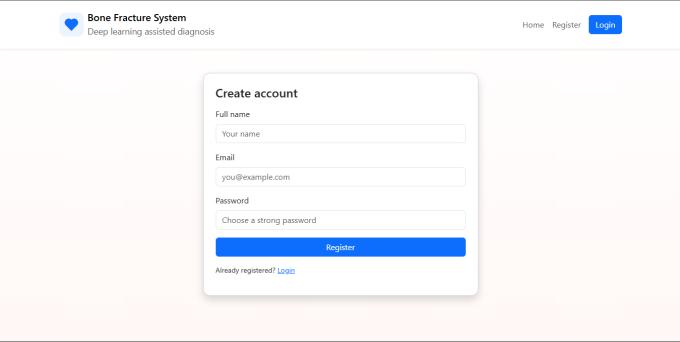
Users (doctor/technician) will be able to register and log into the system. Once authenticated, users can upload X-ray images of bones in supported formats such as .PNG and .JPG. The system will preprocess all uploaded images using a standardizedpipelinebeforesendingthemtothepre-trainedconvolutionalneuralnetworkforprediction.Thesystemwill displaytheoutputaseither “Fractured” or “Normal” alongwithan embeddedconfidencescore.Basicinformationrelated toimageuploadandpredictionwillbestoredinthedatabaseforauditandhistorypurposes.
B. Non-Functional Requirements
The prediction time for a single image should not exceed a few seconds on commonly available hardware. The web interfacemustbesimple,intuitive,andresponsivetoensurea smoothuser experience.Theapplicationanddeeplearning model shouldsupportmodularitytoallowfutureupdatessuchasintegratingadditional models.Basicsecurity measures, includingpasswordhashingandsecurehandlingofuserinputs,shouldbeimplementedtoenhancesystemreliability.
C. Software and Hardware Requirements Programming Language: Python
Libraries: TensorFlow/Keras,OpenCV,NumPy,Pandas,Flask,SQLAlchemy(orequivalent)
Database:SQLite
Hardware:AsystemwithaCPU(andoptionalGPU)capableoftrainingandperforminginferenceonmedicalimagedata.
1.2 Key Technologies used
Convolutional Neural Networks (CNNs) –forautomatedclassificationoffracturedandnon-fracturedX-rayimages..
Transfer Learning Models –includingResNet-50,DenseNet-121,andEfficientNetB3toimproveaccuracyandreduce trainingtime..
Image Pre-processing Techniques – such as CLAHE and Gaussian filtering for contrast enhancement and noise reduction.
Flask Web Framework –usedtodeveloptheclinicalinterfaceforimageuploadandreal-timeprediction.
Tensor Flow/Keras with Open CV and SQLite –formodeldevelopment,imagehandling,anddatabasestorage.
The proposed Bone Fracture Detection System is designed to support clinical decision-making by automating the interpretation of X-rayimagesusing deep learning.The systemintegratesimagepreprocessing,CNN-basedclassification, andauser-friendlywebinterfacetodeliverquickandreliablediagnosticresults.Itsfunctionsfocusonimprovingaccuracy, reducinghumanerror,andenablingaccessibilityinbothwell-equippedandresource-limitedmedicalenvironments.
2.1 Automated Image Classification
The system automatically processes uploaded X-ray images and classifies them as Fractured or Normal using a trained convolutionalneuralnetwork,minimizingmanualassessmentandreducingdiagnosticdelays.
2.2 Standardized Image Pre-Processing
All input images undergo uniform preprocessing steps, including resizing, normalization, CLAHE enhancement, and Gaussianfilteringtoensureconsistentvisualqualityandmodelreliabilityacrossvaryingimageconditions.
2.3 Real-Time Prediction and Output Display
The application provides instant prediction results through the web interface, displaying the diagnosis along with a confidencescore,enablingfastclinicaldecisionsupportinemergencyorhigh-volumesettings.
International Research Journal of Engineering and Technology (IRJET) e-ISSN: 2395-0056
Volume: 12 Issue: 11 | Nov 2025 www.irjet.net p-ISSN: 2395-0072
2.4 User Authentication and Access
Only registered and authenticated users (doctors or technicians) can access the system. Login controls and password hashinghelpprotectpatient-relateddataandpreventunauthorizedusage.
2.5 Integrated Data Storage and History Tracking
Basic information related to image uploads and prediction results is stored in a database, allowing users to review past records,maintainaudittrails,andtrackdiagnosticoutcomesovertime.
2.6 Modular and Scalable System Design
The architecture supports integration of multiple deep learning models for future upgrades, such as improved accuracy, newfracturetypes,ormulti-classclassification,withoutrequiringmajorsystemchanges.
3. Problem Statement
Bone fractures are commonly diagnosed using manual interpretation of X-ray images by radiologists, which is timeconsuming, subjective, and prone to diagnostic errors especially in high-volume or resource-limited clinical environments. Limited availability of radiology experts in developing regions further increases delays in diagnosis and treatment, leading to preventable complications. Existing fracture detection methods lack automation, standardized evaluationcriteria,andpractical deployment forreal-timeuse.Therefore,thereis aneedforanautomated,accurate,and accessible computer-aided diagnostic system capable of detecting bone fractures from X-ray images using deep learning, reducinghumanerror,improvingdiagnosticspeed,andsupportinghealthcaresettingswithlimitedradiologicalexpertise.
3.1 Existing System
Intheexistingfracturedetectionprocess,diagnosisreliesentirelyonmanualinterpretationofX-rayimagesbyradiologists or orthopedic specialists. This approach is slow, subjective, and prone to variability depending on the experience and workload of the clinician. In busy emergency departments, delayed image review increases the risk of missed or late fracturediagnosis,especiallyinsubtleorcomplexcases.Human errorrateshavebeenreportedtorangebetween10–25% inconventional fracture assessments. Additionally, many developing or rural healthcare settings lack sufficient radiology expertise, resultinginlongerwaitingtimesandreduced accesstotimely treatment. Existingcomputer-aidedsystemsare limited, focusing only on specific anatomical regions, lacking real-time deployment, or failing to provide standardized detection criteria. Therefore, current systems are insufficient in delivering fast, consistent, and accessible fracture diagnosisacrossdiverseclinicalenvironments.
The proposed system introduces an automated bone fracturedetection framework using Convolutional Neural Networks (CNNs) to classify X-ray images into fractured and non-fractured categories. The system integrates a custom CNN architecture along with transfer learning models such as ResNet-50, DenseNet-121, and EfficientNetB3 to significantly improve diagnostic accuracy and reduce training complexity. All uploaded X-ray images undergo standardized preprocessing, including CLAHE enhancement, Gaussian filtering, resizing, and normalization, ensuring consistent image quality before prediction. A Flask-based web application enables secure user authentication, image upload, and real-time classification, displaying results with an embedded confidence score. The system also stores prediction history in a databaseforrecord-keepingandauditsupport.Byautomatingthedetectionprocess,reducinghumanerror,andproviding rapid diagnostic feedback, the proposed system offers a reliable computer-aided diagnosis (CAD) tool suitable for deploymentinbothadvancedclinicalfacilitiesandresource-limitedhealthcareenvironments.
The proposed system provides an AI-based solution for automated bone fracture detection using X-ray images. It allows authorized users to upload images, receive predictions from a pre-trained CNN model, and store results for future reference. The system is designed to be fast, reliable, and user-friendly, ensuring seamless operation in clinical settings. Bothsoftwareandhardwarecomponentsarespecifiedtosupportaccurateandefficientmodelperformance.
International Research Journal of Engineering and Technology (IRJET) e-ISSN: 2395-0056
Volume: 12 Issue: 11 | Nov 2025 www.irjet.net p-ISSN: 2395-0072
4.1 Functional Requirements
Userssuchasdoctorsortechnicianswillbeabletoregisterandlogintothesystem.Aftersuccessfulauthentication,users can upload bone X-ray images in supported formats including .PNG and .JPG. The system will automatically preprocess eachuploadedimageusingastandardizedprocedurebeforesendingittothepre-trainedconvolutionalneuralnetworkfor prediction. The output will be displayed as either “Fractured” or “Normal” along with an embedded confidence score. Additionally,thesystemwillstoreessentialinformationrelatedtoeachuploadandpredictioninthedatabaseforauditand historicaltrackingpurposes.
4.2 Non-Functional Requirements
ThepredictiontimeforprocessingasingleX-rayimageshouldnotexceedafewsecondsoncommonlyavailablehardware. Thewebinterfacemustremainsimple,intuitive,andresponsivetoensureasmoothuserexperience.Theapplicationand underlying model should support modularity, allowing future updates such as integration of additional models without major system changes. Basic security practices including password hashing and securing user inputs should be implementedtoenhancesafetyandreliability.
4.3 Software Requirements Programming Language: Python
Libraries: TensorFlow/Keras, OpenCV, NumPy, Pandas, Flask,SQLAlchemy(orequivalent)
Database: SQLite
4.4 Hardware Requirements
A systemwithCPU(andoptionallyGPU)capableoftrainingandinferenceonmedicalimagedata.
5. System Design
5.1 System Architecture
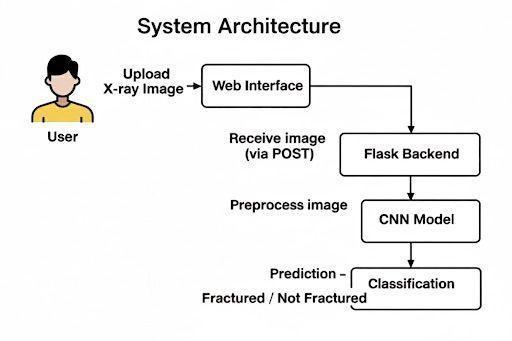
System Architecture for Fracture Diagnosis Approach Using Deep Learning
5.2 Use Case Diagram
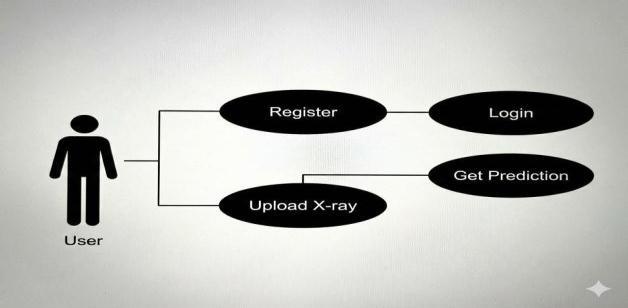
Fig5.2 Use Case Diagram for Fracture Diagnosis Approach Using Deep Learning
International Research Journal of Engineering and Technology (IRJET) e-ISSN: 2395-0056
Volume: 12 Issue: 11 | Nov 2025 www.irjet.net p-ISSN: 2395-0072
Various levels of testing are performed to ensure the reliability and robustness of the system. Unit testing verifies individual functions, including image pre-processing, model loading, and prediction, using both valid and invalid inputs. Integration testing ensures correct interaction among the Flask routes, pre-processing pipeline, CNN model, and database. System testing validates the complete workflow, from user login to image upload and final prediction. User acceptance testing (UAT) confirms that the user interface and overall functionality meet user expectations in terms of easeofuseandclarityofresults.Modulessuchasaudioupload,speech-to-textconversion,emotiondetection,translation, andPDFexportareselectedforcombinedtesting.
To evaluate model performance, standard classification metrics commonly used in medical imaging literature were employed.Theseinclude accuracy, precision, recall, F1- score, and confusion matrix,computedonaheld-outtestsetof X-rayimages.These metricsprovide quantitativeinsightsinto themodel’s effectivenessincorrectlyidentifying fractured andnormalcases.
Furthermore, the system’s robustness is assessed under different conditions, such as variations in image quality, brightness,andorientation,tosimulatereal-worldscenarios.Stresstestingisalsoconductedtoevaluatetheapplication’s performance when multiple users upload images simultaneously. The combination of functional testing, performance evaluationandrobustnessassessmentensuresthatthesystemisreliable,accurate,andreadyforpracticaldeploymentin clinicalsettings.
Results and Discussion
International Research Journal of Engineering and Technology (IRJET) e-ISSN: 2395-0056
Volume: 12 Issue: 11 | Nov 2025 www.irjet.net p-ISSN: 2395-0072
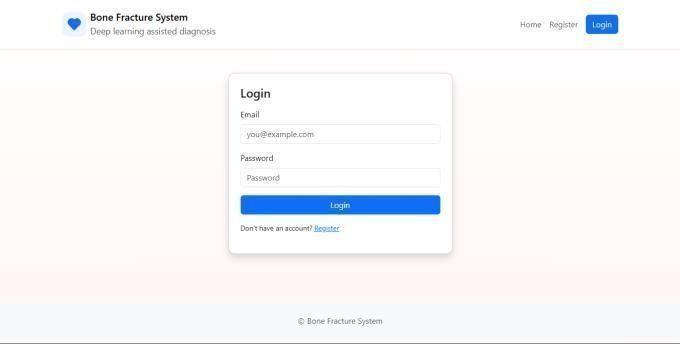
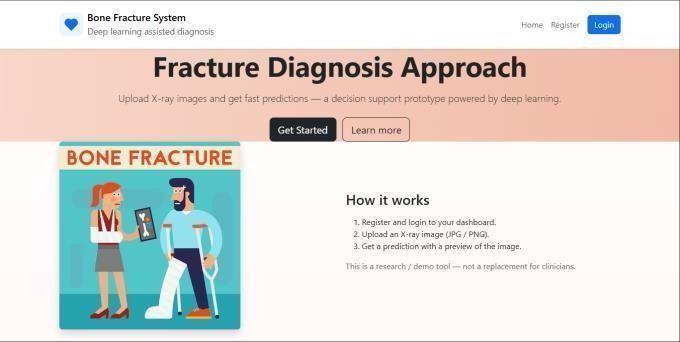
Fig-7.3: UserLoginInterfaceoftheBoneFractureDiagnosisSystem
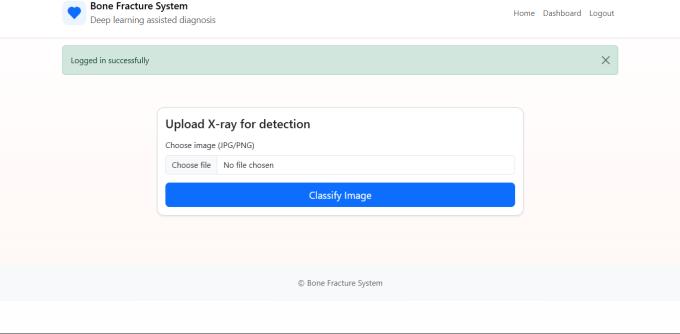
Fig -7.4: X-rayImageUploadInterfaceforFractureDetection
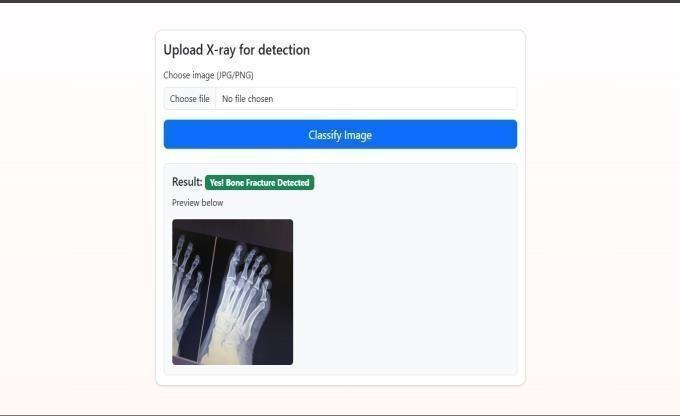
Fig-7.5:X-rayClassificationOutputShowingFractureDetectionResult
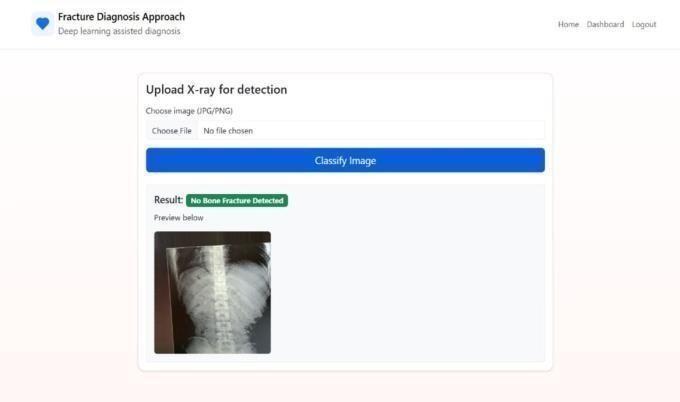
Fig-7.6: X-rayClassificationOutputShowingFractureDetectionResult
© 2025, IRJET | Impact Factor value: 8.315 | ISO 9001:2008 Certified Journal | Page980
International Research Journal of Engineering and Technology (IRJET) e-ISSN: 2395-0056
Volume: 12 Issue: 11 | Nov 2025 www.irjet.net p-ISSN: 2395-0072
Theuseofdeeplearning-basedapproaches,particularlyConvolutionalNeuralNetworks(CNNs),hassignificantly sformed automated bone fracture detection using medical X-rays. By standardizing data pre-processing, model training, and deployment through an accessible web application, these systems enable fast and reliable fracture diagnosis in both hospitalandpoint-of-caresettings.Studies analyzing wrist,hand, andlong bone radiographs reportdiagnostic accuracies and sensitivities exceeding 95%, demonstrating the high potential for CNNs to become established clinical imaging tools across various anatomical locations. Despite these advancements, challenges remain, including the need for external validation, handling non-standard or noisy images, and performing multi-class or fine-grained fracture identification to seamlessly fit into clinical workflows. AI diagnostics can reduce human workload, minimize errors, and provide valuable second opinions;however,issuesregarding model generalizationand interpretabilitymust beaddressedto buildclinical trust.Futureworkshouldemphasizeexternalmodelvalidation,inclusionofdiversepopulations,datasetenrichment,and integration of AI systems into robust hospital decision- support frameworks. Collectively, these efforts aim to bridge AI research and healthcare, enabling faster, more reliable, and widely accessible bone fracture diagnosis for patients worldwide.
[1] “Artificial intelligence for fracture detection in wrist and hand radiographs: CNN-based approach,” Scientific Reports,vol.12,no.1,pp.1–10,2022.
[2] BiomedPharmaJ.,“CNN-basedlongbonefracturedetectioninX-rays,”BiomedPharmaJournal,vol.15,no.2, pp. 345–352,2025.
[3] ETASR,“BonefractureclassificationusingCNNsonmixedX-raydatasets,”ETASR,vol.29,no.4,pp.123–131,2024.
[4] Deep CNNs with data augmentation for medical X-rayAnalysis,”ETASR,vol.28,no.3,pp.98–107,2023.
[5] IJARCCE,“SurveyonCNNarchitecturesandapplicationsinmedicalimaging,” Int.J. Adv.Res.Compute Common Eng.,vol.14,no.1,pp.56–65,2025.
[6] P. Rajpurkar, J. Irvin, K. Zhu, et al., Radiologist-Level Pneumonia Detection on Chest X-Rays with Deep Learning,” arXivpreprintarXiv:1711.05225,2017.[Online].Available:https://arxiv.org/abs/1711.05225
[7] Natl.Acad.Sci.U.S.A.,vol.115,no.45,pp.11591–11596,2018.doi:10.1073/pnas.1806905115.[Online].Available: https://www.pnas.org/doi/10.1073/pnas.1806905115
[8] Lindsey, A. Daluiski, S. Chopra, et al., “Deep neuralnetworkimprovesfracturedetectionbyclinicians,”Proc.
[9] Ç. B. Erdaş, “Automated fracture detection in the ulna and radius using deep learning on upper extremity radiographs,”Jt. Dis. Relat. Surg., vol. 34, no. 3, pp. 598–604, 2023.doi:10.52312/jdrs.2023.1312. [Online]. Available:https://www.joint
[10]G. Mehr, “Automating Abnormality Detection in Musculoskeletal Radiographs through Deep Learning,” arXiv preprintarXiv:2010.12030,2020.[Online].Available:https://arxiv.org/abs/2010.12030
[11]Y.Sato, Y.Takegami,T.Asamoto, etal.,“AComputer- AidedDiagnosis SystemUsingArtificial Intelligencefor Hip Fracts: Multi-Institutional Joint Development,” arXiv preprint arXiv: 2003. 12443, 2020. [Online]. Available: https://arxiv.org/abs/2003.12443