
International Research Journal of Engineering and Technology (IRJET) e-ISSN: 2395-0056
Volume: 12 Issue: 08 | Aug 2025 www.irjet.net p-ISSN: 2395-0072
International Research Journal of Engineering and Technology (IRJET) e-ISSN: 2395-0056
Volume: 12 Issue: 08 | Aug 2025 www.irjet.net p-ISSN: 2395-0072
Hemanth Raj KB1 , Ashwin CA2
1PG Student (M tech), Department of Civil Engineering, Dr. Ambedkar Institute of Technology, Karnataka, India
2Assistant Professor, Department of Civil Engineering, Dr. Ambedkar Institute of Technology
Abstract - Strengthening and retrofitting of reinforced concrete (RC) elements has become essential in modern infrastructure due to increased load demands, deterioration, and revised design codes. Conventional fiber reinforced polymer (FRP) systems, though effective, are limited by poor fireresistanceandthe useof epoxyresins. Toovercomethese shortcomings,FabricReinforcedCementitiousMatrix(FRCM) systems, which use cement-based matrices instead of epoxy, offerimprovedcompatibility,durability,andsustainability.In this study, an experimental program was conducted on nine RC slabs (1100 × 1100 × 60 mm), comprising three control slabs and six slabs strengthened using glass FRCM with two and four layers. The slabs were subjected to uniformly distributed loading, and their flexural performance was evaluated in terms of load-carrying capacity, deflection response,andcrackpropagation.Resultsindicatedthatslabs strengthened with two layers of FRCM exhibited a 75% increase in ultimate load capacity, whereas four-layer strengthened slabs showed an enhancement of 128% compared to control specimens. Crack patterns also demonstrated improved ductility andreduced crack width in strengthened slabs. The study concludes that FRCM systems can serve as an effective and practical alternative for the flexural strengthening of RC slabs, combining structural efficiency with cost-effectiveness and environmental advantages.
Key Words: Reinforced Concrete Slabs, Flexural Strengthening,FabricReinforcedCementitiousMatrix,Glass Fibers,Retrofitting,StructuralRehabilitation,LoadCapacity, Deflection.
Strengthening of reinforced concrete (RC) structures has becomeessentialduetoaginginfrastructure,increasedload demands, and deterioration from environmental effects. Conventional fibre reinforced polymer (FRP) systems, though effective, suffer from drawbacks such as poor fire resistance and dependence on epoxy resins. To address theseissues,FabricReinforcedCementitiousMatrix(FRCM) systemshaveemergedasapromisingalternative.
FRCMcombineshigh-strengthfibres,suchasglassorcarbon, with an inorganic cementitious mortar, ensuring better compatibilitywithconcrete,improveddurability,andeaseof application. Recent studies have shown significant
improvementsinflexuralandshearcapacityofRCmembers usingFRCM,makingitanattractiveoptionforretrofitting.
Thisstudyinvestigatestheflexuralperformanceoftwo-way RCslabsstrengthened with glassFRCM.Control slabsand strengthened slabs with varying numbers of FRCM layers were tested under uniform loading to evaluate their behaviour in terms of load capacity, deflection, and crack development.
Koutas and Bournas (2017) performed an extensive experimental investigation on two-way RC slabs strengthenedwithtextilereinforcedmortar.Theyproposed design equations based on their results, where slabs exhibitedupto140%enhancementinflexuralcapacity.
Loreto et al. (2013) studied RC slab-type elements strengthened with FRCM composites and demonstrated significantimprovementsinloadcapacityandserviceability withoutissuesofdebonding,highlightingitssuitabilityfor slabstrengthening.
Triantafillou et al. (2010) investigated the shear strengtheningofRC beamsusingtextile reinforcedmortar (TRM).TheirresultsshowedTRMincreasedcapacity,butits effectivenesswasslightlylowerthanFRP.However,TRMwas foundtobemoredurableandcompatiblewithcementitious substrates.
Bruckneretal.(2008) conductedexperimentalresearchon glass FRCM reinforced beams and reported a strength increaseofupto33%whenmultiplelayersandmechanical anchorages were adopted. Their study emphasized the importanceofproperanchorageinmaximizingefficiency.
To investigate the flexural behaviour of RC slabs strengthenedwithglassFRCM.
Tocompareultimateloadcapacityandcrackingbehaviourof controlandstrengthenedslabs.
Toassesstheinfluenceofdifferentstrengtheninglayers(two vs.four)onoverallslabperformance.
International Research Journal of Engineering and Technology (IRJET) e-ISSN: 2395-0056
Volume: 12 Issue: 08 | Aug 2025 www.irjet.net p-ISSN: 2395-0072
To validate FRCM as a sustainable and effective strengtheningtechniqueforslabelements.
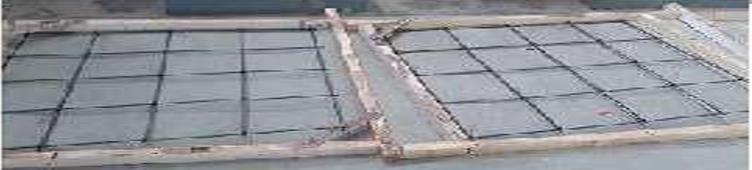
Theexperimentalprograminvolvedcastingandtestingnine RCslabsofdimensions1100×1100×60mm.Threeslabs were tested as control specimens, while six slabs were strengthened using Glass FRCM with two and four layers. ConcreteofgradeM30wasused,withacompressivestrength of approximately 40.8 MPa on the day of testing. Reinforcement consisted of 8 mm diameter bars placed at 120 mm c/c in both directions. The Glass FRCM had an averagethicknessof0.70mm,massperunitarea of0.310 kg/m²,andtensilestrengthof1250N.
Table -1: DescriptionofRCSlabSpecimens
Specimen ID Strengthening Type No.of FRCM Layers Purpose
CS-1,CS-2, CS-3 Control (Unstrengthen) 0 Benchmark
S-2L-1,S2L-2,S-2L3
S-4L-1,S4L-2,S-4L3
Strengthened 2 Flexural performance study
Strengthened 4 Flexural performance study
This table summarizes the specimen details used in the experimentalprogram.Outofnineslabs,threewerecontrol specimens without strengthening, while the remaining six wereretrofittedwithFRCM threewithtwolayersandthree withfourlayers.Thisclassificationhelpedincomparingthe effectofdifferentstrengtheninglevels.
Table -2: PropertiesofGlassFRCM
Property Value
Thickness(mm) 0.70 Massperunitarea(kg/m²) 0.310 No.ofholespersq.meter 31,500
TensileBreakingLoad(N) 1250
Thepropertiesoftheglassfibermeshusedinthestudyare listed here. With a thickness of 0.70 mm, mass of 0.310 kg/m², and tensile strength of 1250 N, the material demonstratedsufficientmechanicalperformancetoserveas aneffectivestrengtheningmedium.
Specimen ID
CS-1to CS-3(avg) 12 32 9.8
Flexural cracksat mid-span
S-2L(avg) 21 56 14.2 Multiple finecracks, gradual failure
S-4L(avg) 28 73 17.5
Distributed cracks,fiber rupture
This table presents the cracking load, ultimate load, maximum deflection, and failure modes of different slab groups.Controlslabsfailedatlowerloadswithwidercracks, whereasstrengthenedslabsexhibitedhighercrackingloads, greaterultimatecapacities,andmoreductilefailuremodes. Thefour-layerslabsshowedthebestperformanceamongall groups.
Table -4: PercentageImprovementinStrength
Strengthening Type Avg.Ultimate Load(kN) Increaseover Control(%)
ControlSlabs 32 –2-LayerFRCM 56 75% 4-LayerFRCM 73 128%
This table provides a comparative assessment of strength enhancement. The two-layer strengthened slabs showed a 75% increase in load capacity, while four-layer slabs achieveda 128%improvementcomparedtocontrol slabs. The results confirm the direct influence of the number of FRCMlayersonflexuralstrength.
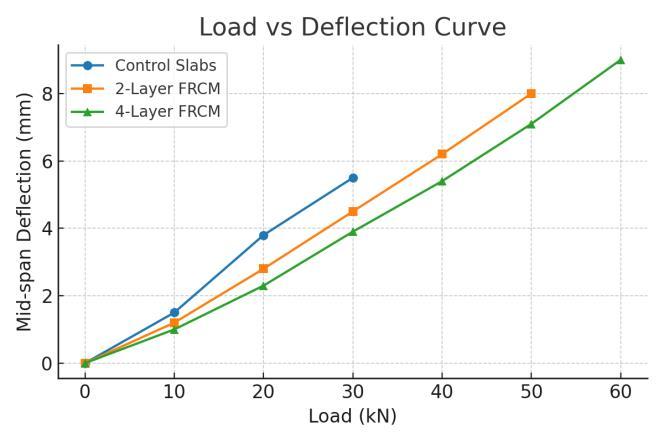
Chart -1:LoadvsDeflectionCurve
International Research Journal of Engineering and Technology (IRJET) e-ISSN: 2395-0056
Volume: 12 Issue: 08 | Aug 2025 www.irjet.net p-ISSN: 2395-0072
Thegraphshowsthatcontrolslabscarriedthelowestload andfailedearlywithlargerdeflections.Slabsstrengthened withtwolayersofFRCMresistedhigherloadsandshowed reduced deflections, while four-layer slabs carried the maximum load with further improvement in stiffness. Strengthened slabs also exhibited a more gradual failure, provingthatFRCMenhancesbothcapacityandductility
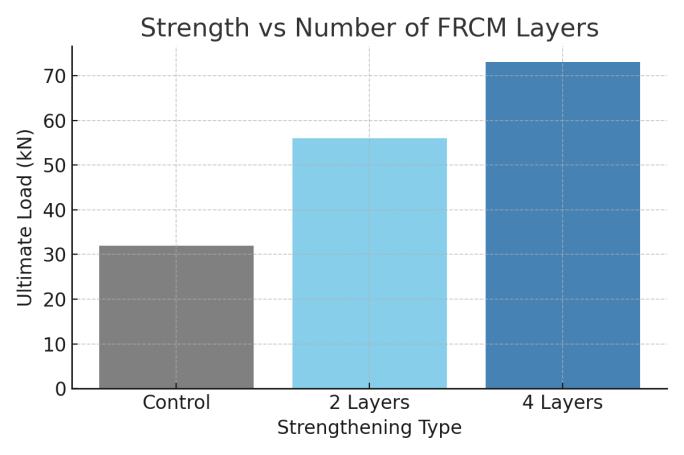
Thebarcharthighlightsthesteadyincreaseinultimateload withadditionalFRCMlayers.Comparedtothecontrolslabs, two-layerslabsshowedabout75%improvement,andfourlayer slabs achieved nearly 128% higher strength. This confirms that the number of strengthening layers directly influencesflexuralperformance.

3. RESULT
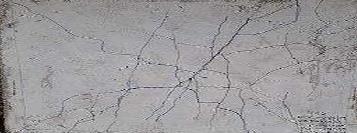
Controlslabsfailedatanaverageloadof32kN,exhibiting wide crack formation. Two-layer strengthened slabs sustained about 56 kN before failure, while four-layer strengthened slabs reached up to 73 kN. Load-deflection responsesindicatedlinearelasticbehavioruptothecracking load, followed by non-linear behavior. Strengthened slabs exhibited improved ductility and reduced crack widths comparedtocontrolspecimens.
FRCM significantly improves the flexural capacity of RC slabs.
Strengthincreasewas75%fortwolayersand128%forfour layers,showingaclearcorrelationbetweenlayercountand performance.
International Research Journal of Engineering and Technology (IRJET) e-ISSN: 2395-0056
Volume: 12 Issue: 08 | Aug 2025 www.irjet.net p-ISSN: 2395-0072
Crackingloadandserviceabilityimproved, withenhanced ductilityandreducedcrackwidths.
FRCMsystemsareadurable,cost-effective,andeco-friendly alternativetoepoxy-basedFRPstrengthening.
[1] Bruckner,A.,etal.(2008).Experimentalstudyonglass FRCMinreinforcedbeams.ASCEJournalofComposites.
[2] Triantafillou,T.,etal.(2010).ShearstrengtheningofRC beams using TRM composites. Journal of Structural Engineering.
[3] Loreto, G., et al. (2013). Performance of RC slab-type elementsstrengthenedwithFRCMcomposites.Journal ofCompositesforConstruction.
[4] Koutas,L.&Bournas,D.(2017).Flexuralstrengthening oftwo-wayRCslabswithTRM: