
International Research Journal of Engineering and Technology (IRJET) e-ISSN:2395-0056
Volume: 12 Issue: 09 | Sep 2025 www.irjet.net p-ISSN:2395-0072
International Research Journal of Engineering and Technology (IRJET) e-ISSN:2395-0056
Volume: 12 Issue: 09 | Sep 2025 www.irjet.net p-ISSN:2395-0072
Bhavik Bharatbhai Joshi1, Deepali Borade2
Lecturer, Dept. of Diploma Civil Engineering, Laxmi Institute of Technology, Sarigam, Gujarat, India
Assistant Professor, Dept. of Civil Engineering, Laxmi Institute of Technology, Sarigam, Gujarat, India
Abstract The increasing demand and rising cost of natural aggregates, coupledwith the adverse environmental impact of quarrying activities, has encouraged the search for sustainable alternatives in concrete production. This studyevaluatesthepotential ofwastecoconutshells(CS),an abundant agricultural byproduct, as a partial substitute for conventional coarse aggregates. Concrete mixes were preparedbyreplacinggranite aggregate with coconut shells in proportions of 5%, 10%, and 20% (by weight), and compared against a control mix without replacement. The primary parameter investigated was compressive strength, assessed on standard cube specimens (150×150×150 mm) after 7, 14, and 28 days of curing. Results showed that increasing CS content led to a reduction in compressive strength. However, the 5% replacement mix achieved strength values comparable to normal concrete, indicating its potential for structural applications with low to moderate loads. Higher replacement levels produced lightweight concrete suitable for non-structural works. This research highlights the dual benefits of sustainable waste managementandeco-friendlyconstructionpractices.
1.INTRODUCTION
Concrete remains the most utilized construction material worldwide, forming the foundation of infrastructure and building projects. Its primary ingredients include cement, water, fine aggregate, and coarse aggregate. The largescale extraction of natural aggregates from quarries not only escalates construction costs but also causes significant environmental concerns such as loss of biodiversity,soilerosion,andlandscapedegradation.
At the same time, rapid urbanization and population growth contribute to a significant increase in agricultural waste generation. Coconut shells, a byproduct of the coconut industry, are produced in large volumes, particularly in tropical regions. In most cases, they are discarded or incinerated, leading to waste disposal issues andenvironmentalpollution.
Coconut shells are durable, lightweight, and weatherresistant due to their high lignin content, making them an attractive alternative aggregate. Their relatively low cellulose composition also reduces water absorption compared to other agricultural wastes. Thus, their incorporation into concrete may help address both waste managementandresourcedepletionchallenges.
This study investigates the mechanical performance of concrete mixes incorporating coconut shells as partial replacements(5%,10%,and20%)forconventionalcoarse aggregates, with a particular focus on compressive strength.
Theincorporationofagricultural wastesintoconcretehas been widely studied as part of sustainable construction practices. Research has particularly examined oil palm shells and coconut shells as lightweight aggregate substitutes.
Olanipekunetal.reportedthatbothpalmkernelshellsand coconut shells can be used successfully in lightweight concrete,withcoconutshellsexhibitingfavorablestrength characteristics. Adeyemi confirmed the suitability of coconut shells in concrete production, while Olutoge and Abdullahstudiedcombinationsofwastessuchassawdust, palm kernel shells, and rice husk ash, emphasizing their contributiontoeco-friendlyconstructionmaterials.
Overall, previous studies agree that coconut shells offer promising potential as a partial aggregate replacement. However, determining the optimum percentage for practical applications requires further experimental validation,whichformsthebasisofthepresentstudy
A.Materials
● Cement: Ordinary Portland Cement (OPC) conformingtoISspecifications.
International Research Journal of Engineering and Technology (IRJET) e-ISSN:2395-0056
Volume: 12 Issue: 09 | Sep 2025 www.irjet.net
● FineAggregate:Cleanriversand,locallyavailable.
● Coarse Aggregate: Crushed granite stone of nominalsize.
● Coconut Shells: Waste shells collected from vendors, cleaned, dried, crushed, and sieved to matchthesizeofcoarseaggregates.
Four mixes were prepared: a control mix (M0) with 0% replacement, and three mixes containing 5% (M5), 10% (M10), and 20% (M20) coconut shell as coarse aggregate replacement (by weight). The water–cement ratio was kept constant. Standard cube specimens (150×150×150 mm)werecast,compacted,demouldedafter24hours,and curedinwaterfor7,14,and28days.
Compressive Strength: Tested using a Compression TestingMachine(CTM)ateachcuringage.
● Water Absorption: Calculated from the weight difference between oven-dry and saturated surface-dryspecimens.
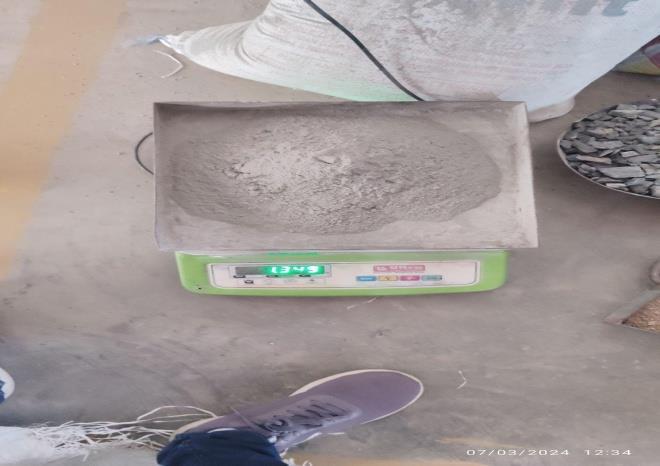
Fig. 1:Figure1:Measurementofcementweightonadigital weighingbalanceformixpreparation.
p-ISSN:2395-0072
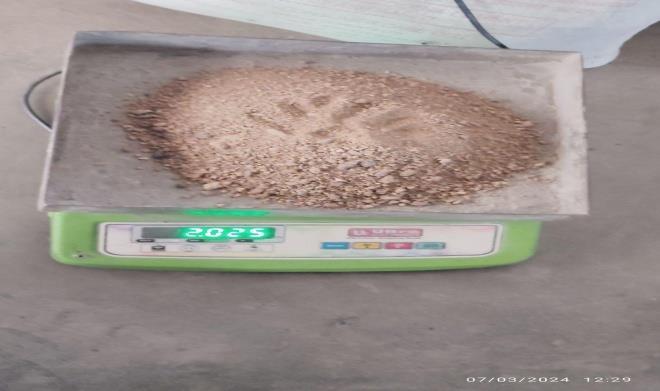
Figure 2:Measurementoffineaggregate(sand)weight on adigitalweighingbalance.
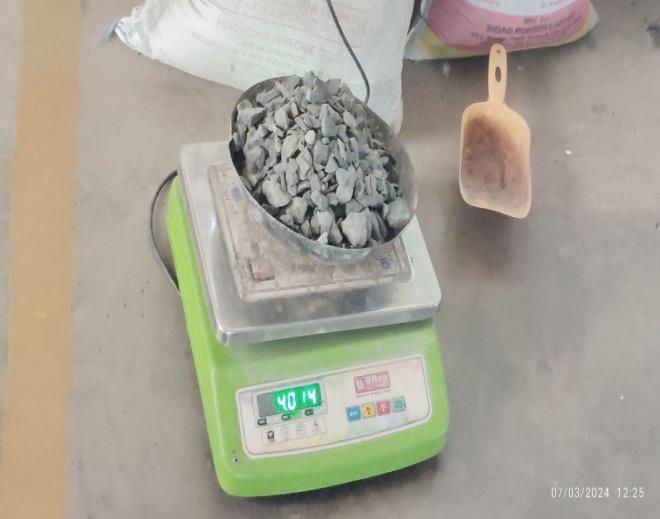
Figure 3: Measurementofcoarseaggregateweightona digitalweighingbalance.
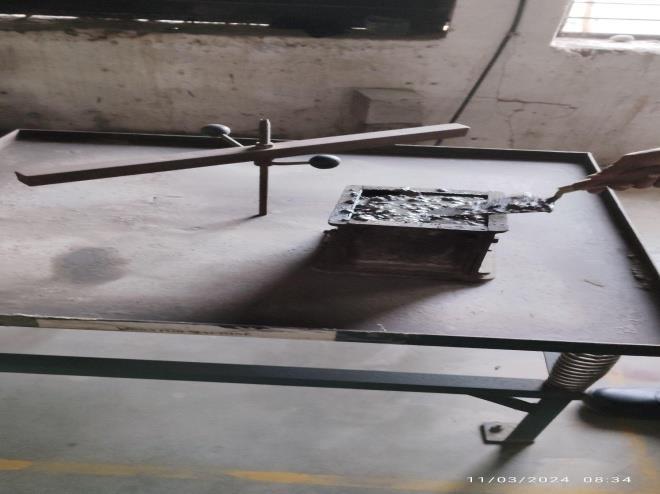
Fig. 4:Compactionofafreshconcreteorcementmortar specimeninacubemoldonavibratingtableforastrength test.
International Research Journal of Engineering and Technology (IRJET)
Volume: 12 Issue: 09 | Sep 2025 www.irjet.net
IV. RESULTS AND DISCUSSION
TABLE I COMPRESSIVESTRENGTHAT7DAYS(N/mm²)
TABLE II COMPRESSIVESTRENGTHAT14DAYS(N/mm²)
TABLE III COMPRESSIVESTRENGTHAT28DAYS
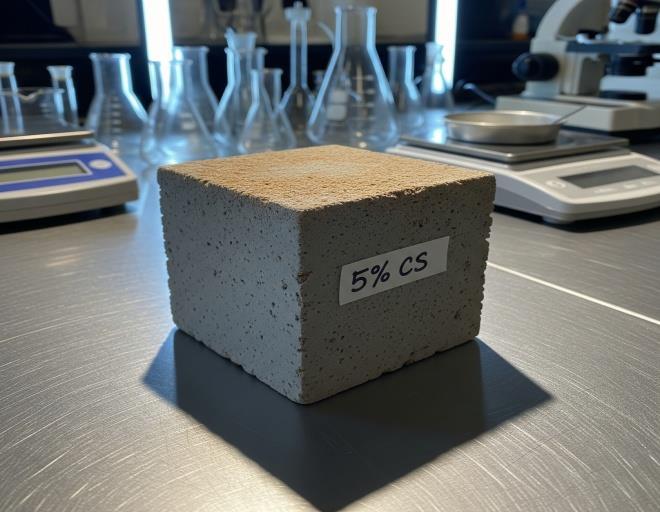
Aconcretetestcubewith5%coconutshell(CS) aggregate.
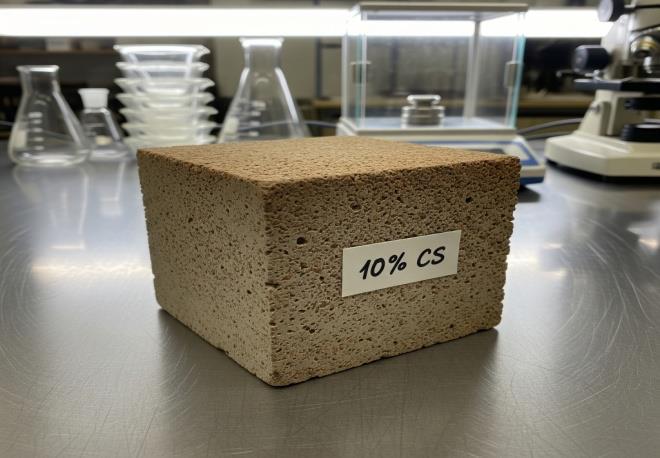
Aconcretetestcubewith10%coconutshell(CS) aggregate.
International Research Journal of Engineering and Technology (IRJET) e-ISSN:2395-0056
Volume: 12 Issue: 09 | Sep 2025 www.irjet.net p-ISSN:2395-0072
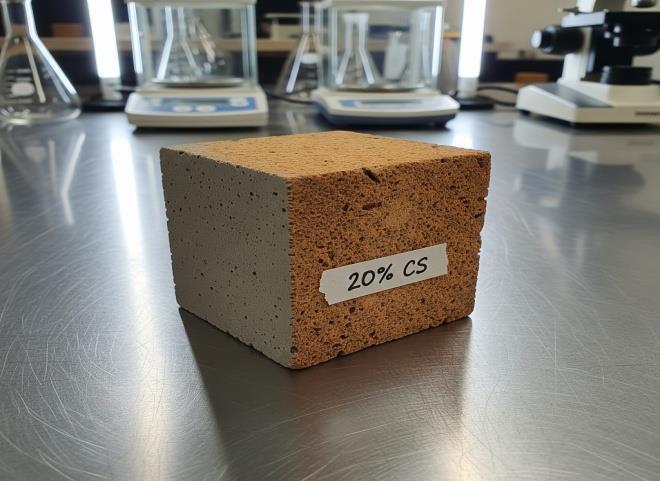
Fig.4:Aconcretetestcubewith20%coconutshell(CS) aggregate.
The results confirm that compressive strength reduces as theproportionofcoconutshellincreases.Thisreductionis attributed to the lower density and strength of coconut shells compared to granite, weaker bonding at the interfacial transition zone, and higher void content due to irregularparticleshapes.
Nevertheless, the 5% replacement mix retained approximately 92% of the compressive strength of conventional concrete at 28 days, making it suitable for certain structural applications. The 10% and 20% replacement mixes, while weaker, still produced acceptable strengths for non-structural and lightweight constructionpurposes,offeringadditionalbenefitssuchas reduceddeadload.
This research confirms the feasibility of incorporating waste coconut shells as a partial replacement for coarse aggregatesinconcrete.Keyfindingsinclude:
1. Strength Relationship: Compressive strength decreasesascoconutshellcontentincreases.
2. Optimum Replacement: A 5% replacement provides strength values close to conventional concrete, suitable for low-load structural applications.
3. Lightweight Concrete: Higher percentages (10%–20%) yield lightweight concrete useful for nonload-bearingelements.
Future research should focus on surface treatments of coconut shells to enhance bonding, the addition of supplementarycementitiousmaterialstomitigatestrength loss, and long-term durability studies under aggressive environmentalconditions.
[1] M. Cyr et al., “Recycling Waste in Cement Based Materials,” RILEM Conference, Barcelona, 2004.
[2]H.B.Basri etal.,“ConcreteUsingWasteOilPalmShells as Aggregates,” Cement and Concrete Research,1999.
[3] J.G. Ohler, Modern Coconut Management, London: Intermediate Technology Publ., 1999.
[4] S.A. Tukiman,S.Mohd, “Combination of Coconut Shell andPalmKernelasAggregate,”NCON-PGR,Malaysia,2009.
[5] E.A. Olanipekun et al., “Comparative Study Between Palm Kernel Shell and Coconut Shell as Aggregates,”J.Eng.Appl.Sci.,2005.
[6] E.A. Olanipekun et al., “Concrete Properties Using Agricultural Wastes,” Building and Environment,2006.
[7] N.M.S. Hasan et al., “Use of Coconut Fibre in Lightweight Concrete,” J. Applied Sciences, 2012.
[8]A.Y.Adeyemi,“SuitabilityofCoconutShellsinConcrete Production,” J. Environ. Design & Mgmt., 1998.
[9]F.A.Olutoge,“UseofSawdustandPalmKernelShellsas Aggregates,” ARPN J. Eng. Appl. Sci., 2010.
[10] F.A.Olutoge,M.Sc. Thesis, Univ. of Lagos, 1995.
[11] A.A.A. Abdullah, “Strength Properties of Lightweight Concrete Using Agricultural Wastes,” Intl. Conf. Low-Cost Housing,Roorkee,1984.