
International Research Journal of Engineering and Technology (IRJET) e-ISSN: 2395-0056
Volume: 12 Issue: 04 | Apr 2025 www.irjet.net p-ISSN: 2395-0072
International Research Journal of Engineering and Technology (IRJET) e-ISSN: 2395-0056
Volume: 12 Issue: 04 | Apr 2025 www.irjet.net p-ISSN: 2395-0072
N. Sivaraj1, B. Rajagopal2
1Research Scholar, Annamalai university, Annamalai nagar, Tamil Nadu, India
2Associate Professor, Annamalai university, Annamalai nagar, Tamil Nadu, India
Abstract - Fault detection and classification in threephase induction motors are essential for improving reliability and reducing maintenance costs. This research presentsaGreyWolfOptimizedPatternRecognitionNeural Network(GWO-PRNN)fordiagnosingfaults,withafocuson broken rotor faults, bearing faults and stator interturn fault. A 1.5 kW three-phase induction motor was tested under various load conditions to evaluate the proposed approach. The Hilbert Transform is applied as a preprocessingtechniquetoextractmeaningfulfeaturesand remove noise from motor current and speed signals. The Grey Wolf Optimization (GWO) algorithm fine-tunes the neural network parameters, enhancing classification accuracy and convergence speed. The proposed method is evaluated on multiple fault scenarios, including broken rotor faults, inter-turn stator faults, and bearing defects. Experimental results show that GWO-PRNN achieves superior performance across different load conditions, with an overall performance of 97.06%, considering accuracy, recall,precision,andF1-score.Thisapproachcontributesto predictive maintenance strategies, ensuring improved operationalefficiencyandextendedmotorlifespan.
Key Words: (Fault Detection, Fault Classification, ThreePhase Induction Motor, Grey Wolf Optimization (GWO), Pattern Recognition Neural Network (PRNN), Hilbert Transform, Broken Rotor Fault, Predictive Maintenance, MotorConditionMonitoring.
Three-phase induction motors are the backbone of modern industrial systems due to their efficiency, durability, and cost-effectiveness [1]. However, these motorsarepronetovariousfaults,includingbrokenrotor faults, inter-turn stator faults, and bearing defects, which can lead to unexpected failures, increased maintenance costs,andreducedoperational efficiency[2][3].Earlyand accurate fault detection is crucial for preventing costly downtimeandensuringreliablemotorperformance.
Traditional fault diagnosis techniques, such as vibration analysis and thermal imaging, require direct access to the motor, making them expensive and impracticalforreal-timemonitoring[4].Incontrast,Motor Current Signature Analysis (MCSA) is a non-invasive and cost-effective approach that utilizes current signals for fault detection [5]. However, raw current signals often
containnoiseandexternaldisturbances,makingitdifficult toextractfault-relatedfeatureseffectively[6].
To address these challenges, this research proposes a Hilbert Transform-based preprocessing technique to enhance signal quality and extract essential fault-related features [7]. A 1.5 kW three-phase induction motor was tested under different load conditions to evaluate the effectiveness of the proposed approach. Furthermore, a GreyWolfOptimizedPatternRecognitionNeuralNetwork (GWO-PRNN) is implemented for fault detection and classification. The Grey Wolf Optimization (GWO) algorithm is employed to fine-tune the neural network parameters, enhancing classification accuracy and convergencespeed[8][9].
This research aims to develop an intelligent and reliable fault diagnosis system capable of detecting and classifyinginductionmotorfaultswithhighprecision.The proposedapproachcontributestopredictivemaintenance strategies,improvingthelong-termoperationalstabilityof inductionmotors.
Several studies have also investigated the impact of varying load conditions on the effectiveness of fault diagnosis techniques. Singh et al. [10] conducted a comparativestudyofinductionmotorfaultdiagnosisusing vibration analysis and MCSA, concluding that currentbased techniques are more suitable for real-time applications. However, they emphasized that load variations introduce additional complexities, requiring adaptivepreprocessingmethods.Similarly,Wangetal.[11] explored the influence of load fluctuations on neural network-based fault classification, highlighting the importance of dynamic feature selection methods to maintain high accuracy across different operating conditions. Furthermore, hybrid techniques integrating multiple preprocessing and classification methods have shown promise in improving fault diagnosis accuracy. Riera-Guasp et al. [12] combined wavelet analysis with MCSA to enhance the detection of broken rotor faults, demonstrating improved performance compared to standalone MCSA. Li et al. [13] proposed a hybrid deep learningapproachincorporatingfeaturefusiontechniques, achieving superior classification performance across multiplefaultconditions.Althoughsignificantprogresshas
International Research Journal of Engineering and Technology (IRJET) e-ISSN: 2395-0056
Volume: 12 Issue: 04 | Apr 2025 www.irjet.net p-ISSN: 2395-0072
been made in induction motor fault diagnosis, the integrationofHilbertTransform-basedpreprocessingwith Grey Wolf Optimized Pattern Recognition Neural Network (GWO-PRNN) remains underexplored. This research bridges this gap by developing a robust fault diagnosis framework capable of handling varying load conditions whileimprovingclassification accuracy through optimized neuralnetworkparameters.
The proposed methodology, integrating real-time signal acquisition, feature extraction using the Hilbert Transform and SIFT, and fault classification via a Grey Wolf Optimized Pattern Recognition Neural Network (GWO-PRNN)isillustratedinFigure1.Thisblockdiagram outlinesastreamlinedprocessforeffectivefaultdiagnosis inthree-phasesquirrelcageinductionmotors.
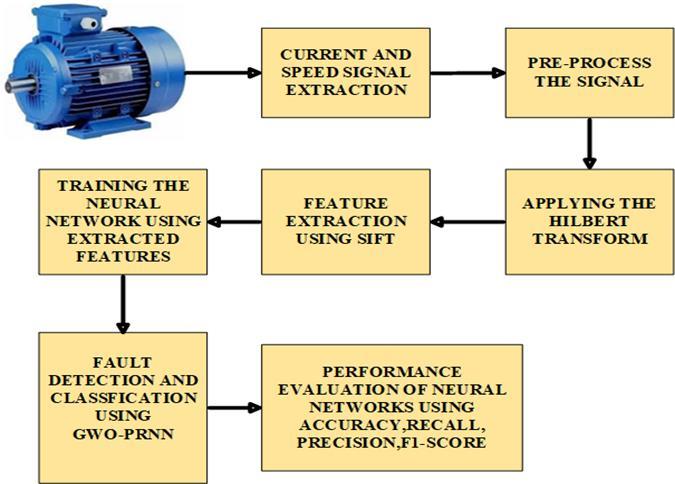
Fig -1: BlockDiagramoftheProposedWork
The proposed methodology begins with the extraction of current and speed signals from the three-phase induction motor under investigation. These raw signals are then pre-processed to eliminate noise and unwanted disturbances, ensuring the integrity of the data for subsequentanalysis.Followingpre-processing,theHilbert Transform is applied to the signals to capture essential features related to signal envelope and instantaneous characteristics. Feature extraction is further enhanced usingtheScaleInvariantFeatureTransform(SIFT),which identifies stable and significant features regardless of variations in load and speed conditions. The extracted features are then utilized to train a Pattern Recognition Neural Network (PRNN), whose weights and biases are optimized using the Grey Wolf Optimization (GWO) algorithm, leading to improved fault detection accuracy. The trained model performs fault detection and classification, distinguishing between different types of motor faults. Finally, the performance of the developed neural network model is evaluated based on standard metrics such as accuracy, recall, precision, and F1-score,
ensuring a comprehensive assessment of its fault classificationcapability.
The experimental setup is designed to acquire the electrical and mechanical parameters of a three-phase induction motor under various operating conditions for faultdiagnosis.Aregulated three-phaseACsupplyisused to energize the squirrel cage induction motor. The electrical quantities, such as phase voltages and currents, are measured using calibrated voltmeters and ammeters connected to the supply lines. The current signals are captured through an LA55P Hall effect-based current sensor, providing isolated and accurate measurements withoutdirectelectricalcontact.
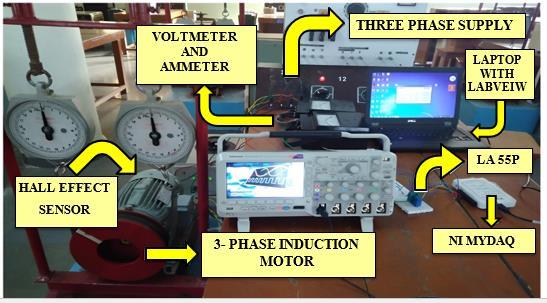
To monitor the motor's speed, a Hall effect sensor is positioned near the rotating shaft. This sensor generates digital pulses proportional to the shaft’s rotational speed, enabling precise speed measurement. Both current and speed signals are interfaced through a National Instruments(NI)MyDAQsystem,whichactsasanefficient data acquisition unit. The NI MyDAQ captures the analog signals, digitizes them, and transfers the data to a laptop installed with LabVIEW software for real-time visualization, recording, and preliminary signal processing.
LabVIEW is programmed to display the voltage, current, and speed waveforms and to store the acquired data for further offline analysis. This data forms the foundation for signal preprocessing, feature extraction, andneuralnetworktrainingformotorfaultdiagnosis.The setup ensures a reliable and accurate collection of critical motor parameters under healthy and faulty conditions, aidinginthedevelopmentofarobustdiagnosticsystem.
ThelistofthesoftwareusedislistedinTable1.where LabVIEW is utilized for data collection, and MATLAB is employed for neural network implementation and additionally,listofhardwarecomponentsusedisshownin
International Research Journal of Engineering and Technology (IRJET) e-ISSN:
Volume: 12 Issue: 04 | Apr 2025 www.irjet.net
Table 2 and specification of the Three Phase Induction Motor used in the experimental setup is shown in the Table3.
Table - 1: Listofsoftwareused
S.No. NAME OF THE SOFTWARE SUPPLIER
1. LabVIEW NationalInstruments
2. MATLAB2021a Mathworks
Table – 2: Listofhardwarecomponentsused
S.No. NAME OF THE COMPONENT RANGE
1. 3phasesquirrelcageinduction motor
2. myDAQ ±10V
3. DOLstarter 415V/10A
4. HallEffectSensor(US1881) 0-100KHz
5. LA55p(CurrentTransducer) 0-30A
6. DualDCpowersupply ±15V
Table - 3: Listofhardwarecomponentsused
S.No. NAME OF THE COMPONENT
5. GENERATING SYNTHETIC FAULTS ON THREE PHASE CAGE INDUCTION MOTOR
To develop a neural network capable of detecting bearing defects, broken rotor anomalies, and stator interturnfaultsinathree-phasesquirrelcageinductionmotor, it is essential to generate synthetic datasets that accuratelyreflectthemotor'sperformanceunderdifferent faultscenarios.Initially,datawasgatheredfromahealthy induction motor operating under no load, half load, and full load conditions. Subsequently, artificial faults were systematically introduced into the bearings, rotor bars, and stator windings to simulate various fault states and enrich the dataset for training purposes. To further enhance the quality and diversity of the dataset, preprocessing techniques such as normalization, scaling, and feature extraction were applied to the raw motor signals.
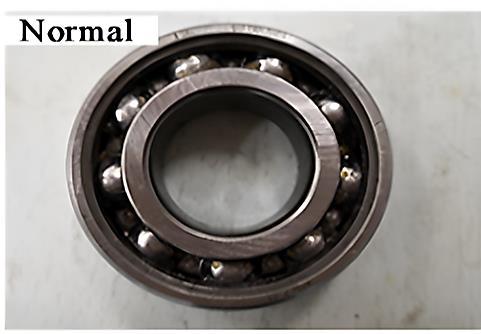
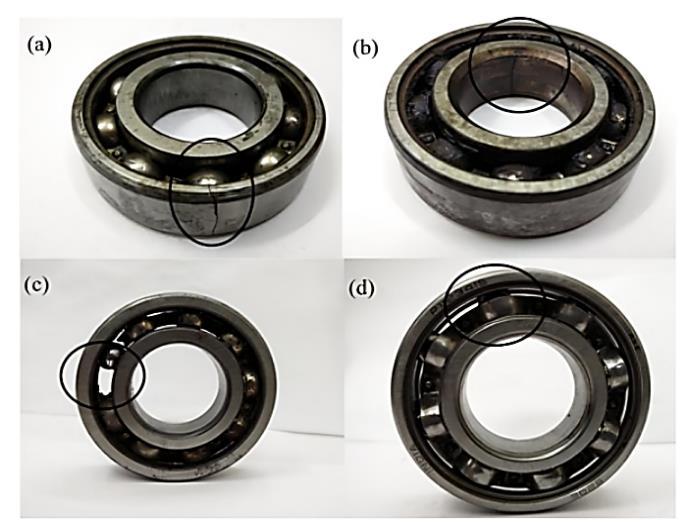
Figure3illustratesthehealthybearingoftheinduction motor, while Figure 4 presents the simulated faults introduced on the inner race, outer race, cage, and ball componentsofthebearing.Theexperimentswerecarried out using 6205-2Z bearings, characterized by a 25 mm borediameter,a52mmouterdiameter,andawidthof15 mm. Artificial defects were generated by intentionally damaging specific sections of the bearing with the aid of ananglegrinderandotherprecisionpowertools[14-16].
International Research Journal of Engineering and Technology (IRJET) e-ISSN: 2395-0056
Volume: 12 Issue: 04 | Apr 2025 www.irjet.net p-ISSN: 2395-0072
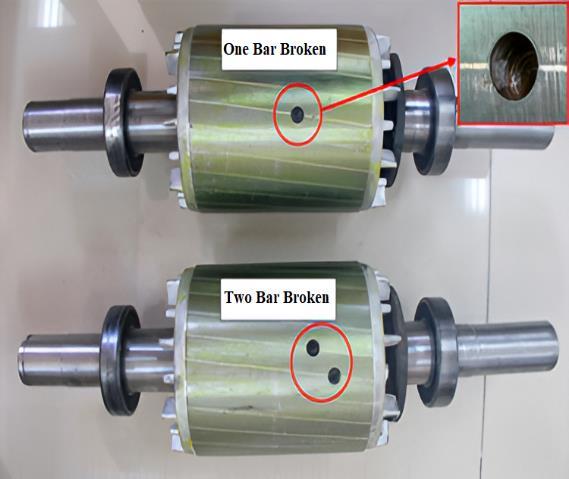
Fig - 6 :Damagedrotorbars
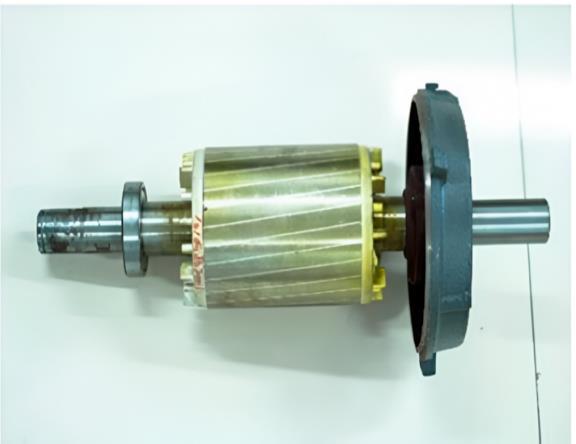
Similarly , the synthetic faults in the rotor bars were created by intentionally damaging the bars through drilling. The rotor consists of 32 bars and a hole was drilledintooneofthebarstoadepthofapproximately10 mm and a diameter of 6 mm[17-19]. This modification effectively disrupts the current flow in the rotor circuit. Healthy rotor bar is shown in the figure 5 and damaged rotorbarisshowninthefigure6.

Fig - 7 :Inter-turnfaultinstatorwithtapingsexposed fortesting
To simulate stator interturn faults, additional tapings
were taken from the stator windings of the induction motor, as illustrated in figure 7. The interturn fault conditions were replicated by intentionally shorting 10% ofthewindingsinPhaseAandthenincreasingitto25%of the winding turns[20-22]. This deliberate shorting alters the winding impedance and disrupts the magnetic flux distributionandgeneratesarealisticfaultdataforanalysis andneuralnetworktraining.
The experimental setup was carefully monitored to ensure controlled fault creation without causing permanent damage to the motor. current, and speed signals were continuously recorded under each fault conditiontobuildacomprehensivedataset.
6. FORMULATION OF FAULT TYPES AND DATASETCOLLECTION
A systematic methodology was adopted for fault formulation and data acquisition to establish a reliable detection and classification system for three-phase inductionmotors.Thecompileddatasetwasstructuredto capture a broad spectrum of operational anomalies,
enabling the neural networks to differentiate faults effectively under multiple loading scenarios. The experimental framework encompassed eight distinct fault categories along with a baseline healthy state, ensuring coverageofpracticaldegradationmodes.
These faults were organized into three principal groups: bearing anomalies, rotor defects, and stator irregularities. The bearing anomalies included Inner Race Bearing Fault (IRBF), representing imperfections within the inner raceway; Outer Race Bearing Fault (ORBF), indicating damage localized at the outer race section; Ball Cage Bearing Fault (BCBF), referring to deformation affecting the cage that guides rolling elements; and Ball Bearing Fault (BBF), describing surface flaws on the rollingsphereswithintheassembly.
Rotor defects involved 1-Bar Broken Rotor Fault (1BRF), caused by fracture of a single rotor bar compromisingelectromagneticbalance,and2-BarBroken Rotor Fault (2-BRF), characterized by dual bar fractures intensifyingasymmetryandvibration.Statorirregularities comprised a 10% Inter-turn Short Circuit (10% STF), denoting partial winding insulation failure involving 10% ofphaseA,anda25%Inter-turnShortCircuit(25%STF), highlighting extensive turn-to-turn shorts encompassing 25%ofphaseAconductors.
Each fault was meticulously introduced under controlled laboratory conditions to facilitate accurate signalrecordingforalgorithmtrainingandvalidation.For comprehensive data generation, the induction motor was operated 200 cycles per condition, incorporating variations in load to simulate diverse field scenarios. During every trial, both current and rotational speed signals were captured independently, followed by feature extraction to prepare inputs for the classification models. An aggregate of 5,400 instances was assembled, comprising600recordsfor eachanomalyandthehealthy baselineacrossvaryingoperationalstresses.
This extensive and representative repository underpinsthedevelopmentofintelligentfaultrecognition frameworkscapableofdiscerningsubtledeviationsacross arangeofpracticalconditions.
7. FEATURE EXTRACTION FROM CURRENT ANDSPEEDSIGNALS
Feature extraction plays a crucial role in analyzing rotor speed and stator current waveforms for diagnosing theoperationalconditionofthree-phaseinductionmotors. This process was performed for eight fault types along with the healthy condition. The feature extraction procedure for a representative sample under full-load conditions, corresponding to healthy, Outer Race Bearing Fault (ORBF), and 1-Bar Broken Rotor Fault (1-BRF), is demonstrated in Figures 8 through 13, with analysis carriedoutbetween 5and 15seconds. Sameprocedureis carried out for other two load conditoins no load and full load.
International Research Journal of Engineering and Technology (IRJET) e-ISSN: 2395-0056
Volume: 12 Issue: 04 | Apr 2025 www.irjet.net p-ISSN: 2395-0072
Initially, a zoomed view of the speed and current waveforms provides a detailed visual representation of signal characteristics. Following this, the Hilbert Transform was applied to both current and speed signals to enhance signal clarity by mitigating noise, thereby improving the quality of features extracted. Post transformation,500significantpeakswereidentifiedfrom eachsignal,ensuringthatonlythemostinformativeparts of the waveform were selected. Subsequently, the ScaleInvariant Feature Transform (SIFT) technique was employed to extractcritical statistical featuresfrom these peaks.
Theextractedfeaturesincluded:
Mean: Represents the average values of rotor speed and stator current during the filtered time window.
Median: Indicates the central tendency of the data.
Minimum value: Captures the lowest observed valueinthedataset.
Maximum value: Captures the highest observed valueinthedataset.
Standard deviation: Quantifies variability and reflects the stability of the motor under operationalstresses.
These extracted features served as valuable inputs forthesubsequentclassificationmodels,enablingeffective fault detection and condition monitoring. By carefully selecting and processing relevant features, the reliability and accuracy of diagnosing different fault conditions in inductionmotorsweresignificantlyimproved.
In summary, the combination of advanced signal processing techniques and statistical feature extraction laid a strong foundation for the development of robust diagnostic models. This approach not only enhanced the sensitivity of fault detection but also contributed to the creation of a reliable and efficient condition monitoring systemforthree-phaseinductionmotors.
The feature extraction process from the current and speed waveforms at healthy conditions under full load is illustrated in figure 8 and figure 9, respectively. The correspondingextractedvaluessummarizedintable4.

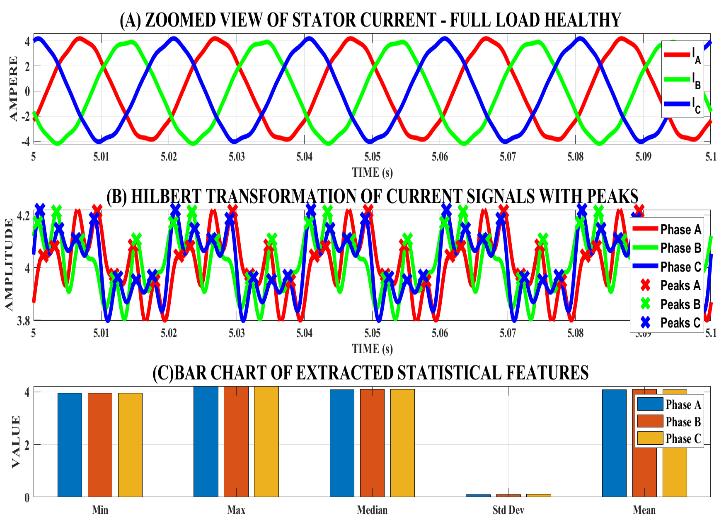
- 8 : Featureextractionfromhealthycurrentwaveform underfullload
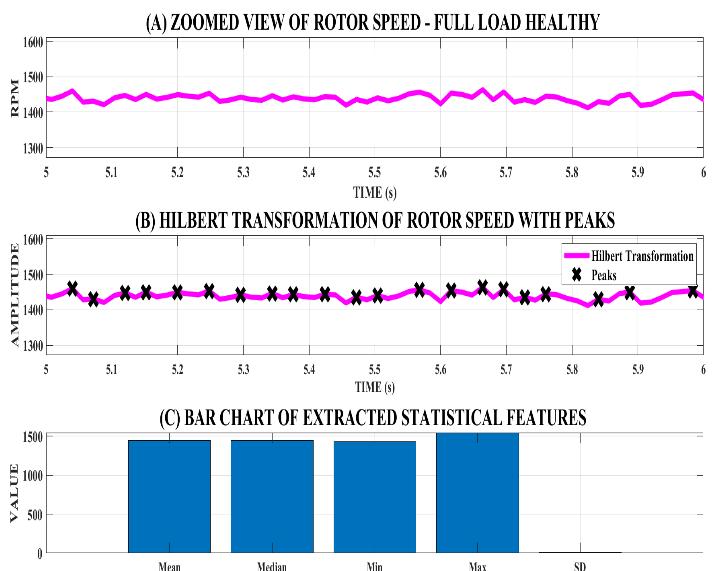
- 9 : Featureextractionfromhealthyspeedwaveform underfullload
Table – 4 : Valuesofextractedfeaturesfromhealthy underfullloadcondition
The feature extraction process from the current and speed waveforms at ORBF under full load conditions is illustrated in figure 10 and figure 11, respectively. The correspondingextractedvaluessummarizedintable5
International Research Journal of Engineering and Technology (IRJET) e-ISSN: 2395-0056
Volume: 12 Issue: 04 | Apr 2025 www.irjet.net p-ISSN: 2395-0072
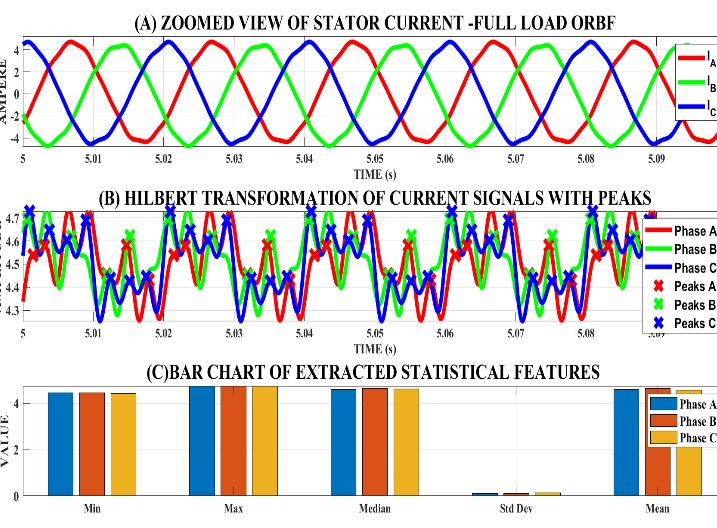

– 10 : FeatureextractionfromORBFcurrentwaveform underfullload

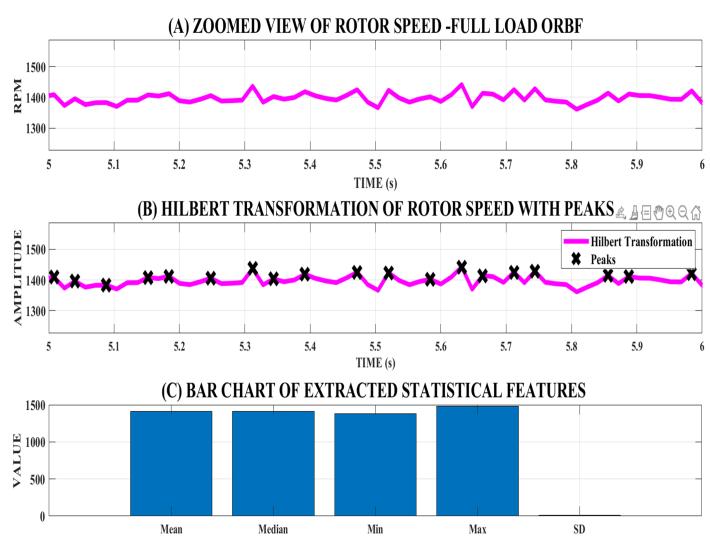
Fig - 11: FeatureextractionfromORBFspeedwaveform underfullload
Table - 5: ValuesofextractedfeaturesfromORBFunder fullloadcondition
The feature extraction process from the current and speed waveforms at 1-BRF under full load conditions is illustrated in figure 12 and figure 13, respectively. The correspondingextractedvaluessummarizedintable6
2025, IRJET | Impact Factor value: 8.315 |
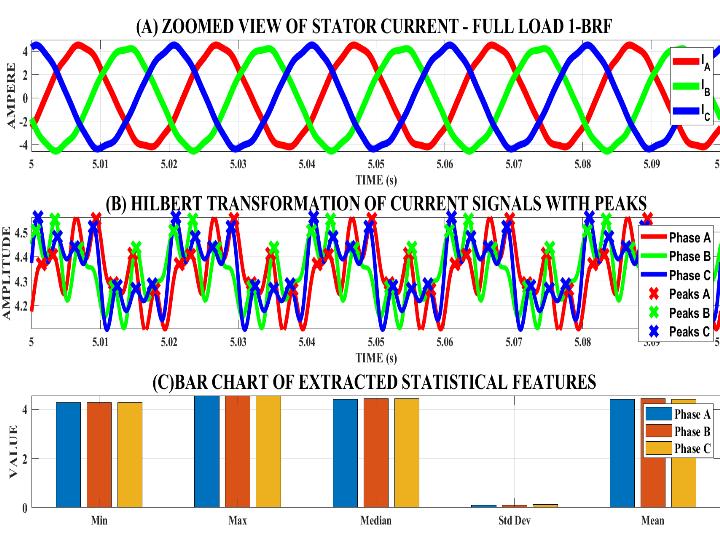
- 12 : Featureextractionfromhealthycurrent waveformunderfullload
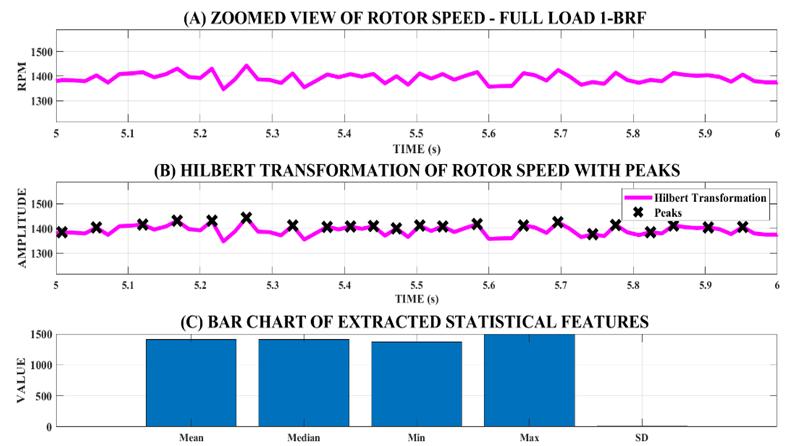
Fig – 13 : Featureextractionfromhealthyspeed waveformunderfullload
Table - 6: ValuesofextractedfeaturesfromORBFunder fullloadcondition
The extracted features include statistical parameters such as mean, median, standard deviation, minimum, and maximumvaluesforeachphasecurrentandmotorspeed. These features serve as critical inputs for the pattern recognition neural network (PRNN) during the fault diagnosisprocess.
International Research Journal of Engineering and Technology (IRJET) e-ISSN: 2395-0056
Volume: 12 Issue: 04 | Apr 2025 www.irjet.net p-ISSN: 2395-0072
The flowchart representing the GWO-PRNN methodology is presented in Figure 14. In this work, features extracted from current and speed data are used as inputs to the PRNN. The dataset was partitioned such that 80% was used for training and the remaining 20% wasreservedfortestingthemodel'sperformance.
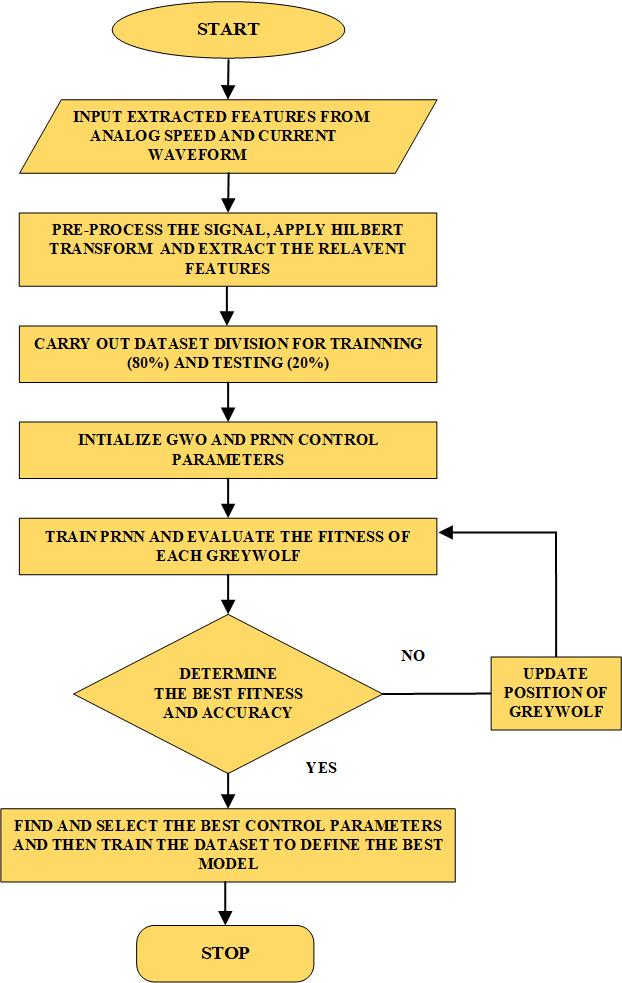
Fig -14 : FlowchartofGWO-PRNN
The flowchart shown in Figure 14 outlines the GWO-
PRNN training process. Initially, features are extracted from the analog speed and current waveforms and providedasinputtothemodel.Theinputsignalsundergo pre-processing,wherenoisereductiontechniquesandthe HilbertTransformareappliedto extractrelevantfeatures necessary for accurate classification. Following preprocessing, the dataset is divided into two portions, with 80% allocated for training and the remaining 20% reservedfortesting.Thenextstepinvolvesinitializingthe control parameters for both the Grey Wolf Optimizer (GWO) and the Pattern Recognition Neural Network (PRNN). The PRNN is then trained using the training dataset, and the performance (fitness) of each Grey Wolf, representing a candidate solution, is evaluated. Based on the evaluation, the best fitness and corresponding accuracy are determined. If the best solution is not yet
achieved, the positions of the Grey Wolves are updated, and the training process is repeated. Once the optimal control parameters are identified, the PRNN is retrained using these parameters to finalize the best-performing model. The process concludes after successfully building anoptimizedfaultclassificationsystem.
After feature extraction from the speed and current waveforms, a dataset representing healthy and faulted conditionsoftheinductionmotorwascreatedandusedto train and test the GWO-PRNN model. The model’s performance was evaluated using a confusion matrix, providing a detailedview of classificationaccuracyacross nine classes (eight faults and one healthy condition). The confusion matrix highlights the relationship between actual and predicted results through key components: True Positives (TP), True Negatives (TN), False Positives (FP), and False Negatives (FN). These elements form the basisforassessingthemodel’sreliabilityandeffectiveness infaultclassification.
From these values, several key performance metrics werecalculatedtoevaluatetheGWO-PRNNmodel:
(i) Accuracy:
Accuracy measures the overall correctness of the model by evaluating the ratio of correctly classified samples to the total number of samples. It is given by Equation(1):
100 (1)
(ii) Precision:
Precision quantifies the proportion of positive identifications that were actually correct. It helps in understanding how reliable the model's positive predictionsare.PrecisionisexpressedbyEquation(2): x100 (2)
(iii) Recall (Sensitivity):
Recallmeasurestheabilityofthemodeltocorrectly identifyallpositiveinstances.Ahigherrecallvaluereflects betterdetectionoffaultcases.Itisrepresentedby Equation(3): x100 (3)
(iv) F1-Score:
The F1-score is the harmonic mean of precision and recall, providing a single metric that balances both measures. This is especially useful when dealing with imbalanceddatasets.ItiscalculatedusingEquation(4):
International Research Journal of Engineering and Technology (IRJET) e-ISSN: 2395-0056
Volume: 12 Issue: 04 | Apr 2025 www.irjet.net p-ISSN: 2395-0072
Table – 7: ConfusionMatrixofGWO-PRNNatno-load condition
The confusion matrices were employed to analyse the performance of the GWO-PRNN by comparing its predicted outputs with the actual values. Tables 7, 9, and 11 illustrate the confusion matrix of GWO-PRNN at no load, half load and full load respectively. Metrics EvaluationoftheGWO-PRNNispresentedintheTables8, 10 and 12 respectively. classification performance of the GWO-PRNNunderthreedifferentloadconditions:noload, half load, and full load presenting both the predicted and actual outputs for each case. Table 13 summarizes the overall classification metrics, including Accuracy, Precision, Recall, and F1-Score, of the GWO-PRNN model acrossallloadconditions.
Foreasyanalysis,thefollowinglabelswereassignedto eachfaultcondition:
Healthy(A)
InnerRaceBearingFault(G)
OuterRaceBearingFault(H)
Ballcagefault(I)
Ballfault(J)
1-BrokenRotorFault(K)
2-BrokenRotorFault(L)
10%StatorTurnFault(M)
25%StatorTurnFault(N)
10.1 Performance of GWO-PRNN at no load
Table 7 presents the confusion matrix of the GWOPRNN model evaluated under no-load condition. For easy analysis, the following labels were assigned to each condition:Healthy(A),InnerRaceBearingFault(G),Outer RaceBearingFault(H),BallCageFault(I),BallFault(J),1Broken Rotor Fault (K), 2-Broken Rotor Fault (L), 10% StatorTurnFault(M),and25%StatorTurnFault(N).The matrix compares the predicted classes (P) against the actual classes (A). The diagonal elements, which have the highest values, indicate correct classifications, with each fault condition showing strong prediction accuracy (for example, Healthy (A) has 195 correct predictions out of 200). The off-diagonal elements represent misclassifications, which are relatively minimal. Occasional minor misclassifications, such as Inner Race BearingFault(G)beingconfusedwithOuterRaceBearing Fault (H) or Ball Cage Fault (I), are observed but are few compared to correct classifications. Overall, the GWOPRNN model demonstrates robust fault identification capabilityatno-loadoperation.
Table 8 shows the detailed metrics evaluation for the GWO-PRNN model under no-load condition. Each fault condition Healthy (A), Inner Race Bearing Fault (G), OuterRaceBearingFault(H),BallCageFault(I),BallFault (J), 1-Broken Rotor Fault (K), 2-Broken Rotor Fault (L), 10%StatorTurnFault(M),and25%StatorTurnFault(N) was assessed based on True Positives (TP), False Positives (FP), False Negatives (FN), and performance metricssuchasAccuracy,Precision,Recall,andF1-Score.
Most fault types showed high accuracy, with Healthy (A) and Outer Race Bearing Fault (H) achieving excellent classificationresults.PrecisionandRecallvaluesremained consistently high, ensuring balanced performance across fault categories. Although the 25% Stator Turn Fault (N) recorded slightly more false positives, it maintained a strong recall rate. Overall, the GWO-PRNN model demonstrated strong and reliable performance under noload conditions, confirming its effectiveness for accurate faultdiagnosis.
Table – 8 : MetricesEvaluationforGWO-PRNNatno load
International Research Journal of Engineering and Technology (IRJET) e-ISSN: 2395-0056
Volume: 12 Issue: 04 | Apr 2025 www.irjet.net p-ISSN: 2395-0072
Table – 10 : MetricesEvaluationforGWO-PRNNat
Table 9 presents the confusion matrix of the GWOPRNN model evaluated under half-load condition. The tablecomparestheactualclasses(A)againstthepredicted classes (P) for various fault types, where A stands for Healthy, G for Inner Race Bearing Fault, H for Outer Race BearingFault
Table – 9 : ConfusionMatrixofGWO-PRNNathalf-load
I for Ball Cage Fault, J for Ball Fault, K for 1-Broken Rotor Fault, L for 2-Broken Rotor Fault, M for 10% Stator TurnFault,andNfor25%StatorTurnFault.
The diagonal elements, representing correct classifications, have the highest counts, indicating that most samples were accurately classified. Minor misclassifications are observed, particularly between similar fault categories such as bearing and rotor faults. However, the number of misclassifications remains small compared to the correct predictions, showing that the GWO-PRNN model maintained strong and consistent fault identificationperformanceevenathalf-loadoperation.
Table 10 provides the metric evaluation of the GWOPRNN model at half-load condition across different fault types. The table summarizes True Positives (TP), False Positives (FP), False Negatives (FN), along with performance indicators such as Accuracy, Precision, Recall,andF1-Score.TheHealthycondition(A),Innerand Outer Race Bearing Faults (G and H), Ball Cage Fault (I), Ball Fault (J), Broken Rotor Faults (K and L), and Stator Turn Faults (M and N) all exhibited strong classification performance.Mostfaultsachievedhightruepositiverates withminimal falsepositivesandfalsenegatives.Although slight variations occurred, particularly for Inner Race Bearing Fault (G) and Stator Turn Faults (M and N), the model maintained a high overall accuracy, precision, recall, and F1-score. These results demonstrate that the GWO-PRNN model consistently performs well even when themotoroperatesunderhalf-loadconditions.
Table 11 shows the confusion matrix of the GWOPRNN model evaluated at full-load condition. It presents the comparison between actual classes (A) and predicted classes (P) for different motor fault types, including Healthy (A), Inner Race Bearing Fault (G), Outer Race Bearing Fault (H), Ball Cage Fault (I), Ball Fault (J), 1Broken Rotor Fault (K), 2-Broken Rotor Fault (L), 10% StatorTurnFault(M),and25%StatorTurnFault(N).The majority of the samples were classified correctly, as indicated by the high values along the diagonal. However,
International Research Journal of Engineering and Technology (IRJET) e-ISSN: 2395-0056
Volume: 12 Issue: 04 | Apr 2025 www.irjet.net p-ISSN: 2395-0072
a few misclassifications were observed, particularly among faults that share similar characteristics, such as between bearing faults and rotor faults. Despite these minor errors, the overall performance remains strong, confirming that the GWO-PRNN model is effective in fault classification even when the motor operates under fullloadconditions.
Table – 11 : ConfusionMatrixofGWO-PRNNatFull-load condition
Table 13 summarizes the overall performance of the GWO-PRNN model under no-load, half-load, and full-load conditions. The accuracy, precision, recall, and F1-score values remained consistently high across all loading conditions, demonstrating the model’s strong generalization capability. Although there was a slight reductioninperformanceatfullloadcomparedtono-load andhalf-loadconditions,thevariationswereminimal.
The model achieved its highest performance at noload, while maintaining reliable detection even under increased mechanical stress at half-load and full-load conditions. Overall, the GWO-PRNN model delivered robust and stable results, making it suitable for accurate faultdiagnosisinvaryingoperationalscenarios.
Table 12 presents the detailed performance metrics of theGWO-PRNNmodelatfull-loadconditionacrossvarious fault types. The table lists the True Positives (TP), False Positives (FP), False Negatives (FN), along with the Accuracy, Precision, Recall, and F1-Score for each fault category. The Healthycondition(A), bearing faults(Gand H), rotor faults (K and L), and stator faults (M and N) all maintained strong classification results, with minimal deviation. Although the Inner Race Bearing Fault (G) and StatorTurnFault(M)experiencedslightlylowerprecision and recall values compared to others, the overall performance of the model remained consistent. High true positiveratesacrossallfaulttypesindicatetherobustness and generalization ability of GWO-PRNN under full-load operation. The overall evaluation highlights the model’s reliability and effectiveness for real-world fault diagnosis evenatmaximummotorloading.
Table – 12 : MetricesEvaluationforGWO-PRNNat
Furthermore, the overall performance of the GWOPRNN model across differentloadconditionsunderscores its practical applicability in real-time motor monitoring systems. The model’s ability to maintain high diagnostic accuracy under varying operational stress is crucial for minimizing downtime and ensuring the continuous performanceofmotorsinindustrialsettings.Theseresults reinforcethepotentialofGWO-PRNNasareliabletoolfor faultdetection,enablingtimelyinterventionsandreducing maintenance costs. Its robustness makes it a promising candidate for deployment in both laboratory and field environments,whereloadconditionscanfluctuate.
Table -13 : OverallPerformanceoftheGWO-PRNN
These findings highlight the model’s effectiveness in real-world applications, ensuring reliable fault detection
International Research Journal of Engineering and Technology (IRJET) e-ISSN: 2395-0056
Volume: 12 Issue: 04 | Apr 2025 www.irjet.net p-ISSN: 2395-0072
across different motor operating conditions. The consistent performance across all load conditions proves the model's robustness and practicality for motor conditionmonitoring.
In conclusion, this research demonstrates the effectiveness of the GWO-PRNN model for fault diagnosis in three-phase squirrel cage induction motors under varying load conditions. The model has shown robust performance in detectinga widerange of faults,including bearingfaults,rotorfaults,andstatorturnfaults,withhigh accuracy, precision, recall, and F1-scores across no-load, half-load,andfull-loadscenarios.
Despite a slight reduction in performance at full load, the model’s overall reliability remained impressive, making it highly suitable for real-time motor condition monitoring and fault detection. The GWO-PRNN model’s ability to generalize across different operational conditions highlights its practical applicability in industrialsettings,wheremotorloadcanvary.Theresults suggest that GWO-PRNN can significantly reduce downtime, lower maintenance costs, and extend the operational lifespan of motors. This model presents a promising solution for enhancing the efficiency and reliability of industrial motors, offering potential for broaderdeploymentinpredictivemaintenancesystems.
References:
[1] Singh, M., et al. (2013), Early Detection of Bearing Faults in Induction Motors Using Artificial Neural Networks, IEEE Transactions on Industrial Informatics,Vol.9(3),pp.1234–1242.
[2] Gupta, R. K., et al. (2014), ANN-Based Fault Diagnosis for Rolling Element Bearings in Electric Motors, Expert Systems with Applications, Vol. 41(12),pp.5678–5687.
[3] Silva, L. I., et al. (2012), Multi-Domain Modelling of Induction Motor with Stator Winding Turn-Faults, IFACProceedings,Vol.45(20),pp.1382–1387.
[4] Lopez-Ramirez, M., et al. (2020), Automatic Early Broken-Rotor-Bar Detection and Classification Using Otsu Segmentation, IEEE Access, Vol. 8, pp. 112624–112632.
[5] Yun, J., et al. (2009), Detection and Classification of Stator Turn Faults and High-Resistance Electrical Connections for Induction Machines, IEEE TransactionsonIndustryApplications,Vol.45(2),pp. 666–675.
[6] Mirafzal, B., et al. (2006), Interturn Fault Diagnosis in Induction Motors Using the Pendulous Oscillation Phenomenon, IEEE Transactions on Energy Conversion,Vol.21(4),pp.871–882.
[7] Seshadrinath, J., et al. (2012), Single-Turn Fault Detection in Induction Machine Using ComplexWavelet-Based Method, IEEE Transactions on IndustryApplications,Vol.48(6),pp.1846–1854.
[8] Asfani, D. A., et al. (2012), Temporary Short Circuit Detection in Induction Motor Winding Using a Combination of Wavelet Transform and Neural Network, Expert Systems with Applications, Vol. 39(5),pp.5367–5375.
[9] Moosavi, S. S., et al. (2015), ANN-Based Fault Diagnosis of Permanent Magnet Synchronous Motor Under Stator Winding Shorted Turn, Electric Power SystemsResearch,Vol.125,pp.67–82.
[10] Asfani, D. A., et al. (2012), Temporary Short Circuit Detection in Induction Motor Winding Using a Combination of Wavelet Transform and Neural Network, Expert Systems with Applications, Vol. 39(5),pp.5367–5375.
[11] Gupta, R. K., et al. (2014), ANN-Based Fault Diagnosis for Rolling Element Bearings in Electric Motors, Expert Systems with Applications, Vol. 41(12),pp.5678–5687.
[12] Gandhi, A., et al. (2011), Recent Advances in Modelling and Online Detection of Stator Interturn Faults in Electrical Motors, IEEE Transactions on IndustrialElectronics,Vol.58(5),pp.1564–1575.
[13] Patel, A., Kumar, S., and Singh, R. (2021), “Deep Convolutional Neural Network for Stator Fault Diagnosis inInductionMotors,” IEEE Transactions on IndustryApplications,Vol.57(6),pp.3000–3008.
[14] Zhang, T., Li, X., and Chen, Y. (2022), “Real-Time Motor Fault Detection Using LSTM Networks Under Variable Loads,” Mechanical Systems and Signal Processing,Vol.161,pp.107987.
[15] Ahmed, F.,and Begum, S. (2019),“Multi-SensorData Fusion for Enhanced Induction Motor Fault Diagnosis,” Measurement,Vol.145,pp.496–505.
[16] Ortega, J., Morales, G., and Perez, D. (2021), “An Ensemble Learning Approach for Induction Motor Fault Classification,” ISA Transactions, Vol. 112, pp. 182–192.
[17] Wang, Y., Li, L., and He, X. (2016), “Load-Adaptive Feature Extraction for Induction Motor Fault Diagnosis,” MechanicalSystemsandSignalProcessing, Vol.72–73,pp.214–227.
[18] Zhao, W., Zhang, W., and Wang, J. (2018), “Hybrid Wavelet–MLP Approach for Broken Rotor Bar Detection in Induction Motors,” Electric Power SystemsResearch,Vol.154,pp.129–136.
[19] Chen, J., and Liu, Z. (2017), “Adaptive Preprocessing Methods for Load Variation in Motor Current Signature Analysis,” IEEE Transactions on Industrial Electronics,Vol.64(4),pp.3251–3259.
[20] Riera-Guasp, J., Codina, E., and Penya, J. (2003), “Wavelet-Based Detection of Broken Rotor Bars in Induction Motors,” IEEE Transactions on Energy Conversion,Vol.18(4),pp.512–519.
International Research Journal of Engineering and Technology (IRJET) e-ISSN: 2395-0056
Volume: 12 Issue: 04 | Apr 2025 www.irjet.net p-ISSN: 2395-0072
[21] Li, J., Smith, S., and Brown, T. (2020), “Feature Fusion–Based Deep Learning Framework for Induction Motor Fault Diagnosis,” IEEE Transactions onIndustrialInformatics,Vol.16(3),pp.1897–1907.
[22] Kumar, P., and Das, S. (2019), “Dynamic Feature SelectionforRobustMotorFaultClassificationUnder VaryingLoads,” Measurement,Vol.140,pp.242–251.
© 2025, IRJET | Impact Factor value: 8.315 | ISO 9001:2008
| Page