
International Research Journal of Engineering and Technology (IRJET) e-ISSN:2395-0056
Volume: 12 Issue: 06 | Jun 2025 www.irjet.net p-ISSN:2395-0072
International Research Journal of Engineering and Technology (IRJET) e-ISSN:2395-0056
Volume: 12 Issue: 06 | Jun 2025 www.irjet.net p-ISSN:2395-0072
Alan Nadh U, Krishna Raju, Muhammad Yaseen N, Sanooja Johny, Assistant. Professor MS. Divya V.B
Department of Computer Science &Engineering
Rajadhani Institute of Engineering &Technology, Kerala, India
Abstract Thisprojectaimstodevelop afacerecognitionbased attendance monitoring system to enhance and modernize the current attendance system in educational institutions. Human faces, as unique identifiers, are utilized to trace an individual’s presence. The system establishes a face utilized to trace an individual's presence. The system establishes face databases to feed the recognition algorithm. During attendance sessions, detected faces are compared against the database, leading to automatic attendance recording for identified individuals otherwise invalid. This system leverages Python and OpenCV to streamline attendance tracking processes. It operates in four phases: database construction, face detection, recognition, and attendance record updates in an Excel sheet. The system’s effectiveness is measured by its accuracy, and it promises to savetime, reduce humanerror, and boost overall operational efficiencybyeliminatingmanualattendancetaking.
Index Terms Facial recognition, automated attendance, computer vision, Python, OpenCV, LBPH, MongoDB, Haar Cascade, real-time face detection, educational technology, biometric authentication, AIbasedattendancesystem
Traditional methods of recording attendance, such as rollcalls or sign-in sheets, have been a staple in educational institutions for years. These processes are often timeconsuming, prone to errors. These inefficiencies can disrupt the rhythm of a session, pulling attention away fromteachingandlearning.Inanerawheretechnologycan simplify almost every aspect of our lives, the need for an automated system that is seamless, accurate, and efficient hasbecomeincreasinglyclear.
Facial recognition technology offers a practical solution to these challenges. By using advanced algorithms to analyse unique facial features, this technology can automatically recorded attendance as students enter the classroom. This processissimplestudentsdonot needtosign anything or respond to roll-calls. Instead, their presence is captured digitally and verified instantly. This eliminates the
possibility of human error and significantly reduces the time spent on attendance. Facial recognition systems can workinreal-time,ensuringthatattendancerecordsarenot only accurate but also immediately available for review. This modern approach streamlines the process and allows educators to focus on their core responsibilities teaching andmentoringtheirstudents.
This paper explores the design and implementation of an an automated attendance system using face recognition technology. The system's architecture consists of a frontend, which features a user-friendly HTML/CSS interfaceforadmin,faculty,andstudentdashboards,anda backend powered by Python Flask with MongoDB as the database.ThefacerecognitionmoduleutilizesOpenCVand the Local Binary Pattern Histogram (LBPH) algorithm for accurate and efficient performance. The database is implemented using MongoDB, integrated via Mongoose. For frontend development, HTML5, CSS3, JavaScript, and custom UI components are utilized. The backend is implemented with Python Flask and Node.js, while MongoDB handles database operations. The computer vision module is powered by OpenCV, LBPH Face Recognizer,andHaarCascadeClassifier.
Unlike traditional systems, the proposed system ensures accuracy, efficiency, and fostering a forward-thinking culture Additionally, the implementation delivers a scalable, user-friendly, and robust solution for automated attendance management using facial recognition technology.
The remainder of this paper is structured as follows: Section II discusses the system architecture, including hardware and software components. Section III details the implementationprocess.SectionIVexplainsthereal-world implementation. Section V presents experimental results and performance evaluation. Finally, Section VI concludes the paper and outlines potential future enhancements, includingAIintegration
International Research Journal of Engineering and Technology (IRJET) e-ISSN:2395-0056
Volume: 12 Issue: 06 | Jun 2025 www.irjet.net p-ISSN:2395-0072
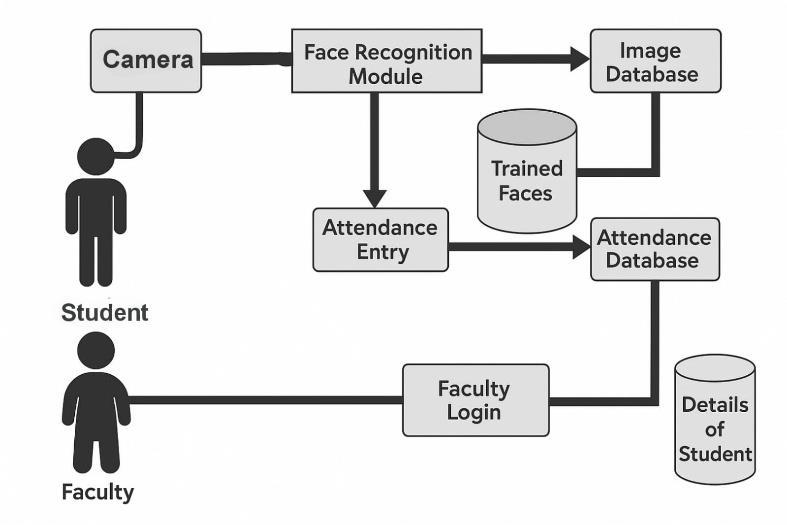
The project employs a camera to automate student attendance through facial recognition technology. When a student appears before the camera, their facial image is captured in real time and passed to the face recognition module.Usingpre-trainedfacialdata,thesystemcompares the captured image against stored entries in the image database. If a match is found, the system logs the attendanceentryintotheattendancedatabase.Themodule leverages trained facial data to ensure accurate and efficientidentification.
Faculty members can access the system through a dedicated login interface, which connects them to student details stored in the system. This enables real-time monitoring and management of attendance records. The system architecture integrates components like image storage, face recognition logic, and database interaction, delivering a contactless, automated attendance solution that enhances classroom efficiency and reduces manual effort.
The project, "Face Recognition Attendance System," implements an automated attendance system using face recognition technology. The system's architecture consists of a frontend, which features a user-friendly HTML/CSS interfaceforadmin,faculty,andstudentdashboards,anda backend powered by Python Flask with MongoDB as the database.ThefacerecognitionmoduleutilizesOpenCVand the Local Binary Pattern Histogram (LBPH) algorithm for accurateandefficientperformance.
The database is implemented using MongoDB, integrated via Mongoose. Dedicated schemas are defined for users (students), admins, departments, semesters, and attendance records, ensuring a well-structured data organization. The face recognition module employs OpenCV for face detection and recognition, utilizing the LBPHFaceRecognizer.Thetrainingpipelineinvolvesimage collection in a dataset folder, face detection using Haar Cascade, and model training with results stored in a Trainer.ymlfile.
Forattendancemanagement,thesystemprovidesreal-time facerecognitiontomarkattendanceinstantly.Itusesadual storage system, comprising CSV files for daily records and Excel files for formatted reports. The system is equipped witherrorhandlingmechanismsandfilelockingto ensure datareliability.
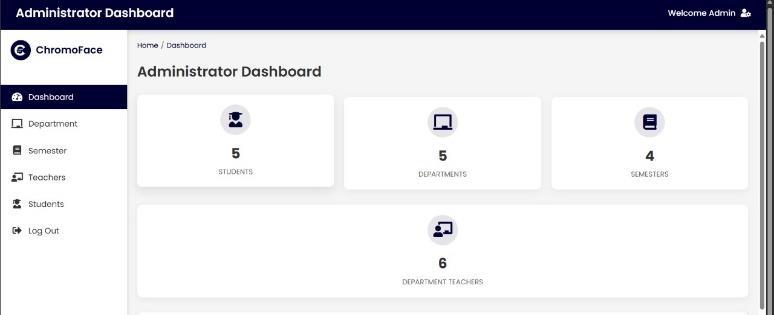
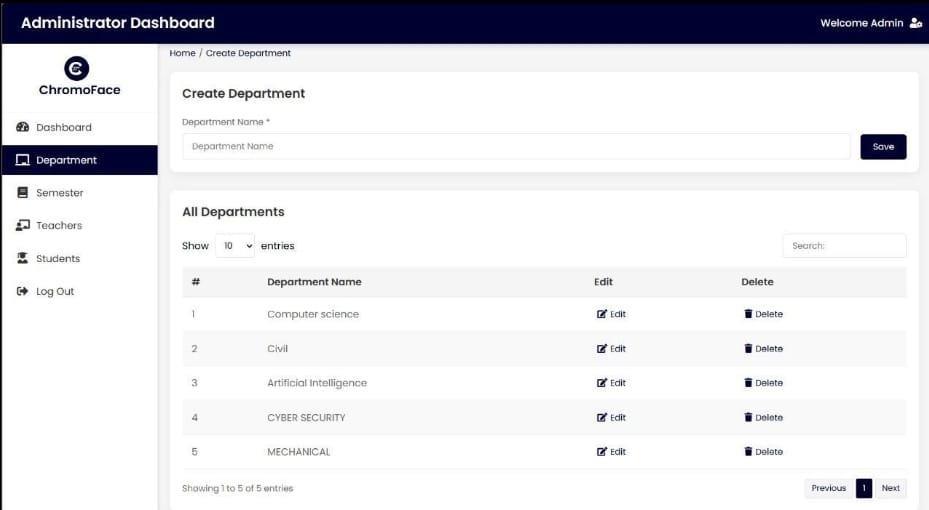
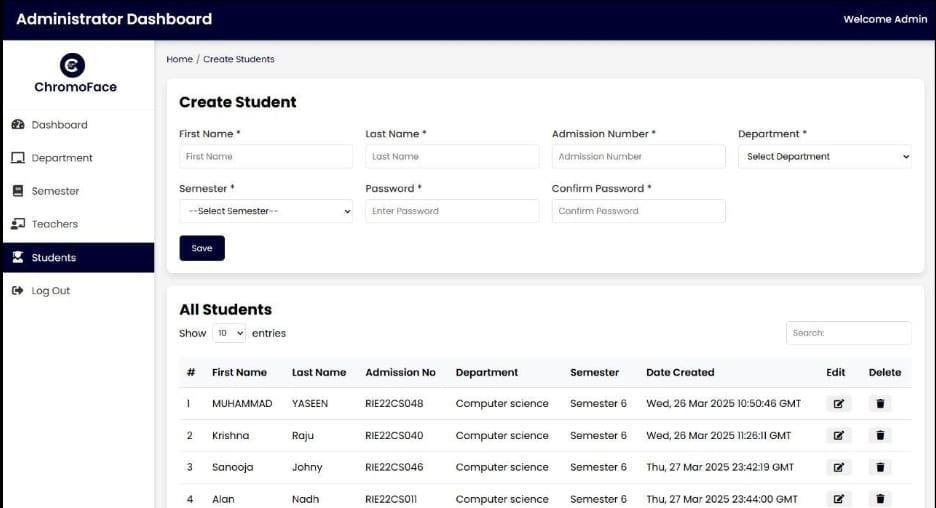
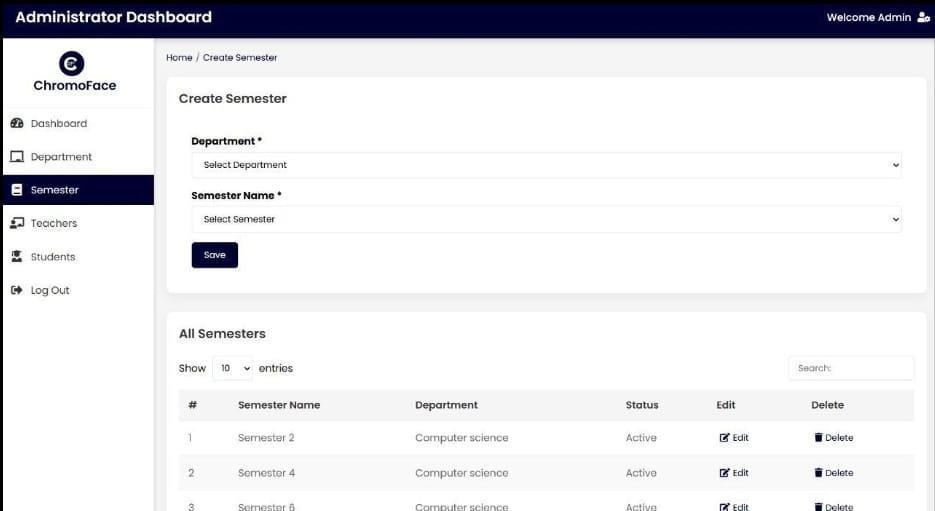
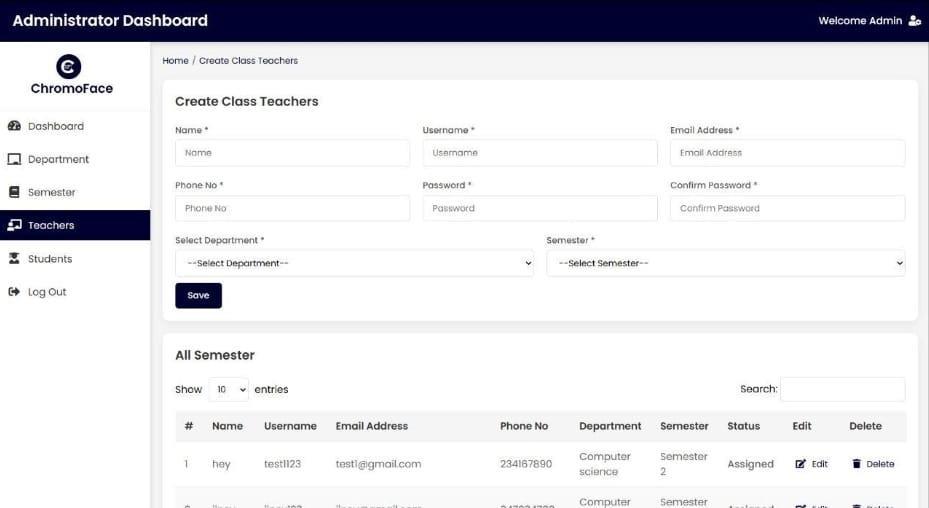
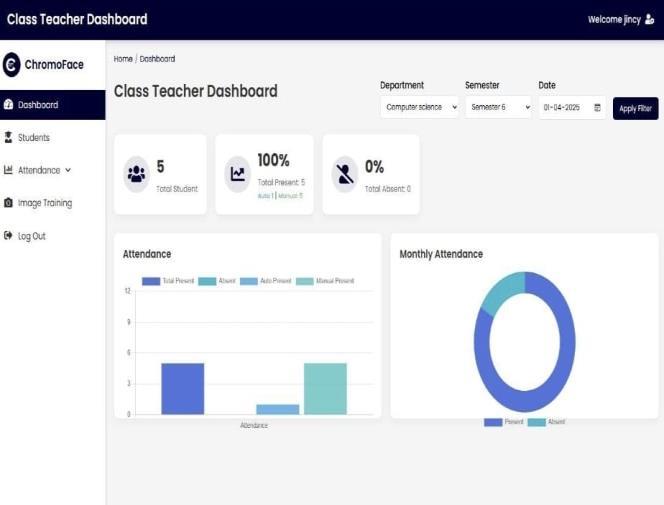
The project features three distinct user interfaces tailored to different roles. The admin dashboard facilitates departmentandsemestermanagement,usermanagement, system configuration, and attendance reporting. The faculty dashboard allows real-time attendance monitoring, department-wiseandsemester-wisefilters,andattendance statistics reporting. The student dashboard displays personalattendancerecords,providesacalendarview,and presentsattendancestatisticsforindividualstudents.
Several key features enhance the system's functionality. The real-time processing module enables live face detection and immediate attendance marking, complementedbyaninstantfeedbacksystem.Hierarchical data management organizes records by department, semester, and student, ensuring efficient record keeping. The reporting system generates daily attendance reports, allows Excel exports, and conducts statistical analysis of attendancedata.
The system incorporates robust security measures. User accountsareprotectedbypasswords,andaccesscontrolis role-based. Secure database connections, along with error handling and logging mechanisms, enhance overall system reliability.
The project uses a variety of technologies. For frontend development, HTML5, CSS3,JavaScript, and custom UI componentsareutilized.Thebackendisimplementedwith PythonFlaskandNode.js,whileMongoDBhandlesdatabase operations. The computer vision module is powered by OpenCV, LBPH Face Recognizer, and Haar Cascade Classifier.Overall, this implementation delivers a scalable, user-friendly, and robust solution for automated
International Research Journal of Engineering and Technology (IRJET) e-ISSN:2395-0056
Volume: 12 Issue: 06 | Jun 2025 www.irjet.net p-ISSN:2395-0072
The Face Detection Attendance Management System was designed with practical deploymentin mind,reflecting the real-world needs of educational institutions to streamline attendancetrackingwithhighaccuracy,speed,andminimal manual intervention. This implementation combines biometric authentication, data management, and real-time processing to provide a robust and scalable attendance solution.
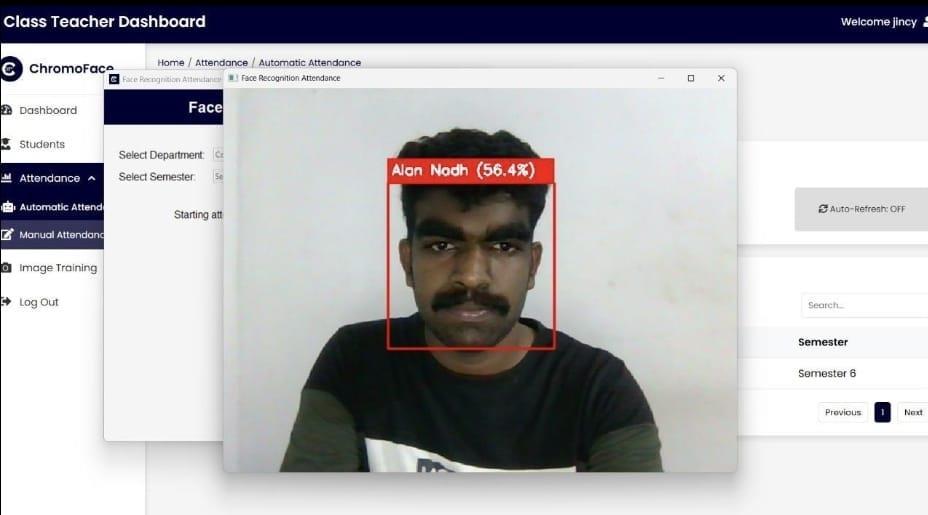
In a real-world classroom or institutional setting, the systemisdeployedusinga webcamor CCTVfeedinstalled atclassroomentrypoints.Whenstudentsenter,thesystem activates and captures facial images in real time. These images are processed using OpenCV for face detection, followed by feature extraction and recognition via the LBPH (Local Binary Pattern Histogram) algorithm. Each detected face is compared against a pre-trained dataset of facial images collected during the student registration phase.
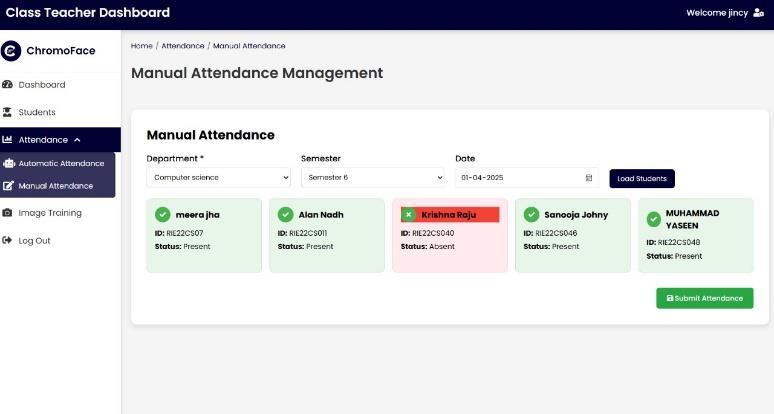
The system architecture supports multiple user roles Admin,Faculty,andStudent eachwithtailoredinterfaces. Administrators are responsible for adding departments, semesters, students, and faculty data through the dashboard. Faculty can train new student face data, take attendance, and manage exceptions (e.g., edit absentees). Students can log in to view their attendance status and history.
To ensure operational reliability, the backend leverages Python (with Flask) and MongoDB for scalable data storage. Attendance is recorded in both .csv and .xlsx formats, facilitating integration with existing academic reporting systems. Real-time recognition ensures that attendance is logged with a timestamp, and unauthorized or unrecognized faces are marked as “Unknown,” thus minimizingtheriskofproxyattendance.
This deployment offers numerous advantages in a live educational context. Itreducesadministrativeoverhead by automating roll-calls, prevents fraudulent entries, and enhances data transparency. Additionally, it enables quick attendance analytics across departments and semesters and provides accurate, tamper-resistant logs useful for auditsorcompliancetracking.
From a technical perspective, this system can be scaled across multiple classrooms by integrating the central database and deploying additional recognition nodes. It also opens avenues for integration with cloud services or IoT devices for remote access and monitoring, making it highly adaptable to institutional growth and evolving digitalinfrastructure.
The Attendance Management System with Facial Recognition is a solution designed to simplify attendance tracking while ensuring accuracy and security. It incorporates facial recognition technology to identify students and mark their attendance. The system features an admin dashboard for managing student and faculty accounts, a registration option for students to provide personalandfacialrecognitiondetails,andfacultytoolsfor markingattendanceviafacialrecognition,withanoptionto manually edit the attendance. Attendance is automatically logged in Excel and CSV files,and students and faculty can view attendance records and summaries. Key benefits include improved accuracy, efficiency, security, detailed insights into attendance patterns, and streamlined administrativeprocesses.Thesystemrequireshighquality cameras, facial recognition software, serversfor data storage, reliable internet connectivity, and secure infrastructure.
International Research Journal of Engineering and Technology (IRJET) e-ISSN:2395-0056
Volume: 12 Issue: 06 | Jun 2025 www.irjet.net p-ISSN:2395-0072

International Research Journal of Engineering and Technology (IRJET) e-ISSN:2395-0056
Volume: 12 Issue: 06 | Jun 2025 www.irjet.net p-ISSN:2395-0072
6.CONCLUSION
Face Detection Attendance Management System aims to develop a face recognition-based attendance monitoring system to enhance and modernize the current attendance system in educational institutions. During attendance sessions,detectedfacesarecomparedagainstthedatabase, leading to automatic attendance recording for identified Individuals otherwise invalid. The benefits of integrating facial recognition technology extend beyond accuracy and efficiency. This innovation fosters a tech-savvy, disciplined environment in classrooms, signalling a commitment to modernizing education. It demonstrates to students that their institutions are willing to embrace new technologies to enhance the learning experience. Furthermore, the ease of use and intuitive nature of these systems make them appealing to educators and administrators alike. By automating attendance, schools and colleges can free up timeandresourcesthatcanberedirectedtowardenriching the educational experience. Beyond the immediate advantages, facial recognition technology has the potential to pave the way for broader tech integration in education. From personalized learning tools to smarter classroom
management systems, the adoption of cutting-edge technology can transform the way institutions operate. It sets a precedent for embracing innovation and opens the door to possibilities that can improve both academic and administrativepractices.
Automating attendance management through facial recognition technology is more than just a convenience it’s a step toward revolutionizing educational systems. It addresses the limitations of traditional methods while bringing multiple benefits such as accuracy, efficiency, and fostering a forward-thinking culture. As educational institutionsevolvetomeetthedemandsofadigitalage,the integrationofsuchadvancedsystemscanhelpbuildamore engaging, disciplined, and future-ready learning environment. By embracing innovation, I ensure that education remains relevant and impactful in shaping the leadersoftomorrow.
[1] "A Python Environment for Computer Vision ResearchandEducation"byR.PiresandA.GarciaSilva,JournalofOpen-SourceSoftware,2018.
[2] "Image Processing using OpenCV and Python" by D. Rathi and S. Patil, International Journal of ComputerApplications,2018.
[3] "Object Detection using Haar Cascades and OpenCV" by A. Gupta and R. Sinha, International Journalof ScientificResearchinComputerScience andEngineering,2016.
[4] "A Comparative Study of OpenCV, MATLAB, and PythonforImageProcessing"byM.HossainandS. Islam, International Journal of Computer Science andNetworkSecurity,2018.
[5] "DataVisualizationandAnalysisusingPythonand Pandas" by S. Ahuja and 1 Chopra, International JournalofComputerApplications,2016.
[6] "Object Recognition using Haar-like Features and Support Vector Machines" by M. Çay H and N. Çeliktutan,ProcediaComputerScience,2017.
[7] "AComparative Studyof PythonLibrariesfor Data Science" by V. G. Vinod and S. Latha, International JournalofComputerApplications,2018.