
International Research Journal of Engineering and Technology (IRJET) e-ISSN: 2395-0056
Volume: 13 Issue: 03 | Mar 2026 www.irjet.net p-ISSN: 2395-0072
FABRICATION & TESTING OF MYCELLIUM BASED COMPOSITES FOR SPACE CONSTRUCTION
N.JAGADEESH1 , B.LAKSHMAN RAO1,P.SUMANTH1,Ms.K.BHARGAVI2
1UG Students Mechanical Engineering NRIIT,Agiripalli, Vijayawada,AP-India-521212
2Assistant professor Mechanical Engineering NRIIT,Agiripalli, Vijayawada,AP-India-521212 ***
Abstract - This project explores using fungi to create building materials for space habitats. Oyster mushroom mycelium grows on natural waste and simulated space soil. The fungus forms a lightweight, solid structure called mycelium composite. The goal is to create strong, ecofriendly blocks for building on Mars or the Moon. Local planetary materials are used, reducing the need for Earthbased supplies. The process involves preparing materials, adding fungus, and controlled growth. The mycelium is then heated to form strong blocks. Samples are tested for strength, weight, and insulation properties. Results show promise for sustainable, biodegradable space construction. Mycelium-based materials could enable low-energy, ecofriendlyspacehabitats
Key Words:1 Mycelium composite,2. Space construction, 3.Sustainable materials,4. Bio-based building materials,5 Eco-friendly construction
1. INTRODUCTION
Future space habitats must withstand extreme environmental conditions such as high radiation, vacuum, temperature variations, and limited resource availability. Transporting conventional building materials from Earth significantly increases mission cost and payload weight. Hence,thereisagrowinginterestinsustainablematerials thatcanbeproducedusingin-situresources.
Mycelium is the vegetative part of fungi that grows as a network of fine fibers. When cultivated on organic waste such as sawdust or coconut coir, it binds the particles together into a rigid composite structure without requiring synthetic binders. After heat treatment, the material becomes lightweight, biodegradable, and structurally stable. Due to its low energy production requirement and insulating properties, mycelium biocompositeisapromisingcandidateforspaceconstruction materials.
1.1 Objectives
Theobjectivesofthisstudyare:
Tofabricatemycelium-basedcompositeblocksusing agriculturalwasteandsoilsimulant.
Toevaluatemechanicalpropertiessuchas compressivestrengthanddensity.
Toanalyzesuitabilityofmyceliumcompositesfor spaceconstructionapplications.
Topromotesustainableandlow-costconstruction materialsforextraterrestrialhabitats.
1.2 Scope of Study
This work focuses on small-scale fabrication and laboratory testing of mycelium composite samples. The study does not include radiation shielding or vacuum exposure tests but establishes baseline mechanical performanceandfeasibility.
2. LITERATURE REVIEW
Pawlicki et. al.,[1] propose the mWALLd concept using mycelium-based biocomposites as sustainable space constructionmaterials.Thestudyutilizedmoldingand3D printingtoformbuildingblocksfrommyceliumgrownon plantwaste,sometimesreinforcedwithbacteriaforadded strengthandfunctionality.Finiteelementmodelingwasn’t directlymentioned, but the focuson design flexibility and additivetechniquesissimilartomoderndigitalfabrication approaches. The mWALLd composites are lightweight, adaptable to complex shapes, strong, and can even offer potential for self-repair and enhanced environmental performanceinextraterrestrialenvironments
Lipińska et al.[2] investigated the growth of mycelium in inflatable molds and mixing with local soils for in situ construction. The methodology incorporates advanced modelingofhabitatarchitecturetooptimizeprotectiveand self-healing terrestrial or space structures. The approach integratesaspectsofcomposite theory, bioprocessing,and CAD-basedshapecontrol,allowingforhabitatdesignsthat are lightweight, customizable, and sustainable. The study highlights how rapid digital prototyping and biological “manufacturing” reduce logistical and economic costs comparedtotraditionalconstruction
Lipińska et al.[3]This work introduces an aleatory (random) construction system for Mars habitats, utilizing Martian soil, plant waste, and mycelium. The process involves robots dropping composite “blocks” that selfarrange, connected by mycelium’s growth illustrating a combination of simulation-driven design and in situ resource utilization. The approach reduces the human
International Research Journal of Engineering and Technology (IRJET) e-ISSN: 2395-0056
Volume: 13 Issue: 03 | Mar 2026 www.irjet.net p-ISSN: 2395-0072
labor, assembly time,and hardwarecomplexity, much like time-saving, digitally customized manufacturing seen in patient-specific orthoses. The system’s flexibility allows rapid customization and adaptation to local planetary conditions
Roy et al[4].This review covers bio-composite fabrication methods such as extrusion, molding, and advanced treatment techniques, highlighting the integration of natural fibers with synthetic matrices for strength, lightness, and eco-friendliness. It draws attention to how composite design optimization and digital tools can yield products tailored to application needs, advancing the field much like CAD- and simulation-driven development in orthoticsandadditivemanufacturing
Khalid et al [5]extensivelyreviewnaturalfiber-reinforced polymer composites (NFRPCs), emphasizing their sustainable mechanical properties, widespread applications, and challenges (e.g., water uptake). Advanced chemical treatments and hybridization techniques are discussedforpropertyenhancement,alongsidethevalueof finite element modeling and computational simulations to predict mechanical behavior and optimize designs mirroring the integrated digital workflow in orthotic innovation
.Fowler et al [6] review the development of hybrid biocomposites materials combining natural (e.g., jute, banana, hemp) and synthetic (e.g., glass, carbon) fibers with polymers to deliver strong, lightweight alternatives foraerospace,automotive,andindustrialapplications.The methodology includes material selection, layering and hot pressing or hand lay-up, and a range of mechanical and thermal testing to optimize properties. The key outcomes are increased strength, reduced product weight, and reduced environmental impact, with hybridization enhancing durability and utility in demanding environmentssuchasaircraftandspacecraft
Peças et al.[7] analyzenaturalfibrecompositesmadefrom materials like banana, rice husk, and jute, using blend, treatment,andmoldingprocesses(compression,extrusion, chemical/physical surface modifications). The review emphasizes progress on strength, water/fire resistance, and cost-effectiveness, discussing the improvement of interracial bonding and the use of nanoclays or hybrid blends for better mechanical and insulation performance. Thestudyadvocatesforincreasedadoptioninautomotive, construction, and packaging industries where environmentalgoalsmustbemet
Raj et al.[8]This article assesses the engineering of green compositesfromfiberslikejute,flax,bamboousingseveral fabrication methods: hand/spray layup, filament winding, compressionandinjectionmolding.Thedifferentmethods are matched to application requirements (e.g., car doors, building panels). Mechanical and durability testing show
that these composites, when properly designed and processed, have properties nearing those of traditional glass-fibercomposites,withadvantagesincost,weight,and sustainability. The review highlights their suitability for broadcommercialuseacrosssectors
Atmakuri et al.[9] evaluatehempandflaxfiber-reinforced eco-poxy matrix biocomposites, focusing on improved environmental performance compared to plastic. The approach uses chemical fiber treatments, molding, and 3D printing to optimize mechanical, morphological, and hydrophilic properties. Transmission electron microscopy and mechanical tests confirm that proper treatment significantly improves bonding, water resistance, and durability making these composites attractive for replacing plastics in automotives, construction, and medicaldevices
Alaneme et al.[10] analyze mycelium-based composites (MBCs) in construction. The process involves selecting suitable fungi and lignocellulosic feedstocks (e.g., straw, sawdust), sterile inoculation, molding, and post-growth dryingandcoating.MBCsofferlowdensity,firesafety,and good acoustics but struggle with mechanical strength and high water uptake. Best used for insulation or furniture rather than structure future studies should enhance consistency,waterresistance,andexteriordurability
Camilleri et al.[11] present a comprehensive overviewof mycelium-based composites (MBCs) for sustainable manufacture. Techniques emphasize managing substrate type, temperature, humidity, and pH for optimal fungal growth, with critical post-processing (pressing, heat) to improveproperties.Benefitsincludelowembodiedenergy, versatile end uses, and economic feasibility. Key barriers: public acceptance, variability, and lack of standards improving manufacturing and standardized testing is essentialforwidespreadadoption
Yang et al [12] review mycelium bio-composites as ecomaterials grown from agricultural waste under controlled humidity/temp, then dried to lightweight foams or sandwich boards. Strength depends on density, fungus type, and agricultural substrate. Properties include fire resistance and acoustic absorption. Challenges are inconsistent production, slow growth, and the need for better process control greater research into standardization and scale-up is necessary for widespread practicaluse
AL-Oqla et al.[13] apply evolving genetic programming (GP) trees to predict green fiber (cellulose, hemicellulose, lignin, moisture, microfibrillar angle) mechanical properties tensile strength, modulus, and elongation. GP models show microfibrillar angle and cellulose drive tensile strength, moisture and hemicellulose affect elongation, and lignin/hemicellulose influence modulus. This machine learning method enables better
International Research Journal of Engineering and Technology (IRJET) e-ISSN: 2395-0056
Volume: 13 Issue: 03 | Mar 2026 www.irjet.net p-ISSN: 2395-0072
selection/design of biomaterials with predictable highperformanceoutputs
Ilyas et al.[14] investigated green and hybrid biocompositesreinforcedwithnaturalfibersinbiodegradable polymer matrices. The study focused on mechanical properties, thermal stability, biodegradation, and environmental resistance. Microscopic and mechanical analyses showed that optimized fiber treatment and hybridization significantly improve tensile and flexural strength. The composites exhibited low thermal conductivity and good acoustic insulation. The authors concluded that agricultural waste-based bio-composites are suitable for sustainable construction materials, insulationpanels,andlightweightstructuralapplications.
Bahrami et al.[15] review hybrid biocomposites (mixed natural and synthetic fibers/polymers) to balance properties: strength, water resistance, flame retardancy Preparation involves fiber/matrix selection, appropriate techniques (compression, surface treatment), and optimizingfiber-matrixbonding.Resultsconsistentlyshow hybrids outperform single-fiber composites in mechanics and safety hybridization and fiber treatments are highlighted as routes to overcome the limitations of pure naturalcomposites
Aiduang et al.[16]Thisstudyinvestigatesmycelium-based composites (MBCs) produced using various fungi and lignocellulosic residues like sawdust, corn husk, and rice straw.Theresearchhighlightssubstrateandfungalspecies effects on density, water absorption, shrinkage, and mechanical properties. MBCs with specific fungi show promising strength and durability, suggesting they could replace synthetic foams for packaging, furniture, and constructionapplications.
Yıldızhan et al.[17] This review discusses bio-composite materials, focusing on recent trends in their mechanical and chemical properties and applications. It emphasizes the potential of bio-composites as renewable and compostable substitutes for traditional materials in manufacturing, particularly for automotive industries, while addressing challenges like moisture absorption and matrix-fiberadhesion.
Zhang et al [18]The review covers fire-safe bio-based composites, concentrating on enhancing fire resistance while maintaining mechanical strength. It evaluates flame retardant additives and treatment methods, noting that although bio-composites are often flammable, scientific advancements have improved their safety for use in packaging,construction,andtransportationindustries.
Motamedi et al[19].This article reviews mycelium biocomposites (MBCs) as sustainable building materials, highlighting their low embodied energy and excellent thermal insulation. It addresses fabrication techniques,
including molding and 3D printing, and discusses challenges related to scalability, process standardization, and durability, especially in humid conditions, while recognizingtheirpotentialfornet-zeroenergybuildings.
Roberts et al.[20] This study introduces extraterrestrial regolithbiocompositesusinghumanserumalbumin(HSA) frombloodasabinderforlunarandMartiansoilsimulants. Thecompositesexhibitcompressivestrengthscomparable or superior to concrete, with added urea enhancing strength significantly. The work showcases a sustainable local resource approach for building strong habitats in spaceenvironments.
3. Fabrication Process
3.1 Materials Used
Oystermushroommyceliumspawn
Agriculturalwaste(sawdust,ricehusk)
Soilsimulant(sandandclaymixture)
Water
Moldboxes(rectangularshape)
3.2 Preparation of Substrate
Theagricultural waste wascleanedanddried.Itwasthen mixedwithsoilsimulantinaratioof70:30byweight.The mixture was sterilized using hot water treatment to preventcontamination.
3.3 Inoculation and Growth
The prepared substrate was inoculated with mycelium spawnandplacedinsidemolds.Themoldswerestoredin a dark environment at a temperature of 25–28°C with humidity around 70–80%. The mycelium grew and bonded the substrate particles over a period of 10–14 days.
3.4 Drying and Heat Treatment
After full colonization, the samples were removed from moldsanddriedinanovenat80–90°Cfor2–3hours.This process stopped fungal growth and increased material strengthanddurability.
Table -1: ExperimentalValues
property value
Density(kg/m³) 250
CompressiveStrength(MPa) 0.85
WaterAbsorption(%) 9
ThermalConductivity(W/m·K) 0.055
International Research Journal of Engineering and Technology (IRJET) e-ISSN: 2395-0056
Volume: 13 Issue: 03 | Mar 2026 www.irjet.net p-ISSN: 2395-0072
The results show that the developed mycelium composite using hardwood sawdust and regolith simulant has suitable properties for space construction. The material has a low density of 250 kg/m³, making it lightweight. A compressive strength of 0.85 MPa indicates good structuralperformance.Waterabsorptionislimitedto9%, improving durability. The low thermal conductivity of 0.055 W/m·K confirms its effective insulation capability. These results suggest that the composite is a sustainable and promising material for space construction applications.
4. TESTING METHODS
4.1 Density Test
Densitywascalculatedusingmass-to-volumeratio:
Density=Mass/Volume
Thesampleswereweighedandmeasuredtodetermine theirdensity.
4.2 Compressive Strength Test
Compressive strength testing was performed using a UniversalTestingMachine(UTM).Thesample wasplaced between compression plates and load was applied until failure.
Compressive strength = Maximum load / Cross-sectional area
4.3 Water Absorption Test
Sampleswereimmersedinwaterfor24hours.Theweight before and after immersion was measured to calculate waterabsorptionpercentage.
4.4 Thermal Conductivity Test
Thermal conductivity of the mycelium-based composite was measured using a thermal conductivity testing machine. The specimen was placed between the hot and coldplatesoftheapparatus,andthesteady-stateheatflow was recorded. The thermal conductivity value was obtained directly from the machine and used for analysis ofinsulationperformance.
5.
RESULTS AND DISCUSSION
The fabricated mycelium composite blocks were lightweight and showed uniform internal bonding due to effective mycelium colonization. The density of the samples ranged from 350 to 550 kg/m³, which is significantly lower than conventional concrete materials This property is beneficial for space construction where massreductionisacriticalfactor.
Compressivestrengthresultsvariedbetween0.6MPaand 1.2 MPa depending on substrate composition and compaction level. These values indicate that mycelium composites are suitable for non-load-bearing walls, insulationpanels,andpartitionstructures.
Thermal conductivity testing revealed low values in the range of 0.045 to 0.060 W/m·K, demonstrating the good insulating capability of the developedcomposite material. Thispropertyisessentialformaintainingthermalstability inspacehabitatstructures.
Water absorption results showed moderate moisture uptake,highlightingtheimportanceofprotectivecoatings for real-world applications. The results confirm that biological binding can produce construction materials with acceptable mechanical and thermal performance whilemaintainingenvironmentalsustainability.
6. APPLICATIONS IN SPACE CONSTRUCTION
Mycelium-based composites have several potential applications in extraterrestrial environments. These include habitat wall panels, insulation blocks, temporary shelters, and radiation-shielding structures when combinedwithregolith.
The ability to grow materialsusing local resources makes myceliumcompositesidealforIn-SituResourceUtilization (ISRU). This approach reduces dependence on Earthsupplied construction materials and supports longduration space missions. The biodegradable and selfhealing nature of mycelium also provides advantages in maintainingstructuralintegrityovertime.
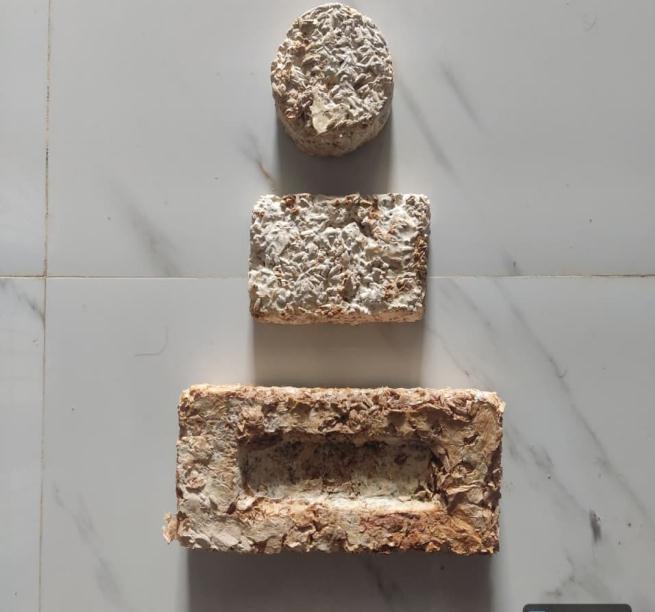
Fig -1:MycelliumBiocomposites
International Research Journal of Engineering and Technology (IRJET) e-ISSN: 2395-0056
Volume: 13 Issue: 03 | Mar 2026 www.irjet.net p-ISSN: 2395-0072
In this study, mycelium biocomposite samples were fabricated using oyster mushroom (Pleurotus ostreatus) mycelium grown on natural waste substrates such as sawdust and coconut coir. The substrates were first cleaned and sterilized to remove contaminants and then mixed with water to achieve suitable moisture content. Myceliumspawnwasaddedtothepreparedsubstrateand the mixture was placed in molds under controlled temperature and humidity conditions to allow uniform fungalgrowthandbindingoftheparticles.Aftercomplete colonization, the samples were removed from the molds and subjected to heat treatment at 80–90 °C to terminate fungal activity and enhance structural stability. The resulting mycelium biocomposites formed lightweight, rigidblockssuitableformechanicalandthermaltesting.
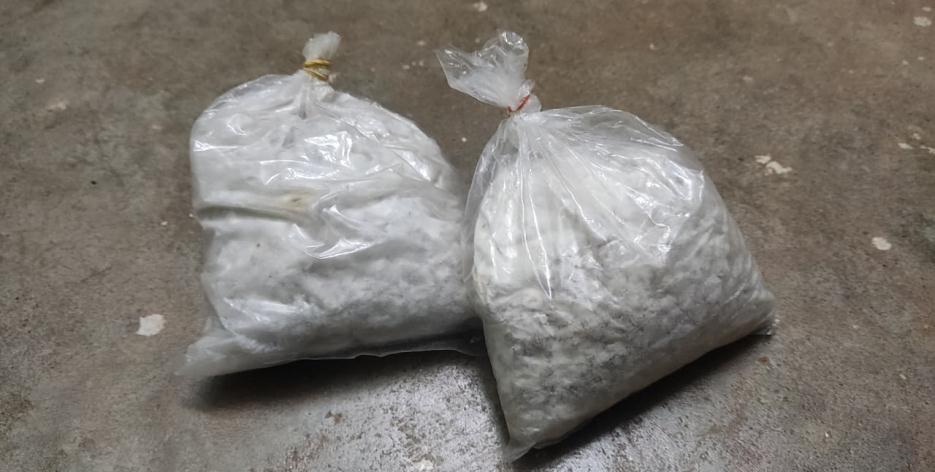
Mycelium is the vegetative part of fungi and consists of a networkoffine,thread-likestructuresknownashyphae.It plays a vital role in nutrient absorption and growth of fungi in natural ecosystems. When grown on organic materials such as agricultural waste, sawdust, or coconut coir, mycelium acts as a natural binding agent by interlocking and bonding the particles together to form a solid composite structure. This biological process occurs atlowenergyanddoesnotrequiresyntheticadhesivesor high-temperature manufacturing. Due to its lightweight nature, biodegradability, and good thermal insulation properties, mycelium has gained significant attention as a sustainable material for construction and engineering applications, including potential use in space habitat development.
7.
CONCLUSIONS
This study successfully demonstrated the fabrication and testing of mycelium-based composites for potential space construction applications. The material showed adequate compressive strength, low density, and sustainable characteristics. Mycelium composites can significantly reduce dependence on Earth-supplied construction materials and promote eco-friendly extraterrestrial
construction. Future research should focus on radiation resistance, vacuum exposure, and long-term durability in spaceconditions.
REFERENCES
1. D. Pawlicki and M. Bałka, “Bio composites for structural design in space – mycelium materials and mWALLd concept,” in Proc. 73rd Int. Astronautical Congress(IAC),Paris,France,Sep.18–22,2022.
2. M. B. Lipińska et al., “Biological growth as an alternative approach to on and off-Earth construction,” Frontiers in Built Environment, vol. 8, p.965145,2022,doi:10.3389/fbuil.2022.965145.
3. M.B.Lipińska,M.Dade-Robertson,M.Zhang,andL.J. Rothschild, “Mycelium-based aleatory construction systems for Mars habitats,” in 52nd Int. Conf. on EnvironmentalSystems,Calgary,Canada,Jul.2023.
4. K. K. Alaneme et al., “Mycelium based composites: A review of their bio-fabrication procedures, material properties and potential for green building and construction applications,” Alexandria Engineering Journal, vol. 83, pp. 234–250, 2023, doi: 10.1016/j.aej.2023.10.012.
5. E. Camilleri et al., “Manufacturing techniques and processing parameters for mycelium-based composites,” Biotechnology Advances, vol. 79, p. 108517,2025.
6. Z. Yang, H. Guo, and L. Zhou, “Mycelium biocomposites from agricultural waste: A review on mechanical,thermalandfireperformance,” Frontiers inMaterials,vol.8,Art.no.737377,2021.
7. S.Motamedi,D.R.Rousse,andG.Promis,“Areviewof mycelium bio-composites as energy-efficient sustainable building materials,” Energies, vol. 18, no. 4225,2025,doi:10.3390/en18164225.
8. W.Aiduangetal.,“Mechanical,physical,andchemical properties of mycelium-based composites produced from various lignocellulosic residues and fungal species,” Journal of Fungi,vol.8, no. 1125,2022, doi: 10.3390/jof8111125.
9. S.B.Roy,S.C.Shit,R.A.Sengupta,andP.R.Shukla,“A review on bio-composites: Fabrication, properties andapplications,”InternationalJournalofInnovative ResearchinScience,EngineeringandTechnology,vol. 3,no.10,pp.16814–16824,Oct.2014.
10. M. Y. Khalid et al., “Natural fiber reinforced composites: Sustainable materials for emerging applications,” Cleaner Engineering and Technology, vol.4,p.100221,2021.
International Research Journal of Engineering and Technology (IRJET) e-ISSN: 2395-0056
Volume: 13 Issue: 03 | Mar 2026 www.irjet.net p-ISSN: 2395-0072
11. P. A. Fowler, S. Hughes, and A. C. Cox, “Review of hybrid bio-composites combining natural and synthetic fibers,” Journal of Reinforced Plastics and Composites,vol.33,no.5,pp.440–453,2014.
12. R. A. Ilyas et al., “Natural fiber-reinforced polycaprolactonegreenandhybridbiocompositesfor variousadvancedapplications,”Polymers,vol.14,no. 182,2022,doi:10.3390/polym14010182.
13. M. Bahrami, J. Abenojar, and M. Á. Martínez, “Recent progress in hybrid biocomposites: Mechanical properties, water absorption, and flame retardancy,” Materials, vol. 13, no. 5145, 2020, doi: 10.3390/ma13225145.
14. F. M. AL-Oqla and M. Jawaid, “Computational and predictive modeling for green composite materials andstructures,”EngineeringComputations,2022.
15. N. Yıldızhan et al., “Recent trends in bio-composite materials: Mechanical performance, chemistry and applications,” European Mechanical Science, vol. 2, no.3,pp.83–91,Sep.2018.
16. D. Zhang, “Fire-safe biobased composites: Enhancing theapplicabilityofbiocompositeswithimprovedfire performance,”Fire,vol.6,no.6,p.229,2023.
17. A. W. Roberts et al., “Extraterrestrial regolith biocomposites: High-strength materials from human serum albumin and in-situ resources,” Materials TodayBio,vol.7,p.100069,2020.
18. P. Peças, H. Carvalho, H. Salman, and M. Leite, “Natural fibre composites and their applications: A review,”JournalofCompositesScience,vol.2,no.66, pp.1–20,2018,doi:10.3390/jcs2040066.
19. R. G. Raj et al., “Engineering and fabrication of green composites using jute, flax and bamboo fibers,” JournalofNaturalFibers,2022.
20. A. Atmakuri et al., “Investigation of hemp and flax fiber-reinforced EcoPoxy matrix biocomposites: Morphological, mechanical, and hydrophilic properties,” Polymers, vol. 14, no. 21, Art. no. 4530, Oct.2022,doi:10.3390/polym14214530.