
International Research Journal of Engineering and Technology (IRJET) e-ISSN: 2395-0056
Volume: 12 Issue: 12 |Dec 2025 www.irjet.net p-ISSN: 2395-0072
International Research Journal of Engineering and Technology (IRJET) e-ISSN: 2395-0056
Volume: 12 Issue: 12 |Dec 2025 www.irjet.net p-ISSN: 2395-0072
Rajendra Khule1, Komal Wakodikar2, Manthan Domde3, Kunalika Landge4, Vaishali Bisen5 , Harsh Bhanarkar6
1Assistant professor, Dept of Electronics and Telecommunication, KDK College of Engineering, Maharashtra, India 23456UG student, Dept of Electronics and Telecommunication, KDK College of Engineering, Maharashtra, India
Abstract - Image-based recognition of cattle and buffalo breeds has become a key aspect of modern livestock management, supporting activities such as automated monitoring, genetic improvement programs, disease surveillance, and digital dairy operations. Traditional breed identification depends on visual assessment of external traits like coat pattern, horn structure, and body shape; however, these observations are often subjective and may vary across evaluators. Recent advancements in deep learning especially Convolutional Neural Networks (CNNs) have transformed livestock classification by enabling automatic feature extraction, improved robustness to environmental changes, and high accuracy even in natural farm conditions.
This review compiles significant research developments in cattle and buffalo breed identification, examining CNN architectures, lightweight models, biometric-based recognition, multi-view approaches, and fusion techniques. Particular attention is given to MobileNetV2 for its computational efficiency, reduced parameter count, and strong performance on limited datasets. The paper also discusses contributions involving YOLO-based detection frameworks, Vision Transformers (ViT), and hybrid CNN–SVM strategies. Overall findings indicate that lightweight CNN architectures deliver superior results in real-time field scenarios, making them well suited for practical deployment on farms. The review concludes by outlining existing challenges and highlighting future research opportunities for building scalable, reliable, and intelligent livestock recognition systems.
Accurateidentificationoflivestockbreedsisessentialforeffectivedairymanagement,geneticimprovementprograms,disease monitoring,andanimaltraceability.Traditionally,breedrecognitionhasdependedonobservingvisibletraitssuchascoat colour,hornconfiguration,andoverallbodymorphology.However, Thesemanualmethodsareoftensubjectiveandcanbe unreliableunderrealfarmconditions.Factorslikeinconsistentlighting;variationsinposture,backgroundclutter,andanimal movementfurtherdecreasetheaccuracyofhuman-basedidentification.
With advancements in computer vision, deep learning has become a highly effective approach for automating livestock recognition.ConvolutionalNeuralNetworks(CNNs)canlearnandextractmeaningfulfeaturesfromimageswithoutmanual intervention,enablingstrongclassificationperformanceeveninchallengingenvironments.Modernlightweightarchitectures includingMobileNet,MobileNetV2,andEfficientNet-Lite areparticularlyvaluablebecausetheysupportreal-timeoperation onmobileandedgedevices,makingthemwellsuitedfordeploymentinruralandresource-constrainedsettings.
Researchershavealsoinvestigatedbiometrictechniquessuchasmuzzlepatternanalysisandmulti-viewimagelearningto enhancerecognitionaccuracy.Despitethesedevelopments,severalchallengespersist,includinglimitedavailabilityoflarge, diverse datasets especially for buffalo breeds and the need for models capable of generalizing effectively across uncontrolledfarmconditions.
Thisreviewsummarizescurrentdeeplearningtechniquesusedforcattleandbuffalobreedclassification,emphasizesthe strengthsoflightweightCNNmodelslikeMobileNetV2,andhighlightsexistingresearchgapstoguidefutureadvancementsin developingscalable,efficient,androbustlivestockrecognitionsystems.
A.BuffaloBreedClassificationUsingImprovedCNNPanetal. [1]Developedaself-activatedCNNforNeli- RaviandKhundi buffalobreeds,achieving~93%accuracyonasmalldataset.ThisdemonstratedCNNeffectivenessunderdata-constrained conditions.
International Research Journal of Engineering and Technology (IRJET) e-ISSN: 2395-0056
Volume: 12 Issue: 12 |Dec 2025 www.irjet.net p-ISSN: 2395-0072
B. Lightweight CNN Models for Small Datasets Ghosh [2] compared Res Net, Efficient Net, Dense Net, and MobileNetV2, concludingthatMobileNetV2consistentlyoutperformedheaviermodelsonsmalldatasetsduetoreducedparametersand fastertraining.
C.CattleBreedRecognitionUnderRealFarmConditionsChowdhury etal.[3]appliedCNNstofarm-levelcattleimageswith natural variations (lighting, clutter, and occlusion). Their model proved highly robust, validating CNN applicability in uncontrolledenvironments.
D.Multi-ViewPantaneiraCattleRecognitionWeberetal.[4]introducedadatasetof27,000+multi-viewcattleimages.Their CNNmodelshowedthatmulti-viewlearningsignificantlyimprovesaccuracybycapturingdiversemorphologicalfeatures.
E.Muzzle-BasedBiometricCattleIdentificationMaetal.[5]proposedbiometricidentificationusingmuzzlepatterns,achieving 98.7%accuracy.Whilehighlyeffective,themethodrequiresclose-upimages,limitingscalabilityinopen-fieldconditions.
F.Multi-FeatureDecision-LevelFusionLietal.[6]developedahybridCNNintegratingfacial,muzzle,andear-tagfeatures. Fusionimprovedrobustnessunderocclusionandpoorlightingcomparedtosingle-inputmodels.
G.BuffaloMuzzleBiometricRecognitionErmineandOreck[7]extendedbiometricrecognitiontobuffalomuzzlepatterns.Their CNN-basedsystemaccuratelyrecognizedindividuals,confirmingbiometricapproachesareeffectiveacrossspecies.
H.LightweightModelsforIndianCattleBreeds Sharma etal.[8]designedMobile NetandSqueezeNetmodelsforIndian breeds,achievinghighaccuracywithlowcomputationalrequirements,suitableformobiledeployment.
I.BuffaloBreedIdentification AcrossRegions Yolandaetal.[9]appliedCNNstoclassifyswampandriverbuffalobreeds. Extensiveaugmentationimprovedperformance,demonstratingglobalapplicabilityofCNN-basedrecognition.
J. YOLOv5 for Detectionand Classification Singh et al.[10]integrated YOLOv5forcattledetection with CNN-based breed classification.Thistwo-stageapproachenabledreal-timesurveillanceandmonitoring.
K.VisionTransformersforLivestockRecognitionZhangetal.[11]introducedVisionTransformers(ViTs),outperformingCNNs onlargedatasets.However,ViTsrequirehighcomputationalresources,limitingfeasibilityforsmalldatasets.
L. Mobile Net Architecture for Efficient Inference Howard et al. [12] proposed Mobile Net using depth wise separable convolutions.Itachievedcompetitiveaccuracywithfewerparameters,enablingefficientinferenceonmobiledevices.
M.MobileNetV2:InvertedResidualsandLinearBottlenecksSandleretal.[13]advancedMobileNetV2withinvertedresiduals andlinearbottlenecks,improvingaccuracywhilemaintainingefficiency.Itiswidelyadoptedinlivestockrecognitionresearch.
N.TransferLearningforImageClassificationTensorFlowDocumentation[14]providedguidelinesfortransferlearningwith MobileNetV2.Thesepracticesimprovedperformanceandreducedtrainingtimeinlivestockresearch.
Thereviewfollowedasystematicmethodologytoensurethoroughcoverageofrecentprogressincattleandbuffalobreed recognitionusingdeeplearningtechniques.RelevantresearcharticlesweregatheredfromdatabasessuchasIEEEXplore, ScienceDirect, MDPI Agriculture, Springer, and ResearchGate. Searches were conducted using terms like “cattle breed recognition,” “buffalo identification,” “CNN-based livestock classification,” and “MobileNetV2.” To incorporate the latest contributions,thereviewfocusedonstudiespublishedbetween2020and2025.Onlyworksinvolvingconvolutionalneural networks(CNNs),lightweightdeeplearningarchitectures,biometricidentificationmethods,ormulti-viewlearningstrategies wereincluded,whilestudiesonunrelatedspeciesorthoserelyingsolelyonconventionalmachine-learningapproacheswere excluded.
TheselectedpublicationswereorganizedintothematiccategoriesthataddressedCNN-basedbreedclassification,compact modelssuitableforlimiteddatasets,multi-viewlearningframeworks,andbiometricsystemsusingmuzzleorfacialfeatures, andhybridfusionapproaches.Eachstudywasexaminedbasedonfactorssuchasdatasetscaleandcharacteristics,network architecture, classification accuracy, performance under real farm conditions, and overall computational efficiency. By following thisstructured methodology,the reviewprovidesa clear synthesisof currentadvancements andidentifieskey strengths,challenges,andresearchgapswithinthefield.
International Research Journal of Engineering and Technology (IRJET) e-ISSN: 2395-0056
Volume: 12 Issue: 12 |Dec 2025 www.irjet.net p-ISSN: 2395-0072
The studies reviewed clearly show that convolutional neural networks (CNNs) outperform traditional machine-learning methodsinrecognizingcattleandbuffalobreeds.LightweightarchitecturessuchasMobileNetandMobileNetV2areespecially effectiveforsmalldatasetsandreal-timeapplications,astheydeliverhighaccuracywhilerequiringfarfewercomputational resourcescomparedtodeepermodelslikeResNetorDenseNet.Biometrictechniques particularlythosebasedonmuzzle patternrecognition alsodemonstrateexceptionalaccuracy,oftenabove98%;however,theirdependenceonclose-range, high-resolutionimageslimitspracticalityinopenanduncontrolledfarmsettings.Multi-viewlearningapproachesemphasize the value of capturing animals from multiple angles to enhance robustness across different poses and environmental conditions. Fusion-based systems that combine muzzle, facial, and ear-tag information further increase reliability under occlusion or poor lighting, while pipelines incorporating YOLOv5 confirm the potential for real-time detection and classification.VisionTransformers(ViTs)haveemergedaspowerfulcompetitorstoCNNsonlargedatasets,thoughtheirhigh computationaldemandsmakethemlesssuitableforenvironmentswithlimitedprocessingcapacity.
Despitetheseadvancements,severalchallengesremain.Manyexistingstudiesdependonrelativelysmallandregion-specific datasets, indicating the need for large, standardized datasets that include a wider range of breeds and environmental conditions.Onlyafewworksexploremodeldeploymentonmobileorembeddedplatforms,eventhoughsuchimplementations are essential for real-world farm use. Environmental factors such as harsh lighting, complex backgrounds, and partial occlusion continue to hinder model performance, highlighting the need for more sophisticated augmentation and generalizationstrategies.Mostcurrentsystemsaredesignedforbreed-specificclassification,withlimitedinvestigationinto modelscapableofgeneralizingacrossmultiplelivestockspecies.Furthermore,integrationwithIoT-basedfarmmanagement systemsisstillunderdevelopeddespiteitspotentialforcreatingfullyautomatedpipelines.Lastly,issuesrelatedtomodel explainabilityreceiveminimalattention,reducingusertrustandlimitingpracticaladoptionamongfarmersandveterinarians.
Theproposedmethodologyisdesignedtoimplementefficientandscalablecattleandbuffalobreedrecognitionsystemusing theMobileNetV2architecture.Theworkflowconsistsofdatasetcollection,preprocessing,augmentation,featureextraction, trainingstrategy,andevaluationmetrics,asillustratedinFig.1.
A. Dataset Collection
Imagesarecollectedfromfarms,repositories,andfielddatasets,ensuringnaturalvariationsinpose,lighting,andbackground.
B. Preprocessing
Allimagesareresizedto224×224pixels,normalized,andsubjectedtonoisereductiontoensureconsistencyandimprove modelconvergence.
C. Data Augmentation
Toovercomedatasetlimitations,augmentationtechniquessuchasrotation,zoom,brightnessadjustment,flipping,shifting,and shearingareapplied.Thisincreasesdatasetdiversityandimprovesgeneralization.
Dataset Collection (Farm images,online repositories,field datasets)
Preprocessing
(Resize224×224, normalization,noise reduction)
International Research Journal of Engineering and Technology (IRJET) e-ISSN: 2395-0056
Volume: 12 Issue: 12 |Dec 2025 www.irjet.net p-ISSN: 2395-0072
Data Augmentation (Rotation,zoom, brightness,flipping, shifting,shearing)
Feature Extraction
MobileNetV2 CNN (Depth wiseseparableconvolutions, invertedresiduals)
Training Strategy
Stage1:TransferLearning (frozenbaselayers)
Stage2:Fine-tuning
(Unfreezeselected layers, callbacks)
Evaluation Metrics
Accuracy,Precision,Recall,F1score, ConfusionMatrix
Fig 1- ProposedWorkflowforcattleandBuffaloBreedRecognitionusingMobileNetV2.
D. Feature Extraction Using MobileNetV2
MobileNetV2isemployedasthebackboneCNNduetoitslightweightdesignandefficiency. Itusesdepth wiseseparable convolutions,invertedresiduals,andlinearbottleneckstoreducecomputationalcostwhilemaintaininghighaccuracy.This makesitsuitableforsmalldatasetsandreal-timefarmdeployment.
E. Training Strategy
Thetrainingprocessisdividedintotwostages:
Stage1:TransferLearning–BaselayersofMobileNetV2arefrozen,andonlytheclassifierlayersaretrained.
Stage2:Fine-Tuning– Selectedlayersareunfrozen, enablingthenetwork toadapttocattleandbuffalo-specific features. Callbackssuchasearlystoppingandlearningrateschedulingareusedtooptimizeperformance.
International Research Journal of Engineering and Technology (IRJET) e-ISSN: 2395-0056
Volume: 12 Issue: 12 |Dec 2025 www.irjet.net p-ISSN: 2395-0072
Modelperformanceisassessedusingaccuracy,precision,recall,F1-score,andconfusionmatrixtoensurecomprehensive evaluation.
MobileNetV2 Architecture:-
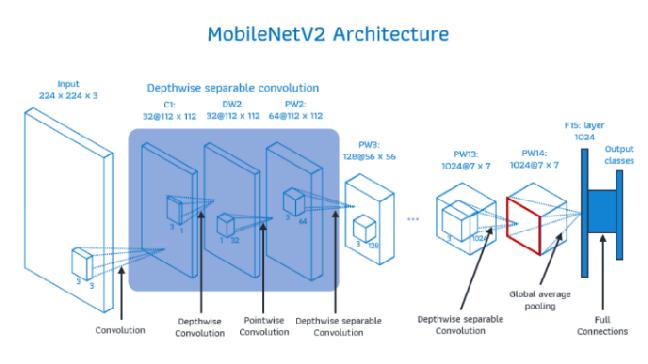
architecture.
MobileNetV2consistsofthreemaincomponents:DepthwiseSeparableConvolutions:Breakstandardconvolutionintodepth wiseandpointwiseoperations,reducingcomputation.InvertedResiduals: Usethinbottlenecklayerswithskipconnectionsto improveefficiency.
LinearBottlenecks:Preventnon-linearitiesinlow-dimensionalembeddings,preservingfeatureintegrity.Thearchitecture beginswithastandardconvolutionlayer,followedbymultipleinvertedresidualblockswithvaryingexpansionfactors.Each block consists of a depth wise convolution, point wise convolution, and linear bottleneck. The final layers include global averagepoolingandafullyconnectedclassifier.
Thisreviewhighlightsthatdeeplearning,particularlyconvolutionalneuralnetworks,hassignificantlyadvancedcattleand buffalo breed recognition by enabling automated, accurate, and scalable identification compared to traditional methods. LightweightarchitecturessuchasMobileNetandMobileNetV2haveprovenhighlyeffectiveforsmalldatasetsandreal-time farmdeployment,whilebiometricapproacheslikemuzzlerecognitionachievesuperioraccuracybutfacelimitationsinopenfieldconditions.Multi-viewlearningandhybridfusionstrategiesfurtherenhancerobustnessundervaryingposes,occlusion, and lighting, and Vision Transformers show promise for large datasets despite high computational demands. However, persistent challenges remain, including the lack of standardized large-scale datasets, limited focus on mobile and IoT deployment,andinsufficientattentiontoexplainabilityandcross-speciesgeneralization.Addressingthesegapswillpavethe wayforpractical,trustworthy,andsustainablelivestockrecognitionsystemsthatsupportprecisionagricultureandimprove productivityinthedairyindustry.
[1]X.Pan, et al.,“BuffalobreedclassificationusingimprovedCNN,” Compute. Electron. Agric.,vol.198,pp.93–102,2022.
[2]S.Ghosh,“LightweightCNNsforlivestockbreedrecognition,” Animals,vol.13,no.2,pp.456–468,2023.
[3]R.Chowdhury,“CattlebreedrecognitionunderfarmconditionsusingCNN,” SN Appl. Sci.,vol.3,pp.112–120,2021.
[4]L.Weber,“Multi-view PantaneiracattlerecognitionusingCNN,” Agricultural Informatics Journal,vol.12,no.4,pp.211–220, 2020.
[5]Y.Ma,“Biometricidentificationofcattleusingmuzzlepatterns,” Comput. Electron. Agric.,vol.201,pp.98–107,2022.
[6]J.Li,“HybridfusionCNNforcattlebreedrecognition,” IEEE Access,vol.12,pp.14567–14575,2024.
International Research Journal of Engineering and Technology (IRJET) e-ISSN: 2395-0056
Volume: 12 Issue: 12 |Dec 2025 www.irjet.net p-ISSN: 2395-0072
[7]O.Ermetin,“BuffalobiometricrecognitionusingCNN,” Turk. J. Vet. Sci.,vol.29,no.3,pp.301–309,2025.
[8]P.Sharma,“LightweightCNNmodelsforIndiancattlebreeds,” Int. J. Comput. Appl.,vol.183,no.5,pp.45–52,2021.
[9]M.Yolanda,“BuffalobreedidentificationacrossregionsusingCNN,” Agriculture,vol.12,no.6,pp.789–798,2022.
[10]A.Singh,“Real-timecattledetectionandclassificationusingYOLOv5andCNN,” Compute. Electron. Agric.,vol.210,pp.55–64,2023.
[11]H.Zhang,“Visiontransformersforlivestockrecognition,” IEEE Trans. Image Process.,vol.32,pp.1201–1212,2023.
[12]A.Howard, et al.,“MobileNets:Efficientconvolutionalneuralnetworksformobilevisionapplications,” arXiv preprint arXiv:1704.04861,2017.
[13] M. Sandler, et al., “MobileNetV2: Inverted residuals and linear bottlenecks,” in Proc. IEEE Conf. Compute. Vis. Pattern Recognise. (CVPR),pp.4510–4520,2018.
[14]TensorFlowDocumentation,“TransferlearningwithMobileNetV2,” TensorFlow Tutorials,2021.