
International Research Journal of Engineering and Technology (IRJET) e-ISSN:2395-0056
Volume:12Issue:11|Nov2025 www.irjet.net p-ISSN:2395-0072
International Research Journal of Engineering and Technology (IRJET) e-ISSN:2395-0056
Volume:12Issue:11|Nov2025 www.irjet.net p-ISSN:2395-0072
MAHAMMADRIZWAN
Professor Dr ARUN B R Dept. of Civil Engineering, Dr. Ambedkar Institute of Technology, Karnataka, India.
Abstract - Self-compacting concrete (SCC) exhibits excellentdeformabilityandfillingabilitywithoutmechanical vibration.Thisstudyevaluatestheinfluenceofspentcoffee grounds(SCG)biochar pyrolyzedat350°Cand400°C as a fine aggregate replacement at 3%, 6%, and 9% on SCC workability parameters. Workability tests performed according to EFNARC guidelines include slump flow, T50 time,V-funnel,L-box,andJ-ringtests.ResultsshowthatSCC mixes containing SCG pyrolyzed at 400°C consistently deliverimprovedflowcharacteristics,reducedviscosity,and superiorpassingabilitycomparedto350°C.Theoptimum replacement level was identified as 3% SCG at 400°C, achievingslumpflowvalueswithin680mm,T50timeof2.2 seconds, V-funnel flow time of 9.2 seconds, L-box ratio of 0.93, and J-ring spread difference of 9 mm. Higher replacement levels (6% and 9%) resulted in reduced flowability,increasedobstruction,andhigherviscosity.The results confirm that SCG biochar can be incorporated sustainablyintoSCCwithoutcompromisingfreshproperties whenusedincontrolledproportions.
Key Words: SCC,Workability,Biochar,SCG,SlumpFlow,VFunnel,L-Box,J-Ring
1.INTRODUCTION
SCCisdesignedtoflowunderitsownweight,requiring carefully optimized fresh concrete properties. Workabilityparameterssuchasfillingability,passing ability,andviscositycontroldeterminethesuitability of SCC mixes for structural applications. This study incorporates sustainable waste-derived material spent coffee grounds (SCG) biochar processed via pyrolysis at two temperatures. The reference guidelines used in this work align with EFNARC specifications. Test results are evaluated based on acceptance ranges and compared with standard SCC performance.
Roychand et al. (2023) (1) Thisresearchfocusedonconverting spent coffee grounds into biochar and using it as a fine
additive in concrete. Workability tests demonstrated that biocharatlowdosagesimprovedflowduetoitsmicro-filling effect, while higher dosages adversely affected slump and dischargetimesinV-funneltests.Thebiochar’shighsurface area increased water demand, reducing spread diameter unlesscompensatedwithadmixtures.Thestudyhighlighted thatbiochar-modifiedmixesexhibitimprovedsustainability butrequireoptimizeddosagestopreventworkabilityloss.
Almeida et al. (2023) [2] This study evaluates sand concretewithnaturalsandwhichispartiallyreplacedby5% of spent coffee grounds. Compressive strength testing demonstrated slight improvement due to finding denser particlepackingandreducedvoidsinmicrostructurelevel.At thisdosageofspentcoffeegrounds,thematerialretainedits mechanicalintegrityandstrengthwhilereducingrelianceon natural sand, offering both sustainability and efficiency benefitsforindustryandsustainability.
Charai et al. (2022) [3] In this study investigated by replacing cement with pyrolyzed ash derived from spent coffee grounds in mortar. Thermal and mechanical performance assessments showed that a 5% substitution achievedthebestbalanceinmixesandcomposures,lowering thermalconductivitybyfarmorethan70%whilepreserving acceptablegoodstrength.Beyondthisproportionofmixes, thermal conductivity benefits continued but strength droppednotablybyfurther.
Lachheb et al. (2019) [4] This study explains and examinedplastermaterialcompositeswherefineaggregate sandwasreplacedby2and6%byspentcoffeegrounds. Testingthermalconductivityandenergydemandforthemix showed conductivity and decreased from 0.50 to 0.31 W/m·K at 6% in addition. This translated into a 20% reduction in heating and cooling loads, with minor compromisetostructuralbehavioroftheconcrete.
Senol(2024) [5] Thisstudyexploresmortarswithcement partiallysubstitutedbyincineratedcoffeewasteat2.5%,5%, and7.5%.Workabilityandstrengthtestswereconductedand evaluations revealed that 2.5% replacement preserved adequate satisfying performance, but higher percentages sharp suddenly reduced mechanical properties. The study
International Research Journal of Engineering and Technology (IRJET) e-ISSN:2395-0056
Volume:12Issue:11|Nov2025 www.irjet.net
highlightedcarefulandneedfuldosagecontrolasessentialto maintainingbothdurabilityandusabilityofallmixes.
• Limited focus on SCC workabilityparameters: MoststudiesusingSCGorSCGbiocharevaluateonly slump or general flow, while complete EFNARCbased SCC workability tests (Slump flow, T50, Vfunnel,L-box,J-ring)arerarelyreported.
• Insufficientresearchonpyrolysistemperature effects:
VeryfewstudiescompareSCGbiocharproducedat different pyrolysis temperatures (e.g., 350°C vs 400°C) and their direct influence on SCC’sfresh properties.
• Lack of systematic evaluation across multiple replacement levels: Existing work often investigates only one or two SCG percentages, leaving a gap in understanding how 3%, 6%, and 9% replacement levels affect fillingability,passingability,andviscosity.
• Inadequateunderstandingofviscosity-related parameters:
Very few studies analyze T50 time and V-funnel flow,whicharecriticalindicatorsofSCC’sviscosity andflowresistance.
• Limitedresearchonpassingabilitybehaviour: L-box and J-ring tests, which determine blocking, reinforcementcompatibility,andflow restrictions, are underreported in SCG/biochar-modified SCC mixes.
• Lackofintegratedassessmentlinkingparticle characteristics to workability: Relationshipsbetweenbiocharabsorptioncapacity, fineness,residualorganics,andSCCflowbehaviour havenotbeencomprehensivelystudied.
Toevaluatethefresh-stateworkabilityparameters of SCC incorporating spent coffee grounds (SCG) biocharasa partial fineaggregatereplacementat 3%,6%,and9%levels.
Tocomparetheinfluenceofpyrolysistemperatures (350°Cand400°C)ontheworkabilitybehaviourof SCG biochar and its effect on SCC flow characteristics.
Toanalyzefillingabilityusingslump-flowdiameter andT50flowtimeasperEFNARCguidelines.
ToassessviscosityandflowresistancethroughVfunnel flow time for all replacement levels and pyrolysistemperatures.
TodeterminepassingabilityofSCCmixesusingLbox (H2/H1) ratios, indicating the ability to flow aroundreinforcement.
p-ISSN:2395-0072
To examine blocking and obstruction effects through the J-ring test, evaluating height/spread differencesrelativetothecontrolmix.
ToidentifytheoptimumSCGbiocharreplacement percentage that satisfies all EFNARC acceptance criteriawhilemaintainingstableandcohesiveSCC mixbehaviour.
To study the relationship between biochar properties(porosity,absorption,particlefineness) andSCCworkabilityresponsesacrossalltests.
To contribute towards sustainable construction practices by validating SCG biochar as an ecofriendly fine aggregate substitute without compromisingfreshperformance.
ThematerialsusedinthisstudyincludeOrdinaryPortland Cement (OPC) 43 grade conforming to IS 8112, which providedtherequiredbindingstrengthforSCCproduction. NaturalriversandofZoneIIgradingasperIS383:2016was adoptedasthefineaggregate,whilecrushedgraniteof10 mmand20mmsizesservedasthecoarseaggregates.Spent coffeegrounds(SCG)werecollectedfromlocalcafés,ovendried at 105°C to remove moisture, and subsequently pyrolyzed at two different temperatures 350°C and 400°C toobtainbiocharwithvariedstabilityandorganic content. The biochar was sieved through a 4.75 mm sieve andusedasafineaggregatereplacementat3%,6%,and9% byweight.Potablewaterfreefromimpuritieswasusedfor mixing, and a Polycarboxylate Ether-based high-range water-reducingadmixturewasincorporatedtoensurethe highflowabilityrequiredforSCC.
ThemixdesignwaspreparedbasedonEFNARCguidelines andIS10262:2019recommendations,maintainingawater–cementratioof0.40toachievesatisfactorydeformability.A controlmixwith0%SCGbiocharwasprepared,alongwith six modified mixes containing biochar at different percentagesandpyrolysistemperatures.Allmaterialswere weighedaccurately,andthemixingprocedureinitiatedwith thedryblendingofcement,aggregates,andSCGbiocharfor twominutes. Watermixed withsuperplasticizer wasthen gradually introduced, followed by three minutes of additional mixing to ensure homogeneous dispersion of biocharwithintheSCCmatrix.
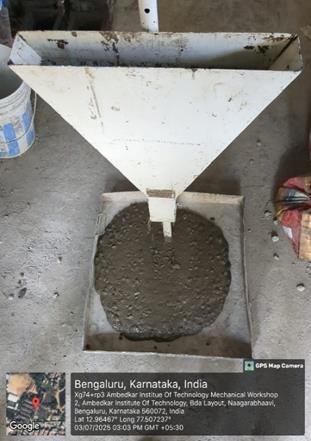
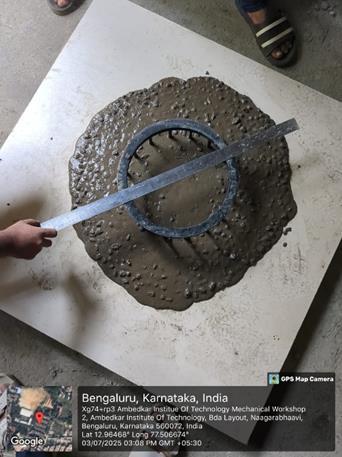
Fresh concrete from each mix was immediately tested for workability using EFNARC-standard methods. Slump flow and T50 tests were conducted to assess filling ability and viscosity,wheretheconcretewasallowedtospreadfreely uponliftingtheslumpcone,andthetimetoreacha50cm spread diameter was recorded. The V-funnel test was performed to evaluate flow resistance, with the discharge time indicating the viscosity and cohesiveness of the mix. Passing ability was examined using the L-box apparatus,
International Research Journal of Engineering and Technology (IRJET) e-ISSN:2395-0056
Volume:12Issue:11|Nov2025 www.irjet.net p-ISSN:2395-0072
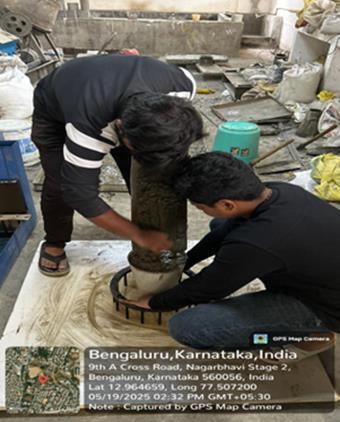
wheretheratiooffinalheightsinthehorizontalandvertical sections(H₂/H₁)reflectedthemix’sabilitytopassthrough congestedreinforcement.TheJ-ringtestwascarriedoutto determine blocking effects by measuring the difference in concretespreadbetweentheJ-ringandtheslumpflowtest. All obtained values were compared against EFNARC acceptancecriteriatodeterminetheinfluenceofSCGbiochar percentageandpyrolysistemperatureonSCCworkability.
The experimental methodology followed a systematic approach beginning with the preparation of mixes, conducting all five essential workability tests, and interpreting data in relation to SCG content, particle properties, and flow behavior. Parameters such as slump flow, T50 time, V-funnel discharge, L-box ratio, and J-ring differential were analyzed collectively to identify the optimum replacement level of SCG biochar that provides EFNARC-compliant workability. The influence of biochar porosity,waterabsorption,andpyrolysistemperaturewas consideredinconcludingthefresh-stateperformanceofSCC mixes.
Table-1: SlumpFlowValuesforSCCMixes
(mm)
(400°C) (mm)
Table-2: T50SlumpFlowTime
Table-3: L-BoxRatio
Table-4: V-Funnel
Table-5: J-RingBlockingValues
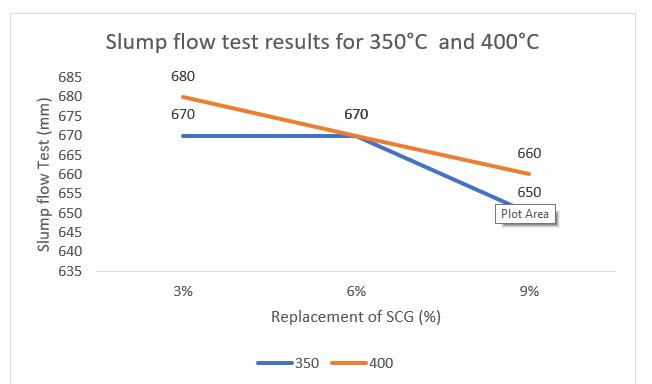
Chart-1:Slumpflowtestresults
Thischartshowshowtheslumpflowdiameter(mm)ofSCC changeswhenSpentCoffeeGrounds(SCG)biocharisadded at different replacement levels (3%, 6%, and 9%) and processedattwopyrolysistemperatures(350°Cand400°C).
KeyObservations:
AllmixesfallwithinEFNARClimits(650–800mm), meaningtheSCCmaintainssufficientfillingability evenafteraddingSCGbiochar.
At 350°C, •3%and6%SCGshowidenticalslumpflow(670 mm),
•9%SCGdecreasesto650mm,indicatingreduced workabilitywithhigherSCGcontent.
At 400°C,
•3%SCGgivesthe highest slumpflow(680 mm) among all mixes,
•6%SCGmaintainsacceptableflowat 670 mm,
•9%SCGreducesto 660mm,still acceptablebut withlowerfillingability.
International Research Journal of Engineering and Technology (IRJET) e-ISSN:2395-0056
Volume:12Issue:11|Nov2025 www.irjet.net
400°Cbiocharperformsslightlybetterthan350°C biocharoverallduetoreducedorganiccontentand betterparticlestability.
Conclusion:
The optimum slump flow performance is observed at 3% SCG(400°C),producingthehighestflowdiameterandbest fillingability.IncreasingSCGbeyond6%reducesflowability for both temperatures, indicating that higher SCG percentagesincreaseviscosityanddecreasethefreeflowof SCC. Thus, for best slump flow characteristics, 3–6% SCG biochar is recommended, especially when pyrolyzed at 400°C
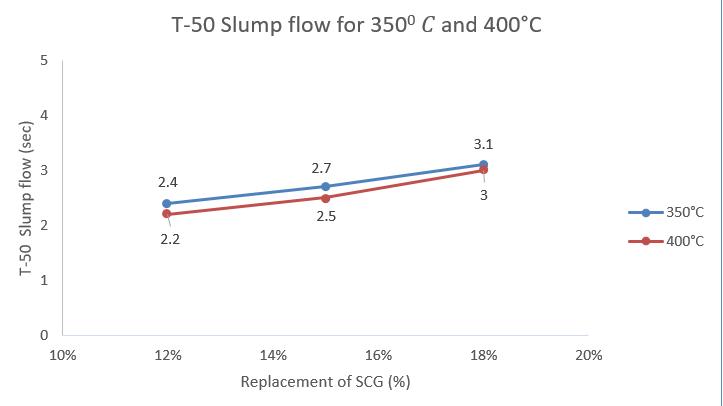
Chart-2:T-50Slumpflowtestresults
ThisgraphshowshowtheT50flowtime(seconds)ofSCC changeswithdifferentpercentagesofSpentCoffeeGrounds (SCG) biochar at two pyrolysis temperatures (350°C and 400°C).
T50 indicates viscosity – higher T50 = thicker mix, lower flowability.
KeyObservations:
•At350°Cpyrolysistemperature:
3% SCG → 4 seconds
Goodflowabilitywithlowviscosity.
6% SCG → 4 seconds
Sameflowtimeas3%,indicatingstableviscosity.
9% SCG → 5 seconds
Highesttimeat350°C,showingincreasedviscosity andresistancetoflow.
•At400°Cpyrolysistemperature:
3% SCG → 4 seconds
Excellentflowbehavior,sameas350°C.
6% SCG → 4 seconds
Maintainslowviscosityandgoodworkability.
9% SCG → 5 seconds
Flowtimeincreases,showingthickeningofthemix.
OverallTrends:
p-ISSN:2395-0072
3%and6%SCGshow consistently low T50 times (4 seconds), meaning the mix is smooth and flows easily.
9%SCGincreasesT50totheupperEFNARClimit(5 seconds), indicating higher viscosity and reduced SCCflowability
Biocharat400°CdoesnotsignificantlychangeT50 values, suggesting that the temperature mainly affectsslumpflowbutnotviscosity.
Conclusion:
T50resultsshowthat3%and6%SCGbiocharprovideideal viscosity, keeping the mix within EFNARC limits and maintaining smooth flowability. At 9% SCG, the T50 increases,indicatingthemixbecomesthickerandharderto flow.Therefore,higherSCGcontentreducestheeaseofSCC spreading,and3–6%SCGisrecommendedforachievingthe bestviscosityandflowperformance.
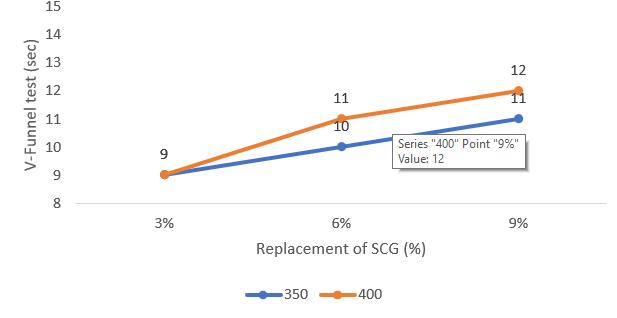
TheV-Funneltestmeasuresthetime(inseconds)required for SCC to completely flow out of the V-shaped funnel. A higher V-Funnel time indicates higher viscosity and reducedflowability,whilelowervaluesrepresentsmoother andfasterdischarge.
TheEFNARCacceptablerangeis6–12seconds.
OverallTrends:
Forbothtemperatures,V-Funneltimeincreasesas SCGpercentageincreases.
3% and 6% SCG remain within a comfortable workingrange,showinggoodflowability.
9% SCG consistently shows maximum V-Funnel time, meaning the concrete becomes thicker and lessfluid.
Biocharat400°CresultsinslightlyhigherV-Funnel times, showing that increased thermal treatment doesnotlowerviscositybutenhancesstability.
International Research Journal of Engineering and Technology (IRJET) e-ISSN:2395-0056
Volume:12Issue:11|Nov2025 www.irjet.net p-ISSN:2395-0072
Conclusion:
TheV-Funneltestresultsindicatethatlowerpercentagesof SCG (3%and6%) provideacceptableviscosity withquick discharge times, supporting smooth SCC flow. When SCG content reaches 9%, the mix becomes significantly more viscous and approaches EFNARC’s upper limit, demonstrating reduced workability. Therefore, 3–6% SCG biochar is ideal for maintaining good flowability, while higherpercentageshinderdischargebehaviorandshouldbe avoidedforSCCapplications.
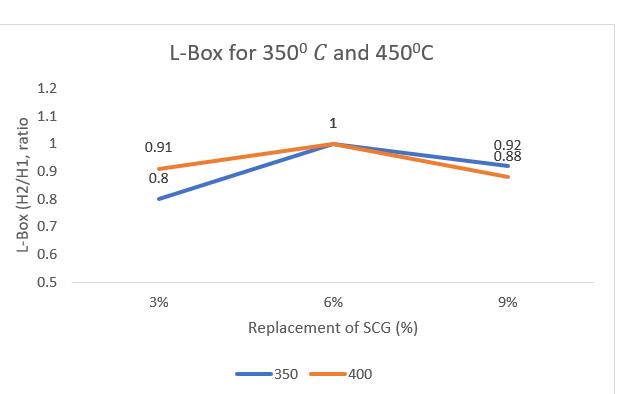
Chart-4:L-Boxtestresults
The L-Box test measures the passing ability of SCC by determining how easily concrete flows through bars that simulate congested reinforcement. ThetestreportstheH₂/H₁ratio,where:
1.0=excellentpassingability(noblockage)
0.8–1.0=acceptablerangeasperEFNARC
< 0.8 = insufficient passing ability or high risk of blocking
KeyObservations:
OverallTrends:
3% SCG shows excellent passing ability at both temperatures,indicatingimprovedflowbehaviorat lowbiocharcontent.
6% SCG performs best at 400°C (ratio = 1.00), showingperfectpassingability.
Higher SCG content (9%) reduces passing ability, dueto:
o increasedroughnessofbiocharparticles
o higherwaterabsorption
o increasedmixviscosity
Passing ability is consistently better at 400°C, showing that higher pyrolysis temperature improvesparticlestabilityandreducesblockages.
Conclusion:
L-Box results demonstrate that SCC containing 3–6% SCG biocharmaintainsexcellentpassingabilityandflowseasily through reinforcement. The optimal performance is observed at 6% SCG (400°C) with a perfect L-Box ratio of 1.00.At9%SCG,bothtemperaturesshowreducedpassing ability,indicatingthathigherSCGlevelsincreasetheriskof blocking.Therefore,3–6%SCGbiocharisrecommendedfor achievingsmoothpassingabilitywithinEFNARClimits.
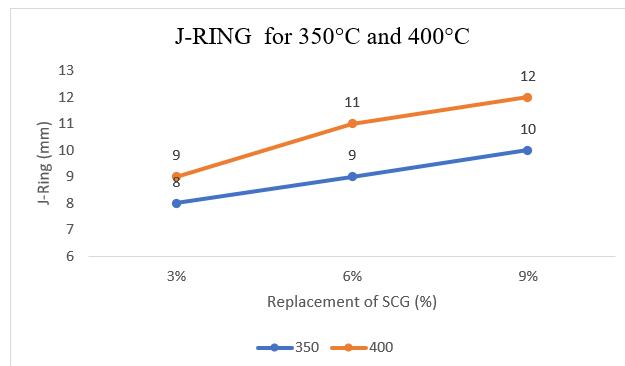
Chart-5:J-Ringtestresults
The J-Ring test measures the passing ability of SCC by determining the difference in flow spread (mm) when concretepassesthroughsteelbarscomparedtofreeslump flow.
AsmallerJ-Ringdifference(0–10mm)indicates:
Lowblocking
Smoothpassingability
Goodresistancetosegregation
Values above 10 mm indicate significant obstruction or blocking.
OverallTrends:
J-RingblockingincreaseswithhigherSCGcontentat bothtemperatures,duetoincreasedroughnessand higherviscosity.
350°CbiocharperformsbetterinJ-Ringresultsthan 400°Cbiochar:
o Allvaluesat350°CremainwithinEFNARC limits(0–10mm).
o At 400°C, both 6% and 9% exceed the acceptablerange.
3% SCG gives the best performance for both temperatures,showingsmoothflowandnegligible blocking.
Athigherpercentages(6%and9%),inter-particle frictionincreases,causingmoreobstructionaround theJ-Ringbars
International Research Journal of Engineering and Technology (IRJET)
Volume:12Issue:11|Nov2025 www.irjet.net p-ISSN:2395-0072
Conclusion:
J-Ring results indicate that SCC mixes containing 3% SCG biochar exhibit the best passing ability, with minimal blocking and smooth flow behavior. At 6% and 9% SCG, especially at 400°C, the blocking resistance decreases significantly, exceeding EFNARC limits and indicating that the mix experiences considerable obstruction. Thus, for optimalpassingabilitywithminimalblockagerisk,3%SCG biocharistherecommendedreplacementlevel.
TheworkabilityresultsofSCCincorporatingSCGbiocharat 3%,6%,and9%replacementlevelsshowedclearvariations infillingability,viscosity,andpassingperformance.Slump flow values for all mixes remained within EFNARC limits (650–800mm),withthehighestflowobservedat3%SCG (680mmat400°C),whilehigherreplacementlevelsslightly reducedflowability.T50flowtimesremainedbetween4–5 seconds,where3%and6%SCGexhibitedgoodviscosity,but 9%SCGincreasedtotheupperacceptablelimit,indicating thickermixes.V-Funnelresultsfollowedasimilarpattern: lower percentages (3% and 6%) discharged within 9–11 seconds, while 9% SCG reached 12 seconds, showing increasedflowresistance.PassingabilitymeasuredbyL-Box revealedthat3%SCGshowedexcellentflow(0.92and0.91), while 6% SCG at 400°C achieved the ideal ratio of 1.00, whereas higher percentages (9%) reduced the ratio, indicatingmoreobstruction.J-Ringresultsconfirmedthese trends,where3%SCGshowedminimalblocking(8–9mm), 6%SCGat400°CcrossedtheEFNARClimit(11mm),and9% SCGshowedmaximumobstruction(10–12mm).Overall,the results indicate that 3–6% SCG biochar maintains optimal SCCworkability,while9%SCGincreasesviscosity,reduces flowability,andcausesgreaterblocking,especiallyat400°C pyrolysistemperature.
International Research Journal of Engineering and Technology (IRJET) e-ISSN:2395-0056
Volume:12Issue:11|Nov2025 www.irjet.net
The experimental investigation on the workability characteristics of Self-Compacting Concrete (SCC) incorporating Spent Coffee Grounds (SCG) biochar at 3%, 6%,and9%replacementlevelsprovidedsignificantinsights into the influence of biochar content and pyrolysis temperatureonfreshconcretebehavior.Allmixessatisfied theEFNARClimitsforfilling ability,viscosity,andpassing performance, although variations were evident with increasing SCG content. The slump flow and T50 results confirmed that lower replacement levels (3% and 6%) producedhighlyworkablemixeswithadequateflowability and acceptable viscosity, whereas 9% SCG led to reduced spreaddiameterandincreasedflowtime,indicatinghigher mixresistance.V-Funneldischargetimesalsodemonstrated that higher SCG percentages increased viscosity and flow resistance, reaching the upper EFNARC limit at 9% replacement.PassingabilitymeasuredthroughL-BoxandJRing tests showed that 3% SCG maintained excellent performance,while6%SCGat400°Cprovidedthebest LBoxresultwithaperfectratioof1.00.However,beyond6% SCG,blockingtendenciesincreased,particularlyevidentin theJ-Ringvaluesfor400°Cmixes.
Overall,thestudyconcludesthat3–6%SCG biocharisthe optimalreplacementrangeforachievingEFNARC-compliant workability performance in SCC. Increasing SCG to 9% adversely affects filling ability, viscosity, and passing capacityduetoitshighabsorptionandparticleroughness. Additionally,biocharproducedat400°Cgenerallyenhances workability compared to 350°C, due to reduced organic contentandbetterparticlestability.Therefore,SCGbiochar, particularly at lower dosages, presents a sustainable and effectivepartialfineaggregatereplacementforSCCwithout compromisingessentialfresh-stateproperties.
[1]Senol,Y.,“EffectofSpentCoffeeGroundBiocharonthe FreshandMechanicalPropertiesofMortar,” Construction and Building Materials,2024.
[2]M.Young, The Technical Writer’s Handbook,MillValley, CA:UniversityScience,1989.
[3]D.KornackandP.Rakic,“CellProliferationwithout NeurogenesisinAdultPrimateNeocortex,” Science,vol.294, pp.2127–2130,Dec.2001.
[4]R.Nicole,“Titleofpaperwithonlyfirstwordcapitalized,” J. Name Stand. Abbrev.,inpress.
p-ISSN:2395-0072