
International Research Journal of Engineering and Technology (IRJET) e-ISSN: 2395-0056
Volume: 12 Issue: 07 | Jul 2025 www.irjet.net p-ISSN: 2395-0072
International Research Journal of Engineering and Technology (IRJET) e-ISSN: 2395-0056
Volume: 12 Issue: 07 | Jul 2025 www.irjet.net p-ISSN: 2395-0072
Snehal Kshirsagar1 , Shidhi swarupa Nayak2
Assistant Professor, Dept. of Civil Engineering, Sanghavi college of Engineering, Maharashtra , India
Assistant Professor, Dept. of Civil Engineering, Sanghavi college of Engineering, Maharashtra , India
Abstract-
Seismic analyses typically overlook infill walls, which are frequentlyusedinR.C.buildings,becausetheyareassumed to be non-structural components. A general review of variousexpressionsputforthbyresearcherstodetermine this equivalent width of the diagonal strut is presented in thispaper.Thefundamentalfactorinfluencingthestiffness andstrengthofthesestrutsistheirequivalentwidth.Onthe other hand, infill walls help the building's lateral stiffness and seismic resistance. An attempt is being made in this study to incorporate the masonry infill in the form of an equivalentdiagonalstrut,thewidthofwhichisdetermined by the different relations that the researchers have proposed.Inordertodeterminethewidthoftheequivalent diagonal strut, a general review and comparison of the relationssuggestedbytheresearchersisbeingconducted. Thepurposeofthisstudyistocomparetheequivalentwidth ofadiagonalstrutcalculatedmanuallyandwithsoftware UsingABAQUSsoftware.
Key Words: R.C. frame, Infilled wall, Equivalent width of diagonal strut, ABAQUS Software.
Themostpopularbuildingdesignindevelopingnationslike India is RC moment-resisting frames. Buildings with RC moment-resisting frames are made of moment-resisting frameswithmasonrywallsasinfills.Accordingtobuilding practices, these walls are regarded as non-structural components.Modernbuildingdesignpracticesdisregardthe impact of infill masonry walls and treat them as nonstructural components, instead designing buildings as framedstructures.Whencomparedtobuildingswithonly moment-resistingframes,buildingswithinfillwallsbehave differently for the reasons mentioned above. Through numerousanalyticalandexperimentalinvestigationsover thepastfortyyears,thesignificanceofbrickinfillhasbeen acknowledged; however, because it is regarded as a nonstructural element, its strength and stiffness contribution hasbeenoverlooked.
In this paper, the strength and stiffness of brick masonry infillaretakenintoconsiderationwhenmodellingamasonry infillwallwitha"equivalentdiagonalstrut."Innationsthat experience earthquakes, masonry infill walls are typically utilized as an infill (partition) in RC frame buildings.
Masonry units, which are made of clay bricks and/or concrete blocks, are used primarily for their affordability and ease of use in construction. Mortar is a necessary materialusedtobindindividualmasonryunitsinmasonry construction.Sandiscombinedwithabindingsubstanceto create mortar. Most seismic-resistant structural design processesviewthemasonryinfillwallthatisusedwithan RC frame as a non-structural component of the building. Consequently, this comprehension leads to an inaccurate estimationoftheRCframe'slateralstiffness,ductility,and strength. Because of the lack of knowledge regarding the behaviourofinfilledRCframes,thedifficultyofconductinga structural analysis, and uncertainty regarding the relationshipbetweeninfillwallsandRCframes,anumberof researcherswerereluctanttoconsiderthecontributionof masonryinfillunits.ThedamagethatoccurredinRCframe buildingsfollowingearthquakesactuallydemonstratedthat theinfillmasonrywallmayhavebeenamajorfactorinthe structural seismic resistance, as RC frame buildings with masonryinfillwallshavebornegreaterseismicforcesthan bare frames (frames without masonry infill wall). In RC framebuildings,theperformanceofmasonryinfillwallshas beenexperimentallyinvestigatedbynumerousresearchers. According to experimental findings, the composite action betweentheRCframeandmasonryinfillwallaswellasthe amountoflateralloadswererelatedtothemasonryunit's performance. The stiffness of the structural system is therefore greater than that of the RC bare frame. The masonry units begin to fracture and slip at the interface betweentheRCframeandmasonryinfillunitsatthetension zoneaslateralloadsincrease.Themasonryunits,however, createadiagonalstrutactiononthecompressionzone.The primaryobjectiveofthisresearchistobetterunderstandthe behaviourofall building framecomponents by examining the presence of masonry walls in structures that are subjected to seismic loads. In order to shed light on the structuralperformanceanddirectthenewprovisionsinthe developmentoflogicaldesignrules,numericalsimulations arecrucial.
The distribution of stiffness, mass, plan, strength, and numerousotherirregularitiesinthestructure'sverticaland horizontal directions determines how the structure will behave during an earthquake. Previous building damage scenariosshowedthatirregularitieswereamajorfactorin thestructures'failureduringintensegroundshaking.When an earthquake occurs, the structure generates horizontal forces, which result in inertia forces acting through the
International Research Journal of Engineering and Technology (IRJET) e-ISSN: 2395-0056
Volume: 12 Issue: 07 | Jul 2025 www.irjet.net p-ISSN: 2395-0072
structure'scentreofmass.Theverticalcolumnsandwalls resist all of these forces, and the centre of stiffness is the pointthroughwhichtheforcesact.
Duringintensegroundshaking,thedegreeofhorizontaland vertical irregularities has a significant impact on the performance of the structure. A structure must have sufficient lateral strength, a straightforward and regular design, and enough stiffness and ductility in order to withstandseismicforces.Structureswithuniformmassand stiffnessinplanandelevation,aswellassimplegeometry, are less susceptible to damage than those with irregular configurations.Insomeways,manybuildingstructuresare asymmetrical.Somewereintentionallydesignedthatway, whileothersdevelopedthisqualitybychance.
1. Toobtaingeneraldiagonalstrutwidthbyusingsoftware SIMULIAABAQUS
2. To get the width dimensions of strut to check the out response of high story building with and without structuralirregularitiesandcomparetheresultofboth witheachtochecktheirstructuralbehaviorinformof baseshear,nodaldisplacement.
3. To study and analyze the evaluation of structural irregularitiesinRCCstructureunderseismicloadingin staticcondition
4. Comparetheresultswiththoseofavailableinliterature andvalidatethetheory.
Bharat Pradhan, Maria Zizzo, Vasilis Sarhosis, Liborio Cavaleri they have studied that extensive literature regarding the Out-of-Plane tests on infill walls has been reviewed with a detailed comparison of the experimental results based on different influencing parameters (slenderness ratio, aspect ratio, boundary conditions, openings, vertical load. In-Plane damage, strength of masonryandplaster,framestiffness).
PantoB,SilvaL,VasconcelosG,LourençoPB theystudied thatthenumericalsimulationoftwosolutionsofbrickinfill wallsdevelopedatUniversityofMinhounderout–of–plane loading.Thenumericalsimulationisbasedonaninnovative discrete macro-modellingstrategy proposed by Caliò and Pantò(2014).Thismethodisbasedonahybridapproachby which the frame is modelled using concentratedplasticity beam-columnelements,whereasthenon-linearbehaviourof masonryinfillismodelledbymeansofa3Ddiscretemacroelement.
IdaAyuMadeBudiwati,MadeSukrawa.Inthispaper,they havestudiedthatBasedonresultsfromnumericalanalyses thefollowingformulafortheequivalentwidthofdiagonal strutofinfilledframewithreinforcedopeningisproposedin
equation8and9.Theapplicationoftheformulaoninfilled RCframestructuresof2-6storeyshowedthatthebehavior of strut models correspond to that of the shell element model.
Dillon S. Lunn, Sami H. Rizkalla they studied that the evaluates the effectiveness of different externally bonded glassfiber–reinforcedpolymer(GFRP)systemsforincreasing theout-of-planeresistanceofinfillmasonrywallstoloading. The research included a comprehensive experimental program comprising 14 full - scalespecimens, including fourstrengthened(control)specimensand10strengthened specimens. To simulate the boundary conditions of infill walls, all specimens consisted ofa reinforced concrete (RC)frame, simulating the supporting RC elements of a building superstructure, which was infilled with solid concretebrickmasonry.Thespecimenswereloadedout–of –plane usinguniformlydistributedpressure tosimulate the differential (suction) pressure induced by a tornado. Parameters investigated in the experimental program includedaspectratio,FRPcoverageratio,numberofmasonry wythes,andtypeofFRPanchorage.
Liu Ming, Cheng Yun, Liu Xiawei they studied that the behaviors of infill wall in earthquakes show that infill masonrywalls,whichareusedasnonstructuralelementsof concreteframes,arevulnerablewhentheyaresubjectedto earthquake. In order to achieve an optimalanti seismic behavior,orevenstability,twomethodsofconnectionare investigated.Theshakingtabletests,with1:3scalewallsof two-storeymodel subjected to horizontal earthquake loads, were carried outto investigate the out – of – plane behaviors with different connectionsbetween walls and beams. Thetest results showthat theconnectionmethods employedbetween wallsandbeamshaveasignificanteffect ontheout-of-planestabilityofinfillwalls.
4.METHODOLOGY:
Tostudytheeffectofearthquakeonahigh-riseRCframed structure by considering different irregularities in earthquake seismic zone IV as per IS code 1893 (Part I):2002.
Followingstepsofmethodsofanalysisareadoptedinthis study:
Step-1: Selection of the structures with different irregularities.
Step-2:Selectionofseismiczone(IV).
Step-3:Formationofloadcombinations.
Step-4: Modelling of building frames using ABAQUS software.
Step-5:EquivalentstaticAnalysisofallthemodels.
Step-6:Comparativestudyofresults(seismicparameters)in terms of width of diagonal strut, stiffness of infilled wall, pushovercurve.
International Research Journal of Engineering and Technology (IRJET) e-ISSN: 2395-0056
Volume: 12 Issue: 07 | Jul 2025 www.irjet.net p-ISSN: 2395-0072
Problem statement:-
A10storeyedmoment-resistingRCframedbuildinghaving theplandimensionsof15mX20mwithbaylengthof5min bothdirectionsandfloorheightof3.2masshowninfigure. Isconsideredinthestudy.
Column and beam size (based on preliminary design)
1st to4th floor=350mmX750mm.
5th to7th floor=300mmX600mm.
8th to10th floor=230mmX450mm.
Beamsize=230mmX450mm.
Thicknessofslab=125mm.
The structure is modelled as 3D frame using ANSYS . The masonry infill is modelled as equivalent diagonal strut member, quadrilateral shell element and as membrane element (with in plane stiffness) of uniform thickness (230mm).
Properties of the concrete :-
Modulusofelasticity=25000MPa.
Poisson’sratio=0.2
Grade=M25(25MPa)
Density=25KN/m3.
Massperunitvolume=2.55kg/m3.
Properties of the reinforcement steel:-
Modulusofelasticity=210000MPa.
Poisson’sratio=0.3
Grade=Fe415(415MPa)
Properties of the masonary:-
Modulusofelasticity=3500MPa
Poisson’sratio=0.2
Density=20KN/m3.
Massperunitvolume=2.03kg/m3
Loads on the structure: self–weightofframe(beams,columns,slabs),weightofinfill walls,andliveload(KN/m2)isconsideredfortheanalysisof theframe.
Note:-checkatdifferentliveloadvalues.
In the present work, seismic response of frames having different configurations are obtained numerically using a finiteelementbasedsoftware, themajorinputsareeffective widthofdiagonalstrut.
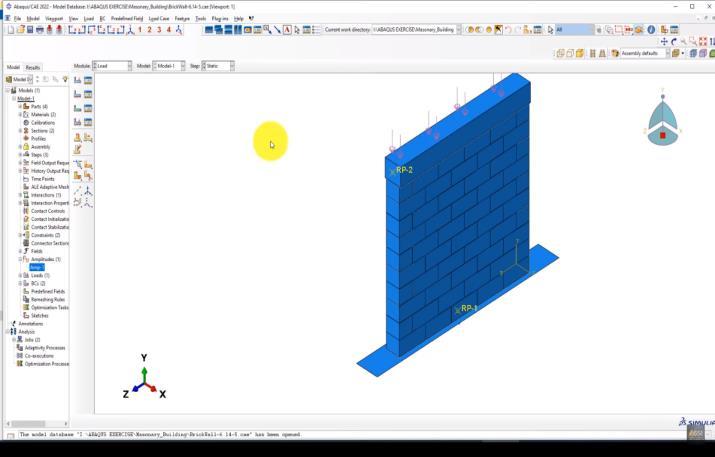
1) Staticloadapplyinwall staticload
3.2.1staticloadapplyinwall
The structure is analysed for the seismic loads and load combinationsaspertheIndianstandards,IS-1893(Part-1)2002;
Seismiczone=ZoneV
Importancefactor=1
Soiltype=II
Liveload=10,20,30,uptofailure(KN/m2)anddesignedas perIS456-2000.
Full dead load (self – weight ) and 25% of live (imposed) load constitutetheseismicweightasperIS-1893-2002.
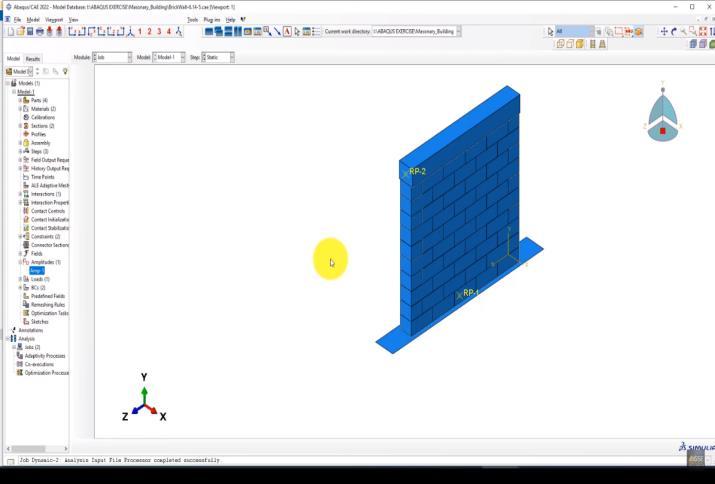
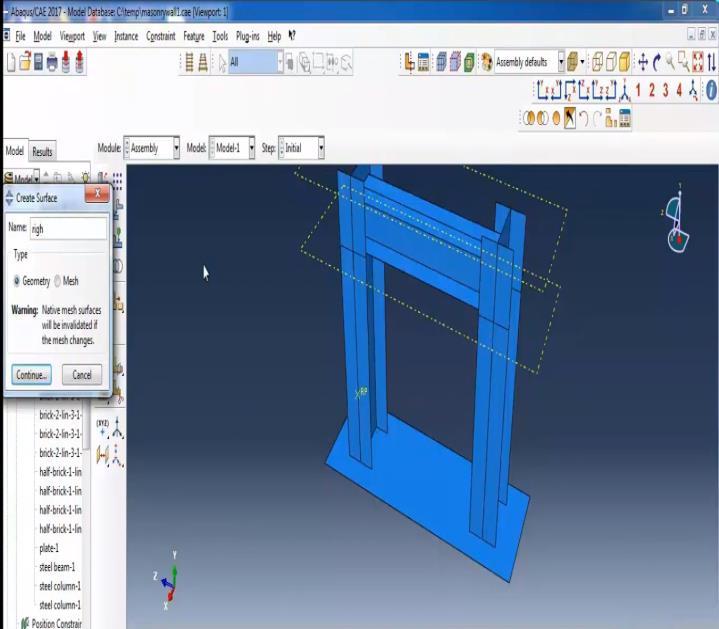
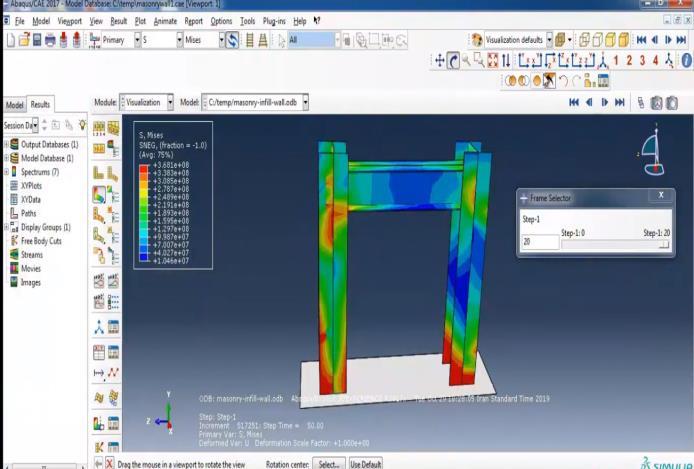
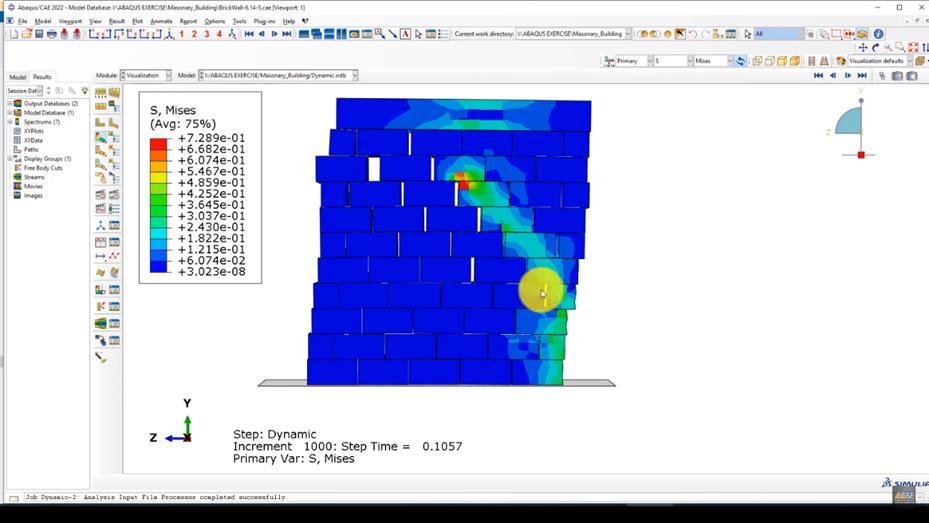
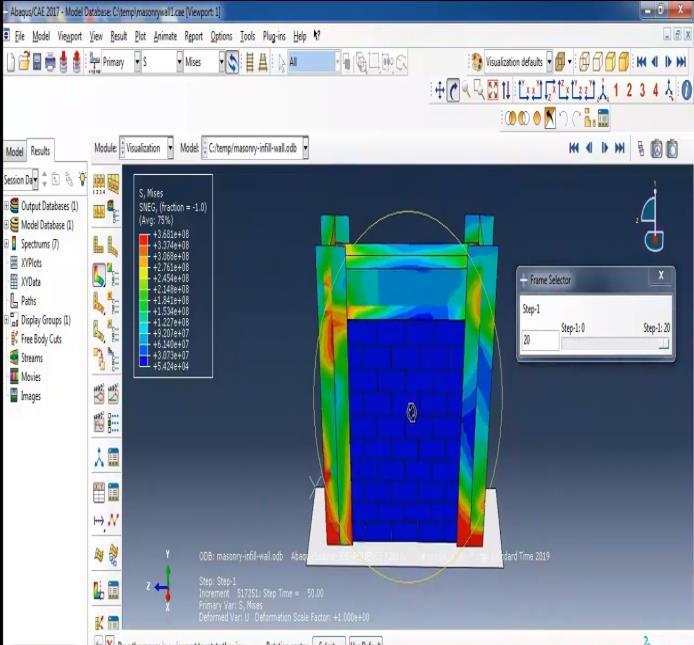
As per mentioned problem the columns and beams are modelledbeamelementsandtheslabastherigiddiaphragm the masonry infill walls are modelled as the equivalents diagonal strut. The diagonal strut is modelled as “compressiononly”membersinABAQUSSoftware.
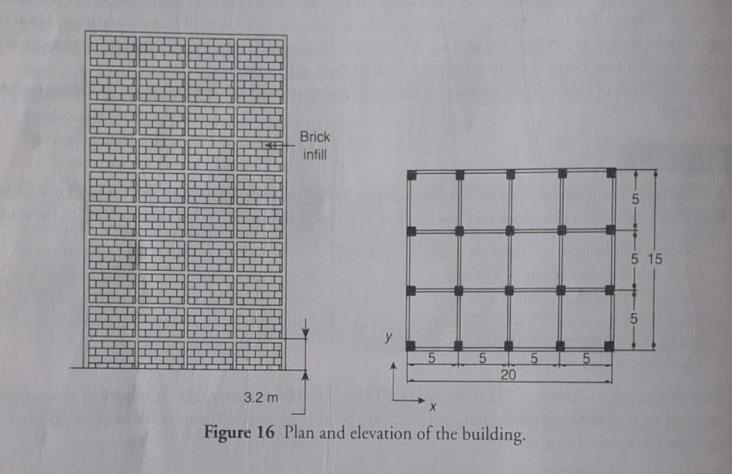
– Planandelevationofbuilding
International Research Journal of Engineering and Technology (IRJET) e-ISSN: 2395-0056
Volume: 12 Issue: 07 | Jul 2025 www.irjet.net p-ISSN: 2395-0072
International Research Journal of Engineering and Technology (IRJET) e-ISSN: 2395-0056
Volume: 12 Issue: 07 | Jul 2025 www.irjet.net p-ISSN: 2395-0072
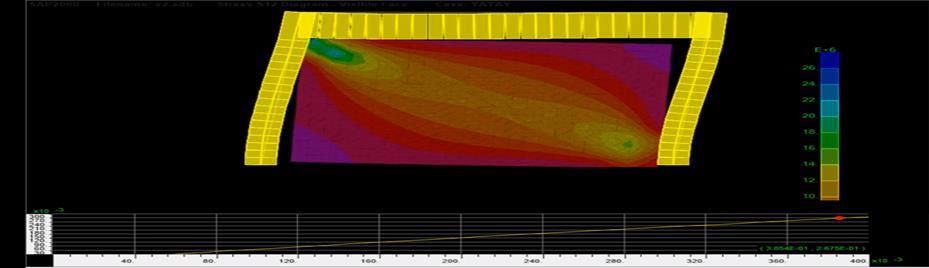
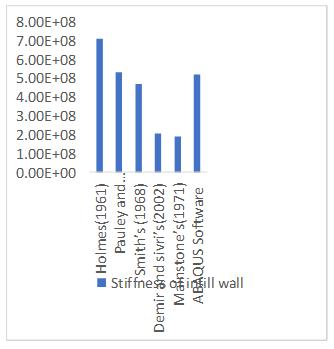
From the above conclusions it is clear that the regular structurewithRCmomentresistingframeandwithmasonry walls,performbetterundertheactionofseismicload.The obtain general diagonal width of strut by using software SIMULIA ABAQUS is 1.30 and Area = 0.340181 m2 the stiffnessofinfillwallis5.21E+08.theresultsarecompared byotherresearchers theoryitisconcludedthatasperthe software results the width of diagonal strut dimension nearlyvalidatetothetheoryofpauleyandpriestley’s and areshownbelow;
Table – 1: Comparison of width of diagonal strut
Methods
Smith’s(1968) W=1/2(αh+αL)^(1/2) 1.240
Demir and sivri’s(2002) W=0.175(λH)^(0.4)(H2+L2)^(1/2)
Mainstone’s(1971) W=0.175(λh)^(-0.4) *w 0.502
Softwareanalysis ABAQUSmodelling 1.302
Table – 2: Comparison of stiffness of infill wall
Methods
and sivri’s(2002)
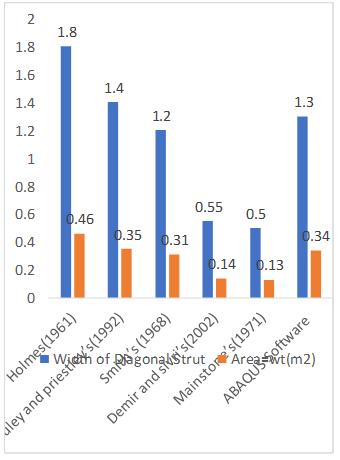
Fig-Validatethemanualandsoftwareresultscomparatively
(1968)
Fig –Stiffnessofinfilledwall
International Research Journal of Engineering and Technology (IRJET) e-ISSN: 2395-0056
Volume: 12 Issue: 07 | Jul 2025 www.irjet.net p-ISSN: 2395-0072
[1] Bharat Pradhan, Maria Zizzo, Vasilis Sarhosis, Liborio Cavaleri ,2021 “out of plane behaviour of reinforced masonry infill walls: review of the experimentalstudiesandanalysisoftheinfluencing parameters”Institution of structural engineers,pp 4387-4406.
[2] Melanesia RR, Morandi P, Manzini CF, Albanesi L, Magenes G,2020 “out of plane response of an innovative masonry infill with sliding joints from shaking table test” journal of earthquake engineering,pp1-35.
[3] Joel morenoHerrera,Jorge Varela rivera,andluis Fernandez baqueiro,2016 “out of plane design procedure for confined masonry walls” journal of structuralengineering,pp1-12.
[4] DillonS.lunnandSamiH.Rizkalla,“strengtheningof infillmasonrywallswithFRPmaterials”journalof compositesforconstructionvol.15pp207-213.
[5] LIU Ming , cheng Yun , liu xiaowei “ shaking table testonoutofplanestabilityofinfillmasonrywall” Shenyangjianzhuuniversity,pp126-131.
[6] DeveshPsoni,BharatBMistry“Qualitativereview ofseismicresponseofverticallyirregularbuilding frames”ISETjournalofearthquaketechnology,vol43,no-4pp121-132.
[7] VSigmundandD.Penava,2015“experimentalstudy ofmasonryinfilledR/cframeswithopening”Josip jurajuniversityofOsijek.
[8] Syeda Sofiya Rahman, P. M. Shimpale,2021 ” Analysis of Effect of Structural Irregularity in Multistorey Building under Seismic Loading” InternationalJournalofScientificDevelopmentand Research(IJSDR)vol-6 pp275-282.
[9] Ida Ayu Made Budiwati, Made Sukrawa,2018, “DevelopmentofDiagonalStrutWidthFormulafor Infill Wall with Reinforced Opening in Modeling SeismicBehaviorofRCInfilledFrameStructures”.
[10] Bartolome Pantò , Pier Paolo Rossi,2019, “A new macro-model for the assessment of the seismic response of infilled RC frames” earthquake engineeringstructurepp1-26.
[11] Dr. S.S. Sankhla , Deepak Bhati, 2016, “ A ComparativeStudyontheEffect ofInfill Wallson RCCFrameStructures”IOSRJournalofMechanical
andCivilEngineering(IOSR-JMCE)Vol13,Issue6 Ver.VI,pp01-08.
[12] K.H.Abdelkareem,F.K.AbdelSayed,M.H.Ahmed, N.AL-Mekhlafy,2013,“Equivalentstrutwidthfor modelingr.c.infilledframes”AssiutUniversity,pp. 851–866.
[13] YadunandanC,KiranKuldeepKN,2017,“Studyon behaviour of RC structure with infill walls due to seismic loads” (IRJET) vol-04 Issue 06 pp 24942500.