
International Research Journal of Engineering and Technology (IRJET) e-ISSN: 2395-0056
Volume: 12 Issue: 05 | May 2025 www.irjet.net p-ISSN: 2395-0072
International Research Journal of Engineering and Technology (IRJET) e-ISSN: 2395-0056
Volume: 12 Issue: 05 | May 2025 www.irjet.net p-ISSN: 2395-0072
Bibek Bhandari
Undergraduate Student, Civil Engineering Department Oxford College of Engineering and Management, Nepal ***
Abstract - Soil stabilization is a crucial process in geotechnical engineering, significantly enhancing the strength, durability, and workability of soil used in construction. This studyinvestigates the effect ofusingflyash as a stabilizing agent in soil to improve its engineering properties.Theresearchinvolvedcollectingsoilsamplesfrom a depth of 18 inches and mixing them with fly ash in different proportions (0%, 7%, 14%, 21%, and 28%). A series of laboratory tests, including Specific Gravity Test, Standard Proctor Test, Unconfined Compression Strength (UCS) Test, and California Bearing Ratio (CBR) Test, were conducted to determine the optimum percentage of fly ash that enhances soil strength and stability. The results indicate that 21% fly ash addition yielded the highest compressive strength (412 kN/m²) and optimal CBR value (6.76%), making it the most suitable mix for soilstabilization. This research confirms that fly ash is a viable solution for improving soil performance whilesimultaneouslycontributingtosustainableconstruction by utilizing industrial by-products.
Key Words: Soil Stabilization, Fly Ash, California Bearing Ratio, Standard Proctor Test, Unconfined Compression Strength,SustainableConstruction
Soilisafundamentalelementincivilengineering,forming the foundation of roads, buildings, bridges, and other infrastructureprojects[1].However,itsnaturalproperties suchasswelling,shrinkage,andlowbearingcapacity can significantly affect structural stability. Soil stabilization techniques are widely adopted to address these issues by improvingthemechanicalandphysicalcharacteristicsofsoil [2].
Amongvarioussoilstabilizingmaterials,flyashhasgained prominence due to its availability, cost-effectiveness, and environmental benefits [3]. Fly ash is a fine by-product of coalcombustion,oftenutilizedasanadditivetoimprovesoil cohesion, reduce permeability, and increase strength [4] This research aims to evaluate the effect of different proportionsofflyashonsoilstability,withaparticularfocus onunconfinedcompressionstrengthUCSandCBRvalues.By determining the optimal percentage of fly ash for stabilization,thisstudyseekstoprovideasustainableand effectiveapproachtoimprovingsoilqualityinconstruction applications.
Theconceptofsoilstabilizationthroughtheuseofindustrial waste materials has been extensively explored in past studies.Researchershavewidelyacknowledgedthevalueof flyashduetoitsabundantavailability,cost-effectiveness,and positive impact on the environment. Fly ash serves as a supplementarycementitiousmaterialthat,uponmixingwith soil,undergoesapozzolanicreactionleadingtotheformation ofcalciumsilicatehydrates,whichimprovethesoil’sbinding characteristics. Senol et.al (2002) emphasized that fly ash, especiallyClassF type,significantlyimproves the strength and durability of soft soils when used in appropriate quantities[5].Ji-ru&Xing(2002)highlightedthatcombining fly ash with lime yields even better stabilization results, particularlyforexpansivesoils[6].Furthermore,studiesby Zha et.al (2008) demonstrated that fly ash reduces the plasticityindexandimprovestheworkabilityofclayeysoils [7]
The primary objective of the research was to assess and enhancetheengineeringbehaviorofnaturalsoilusingflyash asastabilizingadditive.
Todeterminetheoptimalpercentageofflyashthat offersthehigheststrengthandstability.
Toanalyzetheeffectofflyashonpropertiessuchas specific gravity, moisture content, dry density, compressivestrength,andbearingcapacity.
Tocontributetosustainableengineeringbyutilizing industrialby-productsincivilinfrastructure.
The research commenced with an extensive theoretical review, aimed at understanding various soil stabilization techniquesandtheroleofflyashinmodifyingsoilbehavior. Multiplesourcesincludingacademicjournals,dissertations, engineering standards, and textbooks were studied to acquire the foundational knowledge necessary for the experiments.
Forpracticalexperimentation,soilsampleswerecollected fromadepthof18inchesbelowthesurfaceusingmanual excavation tools. This depth was chosen to obtain
International Research Journal of Engineering and Technology (IRJET) e-ISSN: 2395-0056
Volume: 12 Issue: 05 | May 2025 www.irjet.net p-ISSN: 2395-0072
undisturbedsoilwithmoreconsistentproperties,asupper layers are often loose and contaminated. Fly ash was procuredfromalocalindustrialsourceandthoroughlydried beforeuse.
Fivedistinctsoilsampleswerepreparedbymixingsoilwith flyashinvaryingpercentages:0%(control),7%,14%,21%, and 28%. Each mixture was then subjected to a series of laboratorytestsasperIndianStandardCodes.
TheSpecificGravityTestwasconductedusingthedensity bottlemethod, where oven-driedsoil wasweighed before and after adding water to determine the specific gravity. Next, a Standard Proctor Test was (SPT) performed on compactedsamplestofindtheOptimumMoistureContent (OMC)andMaximumDryDensity(MDD).Thesevaluesallow the determination of the best moisture condition for maximumcompactioninthefield
Next, cylindrical specimens were tested in UCS tests to examinetheaxialloadbearingcapacityofeachmixwithout lateral confinement. CBR tests were finally performed on soaked samples to simulate the real world subgrade conditions.Thesamplesweresubmergedfor96hoursand thenpenetrationresistancewasmeasuredat2.5mmand5 mmdepthstocalculatetheCBRvalues.
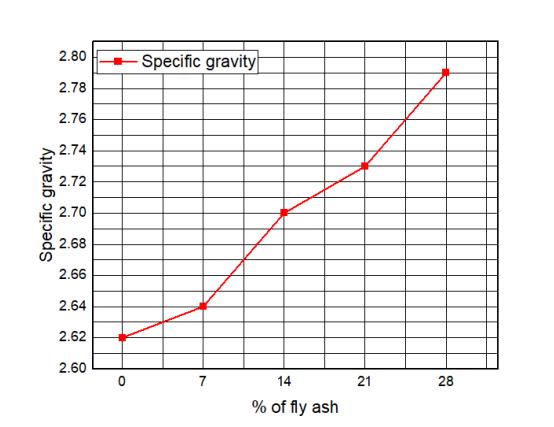
Theresultsofthetestsshowedthatthebehaviorofsoilwith differentlevelsofflyashcontentwasquiteobvious.Forthe SpecificGravityTest,untreatedsoilhadavalueof2.62and at 28% fly ash it was 2.79, which means that the fine and denseparticlesofflyashmarginallyincreasedthespecific gravity
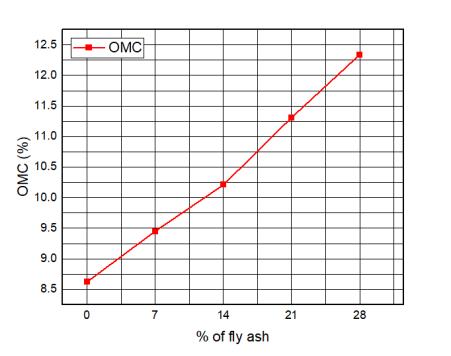
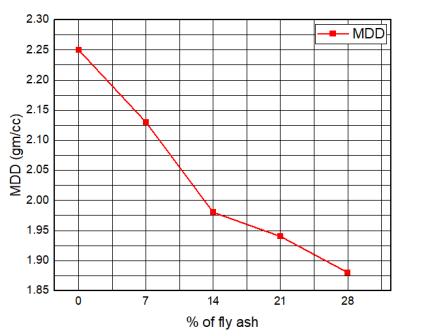
TheSPTindicatedthatasthepercentageofflyashincreased, the Optimum Moisture Content also increased, with a maximumof12.34%recordedat28%flyash.Conversely, the Maximum Dry Density decreased from 2.25 gm/cc to 1.88 gm/cc, likely due to the lighter nature of fly ash comparedtonaturalsoil.
Intermsofstrength,theUCSpeakedat412N/m²with21% flyashcontent.Theinitialstrengthofuntreatedsoilwasonly 218 N/m², demonstrating a significant improvement. However,furtherincreasebeyond21%resultedinaslight decrease,suggestingthatexcessflyashreducescohesion.
Similarly,theCaliforniaBearingRatioshowedthebestresult at21%flyashwithavalueof6.76%,surpassingthebaseline value of 4.02% for untreated soil. Penetration resistance decreased at 28% fly ash, which aligns with the behavior observedinUCStesting.
The results confirm that while fly ash improves soil performance, there exists a threshold beyond which additional fly ash may become counterproductive. The
optimumvalueof21%notonlyprovidedsuperiorstrength and compaction but also aligned with economic and sustainabilityconsiderations.
International Research Journal of Engineering and Technology (IRJET) e-ISSN: 2395-0056
Volume: 12 Issue: 05 | May 2025 www.irjet.net p-ISSN: 2395-0072
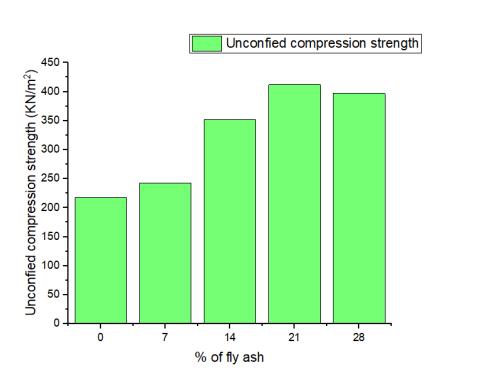
Chart -4:UCSwithorwithoutadditives-flyash
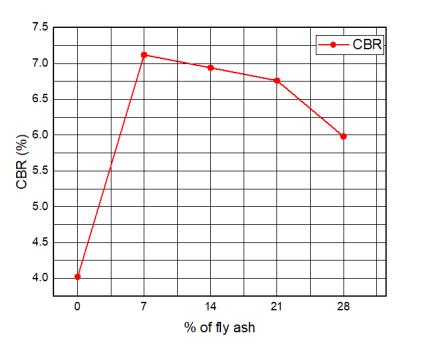
Chart -5:UCSwithorwithoutadditives-fly-ash
Thestudysuccessfullydemonstratedthattheinclusionoffly ash significantly enhances the geotechnical properties of natural soil. The most favorable results were achieved at 21% fly ash content, where the soil displayed maximum compressive strength and improved bearing capacity. Beyond this proportion, the benefits diminished slightly, confirmingtheneedforoptimizationinadditiveuse.
Inadditiontotechnicalperformance,thestudysupportsthe sustainablereuseofflyash, anindustrialby-product,thus aligningwithenvironmentalobjectivesincivilengineering. The findings of this research offer practical insights for futureprojectsinvolvingsubgradepreparationandground improvement, especially in regions where soil quality is a limitingfactor.
[1] Lambe,T.W.,&Whitman,R.V.(1991).Soilmechanics. JohnWiley&Sons
[2] Little,D.N.,&Nair,S.(2009).Recommendedpracticefor stabilizationofsubgradesoilsandbasematerials.
[3] Upadhyay,A.,&Kamal,M.(2007).Characterizationand utilizationofflyash(Doctoraldissertation).
[4] Jegandan, S., Liska, M., Osman, A. A., & Al-Tabbaa, A. (2010). Sustainable binders for soil stabilisation. ProceedingsoftheInstitutionofCivilEngineers-Ground Improvement,163(1),53-61.
[5] Senol,A.,Bin-Shafique,M.S.,Edil,T.B.,&Benson,C.H. (2002,September).UseofclassCflyashforstabilization of soft subgrade. In Fifth international congress on advances in civil engineering (pp. 25-27). Istanbul, Turkey:IstanbulTechnicalUniversity.
[6] Ji-ru,Z.,&Xing,C.(2002).Stabilizationofexpansivesoil by lime and fly ash. Journal of Wuhan University of Technology-Mater.Sci.Ed.,17(4),73-77.
[7] Zha, F., Liu, S., Du, Y., & Cui, K. (2008). Behavior of expansivesoilsstabilizedwithflyash.Naturalhazards, 47,509-523.