
International Research Journal of Engineering and Technology (IRJET) e-ISSN: 2395-0056
Volume: 12 Issue: 09 | Sep 2025 www.irjet.net p-ISSN: 2395-0072
International Research Journal of Engineering and Technology (IRJET) e-ISSN: 2395-0056
Volume: 12 Issue: 09 | Sep 2025 www.irjet.net p-ISSN: 2395-0072
Harshavardhan Bhagwan Aldar1, Prof. V.J. Patil2
Fabtech Technical Campus College of Engineering and Research Sangola
ABSTRACT: Theincreasingdemandforrenewableenergysystemshashighlightedthenecessityforefficientpowerconversion technologies.Inthiscontext,multilevelinverters(MLIs)havegainedsignificantattentionduetotheirabilitytoprovide highqualityoutputwithreducedharmonicdistortion,whichisparticularlycrucialforrenewableenergysystems.Thispaperpresents an enhancement of the performance of multilevel inverters in renewable energy applications by employing improved modulationtechniques.Traditionalmodulationstrategiesoftenresultinhigherharmoniccontentandlowerefficiency,which can negatively impact the overall system performance. Therefore, this study proposes advanced modulation techniques that optimize the switching patterns and improve the voltage waveform quality, thereby enhancing the inverter's efficiency and reliability. The proposed modulation techniques, such as enhanced space vector modulation (SVM) and selective harmonic elimination (SHE), are compared with conventional methods like sinusoidal pulse width modulation (SPWM) and traditional SVM.Theresultsshowsignificantimprovementsintermsofharmonicreduction,efficiency,andoutputvoltagequality,especially undervaryingloadconditions.Furthermore,thestudyinvestigatestheintegrationofthesemodulationstrategiesinrenewable energy systems, particularly solar and wind energy, to demonstrate their practical benefits in real-world applications. By improvingtheoverallperformanceofmultilevelinverters,thesetechniquescontributetotheincreasedstabilityandefficiency ofrenewableenergysystems,facilitatingtheirwidespreadadoption.
Keywords: Multilevel Inverter, Modulation Techniques, Renewable Energy Systems, Space Vector Modulation, Harmonic Reduction
Thegrowingglobaldemandforsustainableandcleanenergysourceshasacceleratedtheadoptionofrenewableenergysystems suchassolarphotovoltaics(PV)andwindturbines.Astheintegrationofrenewablesourcesintothepowergridincreases,the performanceandreliabilityofpowerelectronicconvertersplayavitalroleinenergyconversionanddelivery[1].Amongthese, multilevel inverters (MLIs) have emerged as a prominent solution due to their capability to generate high-quality voltage waveforms, improve power efficiency, and reduce total harmonic distortion (THD). MLIs function by synthesizing a desired outputvoltagefrommultiplevoltagelevels,therebyprovidingastaircasewaveformthatcloselyresemblesasinusoidaloutput [2].Thisfeaturesignificantlyminimizesthestressonpowerelectronicsandreducestheneedforlargefilters,makingMLIshighly suitable for medium and high-power renewable energy applications. In conventional inverter systems, the switching devices operate at high frequencies to approximate a sinusoidal waveform, which introduces substantial switching losses and electromagneticinterference(EMI).Incontrast,MLIsemployseverallow-frequencyswitchestoproducethesameresultwith reducedstressandlosses[3].TherearevarioustopologiesofMLIs,includingNeutralPointClamped(NPC),CascadedH-Bridge (CHB),andFlyingCapacitor(FC)inverters,eachwithitsownmeritsandlimitations[4].However,asthenumberofvoltagelevels increases,challengessuchascontrolcomplexity,balancingcapacitorvoltage,andincreasednumberofcomponentsarise.These issuesnecessitatethedevelopmentofimprovedmodulationtechniquesandcontrolstrategiestofullyleveragetheadvantages ofmultilevelinverters[5] Withtheevolutionofrenewableenergytechnologies,MLIsarebeingincreasinglydeployedinsmart grid systems, hybrid power plants, and distributed energy resources (DERs). In these applications, maintaining high-quality power output under variable operating conditions is critical. Traditional pulse width modulation (PWM) methods such as sinusoidal PWM and space vector modulation (SVM) have limitations in handling the dynamic nature of renewable energy sources.Thishasspurredthedevelopmentofadvancedmodulationstrategieslikeselectiveharmonicelimination(SHE),phaseshiftedPWM,andoptimizedSVMthataimtoenhancevoltagecontrol,minimizeharmoniccontent,andimproveoverallsystem efficiency[6].Asaresult,improvedmodulationtechniquesareessentialtooptimizeinverterperformance,ensurepowerquality, andfacilitateseamlessintegrationofrenewableenergyintoexistingpowersystems.Inrecentyears,theemphasisonenhancing theperformanceofmultilevelinvertershasshiftedtowardtheincorporationofintelligentmodulationtechniquesthatarenot onlyrobustbutalsoadaptivetoreal-timeoperatingconditions [7].Thecoreobjectiveofmodulationininvertersystemsisto controltheswitchingsequenceandtimingofpowersemiconductordevicestogeneratethedesiredACvoltagefromaDCsource.
International Research Journal of Engineering and Technology (IRJET) e-ISSN: 2395-0056
Volume: 12 Issue: 09 | Sep 2025 www.irjet.net p-ISSN: 2395-0072
Inthecontextofrenewable energysystems, where voltageandcurrentparametersfluctuatebasedon environmental factors (e.g., irradiance and wind speed), the modulation technique must be capable of dynamically adjusting to maintain voltage stabilityandminimizedistortions.AdvancedmodulationschemessuchashybridPWM,carrier-basedmodulation,andartificial intelligence(AI)-assistedmethods(likegeneticalgorithmsandneuralnetworks)haveshownpromisingresultsinthisdomain.
Onesignificantperformanceindicatorforinvertersystemsisthetotalharmonicdistortion(THD)inoutputvoltageandcurrent. Excessive harmonicscan leadto equipmentoverheating, reduced efficiency, and resonance inthe grid.Improvedmodulation techniquesdirectlycontribute tolowering THD by optimizing the switchingpatterns,thus enabling moreaccuratewaveform synthesis and smoother voltage transitions [8]. For instance, multicarrier PWM schemes can achieve better harmonic performancebyassigningdifferentcarriersignalstoeachphaselegofamultilevelinverter.Similarly,spacevectormodulation techniquesofferbetterDCbusutilizationandreduceharmonicspreadbyrepresentingtheinverter’soutputasavectorinthe two-dimensionalplane[9].Theseinnovationsnotonlyensurecompliancewithpowerqualitystandards(likeIEEE519)butalso extendthelifespanofboththeinverterandconnectedloads.Moreover,withtheincreasingpenetrationofrenewableenergyinto the grid, inverters are required to perform additional grid-support functions such as voltage regulation, reactive power compensation, and frequency stabilization [10]. These advanced functionalities can only be reliably delivered through highperformancemodulationalgorithmsthatcanpreciselycontrolpowerflowandmaintainsynchronizationwithgridparameters. Theintegrationofmachinelearning-basedpredictivecontrol,modelpredictivemodulation(MPM),andreal-timedigitalsignal processing(DSP)techniquesfurtherenhancesthesystem’sresponsivenessandresilienceunderfaultorfluctuatingconditions. In conclusion, the enhancement of multilevel inverter performance in renewable energy systems is heavily reliant on the evolutionofmodulationtechniques.Byimplementingimprovedandintelligentmodulationstrategies,engineerscanovercome traditionallimitationsassociatedwithinverteroperationandunlockthefullpotentialofcleanenergysystems[11].Thesynergy betweenmultilevelinverterarchitectureandoptimizedmodulationleadstosuperiorpowerconversion,reducedenergylosses, improved grid compliance, and greater overall system efficiency an essential step toward a sustainable and smart energy future.
Modular Multilevel Converters (MMC) have become an essential component in DC voltage transmission systems due to their scalability and efficiency. Ferreira et al. (2020) focused on the voltage modulation of MMCs, especially for medium voltage applicationswitharelativelysmallnumberofsubmodules.Thestudyprovidedathoroughreviewofthecarrier-basedpulsewidth modulation (CB-PWM) techniques, which were adapted to ensure equal energy distribution across arm cells [12]. The reviewalsodelvedintotheimpactofzero-sequencesignals(ZSS)onthree-phaseinverters,demonstratingthatcombiningZSS withCB-PWMsignificantlyimprovestheharmoniccontent,efficiency,andvoltagerippleofMMCs.Theresearchanalyzeda15 MW, 28-cell-based MMC to investigate various modulation combinations and their effects on the system's performance. Multilevel inverters (MLIs) offer distinct advantages over conventional two-level inverters, especially in reducing switching lossesandimprovingpowerquality[13].Balaletal.(2021)presentedareviewofMLItopologies,notingthattraditionaltwolevel inverters require additional filters to produce sinusoidal waveforms. In contrast, MLIs, with their reduced switching frequencies,mitigatetheneedforbulkytransformersandfilters.Thisfeature,alongwithlowerswitchinglossesandimproved outputquality,makesMLIsmoreefficient.However,MLIsaremorecomplexduetothelargenumberofswitchesrequired.The reviewemphasizedtheimportanceofreducingswitchcountswithoutcompromisingsystemperformance.
Theneedforreducedswitchmultilevelinverters(RSMLIs)hasbeenasignificantfocusinMLIresearch.Siddiqueetal.(2019) proposedtwoinnovativetopologiesforgeneratingstaircasevoltageoutputwithfewerswitches.Thefirsttopologyusedthree DC voltage sources and ten switches to achieve 15 levels, while the second topology utilized four DC voltage sources and 12 switchestoproduce25levels[14].Bothtopologiesnotonlyreducedthenumberofswitchesbutalsoexhibitedreducedvoltage stressesontheswitches.Thepaperincludedadetailedcomparisonofthesetopologies,demonstratingtheireffectivenessunder varying load conditions and dynamic load changes, which were validated through experimental results. Bana et al. (2019) providedacomprehensivereviewofvariousMLItopologiesusedinhigh-andmedium-voltageapplications.Theyhighlighted theshifttowardsRSMLItopologiestoreducethenumberofswitchesrequiredforgeneratingahigh-qualityoutput.Thepaper categorized the topologiesinto symmetrical,asymmetrical,andmodifiedtypesand emphasizedtheperformanceparameters such as harmonic distortion and efficiency. The review also discussed the technical challenges and potential solutions for enhancing the performance of MLIs in renewable energy systems. The experimental demonstration of an RS MLI topology illustratedtheworkingprinciplesandbenefitsofthisapproach,whichutilizesacombinationoffundamentalandhigh-switching frequencytechniques[15].
International Research Journal of Engineering and Technology (IRJET) e-ISSN: 2395-0056
Volume: 12 Issue: 09 | Sep 2025 www.irjet.net p-ISSN: 2395-0072
Stonieretal.(2016)focusedonthedesignofsolarphotovoltaic(PV)inverterswithreducedharmonicdistortion,emphasizing theneedforimprovedpowerquality.UnlikeconventionalsolarPVinverters,theirproposedinvertersystemusedmultiplestages to maintain a consistent 230 VRMS output despite fluctuations in solar PV performance due to temperature and irradiance changes [16]. By employing advanced switching techniques, the system minimized harmonic distortion, resulting in better powerquality.A3kWpphotovoltaicplantcoupledwiththeproposedmultilevelinverterdemonstratedthedesign'seffectiveness inbothstand-aloneandgrid-connectedapplications,thusimprovingtheefficiencyandreliabilityofsolarPVsystems.Amamra et al. (2016) proposed a three-phase parallel grid-connected multilevel inverter topology designed for renewable energypoweredmicrogrids.Theirdesignaimedtoovercomethechallengesofpollutedsinusoidaloutputsfromclassicalinvertersand reduce component count while maintaining high output fidelity. The study showed that as the number of renewable energy sourcesincreased,theoutputwaveformbecamemoresinusoidal,resultinginbetterqualitypower.Thetopologyutilizedpulse widthandheightmodulationtooptimizeswitchingstatesandreducetotalharmonicdistortion[17].Thesystemwasvalidated experimentally,confirmingitseffectivenessinprovidingacleanerandmoreefficientpowersupplyformicrogrids.
TheNeutralPointClamped(NPC)multilevelinverteriswidelyusedinmedium-voltageapplicationsduetoitslowconduction lossesandhighefficiency.Chokkalingametal.(2019)exploredtheperformanceofathree-levelNPCT-typemultilevelinverter, comparingvariouspulsewidthmodulation(PWM)schemes[18].Theyspecificallyexaminedmulti-carrierPWM(MCPWM)and itsimpactonvoltageprofile,totalharmonicdistortion(THD),andconductionlosses.ThestudyalsoaddressedthecapacitorbalancingissueinNPCMLIsandproposedusingtheNeutralPointFluctuation(NPF)methodtomitigatethischallenge.Their resultsindicatedthattheT-typeNPCMLIperformedbetterthanconventionalNPCMLIsintermsofbothefficiencyandharmonic reduction.Nagarajanetal.(2021)analyzedtheperformanceofflyingcapacitormultilevelinverters(FC-MLIs)andcascadedHbridgemultilevelinverters(CHB-MLIs)forhigh-powerapplications.TheirstudycomparedtheperformanceofdifferentPWM techniques, including phase-shifted PWM and sine wave modulation, and assessed their effects on harmonic distortion and voltagestressacrosstheswitches[19].FlyingcapacitorMLIs,withtheirphaseredundancy,werefoundtoofferbettervoltage balancingandlowerharmonicdistortion.Ontheotherhand,CHB-MLIsdemonstratedbetterreliabilityandfaulttolerancedue totheirmodularstructure.TheresearchalsofocusedontheadvantagesofthemodulardesignofCHB-MLIs,whichallowsfor betterfaulttoleranceandensurescontinuousoperationevenaftercellfailures.
Theintegrationofrenewableenergysourcessuchassolarandwindintomodernpowersystemshassignificantlyincreasedthe demandforefficientandreliablepowerconversiontechnologies.Inrenewableenergysystems,theroleofinvertersiscriticalas theyareresponsibleforconvertingthevariabledirectcurrent(DC)outputfromsourceslikesolarpanelsandwindturbinesinto usable alternating current (AC) for grid integration or standalone applications. Among various inverter types, multilevel inverters(MLIs)haveemergedasapreferredoptionduetotheirabilitytogeneratehigh-qualityoutputvoltagewaveformswith reduced harmonic distortion, enhanced voltage control, and lower electromagnetic interference [20]. Despite the inherent advantages of MLIs, the overall performance of these inverters heavily depends on the modulation technique employed. Therefore,thisresearchfocusesonenhancingtheperformanceofMLIsinrenewableenergysystemsbyintroducinganimproved modulationtechnique.ThefirststepoftheresearchmethodologyinvolvesselectinganappropriateMLItopology.Threemajor multilevelinvertertopologiesareconsideredforevaluation:NeutralPointClamped(NPC),CascadedH-Bridge(CHB),andFlying Capacitor(FC)inverters[21].Afteradetailedcomparisonbasedonstructuralcomplexity,componentrequirements,modularity, andsuitabilityforrenewableenergyintegration,theCHBtopologyisselected.TheCHBtopologywaschosenduetoitsmodular structure, which makes it easier to scale and expand voltage levels, and its fault-tolerance capability, which is essential in renewable energy applications that require high reliability. A model of the CHB MLI is created using MATLAB/Simulink, incorporatingrealisticDCsourcesderivedfromsolarphotovoltaicpanelsorwindturbines,alongwitharesistive-inductive(RL)loadtosimulatepracticaloperatingconditions[22].Akeyinnovationinthisresearchistheimplementationofanenhanced modulationtechnique,whichimprovesupontraditionalmodulationmethodslikeSinusoidalPulseWidthModulation(SPWM) and Selective Harmonic Elimination PWM (SHE-PWM). The proposed modulation technique utilizes an adaptive harmonic optimization algorithm that dynamically adjusts switching angles in real-time based on fluctuations in the renewable energy sourceandvariationsinloaddemand.Thisdynamicadjustmentleadstoareduction intotalharmonicdistortion(THD),lower switching losses, and improved stability in the output waveform. Additionally, a maximum power point tracking (MPPT) algorithmisincorporatedattheinputstage tooptimize theenergyharvestingprocess.TheMPPT algorithm,suchasPerturb and Observe or Incremental Conductance, ensures that the inverter receives the optimal and stable DC voltage necessaryfor maximizingsystemefficiency[23]
International Research Journal of Engineering and Technology (IRJET) e-ISSN: 2395-0056
Volume: 12 Issue: 09 | Sep 2025 www.irjet.net p-ISSN: 2395-0072
To verify the performance of the proposed modulation technique, both simulation and experimental methods are used. A simulation environment is created in MATLAB/Simulink to test the inverter under different operating conditions, such as switchingfrequenciesrangingfrom2kHzto10kHz,variationsinmodulationindex,dynamicloadchanges,andreal-timeprofiles ofirradianceandwindspeed[24].UsingFastFourierTransform(FFT)analysis,keyperformancemetricssuchasoutputvoltage, current waveforms, and harmonic content are analyzed. The proposed modulation technique is compared against traditional modulation methods like Level-Shifted PWM (LS-PWM) to quantify improvements in THD, voltage stress on switches, and reductioninswitchinglosses.
Problem Identification
System Design and Modeling
Modulation Technique Optimization
Simulation and Performance Analysis
Hardware Implementation
Experimental Validation
Result Analysis and Comparison
In addition to simulation, a hardware-in-the-loop (HIL) testing framework is employed to evaluate the proposed modulation techniqueunderrealisticoperatingconditions.Usingreal-timesimulationplatformssuchasdSPACEorOPAL-RT,thebehavior oftherenewable energy sourceandpower electronics circuitsis emulated,allowingthe control algorithm to respondin real time. A digital signal processor (DSP) or microcontroller implements the modulation technique, and the inverter’s output is monitoredforwaveformquality,transientresponse,andharmonicmitigation[25].Thissetupallowsforathoroughevaluation of the inverter under grid fault conditions, such as voltage sags, frequency deviations, and phase imbalances. The system’s robustnessisassessedbasedonitsabilitytomaintainvoltagestability,preventovercurrentconditions,andcontinueoperating duringdisturbances.Additionally,theinverter’sefficiencyismeasuredbycomparingtheACoutputpowertotheDCinputpower undervariousloadandenvironmentalconditions.
The research also involves a thermal analysis of the inverter switches using simulation-based tools to evaluate junction temperature variations and the cooling requirements for the system. This analysis ensures that the proposed modulation technique not only enhances electrical performance but also improves thermal management, contributing to extended componentlifespanandoverallsystemreliability.Insummary,theproposedmethodologyintegratessystemdesign,simulation, algorithm development, and real-time validation to demonstrate how an advanced modulation technique can significantly enhance the performance of MLIs in renewable energysystems. By focusing on harmonic reduction, efficiencyimprovement, andfaultresilience,theproposedapproachprovestobeaviablesolutionfornext-generationsmartgridapplications. Thesystemdesignandmodelingofthemultilevelinverterforrenewableenergyintegrationfocusonachieving higherpower quality,reducingharmonic distortion,andimprovingsystem efficiency.The typical systemconfiguration includessolarPVor windturbineinputsources,DC-linkcapacitors,andacascadedH-bridgeorneutral-pointclampedmultilevelinvertertopology [26]. The proposed model incorporates an improved modulation technique, such as Space Vector Pulse Width Modulation
International Research Journal of Engineering and Technology (IRJET) e-ISSN: 2395-0056
Volume: 12 Issue: 09 | Sep 2025 www.irjet.net p-ISSN: 2395-0072
(SVPWM)orSelectiveHarmonicElimination(SHE-PWM),tooptimizeswitchingpatternsandminimizetotalharmonicdistortion (THD). Furthermore, Maximum Power Point Tracking (MPPT) algorithms are integrated to regulate the DC input and ensure consistentenergyharvesting.Thesystemalsoincludesessentialprotectiveelements,suchascurrentsensors,DC-linkvoltage regulators, and fault detectors, to ensure operational reliability. Modeling of the proposed system is performed using MATLAB/Simulink, where the inverter architecture is modeled in blocks [27]. These blocks represent input source modules, inverterswitchingdevices(suchasIGBTsorMOSFETs),controllogic,andoutputfilteringstages.Thecontrolstrategyemploys a DSP-based controller that implements the improved modulation technique, and simulation involves varying input voltage levels and load conditions to evaluate system dynamics such as output voltage quality, THD, switching losses, and dynamic response to fluctuating renewable input. Simulation results provide insights into optimizing the inverter control logic, demonstratingthattheimprovedmodulationtechniqueleadstosmoothervoltageoutput,reducedstressoncomponents,and improvedcompatibilitywithgridstandards[28].
Advancedmodulationtechniques,suchasPhaseDispositionPWM(PD-PWM),NearestLevelModulation(NLM),andSelective HarmonicElimination(SHE-PWM),areincreasinglyusedinrenewableenergysystemsduetotheirabilitytoadaptswitching frequencyandenhanceTHDperformance.Theseimprovedtechniquesensuredynamicvoltagebalancingacrossinverterlevels andoptimize switchingpatterngeneration.Additionally,hybrid modulationstrategiesbasedonartificial intelligence,such as fuzzylogicorneural networks,areexploredtoprovideintelligent,real-timecontrolforoptimizedinverteroutputincomplex renewablesetups.In solarpower integration,whereirradiancelevelsfluctuate, modulationmethodslikecarrier-basedPWM with real-time feedback adaptation help maintain consistent voltage levels [29]. These techniques enable efficient energy transferwhilereducingstressonpassivecomponents,leadingtoamorestableandefficientrenewableenergysystemcapable ofseamlesslyinterfacingwiththegrid.Thedevelopmentofoptimizedmodulationtechniquesformultilevelinvertersrepresents asignificantsteptowardachievingreliable,efficient,andlow-costrenewableenergyconversionsystems,ensuringbetterpower qualityandloweroperationalcosts.Performanceevaluationofthemultilevelinverteriscriticalinassessingitspowerquality, efficiency,andreliabilityundervariousoperatingconditions[30].KeyperformanceindicatorsincludeTotalHarmonicDistortion (THD), voltage regulation, switching losses, and dynamic response to load fluctuations. Implementing improved modulation techniques like Selective Harmonic Elimination (SHE), Space Vector Modulation (SVM), or Pulse Width Modulation (PWM) significantlyreducesharmoniccontentintheoutputvoltageandcurrent,therebyenhancingpowerquality.Theevaluationalso considers the inverter's behavior under fluctuating renewable input, such as partial shading in solar PV systems and wind turbulence in wind energy systems [31]. Efficiency is calculated by comparing input and output power under real-time load conditions.Thesimulationandexperimentalvalidationoftheproposedmodulationtechniqueconsistentlyshowthatthesystem meetsgridstandardssuchasIEEE519andIEC61000forharmoniclimits,confirmingitssuitabilityforpracticaldeploymentin renewableenergyapplications.
1. Cascaded H-Bridge Inverter
International Research Journal of Engineering and Technology (IRJET) e-ISSN: 2395-0056
Volume: 12 Issue: 09 | Sep 2025 www.irjet.net p-ISSN: 2395-0072
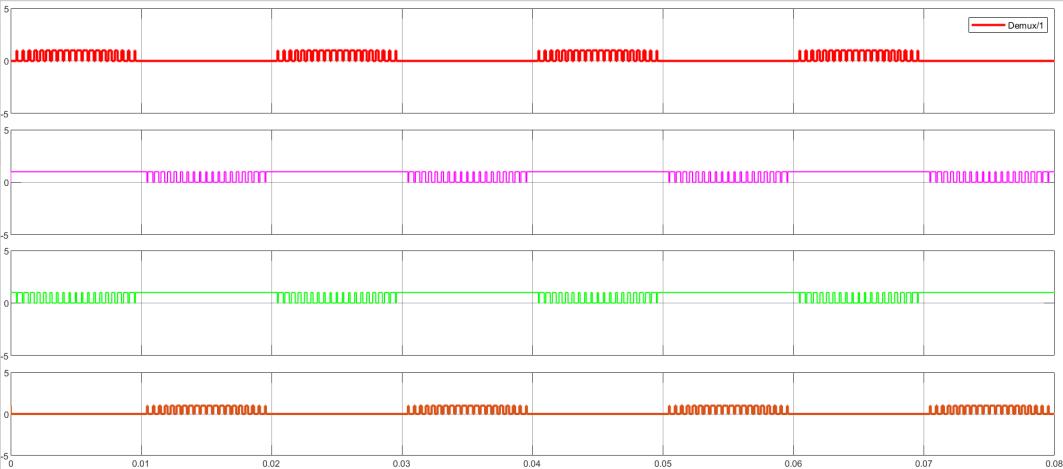
Theabovefiguredisplaysthesimulatedwaveformsforademultiplexer(Demux)outputsignals.Thegraphshowsfourseparate channelsofsignals eachrepresentedbyadifferentcolor(red,magenta,green,andorange) thatcorrespondtotheDemux’s outputlines.Thehorizontalaxisdenotestimeinseconds,rangingfrom0toapproximately0.08seconds,whiletheverticalaxis showsthelogiclevelofeachoutput.Thesignalsexhibitperiodicpulsepatterns,reflectingtheirrespectiveenablephasesduring thesimulation.Theredoutput(Demux1)maintainshighpulseamplititudecloseto5volts,whilesubsequentsignalsfollowa similarpulsepatternwithslightphasesofdelay.Thepulsewidthforeachoutputpulseisroughly0.01seconds,indicating the Demux’sabilitytorouteasingleinputtomultipleoutputlinesefficiently.Overall,theplotillustrateshowtheDemuxoperates by selecting a particular output while keeping all other lines inactive, thereby demonstrating its functionality in digital communicationanddataroutingapplications.
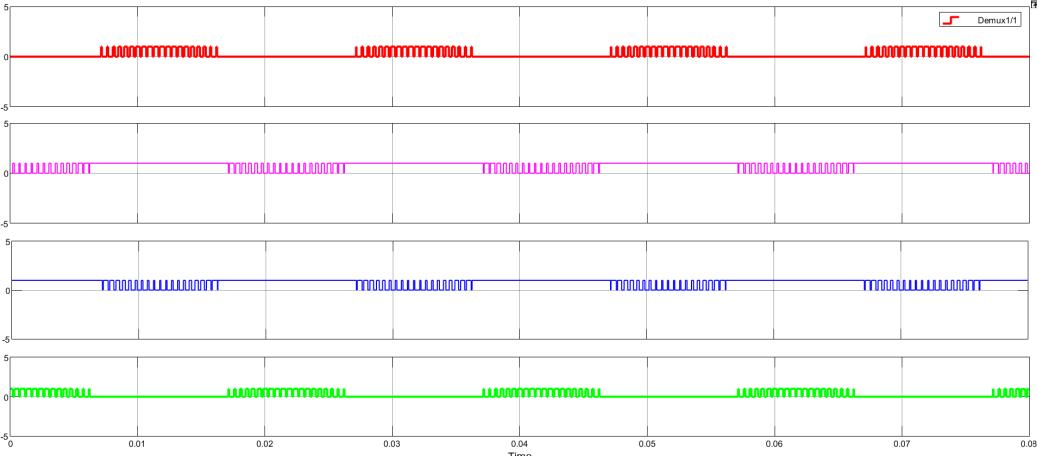
Theabovefigureshowstheoutputwaveformsforademultiplexer(Demux)duringitsoperation.Theplotdisplaysfourseparate channels,eachrepresentedbyadifferentcolor red,magenta,blue,andgreen correspondingtotheDemux’soutputlines. Thehorizontalaxisdenotes timeinseconds,rangingfrom0toapproximately0.08seconds, whiletheverticalaxisshowsthe logic level of each output. The signals exhibit periodic pulse patterns, reflecting their respective enable phases during the simulation. The red output maintains high pulse amplititude close to 5 volts, while subsequent signals follow a similar pulse pattern withslightphasesofdelay.Eachpulsewidthis roughly0.01seconds,which illustratestheDemux’sabilitytoroute a singleinputtomultipleoutputlinesefficiently.Overall,thegraphdemonstrateshowtheDemuxoperatesbyselectingaparticular output while keeping all other lines inactive, thereby validating its functionality in digital communication and data routing applications.
International Research Journal of Engineering and Technology (IRJET) e-ISSN: 2395-0056
Volume: 12 Issue: 09 | Sep 2025 www.irjet.net p-ISSN: 2395-0072
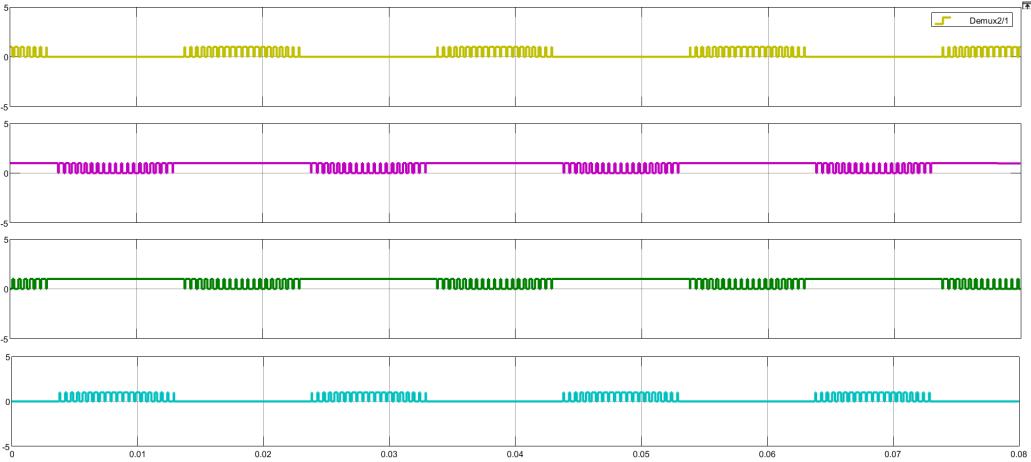
Theabovefigureillustratestheoutputwaveformsfora2-to-1demultiplexer(Demux)duringitsoperation.Theplotshowsfour separatesignals yellow,magenta,green,andcyan eachrepresentingadifferentoutputfromtheDemux. Thehorizontal axisdenotestimeinseconds,rangingfrom0toapproximately0.08seconds,whiletheverticalaxisshowsthelogiclevelofeach output.Thesignalsexhibitperiodicpulsepatterns,reflectingtheirrespectiveenablephasesduringthesimulation.Theyellow output maintains high pulse amplititude close to 5 volts, while subsequent signals follow a similar pulse pattern with slight phasesofdelay.Eachpulsewidthisroughly0.01seconds,whichillustratestheDemux’sabilitytorouteasingleinputtomultiple outputlinesefficiently.Overall,thisplotdemonstrateshowtheDemuxoperatesbyselectingaparticularoutputwhilekeeping allotherlinesinactive,therebyvalidatingitsfunctionalityindigitalcommunicationanddataroutingapplications.
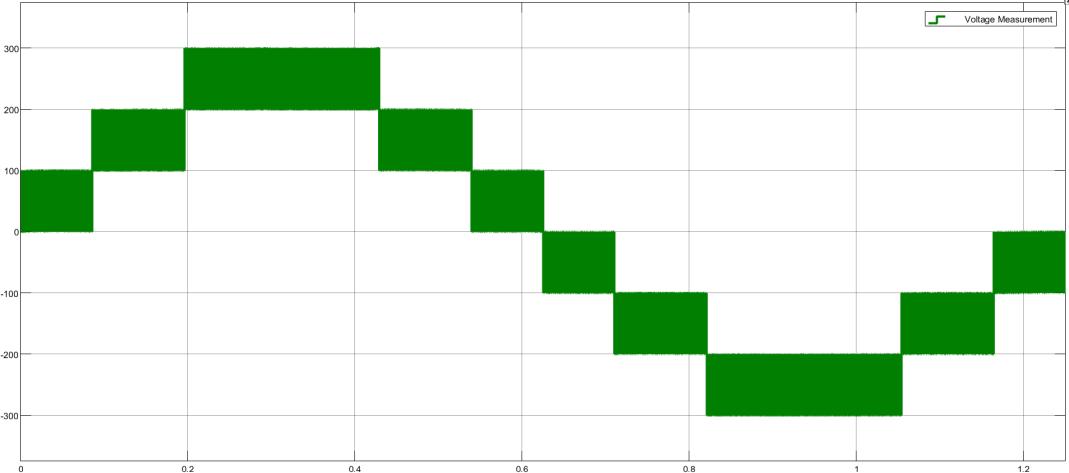
Theabovefiguredisplaysthevoltagemeasurementwaveformcapturedduringasimulatedelectronicoperation.Theplotshows astep-likewaveformwithbothpositiveandnegativeamplitudes.Thehorizontalaxisdenotestimeinseconds,rangingfrom0to approximately1.20seconds,whiletheverticalaxisshowsthevoltagelevelinvolts.Thewaveformstartswithapositivevoltage of +100 volts, then gradually climbs to +200 volts and reaches a peak of +300 volts before descending back toward 0 volts. Subsequently,the voltagedropsintothenegativerange, fallingto -100volts,then-200volts,andfurtherdownto -300volts, reflecting a symmetric pattern. Each step maintains its respective voltage for nearly 0.20 seconds, which illustrates the waveform’s multilevel nature. Overall, this plot demonstrates how the voltage varies over time, which is a crucial aspect in analyzingelectronicsignalsandunderstandingtheirbehaviorinrelatedcircuits.
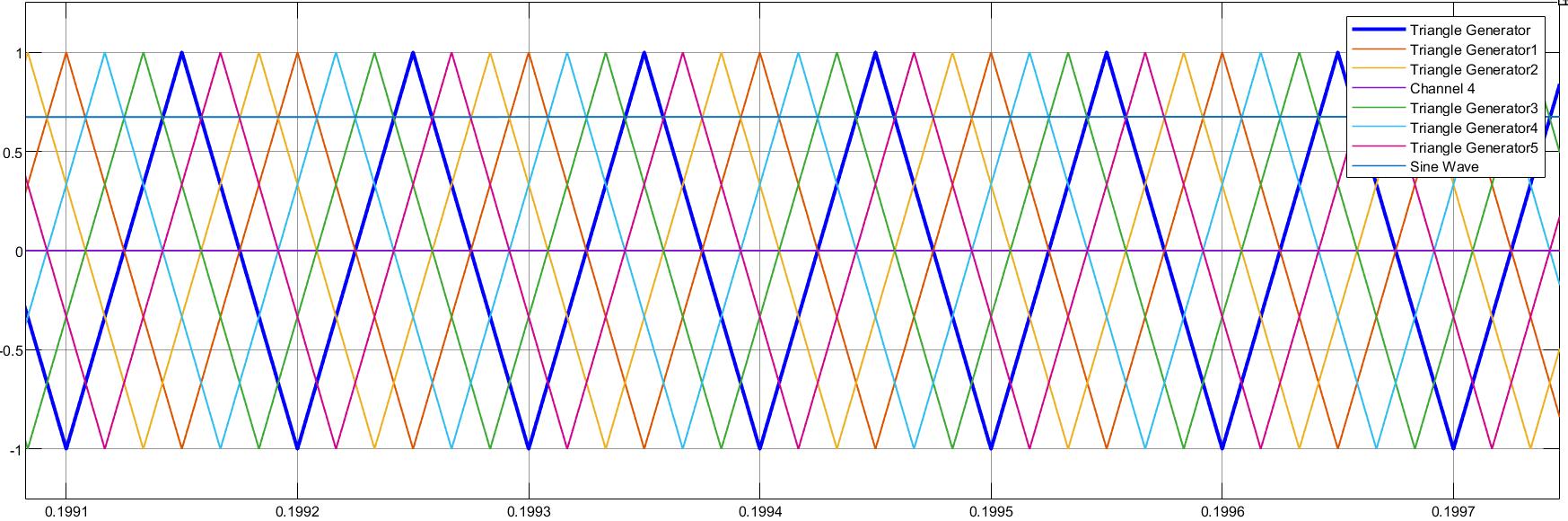
The above figure displays the output waveforms of multiple triangle wave generators. The plot shows several overlapping triangle signals each represented by a different color which collectively form a composite pattern. The horizontal axis
International Research Journal of Engineering and Technology (IRJET) e-ISSN: 2395-0056
Volume: 12 Issue: 09 | Sep 2025 www.irjet.net p-ISSN: 2395-0072
denotestimeinseconds,rangingfromapproximately0.1991to0.1997seconds,whiletheverticalaxisshowsthevoltagelevel for each generator, varying between -1 and +1 volts. Each triangle waveform maintains a consistent peak-to-peak voltage of nearly2volts,reflectingtheirsymmetricalnature.Thesignalsappeartobeevenlyspacedintimewithaperiodicrepetitionof theirphases,demonstratingtheirfunctionalityingeneratingperiodicsignalswithafixedfrequency.Thiskindofwaveform is frequentlyusedinelectroniccircuitsformodulation,audiosynthesis,andtestingapplicationsduetoitslinearslopeandsharp transitions.Overall,theplotillustratesthemultichanneltrianglewavesignalsandtheirrespectivephases.
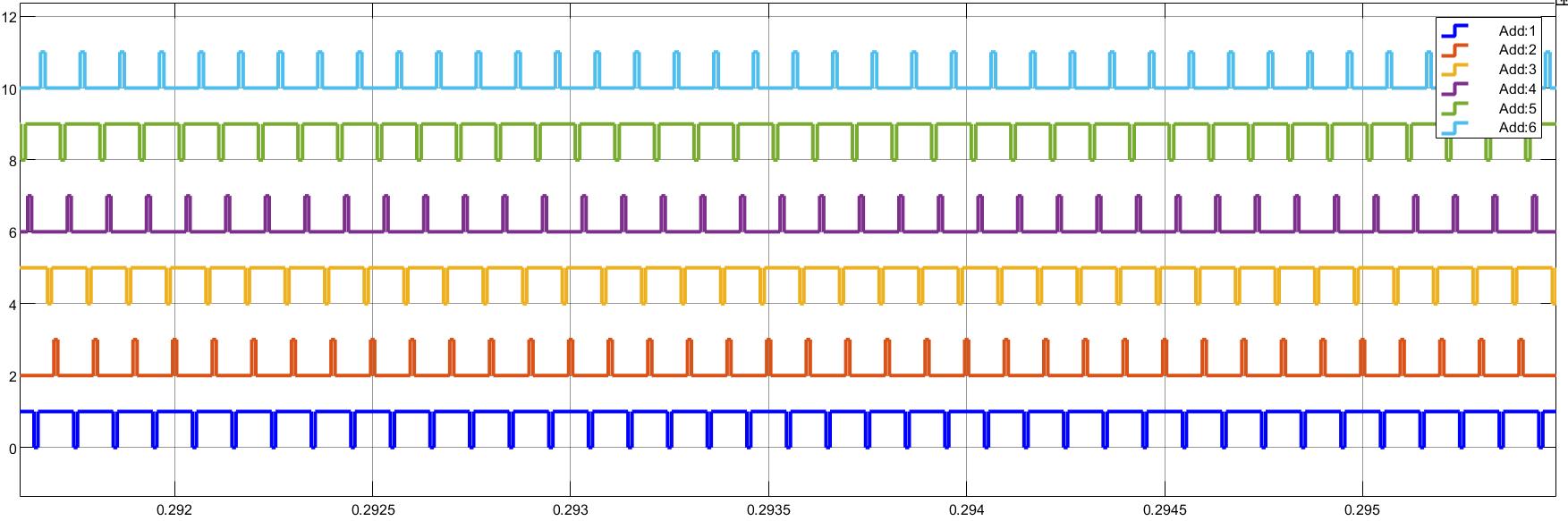
Fig.7: ADDOperationsWaveform
TheabovefigureillustratestheoutputwaveformsformultipleADDoperationsinadigitalcircuit.Theplotshowssixseparate signals each represented by a different color which correspond to the ADD modules’ output lines. The horizontal axis denotes time in seconds, ranging from approximately 0.292 to 0.296 seconds, while the vertical axis shows the logic level or outputvalueforeachADD.Thesignalsexhibitperiodicpulsepatterns,reflectingtheirrespectiveenablephasesandoperational intervals. Each pulse maintains a consistent high or low state for nearly 0.0005 seconds, which illustrates the ADD modules’ ability to perform repeated addition operations at high speed. The signals collectively demonstrate a well-coordinated and synchronized functionality withina digital processingpipeline. Overall,thisplothighlights themultichannel ADDoperations’ outputsignalsandtheirrespectivephases,reflectingtheirroleincomputinganddataprocessingapplications.
3 Dual Two-Level Inverter
International Research Journal of Engineering and Technology (IRJET) e-ISSN: 2395-0056
Volume: 12 Issue: 09 | Sep 2025 www.irjet.net p-ISSN: 2395-0072
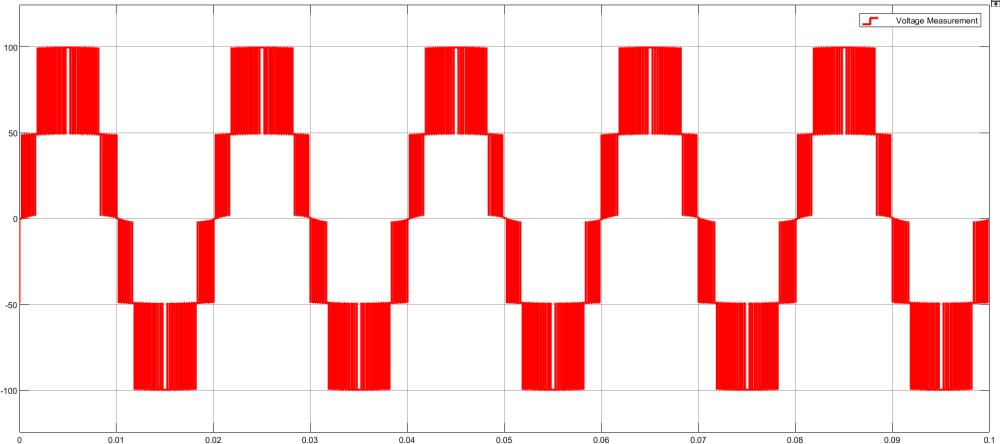
Theabovefigureshowsthevoltagemeasurementwaveformcapturedduringasimulatedelectronicoperation.Theplotdisplays a periodic pulse waveform with both positive and negative amplitudes. The horizontal axis denotes time in seconds, ranging from0to0.1seconds,whiletheverticalaxisshowsthevoltagelevelinvolts.Thewaveformrepeatedlytransitionsbetween+100 voltsand-100voltswithintermediateplateausat+50voltsand-50volts.Eachpulsemaintainsitsrespectivevoltagefornearly 0.01seconds,reflectingthesystematicvariationinoutput.Thispatternillustratesamultilevelpulsewaveformfrequentlyused inelectroniccircuitsforcontrolsignals,modulation,ordatatransmission.Thewaveform’ssymmetricalstructureandconsistent pulse duration aid in verifying the functionality of related electronic components. Overall, this plot highlights the pulse waveform’sroleindeliveringwell-coordinatedsignalswithinelectronicsystems,demonstratingtheirstabilityandpredictability inmanyapplications.
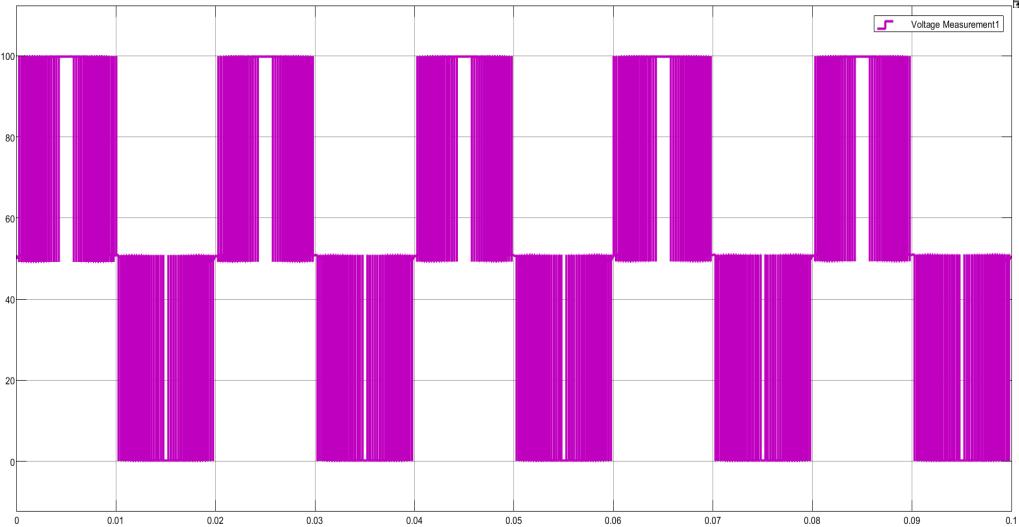
Theabovefiguredisplaysavoltagemeasurementwaveformcapturedduringasimulatedelectronicoperation.Theplotshowsa pulsewaveformwithalternatinghighandlowamplitudes.Thehorizontalaxisdenotestimeinseconds,rangingfrom0to0.1 seconds,whiletheverticalaxisshowsthevoltagelevelinvolts.Thewaveformrepeatedlytransitionsbetween+100voltsand +50volts,reflectingitspulse-likestructure.Eachpulsemaintainsitsrespectivehighorlowstatefornearly0.01secondsbefore transitioning again, which illustrates its periodic and systematic variation. This pulse waveform typically finds application in electroniccontrolsignals,datatransmission,andclockpulsegeneration.Theconsistencyandsharptransitionsaidinverifying the functionality of related electronic components and circuits. Overall, this plot highlights how pulse signals can carry information and enable reliable operation within electronic systems, emphasizing their significance in modern digital and electronicdesign.
4 Buck Converter Inverter
International Research Journal of Engineering and Technology (IRJET) e-ISSN: 2395-0056
Volume: 12 Issue: 09 | Sep 2025 www.irjet.net p-ISSN: 2395-0072
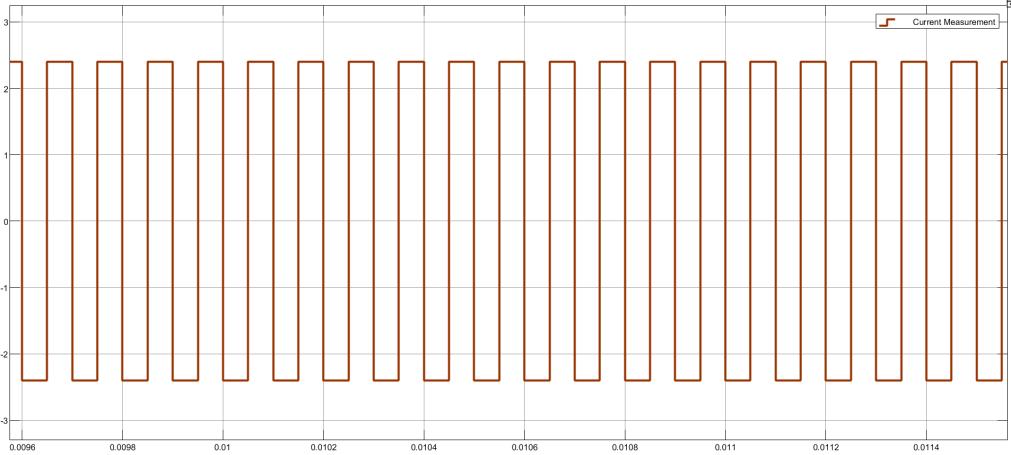
Theabovefigureshowsthecurrentmeasurementwaveformcapturedduringasimulatedelectronicoperation.Theplotdisplays aperiodicpulsewaveformwithsharptransitionsbetweenhighandlowamplitudes.Thehorizontalaxisdenotestimeinseconds, ranging from 0.0096 to 0.0115 seconds, while the vertical axis shows the current level in amps. The waveform repeatedly transitionsbetween+2ampsand-2amps,reflectingitspulse-likenature.Eachpulsemaintainsitsrespectivehighorlowstate for nearly 0.0001 seconds before switching, which highlights its periodic and systematic variation. This pulse waveform is typicallyusedinelectroniccontrolsignals,datatransmission,orfortestingandverifyingelectroniccomponents’functionality. The high-frequency pulse signals enable reliable operation within circuits and aid in understanding their dynamic response. Overall,thisplotemphasizeshowpulsesignalscancarryinformation,controlmechanisms,orperformdiagnosticsinarangeof electronicapplications,demonstratingtheirsignificanceinmodernelectronicdesign.
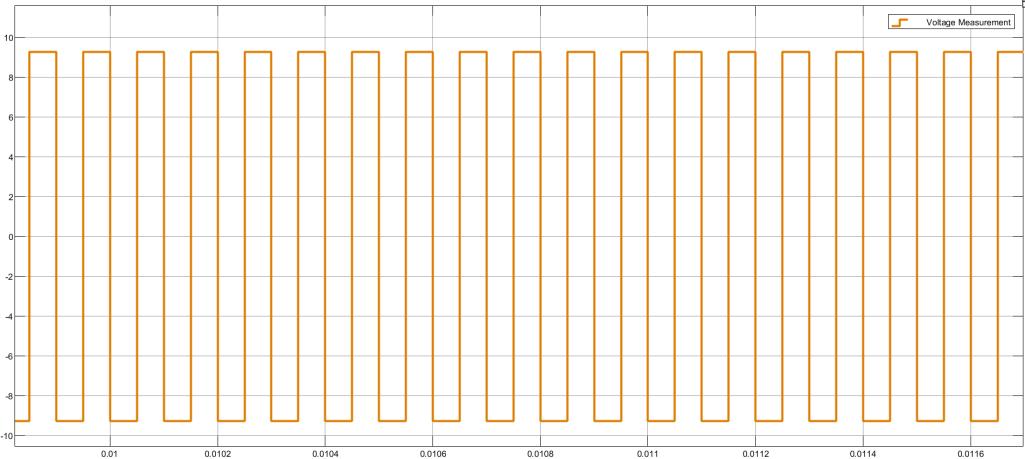
Theabovefigureshowsthevoltagemeasurementwaveformcapturedduringasimulatedelectronicoperation.Theplotdisplays aperiodicpulsewaveformwithsharptransitionsbetweenhighandlowamplitudes.Thehorizontalaxisdenotestimeinseconds, rangingfrom0toapproximately0.012seconds,whiletheverticalaxisshowsthevoltagelevelinvolts.Thewaveformrepeatedly transitionsbetween+10voltsand-10volts,reflectingitspulse-likenature.Eachpulsemaintainsitsrespectivehighorlowstate for nearly 0.0005 seconds before transitioning, which highlights its periodic variation. This pulse waveform typically finds applicationsinelectroniccontrolsignals,clockpulsegeneration,ordatatransmission.Thehigh-frequencypulsesignalsenable reliableoperationwithinelectroniccircuitsandaidinunderstandingtheirdynamicresponse.Overall,thisplotemphasizeshow pulse signals can carry information, control mechanisms, or perform diagnostics in a range of electronic applications, demonstratingtheirsignificanceinmodernelectronicdesign.
International Research Journal of Engineering and Technology (IRJET) e-ISSN: 2395-0056
Volume: 12 Issue: 09 | Sep 2025 www.irjet.net p-ISSN: 2395-0072
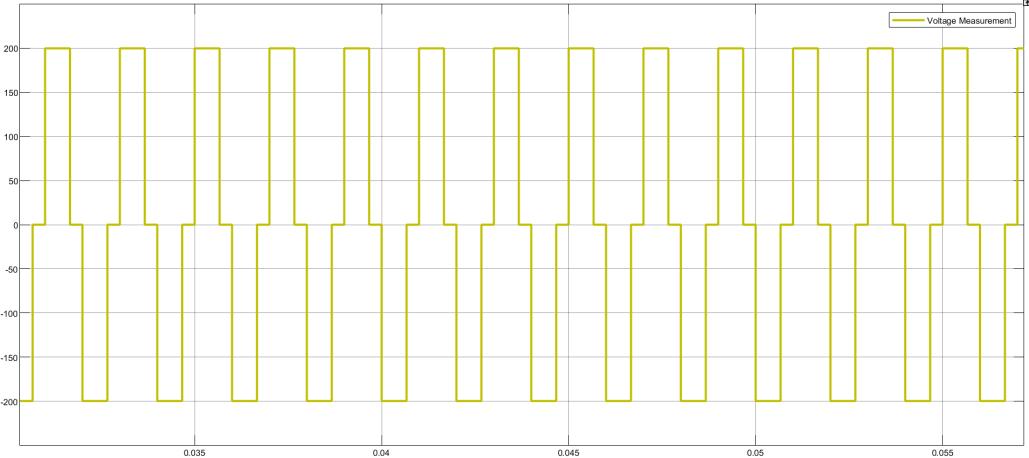
ThedisplayedfigureshowsaPulseWidthModulated(PWM)VoltageWaveform,characterizedbyarepetitiverectangularsignal patternalternatingbetweenhighandlowvoltagelevels.Thevoltageswingsfromapproximately+200Vto -200V,indicatinga bipolar PWM signal. This type of waveform is commonly used in power electronics for applications such as inverter output control,motordrives,orvoltageregulation.Thewaveformhasaconsistentdutycycleandfrequency,reflectingstableswitching behavior.TherapidtransitionsbetweenhighandlowvoltagelevelssuggestthatthesignalisintendedtosimulateanACvoltage usinghigh-frequencyswitching.Suchwaveformsaretypicalindigitalcontrolsystems,wherehigh-speedswitchingdevices(like IGBTsorMOSFETs)areusedtogenerateanaverageoutputvoltagecorrespondingtothedesiredanalogsignal.Theflattopsand bottoms of the waveform confirm that the voltage remains stable during the on and off periods, ensuring effective voltage modulationovertime.
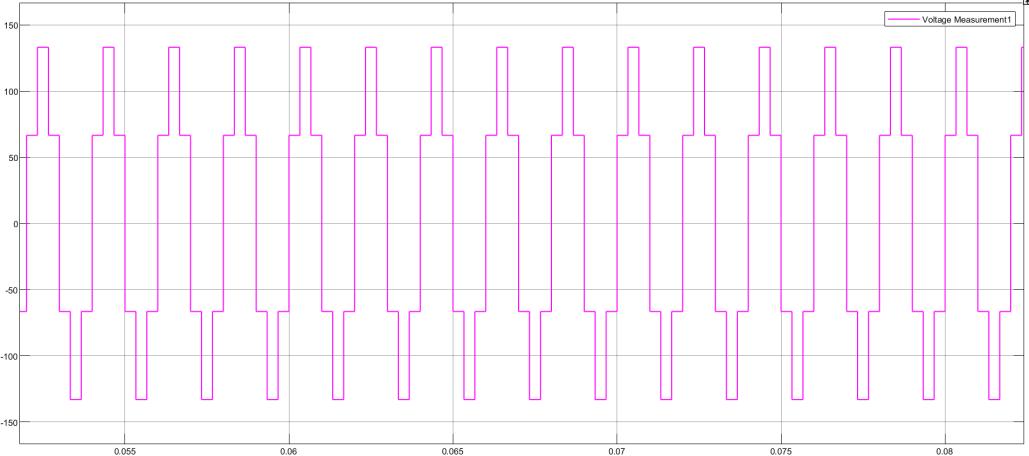
ThefiguredisplaysaPulseWidthModulated(PWM)outputsignalwithalternatingvoltagelevelsrangingfromapproximately +125Vto-125V.Thewaveformconsistsofasymmetricalrectangularpattern,suggestingbalancedhighandlowpulsewidths overtime.Thefrequencyappearsrelativelyhigh,andtheconsistentpulseintervalsindicateasteadyswitchingoperation.This type of signal is typical in inverter circuits or digital control systems for modulating power to devices such as motors or transformers. The waveform demonstrates narrow and wide pulses in a repeating pattern, which is a common approach to simulatesinusoidalwaveformsinpowerelectronicsbycontrollingtheaveragevoltage.Thecleartransitionsandstablepulse levelsensureeffectivepowerdeliverywhileminimizingdistortion.Themagentacolorofthetracerepresentsthesignallabeled "Voltage Measurement1", helping differentiate it visually during analysis. Overall, the waveform indicates an efficient and controlledPWMprocessusedforvoltageregulationorwaveformsynthesis.
International Research Journal of Engineering and Technology (IRJET) e-ISSN: 2395-0056
Volume: 12 Issue: 09 | Sep 2025 www.irjet.net p-ISSN: 2395-0072
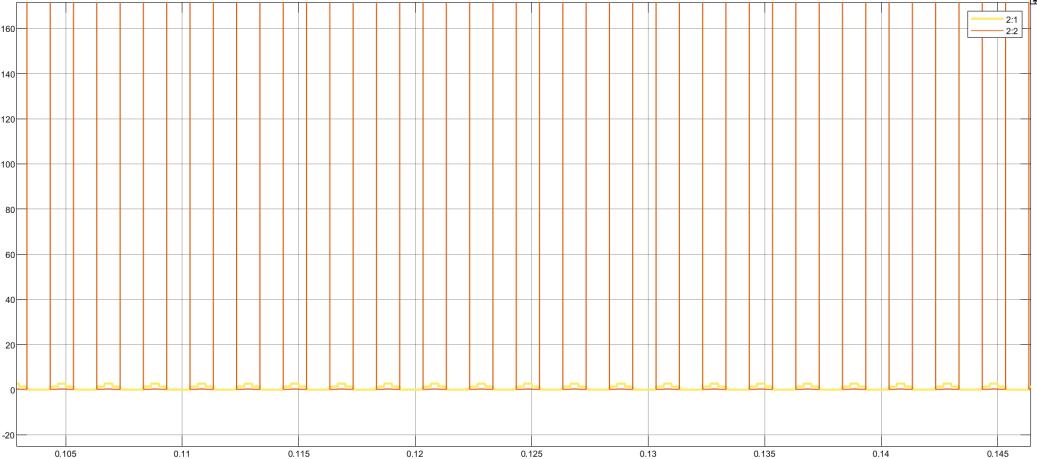
The figure illustrates a comparative plot of two signals labeled as "2:1" (orange) and "2:2" (yellow), likely representing two differentPWM(PulseWidthModulation)outputsorgatepulsesignalsinapowerelectroniccircuit.Theorangewaveform("2:1") consistsoftall,narrowpulseswithapeakvaluereachingapproximately160V,indicatingahigh-frequencyswitchingsignal possiblythegatesignalforaswitchingdevicelikeaMOSFETorIGBT.Incontrast,theyellowwaveform("2:2")showsamuch loweramplitude,around5V,andexhibitssmallripple-likevariationsatthebottom,whichcouldrepresentafeedbackorcontrol signal. The timing of both signals aligns precisely, suggesting synchronization in operation. This figure is useful in analyzing switchingbehaviorandpulsetimingbetweencontrolandpowersignalsinadigitaldriverorinvertercircuit.Theverticalpulse patternsandconsistentspacingemphasizeregularswitchingintervals,whichareessentialforsystemstabilityandperformance.
6 Single-phase inverter
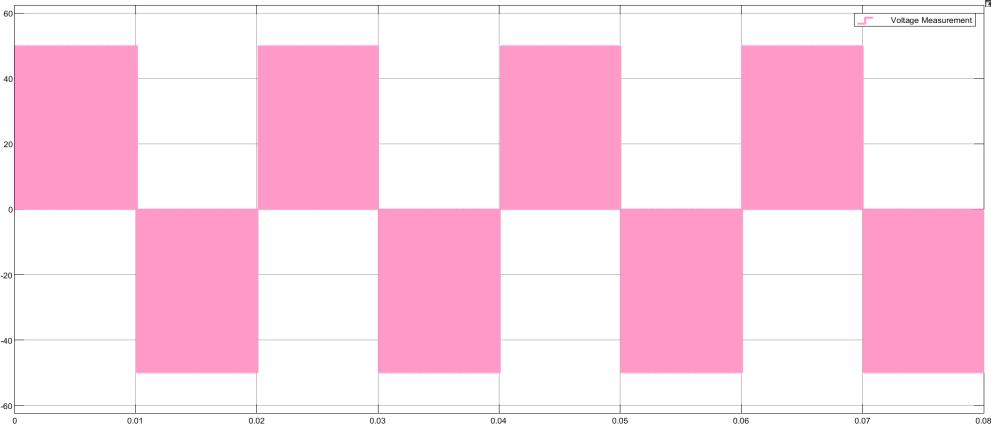
Thefigurepresentsabipolarsquarewavesignallabeled"VoltageMeasurement,"withalternatingvoltagelevelsofapproximately +50Vand-50V.Thewaveformexhibitsasymmetricalrectangularshape,indicatingaconstantdutycyclecloseto50%.Thistype ofwaveformistypicallyobservedindigitalsignalprocessingorinvertercircuits,whereasquarewaveisusedtorepresentbinary statesorsimulateACsignals.Thepinkshadinghighlightstheactivevoltageregions,improvingvisualclarity.Eachcompletecycle includesapositiveandnegativevoltagephase,whichhelpsinachievingzeroaveragevoltageovertime adesirablefeaturein applicationslikemotorcontrolortransformerexcitationtopreventcoresaturation.Thecleantransitionsanduniform timing between high and low states indicate precise switching, essential for efficient and stable operation. The regularity of the waveformconfirmsitasastableandreliableoutputsignalfromadigitalorpulsegenerationsystem.
International Research Journal of Engineering and Technology (IRJET) e-ISSN: 2395-0056
Volume: 12 Issue: 09 | Sep 2025 www.irjet.net p-ISSN: 2395-0072
7 Multilevel inverter
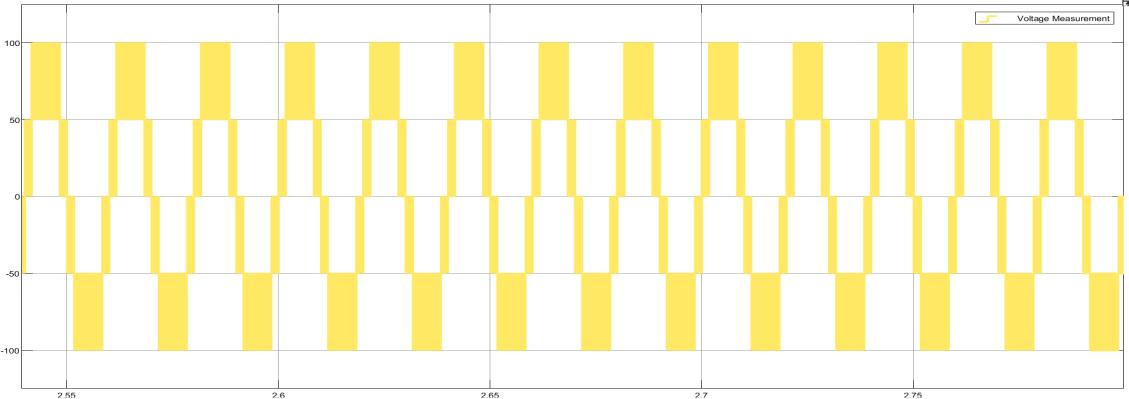
Fig.16: PWMVoltageSignal
Thefigure representsa PulseWidthModulation(PWM) voltagewaveformtitled"VoltageMeasurement," displayedina timedomain format. The waveform oscillates between approximately +100V and -100V, showcasing a symmetrical square wave pattern.Thisindicatesthatthesignalislikelyusedforpowercontrolormotordriveapplications.Thex-axisrepresentstimein seconds,rangingfromapproximately2.95to3.15seconds,whilethey-axisshowsvoltageamplitude.Therepetitivenatureof thewaveformanduniformpulsewidthssuggestaconsistentdutycycleovertime.Theyellowshadedareasrepresentthehighvoltage state (ON), while the white gaps signify the low-voltage state (OFF). The PWM waveform demonstrates four discrete amplitude levels (around ±100V, ±50V, 0V), indicating a multilevel inverter or digital modulation technique. This pattern is typicalinapplicationswhereefficientvoltageregulationandenergycontrolareessential,suchasinDC-ACconversionorpower electronics.
9 Three-phase inverter
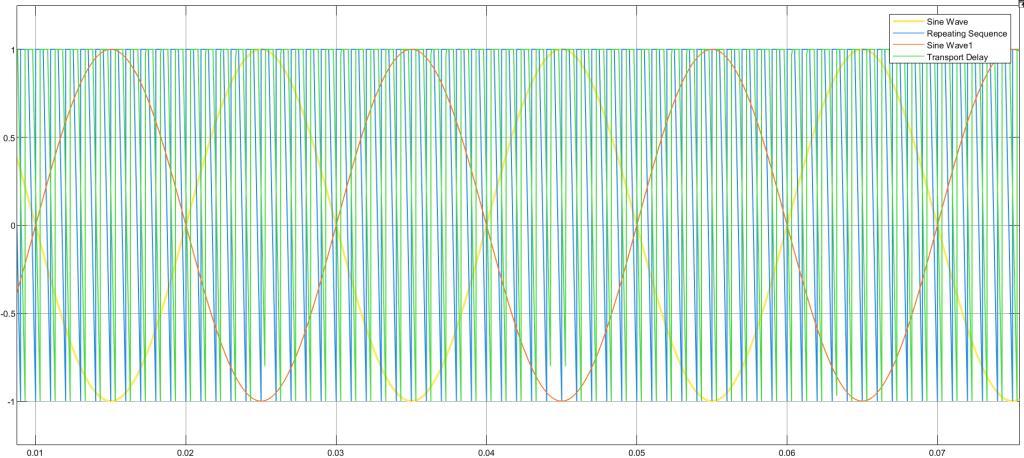
Fig.17: PWMModulationWaveform
ThefigureillustratesaPWM(PulseWidthModulation)modulationprocessinvolvingsinewavecomparison.Itshowsfoursignal traces:areferencesinewave(orange),arepeatingsequenceorcarrierwave(blue),anothersinewave(likelydelayed,inyellow), andatransportdelayoutput(green).Thecarrierwaveisahigh-frequencytriangularorsawtoothwaveformusedforswitching control,whilethesinewavesactasmodulationsignals.TheoutputPWMwaveformisgeneratedbycomparingthesinewaveto the carrier wave wherever the sine wave exceeds the carrier, the output is high (logic 1); otherwise, it's low (logic 0). This comparison results in a high-density switching pattern, evident from the densely packed blue pulses. The transport delay introducesaphaseshifttotheoriginalsinewave,visiblebytheslightlaginthegreenwaveformcomparedtotheoriginalsine wave.Thisplotisatypicalrepresentationininverterdesignandsignalmodulationstudies.
International Research Journal of Engineering and Technology (IRJET) e-ISSN: 2395-0056
Volume: 12 Issue: 09 | Sep 2025 www.irjet.net p-ISSN: 2395-0072
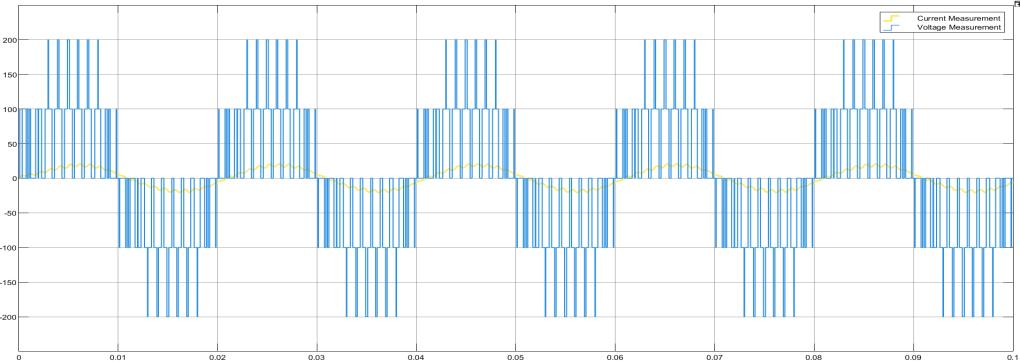
The figure shows the output waveform of an inverter system, displaying both current measurement (in blue) and voltage measurement(inyellow).ThevoltagewaveformexhibitsasteppedPWM(PulseWidthModulation)shape,indicatingthatitis generated using a multilevel inverter or switching logic. This stepped waveform aims to approximate a sine wave but with discretelevels,reducingharmonicdistortion.Thecurrentwaveform,incontrast,issmootherandfollowsasinusoidalpattern, suggestingthepresenceofaloadlikeaninductivemotorwhichfiltersthehigh-frequencyswitching.Thepeakvoltagereaches around±200V,whilethecurrentamplitudevariesaround±50units.Theperiodicswitchingandshapingofthevoltageresultin efficient power delivery with minimal harmonic loss. This type of waveform is typical in applications like variable frequency drives,solarinverters,andmotorcontrolsystems,whereconvertingDCtoACwithcontrolledfrequencyandvoltageisessential.
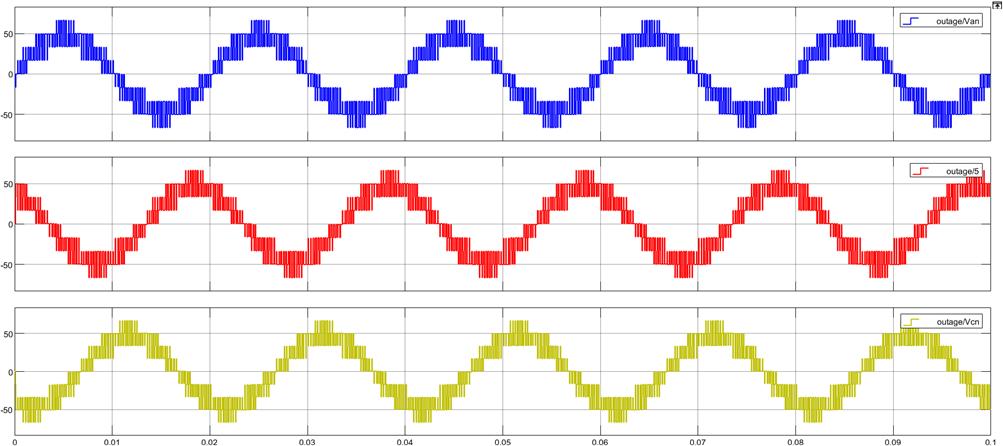
Theaboveimage(Figure5.18)showstheneutral voltagesofthethree-phaseinvertersystem.Thegraphdisplaystheneutral voltagewaveformforeachofthethreephases:PhaseA,PhaseB,andPhaseC(labeledasoutageVan,outageVbn,andoutageVcn, respectively).Thesevoltagesareshownindifferentcolors(blueforPhaseA,redforPhaseB,andyellowforPhaseC).Eachgraph depictsasinusoidalwaveformwithvoltagelevelsoscillatingbetweenapproximately+50Vand-50V,correspondingtothetypical neutral point voltage fluctuations in a three-phase system. The waveforms are modulated by the SPWM technique, which generates pulse width modulation with a varying duty cycle to maintain the desired AC voltage output. The image indicates stableandbalancedneutralvoltagesinathree-phaseinvertersystem,demonstratingthecontrolledswitchingbehaviorofthe inverterundernormaloperatingconditions.
International Research Journal of Engineering and Technology (IRJET) e-ISSN: 2395-0056
Volume: 12 Issue: 09 | Sep 2025 www.irjet.net p-ISSN: 2395-0072
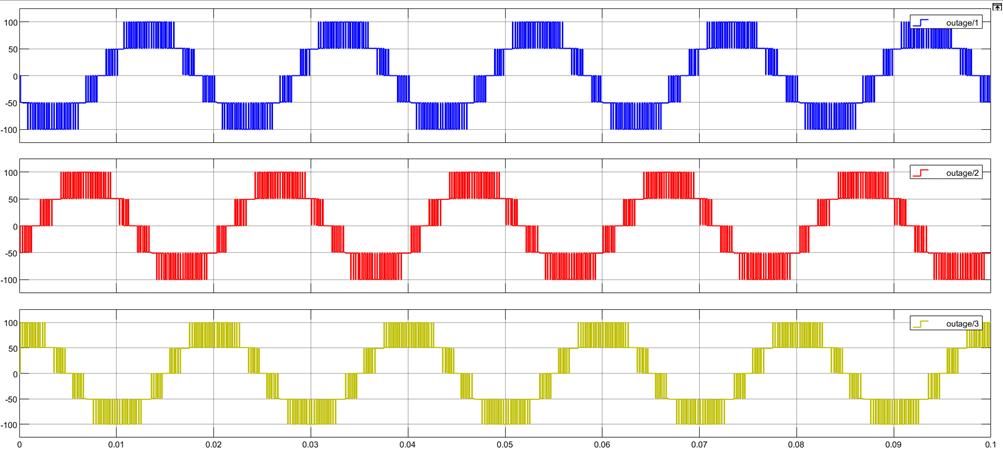
The Figure No. 5.19 Line Voltage" depicts three distinct line voltage waveforms labeled output1 (blue), output2 (red), and output3(yellow).Eachwaveformspans0to0.1secondsonthex-axis,withvoltagevaluesrangingfrom-100to100ontheyaxis.Thewaveformsexhibitsharp,repetitivepulses,indicatingrectangularwavepatternsforeachoutput.Output1(blue)shows consistent voltage levels with symmetrical peaks, output2 (red) follows a similar pattern with slight variations, and output3 (yellow)presentsasimilarformwithsubtledifferencesinthetiminganddistributionofthevoltagepeaks.Thesewaveforms representthevoltagebehavioracrossthreeoutputsundertestconditions.
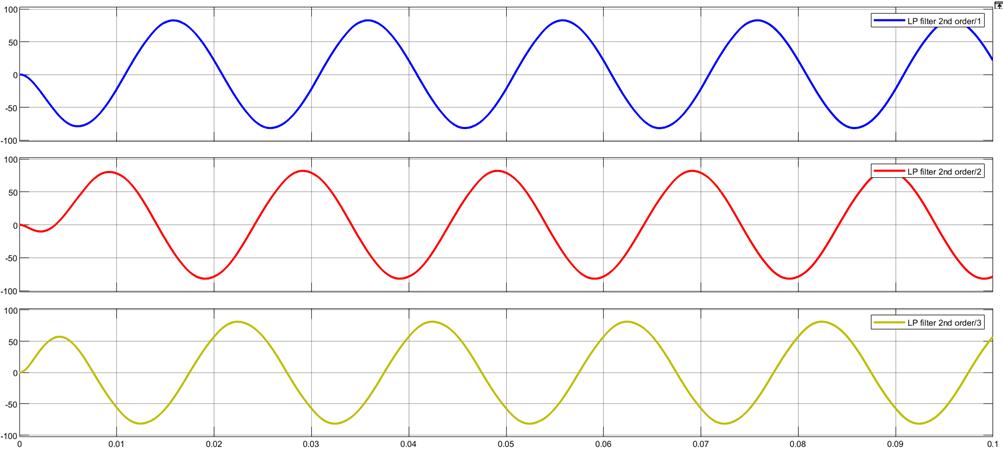
Theimagedisplaysthreesinusoidalwaveformsoffilteredlinevoltages,eachresultingfromapplyingasecond-orderlow-pass filtertodifferentvoltagesignals.Thefirstgraph(blue)representsthefilteredvoltageofthefirstline,oscillatingbetween+100 and-100volts.Similarly,thesecondgraph(red)showsthefilteredvoltageforthesecondline,withasimilaroscillationpattern. The third graph (yellow)illustratesthe filtered voltage ofthe third line,alsoexhibitinga smooth sinusoidal pattern withthe same amplitude range. All three plots show the effectiveness of the low-pass filter in reducing high-frequency noise while preservingtheoriginalsinusoidalwaveform.Thetimeaxisspansfrom0to0.1seconds,andthevoltagevaluesoscillatebetween approximately±100volts.Thisdemonstratesthefilter'sabilitytocleanupthesignalwhilemaintainingthecorecharacteristics ofthevoltagewaveforms.
The implementation of enhanced modulation techniques in multilevel inverters significantly contributes to improved performance, reliability, and energy efficiency in renewable energy systems. By optimizing modulation strategies such as Sinusoidal Pulse Width Modulation (SPWM), Space Vector Modulation (SVM), and Selective Harmonic Elimination (SHE), the inverter output becomes more sinusoidal with reduced Total Harmonic Distortion (THD). This improvement leads to better compatibilitywithgridstandards,reducesstressonelectricalcomponents,andextendstheoperationallifespanofrenewable systemslikesolarphotovoltaicandwindpowersetups.Furthermore,advancedmodulationmethodshelpinachievingprecise voltage control, lower switching losses, and higher dynamic response, making them suitable for applications where power
International Research Journal of Engineering and Technology (IRJET) e-ISSN: 2395-0056
Volume: 12 Issue: 09 | Sep 2025 www.irjet.net p-ISSN: 2395-0072
quality and efficiency are critical. In renewable energy integration, especially with solar and wind systems, where power fluctuationisachallenge,enhancedmultilevelinverterswithimprovedmodulationofferbettervoltagebalancingandrobustness undervariableloadandsupplyconditions.Thescalabilityandmodularityofthesesystemsallowtheiruseinbothgrid-tiedand standalone applications. Moreover, with the integration of control algorithms such as Artificial Intelligence (AI) or Machine Learning (ML), predictive modulation strategies can be developed for dynamic adaptation to real-time operating conditions. Overall,theenhancedmodulationtechniquenotonlyimprovestheinverter’sperformancemetricsbutalsocontributestothe broader goals of renewable energy adoption, grid stability, and sustainable power distribution in modern smart grid infrastructures.
[1] LMeegahapola,“Powerelectronics-theenablingtechnologyforrenewableenergyintegration,” CSEE J. Power Energy Syst., 2021,doi:10.17775/CSEEJPES.2021.02850.
[2] E.Hendawi,“AnEffectiveModulationTechniquefor Multi-LevelInverters,” Saudi J. Eng. Technol.,vol.8, no.11,pp.283–292,Nov.2023,doi:10.36348/sjet.2023.v08i11.003.
[3] B. Tejasvi and P. Vijayapriya, “A comprehensive review of various MLI topologies to minimise the THDs for FACTS applications,” Int. J. Syst. Syst. Eng.,vol.14,no.4,pp.403–445,2024,doi:10.1504/IJSSE.2024.139429.
[4] S.Munawar,M.S.Iqbal,M.Adnan,M.AliAkbar,andA.Bermak,“MultilevelInvertersDesign,Topologies,andApplications: Research Issues, Current, and Future Directions,” IEEE Access, vol. 12, pp. 149320–149350, 2024, doi: 10.1109/ACCESS.2024.3472752.
[5] S.Choudhury,M.Bajaj,T.Dash,S.Kamel,andF.Jurado,“MultilevelInverter:ASurveyonClassicalandAdvancedTopologies, ControlSchemes,ApplicationstoPowerSystemandFutureProspects,” Energies,vol.14,no.18,p.5773,Sept.2021,doi: 10.3390/en14185773.
[6] N. Subramanian and A. A. Stonier, “A Comprehensive Review on Selective Harmonic Elimination Techniques and Its Permissible Standards in Electrical Systems,” IEEE Access, vol. 12, pp. 141966–141998, 2024, doi: 10.1109/ACCESS.2024.3436079.
[7] H. Naderi, N. Ghaderi, and M. Abedini, “Improving power quality and efficiency of multi-level inverter system through intelligentcontrol algorithm,” Soft Comput., vol.28, no.21–22,pp. 12963–12976, Nov.2024, doi:10.1007/s00500-02410354-5.
[8] R. A. Fahim et al., “Improved Switching Technique to Mitigate THD and Power Loss of NPC Inverters,” IEEE Trans. Appl. Supercond.,vol.34,no.8,pp.1–5,Nov.2024,doi:10.1109/TASC.2024.3420303.
[9] T. Sun et al., “A Comprehensive Review on Comparison and Performance of Five-Phase Space Vector Pulse Width ModulationOvermodulationStrategies,” Energies,vol.17,no.6,p.1356,Mar.2024,doi:10.3390/en17061356.
[10] S. Hasheminasab, M. Alzayed, and H. Chaoui, “A Review of Control Techniques for Inverter-Based Distributed Energy ResourcesApplications,” Energies,vol.17,no.12,p.2940,June2024,doi:10.3390/en17122940.
[11] N.D.Tuyen,N.S.Quan,V.B.Linh,V.VanTuyen,andG.Fujita,“AComprehensiveReviewofCybersecurityinInverter-Based Smart Power System Amid the Boom of Renewable Energy,” IEEE Access, vol. 10, pp. 35846–35875, 2022, doi: 10.1109/ACCESS.2022.3163551.
[12] Z. A. Aljawary, S. De Pablo, L. C. Herrero-de Lucas, and F. Martinez-Rodrigo, “Local Carrier PWM for Modular Multilevel ConverterswithDistributedPVCellsandCirculatingCurrentReduction,” Energies,vol.13,no.21,p.5585,Oct.2020,doi: 10.3390/en13215585.
[13] T. A. Taha et al., “Recent Advancements in Multilevel Inverters: Topologies, Modulation Techniques, and Emerging Applications,” Symmetry,vol.17,no.7,p.1010,June2025,doi:10.3390/sym17071010.
[14] R.S.Alishah,S.H.Hosseini,E.Babaei,andM.Sabahi,“ANewGeneralMultilevelConverterTopologyBasedonCascaded ConnectionofSubmultilevel UnitsWithReducedSwitchingComponents,DCSources,andBlockedVoltagebySwitches,” IEEE Trans. Ind. Electron.,vol.63,no.11,pp.7157–7164,Nov.2016,doi:10.1109/TIE.2016.2592460.
[15] A.Ali,J. Su,A. Farghly,Z.A. Memon,andP.H. Shaikh,“AdvancedModulation Techniquesand Topological Innovationsin High-Frequency Link Inverters: A Comprehensive Review,” IEEE Access, vol. 13, pp. 128541–128561, 2025, doi: 10.1109/ACCESS.2025.3535776.
[16] OlusayoAdekunleAjeigbeandOreoluwaOmoladeAdeyemi,“Investigationofimprovedcontrolstrategiesofphotovoltaic invertersystemsfortheintegrationofdistributedgenerations,” Glob. J. Eng. Technol. Adv.,vol.22,no.3,pp.259–266,Mar. 2025,doi:10.30574/gjeta.2025.22.3.0071.
International Research Journal of Engineering and Technology (IRJET) e-ISSN: 2395-0056
Volume: 12 Issue: 09 | Sep 2025 www.irjet.net p-ISSN: 2395-0072
[17] S.Pan et al.,“SwitchingFrequencyMinimizedHarmonicMitigation:AMultiobjectiveOptimizedModulationStrategyfor High- Power Converters,” IEEE Trans. Power Electron., vol. 38, no. 9, pp. 11080–11090, Sept. 2023, doi: 10.1109/TPEL.2023.3287482.
[18] P.Madasamy et al.,“ASimpleMultilevel Space VectorModulationTechniqueandMATLABSystemGeneratorBuiltFPGA Implementation for Three-Level Neutral-Point Clamped Inverter,” Energies, vol. 12, no. 22, p. 4332, Nov. 2019, doi: 10.3390/en12224332.
[19] B.Batkhishig,P.F.D.C.Gonçalves,G.Pietrini,B.Nahid-Mobarakeh,andA.Emadi,“PWMTechniquesforTwo-LevelVoltage SourceInverters:AComparativeStudy,” IEEEAccess,vol.13,pp.86235–86255,2025,doi:10.1109/ACCESS.2025.3563115.
[20] M.Salem,A.Richelli,K.Yahya,M.N.Hamidi,T.-Z.Ang,andI.Alhamrouni,“AComprehensiveReviewonMultilevelInverters forGrid-TiedSystemApplications,” Energies,vol.15,no.17,p.6315,Aug.2022,doi:10.3390/en15176315.
[21] S.Zhao,L.Zhang,Y.Liu,andP.Yu,“OverviewofMultilevelInverterTopologiesandModulationMethods,”in Proceedings of the 5th International Conference on Electrical Engineering and Information Technologies for Rail Transportation (EITRT) 2021,vol.864,L.Jia,Y.Qin,J.Liang,Z.Liu,L.Diao,andM.An,Eds.,inLectureNotesinElectricalEngineering,vol.864. , Singapore:SpringerNatureSingapore,2022,pp.1–13.doi:10.1007/978-981-16-9905-4_1.
[22] K.K.Mahto,P.K.Pal,P.Das,S.Mittal,andB.Mahato,“ANewDesignofMultilevelInverterBasedonT-typeSymmetricaland Asymmetrical DC Sources,” Iran. J. Sci. Technol. Trans. Electr. Eng., vol. 47, no. 2, pp. 639–657, June 2023, doi: 10.1007/s40998-022-00568-4.
[23] A.I.M.Ali,Z.M.Alaas,M.A.Sayed,A.Almalaq,A.Farah,andM.A.Mohamed,“AnEfficientMPPTTechnique-BasedSingleStageIncrementalConductanceforIntegratedPVSystemsConsideringFlybackCentral-TypePVInverter,” Sustainability, vol.14,no.19,p.12105,Sept.2022,doi:10.3390/su141912105.
[24] N. Priyadarshi, S. Padmanaban, M. Sagar Bhaskar, F. Blaabjerg, and A. Sharma, “Fuzzy SVPWM-based inverter control realisation of grid integrated photovoltaic-wind system with fuzzy particle swarm optimisation maximum power point trackingalgorithmforagrid-connectedPV/windpowergenerationsystem:hardwareimplementation,” IET Electr. Power Appl.,vol.12,no.7,pp.962–971,Aug.2018,doi:10.1049/iet-epa.2017.0804.
[25] S. Tahir, J. Wang, M. Baloch, and G. Kaloi, “Digital Control Techniques Based on Voltage Source Inverters in Renewable EnergyApplications:AReview,” Electronics,vol.7,no.2,p.18,Feb.2018,doi:10.3390/electronics7020018.
[26] S. Nyamathulla and D. Chittathuru, “A Review of Multilevel Inverter Topologies for Grid-Connected Sustainable Solar PhotovoltaicSystems,” Sustainability,vol.15,no.18,p.13376,Sept.2023,doi:10.3390/su151813376.
[27] M.LakshmiSwarupa,E. VijayKumar,and K. Sreelatha,“Modelingand simulation of solarPVmodules based inverterin MATLAB-SIMULINK for domestic cooking,” Mater. Today Proc., vol. 38, pp. 3414–3423, 2021, doi: 10.1016/j.matpr.2020.10.835.
[28] B.Sharma,S.Manna,V.Saxena,P.K.Raghuvanshi,M.H.Alsharif,andM.-K.Kim,“Acomprehensivereviewofmulti-level inverters, modulation, and control for grid-interfaced solar PV systems,” Sci. Rep., vol. 15, no. 1, p. 661, Jan. 2025, doi: 10.1038/s41598-024-84296-1.
[29] R.K.Padmashini et al.,“Experimentalanalysisofsensor(solarPV)basedvariablefrequencymulticarrierPWMtechniques for enhanced power quality in bioengineering systems,” Case Stud. Therm. Eng., vol. 69, p. 105897, May 2025, doi: 10.1016/j.csite.2025.105897.
[30] N.MukundanCM et al.,“ANewMultilevelInverterBasedGridConnectedReliableSolarPowerTransferUnitWithPower QualityEnhancement,” IEEE Trans. Ind. Appl.,vol.59,no.2,pp.1887–1900,Mar.2023,doi:10.1109/TIA.2022.3218523.
[31] M.M.R.Ahmed et al.,“MitigatingUncertaintyProblemsofRenewableEnergyResourcesThroughEfficientIntegrationof Hybrid Solar PV/Wind Systems Into Power Networks,” IEEE Access, vol. 12, pp. 30311–30328, 2024, doi: 10.1109/ACCESS.2024.3370163.