
Volume: 12 Issue: 10 | Oct 2025 www.irjet.net
Volume: 12 Issue: 10 | Oct 2025 www.irjet.net
Mohd Shahzad1, Laraib Ahmad Siddiqui2, Nazish Baliyan3, Mohd Amaan Khan4
1AWS and DevOps Engineer, Deloitte, India
2Program Control Services Analyst, Accenture, India
3Software Engineer, Nike, India
4Cloud and DevOps Engineer, Intellect Design Arena, India
Abstract - The accuracy of Optical Character Recognition (OCR) depends strongly on document image quality. Low contrast, uneven illumination, scanning artifacts, and sensor noise reduce character separability and degrade OCR. We present a two‑stage preprocessing pipeline that is both simple and explainable: global Histogram Equalization (HE) for contrast enhancement, followed by Sobel edge detection to strengthen characterboundariespriortoOCR.Implementedin Python with OpenCV, the method is evaluated on the UW‑III English Document Image Database and self‑scanned grayscale documents. Across 30 images, OCR accuracy improved from 74.3% (raw) to 82.7% (HE) and 88.9% with HE + Sobel, demonstrating substantial gains in challenging real‑world scans while keeping computational complexity low. These findings support the use of lightweight, interpretable preprocessing before OCR in practical digitization workflows.
Key Words: OCR, Document Preprocessing, Histogram Equalization, Sobel Edge Detection, Image Enhancement, Text Recognition, Grayscale Image Processing
1.INTRODUCTION
Optical Character Recognition (OCR) systems are increasingly used to digitize printed and handwritten material. However, OCR performance deteriorates when documentsexhibitlowcontrast,nonuniformlighting,blur, orscanningnoise.Manyadvancedenhancementstrategies exist,butproductiondeploymentsoftenneedmethodsthat arefast,interpretable,andeasytomaintain.
We study a minimal, two stage preprocessing chain, Histogram Equalization (HE) followed by Sobel edge detection, that aims to (i) redistribute intensity values to improveglobalcontrastand(ii)emphasizecharacteredges to improve text–background separability. The sequential combinationisstraightforwardtoimplement,transparentto debug, and compatible with most OCR engines, including Tesseract.Weprovideacompactmathematicaldescription, an implementation plan, and empirical performance on a mixeddatasetincludingUWIIIandself-scannedpages.
Documentimagepreprocessingtypicallytargetsbinarization, denoising, contrast correction, and geometry correction beforeOCR.
Globalandadaptivebinarization.Otsu’sglobalthresholding maximizes interclass variance and is a strong baseline for well-lit pages [1]. However, global thresholds falter under strong shading or background texture. Adaptive/local methods,Niblack(mean-stdneighbourhood),Sauvola(mean and local deviation), and Wolf–Jolion variants, compute a threshold per pixel from local statistics and are robust to uneven lighting [2–4]. Periodic “Document Image BinarizationContests”(e.g.,DIBCO)havefurtheradvanced adaptiveschemesandevaluationprotocols.
Contrast enhancement. Standard Histogram Equalization (HE)increasesglobalcontrastbyredistributingintensities; OpenCV exposes it via equalizes for 8-bit single-channel images.ContrastLimited Adaptive HistogramEqualization (CLAHE)performsHElocallyandclipshistogrampeaksto avoid noise amplification, with well-documented utility in medicalandlow-contrastimages[5–7].WeadoptglobalHE forsimplicityandspeed,whilenotingCLAHEasaneffective alternativewherelocalcontrastvariesstrongly.
Edge enhancement. Edge detection can strengthen stroke boundariespriortobinarizationorOCR.TheSobeloperator approximates image gradients via separable derivative kernels;itisfastandrobustfortextedges.Canny’sdetector offers strong theoretical guarantees but adds smoothing, non-maximumsuppression,andhysteresisthresholdsthat mayrequiretuning[8–9].OurchoiceofSobelreflectsabias toward speed, simplicity, and easy parameterization in productionpipelines.
Denoising.Classicalfilters(median,Gaussian)arecommonin OCRpipelines,butmoreadvancedmethods,On-LocalMeans (NLM) and BM3D, often preserve thin strokes better, at higher computational cost [10–12]. These can be valuable whentheprimarydegradationisnoiseratherthancontrast.
OCRenginesanddatasets.Tesseractremainsawidelyused OCRengine;Smith’soverview(ICDAR2007)documentsits adaptive classifier and line-finding strategy [13]. For document image benchmarking, UW-III contains roughly 1,600Englishdocumentimageswithdetailedgroundtruth (zones, text lines, words), and it is frequently used for layout/OCRresearch[14–15].
International Research Journal of Engineering and Technology (IRJET) e-ISSN: 2395-0056
Volume: 12 Issue: 10 | Oct 2025 www.irjet.net p-ISSN: 2395-0072
3.1 Dataset
The experiments were conducted on a mixed dataset, including:
UW-III Document Image Database: Printeddocuments with real-world degradation, including low contrast, unevenlighting,andnoise.
Self-Scanned Documents: Grayscale images captured fromacademictextbooksandformsunderuncontrolled lightingusingmobileandflatbedscanners.
Allimageswereconvertedto8-bitgrayscaleandresizedto 512×512pixels.Thisdatasetensuresarealisticevaluation of the preprocessing pipeline under various degradation conditions.
3.2 Preprocessing Pipeline
The proposed preprocessing pipeline consists of two sequentialsteps:
Step 1: Histogram Equalization
Histogram Equalization enhances global contrast by redistributingpixelintensitiesacrosstheavailablerange(0–255).Thisstepmitigatesissuessuchaspoorlighting,faded ink, and background noise, making previously indistinct charactersmoreprominent.
Step 2: Sobel Edge Detection
SobelEdgeDetectioncomputesthegradientmagnitudeof pixel intensities using horizontal and vertical operators, highlightingedgesandstructuraltransitions.Byreinforcing text boundaries, this step improves OCR performance, especiallyinsmudgedorlow-resolutiondocuments.
4.1 Dataset Description
Atotalof30grayscaledocumentimageswereused:
15imagesfromtheUW-IIIdataset.
15 self-scanned academic documents with varied degradations.
OCRevaluationwasperformedusingTesseractunderthree conditions:
1. Nopreprocessing(baseline)
2. HistogramEqualizationonly
3. Histogram Equalization followed by Sobel Edge Detection
Objective: Enhanceglobalcontrasttoimprovetextvisibility. Mathematical Formulation:
ForanM×NgrayscaleimagewithL=256intensitylevels: Computehistogram: Probabilitydistribution: CumulativeDistributionFunction(CDF):

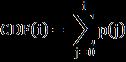
Transformationfunction:

Thistransformationimprovescontrastandtextvisibilityby stretchingpixelintensitydistributions.
4.3 Sobel Edge Detection
Objective: Identifyedgesforbetterseparationoftextfrom background.
Method: Applyhorizontal( )andvertical(( ))kernels:
Gradientmagnitude:

Normalizedoutput:
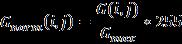
This enhances edges, improving segmentation and OCR recognition.
International Research Journal of Engineering and Technology (IRJET) e-ISSN:
Volume: 12 Issue: 10 | Oct 2025 www.irjet.net
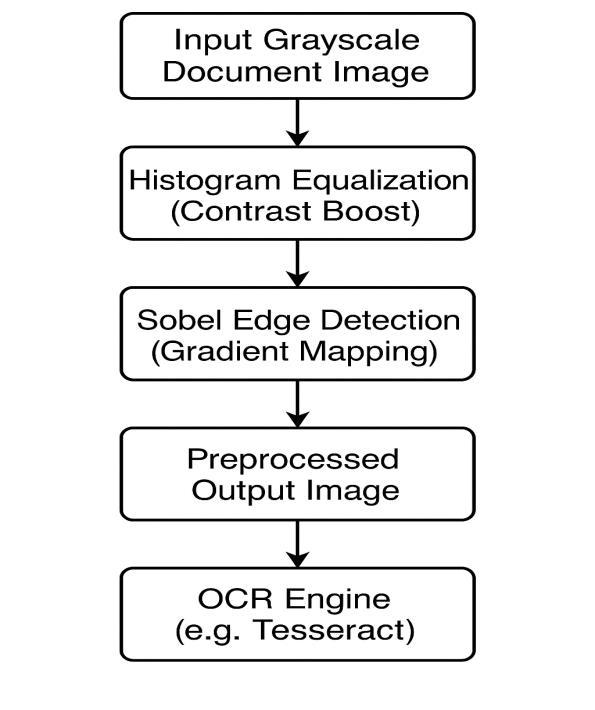
1. Loadgrayscaledocumentimage.
2. ApplyHistogramEqualization.
3. ApplySobelEdgeDetection.
4. UsetheprocessedimageforOCR.
4.5 System Flow Diagram
4.6 Experimental Results
Table 1: OCR Accuracy
TheresultsshowthattheSobelstepsignificantlyimproves recognitioninlow-contrastorshadowedregions.
5. RESULTS
This section presents both qualitative and quantitative results obtained from the application of the proposed preprocessing pipeline, which combines Histogram EqualizationandSobelEdgeDetection.Thepipeline'simpact on document image quality and OCR performance is evaluatedundervariouspreprocessingconditions.
The following table summarizes the various steps of the preprocessing pipeline and their effects on the input documentimages.
Explanation:
• Raw Image: The original scanned image, which often exhibits issues such as low contrast, uneven lighting, and poortextvisibility.
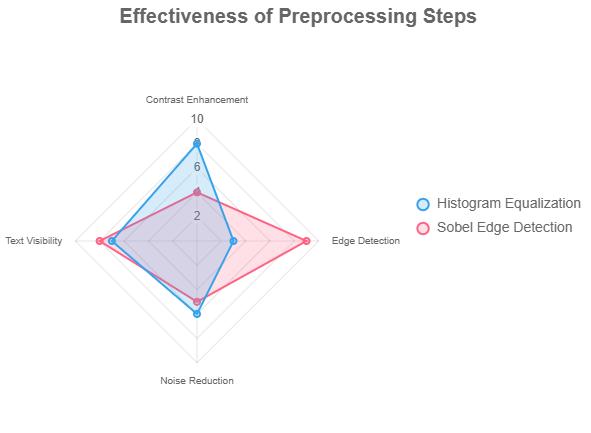
• Histogram Equalized (EQ): The image after applying HistogramEqualization.Thecontrastisenhanced,andtext becomes more visible, especially in the darker or lighter regionsofthedocument.
• Sobel Edge Detection (Edge): The image after applying SobelEdgeDetection,whichhighlightstheedgesofthetext. This step sharpens the boundaries of the characters, improvingtextsegmentationforOCRsystems. These images visually demonstrate the improvements achievedthrougheachpreprocessingstep,makingiteasier for OCR systems to accurately identify text regions and characters.
The following table presents the OCR accuracy achieved underthreedifferentpreprocessingscenarios:
Table 2: OCR Performance
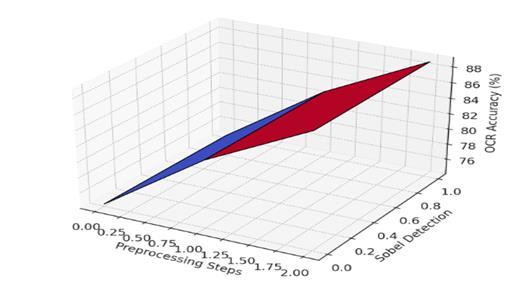
Figure 3: 3D Surface Plot of OCR Accuracy by Preprocessing Method
International Research Journal of Engineering and Technology (IRJET) e-ISSN: 2395-0056
Volume: 12 Issue: 10 | Oct 2025 www.irjet.net p-ISSN: 2395-0072
Interpretation:
•RawImageOnly:OCRaccuracyisthelowestat74.3%,as thesystemstruggleswithpoorimagequality,includinglow contrastandindistincttext.
•WithHistogramEqualization:OCRaccuracyimprovesto 82.7%,asthecontrastenhancementbooststhevisibilityof faint text regions, allowing for more accurate character recognition.
• EQ + Sobel Pipeline: The highest accuracy of 88.9% is achievedwhenbothHistogramEqualizationandSobelEdge Detectionareapplied.TheSobelstepsharpenstheedgesand delineatestextboundariesmoreclearly,reducingOCRerrors significantly.
The OCR accuracy results clearly demonstrate the effectiveness of the proposed pipeline, with both contrast enhancement and edge detection playing crucial roles in improvingtextrecognitionperformance.Thecombinationof these two preprocessing techniques leads to a substantial performance gain, particularly in documents with challengingvisualconditions.
This research demonstrated that a simple, yet highly effective preprocessing pipeline combining Histogram Equalization and Sobel Edge Detection significantly improvesOCRperformanceonlow-qualitydocuments.The resultsshowthat:
• Histogram Equalization enhances global contrast, improvingtextvisibilityinfadedorpoorlylitscans.
• Sobel Edge Detection sharpens edges, making text boundariesmoredistinctandreducingerrorsincharacter recognition.
ComparativeSummary:
• RawimageOCRaccuracy:74.3%
• WithHistogramEqualization:82.7%
WithHistogramEqualization+SobelEdgeDetection:88.9%
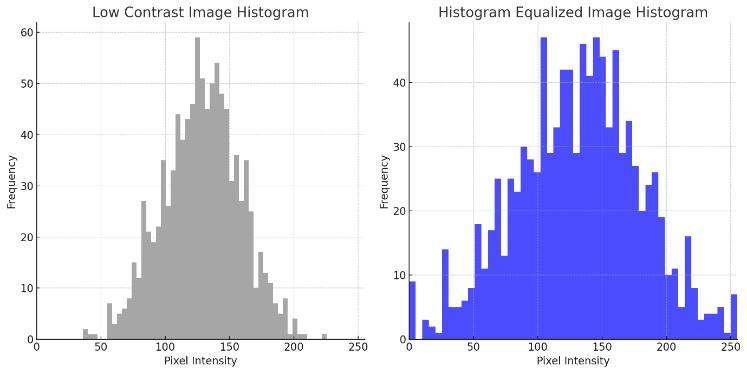
Histogram Equalization:
• Low Contrast Image (left): The pixel intensities are clusteredinanarrowrange.
• HistogramEqualizedImage(right):Thepixelintensities arespreadacrossthefullavailablerange,improvingcontrast andtextvisibility.
Theproposedpipelineachievessubstantialimprovementsin accuracyandreliability,makingitanidealsolutionforrealworld OCR applications, particularly in cases where documentqualityiscompromised.
Future extensions could incorporate more adaptive techniqueslikeCLAHEormachinelearning-baseddenoising methods,potentiallyofferingevengreaterperformancefor morecomplexdocuments.
[1] N.Otsu,“AThresholdSelectionMethodfromGray-Level Histograms,”*IEEETransactionsonSystems,Man,and Cybernetics*,vol.9,no.1,pp.62–66,Jan.1979.
[2] W. Niblack, *An Introduction to Digital Image Processing*. Englewood Cliffs, NJ, USA: Prentice-Hall, 1986.
[3] J. Sauvola and M. Pietikäinen, “Adaptive Document ImageBinarization,”*PatternRecognition*,vol.33,no. 2,pp.225–236,Feb.2000.
[4] C.WolfandJ.-M.Jolion,“TextLocalization,Enhancement and Binarization in Multimedia Documents,” in *Proc. 16thInt.Conf.PatternRecognition(ICPR)*,QuebecCity, QC,Canada,Aug.2002,pp.1037–1040.
[5] OpenCV Documentation, “Histogram Equalization Tutorial(cv::equalizeHist),”OpenCV.org,2024.[Online]. Available:[https://docs.opencv.org/](https://docs.open cv.org/)[Accessed:20-Oct-2025].
[6] K. Zuiderveld, “Contrast Limited Adaptive Histogram Equalization,”in*GraphicsGemsIV*,P.S.Heckbert,Ed. SanDiego,CA,USA:AcademicPressProfessional,1994, pp.474–485.
[7] P.S.Heckbert(Ed.),*GraphicsGemsIV*.SanDiego,CA, USA:AcademicPressProfessional,1994.
[8] OpenCV Documentation, “Sobel Derivatives Tutorial,” OpenCV.org, 2024. [Online]. Available: [https://docs.opencv.org/](https://docs.opencv.org/) [Accessed:20-Oct-2025].
[9] J.Canny,“AComputationalApproachtoEdgeDetection,” *IEEE Transactions on Pattern Analysis and Machine Intelligence*,vol.8,no.6,pp.679–698,Nov.1986.
International Research Journal of Engineering and Technology (IRJET) e-ISSN: 2395-0056
Volume: 12 Issue: 10 | Oct 2025 www.irjet.net p-ISSN: 2395-0072
[10] A. Buades, B. Coll, and J.-M. Morel, “A Non-Local Algorithm for Image Denoising,” in *Proc. IEEE Computer Society Conf. Computer Vision and Pattern Recognition(CVPR)*,SanDiego,CA,USA,Jun.2005,vol. 2,pp.60–65.
[11] A. Buades, B. Coll, and J.-M. Morel, “Non-Local Means Denoising,”*ImageProcessingOnLine(IPOL)*,vol.1, pp.208–212,2011.
[12] K.Dabov,A.Foi,V.Katkovnik,andK.Egiazarian,“Image Denoising by Sparse 3-D Transform-Domain CollaborativeFiltering(BM3D),”*IEEETransactionson ImageProcessing*,vol.16,no.8,pp.2080–2095,Aug. 2007.
[13] R.Smith,“AnOverviewoftheTesseractOCREngine,”in *Proc.9thInt.Conf.DocumentAnalysisandRecognition (ICDAR)*,Curitiba,Brazil,Sep.2007,vol.2,pp.629–633.
[14] IAPR-TC11DatasetRepository,“TableGroundTruthfor the UW-III and UNLV Datasets,” 2024. [Online]. Available:[http://tc11.cvc.uab.es/](http://tc11.cvc.uab. es/)[Accessed:20-Oct-2025].
[15] I.Guyon,L.Schomaker,R.Plamondon,M.Liberman,and S. Janer, “Data Sets for OCR and Document Image Understanding Research,” *Handwriting Recognition andPenComputing*,pp.79–114,1997.