
International Research Journal of Engineering and Technology (IRJET) e-ISSN:2395-0056 p-ISSN:2395-0072

Volume:12Issue:05|May2025 wwwirjetnet

International Research Journal of Engineering and Technology (IRJET) e-ISSN:2395-0056 p-ISSN:2395-0072
Volume:12Issue:05|May2025 wwwirjetnet
Ranjith Kumar Thodupunuri1 , Keerthi Edla2 , Rahul Reddy Thoodi 3 , Mayuka Andrasu 4 , Abhinav
Reddy Kolanu 5 , Shiva Rama Krishna Chethi6
1Assistant professor, Computer Science and Engineering, Kakatiya Institute of Technology and Science, Warangal, India
2,3,4,5,6 Computer Science and Engineering, Kakatiya Institute of Technology and Science Warangal, India
Abstract- Social media sites, particularly Twitter, allow for rapid communication about disasters, they have turned as acute information sources during emergencies. The vital target of this study is the classification of tweets, which employs data from GitHub. The model gains an accuracy of 83.32% in classifying tweets into disaster and non-disaster categories by using Bidirectional Encoder Representations from Transformers (BERT) with the AdamW optimizer. This method outperforms base research that just addressed the identification and categorization of tweets about transportationdisasters, anditattained82% accuracy. Named Entity Recognition(NER)isusednotjusttoclassifytweetsbut alsotoextractprincipalentitiesfromthem,includingdisaster types, locations, and other pertinent information. This study pointsthedeterminedlocationfromthetweetonthemapand also gives assistance regarding the safety measures and emergency contact details during emergency situations through a chat bot. This data can be instantly used by the government agencies, emergency personnel and can protect thelivesofpeople.
KeyWords:BidirectionalEncoderRepresentationsfrom Transformers(BERT),NamedEntityRecognition(NER), Adaptive Moment Estimation with Weight Decay (AdamW), Overfitting, Support Vector Classifier, DecisionTree,RandomForest,XGBoost
Socialmediasites,peculiarlyTwitter,havebecomecrucial forprovidinginstantaneous updatesduringcrises,asthey allow individuals to share significant information, report disasters,andrequesthelp[1],[2].Socialmediahasturned into a vital instrument in disaster management due to the rapid dissemination of information during emergencies, which facilitates quickerdiscoveryandreaction[3],[4].It is very much necessary to categorize tweets correctly about disasters because this information can be instantly used by government agencies, emergency personnel,andcanprotectthelivesofpeople[5]

This study includes cutting-edge Natural Language Processing (NLP) methods to amplify the classification of disastertweets.Diversemachinelearningalgorithmswere first tested for tweet classification, including Support Vector Classifier (SVC), Decision Trees, Random Forest, XGBoost, and BERT with the AdamW optimizer [6]. The BERT model with the AdamW optimizer was the most successful model for this task, showing the highest classification accuracy of 83.32%. A potent pre-trained language model called Bidirectional Encoder Representations from Transformers (BERT) has illustrated outstanding performance in a range of Natural Language Processing (NLP) tasks, particularly because of its capability to find out the contextual relationships in text [5]. We further improvedBERT's performance by finetuning it with the AdamW optimizer, which resulted in high accuracyinclassifyingtweetsconcernedwithdisasters [8].Theaccuracyattainedinthisstudysurpassesthe82% accuracy in an earlier study that considered tweets about transportationdisasters[6].
Classification of Tweets into Disaster orNon- Disaster Tweets: To differentiate tweets into disaster- related or non-disaster related, diverse machine learning algorithms were utilized, like SVC, Decision Tree, Random Forest, XGBoostandBERTwithAdamWoptimizer[5].Outofthem, BERT with AdamW Optimizer had given the maximum accuracy[6].
Information Extraction Using Named Entity Recognition (NER): Named Entity Recognition (NER) is employed to find out the principal elements such as disastercategories,affectedlocalities,andothercrucial facts from tweets [3], [7]. To support the process of disaster management, NER is implemented as a dominant instrumentforobtainingorganizeddata[5].

International Research Journal of Engineering and Technology (IRJET) e-ISSN:2395-0056 p-ISSN:2395-0072
Volume:12Issue:05|May2025 www.irjet.net
Location Dataon Disasters Visualized Geographically: Thegeographiclocationstakenfrom thetweets regarding disasters are pointed onto a map which will enhance the emergencyresponsetactics[7],[6],[8].
Chatbot Integration for Emergency Response: A chatbot is integrated that will present the emergency helpline details and protective measures to be taken duringthetimesofdisasters[8].
Social media has become an essential tool for communicating in real time and sharing information during emergencies in recent years. Platforms such as Twitter are crucial for crisis management because they enable users to share updates, report events, and ask for assistanceinamatterofseconds.Researchersinthefields of natural language processing (NLP), machine learning, and geospatial analysis are very interestedinthegrowing amount of social media data during emergencies. Understanding the development of techniques for extracting, classifying, and using such data is crucial for developing an efficient catastrophe tweet classification andresponsesystem.
This section offers a thorough analysis of the body of research on keyword detection, topic segmentation, sentiment analysis, geolocation extraction, and contemporary transformer-based models, including their optimizationandintegrationwithemergencyservices.Itis arrangedbothchronologicallyandmethodologically.
Early Research on Disaster Detection: Early research investigatedtheuseofsocialmedia,especiallyTwitter,as a platform for disaster-related real-time event detection. Sakakietal.[9]showedhowsocialsensorscanbeusedto quickly identify catastrophic events by presenting a technique for real-time earthquake detection using Twitter conversations. This effort contributed to the expanding field of using crowdsourced data for real-time disaster management by becoming the first to use social mediaforearlydisasterdetection.
Using Twitter to Find Pertinent Disaster Messages: A system for selecting pertinent tweets that could help with disastermanagementwasproposedbyCoboetal.[1], who also looked into the potential of Twitter- based citizen channels for natural disaster scenarios. Their strategy centered on how crucial it is to sort through and discover messages in the vast amount of social media data producedbynaturaldisasters.
Geoparsing and Location Extraction: The precise extractionoflocationdatafromsocialmediaisan essential component of disaster management. In order to identify disasterareasandprovidegeographical context,Middleton etal.[3]investigatedtechniquesforlocationextractionfrom
social media posts using geoparsing, location disambiguation, and geotagging. The integration of location-based data into disaster management systems was made possible by their efforts.
MonitoringDisastersusingRecurrentNeuralNetworks: Recurrent neural networks (RNNs) and word embeddings wereusedbyHernandez-Suarezet al.[4]totrackthesocial dynamicsofnaturaldisasters.Theirmethodhelpedtotrace the development of natural catastrophes in real-time by demonstrating how deep learning techniques may be applied to Twitter data to obtain insights about disaster situations.
Classification Using Machine Learning and Deep Learning Methods: In order to categorize tweets about disasters, Asinthara et al. [5] used both machine learning and deep learning approaches. Their study demonstrated how well deep learning models handled the intricacy of unstructured Twitter data, underscoring the necessity of more sophisticated modelslikeBERTforupcomingdisaster detectionjobs.
Transformer and BERT Models for Crisis Categorization: For text classification challenges, BERT (Bidirectional Encoder Representations from Transformers) has gained popularity. Crisis BERT, a robust transformer model created especially for crisis classification and contextual crisis embedding, was presented by Liu et al. [2] This model fared better than conventional machine learning methods, which makes itidealforhandlingcomplicated,bigdisasterdatasets liketweets.
Modelling Topics for Public Involvement: Topic modeling was used by Ahn et al. [7] to investigate Twitter user participationduringthe2019Ridgecrestearthquake.Inorder to help agencies evaluate the social dynamics of a crisis, this study demonstrated how Twitter may be usedas a platform for measuring public mood and engagement during natural catastrophesituations.
Emergency Assistance Chatbots: A cloud-based chatbot named SPeCECAwas proposed byMaalel etal.[8] that offers intelligent support in emergencysituations. Thechatbot was created to provide vital emergency information and safety guidelines, highlighting how interactive technology may improvetheeffectivenessofcatastropheresponse.
MultimodalAnalysisofDisasterTweets: Gautamet al. [10] investigated multimodal analysis of tweets about disasters, taking into account user-sharedphotos and videos in addition to textual material. Their method increased the overall accuracy of disaster categorization systems by creating new opportunities for the integration of visual data in disaster analysis.
Volume:12Issue:05|May2025 www.irjet.net
International Research Journal of Engineering and Technology (IRJET) e-ISSN:2395-0056 p-ISSN:2395-0072
Recognizing Eyewitness Testimonies: Techniques for automatically recognizing eyewitness tweets during disastersweredevelopedbyZahraetal.[11].Theirefforts improvethequalityofdata utilizedforcrisis management byhelping to separate first-hand reports of disasters from generalreporting.
Information:WithSakakietal.[9]leadingthewayinthis field,thecapacitytorecognizecatastrophesthroughsocial media has developed into an essential instrument for disaster response. Their ground- breaking study investigated the use of social media sites like Twitter for real-time earthquake detection. They created algorithms thatcouldinstantlyscantweetsfortrendsthatmightpoint toanemergency.Sakakietal.'sresearchshowedthatsocial media data, particularly location-tagged tweets, might be used to monitortheoccurrenceandspreadofearthquakes and other natural catastrophes nearly immediately after theyhappen.Thepotentialof"socialsensors" atermused to characterize how the collective activity of social media userscanyieldaplethoraofinformationthatismorerapid and dynamic than traditional reporting methods was underlinedbytheirstudy.Forinstance,Twitter'squickand extensive use can serve as an unofficial butverypowerful sensor network, warning authorities of incidents before the official emergency services have a chance to react. Sakaki et al. were able to create a model that could automatically categorize tweets as being connected to an emergencyoccurrence bylookingatthelinguisticpatterns intweets(suchas the usage of phrases like "earthquake," "shaking,"or"damage") as wellas metadata like timeand location. The accuracy and speed of crisis identification utilizing social media are continuously being improved by increasingly advanced methods, such as those based on BERT (Bidirectional Encoder Representations from Transformers), which were made possible by this architecture.
Gao et al. [12] looked studied how crowdsourcing can be used for disaster aid on social media sites like Twitter. Theirstudydemonstratedhowsocialmediareal-timedata couldhelplocaldisasterresponseinitiatives
Gatheringandpreprocessingdata: The study's dataset, whichincludedtweetswithmatchingid,keyword,location and target columns. In the binary target column,0 signify tweets that are not related to disasters and 1 signify that the tweets are related to disaster [6], [5]. Figure 1 is the sample dataset that is used for this study. The classification models are trained and assessed using this dataset as the basis. Although the raw tweets are initially supplied in a structured CSV file, preprocessing is necessary to make the text content suitable for model training.
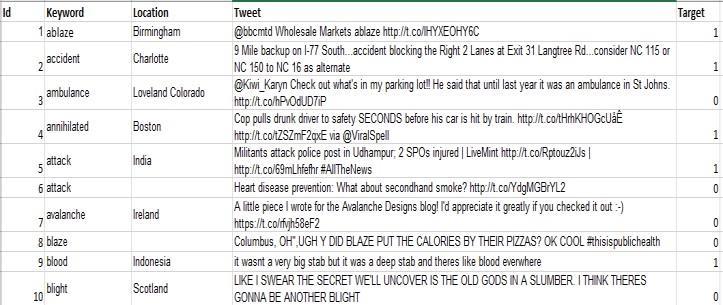
Fig-1:TwitterdatasetcollectedfromGitHub
DataPreprocessing: To raise the quality of the content, URLs,special characters,punctuation, and stop words were eliminated. Just the tweet text was kept for processing [3]. Lowercasing: To maintain consistency, all tweets were changed to lowercase [10]. Word Piece Tokenization was used to break down tweets into sub word tokens in accordance with the BERT model's requirements [5]. Dealing with Missing Values: Tweets which contain null or empty values were dropped from the tweet column [6]. Balancing Data: Used oversampling and under sampling approaches to address the class imbalance between tweets aboutdisastersandthosethatweren’t[5].
Model Selection and Comparison: Diverse machine learning models were assessed in order to determine which onewasbestfortweetclassification:
SupportVectorClassifier (SVC): Divides the tweets into disaster and non-disaster categories using a hyperplanebased methodology. Enhances classification resilience on high-dimensional twitter data by optimizing the margin between classes. For processing textual data, Non-linear classification is made possible by effective kernel methods [10].
Decision Tree Classifier: By dividing data according to feature values, the Decision Tree Classifier creates a treebasedmodelwithlogicaldecisionpaths.Thesignificanceof featuresismeasuredbyrevealingwhichtweetfeatureshave the biggest impact on classification. It provides interpretability and simplicity of visualization for both numericalandcategorydata[11].
RandomForest Classifier: Improves classification stability and accuracy by combining predictions from several decision trees. By employing bagging approach, it reduces overfitting which works especially well with noisy social media data. It provides balanced predictions and resilience tomissingdataandoutliers[4].
TheXGBoostAlgorithm: Uses extreme Gradient Boosting, a potent ensemble classification technique. It handles intricate
Volume:12Issue:05|May2025 www.irjet.net
International Research Journal of Engineering and Technology (IRJET) e-ISSN:2395-0056 p-ISSN:2395-0072
tweet patterns with effectiveness by upgrading weak learners iteratively. It enhances the model generalization and minimizes the chances of overfitting by employing built-inregularization[5].
Bidirectional Encoder Representations from Transformers (BERT) was implemented and optimized using the AdamW optimizer: Surpassed both the 82% accuracyofthebasepaper,whichonlylookedattweetson transportation disasters and conventional ML models to getthegreatestaccuracy[6]
Model Selection Criteria: Because of its contextual awareness, exceptional accuracy and abilitytoanalysethe textinbothdirections,BERT with AdamW was chosen [2] [5] [6] Robust generalization and quicker convergence werefacilitatedbytheAdamWoptimizer[6].
BERTImplementationUsingAdamWOptimizer: Oneof the most sophisticated models in Natural Language Processing (NLP) is BERT (Bidirectional Encoder Representations from Transformers), which is renowned foritspotenttransformer-baseddesign.BERThasaricher comprehension of word context since it processes text in both directions concurrently, in contrast to typicalmodels that process text either from left-to- right or right-to-left. BERT excels at fine-grained classification tasks, including tweet categorization for disaster-related information, becauseofitsbidirectionalnature[5],[6].
Data must be converted into an appropriate input format beforebeingfedintoBERT.TokenizationwithWordPiece, which divides words into sub word units to better handle uncommon or unknown terms, is one example of this. Three additional kinds of embeddings are also applied to the input: position embeddings, which preserve the sequential order of the tokens, segment embeddings, which distinguish various sentences, and token embeddings, which represent each word or sub word. The input sequences are marked and aligned evenly using special tokens such as [PAD] (padding token), [SEP] (separatortoken),and[CLS](classificationtoken)[5],[6]
TheTransformerEncoder,whichisthecentralcomponent of BERT's design, computes associations between each word in the sequence using a self-attention process, enabling the model to comprehend each word's complete context. Furthermore, elements such as layer normalization, feed-forward networks, and residual connections aid in stabilizing training and promoting convergence[5],[6]
There are two steps in the learning process for BERT. It employs the Masked Language Model (MLM) technique in the pre-training stage, in which 15% of the input tokensaremaskedandthemodellearnstopredict them
based on contextual information. This helps BERT gain a stronggraspoflanguageinbothdirections.Furthermore,
BERT determines if a sentence logically follows another by using Next Sentence Prediction (NSP). This facilitates BERT's performance on sentence-level tasks like question answeringandtweet-eventassociation[5],[6]
The model's output from the [CLS] token is connected to a classification head, usually a fully connected layer, which outputs the probability of whether a tweet is related to a disaster or not. This allows BERT to be fine-tuned for disaster tweet classification. When compared to conventional machine learning models, this configuration greatlyincreasesclassificationaccuracybyallowingBERT to produceprecisepredictionsondomain-specifictasks[5],[6]
ThereasonforincludingAdamWoptimizerwithBERT: TheAdamWoptimizerwasincorporatedtoimproveBERT's functionality and training effectiveness. Decoupled weight decay regularization,whichAdamWintroduces,iscrucialfor avoiding overfitting and regulating excessive weight gain during training. Its hybrid technique, which combines the advantages of Momentum and Root Mean Square Propagation (RMSProp), also promotes improved convergence.Fastertrainingandefficienthandlingofsparse gradients which are prevalent in twitter data are the outcomesofthis.Additionally,AdamWismemory-efficient, which makes it appropriate for handling massive datasets, suchastweetsaboutdisasters[8],[6].
Named Entity Recognition (NER): Named Entity Recognition (NER), which helps recognize specific entities like disaster categories (e.g., earthquake, flood), geographical locations, and other pertinent phrases, is essential for extracting important information from tweets about disasters. Because of its better contextual comprehension of natural language, BERT was used in this study to develop token-level NER. The model efficiently separates and classifies important information from unprocessed twitter text by giving eachtokena name,such as LOC for location, DISASTER for crisis category, or O for otherirrelevanttokens[5][6]
The loud, unstructured material seen on social networking sites like Twitter is a common problem for traditional NER algorithms. But unlike previous models, BERT can disambiguate tokens more precisely because of its bidirectional transformer architecture, which allows it to comprehend the context around each word. For example, theword"fire"in"forestfire"isobviouslyacalamity,yetitis not in "she fired him." BERT's simultaneous processing of preceding and succeeding context enables this kind of disambiguation[5].
Additionally, NER's integration into the tweet- processing pipeline facilitates location-specific warnings and event detection,bothofwhichareessentialintheearlyphasesof
Volume:12Issue:05|May2025 www.irjet.net
International Research Journal of Engineering and Technology (IRJET) e-ISSN:2395-0056 p-ISSN:2395-0072
disaster response. The method can assist authorities prioritizeactionsbyhighlightingnotonlythelocationofa crisis but also its type. NER significantly boosts the usefulness of social media in emergency situations by turning unstructured social media conversation into organized,actionableinformation[5],[6].
Information Extraction and Visualization: Mapping Locations-NERmoduleisutilized,usingwhichthelocation entities were taken from the tweet. It was then used by Streamlit to map these places spatially, giving a visual sketchoftheareasaffectedbydisasters[3],[5],[6]
Integration of Emergency Contacts: The Chatbot that is integratedprovidedusefulinformationintimesofcrisisby presenting emergency contact details as per the location andkindofdisaster[5],[6]
StreamlitAppDevelopment: Streamlitwasusedtocreate an interactive Graphical User Interface (GUI), with the followingessentialfeatures:
Tweet Classification: Using the BERT with AdamW model, users can categorize tweets as either disasterrelatedornot[5],[6].
Named Entity Recognition (NER): Used in entity extractiontofindvitalentitiesintweets,including disaster types,locations,andotherpertinentinformation[5],[6]
Geographical Mapping: Provides geographical insights intoareasaffectedbydisastersbyvisualizingtheextracted placesonthemap[5],[6].
Emergency Contact Integration: Provides rapid access to vital support services by displaying pertinent emergency contact information based on the designatedcatastrophesite[5],[6].
Metrics for Evaluation:
Accuracy: Evaluated the model's overall correctness in categorizingtweetsaseithernon-disasteror disaster.
Precision: Measuringthepercentageofcorrectlydetected catastrophe tweets among all tweets classed as disasters indicatesthespecificityofthemodel.
Recall (Sensitivity): Assessed the model's comprehensivenessbydeterminingitscapacityto identify real-worlddisastertweets.
F1Score: A balanced metric for unbalanced datasets, it is computedastheharmonicmeanofprecisionandrecall.
Confusion Matrix: Provides information on misclassification trends by visualizing true positives, true negatives,falsepositives,andfalsenegatives
Comparison with Base Paper: Expanded the base paper's scope to include a greater variety of natural and man-made disasters, rather than just transportation-related ones. Achieved a significant increase in accuracy (from 82% to 83.32%). Demonstrated a comprehensive approach to catastrophe management by adding a unique element for locationmappingandemergencyresponseintegration[6].
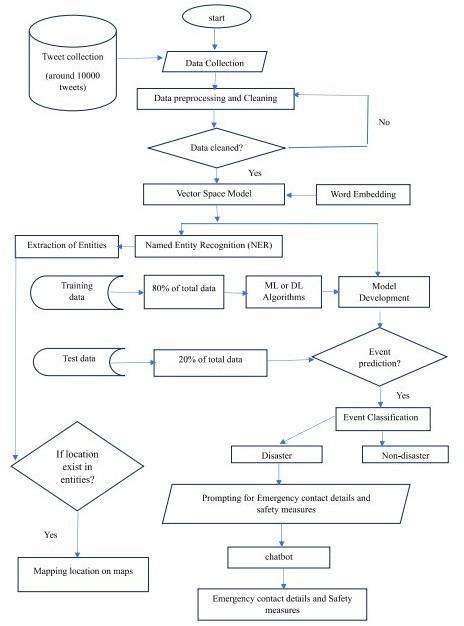
TheflowdiagraminFig-2explainsvariousstepsinthisstudy that includes, Tweet Classification, Event Extraction, Geographical mapping and Emergency response. This flowchart is extended from the flowchart of the paper in reference[6].About10,000tweetsarecollectedasadataset. These tweets provide unprocessed data. Preprocessing is done on the gathered tweets, which includes eliminating unnecessary text, URL’s, stop words, noise, and special characters [3], [10]. Vector Space Model: Embedding Words-The cleaned text is converted into a numerical representation using a word embedding approach for preparingthedataforfurthersteps[5]
Entity Extraction Using Named Entity Recognition (NER): NER is used to extract principal details from tweets,includinglocations,phrasesrelatedtodisasters,and otherpertinentdetails.[3],[10],[11]
Model Creation and Training: Eighty percent of the datasetisusedtotrainthemodel.Tweetsareclassifiedusing a diverse machine learning and deep learning techniques, includingSVM,DecisionTree,Random Forest,XGBoost,and BERTwithAdamWOptimizer[5],[6].Theremaining20%of dataisusedfortestingthetrainedmodel.Whetheratweet is related with a disaster or not is predicted by the model [2],[6].
Using Maps to Point the Location: The place extracted fromthetweetispointedonthemap[3],[10]
Chatbot Interaction for Emergency Response: The chatbotassistsingatheringemergencycontactinformation to ensure appropriate actions are taken [2], [8]. All the abovediscussedsteps arepictoriallypresentedintheform of a flowchart. BERT with AdamW Optimizer is opted for thisstudyasitresultedingreateraccuracywhencompared to other algorithms [5], [6]. Only if the tweet contains the location,thenitisvisualizedonthemap,elsethelocationis notmappedonthemap.
International Research Journal of Engineering and Technology (IRJET) e-ISSN:2395-0056 p-ISSN:2395-0072
Volume:12Issue:05|May2025 www.irjet.net
International Research Journal of Engineering and Technology (IRJET) e-ISSN:2395-0056 p-ISSN:2395-0072
Volume:12Issue:05|May2025 www.irjet.net
Thefirstobjectiveistoclassifytweetseithernon-disaster related or disaster relevant using classification. First, conventional machine learning models like XGBoost, Random Forest, Decision Tree, and Support Vector Classifier(SVC)wereevaluated[5],[6].Afterthat,theBERT model with the AdamW optimizer was used, and it has givenbetterresults[5],[6].
The second goal was to identify disaster types, locations, and other pertinent information by employing Named Entity Recognition (NER) techniques to extract important entitiesfromthetweets[3],[10], [11]. The third goal was tomaptheextractedplacesgeographicallyinordertogive contextanda visual depictionofareasthatarevulnerable to disasters [3], [10]. By providing suitable emergency contact information concerned to the labelled calamity sites,thefourthgoalsoughttoimproveemergencyresponse and support public safety and efficient disaster management[2],[8].
Training and Optimizing Models: BERT with AdamW optimizermodelwasrefinedwiththedatasetoftweets.By modifying weight decay and learning rates, the AdamW optimizer enhances model correctness and facilitates effective gradient updates [5], [6]. Three epochs of training were carried out, with early termination to avoid overfitting[5].
Principal Findings: Conventional Classifiers were outperformed by a Transformer-based model, BERT with AdamWmodelwhichdemonstratedsuperioraccuracyand awell-balancedtrade-offbetweenprecisionandrecall[5], [6]. The utility of pre-trained language models like BERT was highlighted by the fact that traditional machine learning models, although they produced respectable results,hadtroublewithcomplextweetcontexts[2],[6].
For visualizing the tweet classification, entity extraction, locationmapping,andemergencyresponse,aStreamlitapp wascreatedforthisstudywhichoffers an interactive and inherentgraphicaluserinterface(GUI[8],[10]).
Usersoftheappcan:
1. Decidewhetheratweetisaboutadisasterornot [5],[6].
2. NERapproachesareusedtoextractentities,such aslocationsanddisastertypes[3],[10].
3. See the locations that have been extracted on an interactivemap.[3],[10]
4. Present emergency contact information pertinent tothedesignatedcatastrophesites[2],[8]
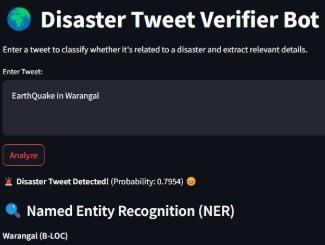
When the tweet was provided as input, for example consider,"EarthquakeoccurredinWarangal."Withthehelpof anambulancehornsymbolandasadfaceemoji,thestreamlit software successfully categorized the tweet as disasterrelated,highlightingthegravityofthesituation[5].Using the Named Entity Recognition (NER) portion, Warangal was accuratelyextractedasthe place.Warangalwasgraphically located on the interactive map by the Mapping Location feature, which gave the catastrophic occurrence of a geographicalcontext[3],[10].
Also integrated a chatbot that will provide assistance in emergency situations by providing safety instructions and pertinent emergency contact information when asked, "Earthquake occurred in Warangal, give me safety tips and emergencycontactphonenumbers"[2],[8].
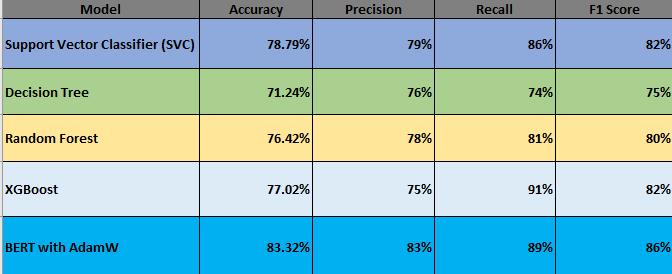
Fig - 3 shows the comparison of different classifiers and their results by considering accuracy, precision, recall and F1-score. From that, it is clear that BERT with AdamW has greater accuracy, precision, recall and F1-Score whencomparedtootherclassifiers[6].
Volume:12Issue:05|May2025 www.irjet.net
International Research Journal of Engineering and Technology (IRJET) e-ISSN:2395-0056 p-ISSN:2395-0072
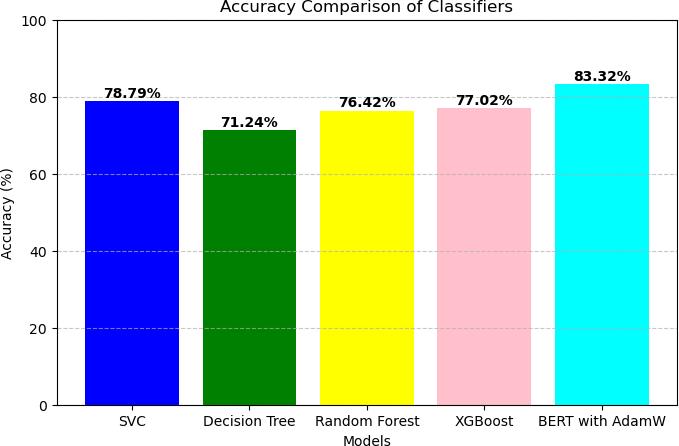
Abargraphcomparingtheaccuracyofdifferentclassifiers is shown in Fig - 4. The graphic makes it clear that the accuracy of the BERT model optimized with AdamW is noticeablyhigherthanthatoftheothermodels[5],[6].
OutputofClassificationandEntityExtraction oftweets
The entity extraction and classification modules process the input tweet "Earthquake in Warangal" in Fig - 5. The tweet is correctly identified by the model as being about a disaster [5], [6]. Additionally, "Warangal" is effectively recognized as a place entity by the Named Entity Recognition (NER)system[3],[10]. Thesystem'scapacity to accurately classify tweets and extract vital information fordisasterreactionandmanagementisshowninFig – 5, [3],[10],[11].
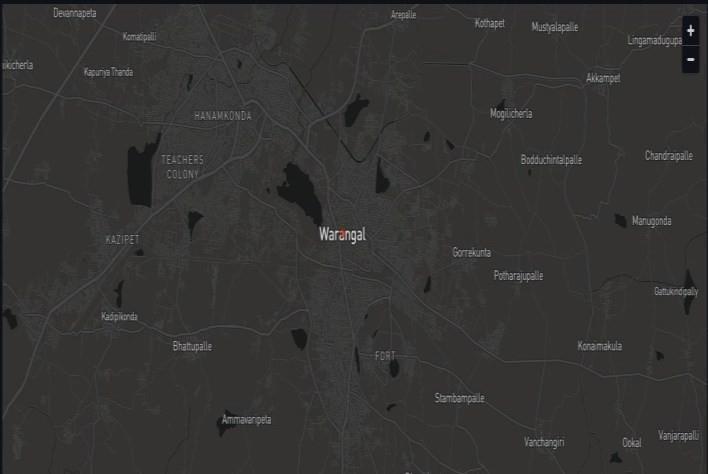
"EarthquakeinWarangal"isanexampleofatweetthathas haditslocationretrievedandshownonaninteractivemap inFig-6.Aclearspatialcontextofthedisaster isprovided bytheidentificationandplottingofthegeographicalentity (Warangal) on the map [3], [10]. This provides instant insight into the area affected by the event and makes it easier for users to identify the affected region [3], [10], [11].
Using the BERT model with the AdamW optimizer and Natural Language Processing (NLP) approaches, this study offers a reliable method for disaster analysis from tweets[5],[6].Theprincipalobjectivesweretocategorize tweets as either catastrophe-related or not, precisely extract entities like locations and types of disasters, and offer a geographic map of disaster sites along with emergency contact details [3], [5], [10]. By using Named Entity Recognition (NER), this study improved the model’s capability to display location- based data, as a substitute to extract location information straight from thetweettext[3],[10].
With an impressive accuracy of 83.32%, the BERT model with the AdamW optimizer outperformed more conventional machine learning models such as XGBoost, Decision Tree, Random Forest, and Support Vector Classifier (SVC) [5], [6]. The addition of the AdamW optimizer improved the BERT model's performance on the unstructured Twitter dataset by reaching greater accuracy,whichwasattributedtoits efficient handling of learning rates and weight decay[2],[5],[6].Eventhough SVCdemonstratedgoodaccuracy,itisnotthebestchoice for large datasets, which is consistent with the goal of increasingthedatasetsizeinthefuture[5].Becauseofthe slowpredictionspeedofRandomForestmodel,itwasless suitableforreal-timeapplicationsevenifitperformedwell [5],[6].
The Streamlit-based GUI created for this project allows tweet classification, entity extraction, geographical mapping, and emergency contact information presentation [5], [6]. In addition to making, it easier to obtain the vital information, the visual interface helps in emergencydecision-making[5],[6],[8].
This study used machine learning models and Natural Language Processing (NLP) approaches to create a reliable model for disaster analysis from tweets. Using Named Entity Recognition (NER), the suggested method extractedtheentitiesandlocationsrelatedtodisasters,and the BERT model with the AdamW optimizer is used for tweet. An interactive platform for tweet classification, entity extraction, location mapping, and emergency aid wasmadeavailablebytheStreamlit-basedGUI.
When the model's performance was compared to more conventional classifiers like Support Vector Classifier (SVC), Decision Tree, Random Forest, and XGBoost, it showed that BERT and AdamW performed more accurately and efficiently. Together with excellent precision, recall, and F1-score, the classification accuracy of83.32%highlightshowwellthesuggestedmodelworks toidentifytweetsaboutdisasters.
Volume:12Issue:05|May2025 www.irjet.net
International Research Journal of Engineering and Technology (IRJET) e-ISSN:2395-0056 p-ISSN:2395-0072
Additionally,importantdatalikethekindandlocationofthe disasterweresuccessfullyrecoveredbytheNER module and displayed on a map in the Streamlit app. By offering safety advice and emergency contact information, the Assistance Bot further enhanced the model's usefulness fordisasterresponseandmanagement.
All things considered, this study demonstrates how effectivesocialmedia particularlyTwitter canbefor crisis management and detection in real time. The suggested solution provides a thorough method to assist emergency response teams, governmental organizations, and the general public during crisis situations by utilizing cutting-edge natural language processing (NLP) techniques and interactive visualization.
Extend the Dataset: To enhance model generalization, gather additional tweets and provide a wider range of disastersituations.
Algorithm Exploration: To increase forecast accuracy even more, try out more sophisticated classification modelsandoptimizationstrategies.
Real-Time Analysis: To enable prompt disaster identification and reaction, use the Twitter API for real timedisasteranalysis.
Severity Assessment: Create a system to analyse the seriousness of disasters thathave been detected so that emergency response teams can efficiently prioritize theirefforts.
[1] Cobo, A., Parra, D., & Navón, J. (2015). Identifying relevantmessagesinaTwitter-basedcitizenchannel for natural disaster situations. WWW '15 Companion: Proceedings of the 24th International Conference on World Wide Web, 1189-1194. https://doi.org/10.1145/2740908.2741719
[2] Liu, T. Singhal, L. Blessing, and K. L. Wood, “Crisis BERT: A robust transformer for crisis classification andcontextualcrisisembedding,”in Proc. 32nd ACM Conf. Hypertext and Social Media (HT '21), 2021, pp. 285–295. doi: 10.1145/3465336.3475117T. Sakaki, M. Okazaki, and Y. Matsuo, “Earthquake shakes Twitter users: Real- time event detection by social sensors,” in Proc. 19th Int. Conf. World Wide Web (WWW), 2010, pp. 851–860. doi: 10.1145/1772690.1772777.
[3] S. E. Middleton, G. Kordopatis-Zilos, S. Papadopoulos, and Y. Kompa Tsiaris, “Location
extraction from social media: Geoparsing, location disambiguation,andgeotagging,” ACM Transactions on Information Systems (TOIS),vol.36,no.4,article no.40,pp.1–27,Jun.2018.doi:10.1145/3202662
[4] A.Hernandez-Suarez,G.Sanchez-Perez,K.ToscanoMedina, H. Perez-Meana, J. Portillo-Portillo, V. Sanchez, and L. J. García Villalba, “Using Twitter datatomonitornatural disastersocial dynamics:A recurrent neural network approach with word embeddings and kernel densityestimation,” Sensors (Basel),vol.19,no.7,articleno.1746,Apr.2019.doi: 10.3390/s19071746
[5] K. Asinthara, M. Jayan, and L. Jacob, “Classification ofdisastertweetsusingmachinelearninganddeep learningtechniques,”in Proc. 2022 Int. Conf. Trends in Quantum Computing and Emerging Business Technologies (TQCEBT), Pune, India, Oct. 13-15, 2022.doi:10.1109/TQCEBT54229.2022.10041629
[6] Prasad, R., Garg, A. K., Udeme, A. U., Misra, S., & Bisallah, H. (2023). Identification and classification of transportation disaster tweets using improved bidirectional encoder representations from transformers. International Journal of Information Management Data Insights, 3(1), 100154. https://doi.org/10.1016/j.jjimei.2023.100154
[7] J. Ahn, H. Son, and A. D. Chung, “Understanding public engagementonTwitterusingtopicmodeling: The 2019 Ridgecrest earthquake case,” Journal of the Japanese Society for Information and Media Studies,vol.30,no.2,articleno.100033, 2021. doi:10.1016/j.jjimei.2021.100033
[8] A. Maalel, N. Ouerhani, and H. Ben Ghezala, "SPeCECA:Asmartpervasivechatbotforemergency caseassistance based on cloud computing," Cluster Computing,vol.23,no.S1,pp.1–12,Dec.2020.doi: 10.1007/s10586-019-03020-1.
[9] A. Gautam, L. Misra, A. Kumar, and K. Misra, “Multimodal analysis of disaster tweets,” in Proc. 2019 IEEE Fifth Int. Conf. Multimedia Big Data (BigMM), 2019, pp. 1–8. doi: 10.1109/BigMM.2019.00-38
[10] K. Zahra, M. Imran, and F. Ostermann, “Automatic identification of eyewitness messages on Twitter during disasters,” Information Processing & Management, vol. 57, no. 1, article no. 102107, 2019.doi:10.1016/j.ipm.2019.102107
[11] T. Sakaki, M. Okazaki, and Y. Matsuo, “Earthquake shakes Twitter users: Real-time event detection by social sensors,” in Proc. 19th Int. Conf. World Wide Web (WWW), 2010, pp. 851–860. doi: 10.1145/1772690.1772777.
Volume:12Issue:05|May2025 www.irjet.net
International Research Journal of Engineering and Technology (IRJET) e-ISSN:2395-0056 p-ISSN:2395-0072
[12] O. E. Akerele-Popoola, A. L. Azeez, and A. Adeniyi, “Twitter, civil activism, and EndSARS protest in Nigeria as a developing democracy,” Cogent Social Sciences,vol. 8, no. 1, article no. 2095744, Jul. 2022. doi:10.1080/23311886.2022.2095744
[13] H. Gao, G. Barbier, and R. Goolsby, “Harnessing the crowdsourcing power of social media for disaster relief,” IEEE Intelligent Systems,vol.26,no.3,pp.10–14,Jul.2011.doi:10.1109/MIS.2011.52
[14] O.D.ApukeandB.Omar,“FakenewsandCOVID-19: Modelling the predictors of fake news sharing among social media users,” Telematics and Informatics,vol.56,article no. 101475,2020. doi:10.1016/j.tele.2020.101475