
International Research Journal of Engineering and Technology (IRJET) e-ISSN:2395-0056 p-ISSN:2395-0072

Volume:12Issue:04|Apr2024 www.irjet.net

International Research Journal of Engineering and Technology (IRJET) e-ISSN:2395-0056 p-ISSN:2395-0072
Volume:12Issue:04|Apr2024 www.irjet.net
Sushma A Chitte1 , I B Dahat2
1Research Scholar, Civil Engineering Department, G H Raisoni Amravati University
2Assistant Professor, Civil Engineering Department, G H Raisoni Amravati University
Abstract - Thisstudyevaluatestheseismicperformanceof 12-storey irregular buildings usingvariousconfigurations of X-bracing systems. Sixteen different models were analyzed withX-bracingappliedatthefront,back,frontandback,and on all three sides of four types of irregular buildings. The resultsdemonstratethattheplacementanddistributionofXbracingsignificantlyaffectstructuralbehaviorunderseismic loads. Models with bracing on all three sides consistently showedreduceddisplacements andimprovedlateralstability. Model-8 exhibited the lowest resultant displacement, indicating optimal efficiency, while Model-16 recorded the highest bending moments, highlighting superior energy absorptionandstructuralengagement.Beamforcereactions and membrane stress analysis further confirmed that welldistributed X-bracing enhances internal load distributionand reduces stress concentrations. Overall, comprehensive Xbracing configurations not only improve global seismic resilience but also optimize local beam performance. The findings provide valuable insights for designing earthquakeresistant structures, especially in geometrically irregular highrisebuildings.
Key Words: Seismic, irregular, X-bracings, structural, resilience,beam,driftcontrol
In regions susceptible to earthquakes, ensuring that buildingsarestructurallyresilientagainstseismicforcesisa fundamental priority for architects and civil engineers. Structures in such areas must endure dynamic loading withoutincurringmajorstructuralfailures.Toaddressthis, engineers frequently employ bracing systems to bolster seismic resistance. Among these, X-bracing is especially favouredforitsstraightforwarddesign,materialefficiency, and strong performance in resisting lateral forces. It significantly improves lateral stiffness and helps in minimizing deformation while absorbing and dissipating seismicenergy.Nevertheless,itsperformanceinbuildings with non-uniform shapes remains a subject of ongoing investigation,asirregularconfigurationsintroduceunique complexitiesinstructuralbehaviourduringearthquakes.
Modern architectural trends often involve irregular designs such as asymmetric layouts, mass eccentricities, and unconventional floor plans for both aesthetic and

functionalreasons.Whilethesedesignchoicesenhancethe visual and spatial appeal of structures, they also increase vulnerabilitytoseismiceffects.Irregularitiescauseuneven distribution of stiffness and mass, which may lead to localizedstressconcentrationsandunpredictablestructural responses under earthquake loads. As a result, evaluating howX-bracinginteractswithsuchirregularitiesiscrucialfor developing safer, more reliable buildings in seismically activezones.
Numerous studies have highlighted that X-bracing, when strategically positioned, can help mitigate some of the adverse effects caused by structural irregularities. It redistributes lateral forces more evenly throughout the structure,helpingtoreduce torsional responsesandstory drifts. The efficiency of X-bracing also depends on factors such as bracing location, the number of stories, material type,andthenatureofirregularities.Forinstance,placingXbracesnearthebuilding'scoreorsymmetricallyalongthe perimetertendstoyieldbetteroverallstabilitycomparedto randomorasymmetricarrangements.
Moreover,advancedmodellingandanalysistoolslikefinite elementsimulationsanddynamictime-historyanalyseshave become instrumental in assessing how different bracing configurationsperformunderseismicloading.Thesetools allow engineers to simulate real-world earthquake conditionsandpredictthebehaviourofirregularbuildings equippedwithX-bracing.Experimentalstudiesusingshake tablesandfull-scalemodelsfurthersupportcomputational findings,validatingthat proper X-bracingcansignificantly improvestructuralresilienceevenincomplexgeometrical layouts.
As urban development continues to push the limits of architecturalcreativity,thechallengeofbalancingaesthetics withstructuralsafetybecomesmorepressing.Engineersand designers must work in tandem to ensure that visually striking,irregularbuildings arealsostructurallysound.In thiscontext,X-bracingemergesasareliable,cost-effective solution to enhance seismic performance without compromisingarchitecturalintent.Continuedresearchand innovationinthisareawillhelprefinedesignguidelinesand standardsforirregularbuildings,ultimatelycontributingto safer and more sustainable construction practices in earthquake-proneregions.

International Research Journal of Engineering and Technology (IRJET) e-ISSN:2395-0056 p-ISSN:2395-0072
Volume:12Issue:04|Apr2024 www.irjet.net
Aconsiderableamountofresearchhasbeenconducted to evaluatetheroleofvariousbracingsystemsinimprovingthe earthquake resistance of buildings. Abdulridha, A. J. identifiedX-bracingasespeciallybeneficialforenhancinga structure's lateral rigidity and minimizing displacement duringseismicactivity.[1]Thestudyalsoshedlightonhow X-bracingdistributesseismicforcesefficiently,reinforcingits effectivenessinmediumtohighseismicriskareas.[1]
Structures with non-regular layouts face distinct stability issues under earthquake loading. Ahasan–ul–Haque noted thatbuildingswithirregularconfigurations,suchasLorTshapes, experience heightened stress concentrations and torsional effects, increasing their vulnerability. [2] Their findingsemphasizedtheimportanceofcustomizedstructural approachestomanagethesedynamicchallengeseffectively. [2]
Al-sabaeei examined how different X-bracing placements affectstructuralperformanceinmulti-storybuildings.They concludedthatpositioningbracesnearthebuilding'scoreor usingbalanced,symmetricallayoutsenhancesstabilityand energyabsorptionmoreeffectivelythanunevenorrandom arrangements.[3]
Similarly, Al-Safi explored how varying seismic zone intensities influence design requirements. Their research highlighted that buildings located in more active seismic regionsneedincreasedductilityandlateralstiffness,andthat bracing systems must be adapted accordingly to suit the seismicdemandsofspecificlocations.[4]
In summary, X-bracing has emerged as a consistently effectivetechniqueforboostingtheseismicperformanceof high-risebuildings,especiallythosewithirregularshapes.It offers notable improvements in terms of stiffness, energy dissipation, and drift mitigation, proving to be a reliable strategyforstructuralsafetyinearthquake-proneregions.
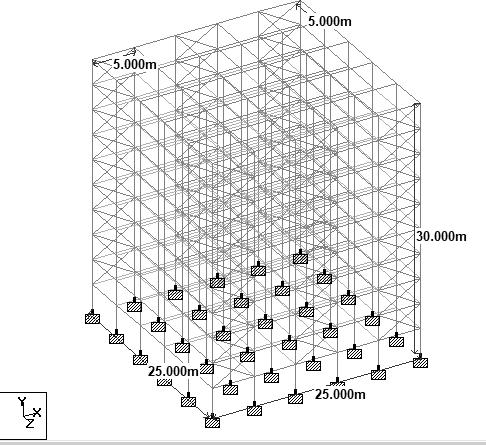
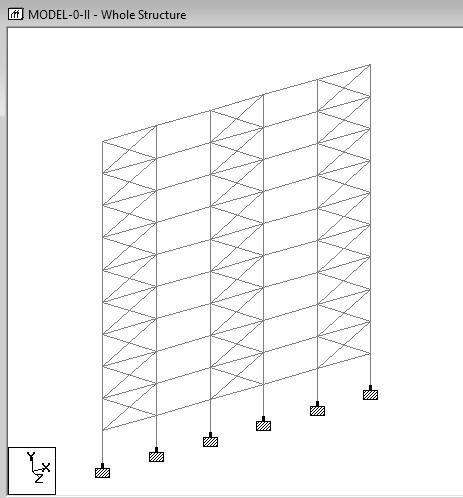
The present study focuses on evaluating the seismic performance of multi-storey buildings with irregular geometriesusingX-bracingsystems,modeledandanalyzed inSTAAD.Prosoftware.Atotalof16modelsaredeveloped, representing various bracing configurations applied to different types of geometric irregularities in a 12-storey buildingframe.
1. ToassesstheeffectofdifferentX-bracingplacementson the seismic performance of irregular multi-storey buildings.
2. Toassesstheimpactofbracingsystemplacementand configuration on reducing lateral displacements and improvingstructuralstabilityunderseismicloads.
STAAD.Pro–forstructuralmodelingandseismicanalysisin accordancewithIS1893(Part1):2016.
1. All models are 12-storey reinforced concrete (RC) structures.
2. Fourdistinctirregulargeometriesareconsidered:
Building1:IrregularityTypeA
Building2:IrregularityTypeB
Building3:IrregularityTypeC
Building4:IrregularityTypeD
1. OnlyX-bracingsystemsareusedforuniformity.
2. Bracingisappliedatdifferentpositions:
Frontfaceonly
Backfaceonly
Frontandbackfaces
Front,back,andsidefaces
3.5
The following table 3.1 shows the model description in detailed:
Table3.1ModelDescription
ModelNo. BuildingType BracingLocation
Model-1 Irregular Building-1 Front
Model-2 Irregular Building-1 Back
Model-3 Irregular Building-1 Front,Back
Model-4 Irregular Building-1 Front,Back,Side
Model-5 Irregular Building-2 Front
Model-6 Irregular Building-2 Back
Model-7 Irregular Building-2 Front,Back
Model-8 Irregular Building-2 Front,Back,Side
Model-9 Irregular Building-3 Front
Model-10 Irregular Building-3 Back
Model-11 Irregular Building-3 Front,Back
Model-12 Irregular Building-3 Front,Back,Side
Model-13 Irregular Building-4 Front
Model-14 Irregular Building-4 Back
Model-15 Irregular Building-4 Front,Back
Model-16 Irregular Building-4 Front,Back,Side
DeadLoad(DL)andLiveLoad(LL)asperIS875.
SeismicLoad(EQ)asperIS1893(Part1):2016,for selectedseismiczones.
Response Spectrum Analysisisused for dynamic responseunderseismicexcitation.
Thetable4.1belowsummarizesthehorizontal,vertical,and resultant displacements observed in 16 structural models under seismic loading. The models differ by bracing configurationandbuildinggeometry.
Table 4.1 Horizontal, vertical, and resultant displacements observed in 16 structural models
Figure4.1illustratesthehorizontaldisplacementvalues(in mm)for16structuralmodelssubjectedtoseismicloading. Thehorizontalaxisrepresentstheindividualmodels(Model1 through Model-16), while the vertical axis indicates the horizontaldisplacementmagnitudeinmillimeters.
Models such as Model-3 and Model-4 exhibit the lowest horizontal displacement, suggesting effective lateral load resistance,likelyduetooptimizedbracingconfigurations.In contrast, Model-14 shows the highest displacement, indicating poor seismic performance in the horizontal direction. The trend highlights the significant impact of bracingsystemsandbuildinggeometryonlateralstiffness andseismicresponse.
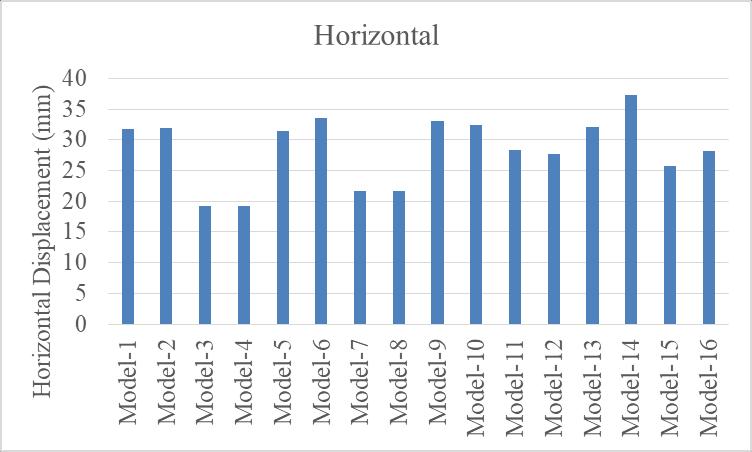
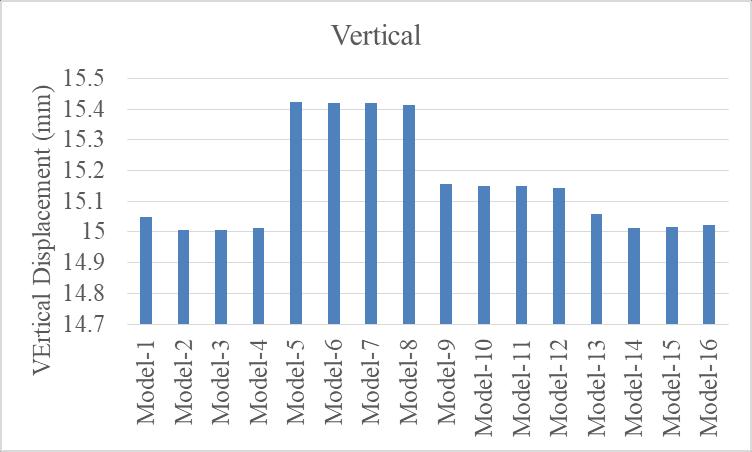
Figure4.2displaystheverticaldisplacement(inmm)for16 structuralmodelsunderseismicloading.Thehorizontalaxis lists the models from Model-1 to Model-16, while the verticalaxisshowsthecorrespondingverticaldisplacement values.
Overall, vertical displacements remain relatively uniform acrossallmodels,rangingnarrowlybetween14.9mmand 15.4 mm, indicating that vertical seismic effects are less influenced by the bracing configurations or geometric irregularitiescomparedtohorizontaldisplacements.Models 5to8exhibitslightlyhigherverticaldisplacements(~15.42
Volume:12Issue:04|Apr2024 www.irjet.net
International Research Journal of Engineering and Technology (IRJET) e-ISSN:2395-0056 p-ISSN:2395-0072
mm),possiblyduetotheinteractionofbracingwithvertical irregularitiesormassdiscontinuities.
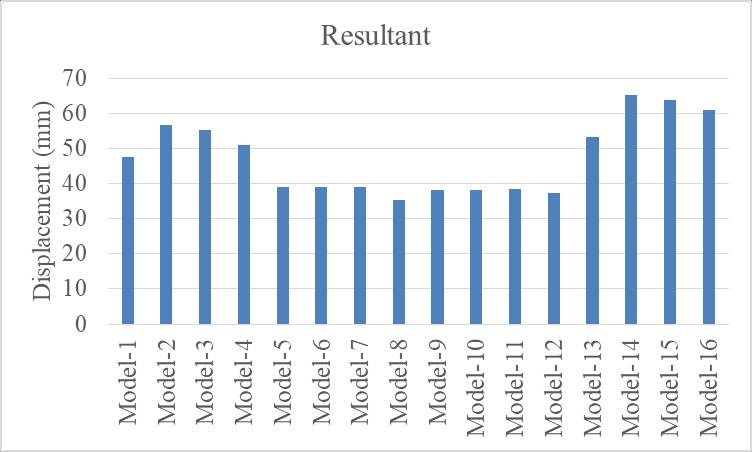
4.3 Resultant Displacement Values of 16 Structural Models
Thisbarchartpresentstheresultantdisplacementvalues(in mm)for16structuralmodelssubjectedtoseismicloading. Thex-axisliststhemodels(Model-1toModel-16),whilethe y-axis indicates the magnitude of total displacement combining horizontal and vertical components. The chart clearly shows that Model-8 has the lowest resultant displacement (~35.26 mm), suggesting superior overall performanceunderseismicconditions.Incontrast,Model-14 experiences the highest resultant displacement (~65.22 mm), indicating the poorest seismic resistance among all models.Thevariationinresultantdisplacementunderscores theimportanceofselectingappropriatebracingsystemsand addressinggeometricirregularitiesinseismicdesign.
CONCLUSION
Thisstudyevaluatedtheseismicperformanceof16different structural models with varying bracing systems and irregular geometries. Displacement data in horizontal, vertical, and resultant directions was analyzed to assess structuralresponseunderseismicloading.
From this analysis we understand that bracing system significantlyimprovesseismicperformance.Allthebraced models exhibit lower displacement compared to their unbraced counter parts. X-bracing was effective in reducing horizontal and resultant displacements. Irregular geometries,suchasre-entrantcornersandverticalsetbacks, showedincreasedvulnerabilitytoseismicloads.Horizontal displacementsvariedwidelyamong models,withModel-8 demonstratingtheleast(mosteffective)andModel-14the greatest (least effective) horizontal displacement. Vertical displacementswererelativelyconsistentacrossallmodels, indicating less sensitivity to bracing variation. Resultant displacements followed the trend of horizontal behavior, highlighting the dominance of lateral forces in seismic design.Model-8, with the lowest resultant displacement, likelyhadanoptimal bracingconfigurationand layoutfor thegivenirregularitytype.ModelssuchasModel-3,4,7,12 also performed well, suggesting that bracing should be
tailoredspecificallytothetypeandlocationofgeometric irregularity.
[1]Abdulridha,A.J.(2023).BehaviorofaMulti-StorySteel Structure with Eccentric X-Brace. Fracture & Structural Integrity/FratturaedIntegritàStrutturale,(66).
[2] Ahasan–ul–Haque, M., Masum, M. A., Ratul, M. M., & Tafheem, Z. (2018, February). Effect of different bracing systemsonthestructuralperformanceofsteelbuilding.In Proceedings od the 4th International Conference on Civil Engineering for Sustainable Development (ICCESD 2018) (pp.9-11).
[3]Al-sabaeei,M.S.,Dabhekar,K.R.,&Khedikar,I.(2023). State of art on seismic comparison of different types (V, diagonalandX)ofbracingsondifferentshapesofbuildings (L,H,Tandrectangular)withresponsespectrummethod. MaterialsToday:Proceedings.
[4] Al-Safi, S., Alameri, I., Wasel, W. A., & Al-kadasi, A. B. (2021).Linearandnonlinearbehaviorofsteelbuildingswith different bracing systems. International Journal of Steel Structures,21,475-486.
[5]Alshamrani,O.,Schierle,G.,Galal,K.,&Vergun,D.(2009). Optimalbracingtypeandpositiontominimizelateraldriftin high-risebuildings.WITTransBuiltEnviron,106,155-66.
[6]Amini,A.,Majd,M.,&Hosseini,M.(2012).Astudyonthe effect of bracing arrangement in the seismic behavior buildings with various concentric bracings by nonlinear static and dynamic analyses. In Fifthteenth World ConferenceonEarthquakeengineering,Lisbon,Portugal.
[7]Chonratana,Y.,&Chatpattananan,V.(2023).ADamage Index for Assessing Seismic-Resistant Designs of Masonry WallBuildingsReinforcedwithX-BracingConcreteFrames. AppliedSciences,13(23),12566.
2025, IRJET