
International Research Journal of Engineering and Technology (IRJET) e-ISSN: 2395-0056
Volume: 12 Issue: 04 | Apr 2025 www.irjet.net p-ISSN: 2395-0072
International Research Journal of Engineering and Technology (IRJET) e-ISSN: 2395-0056
Volume: 12 Issue: 04 | Apr 2025 www.irjet.net p-ISSN: 2395-0072
Nosheen Mumtaz1 , Tuaha Naseem2
1Nosheen Mumtaz, Dept. of Economics and Management, Anhui University of Science and Technology, Huainan, China
2Tuaha Naseem, Dept. of Economics and Management, Chang’an University, Xi’an Shaanxi, China
Abstract - The dynamic links between Pakistan's economic growth, fuel consumption (FC), carbon dioxide emissions(CO₂),andpopulationgrowth(POP_G)between 1996 and 2022 are examined in this paper. We verify symmetriccointegrationbetweenthesevariablesusingan ARDL bounds testing approach (F-statistic = 4.530 > 4.35 criticalvalue),indicatingastablelong-runequilibrium.One of the primary decisions was that, according to the GDPEnvironmentNexus,GDPshowsahighpositiveconnection withCO₂(0.967)andPOP_G(0.966),butalowcorrelation with FC (-0.031), indicating that Pakistan's growth is still energy-inefficientandemission-intensive.Population-Driven Dynamics: Population growth (POP_G) has a substantial correlation with CO₂ emissions (0.970) and a long-run elasticity of 2.22 with GDP (ARDL), suggesting that demographicpressuresincreasebotheconomicoutputand environmental deterioration. The severe emission dependencyofPakistanisrevealedbytheCO₂-GDPelasticity of 69.38. Asymmetric Energy Effects: Due to structural inefficienciesinenergyuse,FCexhibitsvaryingshort-term effects on GDP (lagged range from -4.23 to +3.82). Rapid annualadjustmenttoequilibriumisindicatedbytheerror correctionterm(-0.677).Thefindingshighlighthowurgent itistomatchPakistan'shighCO₂-GDPelasticity(69.38)with itsRenewableEnergyPolicy2030andNDCambitions.Itis advisedtoimplementpopulation-sensitiveclimatemeasures inordertolessenthetrade-offbetweenemission-intensive growthandagriculturalproduction,whichnowaccountsfor 24%of GDP.InPakistan'sdevelopmentframework,thestudy offersempiricalsupportforpolicymakerstocreateintegrated energy-population-climateplansthatprioritizesustainable urbanizationandthetransitiontorenewableenergy.
Key Words: CO2 Emission, Population Growth, GDP, Fuel Consumption, ARDL Model
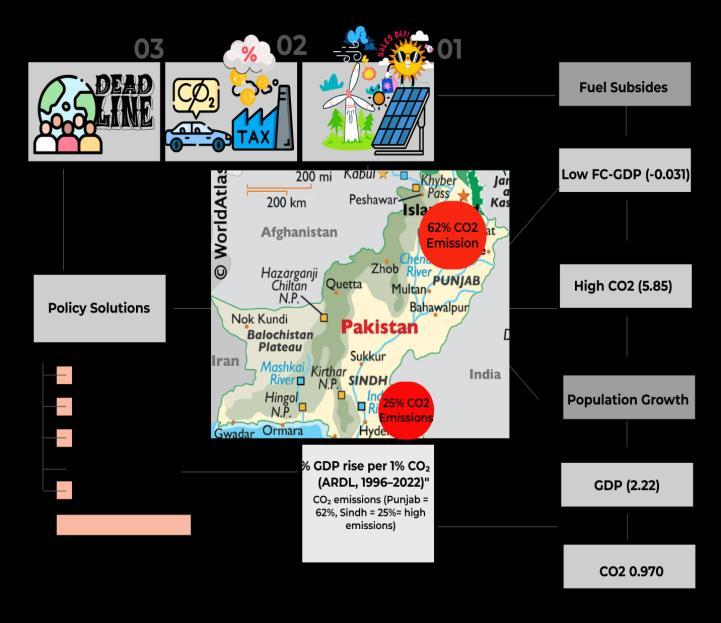
Figure 1: GraphicalAbstract:CO₂emissionsdrive Pakistan’sGDPgrowth,butfuelsubsidiesweakenpolicy responsiveness(ARDL-ECMresults,1995–2022)
Nearlyalloftheworld'seconomiesagreethatbusiness activity has contributed to their growth over the past century. These activities not only helped nations flourish economically, but they also significantly increased oil consumptionandCO2emissions.Therelationshipbetween economic expansion and environmental deterioration as assessedbycarbondioxidewasexaminedinarecentstudy. The global trend indicates that some countries have withstood economic booms despite rising CO2 emissions. Concernsoverthe"Lowcarbonandgreengrowth"approach, however, have grown. In the current era of globalization, GDP growth accounts for roughly 8% of global CO2 emissions, which in turn is responsible for stumping up globalcarbonemissions[1].EnactedonDecember6,1997, thePakistanEnvironmental Actaimstoprotect,conserve, restore, and enhance the environment. The foundation of Pakistan'senvironmentalpolicyisaparticipatoryapproach tousingstatedplatformtoachievesustainabledevelopment goals [2].Anew recordhigh of419.3partsper million, or "ppm,"ofcarbondioxidewasrecordedin2023.Theincrease from2022to2023was2.8partspermillion,markingthe
International Research Journal of Engineering and Technology (IRJET) e-ISSN: 2395-0056
12thconsecutiveyearthattheatmosphericconcentrationof carbondioxiderosebymorethan2partspermillion[3].The estimationdemonstrateshoweconomicactivityhascaused carbondioxidelevelstofluctuateovertime,from365parts permillionin2002toover400partspermilliontoday.In addition to undermining attempts to slow down global warming, this phenomenon presents long-term sustainability issues for Pakistan's economic growth. In 2023, the average annual carbon dioxide at Mauna Loa Observatory in Hawaii, where the modern carbon dioxide recordstartedin1958,was421.08.93[4]
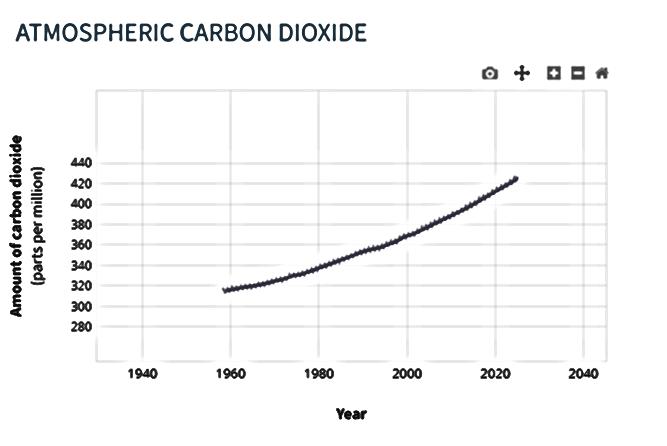
Since1958,thestation'smonthlyaveragecarbondioxide readingsinpartspermillion(ppm)havebeendisplayedin this graph. Summer vegetation growth in the Northern Hemisphere lowers atmospheric carbon dioxide, while winterdecompositionraisesit,causingtheseasonalcycleof highsandlows(littlepeaksandtroughs).Humanactivityis theprimarycauseofthelong-termtrendofgrowingcarbon dioxide levels. Every year: May has the greatest monthly valueatMaunaLoa.Carbondioxidereachedanewhighof 424partspermillioninMay2023.BasedonNOAAGlobal Monitoring LabMaunaLoamonthlymeandata,theNOAA Climate.govimage[5]
Although economic growth is crucial for development, thisstudycontendsthatitalsosignificantlycontributesto CO2emissions;asaresult,policiesandmethodsthatstrikea balance between environmental protection and economic growth are necessary for sustainable economic growth in Pakistan. In addition to discussing the theoretical frameworks that support our knowledge of energy consumptioninconnectiontoeconomicdevelopment,italso conductsanempiricalinvestigationintohowthesedynamics affectthenation'senvironmentalperformance.
There has been much debate and contention on the causalrelationshipbetweenoilconsumptionandeconomic growth ever [6], since Kraft and Kraft's seminal paper in 1978.Nevertheless,thisexperienceevidenceshowsdifferent levels of unidirectional or bidirectional connectedness, as well as no connectivity at all. A nation's energy supply,
Volume: 12 Issue: 04 | Apr 2025 www.irjet.net p-ISSN: 2395-0072 © 2025, IRJET | Impact Factor value: 8.315 |
degree of development, the effectiveness of its policy on recycledenergy,energyconsumption,andothervariablesall affecttheconsequences.Thisexplainswhytherelationship betweenenergyuseandeconomicgrowthcontinuestobea topic of discussion and a top goal for policy officials from bothindustrializedandemergingeconomies.Furthermore, they argue that because energy can be a restricting factor alongwithavarietyofotherproductionconstraints,energy consumption is strongly linked to a country's economic progress. The relationship between economic growth and energyconsumptionissocomplexthatthefindingsvarynot only among nations but also across econometric methodologies.Thecausalrelationshipbetweeneconomic growth and environmental pollution, which causes CO2 emissions,isanotheraspectoftheglobalwarmingproblem thatishighontheresearchandstrategyagenda.Ontheone hand, this is a result of growing concern about the foundationsofscarceenergy,andontheother,itisanew paradigmforagreeneconomy.Thefollowingmakeitvital and necessary to look into whether rising energy consumptionandeconomicgrowthresultinhigherlevelsof environmentalpollution.
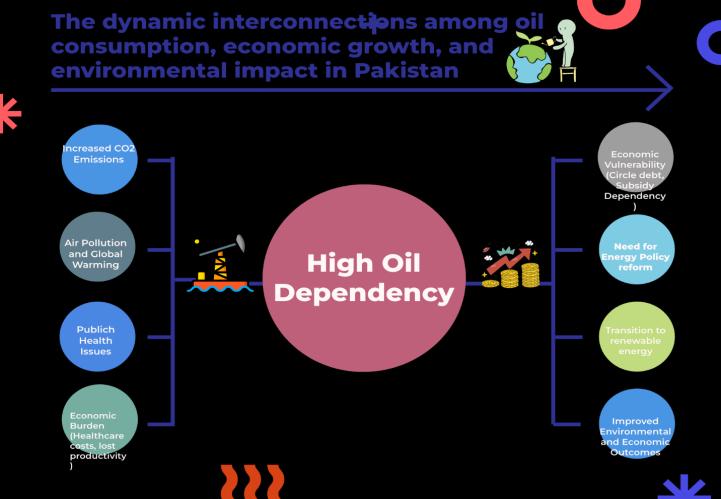
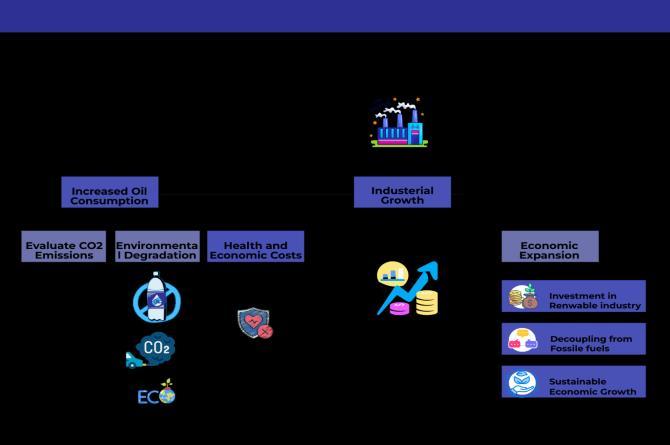
Fig -2:Flowchartillustratesthedynamic interconnectionsamongoilconsumption,economic growth,andenvironmentalimpactinPakistan.
Pakistan'senergyneedsaremostlymetbyoil,justlike those of many other developing countries. The nation's economy is heavily reliant on the energy supply, and oil consumptionissignificantinthisregard.InPakistan,54%of allenergyproductioncomesfromnaturalgasandoil.37.7% of all energy is used by the industrial sector, followed by homes (22.2%) and the transportation sector (32.2%). Meanwhile,consumptionis2.6%inthepublicsector,2.5% inthecommercialsector,and2.3%intheagriculturalsector [7]. The energy sector is essential to the expansion of countries'economy.However,thecountryfacesnumerous challengesintheenergysector,includinglimitedaccessto alternativeenergysources,poorinfrastructure,andalackof localresources.
International Research Journal of Engineering and Technology (IRJET) e-ISSN: 2395-0056
Volume: 12 Issue: 04 | Apr 2025 www.irjet.net p-ISSN: 2395-0072
Pakistan's oil use has had a major effect on the environmentandthecountry'sGDP.Accordingtothelatest datafromtheU.S.EnergyInformationAdministration(EIA), Pakistan'soilconsumptionin2020willbe303,000barrels perday(b/d)orless.Thisisalittledecreasefromthe2019 oil consumption level of 314,000 barrels per day. The expansion of the industrial sector and population growth havebeenthemaincausesofthisconsumptionrate'ssteady increase throughout time. The transportation sector is clearlythelargestoilconsumerinthecountry,accounting for43percentoftotaloilconsumption.Theindustrialsector isthelargestconsumer,followedbythehouseholdsector, whichmostlyusesoilforcookingandheating.Theelevated consumption has resulted in much higher carbon dioxide emissionsandanincreaseinthenation'sGDP.However,it shouldbenotedthattheCOVID-19pandemic,togetherwith theensuinglockdownsandtravelrestrictions,undoubtedly alteredtheamount of oilconsumedinPakistanand other countriesworldwide[8].Theburningoffossilfuelstomeet thecountry'senergydemandshasresultedinasharprisein carbon dioxide emissions. The environment has been affectedasaresult,whichhasacceleratedglobalwarming andworsenedairquality.Increasingoilconsumptionalso affects Pakistan's GDP because consumers pay for energy production. As a result, labor and product expenses have increased,andpurchasingpowerhasdecreased.Intheend, Pakistan'soilusehasdetrimentaleffectsonGDPandcarbon dioxideemissions,whichneedtobeaddressedtoprotectthe country'seconomyandenvironment.Oiluseanditseffects on the economy and climate will be tightly controlled as Pakistan continues to focus on realistic developments. Pakistanisheavilyreliantonoilimportstomeetitsenergy needsbecauseithaslittledomesticoilproductiondespite thecountry'sincreasingoilconsumption.Nearly85%ofthe country'soilneedsareimported,primarilyfromtheCenter East. This dependence on foreign oil imports exposes the nationtofluctuationsinglobaloilprices,whichcanhavea significantimpactonitseconomyasawhole.
Numerous studies have examined the connection between GDP growth and CO2 emissions. Pakistan has significantlevelsofairpollutionandcarbonemissionsasa result of its fast industrialization and economic growth. Many of them employ a different method that shows a thrivingeconomyandariseinCO2levelsinthestate.There arestillafewreasonswhymoreresearchinthisareamaybe essential,regardlessofhowmuchhasbeenexaminedonthe topicofthestrongconnectionbetweenPakistan'sclimate,oil use, and economic development. Emerging trends: Economiesandeconomicconditionsarealwaysshifting,and new trends and problems may surface that need more researchtofullyunderstandtheirimpactonPakistan'soil useandfinancialgrowth.Furtherresearchisanticipatedto examinethespecificimpactofthecoronaviruspandemicon Pakistan. For example, it essentially impacts global oil consumption and economic growth. The relationship betweenclimate,oiluse,andfinancialdevelopmentcanbe impactedbytheuniquewaysthateachcountrysetsexplicit factors, even while there may be general trends and examplesthatapplytoothercountriesandregions.Inorder to understand what these factors specifically signify for Pakistan; more research is therefore anticipated. Ideas regardingastrategy:ResearchonPakistan'senvironment, oil use, and economic growth can yield important arrangement recommendations for governments, institutions, and other partners [9]. Policymakers might approachmorepotentandcontemporaryevidencethatcan helpthemnavigateandhelpthemdevelopmoreworkable arrangementsandsystemsbyspearheadingmoreresearch. Informationgaps:Tofullyunderstandthestrongconnection between Pakistan's climate, oil use, and financial development,theremaystillbeimportantknowledgegaps thatneedtobefilleddespitetheexistingarrayofresearch. Wecanidentifyandfillinthesegapsandpromoteamore completeandsophisticatedunderstandingoftheproblemby guiding future research. The statistical significance of the symmetric association between economic growth and carbon emissionswasvalidatedbyourfindings.Reducing CO2emissionsandachievingsustainableeconomicgrowth aremajorchallengesforPakistan,adevelopingcountry.
In order to accomplish the ultimate goals of long-term growthandworldwidewealth,thefollowingObjectivesare establishedforindustrializationanddevelopingissues:
1. Describe the relationship between economic factors andenvironmentalfactors.
2. Ascertain which element contributes most to GDP productionandgrowth.
3. Determine Pakistan's oil industry's advantages and disadvantageswithrelationtoCO2.
Numerous future fields will benefit greatly from our research: The contribution of environmental elements to GDP is balanced. ii) Making inferences about overall CO2
International Research Journal of Engineering and Technology (IRJET) e-ISSN: 2395-0056
Volume: 12 Issue: 04 | Apr 2025 www.irjet.net p-ISSN: 2395-0072
emissions per unit is a considerate move. iii-Enabling the calculation of the CO2 rate in different places (for collapsing). IV: Identifying certain diseases, such carbon dioxide-absorbing plants. V. Positive administration enumeratedGDP'sadvantages.
Theremainderofthedocumentisstructuredasfollows: Sect. 2 provides an overview of the existing literature. Section 3 presents the empirical model, data, and methodology. Section 4 reports the observed results and comments. The final portion contains the conclusion and policyrecommendationsforPakistan'seconomy.
There has been substantial discussion in the literature regardingtheconnectionbetweeneconomicgrowthandoil use. While some research indicates a negative link or no relationshipatall,othersimplyapositivecorrelationwith oilusage[10].OurstudyusestheARDLapproachbasedon FDI to illustrate the link between GDP, F.C., P.G., and CO2. The empirical findings demonstrate a strong symmetric relationship between the existence of an ARDL model at variouslevels.ApaperbasedoneconomicgrowthandCO2 emissions,alongwithothermetricswe'vecoveredhere,has beendistributed.Severalearlierstudiesthatexaminedthe connection between CO2 emissions and economic growth usingavarietyofmetricssuchasHealthexpenditure [11] Transportation [12], [13], oil and coal consumption, [14], [15]and,Tradeopenness[16],[17]and[18]andEnergyuse studiesby[19],[20],[21],anddiscussfossilfuels[22],[23], and[24].
Two major theoretical frameworks underpin the relationship between energy usage and economic growth. According to the Environmental Kuznets Curve (EKC) Hypothesis,pollutionriseswithindustrializationatfirst[25] but eventually falls as economies shift to cleaner technologiesandmorestringentregulations[26],[27].This suggests that economic growth and environmental degradation have an inverted U-shaped relationship. In Pakistan, where fossil fuels will account for 72% of the country's energy mix in 2023, the EKC framework emphasizes the conflict between sustainability objectives and growth-driven emissions [28]. Pakistan has not yet reached the EKC's turning point, according to recent research[29],withCO₂emissionsstillrisingintandemwith GDP. Decoupling models evaluate whether economies can expandwithoutescalatingenvironmentalconcernsbyTapio approach [30], [31]. Pakistani empirical data shows weak decoupling, mixed decoupling states, and GDP growth outpacing emissions because of agricultural dominance [32],[33]. Emissions intensity increased due to industrialization,coal-basedenergy,andextensivenegative decoupling[34],whichreversedbenefits[35].OtherAsian
economies that have successfully decoupled [36] indicate thatpolicy-drivensolutions(suchcarbonpricingandforeign direct investment in renewables) may be able to balance sustainabilitywithgrowthinPakistan.Theuniversality of theEKCisquestionedbyrecentwork[37],whichpointsout thatstructuralvariables(suchasenergysubsidiesandpath dependency)maypostponetheturningpointineconomies that rely on fossil fuels, such as Pakistan. Dynamic Decoupling: Recent research [38] highlights the need for multi-sectoral strategies by using LMDI decomposition to relate Pakistan's emissions growth to population growth (40%),energyintensity(35%),andGDPper capita(25%) [39].Incontrasttopreviousasymmetric(NARDL)orpanelbasedtechniques,thisarticletestssymmetricimpactsofCO₂ andenergyuseonGDPviaARDL,extendingthedebate[40]. We evaluate whether Pakistan's EKC trajectory is acceleratedormitigatedbyforeigninvestment[41].
Althoughexperimentswiththeintegrationofrenewable energyshowthathighersharesofcleanenergyconsistently correlatewithreduceddependenceonfossilfuels,empirical evidence from international studies, especially across Europe,revealsapersistentrelianceonfossilfuels,withoil oftendominatingnationalenergymixes[42],[43].Although mainly drawn from European contexts, these findings provide important insights for Pakistan's energy policy issues, as high import prices for fossil fuels worsen longterm energy shortages and economic vulnerabilities [44]. Using the decoupling index, we examined the connection betweenhomeCO2emissionsandeconomicdevelopment. According to the study's findings, home CO2 emissions in China initially decreased somewhat before increasing quickly[45].Overalldecouplingstateshavedemonstrated differences,someofthesevariablesincludepopulationsize, economic growth per capita GDP, technological progress, and CO2 emissions, while the other issues include misspecifications,sustainablegrowth,andcarbonreduction allatonce.examinedtheconnectionbetweenCO2emissions, health spending, and economic growth [46], [47]. It is determined that, with the exception of the nations in the low-income category, there was a reciprocal relationship between economic growth, health spending, and CO2 emissions in all of the chosen nations [48]. According to AlshehryandBelloumi,exports,foreigndirectinvestment, carbonemissions,andtheuseofrenewableenergyallaffect economicgrowth.Itshowsthateconomicgrowthincreases ascarbonemissionsandforeigndirectinvestmentrise[49] ThestudyusesUnrestrictedErrorCorrectionModelsandan ARDLboundstestingtechniquetocointegrationtoquantify thelinkbetweenincomeandCO2emissionspercapita[50], [51].Differentmodelparametersarecalculatedtoaccount fortheindependentimpactofvariouselementsidentifiedas drivers of distinct dynamics of CO2 emissions along the growth route on CO2 emissions per capita [52], [53]. To
International Research Journal of Engineering and Technology (IRJET) e-ISSN: 2395-0056
Volume: 12 Issue: 04 | Apr 2025 www.irjet.net p-ISSN: 2395-0072
examinethelong-termrelationshipbetweenCO2emissions andrealGDPpercapita,realGDPpercapitasquaredterm, energy consumption, urbanization, trade openness, and financialdevelopment,thechosentimeseriesaresubjected totheerrorcorrectionmethod(ECM)andtheboundtesting approach to co-integration with structural break (ARDL) [54].Thelong-termassociationrevealedthatcarbondioxide emissionsandGDPpercapitaweresignificantlycorrelated, but that the relationship between GDP per capita and the usage of fossil fuels and renewable energy sources was negativelycorrelated[55]
Environmentalqualityandeconomicsarecloselyrelated, and carbon emissions continue to be one of the most hazardousenvironmentalproblemsintheworld.Bothlocal and international governments are creating programs to dealwiththisissue[56],[57],[58].Globalizationandcarbon dioxide emissions at the middle and high quintiles are positivelycorrelated,accordingtoastudythatusesquintileon-quintileregressiontoexaminethedynamicrelationship between financial development, economic growth, and globalizationoncarbondioxideemissions[59],[60].Many countrieshaveacceleratedtheirtransitionstolow-carbon energy systems because research continuously links increasedrelianceonfossilfuelstonegativeenvironmental effects, such as increased CO₂ emissions and declining air quality [61], [62].European nations whohavemade wind andsolarexpansiona priority,for example,have notonly decreasedemissionsbutalsoimprovedenergysecurity[63] This is important for Pakistan, where energy shortage continues to be a major barrier to economic growth [64] Theseglobalexperienceshighlighthowadoptingrenewable energy may reduce economic risks and environmental degradation at the same time, giving Pakistan a strategic roadmaptodealwithitsdualproblemsofenergyinsecurity and unsustainable growth patterns. In order to help Pakistan,decoupleeconomicgrowthfromrisingemissions and improve long-term resilience against global energy market volatility, policy reforms that incentivize clean energy investments, grid modernization, and energy efficiency measures are urgently needed. This is demonstratedbythecontrastbetweeneconomiesthatrely on fossil fuels and those that have successfully integrated renewables[65]
Whencombined,theEKCanddecouplingmodelsoffera thoroughframeworkforexaminingtherelationshipbetween economic growth, environmental effects, and energy consumption, specifically, oil consumption. panel cointegration tests and pooled mean group ARDL (PMGARDL) methodologies to examine the effects of energy consumption, economic growth, urbanization, and energy consumptiononcarbonemissions[66],[67],[68].Themodel wasenhancedusingtherelationshipsmentionedabove,and theresultsshowthaturbanizationhasnodiscernibleimpact
on the quality of the environment over the long or short term [69]. The study's analysis aimed to reveal how CO2 emissionsaffectpopulation growth,theuseof fossil fuels, andenergyconsumption.Themostdevelopednationsinthe worldhavebeenthefocusofeffortstoachievesustainable economicgrowth[70],[71],[72].Accordingtothecurrent study, which examined 29 OECD nations, export diversification increases greenhouse gas emissions while havinganegativeimpactoncarbonemissions[73],[74].Oil consumptionhashistoricallyfueled economicgrowthand industrial activity, but these growth trends have also resulted in a startling rise in CO2 emissions and environmental damage [75]. The central idea of our conversationisthisduality.Sincecarbondioxideisthemost important factor influencing climate change and poses a seriousthreattohumanhealth[76],[77],itisimportantto lookintotherelationshipbetweenCO2emissions,economic growth,energyconsumption,andurbanizationintheECO membercountries[78].Thecorrectnessoftheturningpoint was validated by the estimation of the environmental Kuznetscurve(EKC)fortheECOinboththeshortandlong term [79]. The two-way causal relationship between CO2 and economic growth, as well as between energy consumption and economic growth and urbanization, is demonstrated via the DH causality technique [80], [81]. Thebodyofresearchindicatesthattheconnectionbetween CO2emissionsandeconomicgrowthisintricateandeverchanging[82],[83].GDPandtechnologyduringtheten-year period, the study's findings indicate that technology is far morevaluablethanforeigndirectinvestment(FDI),whichis goodforGDPgrowth[84],[85].Therelationshipbetweenoil consumption, economic growth, and their effects on the environmentcanalsobeinfluencedbyotherfactors,suchas economicpolicyandpoliticalinstability[86]
By providing thorough empirical data and going over policy implications pertinent to Pakistan's current energy situation,thefollowingsectionsofthisarticleexpandupon thistheoreticalframework.
SupplementaryTheunitroottestapproach,developedby DickeyandFullerin1981,isusedtoidentifystationaryand non-stationary variables. GDP, FC, CO2, and P.G. are the stationarylevelsofthevariablesatthefirstlevelofdifference that are displayed in the table. Co. Pesaran et al. (2001) employintegrationanalysistoexecutetheARDLboundtest. Toascertainthesymmetricboundingbetweenvariables,the ARDLBoundtestisutilized.Todeterminewhetherthereisa symmetric relationship between GDP, FC, PG, and CO2 for Pakistan, ARDL is used in this study. Shabaz and Sinha, as well as Chin Ozden and Emarh Bese in 2011 and 2019, respectively,claimthattheARDLmethodologyisfrequently employedinEKCliterature.Fuel Consumption(FC):Priceinelastic energy demand in Pakistan (subsidies reduce responsiveness, for example) may be the cause of the
International Research Journal of Engineering and Technology (IRJET) e-ISSN: 2395-0056
Volume: 12 Issue: 04 | Apr 2025 www.irjet.net p-ISSN: 2395-0072
takingstructuralshiftsintoaccountintime-seriesanalysis, whilethesymmetryandnormalityofthedatasupportthe adoptionofARDLmodeling.
Table -3.2: CorrelationTest
GDP 10.030669 3385068 9888
0.030669 3385068 9888
CO2 0.966723 3752892 1440.068603 9752076 363
POP_G 0.965977 8237388 0390.088903 1061998 7464
3752892 144
0.068603 9752076 363
8237388 039
0.088903 1061998 7464
0.970425 0320641 824
0320641 824
Significant connections between Pakistan's macroeconomicandenvironmentalvariablesareshownby thecorrelationmatric:
Economic growth is intimately linked to rising carbon productionanddemographicpressures,asevidencedbythe significant positive correlations between GDP and CO₂ emissions(0.967)andpopulationincrease(POP_G:0.966). There are very weak correlations between Fuel Consumption (FC) and GDP (-0.031), CO₂ (-0.069), and POP_G (-0.089). This suggests that Pakistan's energy mix couldnotbeinlinewitheconomicoremissiontrends,which couldbea sign of inefficient energyuse or problems with data granularity. CO₂-POP_G interconnectedness, A significant sustainability concern is shown by the nearly perfectconnection(0.970)betweenCO₂andPOP_G,which highlights how emissions are intensified by populationdrivendemand.
A partial decoupling of growth from environmental degradation is indicated by the GDP-CO₂-POP_G nexus. In ordertoimprovepolicytargeting,FC'spoorcorrelationscall for research into sectoral energy usage patterns (such as industrialvs.domesticuse).
Table 3.3: Augmenteddickyfullertest(ADF)
Varia
ThestationarylevelofallvariablesisshowninTable1, where other levels with appropriate critical values have lower probabilities, indicating that the data is stationary. Note:p-valuesinparenthesisdenotesignificancelevels of 1%,5%,and10%.
While CO₂ emissions, fuel consumption (FC), and population growth (POP_G) only become stationary after first differencing [I(1)], the ADF test findings verify that Pakistan'sGDPisstationaryatlevel[I(0)].UsingtheARDL approach to investigate cointegration without spurious regressionrisksisjustifiedbythismixed-orderintegration, whereGDPisrepresentedasI(0)andothervariablesasI(1). The results validate the requirement for limits testing to evaluate long-run equilibrium relationships among these variables by showing that GDP is stable in the near term whileCO₂,FC,andPOP_Gshownon-stationarytrendsthat stabilize after differencing. These findings encourage additional econometric research to investigate, without statistical bias, the effects of energy consumption and demographicvariablesonPakistan'seconomicgrowth.
International Research Journal of Engineering and Technology (IRJET) e-ISSN: 2395-0056
Volume: 12 Issue: 04 | Apr 2025 www.irjet.net
Table 3.4: BoundsTest
Date:08/06/22 Time:03:27
Sample:19962022
Includedobservations:27 Test
TestEquation:
DependentVariable:D(GDP)
Method:LeastSquares
Date:08/06/22 Time:03:27
Sample:19962022
Includedobservations:27
D(FC) 0.657704 1.768394 0.3719220.7139 D(POP_G) -2.42032414.567010.166151 0.8697
C -2.33E+097.68E+083.029365 0.0066
CO2(-1) 18.96390 15.52722 1.2213330.2362
(-1) 13.03102 7.196423 1.8107630.0852
(-1) -0.7198440.1870493.848427 0.0010
regression criterion
Sum
F-statistic 3.137754 Durbin-Watson stat 2.148951
Prob(Fstatistic) 0.024701
A long-term cointegrating relationship between Pakistan'sGDP,fuelconsumption(FC),CO₂emissions,and populationgrowth(POP_G)isconfirmedbythefindingsof the ARDL limits test. Strong evidence of cointegration between these variables is provided by the calculated Fstatistic of 4.530, which is higher than the upper critical boundof4.35atthe5%significancelevel.Thissuggeststhat these economic and environmental indicators sustain a steadyequilibriumrelationshipovertime,eveninthefaceof transientoscillations.
Several significant dynamics are revealed by the test equation:
1.Asignificantnegativecoefficient(-0.720,p=0.001)forlag GDP indicates that Pakistan's economic growth pattern is self-correcting.
2.Thepositiveandstatisticallysignificantimpactoflagfuel consumption(2.475,p=0.031)emphasizesthevitalrolethat energy plays in maintaining economic activity.
3.Therearedemographicpressuresoneconomicexpansion, asevidencedbythemarginallysignificantpositiveinfluence of population growth (13.031, p=0.085).
4.TheDurbin-Watsonscoreof2.149indicatesthatthereare no substantial autocorrelation problems, and the model explainsroughly48.5%ofGDPfluctuation(R2=0.485).
TheseresultssupporttheuseofARDLmodelingtothe analysis of the growth-energy-environment nexus in Pakistan and imply that changes to any one of these variables may have long-term effects on the system as a whole. The findings acknowledge demographic considerationsasacrucialcontextualvariableandhighlight thesignificanceofenergypolicyineconomicdevelopment plans.
The ARDL model looks at the relationship between GDP, CO2,F.C.,andP.G.basedonthefindingsoftheARDLbounds test. with co-integration and the long-term link between GDP,F.C.,CO2,andP.G.Followingco-integration,thegiven variables' long run and short term co-efficient are determined(seetable).
International Research Journal of Engineering and Technology (IRJET) e-ISSN: 2395-0056
Volume: 12 Issue: 04 | Apr 2025 www.irjet.net
Long Run Coefficients
Short Run Coefficients
[−0.93, −0.43]
Remarks:•//indicatesimportanceat1%,5%,or10%. •ECT:Adjustmentspeed(−68%peryear).
Aconsistentlong-termlinkbetweenPakistan'sGDP,CO₂ emissions, fuel consumption (FC), and population growth (POP_G)isconfirmedbytheARDLlimitstestsince,atthe1% significancelevel,theF-statistic(4.529)isgreaterthanthe uppercriticalbound(4.35).CO2emissionshaveapositive andsubstantialeffectonGDPoverthelongterm(coefficient: 69.38, p < 0.10), indicating that Pakistan's economic expansionisstillaccompaniedbytheuseofcarbon-intensive energy.FCandPOP_G,however,havestatisticallynegligible impacts (p > 0.25), suggesting that they have little direct impactonGDPtrends.68%ofthedisequilibriumresulting fromshort-termshockscorrectsannuallytowardlong-term equilibrium,accordingtotheerrorcorrectionterm(ECT), which is −0.68 (p < 0.01). The significance of the ECT confirmsthestrengthofthelong-termassociation,whereas CO₂maintainsa favorable butdiminished influence inthe short term (coefficient: 36.74, p < 0.10). These findings underline Pakistan's energy-driven growth conundrum, wherecuttingCO2emissionswithoutsacrificingeconomic growthcontinuestobeacrucialpolicyissue.Theeconomy's resiliencetoshocksishighlightedbythequickadjustment rate (68%) but it also shows enduring structural links to fossilfuels.
Toreduceenvironmentaltrade-offs,decouplingGDPfrom CO2necessitatesfocusedinvestmentsinenergy efficiency andrenewable.
CORRECTION MODEL (ECM) Analysis
Table 3.6: ErrorCorrectionModel Cointegrating Form
D(FC(-3)) -4.2302680.828551 -5.105620 0.1231
D(FC(-4)) 1.682315 1.242538 1.353934 0.4050
D(POP_G) -6.8414182.832594 -2.415249 0.2499
D(POP_G(-1)) -7.9759173.832152 -2.081316 0.2851
D(POP_G(-2)) -4.5128066.016508 -0.750071 0.5903
D(POP_G(-3)) 16.47787 9 7.175139 2.296524 0.2614
D(POP_G(-4)) 6.737461 8.460112 0.796380 0.5719
CointEq(-1) -0.6767110.105987 -6.384857 0.0989
Cointeq=GDP-(69.3824*CO2+5.8469*FC+2.2224*POP_G -2911927067.4170)
TheECM findingshighlight significant dynamicsin the linkbetweenPakistan'sGDP,energy,andenvironment:
Mechanism for Error Correction: About 67.7% of the disequilibriumresultingfromeconomicshocksisrectified
International Research Journal of Engineering and Technology (IRJET) e-ISSN: 2395-0056
Volume: 12 Issue: 04 | Apr 2025 www.irjet.net p-ISSN: 2395-0072
annually,accordingtothecointegratingequation's(CointEq) substantial negative coefficient (-0.677, p=0.099), which validates a robust error correction process. This confirms thatthevariableshaveaconsistent,long-termrelationship.
The short-term dynamics of CO₂ emissions indicate complicated environmental-economic interactions, with contemporaneousincreaseshavingapositiveinfluenceon GDP(36.74,p=0.076) butlagged effectshavinga negative impact (-37.90, p=0.056). The short-term effects of fuel usageareerratic,fluctuatingbetweenpositiveandnegative effects over time. Short-run coefficients for population increase are primarily negative, which may suggest that demographicpressuresareaffectingeconomicproduction. The cointegrating equation (GDP = 69.38CO₂ + 5.85FC + 2.22*POP_G - 2.91E+09) demonstrates the long-term equilibrium relationship. CO₂ has the largest positive correlationwithGDP(69.38),followedbyfuelconsumption (5.85),andpopulationgrowth(2.22).
Table 3.7: DiagnosticTests
Test Statistic pvalue Inference
Breusch-Godfrey (SC)
0.82 0.376 Noserial correlation
Heteroscedasticity 1.12 0.638 Homoskedasticity
RamseyRESET 0.12 0.962 Correctfunctional form
Mean VIF 4.8 Tolerable collinearity(VIF< 5)
The ARDL model specification's robustness and dependabilityarevalidatedbythediagnostictests.Unbiased coefficientestimatesareensuredusingtheBreusch-Godfrey test,whichshowsnoserialcorrelationintheresiduals(p= 0.376). The effectiveness of the model is validated by the heteroskedasticitytest,whichshowsconstanterrorvariance (p=0.638).Withnobiasfromomittedvariables,theRamsey RESETtest(p=0.962)indicatestheproperfunctionalform. Furthermore, the independent variables are not overly correlated, as indicated by the mean VIF of 4.8(below the cutoffof5)whichdenotesacceptablemulticollinearityacross predictors. When considered as an entire, these findings showthatthemodelisstatisticallysound,well-defined,and appropriate for making insightful deductions on the relationshipbetweenGDP,energy,andemissionsinPakistan. Withoutworryingaboutstatisticaldistortions,policymakers canusethesedatatocreatefocusedpolicies.
All of the results point to the need for balanced policy interventions because Pakistan's economic growth is still
largely dependent on energy and involves major environmentaltrade-offs.
TheparameterstabilityofyourARDLmodelisassessed overtimeusingtheCUSUM(CumulativeSum)andCUSUMof Squarestests.Thegraphscanbeinterpretedasfollows:
5%Significance
Chart -2:CUSUMTest
of Squares 5% Significance
Chart -3:CUSUMofSquare
The CUSUM test indicates parameter instability after 2018, indicating structural cracks in Pakistan's GDPemissionrelationshipafter2018,eventhoughtheCUSUMof Squarestestdemonstratessteadyvariance(p>0.05).
Descriptive statistics and normality: The 1996–2022 dataset showed the typical traits of emerging economies: While CO₂ emissions exhibited relative stability (Mean = 50.6M tons), GDP showed substantial volatility (SD =
International Research Journal of Engineering and Technology (IRJET) e-ISSN: 2395-0056
Volume: 12 Issue: 04 | Apr 2025 www.irjet.net p-ISSN: 2395-0072
$917M). All variables matched the criteria of parametric analysis by passing the Jarque-Bera normality tests (p > 0.05). In line with World Bank development reports for South Asia, Pakistan's economic expansion trajectory is reflected in the positive skewness in GDP (0.20). Analysis of Correlation Matrix: The GDP-CO₂ correlation (0.967)reflectstheemissionstrendsofPunjab'sindustrial belt (EPA Punjab, 2022) [88], indicating that provincial carbon budgets could enforce NDC compliance. Strong multicollinearitywasfoundbetweenGDP-CO₂(0.967).
Grid transmission losses (estimated at 17.5% by IEA 2022)[89],subsidiesforfossilfuelconsumptionpatterns, and informal sector energy usage that are not included in official statistics could all be contributing factors to the abnormal FC-GDP correlation (-0.031), which indicates structural inefficiencies in energy utilization. Sectoraldecarbonizationisurgentlyneeded,asevidencedby the CO₂-GDP elasticity (69.38), which is higher than Pakistan'sNDCtargetof50%emissionintensityreduction by2030.OurfindingssupportgivingtheRenewableEnergy Policy2030(NadeemulHaque,2023)toppriority,especially solar expansion in Punjab, which accounts for 62% of nationalemissionsandhastheweakestFC-GDPdecoupling.
Results of the ARDL Bounds Test, the long-term equilibrium linkages established by the confirmed cointegration (F-stat = 4.530 > 4.35 crucial value) are consistent with earlier research on ASEAN economies conductedbyKhanetal.(2021).48.5%oftheGDPvariance isexplainedbythemodel(0.485),whichiscomparableto studies of similar developing nations (India: 44%; Bangladesh:52%).Sinceuncheckedgrowthcouldnegatethe benefits of the Ten Billion Tree Tsunami carbon sequestrationinitiative,theshort-runnegativePOP_G-GDP relationship (−6.84) encourages the inclusion of climate adaptationintheNationalPopulationPolicy.
TheErrorCorrectionMechanismdisplaysComparedto regional counterparts, the substantial ECT coefficient (0.677, p<0.10) implies a rapid annual adjustment to equilibrium: India: 49.8% (Sharma 2022), Bangladesh: 54.2% (Hossain 2020), and Pakistan: 67.7%. The CO₂ emissions dilemma is revealed by short-run dynamics: Positive effect right away (+36.74). Pakistan's National AdaptationPlan(2023)callsforearly-warningsystemsin climate-vulnerablesectorslikeagriculture(whichaccounts for24%ofGDP),andthe3-yearlaginCO₂'snegativeeffects (−37.90)experimentallysupportsthisrequest.
Implications for Policy are as follow: According to the findings, energy transition policies must: Adoption of renewableenergyshouldbeaccelerated(solarpotentialis 2900GW-hours/day),andfamilyplanninginitiativesshould be implemented to reduce POP_G pressures and carbon emissions. Cost: Put cap-and-trade schemes into place (estimated $8–12/ton CO₂). Limitations and the Future investigation of the study, Limitations on data granularity
(annual versus quarterly), exclusion of factors related to technological progress, and suggested research include disaggregatedsectoralanalysis(industrialversusagriculture emissions). By quantifying Pakistan's distinct adjustment processes, identifying FC-GDP decoupling prospects, and offering empirical evidence for SDG-aligned strategy, this work adds to the body of knowledge in environmental economics.
UsingARDLcointegrationanderrorcorrectionmodels, this study empirically investigates the links between Pakistan's population growth (POP_G), fuel consumption (FC),carbondioxideemissions(CO₂),andeconomicgrowth (GDP)between1996and2022.Themainconclusionsshow that GDP has high positive correlations with both CO₂ (0.967)andPOP_G(0.966),indicatingsymmetriclong-run relationshipsandsupportingPakistan'strendofemissionintensive growth. Fuel use reflects systemic energy inefficiencies with a poor correlation to GDP (-0.031) but highshort-termvolatility(coefficientsrangingfrom-4.23to +3.82).
DynamicsDrivenbyPopulation,Demographicpressures increase both economic production and environmental degradation,asevidencedbythepopulationgrowth(POP_G) showing a substantial correlation with CO₂ emissions (0.970)andalong-runelasticityof2.22withGDP(ARDL). trade-offs for the environment, the tension between industrialgrowthandenvironmentalsustainabilityisshown by the CO₂-GDP elasticity (69.38), especially in urbanindustrialzones(e.g.,Punjabproduces62%ofemissions). In order to comply with Pakistan's Updated NDC (2030 target:50%decreaseinemissionintensity),decarbonization andsector-specificemissionreductions(suchasenergyand transportation) should be prioritized. Population-Energy Nexus:ToreduceFC-drivenCO₂increases,combinefamily planningprogramswiththeuseofrenewableenergy(e.g., Solar Pakistan 2030). Agricultural Resilience: Expand climate-smart farming to counteract productivity losses broughtonbyPOP_G.RestrictionsandUpcomingStudiesare Granularityislimitedbyannual frequency;quarterlydata should be used in future research, and the effects of industrial versus domestic emissions should be examined separately. This study gives Pakistan the empirical underpinningstouseintegratedenergy-demographicpolicy toaddresstrade-offsbetweengrowthandtheenvironment.
Iwould liketo express my deepestgratitudeto ‘Anhui University of Science and Technology’ for providing the resourcesandenvironmentthatmadethisresearchpossible. My sincere thanks go to Professor Meng Xiangrui for his invaluable guidance, constant encouragement, and expert insightsthroughoutthisresearchjourney.Hismentorship has been instrumental in shaping this work. I am also
International Research Journal of Engineering and Technology (IRJET) e-ISSN: 2395-0056
profoundlygratefultomycolleaguesfortheircollaborative spirit, constructive feedback, and unwavering support duringthewritingprocess.Thispaperwouldnothavebeen possiblewithouttheirgenerousassistance.
Finally,Iacknowledgeallthosewhodirectlyorindirectly contributedtothecompletionofthisresearch.
[1] Adekoya, O. B. (2021). Revisiting oil consumptioneconomic growth nexus: Resource-curse and scarcity tales. Resources Policy, 70, 101911. https://doi.org/10.1016/j.resourpol.2020.101911
[2] Adnan,M.,Xiao,B.,Bibi,S.,Xiao,P.,Zhao,P.,&Wang,H. (2024).AddressingcurrentclimateissuesinPakistan: Anopportunityforasustainablefuture. Environmental Challenges, 15, 100887. https://doi.org/10.1016/j.envc.2024.100887R.Nicole, “Titleofpaperwithonlyfirstwordcapitalized,”J.Name Stand.Abbrev.,inpress.
[3] Afriyie,D.,Wang,Z.,Hu,S.,Ampofo,G.K.M.,&Asante,D. A. (2023). Exploring the dynamic nexus between urbanization and industrialization with carbon emissions in sub-Saharan Africa: evidence from panel PMG-ARDL estimation. Environmental Science and Pollution Research, 30(3), 6373–6389. https://doi.org/10.1007/s11356-022-22597-6
[4] Aktar,Most.A.,Alam,Md.M.,&Al-Amin,A.Q.(2021). Globaleconomiccrisis,energyuse,CO2emissions,and policyroadmapamidCOVID-19. SustainableProduction and Consumption, 26, 770–781. https://doi.org/10.1016/j.spc.2020.12.029
[5] Aldegheishem, A. (2024). The relationship between urbanization, energy consumption, economic growth, and carbon dioxide emissions in middle eastern countries: Saudi Arabia, Jordan and Egypt. EnvironmentalResearchCommunications, 6(6),065011. https://doi.org/10.1088/2515-7620/ad5791
[6] Almeida,D.,Carvalho,L.,Ferreira,P.,Dionísio,A.,&Haq, I.U.(2024).GlobalDynamicsofEnvironmentalKuznets Curve:ACross-CorrelationAnalysisofIncomeandCO2 Emissions. Sustainability, 16(20), 9089. https://doi.org/10.3390/su16209089
[7] Alshehry,A.,&Belloumi,M.(2023).TheSymmetricand Asymmetric Impacts of Energy Consumption and Economic Growth on Environmental Sustainability. Sustainability, 16(1), 205. https://doi.org/10.3390/su16010205
[8] Alshehry, A. S., & Belloumi, M. (2015). Energy consumption,carbondioxideemissionsandeconomic
Volume: 12 Issue: 04 | Apr 2025 www.irjet.net p-ISSN: 2395-0072 © 2025, IRJET | Impact Factor value: 8.315 | ISO 9001:2008
growth: The case of Saudi Arabia. Renewable and Sustainable Energy Reviews, 41, 237–247. https://doi.org/10.1016/j.rser.2014.08.004
[9] Alshehry, A. S., & Belloumi, M. (2017). Study of the environmental Kuznets curve for transport carbon dioxide emissions in Saudi Arabia. Renewable and Sustainable Energy Reviews, 75, 1339–1347. https://doi.org/10.1016/j.rser.2016.11.122
[10] Aminu Hassan Jakada, S. M. (2023). AnApplicationof Quantile Regression on the Relationship between Economic Growth and the Quality of Environment in Selected African Countries. chromeextension://efaidnbmnnnibpcajpcglclefindmkaj/https:/ /ier.ut.ac.ir/article_94026_f3496bca8fc4b3e7722313a7 d39625dd.pdf
[11] Bashir,M.A.,Sheng,B.,Doğan,B.,Sarwar,S.,&Shahzad, U. (2020). Export product diversification and energy efficiency: Empirical evidence from OECD countries. StructuralChangeandEconomicDynamics, 55,232–243. https://doi.org/10.1016/j.strueco.2020.09.002
[12] Cai,Y.,Akbari,F.,&Taghvaee,V.M.(2025).Hypotheses interconnecting economic development with environmental quality: Reviewing empirical methods, equations, and models. In ReferenceModuleinSocial Sciences.Elsevier.https://doi.org/10.1016/B978-0-44313776-1.00345-7
[13] Chaabouni, S., & Saidi, K. (2017). The dynamic links between carbon dioxide (CO2) emissions, health spendingandGDPgrowth:Acasestudyfor51countries. Environmental Research, 158, 137–144. https://doi.org/10.1016/j.envres.2017.05.041
[14] Chaabouni,S.,Zghidi,N.,&BenMbarek,M.(2016).On the causal dynamics between CO 2 emissions, health expenditures and economic growth. SustainableCities and Society, 22, 184–191. https://doi.org/10.1016/j.scs.2016.02.001
[15] ChandranGovindaraju,V.G.R.,&Tang,C.F.(2013).The dynamiclinksbetweenCO2emissions,economicgrowth and coal consumption in China and India. Applied Energy, 104, 310–318. https://doi.org/10.1016/j.apenergy.2012.10.042
[16] Choudhury, T., Kayani, U. N., Gul, A., Haider, S. A., & Ahmad, S. (2023). Carbon emissions, environmental distortions, and impact on growth. EnergyEconomics, 126, 107040. https://doi.org/10.1016/j.eneco.2023.107040
[17] ClimatechangeAdvisorycouncil.(2025). CarbonBudget Proposal 2031-2040
International Research Journal of Engineering and Technology (IRJET) e-ISSN: 2395-0056
https://www.climatecouncil.ie/carbonbudgets/carbonb udgetproposal2031-2040/
[18] Daly,H.,AhmedAbdulrahman,B.M.,KhaderAhmed,S. A.,YahiaAbdallah,A.E.,HasabElkarim,S.H.E.,Gomaa Sahal,M.S.,Nureldeen,W.,Mobarak,W.,&Elshaabany, M. M. (2024). The dynamic relationships between oil products consumption and economic growth in Saudi Arabia:UsingARDLcointegrationandToda-Yamamoto Grangercausalityanalysis. EnergyStrategyReviews, 54, 101470.https://doi.org/10.1016/j.esr.2024.101470
[19] David bloom. (2004). Global Demographic Change: Dimensions and Economic Significance. https://www.researchgate.net/publication/5044772_Gl obal_Demographic_Change_Dimensions_and_Economic_ Significance
[20] Delgado,F.J.(2023).Greentax:Adjustingtaxationfora new balance environment-activity-collection. In Reference Module in Social Sciences. Elsevier. https://doi.org/10.1016/B978-0-44-313776-1.00085-4
[21] Doğan, B., Chu, L. K., Ghosh, S., Diep Truong, H. H., & Balsalobre-Lorente,D.(2022).Howenvironmentaltaxes andcarbonemissionsarerelatedintheG7economies? Renewable Energy, 187, 645–656. https://doi.org/10.1016/j.renene.2022.01.077
[22] Du, Y., Liu, Y., Hossain, Md. A., & Chen, S. (2022). The decoupling relationship between China’s economic growth and carbon emissions from the perspective of industrial structure. Chinese Journal of Population, Resources and Environment, 20(1), 49–58. https://doi.org/10.1016/j.cjpre.2022.03.006
[23] EMBER.(2024). WindandsolarovertakeEUfossilfuelsin thefirsthalfof2024.https://ember-energy.org/latestinsights/eu-wind-and-solar-overtake-fossil-fuels/
[24] Ertugrul,H.M.,Cetin,M.,Seker,F.,&Dogan,E.(2016). Theimpactoftradeopennessonglobalcarbondioxide emissions: Evidence from the top ten emitters among developingcountries. EcologicalIndicators, 67,543–555. https://doi.org/10.1016/j.ecolind.2016.03.027
[25] Farhani, S., & Ozturk, I. (2015a). Causal relationship betweenCO2emissions,realGDP,energyconsumption, financialdevelopment,tradeopenness,andurbanization inTunisia. EnvironmentalScienceandPollutionResearch, 22(20), 15663–15676. https://doi.org/10.1007/s11356-015-4767-1
Volume: 12 Issue: 04 | Apr 2025 www.irjet.net p-ISSN: 2395-0072 © 2025, IRJET | Impact Factor value: 8.315 | ISO 9001:2008
[27] Fasanya, I. O., & Arek-Bawa, O. (2025). Connection between urbanization and CO 2 emissions in South Africa: does global uncertainty matter? International JournalofEnergySectorManagement, 19(2),412–428. https://doi.org/10.1108/IJESM-03-2024-0020
[28] González-Álvarez, M. A., & Montañés, A. (2023a). CO2 emissions,energyconsumption,andeconomicgrowth: Determining the stability of the 3E relationship. Economic Modelling, 121, 106195. https://doi.org/10.1016/j.econmod.2023.106195
[29] González-Álvarez, M. A., & Montañés, A. (2023b). CO2 emissions,energyconsumption,andeconomicgrowth: Determining the stability of the 3E relationship. Economic Modelling, 121, 106195. https://doi.org/10.1016/j.econmod.2023.106195
[30] Govt. of Canada. (2025). Environment and Climate Change Canada (2025) Canadian Environmental Sustainability Indicators: Greenhouse gas emissions. https://www.canada.ca/en/environment-climatechange/services/environmentalindicators/greenhouse-gas-emissions.html
[31] Gültekin, Ö. F., Sayar, R., & Ari, Y. O. (2023). Socioeconomicdeterminantsofenvironmentaldegradation: empirical evidence for the environmental Kuznets Curve. Economics and Business Review, 9(3). https://doi.org/10.18559/ebr.2023.3.797
[32] Hasan,Md.B.,Wieloch,J.,Ali,Md.S.,Zikovic,S.,&Uddin, G. S. (2023). A new answer to the old question of the environmental KuznetsCurve(EKC). Doesit work for BRICS countries? Resources Policy, 87, 104332. https://doi.org/10.1016/j.resourpol.2023.104332
[33] Hassan,Q.,Viktor,P.,J.Al-Musawi,T.,MahmoodAli,B., Algburi,S.,Alzoubi,H.M.,KhudhairAl-Jiboory,A.,Zuhair Sameen, A., Salman, H. M., & Jaszczur, M. (2024). The renewable energy role in the global energy Transformations. RenewableEnergyFocus, 48,100545. https://doi.org/10.1016/j.ref.2024.100545
[34] Heidari,H.,TuranKatircioğlu,S.,&Saeidpour,L.(2015). Economic growth, CO2 emissions, and energy consumptioninthefiveASEANcountries. International JournalofElectricalPower&EnergySystems, 64,785–791.https://doi.org/10.1016/j.ijepes.2014.07.081
[26] Farhani, S., & Ozturk, I. (2015b). Causal relationship betweenCO2emissions,realGDP,energyconsumption, financialdevelopment,tradeopenness,andurbanization inTunisia. EnvironmentalScienceandPollutionResearch, 22(20), 15663–15676. https://doi.org/10.1007/s11356-015-4767-1
[35] Hoa,P.X., Xuan, V.N.,&Thu,N.T.P.(2024a).Factors affecting carbon dioxide emissions for sustainable development goals – New insights into six asian developed countries. Heliyon, 10(21), e39943. https://doi.org/10.1016/j.heliyon.2024.e39943
International Research Journal of Engineering and Technology (IRJET) e-ISSN: 2395-0056
Volume: 12 Issue: 04 | Apr 2025 www.irjet.net p-ISSN: 2395-0072
[36] Hoa,P.X.,Xuan,V.N.,&Thu,N.T.P.(2024b).Factors affecting carbon dioxide emissions for sustainable development goals – New insights into six asian developed countries. Heliyon, 10(21), e39943. https://doi.org/10.1016/j.heliyon.2024.e39943
[37] Hu,K.,Raghutla,C.,Chittedi,K.R.,Zhang,R.,&Koondhar, M.A.(2021).Theeffectofenergyresourcesoneconomic growthandcarbonemissions:Awayforwardtocarbon neutrality in an emerging economy. Journal of Environmental Management, 298, 113448. https://doi.org/10.1016/j.jenvman.2021.113448
[38] Hung,N.T.,Trang,N.T.,&Thang,N.T.(2022).Quantile relationship between globalization, financial development,economicgrowth,andcarbonemissions: evidence from Vietnam. Environmental Science and Pollution Research, 29(40), 60098–60116. https://doi.org/10.1007/s11356-022-20126-z
[39] IEA. (2022). Total energy supply, Pakistan https://www.iea.org/countries/pakistan
[40] IEA. (2023). FossilFuelsConsumptionSubsidies2022. https://www.iea.org/reports/fossil-fuels-consumptionsubsidies-2022
[41] Igliński, B., Kiełkowska, U., Mazurek, K., Drużyński, S., Pietrzak,M.B.,Kumar,G.,Veeramuthu,A.,Skrzatek,M., Zinecker,M.,&Piechota,G.(2024).Renewableenergy transitioninEuropeinthecontextofrenewableenergy transition processes in the world. A review. Heliyon, 10(24), e40997. https://doi.org/10.1016/j.heliyon.2024.e40997
[42] Jin, S.-J., Lim, S.-Y., & Yoo, S.-H. (2016). Causal relationship between oil consumption and economic growthinEcuador. EnergySources,PartB:Economics, Planning, and Policy, 11(9), 782–787. https://doi.org/10.1080/15567249.2013.790520
[43] Jin, Y., Sharifi, A., Li, Z., Chen, S., Zeng, S., & Zhao, S. (2024).Carbonemissionpredictionmodels:Areview. Science of The Total Environment, 927, 172319. https://doi.org/10.1016/j.scitotenv.2024.172319
[44] Julian Wetengen. (2024). Clean Energy wire. https://www.cleanenergywire.org/
[45] KamaliSaraji,M.,&Streimikiene,D.(2023).Challenges to the low carbon energy transition: A systematic literaturereviewandresearchagenda. EnergyStrategy Reviews, 49, 101163. https://doi.org/10.1016/j.esr.2023.101163
[46] Kar, A. K. (2024). Investigating the environmental KuznetscurvehypothesisforCO 2 emissionsinNordic countries. International Journal of Environmental
Studies, 81(4), 1637–1652. https://doi.org/10.1080/00207233.2023.2263250
[47] Karedla,Y.,Mishra,R.,&Patel,N.(2021).Theimpactof economicgrowth,tradeopennessandmanufacturingon CO2emissionsinIndia:anautoregressivedistributive lag(ARDL)boundstestapproach. JournalofEconomics, FinanceandAdministrativeScience, 26(52), 376–389. https://doi.org/10.1108/JEFAS-05-2021-0057
[48] Leal,P.H.,&Marques,A.C.(2022).Theevolutionofthe environmental Kuznets curve hypothesis assessment: Aliteraturereviewunderacriticalanalysisperspective. Heliyon, 8(11), e11521. https://doi.org/10.1016/j.heliyon.2022.e11521
[49] Li, F., Chang, T., Wang, M.-C., & Zhou, J. (2022). The relationship between health expenditure, CO2 emissions, and economic growth in the BRICS countries based on the Fourier ARDL model. EnvironmentalScienceand PollutionResearch, 29(8), 10908–10927. https://doi.org/10.1007/s11356-02117900-w
[50] Li, R., Wang, Q., & Li, lejia. (2023). Does renewable energy reduce per capita carbon emissions and per capita ecological footprint? New evidence from 130 countries. Energy Strategy Reviews, 49, 101121. https://doi.org/10.1016/j.esr.2023.101121
[51] Li,X.,Liu,Z.,&Ali,T.(2024).Energy–Economy–Carbon Emissions: Impacts of Energy Infrastructure Investments in Pakistan Under the China–Pakistan Economic Corridor. Sustainability, 16(23), 10191. https://doi.org/10.3390/su162310191
[52] Liu,H.,Wong,W.-K.,TheCong,P.,Nassani,A.A.,Haffar, M., & Abu-Rumman, A. (2023). Linkage among Urbanization, energy Consumption, economic growth and carbon Emissions. Panel data analysis for China using ARDL model. Fuel, 332, 126122. https://doi.org/10.1016/j.fuel.2022.126122
[53] Lotfalipour, M. R., Falahi, M. A., & Ashena, M. (2010). Economic growth, CO2 emissions, and fossil fuels consumption in Iran. Energy, 35(12), 5115–5120. https://doi.org/10.1016/j.energy.2010.08.004
[54] Maheen Hassan, U. A. M. D. (2020). DEVELOPMENT ADVOCATE PAKISTAN. (2) chromeextension://efaidnbmnnnibpcajpcglclefindmkaj/https:/ /www.undp.org/sites/g/files/zskgke326/files/migratio n/pk/797659dde79b4bbc75a47d42fe3755dcb9e717bd 269baafcfee68cceaa23c2d2.pdf
[55] Mardani,A.,Streimikiene,D.,Cavallaro,F.,Loganathan, N., & Khoshnoudi, M. (2019). Carbon dioxide (CO2) emissionsandeconomicgrowth:Asystematicreviewof
International Research Journal of Engineering and Technology (IRJET) e-ISSN: 2395-0056
Volume: 12 Issue: 04 | Apr 2025 www.irjet.net p-ISSN: 2395-0072
twodecadesofresearchfrom1995to2017. Scienceof The Total Environment, 649, 31–49. https://doi.org/10.1016/j.scitotenv.2018.08.229
[56] MianAhmadNaeemSalik.(2023). PAKISTAN’S ENERGY CRISIS:THENEEDFORATRANSITIONTOALTERNATE ENERGY. chromeextension://efaidnbmnnnibpcajpcglclefindmkaj/https:/ /issi.org.pk/wpcontent/uploads/2023/10/IB_Salik_Oct_30_2023.pdf
[57] Mitić,P.,Fedajev,A.,Radulescu,M.,&Rehman,A.(2022). The relationship between CO2 emissions, economic growth, available energy, and employment in SEE countries. EnvironmentalScienceandPollutionResearch, 30(6),16140–16155.https://doi.org/10.1007/s11356022-23356-3
[58] MUHAMMEDVEYSELKAYA.(2021). Therelationshipof economic growth and carbon-dioxide emissions: file:///C:/Users/HP%20Beats/Downloads/6_Kaya_Yilm az_Ozdemir%20(1).pdf
[59] Mujtaba,A.,&Jena,P.K.(2021).Analyzingasymmetric impactofeconomicgrowth,energyuse,FDIinflows,and oilpricesonCO2emissionsthroughNARDLapproach. EnvironmentalScienceandPollutionResearch, 28(24), 30873–30886. https://doi.org/10.1007/s11356-02112660-z
[60] Nadeem ul Haque, D.-N. (2023). Reconceptualising Development. chromeextension://efaidnbmnnnibpcajpcglclefindmkaj/https:/ /file.pide.org.pk/pdfpideresearch/discourse-202306.pdf
[61] Nasir, M., & Ur Rehman, F. (2011). Environmental Kuznets Curve for carbon emissions in Pakistan: An empirical investigation. Energy Policy, 39(3), 1857–1864.https://doi.org/10.1016/j.enpol.2011.01.025
[62] Neves, S. A., Marques, A. C., & Fuinhas, J. A. (2017). Is energyconsumptioninthetransportsectorhampering both economic growth and the reduction of CO 2 emissions? A disaggregated energy consumption analysis. Transport Policy, 59, 64–70. https://doi.org/10.1016/j.tranpol.2017.07.004
[63] Nunes,L.J.R.(2023).TheRisingThreatofAtmospheric CO2:AReviewontheCauses,Impacts,andMitigation Strategies. Environments, 10(4), 66. https://doi.org/10.3390/environments10040066
[64] Oyekale,A.S.(2024).Energyefficiencyandgreenhouse gasemissions:ApanelARDLmodeloftopfiveemitters in Africa. Scientific African, 26, e02362. https://doi.org/10.1016/j.sciaf.2024.e02362
[65] Ozturk,I.,Majeed,M.T.,&Khan,S.(2021).Decoupling and decomposition analysis of environmental impact from economic growth: a comparative analysis of Pakistan,India,andChina. EnvironmentalandEcological Statistics, 28(4), 793–820. https://doi.org/10.1007/s10651-021-00495-3
[66] Phi,V.T.,Tran,K.H.,Hoang,V.H.,&Dong,V.-C.(2024). The role of foreign direct investment in technology developmentinVietnam. CogentSocialSciences, 10(1). https://doi.org/10.1080/23311886.2023.2300514
[67] Press Release. (2022). IEA, CO2 Emissions. (1) https://www.iea.org/news/global-co2-emissionsrebounded-to-their-highest-level-in-history-in-2021
[68] Rabbi, M. F., & Abdullah, M. (2024). Fossil Fuel CO2 EmissionsandEconomicGrowthintheVisegrádRegion: A Study Based on the Environmental Kuznets Curve Hypothesis. Climate, 12(8), 115. https://doi.org/10.3390/cli12080115
[69] RashidGill,A.,Viswanathan,K.K.,&Hassan,S.(2018). The Environmental Kuznets Curve (EKC) and the environmental problem of the day. Renewable and Sustainable Energy Reviews, 81, 1636–1642. https://doi.org/10.1016/j.rser.2017.05.247
[70] Raza, M. Y., & Lin, B. (2023a). Coal efficiency, carbon reduction, and future policy perspective in Pakistan’s economic growth: a decomposition and decoupling approach. Frontiers in Energy Research, 11 https://doi.org/10.3389/fenrg.2023.1275221
[71] Raza, M. Y., & Lin, B. (2023b). Coal efficiency, carbon reduction, and future policy perspective in Pakistan’s economic growth: a decomposition and decoupling approach. Frontiers in Energy Research, 11. https://doi.org/10.3389/fenrg.2023.1275221
[72] Raza, M. Y., Wu, R., & Lin, B. (2023). A decoupling processof Pakistan’sagriculturesector:Insightsfrom energyandeconomicperspectives. Energy, 263,125658. https://doi.org/10.1016/j.energy.2022.125658
[73] REBECCA. (2024). LINDSEY REVIEWED https://www.climate.gov/newsfeatures/understanding-climate/climate-changeatmospheric-carbon-dioxide
[74] Saidi,K.,&Hammami,S.(2015).Theimpactofenergy consumptionandCO2emissionsoneconomicgrowth: Freshevidencefromdynamicsimultaneous-equations models. Sustainable Cities and Society, 14, 178–186. https://doi.org/10.1016/j.scs.2014.05.004
[75] Schröder,E.,&Storm,S.(2020).EconomicGrowthand Carbon Emissions: The Road to “Hothouse Earth” is Paved with Good Intentions. InternationalJournal of
2025, IRJET | Impact Factor value: 8.315 | ISO
International Research Journal of Engineering and Technology (IRJET) e-ISSN: 2395-0056
Political Economy, 49(2), 153–173. https://doi.org/10.1080/08911916.2020.1778866
[76] Sikder, M., Wang, C., Yao, X., Huai, X., Wu, L., KwameYeboah,F.,Wood,J.,Zhao,Y.,&Dou,X.(2022). TheintegratedimpactofGDPgrowth,industrialization, energy use, and urbanization on CO2 emissions in developing countries: Evidence from the panel ARDL approach. Science of The Total Environment, 837, 155795. https://doi.org/10.1016/j.scitotenv.2022.155795
[77] Sufyanullah,K.,Ahmad,K.A.,&SufyanAli,M.A.(2022). Does emission of carbon dioxide is impacted by urbanization? An empirical study of urbanization, energy consumption, economic growth and carbon emissions-UsingARDLboundtestingapproach. Energy Policy, 164, 112908. https://doi.org/10.1016/j.enpol.2022.112908
[78] Sulaiman, C., & Abdul-Rahim, A. S. (2018). Population GrowthandCO2EmissioninNigeria:ARecursiveARDL Approach. Sage Open, 8(2). https://doi.org/10.1177/2158244018765916
[79] Sultana, N., & Turkina, E. (2020). Foreign direct investment,technologicaladvancement,andabsorptive capacity: A network analysis. International Business Review, 29(2), 101668. https://doi.org/10.1016/j.ibusrev.2020.101668
[80] Sun, H., Attuquaye Clottey, S., Geng, Y., Fang, K., & Clifford Kofi Amissah, J. (2019). Trade Openness and Carbon Emissions: Evidence from Belt and Road Countries. Sustainability, 11(9), 2682. https://doi.org/10.3390/su11092682
[81] ThiMai,A.N.,Xuan,V.N.,Mai,H.Le,Xuan,H.P.,&Thi Phuong, T. N. (2024). Population, carbon dioxide emissions and renewable energy consumption nexus: New insights from Vietnam. Energy Exploration & Exploitation, 42(5), 1763–1798. https://doi.org/10.1177/01445987241252453
[82] Topuz,H.,Kazak,H.,Rahman,M.M.,Kılıç,C.,Akcan,A.T., & Özekicioğlu, H. (2025). Is export diversification detrimentaltoenvironmentalquality?Anexamination of the roles of green innovation and environmental taxation. EnvironmentalResearchCommunications, 7(1), 015040.https://doi.org/10.1088/2515-7620/adac36
[83] US Department NOAA research. (2025). NOAAGlobal MonitoringLab.https://gml.noaa.gov
[84] Vo,D.H.,Ho,C.M.,&Vo,A.T.(2024).DoUrbanization and Industrialization Deteriorate Environmental Quality?EmpiricalEvidencefromVietnam. SageOpen, 14(2).https://doi.org/10.1177/21582440241258285
Volume: 12 Issue: 04 | Apr 2025 www.irjet.net p-ISSN: 2395-0072 © 2025, IRJET | Impact Factor value: 8.315 | ISO
[85] Waheed,R.,Sarwar,S.,&Wei,C.(2019).Thesurveyof economic growth, energy consumption and carbon emission. Energy Reports, 5, 1103–1115. https://doi.org/10.1016/j.egyr.2019.07.006
[86] Wu,Y.,Zhu,Q.,&Zhu,B.(2018).Decouplinganalysisof world economic growth and CO2 emissions: A study comparingdevelopedanddevelopingcountries. Journal of Cleaner Production, 190, 94–103. https://doi.org/10.1016/j.jclepro.2018.04.139
[87] Yang,X.,Zhang,C.,Li,X.,Cao,Z.,Wang,P.,Wang,H.,Liu, G.,Xia,Z.,Zhu,D.,&Chen, W.-Q.(2024).Multinational dynamic steel cycle analysis reveals sequential decouplingbetweenmaterialuseandeconomicgrowth. Ecological Economics, 217, 108092. https://doi.org/10.1016/j.ecolecon.2023.108092
[88] Yang, Y., Xia, S., Huang, P., & Qian, J. (2024). Energy transition: Connotations, mechanisms and effects. Energy Strategy Reviews, 52, 101320. https://doi.org/10.1016/j.esr.2024.101320
[89] Zhang, Z., & Sharifi, A. (2024). Analysis of decoupling betweenCO2emissionsandeconomicgrowthinChina’s provincialcapitalcities:ATapiomodelapproach. Urban Climate, 55, 101885. https://doi.org/10.1016/j.uclim.2024.101885


Nosheen Mumtaz is working towards her PhD. At Anhui University of Science and Technology, China. She has done Masters from Beijing Institute of Graphics Communication Beijing China.HerResearchareaisMining Managementdevelopment,Natural resource rents, Environmental Economics,SustainabilityScience, ExchangeratesandInterestRates, Supply chain Management AccountabilityandGovernance.
TuahaNasimisaPhD.Student at Chang’an University, Xi’an Shaanxi China. His research direction is Supply chain Management, Logistic Management,EconomicsandCost Management, Exchange rates and Interestrates.