
International Research Journal of Engineering and Technology (IRJET) e-ISSN: 2395-0056
Volume: 13 Issue: 03 | Mar 2026 www.irjet.net p-ISSN: 2395-0072
International Research Journal of Engineering and Technology (IRJET) e-ISSN: 2395-0056
Volume: 13 Issue: 03 | Mar 2026 www.irjet.net p-ISSN: 2395-0072
Shiv Kumar Yadav1, Dr. Puneet Gangal2, Dr. Anil Khandelwal3
1Research Scholar, Department of Electronics and Communication Engineering, Shubham University, Bhopal, India
2Professor, Department of Electronics and Communication Engineering, Shubham University, Bhopal, India
3Associate Professor, Department of Electronics and Communication Engineering, VNS Group of Institutions, Bhopal, India
Abstract - This paper investigates the problem of dynamic bandwidth allocation in multi-cell massive multiple-input multiple-output (MIMO) under non-orthogonal multiple access (NOMA) systems. In this research, a novel joint optimization framework that dynamically allocates bandwidth across cells and clusters is proposed. It also simultaneously optimizes the power control to maximize the sum spectral efficiency under user fairness constraints. The proposed framework basically incorporates a realistic system model that accounts for pilot contamination, channel estimation errors, intra- and inter-cell interference, and NOMA-specific successive interference cancellation. Recognizing the non-convex and combinatorial nature of the problem, we employ successive convex approximation (SCA) to transform it into a series of tractable convex subproblems and develop an iterative algorithm with guaranteed convergence. Extensive Python simulations demonstrate that the proposed dynamic bandwidth allocation method significantly outperforms the static allocation and orthogonal multiple access (OMA) benchmarks. The proposed method achieves significant improvement in the sum spectral efficiency and maintains high user fairness across varying traffic loads and interference conditions.
Key Words: Non-OrthogonalMultipleAccess(NOMA),DynamicBandwidthAllocation,Multi-CellNetwork,MassiveMIMO, SuccessiveConvexApproximation(SCA),SpectralEfficiency.
Emerging applications, such as the Internet of Things (IoT), streaming ultra-high-definition videos, virtual reality, and other high-speed online activities, have created exponential growth in mobile data traffic. These technological advancements require the unprecedented capacity and connectivity of fifth-generation (5G) and beyond wireless networks [1,2]. Massive multiple-input multiple-output (MIMO) and non-orthogonal multiple access (NOMA) have been widely investigated to fulfill these transformative technological requirements. Massive MIMO basically equips base stations (BSs) with a large number of antennas to serve multiple users simultaneously and provides substantial gains in spectral and energy efficiency through spatial multiplexing [3-6]. Conversely, NOMA allows multiple users to share the sametime-frequencyresourcebysuperposingtheirsignalsinthepowerdomain.Therefore,itenhancesuserconnectivity andspectralefficiencycomparedtoconventionalorthogonalmultipleaccess(OMA)[7,8]
InadditiontotheindividualmeritsofmassiveMIMOandNOMA,theirintegrationposessignificantchallengesdueto intricate inter-cell interference and the requirement for sophisticated resource allocation. Pilot contamination caused by the reuse of pilot sequences across cells in a multi-cell massive MIMO system degrades channel estimation accuracy and limitstheachievablerates[9-11].TheproblembecomesevenmorecomplexwhenitiscombinedwithNOMAbecausethe superimposedsignalsineachcellgenerateadditionalintra-andinter-clusterinterferencethatmustbecarefullymanaged throughpowercontrol,userclustering,andsuccessiveinterferencecancellation(SIC)[12-14]
Fig. 1 illustratesaconceptofmulti-cellmassiveMIMO-NOMAsystem.Eachbasestationisgenerallyequippedwitha largeantennaarraythatservesmultipleNOMAclusters.Thebandwidthisdynamicallyallocatedacrossmultiplecellsand clusterstoadapttovariationsintrafficandchannelconditions.
Resource allocation plays a significant role in unlocking the full potential of massive MIMO-NOMA systems. Power controlanduserclusteringhavebeenextensivelyinvestigatedtomitigateinterferenceand maximizethesumrate[15,16]. Dynamic user clustering algorithms for NOMA mainly enhance the spectral efficiency by dynamically creating a group of usersbasedonthetime-varyingchannelconditions,suchaschannelgaindifferences,tooptimizeSICandpowerallocation [17]. In practice, traffic loads and channel conditions are highly dynamic across cells and over time. Static bandwidth
International Research Journal of Engineering and Technology (IRJET) e-ISSN: 2395-0056
Volume: 13 Issue: 03 | Mar 2026 www.irjet.net p-ISSN: 2395-0072
allocation usually generates inefficient resource utilization, particularly in the presence of asymmetric inter-cell interference and heterogeneous user demands [18]. Therefore, dynamic bandwidth allocation is a crucial to explore the dimensionsinmulti-cellmassiveMIMO-NOMAsystems.
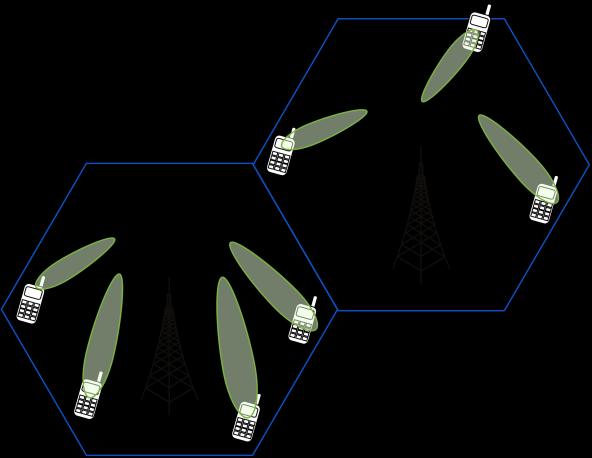
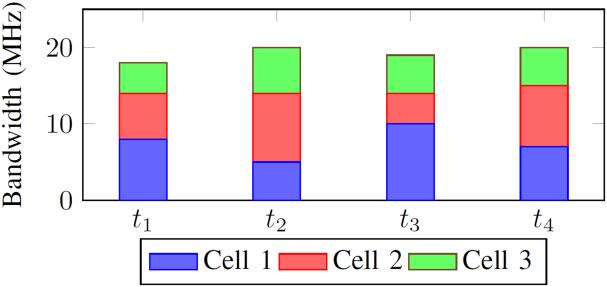
Fig. 2 illustratestheconceptofdynamicbandwidthallocationacrosscellsovertime( ).Thebandwidthallocated to each cell ( ) varies according to traffic load, channel conditions, and interference levels, that enable adaptive resourceutilization.
The remainder of this paper is organized as follows. Section II reviews related work on massive MIMO, NOMA, and resourceallocation.SectionIIIpresentsthesystemmodel,includingchannel estimation,signalmodel,andthebandwidth allocation framework. Section IV details the proposed joint optimization method and algorithm. Section V provides simulationresultsanddiscussions.Finally,SectionVIconcludesthepaperwithfuturedirections.
The evolution of fifth-generation (5G) and beyond wireless networks is driven by high spectral efficiency, massive connectivity, and low latency requirements. Two foundational technologies, MIMO and NOMA, have attracted significant researchinterest.ThissectionmainlyreviewstheexistingstudiesonmassiveMIMO,NOMA,theirintegratedtechnologies, andresourceallocationstrategiesthathighlighttheresearchgapsthatmotivatethiswork.
Thomas L. Marzetta [19] envisioned massive MIMO, which equips base stations (BSs) with many antennas to serve multiple users simultaneously, which offers substantial gains in spectral and energy efficiency. Their seminal work establishedthefundamentalconceptofnon-cooperativecellularsystemswithmanyantennas.Ngo et al. [20]analyzedthe energyandspectral efficiencyofmassiveMIMOunder perfectandimperfectCSI.Subsequently,their research addressed thepracticalchallengessuchaschannelestimationandpilotcontamination.Fernandes et al. [21]investigatedtheeffects ofpilotcontaminationandproposedpilotassignmentschemestominimizetheinter-cellinterference.Björnson et al. [22] provided a comprehensive analysis on the massive MIMO, which basically covers the signal processing, resource allocation,andimplementationaspects.
International Research Journal of Engineering and Technology (IRJET) e-ISSN: 2395-0056
Volume: 13 Issue: 03 | Mar 2026 www.irjet.net p-ISSN: 2395-0072
MassiveMIMOboostsefficiencyin5G/6G,whilegenerativediffusionmodels(GDMs)arethepowerfulAItools.Jin et al. [23] used GDMs to improve channel estimation in massive MIMO, which exhibited promising results and highlighted future challenges. Shi et al. [24] proposed a cell-free massive MIMO system using “six-dimensional movable antennas (6DMA),”wheredistributedaccesspointscooperativelyserveusers,anditcanadjustantennaorientations.Theirsystem optimizes antenna rotations based on user locations using a Bayesian optimization approach to maximize network performance.Theirresultsshowthattheadaptivesetupsignificantlyimprovesthedataratesbyboostingsignalstrength andreducinginterferenceandoutperformsthefixed-antennaandcentralizedsystems,particularlywhenusersarewidely distributed.
Tian and Zheng [25] proposed a hybrid deep learning model for channel estimation in MIMO systems. This model mainlycombinestheconvolutionsandgatedrecurrentunits(GRUs)toimprovetheperformanceacrossdifferentchannel conditions. They basically used techniques like data augmentation and regularization to prevent overfitting and are trainedusingstochasticgradientdescent.Theirsimulationresultsunderbothstaticandtime-varyingchannelsrepresent that the model outperforms traditional and existing deep learning methods and demonstrates better accuracy and generalization.Mashdour et al. [26]addressedtheperformanceissuesincell-freemassiveMIMO,whichisbasicallycaused by the imperfect CSI. They proposed a robust resource allocation framework that has user scheduling and power allocation strategies particularly designed to maximize the data rates and reduce errors under uncertain CSI. Their simulation results represent that their approach significantly improves the performance by up to 30% compared to the existingmethods.
NOMA originated as an auspicious 5G multiple-access technique that enables power-domain multiplexing to enable multiple users to share the same resource block. Saito et al. [27] presented the fundamental principles of NOMA and demonstrateditssuperiorityoverOMAintermsofsumrateanduserfairness.Ding et al. [28]conductedacomprehensive NOMAsurveyanddiscussedpowerallocation,userpairing,andcooperativeNOMA.Islam et al. [29]analyzedSICasakey NOMAenabler.TheycomprehensivelysurveyedtherecentadvancementsinNOMAfor5Gandexaminedcurrentresearch oncapacityanalysis,powerallocationmethods,userfairness,anduser-pairingtechniques.TheintegrationofNOMAwith other technologies, such as MIMO and millimeter-wave, has been explored in [30], which examined the impact of user pairingontheperformanceofNOMAsystems.
Shi and Ouyang [31] proposed a “NOMA-enabled MEC system” where devices offload tasks tomultiple edge servers simultaneously, thereby reducing delay. They introduced an optimization algorithm to efficiently manage resources, achieve lower latency and cost than traditional methods, and extend well to multidevice IoT scenarios. Benjebbour et al. [32] reviewed NOMA as a downlink multiple access technique for LTE and 5G networks. They explained its advantages overtraditionalOFDMAanditsintegrationwithMIMO.Throughsimulationsandexperimentaltests,NOMAachievedmore than30%performancegainsinbothlink-andsystem-levelevaluationscomparedtoOFDMA.
Chen et al. [33] presented a NOMA with reconfigurable intelligent surfaces (RIS) approach that optimizes transmissiontoboostspectral efficiency.Theirproposedalgorithmefficientlyallocatesresources,andtheirresultsshow significantimprovements,particularlywhenaunicast-firstdecodingstrategyisapplied.Abuajwa et al. [34]reviewedways toimproveenergyefficiencyinNOMAandexplorednotablegainsfrompowerallocation,relaying,and energyharvesting. However,trade-offs,suchashighercomplexityandreducedfairnessforedgeusers,werehighlighted.
Srivastava et al. [35] proposed a “low-complexity machine learning-based receiver” for NOMA to overcome the decoding delay and imperfections limitations of traditional SIC. They achieved better accuracy than the maximum likelihood decoding using a simple data-driven model with minimal predictors. Their method is more efficient and adaptable,whichmakesitsuitablefornext-generationsystems.AshwiniK.andJagadeeshV.K. [36]surveyedcooperative NOMAsystemswithafocusonpower-domainNOMAwithvariousrelaystrategiesandchannelmodels.Theyreviewedthe performance analyses, diversity techniques, and integration of NOMA with MIMO. They also highlighted emerging technologies such as cognitive radio and RIS that can enhance NOMA. Finally, they discussed future research challenges, whichcanprovideanoverviewofcurrentdevelopmentsandpotentialimprovementsinNOMA-basedwirelesssystems.
The synergy between massive MIMO and NOMA has recently attracted attention, as the former provides high spatial degreesoffreedomwhilethelatterenhancesmulti-usermultiplexing.
International Research Journal of Engineering and Technology (IRJET) e-ISSN: 2395-0056
Volume: 13 Issue: 03 | Mar 2026 www.irjet.net p-ISSN: 2395-0072
Liu et al. [37]proposedaMIMO-NOMAframeworkandderivedtheachievablesumrate.Ding et al. [38]extendedthis tomulti-cellscenariosandanalyzedtheimpactofinter-cellinterference.Ali et al. [39]furtherinvestigateduserclustering and power allocation for massive MIMO-NOMA and proposed a dynamic user clustering algorithm to maximize the sum rate. Nguyen et al. [40] optimized the power and user association in a massive MIMO-NOMA system. Senel et al. [41] studiedthetrade-offbetweenspectralandenergyefficiencyinsuchsystems.
Kumar et al. [42] investigated a “SIC with reinforcement learning (SIC-RL)” detector for massive MIMO-NOMA, which outperformed traditional methods. It offers lower error rates, better spectral efficiency, and scalable, near-quadratic complexity,making itan efficient solutionfor next-generation systems.Ou et al. [43]proposedan“uplink powercontrol scheme for massive MIMO-NOMA” in “massive ultra-reliable and low-latency communications (mURLLC)” for industrial IoT using group-level SIC to reduce decoding complexity and delay. They analyzed two schemes (with and without pilot sharing) with closed-form achievable rates derived from minimum mean square error (MMSE) and zero forcing (ZF) detectors.Asuccessivecondensationalgorithmoptimizesthepilotanddatapower,whichimprovesthesumrateandmaxmin fairness compared to traditional multi-user MIMO, ultimately demonstrates the advantages of NOMA in low-latency industrialIoTscenarios.
Chebbi et al. [44] introduced “resource allocation in MIMO-NOMA” for 5G, which mainly addresses the challenges such as interference, fairness, and complexity. They compared several user grouping algorithms, such as random clustering, pairing, -means-based user clustering (kUC), correlation iterative clustering algorithm (CIA), and grey wolf optimizer(GWO)-basedclustering.Finally,GWO-basedclusteringperformsbestindynamicscenarios,whereasCIAexcels forspatiallycorrelatedusers,enhancingspectralefficiencyandnetworkperformance.
Alghazali et al. [45] proposed an energy-efficient framework for mobile edge computing (MEC) using dynamic resource allocation and optimized algorithms for NOMA and massive MIMO networks, which achieves significant energy savings.Li et al. [46]proposeda framework for enhancingconnectivityinmassive NOMA systemsusing a multi-antenna UAV relay. The joint beamforming and power allocation were optimized using alternating optimization with SDR and Schur’s complement to minimize the total power while meeting the QoS requirements. They derived closed-form power allocation using Karush-Kuhn-Tucker (KKT) conditions [47], and their simulations show that the method effectively reducespowerconsumptionandremainsrobusttoimperfectSIC.
ResourceallocationiscriticalformaximizingtheMIMO-NOMApotential.Powerallocationproblemshavebeenextensively studied.Wang et al. [48]proposedanoptimalpowerallocationmethodusingconvexoptimization foradownlinkMIMONOMA system. Chen et al. [49] proposed a low-complexity power allocation scheme based on the difference in convex functionprogramming.However,bandwidthallocationhasreceivedlessattention.Moststudiesassumeafixedbandwidth partition among cells or users. Zhang et al. [50] considered energy-efficient resource allocation in NOMA systems with fixed bandwidth. Parida and Das [51] explored dynamic bandwidth allocation in multi-cell scenarios, which optimizes powerandbandwidthin asingle-cellNOMAsystem.InthecontextofmassiveMIMO,BetzandBölcskei [52]investigated theimpactofbandwidthpartitioningontheperformanceofmulti-cellsystems,butwithoutNOMA.
Breesam et al. [53] proposed a “wireless-powered MIMO-NOMA (WP-MIMO-NOMA)” framework using a “harvestthen-transmitprotocol”withjoint“time-splitandpowercontrol (TS-PC)”tooptimizenetwork performanceandlifetime. They introduced an optimal TS-PC scheme to maximize the sum rate and fairness and a near-optimal greedy version to reduce complexity. Their simulation results show that the proposed schemes outperform WP-MIMO-OMA systems and improveuserrates,fairness,andnetworklifetimeunderlimitedpowerandspectrum.Simon et al. [54]proposedanovel user pairing and subband allocation method for massive MIMO with NOMA to reduce interbeam interference using a conditionnumber(CN)criterion. Theirexperimental resultsshowthattheCN-based approachimprovesthroughputand fairness compared with channel correlation methods and approaches the performance of complex rate-maximization techniques. They also extended their method to multi-antenna reception with interference cancellation, which further enhancestheperformanceforuserswithweakchannels.
Bhuker and Grewal [55] proposed a resource allocation strategy for “MIMO-NOMA visible light communication (VLC)” systems using “harmonic one-to-one based optimization (HOOBO),” which combines the harmonic analysis and one-to-one optimization. They applied this in a hybrid VLC-RF multiuser scenario, HOOBO improves transceiver pairing andresourceallocationandachieveshighsumrate,throughput,andenergyefficiencyinsimulations.Khaleelahmed et al. [56]proposedanenergy-efficientpowerallocationtechniqueforNOMA-MIMOnetworksusinga“backpropagationneural
International Research Journal of Engineering and Technology (IRJET) e-ISSN: 2395-0056
Volume: 13 Issue: 03 | Mar 2026 www.irjet.net p-ISSN: 2395-0072
network (BPNN)” optimized by a “Harmonic Ladybug Beetle Honey Badger Optimization (HLBHBO)” algorithm. The proposed method improves communication resource allocation and achieves high sum rate, energy efficiency, and achievabledataratesinsimulationsbyapplyinganetworkslicingframeworkwithQAMandOFDM.
Inter-cell interference is a major bottleneck in multi-cell networks. In massive MIMO, pilot contamination worsens this issue. Ashikhmin and Marzetta [57] proposed a pilot decontamination method using subspace projection. Ali et al. [58] appliedthecoordinatedmultipoint(CoMP)techniquestomassiveMIMO-NOMA,wherebasestationscooperatetomitigate interference. Li et al. [59] introduced a decoupled uplink-downlink association scheme to balance the load and reduce interference. Huang et al. [60] proposed a deep reinforcement learning (DRL) approach for bandwidth allocation in heterogeneousnetworks.Dynamicresourceallocationacrosscellswasappliedtoimproveperformance.
Xie and Huang [61] proposed a multi-cell cooperative transmission scheme for NOMA MU-MIMO networks using coordinatedmulti-point(CoMP)technology.Theirmethodeffectivelymanagesinter-cellinterference,maximizestheuser sum rate, and improves spectral efficiency by integrating power allocation and beam design optimization with a lowcomplexity iterative algorithm. Adam et al. [62] proposed a “generative AI-enhanced primal-dual proximal policy optimization (GAI-PDPPO)” framework for joint user scheduling and beamforming in MC-MIMO-NOMA networks. They appliedaninvertibletransformer-basedactor-criticmodelwithgenerativepretrainingandprioritizedexperiencereplay. The proposed framework efficiently handles interference, minimizes transmit power, and improves spectral efficiency, outperformingstandardPPOandbenchmarkmethodsinsimulations.
Das and Das [63] proposed a “dynamic interference alignment coordinated scheduling (DIACS)” scheme with zeroforcing(ZF)formulticellMIMO-NOMAnetworks.Theirapproachmitigatesinter-cellinterference,improvescell-edgeuser rates, enhances QoS, and increases user fairness, as confirmed by numerical results. Sun et al. [64] proposed the “multiagent deep reinforcement learning and unsupervised learning (MDRL-UL)” framework for near-optimal channel and power allocation in multi-cell NOMA systems. They used MDRL for channel allocation and attention-based unsupervised learning for power allocation, and their method maximizes the energy efficiency and transmission rates, which outperformsexistingalgorithmsinsimulations.
Hasan et al. [65] proposed a “QoS-based cooperative NOMA-aided group D2D system (Q-CNOMA)” that reduces transmitter burden and enhances the overall system performance. They derived closed-form outage probability expressions using a Gaussian-Poisson process to model the D2D transmitter distribution, which demonstrates that QCNOMA outperforms conventional systems. Bardou et al. [66] presented a Bayesian optimization-based framework to evaluate the performance of multi-cell networks with various resource sharing mechanisms (RSMs). Their simulation results show that under fairness constraints, NOMA with full reuse achieves the highest end-user rates. This study highlightstheadvantagesofmulti-cellscenariosdespiteinter-cellinterferenceandschedulingchallenges.
DespitetheextensiveresearchonmassiveMIMOandNOMA,thelimitationofdynamic bandwidthallocationinmulti-cell massiveMIMO-NOMAsystemsremainslargelyunexplored.Mostoftheexistingresearchassumeseitherstaticbandwidth partitioning or focuses only on power control. The dynamic nature of user traffic, channel conditions, and inter-cell interferencedemandsasignificantlyadaptivebandwidthallocationframework.Moreover,thejointoptimizationofpower, bandwidth, and user clustering in such a setting exhibits significant mathematical challenges due to non-convexity and combinatorialcomplexity.Inthisresearch,thisgapisfilledbyproposinganoveloptimizationframeworkthatdynamically allocatesbandwidthacrosscellsandclusters.Italsousesthepowercontroltomaximizethetotalspectralefficiencywhile ensuring userfairness.The successiveconvexapproximationisemployedtoobtain a tractablesolutionanddemonstrate itsefficacythroughextensivesimulations.
To frame the model, a multi-cell massive MIMO-NOMA system is considered by comprising cells. Each cell * +isserved bya central base station(BS) which is equipped with antennas,where islarge ( ).EachBS serves single-antenna user equipments (UEs) which is denoted by the set * +. The UEs are grouped into NOMA clusters per cell, where the set of clusters in cell is * +. The set of UEs in cluster of cell , with | | isrepresentedby
International Research Journal of Engineering and Technology (IRJET) e-ISSN: 2395-0056
Volume: 13 Issue: 03 | Mar 2026 www.irjet.net p-ISSN: 2395-0072
Thechannelbetweenthe th antennaofBS andUE incell ismathematicallymodeledas:
where ( ) represents the large-scale fading coefficient (path loss and shadowing) which is independent of the antenna index ,and ( ) ( ) is thesmall-scalefast fadingcoefficient.Fora massive MIMO system,thechannel vectors becomeasymptoticallyorthogonal.Thechannelvector ( ) fromBS toUE incell isgivenby:
)
( ) ( ) ( )
where ( ) ( )
Inthetimedivisionduplex(TDD)mode,channelstateinformation(CSI)isacquiredthroughuplinkpilotsequences.Dueto thelimitedcoherenceinterval,thesamesetoforthogonalpilotsequencesoflength isreusedacrossallcells,whichleads topilotcontamination.ThereceivedpilotsignalatBS forpilotsequence iscalculatedas:
where denotes the pilot power, represents the orthonormal pilot sequence, represents the set of UEs in cell using pilot , and represents the noise matrix with independent and identically distributed ( ) elements. Using minimummeansquareerror(MMSE)estimation,theestimatedchannel ̂ ( ) foraUEinthehomecell isdeterminedas:
Theestimationerror
BS transmitsasuperpositionofsignalstotheUEsinitscell.Let ( ) bethemessageforthe th UEinthecluster ofcell , with *| ( )| + . The transmit power allocated to this UE is ( ). The superposed signal for cluster is ∑ √ ( ) ( ).ThetotaltransmittedsignalfromBS iscalculatedas:
where represents the precoding vector for cluster . In massive MIMO, a simple conjugate beamforming is employed based on the channel estimates of the UEs within the cluster. To maximize the array gain, the precoder is designedas:
International Research Journal of Engineering and Technology (IRJET) e-ISSN: 2395-0056
Volume: 13 Issue: 03 | Mar 2026 www.irjet.net p-ISSN: 2395-0072
where denotestheindexofthe th UEincluster .Thisdesignensuresthatthesignalenergyisfocusedtowardsthe clustermembers.
ThereceivedsignalatUE incluster ofcell isdeterminedas:
where ( ) ( ) represents the additive white Gaussian noise. This system is assumed with the perfect SIC within the cluster. The decoding order is based on the effective channel gains. Without loss of generality, it is assumed that for cluster incell ,theusersareorderedas:
Thus, user decodes and cancels the signals of users (with weaker channels) before decoding its own signal. The signal from users (with stronger channels) is treated as interference. The Signal-to-Interference-plus-Noise Ratio (SINR)forUE todecodeitsownsignalisdeterminedas:
TheachievablerateforthisUEis ( ) ( ( )),where representsthebandwidthallocatedtocluster in cell
The total available system bandwidth is total. A dynamic allocation where bandwidth is proposed which is not only partitionedbetweencellsbutalsoamongtheNOMAclusterswithinacell.Let bethebandwidthallocatedtocell ,such that ∑ total. Within cell , the bandwidth is further divided among its clusters: ∑ . This two-tier allocation allows for flexible interference management and load balancing. The bandwidth variables are continuous and non-negative.
Theobjectiveofthisresearchistomaximizethesumspectralefficiency(SE)ofthenetworkwhileensuringproportional fairness among users. The optimization variables are the power allocation * ( )+, the bandwidth allocation * +, and implicitlytheuserclustering* +.Theproblemisformulatedas:
International Research Journal of Engineering and Technology (IRJET) e-ISSN: 2395-0056
Volume: 13 Issue: 03 | Mar 2026 www.irjet.net p-ISSN: 2395-0072
where denotesthemaximumtransmitpowerperBS,and min representstheminimumQoSrequirement.Problem is a mixed-integer non-convex programming problem due to the combinatorial nature of user clustering and the nonconvexityoftheratefunction.
To control the non-convexity, firstly, the user clustering is fixed using a channel correlation-based matching algorithm (grouping users with highly correlated channel vectors to minimize intra-cluster interference). The main challenge then liesinthepowerandbandwidthallocationsubproblem.
The rate function ( )( ) ( ( )( )) is not jointly concave in ( ). We adopt a method based on Successive Convex Approximation (SCA).Theauxiliaryvariables * ( )+isintroducedtorepresenttheSINR.Theratecanbe rewrittenusingtheperspectivefunctionof the logarithm,whichisconcave.Generally,therateislower-boundedusinga fractionalprogrammingtechnique,particularly,thequadratictransformforthesum-of-ratiosnatureoftheSINR.
Firstly,theproblemisconvertedtoanequivalentformbyintroducinganauxiliaryvariable ( ) ( ).Theobjective becomes:
( ( )) ( )
Thentheconstraint ( ) ( ) isadded.Usingthefactthat ( )isconcave,alower-boundisappliedatafixedpoint ( ) as:
wheretheconstants and aredeterminedbythefirst-orderTaylorexpansion[67]as:
)( )
Thislowerboundistightwhen
4.2
With fixed bandwidth and the concave lower bound, the power control subproblem becomes a convex problem if the interference term is handled appropriately. The SINR expression ( ) is a ratio of a linear function to a quadratic-overlinearfunction.Itcanbeconvexifiedbyfixingthedenominatorusingpreviousiterates.Let ( )( )bethetotalinterference plusnoiseforUE( ).Atiteration ,withafeasiblepoint ( ),thesystemhas:
International Research Journal of Engineering and Technology (IRJET) e-ISSN: 2395-0056
Volume: 13 Issue: 03 | Mar 2026 www.irjet.net p-ISSN: 2395-0072
where ( ) ( )( ( )).Thisisaconcavelowerbound(in ),derivedfromthefactthat isconvex,anditsperspective functionyieldsaconcavelowerboundforthesquareroot.
Withfixedpower,thebandwidthallocationproblemisaconvexoptimizationproblem.Itinvolvesmaximizingaweighted sum of logarithms, which is a concave function, subject to linear constraints. The optimal bandwidth allocation can be obtainedthroughawater-fillingtypesolutionderivedfromtheKKTconditions. Forfixedpower,theLagrangianforthebandwidthsubproblemis:
where ( ) ( ( ))isconstant.Takingthederivativewithrespectto :
This leads to a multi-level water-filling solution, where bandwidth is allocated first to clusters, which offers the highest sumofrates.
Finally,aniterativealgorithmisproposedthatalternatesbetweenoptimizingpowerallocation(usingSCA)andbandwidth allocation(usingwater-filling).Thestepsaresummarizedin Algorithm 1
Algorithm 1 JointPowerandBandwidthAllocationviaSCA
Require: Initial feasible power ( ), bandwidth ( ), tolerance 0, iterationindex Ensure: Optimized
repeat
Step 1: Computeeffectivechannelgainsandinterferencetermsbasedon ( ) ( )
Step 2: (Power Control)
ConstructconvexsurrogatefortheSINRusingSCAaround ( )
Solvetheconvexpowerallocationsubproblemtoobtain ( ):
where ̂ istheconcavelowerboundoftherate.
Step 3: (Bandwidth Allocation)
With fixed ( ), solve the bandwidth allocation problem using waterfilling:
where ischosentosatisfy∑ ( ) total Step 4: ( ) , ( )
Volume: 13 Issue: 03 | Mar 2026 www.irjet.net p-ISSN: 2395-0072
The proposed SCA algorithm generates a sequence of feasible points with non-decreasing objective values. Since the powerconstraintsetiscompactandtheobjectiveis continuous,thesequenceconvergestoastationarypoint(typicallya KKTpoint)oftheoriginalnon-convexproblem.ThisisguaranteedbecauseeachsubproblemsatisfiestheKKTconditions ofatightconvexapproximation,andthestepsizeensuresdescenttowardsacriticalpoint.
This comprehensive framework can provide dynamic bandwidth allocation in multi-cell massive MIMO-NOMA systems. By jointly optimizing power and bandwidth using SCA, the proposed method can significantly enhance the spectralefficiencywhileensuringtheuserfairness.Theproposedalgorithmprovidesatractablesolutiontoanintractable problemandconvergesefficiently.
Inthissection,theperformanceoftheproposeddynamicbandwidthallocationmethodisevaluatedinamulti-cellmassive MIMO-NOMA system through extensive Python simulations. The proposed method is compared with several baseline schemestodemonstrateitseffectivenessintermsofsumspectralefficiency(SE),userfairness,andconvergencebehavior.
A hexagonal multi-cell network with cells is considered for simulation, each cell having a radius of 500 m. The simulationisperformedusingPython,andallthesimulationparametersarepresentedin Table 1.TheBSsarelocatedat thecenterofeachcellandareequippedwith antennas.In eachcell, single-antenna usersareuniformly distributed,excludingacentralrestrictedregionof50maroundtheBS.Theusersaregroupedinto NOMAclusters percell,witheachclustercontaining users.Theclusteringisperformedbasedon channel correlationtomaximize thebenefitsofNOMA.
Table 1 Simulation Parameters
Parameter
Value
Numberofcells 7
BSantennas 128
Userspercell 20(variable)
Clusterspercell 5
Userspercluster 4
Cellradius 500m
Pathlossexponent 3.8
Shadowingstd sh 8dB
Totalbandwidth total 20MHz
BSmaxpower max 40dBm
Noisepowerdensity dBm/Hz
Coherenceinterval 196symbols
Pilotlength 7
International Research Journal of Engineering and Technology (IRJET) e-ISSN: 2395-0056
Volume: 13 Issue: 03 | Mar 2026 www.irjet.net p-ISSN: 2395-0072
The large-scale fading coefficient ( ) is modeled as ( ) PL( ) sh ( ) , where PL( ) is the path loss given by PL( ) ( ) withpathloss exponent ,and sh dBistheshadowingstandarddeviation.Thesmall-scale fading follows Rayleigh distribution [68]. The coherence interval is symbols, with pilot length which is equaltothenumberofcellsthatleadstothepilotcontamination.Pilotpowerissetto mW.
The total system bandwidth is total MHz. The maximum transmit power per BS is max dBm. The noise powerspectraldensityis dBm/Hz,resultinginnoisepower dBmoverthetotalbandwidth.Theminimum SINR requirement is min dB (there is no minimum for rate maximization, but it is imposed for QoS scenarios). The convergencetoleranceforAlgorithm1is
Tovalidatetheproposeddynamicbandwidthallocationmethod,itiscomparedwiththefollowingbenchmarkschemes:
Static Bandwidth Allocation (SBA):Itisthebenchmarkbandwidthwhichisequallydividedamongallcellsand clusters,i.e., total ( )
Fixed OMA (FDMA): In FOMA, each cell operates in orthogonal multiple access mode (OFDMA) with bandwidth equallydividedamongtheusers,andpowerisallocatedoptimallythroughwater-filling.
NOMA with Equal Bandwidth (NOMA-EB): It is the same clustering as proposed, but here, the bandwidth is equallydistributedamongclusters.
Proposed Dynamic Bandwidth Allocation: Joint optimization of power and bandwidth as described in Algorithm 1.
Allschemes,exceptFDMA,useNOMAclusteringbasedonchannelcorrelation.Forfairness,theJain’sfairnessindex[69]is alsoevaluatewhichisbasicallydefinedas:
5.3
Allresultsareaveragedover500independentchannelrealizations.
5.3.1 Sum Spectral Efficiency vs. Total Transmit Power
Fig. 3 illustrates the sum spectral efficiency (in bps/Hz) as a function of the total transmit power per BS, max, which ranges from 20 dBm to 46 dBm. As expected, the sum SE increases with transmit power for all schemes. The proposed dynamic bandwidth allocation scheme consistently outperforms the others, achieving a gain of approximately 25% over SBA and 40% over FDMA at high SNR. This improvement is due to the dynamic allocation of bandwidth to clusters with better channel conditions, effectively exploiting the multi-user diversity and the capability of NOMA to serve multiple usersonthesameresource.
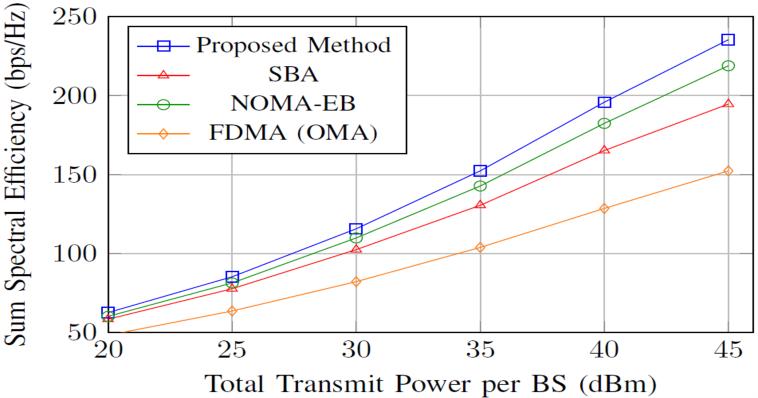
Fig. 3 SumSpectralEfficiencyvs.TotalTransmitPowerperBSforDifferent
International Research Journal of Engineering and Technology (IRJET) e-ISSN: 2395-0056
Volume: 13 Issue: 03 | Mar 2026 www.irjet.net p-ISSN: 2395-0072
At low transmit power, the gains are moderate because the system is noise-limited, but as power increases, interference becomes dominant, and the adaptive bandwidth allocation helps mitigate inter-cell interference by shifting resources awayfromheavilyinterferedclusters.
Fig. 4 illustratesthesum SE versus the numberof users percell, ,whilekeeping the numberof clustersfixedat . Thus, the cluster size increases with . The total transmit power is fixed at max dBm. The proposed dynamic bandwidthallocationmaintainsaclearadvantageas grows.Forsmall ,allNOMAschemesperformsimilarlybecause intra-clusterinterferenceislowandbandwidthallocationislesscritical.However,as increases,thedynamicbandwidth allocationbecomesessentialtobalancetheloadamongclustersandmitigateinter-clusterinterference.TheFDMAscheme saturates quickly because users are orthogonalized, limiting multiplexing gains. The SBA scheme, although using NOMA, suffersfrominefficientresourcedistributionwhensomeclustersbecomeoverloaded.
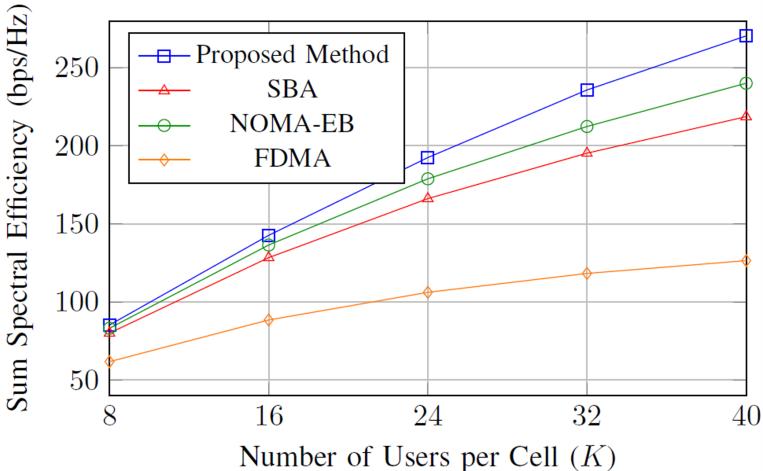
Fig. 4 SumSpectralEfficiencyvs.NumberofUsersperCell( )with 40dBm
The proposed dynamic bandwidth allocation adapts the bandwidth to the cluster’s sum rate, leading to a near-linear increaseinSEwith
5.3.3
Fig. 5 plots the Jain’s fairness index against the number of users per cell. The proposed dynamic bandwidth allocation achievesafairnessindexcloseto0.95,whichissignificantlyhigherthanthatofSBAandFDMA,especiallywhen islarge.
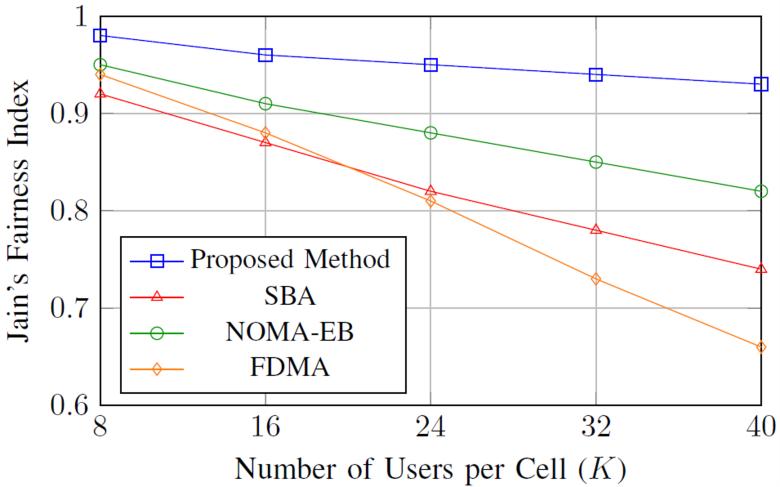
Fig. 5 Jain’sFairnessIndexvs.NumberofUsersperCell
The NOMA-EB scheme also provides reasonable fairness because NOMA inherently serves multiple users, but the proposeddynamicbandwidthallocationfurtherbalancestheratesamongusersby allocatingmorebandwidthtoclusters
International Research Journal of Engineering and Technology (IRJET) e-ISSN: 2395-0056
Volume: 13 Issue: 03 | Mar 2026 www.irjet.net p-ISSN: 2395-0072
with lower instantaneous rates. This demonstrates that the proposed method not only improves sum SE but also maintainsahighlevelofuserfairness.
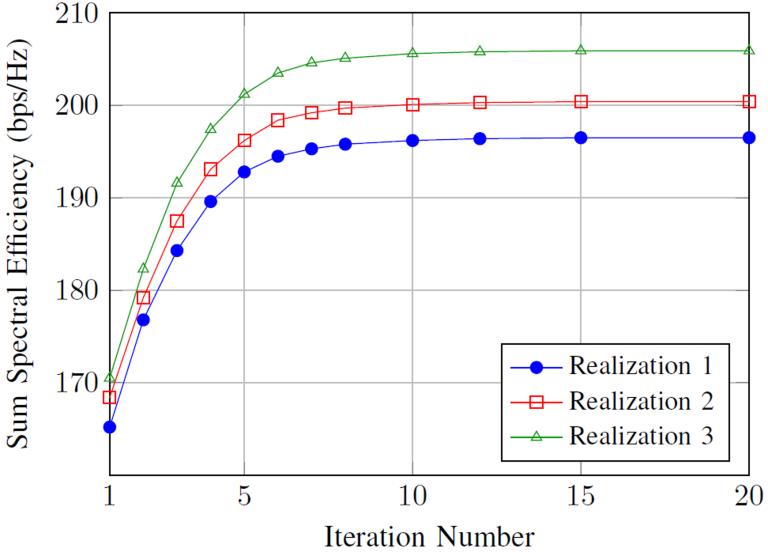
Fig. 6 illustratestheconvergenceoftheproposedSCA-basedAlgorithm1.Theobjectivevalue(sumSE)isplottedagainst the number of iterations for three different random channel realizations at max dBm and . The algorithm converges within 15-20 iterationsforall cases, whichdemonstratesthe practical efficiency of the proposed method. The monotonicenhancementintheobjectivevalueconfirmsthattheSCAupdatesproduceanon-decreasingsequence,andthe convergencetoastationarypointisachieved.
5.4
Thesimulationresultsconfirmthesuperiorityoftheproposeddynamicbandwidthallocationschemeinmulti-cellmassive MIMO-NOMAsystems.Thekeytakeawaysofthisresearchare:
The proposed dynamic bandwidth allocation achieves up to 25% higher sum SE compared to static bandwidth allocation,andupto40%gainoverconventionalOMA.
Theproposedschemescaleswellwiththenumberofusers,exploitingmulti-userdiversityeffectively.
Userfairnessissignificantlyimproved,asthedynamicallocationpreventsresourcestarvationofedgeusers.
TheSCA-basedalgorithmconvergesquickly,makingitsuitableforpracticalimplementations.
These benefits stem from the joint optimization of power and bandwidth, which adapts to the instantaneous channel conditionsandinterferencelandscape.
The crucial issue of dynamic bandwidth allocation in multi-cell massive MIMO-NOMA systems is addressed in this research.Acomprehensive systemmodel isdeveloped thatmainlycapturestheessential featuresofsuchnetworkswith pilot contamination, channel estimation, NOMA clustering, and inter-cell interference. A joint optimization problem is formulated to maximize the sum spectral efficiency by adaptively allocating bandwidth and power across cells and clusters.Toprovideasolutiontotheinherentnon-convexity,SCAisemployedtoderiveaconvergentiterativealgorithm. Thesimulationresultsvalidatedtheeffectivenessoftheproposedapproach.Theresultsillustratesubstantialgainsinthe spectral efficiency and the user fairness over static bandwidth allocation and conventional OMA schemes. The dynamic allocation method resolves the varying channel conditions and interference, which makes the proposed method a promisingsolutionfornext-generationwirelessnetworks.
International Research Journal of Engineering and Technology (IRJET) e-ISSN: 2395-0056
Volume: 13 Issue: 03 | Mar 2026 www.irjet.net p-ISSN: 2395-0072
Thereareseveralextensionsofthisworkthatareworthyofinvestigationasfollows:
The current framework assumes perfect knowledge of channel statistics, which extends it to scenarios with imperfectordelayedCSI.
AItechniques,suchasdeepreinforcementlearning,can beappliedtoenablelow-complexitybandwidthallocation inhighlydynamicenvironments.
The integration of energy efficiency as an optimization objective alongside the spectral efficiency can provide the solutiontothegrowingimportanceofgreencommunications.
The impact of hardware impairments, such as phase noise and nonlinear power amplifiers, on the proposed allocationmethodmeritsfutureresearch.
Thedynamicbandwidthallocation,RIS,andmillimeter-wavecommunicationscanpresentaninterestingapproach forfutureresearch.
1. W. Montlouis and A. L. Imoize, “Fundamentals of wireless communications Massive MIMO essentials for 6G and beyond,” in Massive MIMO for Future Wireless Communication Systems: Technology and Applications. Wiley-IEEE Press,2025,pp.1–21.doi:https://doi.org/10.1002/9781394228331.ch1
2. C.deAlwis,Q.-V.Pham,andM.Liyanage,“Evolutionofmobilenetworks,”in 6G Frontiers: Towards Future Wireless Systems. Wiley-IEEEPress,2023,pp.1–7.doi:https://doi.org/10.1002/9781119862321.ch1
3. T. L. Marzetta, E. G. Larsson, H. Yang, and H. Q. Ngo, “Multi-cell systems,” in Fundamentals of Massive MIMO. CambridgeUniversityPress,2016,pp.77–96.doi:https://doi.org/10.1017/CBO9781316799895.005
4. H. Q. Ngo, “Massive MIMO fundamentals,” in Wiley 5G Ref. John Wiley & Sons, Ltd, 2019, pp. 1–25. doi: https://doi.org/10.1002/9781119471509.w5GRef023
5. H.Asplund,D.Astely,P.vonButovitsch,T.Chapman,S.Faxer,M.Frenne,F.Ghasemzadeh,M.Hagstrom,B.Hogan, G.Jongren, J. Karlsson,F. Kronestedt,andE.Larsson,“Massive MIMOnetwork performance,”in Massive MIMO in Practice,2nded.,AcademicPress,2025,pp.281–366.doi:https://doi.org/10.1016/B978-0-443-29204-0.00015X
6. P. T. Tran, T. N. Nguyen, and L.-T. Tu, Massive MIMO. Springer Nature Singapore, 2026, pp. 119–153. doi: https://doi.org/10.1007/978-981-95-1117-4_6
7. Y. Liu, Z. Qin, and Z. Ding, “What is NOMA?” in Non-Orthogonal Multiple Access for Massive Connectivity. Cham: SpringerInternationalPublishing,2020,pp.7–12.doi:https://doi.org/10.1007/978-3-030-30975-6_2
8. S. Sharma, K. Deka, and D. Dixit, “Non-orthogonal multiple access (NOMA) system Design and analysis,” in NextGeneration Wireless Systems: Fundamentals and Applications. Springer Nature Singapore, 2025, pp. 15–57. doi: https://doi.org/10.1007/978-981-96-3185-8_2
9. T. Van Chien, E. Bjornson, and E. G. Larsson, “Multi-cell massive MIMO performance with double scattering channels,” in 2016 IEEE 21st International Workshop on Computer Aided Modelling and Design of Communication Links and Networks (CAMAD),2016,pp.231–236.doi:https://doi.org/10.1109/CAMAD.2016.7790363
10. Y. Abebaw, R. K. Shakya, D. J. Gelmecha, and E. T. Ware, “Spectral efficiency analysis for uplink multicell massive MIMOcellularcommunicationsystemunderfadingchannels,” Journal of Electrical and Computer Engineering,vol. 2023,no.1,p.6623938,2023.doi:https://doi.org/10.1155/2023/6623938
11. X.Li,E.Bjornson,E.G.Larsson,S.Zhou,andJ.Wang,“MassiveMIMOwithmulti-cellMMSEprocessing:exploiting all pilots for interference suppression,” EURASIP Journal on Wireless Communications and Networking, vol. 2017, no.1,p.117,Jun2017.doi:https://doi.org/10.1186/s13638-017-0879-2
12. A.Falloun and A. A. Madi, “Successive interference cancellation in NOMA for 5G communication system,” in 2025 5th International Conference on Innovative Research in Applied Science, Engineering and Technology (IRASET), 2025,pp. 1–6.doi:https://doi.org/10.1109/IRASET64571.2025.11008207
13. S. Bisen, V. Bhatia, and P. Brida, “Successive interference cancellation with multiple feedback in NOMA-enabled massive IoT network,” EURASIP Journal on Wireless Communications and Networking, vol. 2024, no. 1, p. 71, Sep 2024.doi:https://doi.org/10.1186/s13638-024-02404-1
International Research Journal of Engineering and Technology (IRJET) e-ISSN: 2395-0056
Volume: 13 Issue: 03 | Mar 2026 www.irjet.net p-ISSN: 2395-0072
14. L. Meng, X. Su, X. Zhang, C. Choi, and D. Choi, “Signal reception for successive interference cancellation in NOMA downlink,” in Proceedings of the 2018 Conference on Research in Adaptive and Convergent Systems, ser. RACS ’18. New York, NY, USA: Association for Computing Machinery, 2018, pp. 75–79. doi: https://doi.org/10.1145/3264746.3264751
15. M. Liu, J. Zhang, K. Xiong, M. Zhang, P. Fan, and K. B. Letaief, “Effective user clustering and power control for multiantenna uplink NOMA transmission,” IEEE Transactions on Wireless Communications, vol. 21, no. 11, pp. 8995–9009,2022.doi:https://doi.org/10.1109/TWC.2022.3171793
16. S. Chebbi, O. Habachi, J.-P. Cances, and V. Meghdadi, “Spatial user clustering and power control for downlink MIMO-NOMA systems,” in Proceedings of the Int’l ACM Symposium on Mobility Management and Wireless Access, ser. MobiWac ’23. New York, NY, USA: Association for Computing Machinery, 2023, pp. 9–16. doi: https://doi.org/10.1145/3616390.3618284
17. S.Sumathi,T.K.Ramesh,andZ.Ding,“Dynamicuserclusteringwithhybridbeamforminginmillimeterwavenonorthogonal multiple access (NOMA) and power allocation using teaching learning-based optimization (TLBO),” Transactions on Emerging Telecommunications Technologies, vol. 34, no. 4, p. e4740, 2023. doi: https://doi.org/10.1002/ett.4740
18. A.Misra,U.R.Kalita,andK.K.Sarma,“PerformanceanalysisofmultiuserMIMONOMAnetworkwithhierarchical clustering,” International Journal of Electronics Letters, vol. 12, no. 1, pp. 21–40, 2024. doi: https://doi.org/10.1080/21681724.2022.2129810
19. T. L. Marzetta, “Noncooperative cellular wireless with unlimited numbers of base station antennas,” IEEE Transactions on Wireless Communications, vol. 9, no. 11, pp. 3590–3600, 2010. doi: https://doi.org/10.1109/TWC.2010.092810.091092
20. H.Q.Ngo,E.G.Larsson,andT.L.Marzetta,“EnergyandspectralefficiencyofverylargemultiuserMIMOsystems,” IEEE Transactions on Communications, vol. 61, no. 4, pp. 1436–1449, Apr. 2013. doi: https://doi.org/10.1109/TCOMM.2013.020413.110848
21. F.Fernandes,A.Ashikhmin,andT.L.Marzetta,“Inter-cellinterferenceinnoncooperativeTDDlargescaleantenna systems,” IEEE Journal on Selected Areas in Communications, vol. 31, no. 2, pp. 192–201, Feb. 2013. doi: https://doi.org/10.1109/JSAC.2013.130208
22. E. Bjornson, J. Hoydis, and L. Sanguinetti, “Massive MIMO networks Spectral, energy, and hardware efficiency,” Foundations and Trends in Signal Processing, vol. 11, no. 3-4, pp. 154–655, 2017. doi: https://doi.org/10.1561/2000000093
23. Z. Jin, L. You, H. Zhou, Y. Wang, X. Liu, X. Gong, X. Gao, D. W. K. Ng, and X.-G. Xia, “GDM4MMIMO Generative diffusion models for massive MIMO communications,” IEEE Communications Magazine, pp. 1–7, 2026. doi: https://doi.org/10.1109/MCOM.001.2500399
24. X. Shi, X. Shao, B. Zheng, and R. Zhang, “6DMA-aided cell-free massive MIMO communication,” IEEE Wireless Communications Letters,vol.14,no.5,pp.1361–1365,2025.doi:https://doi.org/10.1109/LWC.2025.3542546
25. X. Tian and Q. Zheng, “A massive MIMO channel estimation method based on hybrid deep learning model with regularization techniques,” International Journal of Intelligent Systems, vol. 2025, no. 1, p. 2597866, 2025. doi: https://doi.org/10.1155/int/2597866
26. S.Mashdour,A.R.Flores,S.Salehi,R.C.deLamare,A.Schmeink,andP.R.B.daSilva,“Robustresourceallocation in cell-free massive MIMO systems,” IEEE Transactions on Communications, vol. 73, no. 8, pp. 5745–5759, 2025. doi:https://doi.org/10.1109/TCOMM.2025.3535891
27. Y.Saito,Y.Kishiyama,A.Benjebbour,T.Nakamura,A.Li,andK.Higuchi,“Non-orthogonalmultipleaccess(NOMA) for cellular future radio access,” in Proc. IEEE Vehicular Technology Conference (VTC Spring), Dresden, Germany, Jun.2013,pp.1–5.doi:https://doi.org/10.1109/VTCSpring.2013.6692652
28. Z. Ding, X. Lei, G. K. Karagiannidis, R. Schober, J. Yuan, and V. K. Bhargava, “A survey on non-orthogonal multiple accessfor5Gnetworks Researchchallengesandfuturetrends,” IEEE Journal on Selected Areas in Communications, vol.35,no.10,pp.2181–2195,Oct.2017.doi:https://doi.org/10.1109/JSAC.2017.2725519
29. S.M.R.Islam,N.Avazov,O.A.Dobre,andK.S.Kwak,“Power-domainnon-orthogonalmultipleaccess(NOMA)in 5G systems Potentials and challenges,” IEEE Communications Surveys & Tutorials, vol. 19, no. 2, pp. 721–742, 2017.doi:https://doi.org/10.1109/COMST.2016.2621116
International Research Journal of Engineering and Technology (IRJET) e-ISSN: 2395-0056
Volume: 13 Issue: 03 | Mar 2026 www.irjet.net p-ISSN: 2395-0072
30. Z. Ding, P. Fan, and H. V. Poor, “Impact of user pairing on 5G nonorthogonal multiple-access downlink transmissions,” IEEE Transactions on Vehicular Technology, vol. 65, no. 8, pp. 6010–6023, Aug. 2016. doi: https://doi.org/10.1109/TVT.2015.2480766
31. B.ShiandJ.Ouyang,“Non-orthogonalmultipleaccess–enhancedmobileedgecomputingfortheinternetofthings via task offloading and resource allocation,” The Computer Journal, p. bxaf143, 01 2026. doi: https://doi.org/10.1093/comjnl/bxaf143
32. A.Benjebbour, K. Saito, A. Li, Y. Kishiyama, and T. Nakamura, “Non-orthogonal multiple access (NOMA): Concept, performance evaluation and experimental trials,” in 2015 International Conference on Wireless Networks and Mobile Communications (WINCOM), 2015,pp.1–6.doi:https://doi.org/10.1109/WINCOM.2015.7381343
33. H. Chen, S. Zhuang, and H. Zhuang, “Non-orthogonal multiple access for RIS-assisted mmWave multicast transmission,” IEEE Wireless Communications Letters, vol. 14, no. 3, pp. 901–905, 2025. doi: https://doi.org/10.1109/LWC.2025.3527626
34. O. Abuajwa, S. Muhammad, Z. Ambak, S. Mitani, and J.-J. Tiang, “Energy efficiency techniques in non-orthogonal multipleaccess(NOMA)in5Gnetwork Anoverviewandoutlook,” Wireless Personal Communications,vol.140,no. 3,pp.971–1013,Feb2025.doi:https://doi.org/10.1007/s11277-025-11754-y
35. S. Srivastava, R. Kumar, and P. P. Dash, “Enhancing non-orthogonal multiple access systems: A reconfigurable machinelearningclassificationapproach,”Engineering ApplicationsofArtificial Intelligence,vol.161,p.112080, 2025.doi:https://doi.org/10.1016/j.engappai.2025.112080
36. Ashwini K. and Jagadeesh V.K., “Co-operative non-orthogonal multiple access networks a survey,” World Journal of Engineering,vol.21,no.6,pp.1128–1141,2023.doi:https://doi.org/10.1108/WJE-11-2022-0451
37. Y. Liu, G. K. Karagiannidis, S. X. Ng, and L. Hanzo, “MIMO-NOMA networks relying on multi-antenna base-station and imperfect SIC,” in Proc. IEEE Global Communications Conference (GLOBECOM), Washington, DC, USA, Dec. 2016,pp.1–6.doi:https://doi.org/10.1109/GLOCOM.2016.7841643
38. Z.Ding,F.Adachi,andH.V.Poor,“TheapplicationofMIMOtonon-orthogonalmultipleaccess,” IEEE Transactions on Wireless Communications, vol. 15, no. 1, pp. 537–552, Jan. 2016. doi: https://doi.org/10.1109/TWC.2015.2475746
39. M. S. Ali, H. Tabassum, and E. Hossain, “Dynamic user clustering and power allocation for uplink and downlink non-orthogonal multiple access (NOMA) systems,” IEEE Access, vol. 4, pp. 6325–6343, 2016. doi: https://doi.org/10.1109/ACCESS.2016.2604821
40. V.-D. Nguyen, H. D. Tuan, T. Q. Duong, H. V. Poor, and O.-S. Shin, “Joint user grouping and beamforming for downlinkMIMO-NOMAwithimperfectCSI,” IEEE Transactions on Communications,vol.66,no.12,pp.6090–6105, Dec.2018.doi:https://doi.org/10.1109/TCOMM.2018.2864745
41. K. Senel, H. V. Cheng, E. Bjornson, and E. G. Larsson, “Joint power control and user grouping for uplink massive MIMO-NOMA systems,” in Proc. IEEE International Conference on Communications (ICC), Shanghai, China, May 2019,pp.1–6.doi:https://doi.org/10.1109/ICC.2019.8761581
42. A.Kumar, A. Nanthaamornphong, M. H. Alsharif, and M. Masud, “SIC based RL for massive MIMO NOMA signal detectionfordifferentmodulationschemesunderdiversechannelconditions,” Scientific Reports,vol.15,no.1,p. 24641,Jul2025.doi:https://doi.org/10.1038/s41598-025-06492-x
43. X. Ou, S. Dang, Z. Ren, and A. Doufexi, “Uplink power control for massive MIMO-NOMA with group-level SIC in massive URLLC services,” IEEE Transactions on Wireless Communications, vol. 24, no. 10, pp. 8505–8519, 2025. doi:https://doi.org/10.1109/TWC.2025.3567364
44. S. Chebbi, O. Habachi, J.-P. Cances, V. Meghdadi, and E. Sabir, “Efficient resource allocation in 5G massive MIMONOMAnetworks:ComparativeanalysisofSINR-awarepowerallocationandspatialcorrelation-basedclustering,” Computer Networks,vol.263,p.111216,2025.doi:https://doi.org/10.1016/j.comnet.2025.111216
45. Q. Alghazali, H. Al-Amaireh, and T. Cinkler, “Energy-efficient resource allocation in mobile edge computing using NOMA and massive MIMO,” IEEE Access, vol. 13, pp. 21 456–21 470, 2025. doi: https://doi.org/10.1109/ACCESS.2025.3535233
46. X. Li, L. Peng, H. Wang, G. Ding, R. Xu, X. Yu, and H. Wang, “Beamforming and power allocation for UAV relayingenabled massive MIMO-NOMA under imperfect SIC,” IEEE Transactions on Vehicular Technology, pp. 1–5, 2025. doi:https://doi.org/10.1109/TVT.2025.3621635
International Research Journal of Engineering and Technology (IRJET) e-ISSN: 2395-0056
Volume: 13 Issue: 03 | Mar 2026 www.irjet.net p-ISSN: 2395-0072
47. H. W. Kuhn and A. W. Tucker, “Nonlinear programming,” in Proceedings of the Second Berkeley Symposium on Mathematical Statistics and Probability,UniversityofCaliforniaPress,Berkeley-LosAngeles,Calif.,1951,pp.481–492.
48. C.-L. Wang, J.-Y. Chen, and Y.-J. Chen, “Optimal power allocation for downlink non-orthogonal multiple access systems,” IEEE Transactions on Vehicular Technology, vol. 67, no. 8, pp. 7800–7804, Aug. 2018. doi: https://doi.org/10.1109/TVT.2018.2825365
49. X. Chen, R. Jia, and D. W. K. Ng, “User pairing and power allocation in downlink non-orthogonal multiple access systems,” in Proc. IEEE International Conference on Communications (ICC), Paris, France, May 2017, pp. 1–6. doi: https://doi.org/10.1109/ICC.2017.7997393
50. H.Zhang,N.Yang,andM.Chen,“Energy-efficientresourceallocationindownlinknon-orthogonalmultipleaccess systems,” IEEE Transactions on Vehicular Technology, vol. 66, no. 4, pp. 3612–3617, Apr. 2017. doi: https://doi.org/10.1109/TVT.2016.2594785
51. P.Parida and S. S.Das,“Powerallocationin OFDMbasedNOMA systems ADC programmingapproach,”in Proc. IEEE International Conference on Communications (ICC), Sydney, Australia, Jun. 2014, pp. 1026–1031. doi: https://doi.org/10.1109/ICCS.2014.7024831
52. S. M. Betz and H. Bolcskei, “Intercell interference coordination in MIMO systems,” IEEE Transactions on Signal Processing,vol.60,no.4,pp.1915–1929,Apr.2012.doi:https://doi.org/10.1109/TSP.2011.2175389
53. N.K.Breesam,W.A.Al-Hussaibi,F.H.Ali,andI.M.Al-Musawi,“Efficientresourceallocationforwireless-powered MIMO-NOMA communications,” IEEE Access, vol. 10, pp. 130 302–130 313, 2022. doi: https://doi.org/10.1109/ACCESS.2022.3228754
54. E.P.Simon,J.Farah,andP.Laly,“ResourceallocationandpairingtechniquesinmultiusermassiveMIMO-NOMA,” IEEE Systems Journal,vol.17,no.4,pp.6312–6321,2023.doi:https://doi.org/10.1109/JSYST.2023.3314789
55. N. Bhuker and S. K. Grewal, “Hybrid optimization model-based energy efficiency maximization for resource allocationinMIMO-NOMA-basedvisiblelight communicationsystem,” Iranian Journal of Science and Technology, Transactions of Electrical Engineering,Nov2025.doi:https://doi.org/10.1007/s40998-025-00927-x
56. S.Khaleelahmed,K.Sivakrishna,G.Rajesh,N.Durgarao,andC.Venkateswarlu,“Adeeplearningwithoptimizationbased power allocation for network slicing in MIMO–NOMA,” International Journal of Communication Systems, vol.38,no.7,p.e70062,2025.doi:https://onlinelibrary.wiley.com/doi/abs/10.1002/dac.70062
57. A.AshikhminandT.L.Marzetta,“Pilotcontaminationprecodinginmulti-celllargescaleantennasystems,”in Proc. IEEE International Symposium on Information Theory (ISIT), Cambridge, MA, USA, Jul. 2012, pp. 1137–1141. doi: https://doi.org/10.1109/ISIT.2012.6283049
58. M. S. Ali, E. Hossain, and D. I. Kim, “Coordinated multipoint transmission in downlink multi-cell NOMA systems: Modelsand spectral efficiencyperformance,” IEEE Wireless Communications, vol.25, no. 2,pp.24–31,Apr.2018. doi:https://doi.org/10.1109/MWC.2018.1700319
59. Y. Li, S. Jin, and X. Gao, “Decoupled uplink and downlink access in heterogeneous cellular networks: A stochastic geometry analysis,” IEEE Transactions on Communications, vol. 67, no. 5, pp. 3606–3620, May 2019. doi: https://doi.org/10.1109/TCOMM.2019.2893642
60. L.Huang,S.Bi,andY. J.Zhang,“Deepreinforcementlearningforonline resourceallocationin wirelessnetworks withdynamicuserarrivals,” IEEE Transactions on Wireless Communications,vol.19,no.2,pp.946–960,Feb.2020. doi:https://doi.org/10.1109/TWC.2019.2949995
61. S.XieandX.Huang,“Multi-cellcooperativetransmissionforMU-NOMAnetworks,” Wireless Networks,vol.31,no. 3,pp.2457–2475,Mar2025.doi:https://doi.org/10.1007/s11276-025-03894-7
62. A.B.Adam,E.M.Diallo,M.S.A.Muthanna,R.I.Alkanhel,A.Muthanna,andM.Hammoudeh,“GenerativeAI-driven reinforcement learning for beamforming and scheduling in multi-cell MIMO-NOMA systems,” Physical Communication,vol.72,p.102771,2025.doi:https://doi.org/10.1016/j.phycom.2025.102771
63. D.S.N.DasandS.Das,“CoordinatedschedulingformulticellMIMO-NOMA AnimprovedQoSapproach,”in 2025 IEEE 6th India Council International Subsections Conference (INDISCON), 2025, pp. 1–4. doi: https://doi.org/10.1109/INDISCON66021.2025.11252114
64. M.Sun, Y. Zhong, X.He,and J.Zhang,“Channel and power allocationformulti-cell NOMA using multi-agent deep reinforcement learning and unsupervised learning,” Sensors, vol. 25, no. 9, 2025. doi: https://doi.org/10.3390/s25092733
International Research Journal of Engineering and Technology (IRJET) e-ISSN: 2395-0056
Volume: 13 Issue: 03 | Mar 2026 www.irjet.net p-ISSN: 2395-0072
65. M. A. Hasan, T. Ahmad, A. Anwar, S. Siddiq, A. Malik, W. Nazar, and I. Razzaq, “A novel multi-cell interferenceaware cooperative QoS-based NOMA group D2D system,” Future Internet, vol. 15, no. 4, 2023. doi: https://doi.org/10.3390/fi15040118
66. A.Bardou, J.-M. Gorce, and T. Begin, “Assessing the performance of NOMA in a multi-cell context: A general evaluation framework,” IEEE Transactions on Wireless Communications, vol. 25, pp. 415–428, 2026. doi: https://doi.org/10.1109/TWC.2025.3584178
67. G.Riccardi,B.A.Cifra,andE.DeBernardis,“ApplicationsoftheTaylorseries,”in Multidimensional Differential and Integral Calculus: A Practical Approach. Cham: Springer Nature Switzerland, 2024, pp. 135–142. doi: https://doi.org/10.1007/978-3-031-70326-310
68. P. Beckmann, “Rayleigh distribution and its generalizations,” Radio Science Journal of Research NBS/USNC-URSI, vol.68D,no.9,pp.927–932,1964.doi:https://doi.org/10.6028/jres.068D.092
69. R. Jain, D. Chiu, and W. Hawe, “A quantitative measure of fairness and discrimination for resource allocation in sharedcomputersystems,” arXiv,1998.doi:https://doi.org/10.48550/arXiv.cs/9809099
2026, IRJET | Impact Factor value: 8.315 | ISO 9001:2008