
International Research Journal of Engineering and Technology (IRJET) e-ISSN: 2395-0056
Volume: 12 Issue: 10 | Oct 2025 www.irjet.net p-ISSN: 2395-0072
International Research Journal of Engineering and Technology (IRJET) e-ISSN: 2395-0056
Volume: 12 Issue: 10 | Oct 2025 www.irjet.net p-ISSN: 2395-0072
Dr.G.Arutjothi1 , Dr.S.Tamilsenthil2
1,2 Assistant Professor, Dept. of Computer Applications, Sona College of Arts and Science, Salem-5,Tamil Nadu, India
Abstract - Today, deep learning AI (artificial
intelligence) is widely used in healthcare to diagnose diseases. Rheumatic heart disease (RHD) and coronary artery disease (CAD) are the main causes of heart failure (HF), which is still a serious problem in India. Given that there are currently about 30 million cases of coronary heart disease (CHD) in the nation, it is evident that the effects of heart failure range greatly dependingontheagegroup, with youngerpeople experiencing greater mortality rates and less favourable treatment outcomes. This underscores the urgent need to establish comprehensiveguidelinesforheartfailuretreatmenttailoredto theIndian context. Early detection is crucialforreducing heart failure rates, and leveraging historical data through deep learning (DL) technology can play a pivotal role in this regard. Our study aims to enhance early heart failure detection and recommend appropriate treatments using deep learning techniques, which have shown the highest accuracy for our dataset. We also compare this model's performance with other machinelearningmodelstovalidateitsefficacy.Evenwhileour results showthatdeep learningmodelscanbeusedtodiagnose and forecast heart failure, more thorough and sophisticated study is still required to further incorporate technology into healthcare. By advancing these methods, we can significantly improvetheearlydetectionand managementofheartfailurein India.
KeyWords: DeepLearning(DL),ArtificialIntelligence(AI), Heart Failure(HF), Accuracy, Precision, Healthcare Technology.
1.
Artificial neural networks with multiple hidden layers are knownasdeeplearning,whichcanbedefinedasasubgroup of machine learning. Applications like picture and audio recognition, natural language processing, and predictive analytics benefit greatly from the deep neural networks' abilitytounderstandintricatepatternsandhigh-levelfeatures presentinhigh-dimensionaldata(Vargasetal.,2017).
Recent developments in machine learning, data accessibility, and the appearance of alluring platforms and acceleratorsaresomeofthereasonsforthegrowinginterest indeeplearning(Liuetal.,2021).Theseinnovationshaveled toprogressinhandlingvariousissueswithhighreliabilityand
speed,asevidentinimageidentification,speechidentification, and other domains (Vargas et al., 2017). Deep learning has madesignificantinroadsintoscientificdomains,oftenleading toentirelynewsolutionsandhypotheses,suchasinprotein folding, semiconductor chip design, and even mathematics (Liuetal.,2021).However,deeplearningsystemsalsoraise concernsrelatedtoworkforceissues,privacy,transparency, andethicaluse(Vargasetal.,2017).
Heart failure is a common type of cardiovascular disease that contributes significantly to global healthcare costs.Itisanacquired clinical condition characterized bya decreaseincardiacfunctionduetodiversecauses,including CAD,hypertension,andcardiomyopathy(CM).Earlydiagnosis and follow-up are crucial for improving prognosis and reducinghealthcareexpenses(V.CA&BabyShalini,2023). Machine learning and its subfield, deep learning, have emergedasrecenttrendsin thediagnosis and prognosisof medicalconditions.Deeplearningmodelscananalyzelarge amountsofpatientdata,includingclinicalhistory,ECGsignals, echocardiogramimages,andphysiologicalmeasurements,to identify important features related to heart failure development(Zhouetal.,2023).
In this research, we propose an ensemble model for predictingheartfailureandwarningofheartfailurerisks.This model's ability to analyze complex datasets promises significantadvancementsinearlydiagnosisandtreatment.
Heartdiseasecontinuestobetheworld'stopcauseof mortality,makingitaseriouspublichealthconcern(Robert Detrano et al., 1989). Deep learning and machine learning developmentshavecreatednewopportunitiesfortheprecise predictionandearlyidentificationofcardiacdisease,which mayhaveasignificanteffectonpatientoutcomes.Theuseof severalmachinelearninganddeeplearningalgorithmsforthe predictionofheartdiseasehasbeenthesubjectofnumerous studies. In order to enhance the diagnosis of patients with heartdisease,ahybridgenericframeworkwasputoutthat integratedseveralmachinelearningapproaches(Al-Alshaikh etal.,2024).
International Research Journal of Engineering and Technology (IRJET) e-ISSN: 2395-0056
Volume: 12 Issue: 10 | Oct 2025 www.irjet.net p-ISSN: 2395-0072
Machine learning has been widely used to develop predictive models for heart disease. Common algorithms includelogisticregression,decisiontrees,randomforests,and supportvectormachines(SVM).Someevidenceforthiscomes fromstudiessuchasthoseof[4]haveusedlogisticregression on medical datasets, and found that heart disease could be predicted with reasonable accuracy. Random forests and SVMsshowedevengreaterperformancethankstotheirability to capture non-linear relationships and interactions in the data. The early detection of heart disease has also been studiedusingdeeplearningtechniques.Artificialintelligence can automatically identify patterns in clinical data and use thosepatternstoforecasttheriskofheartdisease,according tothescientists.
Additionally, a thorough assessment of machine learningmodelsforheartdiseasepredictionwascarriedout, emphasisingthemethods'abilitytotacklethisurgentmedical issue[5].Apromisingmethodforpredictingcardiacdiseaseis the combination of machine learning and deep learning models.Predictingtheriskofheartdiseasecanbemademore accurate and robust by utilising the strengths of individual models through the synergistic combination of multiple algorithms.
The logistic regression algorithm is a basic of ML techniquefrequentlyusedinbinomialclassificationtaskslike theheartdiseaseprediction.Reportshaveshownthatithas beenusedindiverseresearchwork[6][7].Decisiontreesare predictionmodelswhicharealsoknownasclassificationand regressiontrees.Severalstudieshaveuseddecisiontreesto predictheartdiseaseswithgoodperformanceintothework; [8][9]. SVM are a set of supervised methods used in classification, regression technique and for detection of outliers.AfewpapershavepositedthatSVMishelpfulinthe prediction of heart disease [10][11]. Random forest is a techniqueofconstructinganumberoftreesandusingthemto comeupwithafinaldecision.Severalworkshavepointedout that it has returned positive outcomes in heart disease prediction[12][13].Specifically,deepneuralnetworks(DNNs) havegarneredalotofinterestinarangeoffieldsofmedicine includingheartdiseaseprediction[14][15].Currently,CNNs and RNNs have been utilized to extract feature from the medicalimagesandECGsignalsforheartdiseaseprediction respectively.
For the classification of cardiac disease, numerous studies have used public datasets known as the Cleveland databaseandtheUCImachinelearningrepository[12][16]. These investigations have used a variety of clinical parameters, including blood pressure, serum cholesterol levels,age,sex,andabnormalitiesintheelectrocardiogram. Accuracy, precision, recall, F1 score and its variations, and areaunderthereceiveroperatingcharacteristiccurve(AUCROC)aresomeexamplesofthesemetrics[6][13].
Neural networks in the deep learning category have emergedintothefieldofheartdiseasepredictionwithgreater accuracyandimprovementinproductionoffeatures.Complex medical data can be analyzed effectively using CNN (convolutional neural network) and RRN (recurrent neural network).Forinstance,Acharyaetal.aCNN-basedmodelfor predicting coronary artery disease that reported accuracy above90%(2017).DLmodelscanlearnhierarchicalfeatures fromrawdata,whichmakesthemespeciallyappropriatefor medicaldiagnoses[17].
This [18], research paper presents an early warning andpredictionmethodforheartfailureusingdeeplearning approaches. It identifies significant risk factors, detects anomalies,andusesanensembledeeplearningmodel. The method, evaluated on HeartCarer, achieved an accuracy of 98.5%, surpassing other methods and prior work. This method is crucial for preventing disease progression and implementinglifestylechanges.
Athree-dimensionalconvolutionalneuralnetwork(3DCNN)forcategorisingbrainMRIdataintotwopredetermined groupsispresentedinthis[19]paper.Toprovideadditional lightontheroleofthe3D-CNN,avisualisationmethodology called genetic algorithm-based brain masking (GABM) is suggested.TheGABMtechniquefindsknownbrainregionsby trainingthe3D-CNN with brainMRIscans. When testedon ADNI and ABIDE brain MRI datasets, the framework demonstratedafive-foldboostinclassificationaccuracyand, incertainsituations,improvedfinalmodelperformance.
FortheautomaticECGidentificationofcongestiveheart failure(CHF)andcoronaryarterydisease(CAD),anoveltwochannel hybrid convolutional network (THC-Net) has been developed. The network employs a linear support vector machine (SVM) based on Dempster-Shafer (D-S) theory, independent component analysis (ICA)-PCA convolutional networks,andcanonicalcorrelationanalysis(CCA)-principal component analysis (PCA) convolutional networks. With a 95.54%accuracyrateforCAD,CHF,andnormalpatients,the approachhasthe potentialtobeusedforclinicaldiagnosis. More comprehensive research is needed to develop healthcaretechnologies,evenifalotofresearchfocusedon predictingtherisksofheartfailure[19].
This section outlines the methodology employed in developing the PCA-based deep learning models for Heart Failurepredictioninhealthcare.Themethodologycomprises severalstages,includingdatacollection,preprocessing,feature extractionusingPCA,andmodeldevelopment.
International Research Journal of Engineering and Technology (IRJET) e-ISSN: 2395-0056
Volume: 12 Issue: 10 | Oct 2025 www.irjet.net p-ISSN: 2395-0072
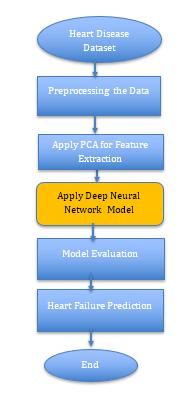
TheFigure1depictsaflowchartforpredictingheartfailure using a deep learning approach. The process begins with a heart disease dataset, which is collected from kaggle reposistory. To preprocess the dataset for further analysis. Principal Component Analysis (PCA) is then applied for featureextraction,reducingthedataset'sdimensionalitywhile retainingessentialinformation.Next,aDeepNeuralNetwork (DNN)modelisemployedforpredictiontasks.Themodel's performance is evaluated to ensure its accuracy and reliability.Finally,thesystempredictsheartfailurebasedon theevaluatedmodel,markingtheendoftheprocess.
Followingdatapreparation,weextractedfeaturesusing PrincipalComponentAnalysis(PCA).Inordertominimisethe dimensionality of the supplemented dataset while maintaining the most important features that contribute to the variance in the data, PCA was applied. The number of principalcomponentsretainedwasdeterminedbasedonthe cumulative explained variance ratio, ensuring that a significantportionofthedata'svariancewascaptured.
Thistransformationnotonlysimplifiedthedatasetbut alsoreducedtheriskofoverfittingbyeliminatingnoisefrom the original feature set. The resulting transformed features werethenutilizedasinputforthemachinelearningmodels, enhancingtheirperformanceandgeneralization.
A popular dimensionality reduction method for breaking down complicated datasets into a collection of orthogonal components is Principal Component Analysis (PCA) [22]. PCA can play a key role in lowering the feature spaceinthecontextofheartfailureprediction,improvingthe effectivenessandperformanceofmachinelearningmodels.
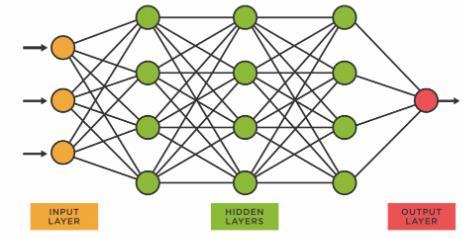
Deep learning, a subfield of machine learning, has revolutionized the way we approach complex problems in artificialintelligence[23]. Deepneuralnetworks,whichare madeupofseveralinterconnectedlayersandareattheheart ofdeeplearning,areabletorecognisecomplexpatternsand representationsinunprocessedinputdata[23].Thestructure and operation of the human brain, where neurones are interconnected and pick up patterns through repeated exposure to data, served as the model for deep neural networks[24].Aninputlayer,oneormorehiddenlayers,and anoutputlayermakeupthesenetworks.Eachlayerismade upofagroupofnodes,orneurones.Deepneuralnetworksare powerfulbecausetheycanlearnhierarchicalrepresentations ofdata,inwhichbasicpropertiesarecapturedbythelower layers and then progressively put together by the deeper layerstocreatemoreintricateandabstractrepresentations. Millions of people worldwide suffer from heart failure, a complicatedandpotentiallyfatalillnessthatcanbepredicted with deep learning. Utilizing the rich information stored in electronichealthrecords,deeplearningmodelscanidentify patternsandrelationshipsthatmaynotbereadilyapparentto humanexperts,leadingtomoreaccurateandearlydetection of heart failure risk. The deep neural netwok shown in Figure2.
The LOSS function often quantifies the DISTANCE betweentwopoints,withthespecificmeasurementmethod tailored to the problem or dataset at hand. The choice of distance metric depends on the nature of the data and the context of the problem. Common Distance Metrics used for calculatinglossfunctionis:
EuclideanDistance
International Research Journal of Engineering and Technology (IRJET) e-ISSN: 2395-0056
Volume: 12 Issue: 10 | Oct 2025 www.irjet.net p-ISSN: 2395-0072
ManhattanDistance
HammingDistance
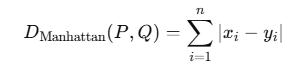
Manhattan distance was used in this piece. The total of the
absolute coordinate differences between two points is the Manhattandistance,sometimesreferredtoastheL1normor taxicabdistance. FortwopointsP=(x1,y1,z1,… )P=(x_1,y_1,z_1, ..)inn-dimensionalspace,theManhattandistanceisgivenby:
This research work used kaggle reposistory heart_failure dataset. This contains 299 instances and 13 attributes.Thedeath_eventattributeisadependentattributeof this prediction. To extract the important features using PCA method.Theresultsobtainedfromtheexperimentsconducted on the PCA-based machine learning models for morality detection. The Artificial Neural Network classifier is used to evaluate the risk of heart failure. We analyze the models' performance using several metrics and talk about the ramificationsoftheresults.
60.42% 73.69% SVM 5830% 7053% RNN 5920% 7169%
Theneuralnetworkclassifier'soutputusingthePCA approach is displayed in the above table. To determine the training set's maximum accuracy, we fine-tune the neural network's parameters. After dividing the dataset in several ways,weobtainthelowesttime, whichis80%:20%of the dataset.TheCNN,SVM,andRNNresultsaredisplayedinTable
1.Aftercomparingthesethreemethods,wediscoveredthat CNNoutperformstheotherclassifiersintermsofaccuracy.
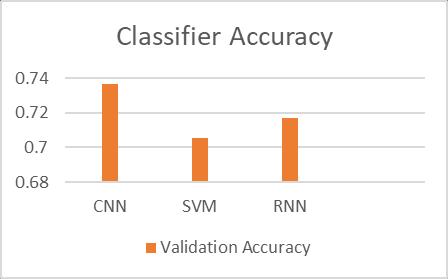
The suggested CNN Neural Network model fared betterthanotherclassifiersintermsofaccuracy,accordingto the model comparison results. Due to its ensemble nature, whichsuccessfullycaughtintricatepatternsinthedataandis appropriate for forecasting the risk of heart failure, the parameterised neural network performed better than the others,accordingtothecomparisonanalysis.
In cardiovascular medicine, it is now crucial to accuratelypredictheartfailurebecauseearlyinterventioncan greatly improve patient outcomes and lessen the strain on healthcaresystems.Inconclusion,theresearchpresentedin this paper highlights the effectiveness of applying deep learning technique, particularly the CNN model combined withthePrincipalComponenetanalysisTechnique(PCA),in detecting death morality. This model gives more accuracy thanthebasicneuralnetworkmodel.Thismodelissuitable forpredictingthecomplexdatasets.Thisworkonlyfocusing theaccuracyofsmalldataset.Infutureresearchwillfocuson applying real complex datasets and also consider to apply someoptimizationtechniques.
[1] Vargas, Rocio & Mosavi, Amir & Ruiz, Ramon. (2017). DEEP LEARNING: A REVIEW. Advances in Intelligent SystemsandComputing.5.
[2] Liu,Tao&Yang,Lexie&Lunga,Dalton.(2021).Change detectionusingdeeplearningapproachwithobject-based image analysis. Remote Sensing of Environment. 256. 112308.10.1016/j.rse.2021.112308.
[3] V.CAandV.BabyShalini,"SystematicReviewonDeep Learning-based Heart Disease Diagnosis," 2023 2nd
Figure 3 displays the comparison of the classifier findings.Withtheclassifiersonthex-axisandtheproportion ofclassifiermetricsonthey-axis,thegraphisdisplayed. International Conference on Edge Computing and Applications (ICECAA), Namakkal, India, 2023, pp. 908912,doi:10.1109/ICECAA58104.2023.10212392.
[4] Robert Detrano, Andras Janosi, et. el, “International application of a new probability algorithm for the
International Research Journal of Engineering and Technology (IRJET) e-ISSN: 2395-0056
Volume: 12 Issue: 10 | Oct 2025 www.irjet.net p-ISSN: 2395-0072
diagnosis of coronary artery disease”, The American JournalofCardiology,Volume64,Issue5,1989,Pages304310,ISSN0002-9149,
[5] Al-AlshaikhHA,PP,PooniaRC,SaudagarAKJ,YadavM, AlSagriHS,AlSanadAA.Comprehensiveevaluationand performanceanalysisofmachinelearninginheartdisease prediction. Sci Rep. 2024 Apr 3;14(1):7819. doi: 10.1038/s41598-024-58489-7.PMID:38570582;PMCID: PMC10991287.
[6] Rajput,M.N.,etal.(2016).Thepossibleuseofmachine learningindevelopingheartdiseasepredictionsystem. JOURNALOFADVANCERESEARCHINDYNAMICALAND CONTROLSYSTEMS,8(3),2017,330-335.
[7] Kaur,H.&Sindhu,N.(2019).Thecomparativestudyof machine learning algorithms for the diagnosis of heart disease. The Third International Conference on InformationManagement,159-163.
[8] Wong,S.T.,etal.(2015).EnsemblelearningforKMIPin Early identification of Myocardial Infarction. 13th InternationalConferenceonDataMining,2015,pp966971.
[9] Sani,R.andMahali,R.R.(2018).Modelingtheapplication ofdecisiontreealgorithmfordiagnosisofheartdiseases. IOPConferenceSeries:MaterialsScienceandEngineering, Vol403,No1,pp1–4,012039.
[10] Hossit,M,&Sulaiman,MN.(2015).Areviewondecision treealgorithms:techniques&applications.IntJAdvSci Technol,70,87–101.
[11] S.MukherjeeandA.Achariya(2019).Applicationofdata mininginthepredictionofheartdiseases:Data mining methods.IndianJ.Sci.Technol,12(10),1-10.
[12] Talukder, S., et al. (2018). An Investigation of Heart DiseaseDiagnosis usingRandomForest basedMachine Learning Technique. Inter Symposium on Health InformaticsACM,108-117.Talo,M.,etal.(2018).
[13] Thakker,D.,etal.(2019).Developmentofheartdisease predictionsystemusingensemblelearningInternational Conference on Computer, Communication and Signal Processing,2019,1-5.
[14] Esteva,A.,etal.(2019).Classificationofskincanceratthe dermatologistlevelusingdeepneuralnetworks.Nature, 542(7639),115-118.
[15] Rajpurkar,P.,etal.(2018).Deeplearningforhealthcare: threats, prospects and potential developments. }. arXiv preprintarXiv:1702.07119.
[16] Gupta, K., et al. (2019). Assessment of chances of developing heart disease using the machine learning algorithms.ProcediaComputerScience,167,2205-2214.
[17] Chaabane, S., et al. (2018). Segmentation of cardiac motion and deformation by applying Convolutional Neural Network to ultrasound images. ;Medical Image Analysis,43,98–108.
[18] Plis,S.,etal.(2019).Usingconvulsiveneural networks, authors observe a gradual enhancement of higher cognitiveprocessesinAlzheimerdisease.HumanNature Neuroscience,22(6),963–969.
[19] Zhou,C.,Hou,A.,Dai,P.,Li,A.,Zhang,Z.,Mu,Y.,&Liu,L. (2023). Risk factor refinement and ensemble deep learningmethodsonpredictionofheartfailureusingreal healthcare records. Information Sciences, 637, 118932. https://doi.org/10.1016/j.ins.2023.04.011
[20] Shahamat,H.,&Abadeh,M.S.(2020).BrainMRIanalysis using a deep learning based evolutionary approach. Neural Networks, 126, 218–234.https://doi.org/10.1016/j.neunet.2020.03.017.
[21] Yang,W.,Si,Y.,Zhang,G.,Wang,D.,Sun,M.,Fan,W.,Liu,X., &Li,L.(2021).Anovelmethodforautomatedcongestive heart failure and coronary artery disease recognition using THC-Net. Information Sciences, 568, 427–447.https://doi.org/10.1016/j.ins.2021.04.036
[22] Maćkiewicz, A., & Ratajczak, W. (1993). Principal components analysis (PCA). Computers & Geosciences, 19(3), 303–342. https://doi.org/10.1016/00983004(93)90090-r
[23] Noor,MohdHalimMohdandAyokunleOlalekanIge.“A Survey on State-of-the-art Deep Learning Applications andChallenges.”(2024).
[24] EmmanuelBengio,MokshJainet.al,“FlowNetworkbased Generative Models for Non-Iterative Diverse Candidate Generation”, Machine Learning, https://doi.org/10.48550/arXiv.2106.04399

Dr.G.Arutjothi,M.Sc.,Ph.D.,isan AssistantProfessorintheDepartment of Computer Applications atSona College ofArts and Science,Salem, TamilNadu. SheearnedherPh.D.in ComputerSciencefromPeriyarUniversity, Salem,in2024.WithexpertiseinDataMining,BigData Analytics, Cloud Computing, and Artificial Intelligence, she has published more than 12 research papers in internationaljournalsandconferences.Dr.Arutjothihas overfiveyearsofteachingexperienceandeightyearsof
International Research Journal of Engineering and Technology (IRJET) e-ISSN: 2395-0056
Volume: 12 Issue: 10 | Oct 2025 www.irjet.net p-ISSN: 2395-0072
research experience, with a strong background in programminglanguagessuchasPython,C,C++,andJava. She has actively participated in faculty development programs, organized international conferences, and contributed as a reviewer for reputed journals. Her commitment to advancing computer science education and research is evident through her involvement in academicandprofessionalactivities.

Dr.S. Tamilsenthil is a seasoned academician and researcherin computersciencewithover15 years experience. Heiss currently working as an Assistant Professor at sona arts and science college,salem.and holds a Ph.D from periyar University.Formerly Head of the computer science department at sengunthar arts and science college his expertise spans cloudcomputing.AI,Machine learning anddatascience.Hehaspublishedwidelyandproficient in c,c++,Java, SQL server and Oracle, passionate about teachingandacademicdevelopment.heactivelyengages inseminar,worshopsandfacultyprogram.Heisfluentin English Tamil and Telugu and enjoys music and travelling