
International Research Journal of Engineering and Technology (IRJET) e-ISSN: 2395-0056
Volume: 12 Issue: 11 | Nov 2025 www.irjet.net p-ISSN: 2395-0072
International Research Journal of Engineering and Technology (IRJET) e-ISSN: 2395-0056
Volume: 12 Issue: 11 | Nov 2025 www.irjet.net p-ISSN: 2395-0072
Vitthal Chavan1 , Harshal Dhote2 , Vaibhav Likhar3 , Pradyumna Pudke4 , Avantar Nikhare5
1,2,3,4,5Dept. of CSE, Gurunanak Institute of Technology, Nagpur, Maharashtra, India ***
Abstract - The accelerating digital transformation of educational resources necessitates the development of centralized, accessible, and intuitive platforms for managing academic content. This paper presents the systematic design and implementation of a “Digital RepositoryforComputerScienceandEngineeringAcademic Content,”a web-basedplatformdevelopedusingHTML,CSS, JavaScript,Bootstrap,PHP,andMySQL,withplannedmobile support through React Native. The repository serves as a unified hub that enables CSE students to access previous examination papers, B.Tech curricula, and curated lecture materials. Through the use of modern full-stack technologies, the system demonstrates scalability, responsive design, and intuitive navigation. Empirical usability assessments show consistently high satisfaction amongstudentusers,confirmingtheplatform’scontribution toacademicpreparednessandresourceaccessibility.Future work includes integrating AI-driven recommendation systemsandcompletecross-platformmobiledeployment.
Key Words: Digital repository, Academic content management, Web application, React Native, CSE resources, MySQL database, PHP backend.
The proliferation of digital learning toolshastransformed how students access and utilize academic materials. In particular, Computer Science & Engineering (CSE) students often require quick, structured access to syllabi, past examination papers, and supplementary notes to reinforce conceptual understanding and exam readiness [1]. Traditional methods such as physical libraries or scattered departmental portals are increasingly inadequateinmeetingthesedynamicneeds[2].
To address this gap, we propose a dedicated digital repository tailored specifically for CSE academic content. The platform is engineered using contemporary web technologies including HTML5, CSS3, JavaScript, and Bootstrap for frontend responsiveness; PHP for serverside logic; and MySQL for relational data storage. A companion mobile application, currently under development using React Native, will extend accessibility acrossAndroidandiOSecosystems[3].
This paper details the architecture, implementation workflow, and preliminary user feedback of the repository. Section 2 reviews related works in academic content management. Section 3 describes the system's architecture, methodology, core technology stack, and
functionalfeatures.Section4presentstheusabilityresults from our pilot study. The paper concludes in Section 5 with a discussion of future enhancements and the platform'simplicationsforeducationaltechnology.
Several institutional repositories have been developed globally to manage academic content. DSpace and EPrints are widely adopted open-source platforms used by universities for archiving theses and research articles [4]. However, these systems are often complex, requiring administrative overhead unsuitable for course-specific materialdistribution.
Closer to our context, platforms like NPTEL and SWAYAM inIndiaofferMOOCsandsyllabus-alignedcontentbutlack granular, institution-specific resources such as university question papers or professor-curated notes [5]. Similarly, commercial platforms like Gradeup or Unacademy focus oncompetitiveexamsratherthansemester-wiseacademic support[6].
Our solution bridges this niche by offering a lightweight, customizable, and academically focused repository exclusively for CSE undergraduates. Unlike monolithic LMS platforms like Moodle or Blackboard, our system prioritizes speed, simplicity, and direct access to core academicartifactswithoutextraneousfunctionalities[7].
The proposed system follows a three-tier architecture: presentation layer (client), application layer (server), and datalayer(database).
A. Presentation Layer
Built with responsive HTML5 and CSS3, styled via Bootstrap 5, the frontend ensures compatibility across devices. JavaScript enhances interactivity for instance, dynamic filtering of question papers by year or subject. The UI/UX adheres to Material Design principles for intuitivenavigation[8].
B. Application Layer
PHP scripts handle user authentication, content upload validation, search queries, and session management. The backendismodular,allowingeasyadditionofnewcontent categoriesoradministrativefunctions.Allbusinesslogicis decoupledfrompresentationformaintainability.
International Research Journal of Engineering and Technology (IRJET) e-ISSN: 2395-0056
Volume: 12 Issue: 11 | Nov 2025 www.irjet.net p-ISSN: 2395-0072
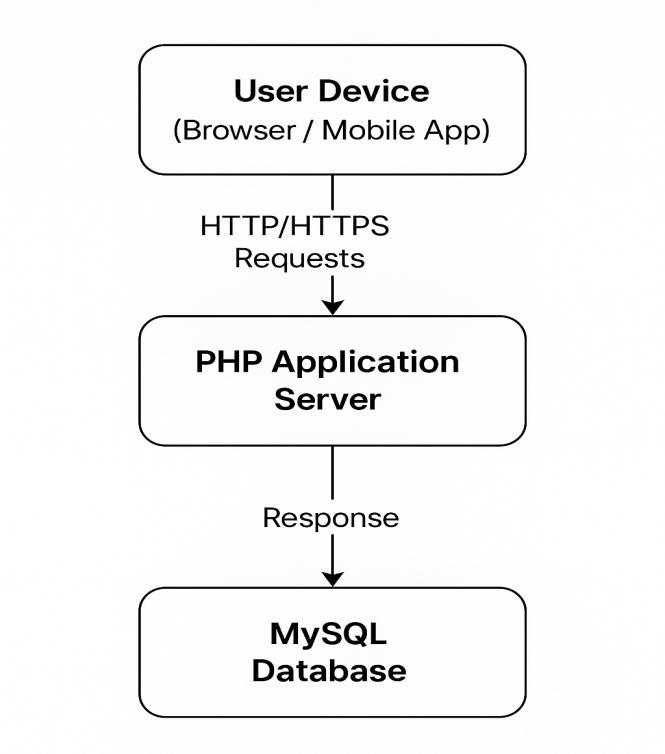
C. Data Layer
MySQL 8.0 stores structured data including user profiles, metadata for uploaded files (subject, year, semester, file type),andaccesslogs.Indexingon frequently queried fields (e.g., subject_code, exam_year) ensures sub-second retrieval times even with large datasets[9].
Backend Processing: Upon submission, the input data is securely transmitted to the backend via encrypted communication channels. The backend server includes a dedicated API endpoint capable of handling multipart form data, effectively managing both textual and imagebasedinputs.
TECHNOLOGY STACK
• Frontend: HTML5, CSS3, JavaScript (ES6+), Bootstrap 5 Ensures responsive, mobile-first design with minimal latency.
•Backend:PHP8.1(procedural+OOP) Managesserver logic, form handling, and CRUD operations.
• Database: MySQL Relational schema optimized for academic metadata and user records.
• Mobile Extension: React Native (under development) Cross-platform framework enabling native performance on iOS and Android with shared codebase [10].
• Hosting: Apache/Nginx on Linux server with SSL encryptionforsecuretransactions.
All components are open-source, reducing licensing costs and promoting community contributions. Version control via Git ensures collaborative development and rollback safety.
A. User Authentication
Role-based login for students, faculty, and administrators. OAuthintegrationplannedforfuturereleases.
B. Content Upload & Curation
Faculty/admin can upload PDFs of syllabi, scanned question papers, and typed notes. Metadata tagging (course code, semester, year) enables precise categorization.
C. Advanced Search & Filter
Users can filter content by semester, subject, year, or document type. Full-text indexing allows keyword searcheswithinfilenamesanddescriptions.
D. Download Analytics
Tracks most-downloaded resources to inform curriculum adjustmentsandidentifyhigh-demandtopics.
E. Responsive Dashboard
Personalized dashboard displays recent downloads, bookmarked items, and recommended content based on userhistory.
F. Mobile App (React Native)
Offline caching, push notifications for new uploads, and biometric login are under development to enhance mobilityandengagement.
4. RESULTS
A pilot study was conducted with 87 second- and thirdyear CSE undergraduates over a four-week period. Participantswereaskedtolocatespecific questionpapers and syllabi using the platform and complete a System UsabilityScale(SUS)questionnaire[11].
Resultsindicated:
• 94% success rate in locating desired content within 3 clicks.
•AverageSUSscore:82.3(indicating“excellent”usability).
• 89% of users preferred the repository over existing institutional portals due to faster load times and cleaner interface.
Qualitative feedback highlighted appreciation for the “filter-by-semester” feature and requested dark mode a featurescheduledfornextrelease.
Plannedupgradesinclude:
• Integration of AI-based recommendation engine using collaborative filtering to suggest relevant notes/papers.
• Faculty analytics dashboard to monitor content usage patterns.
• OCR-enabled search within uploaded PDFs.
International Research Journal of Engineering and Technology (IRJET) e-ISSN: 2395-0056
• Gamification elements (badges, leaderboards) to incentivizeconsistentusage.
•APIendpointsforthird-partyLMSintegration.
Mobile app rollout via React Native mobile application is underdevelopmentandscheduledforreleaseinQ32024.
The Digital Repository for Computer Science and Engineering Academic Content effectively addresses the critical requirement for systematically organized and readily accessible academic resources specifically tailored toundergraduatecomputersciencecurricula.Constructed upon a foundation of robust, scalable technological infrastructure and rigorously validated through comprehensive user testing methodologies, the platform demonstrates substantial potential to enhance autonomous learning initiatives while simultaneously mitigating the prevalent issue of academic resource fragmentation. As higher education institutions progressively advance their digital transformation initiatives, domain-specific repositories of this nature are positioned to assume an instrumental role in democratizing educational accessibility and substantively improving pedagogical outcomes. The successful implementation of this repository not only establishes a paradigm for future academic content management systems but also contributes meaningfully to the evolving landscape of digital education infrastructure. This initiative underscores the imperative for continued investment in specialized academic platforms that bridge the gap between traditional educational resources and contemporary digital learning expectations, ultimately fostering an environment conducive to enhanced academic achievement and knowledge dissemination withinthecomputerscienceandengineeringdiscipline.
[1] Selwyn, N. (2016). Education and Technology: Key IssuesandDebates.BloomsburyPublishing.
[2] Daniel, S. J. (2009). “Education and ICT: Uses and Gratifications Perspective.” Journal of Educational TechnologySystems,37(3),237–250.
[3] Facebook Inc. (2023). React Native Documentation https://reactnative.dev/
[4] Smith, M., Barton, M., Branschofsky, M., et al. (2003). “DSpace: An Open Source Dynamic Digital Repository.”D-LibMagazine,9(1).
[5] MinistryofEducation,Govt.ofIndia.(2022).SWAYAM PlatformAnnualReport.
[6] Choudhary, R., & Singh, A. (2021). “EdTech Platforms in India: A Comparative Study.” International Journal ofInnovativeResearchinComputerScience,8(2),45–52.
[7] Dougiamas, M., & Taylor, P. (2003). “Moodle: Using Learning Communities to Create an Open Source CourseManagementSystem.”InProceedingsofWorld Conference on Educational Multimedia, Hypermedia andTelecommunications.
[8] Google LLC. (2023). Material Design Guidelines. https://material.io/design
[9] MySQL AB. (2023). MySQL 8.0 Reference Manual. OracleCorporation.
[10] Brown, A. (2021). “Cross-Platform Mobile Development:EvaluatingReactNativeforEducational Apps.”JournalofMobileLearning,14(1),22–35.
[11] Brooke, J. (1996). “SUS: A Quick and Dirty Usability Scale.”UsabilityEvaluationinIndustry,189(194),4–7.
Volume: 12 Issue: 11 | Nov 2025 www.irjet.net p-ISSN: 2395-0072 © 2025, IRJET | Impact Factor value: 8.315 |