
Digital Medical Prescriptions & Automatic Delivery of Drugs
Aryan Dinakaran1 , Anshul Bamb2 , Yuvraj Singh Pathania3
1Founder & Research Lead, Epochlypse Research, Mumbai, India
2Department of Computer Science, Vellore Institute of Technology, Pune, India
3Department of Computer Science, Vellore Institute of Technology, Bengaluru, India
Abstract - A QR Code is a two-dimensional matrix code designed with two objectives: it must contain more data than one-dimensional barcodes, and it must have the ability to adapt quickly via phones, tablets, or computer cameras equipped with QR Code scanning software. Each QR Code has a distinct pattern. Doctors in hospitals and clinicsissuemedicalprescriptionstopatientsthatcontain the patient's name, date of visit, name of medicines, numberofdoses,andotherpertinentmedicalinformation. However, not all information about the medication is provided in the prescription. In such a circumstance, digitalisation of the prescription paradigm becomes necessary. Making digital prescriptions will not only give patients all important information about their medications, but it will also savepaper, make the process of writing prescriptions more economical, and eliminate worries about fake prescriptions. Ideally, when patients aredoneconsultingwiththedoctor,theymustproceedto thereceptionisttomaketheirpayment.Theythenheadto thepharmacytopurchasemedications.Thisrepresentsan excessive effort for the patient, and it might cause stress. Asaresult,thepurposeofthisstudyistocreateasolution thatallowsapatienttoeasilyaccessallinformationabout theirmedicationprescribedbyamedicalprofessionaland simplypurchasetheprescribed medicines withouthaving to go to the pharmacy by directly delivering the prescriptionmedicationstothepatient'shome.
Key Words:Medicines,AuthenticPrescriptions,QRCodes, PharmacySupplyChain
1.INTRODUCTION
Digitisation and automation are extremely crucial in our daily lives. The process of converting information into a digital format is known as digitisation. Automation encompasses a broad range of technologies that assist in thereductionofhumaninvolvementinprocesses.
A quick response code is a black-and-white square image thatcanholddataforalocator,identifier,ortrackerthatis linked to an application or a website. Anyone with a smartphone can conveniently scan it and access the informationlinkedwiththecode.
The main objective of this study is to digitise medical prescriptionsinordertomakeallprescribeddetailseasily available to patients seeking medication and to automate
theprocessofpurchasingmedicinesfrompharmacies.We areattemptingtoreducetheamountofworkapatienthas todointhis process byautomatingthepaymentsteps for purchasingmedicationsfromapharmacy.
2. Literature Review
1. QRCodetoSecureMedicalManagement
Utilisingvisualsecretsharing(VSS)technology andthefunctionalityofQRcodes,thispaperfirstevaluates the current state of medical management technology and its unpatched vulnerabilities prior to actually discussing the possible applications of quick response (QR) code to secure medical management administration and enhance medicalmanagementsecurity.
2. AJin-BasedSolutionforE-Prescriptions
Themaingoalofthisresearchistoconcentrate on this problem and describe a Jini-based prototypical solution for electronic prescriptions, which enables their wireless transmission to in-range pharmacies and the enhancementoftheservicelevelsprovidedtotheuser,for example,byprovidingthepatientswithinformationabout queuelengthsandanticipatedwaitingtimes.Highlevelsof agreement were identified in the therapeutic and user assessments of the prototype's performance, simplicity, andutility.
3. QuickResponseCode:MedicalPrescription
The creation of a medication prescription QR code is one of the study's goals. Analysis, design, implementation, testing, deployment, and maintenance phases are all included in the approach. This research describes Medication Prescription QR codes, which provide patients with concise and easy-to-access informationaboutprescribeddrugs.
4. PharmacySupplyChainsModels
This study assesses prospects for pharmaceuticalsupplychain(PSC) reconfiguration driven by manufacturing technology advancements and new, patient-centred delivery models. In order to identify, define, analyse, and classify PSC models, a critical synthesisofbothacademicandpracticalliteratureisused.
International Research Journal of Engineering and Technology (IRJET) e-ISSN: 2395-0056
Volume: 12 Issue: 09 | Sep 2025 www.irjet.net
In order to provide information on a wider range of OR activities,fromconceptualtomathematicalmodellingand model solution, up to implementation, a systems view of operations research is adopted from a theoretical perspective.
5. AuthenticatedPrescriptionsUsingDigitalSignature
This research focuses on the usage of a cryptographic signature technique for electronic prescriptions in order to protect against cybercrime concerns such as robbery, tampering, and unauthorised access. In this research, the RSA 2048-bit algorithm was utilised in Java programming and an Android-based system.ASecureElectronicPrescription(SEP)application ofthistypeismeanttointegratespecialisedservicessuch as nondisclosure, authentication, and non-repudiation.
6. MedicalPrescriptionModelBasedonaWeb Application
This paper proposes a medical prescription model for the issuing of an automatic prescription according to certain symptoms, which will be authorised bya doctorincharge.The model isimplemented withina webapplicationthatpermitsthecollectionofthepatient's medicalrecordandsymptomatologyinordertoeasetheir treatmentandtheprescriptionofmedicalprescriptions.It should be mentioned that the patient is autonomous in recording their medical record and symptoms, which are compared withtheonlineapplication'sdatabasetocreate the automatic medical prescription. The issue stems from patients' inability to make a medical visit to a health facility, as well as Peru's high prevalence of selfmedication.
7. E-PrescriptionsUsingBlockchainTechnology
E-Prescription refers to the electronic transfer of a prescription from a doctor to a pharmacy for the patient's retrieval. A system like this would improve overall medical prescription administration by publicly registering them using blockchain technology in such a fashion that an electronically issued medical prescription may be recognised by any pharmacy or healthcare professional. The article describes a potential implementation of a system for issuing and tracking electronicmedicalprescriptions.
8. MedicalHandwrittenPrescriptionUsingCRNN
Reading a doctor's handwritten prescription is a barrier that most patients and some pharmacists encounter; an issue that can result in adverse effects in some situations owing to incorrect prescription decoding. Doctors adopt Latin acronyms and medical vocabulary thatmostpeople donotunderstand, which contributes to the difficulty in interpreting their prescriptions. This
p-ISSN: 2395-0072
researchshowshowArtificialNeuralNetworks(ANN)are used to create a system smart enough to recognise handwritten English medical prescriptions. Input photos aresegmented and processedtorecognisecharactersand categorise them into the 64 distinct preset characters using the Deep Convolutional Recurrent Neural Network totrainthissupervisedsystem.
9. PatientSatisfactionwithOnlinePharmacyServices
The satisfaction evaluations of 323 patients withonlinepharmacyservicesarepresentedinthisstudy. Patient satisfaction was high with online pharmacy services in general (67.8% of respondents), medicine prices (70.9% of respondents), transportation charges (55.1% of respondents), home delivery of medicines (62.5% of respondents), and pharmacists' professional skills (77.7% of respondents). Patient satisfaction with advice obtained by phone (47.1% of respondents) or email (48.3% of respondents) from pharmacists with informationontheirdrugswaspoor.
10. QRCodeforIdentityTagSystem
This study evaluated and implemented a QR Code Identity Tag system for healthcare in Turkey. The Identity Tag System uses a QR code for the healthcare system, according to this study. It was utilised for medication identification notifications and a patient identification system. The researchers reported that the QR Code Identity Tag was connected to the healthcare system. Each member of the medical system will be allocated a QR code tag, which will be worn as a bracelet ornecklaceorcarriedasanIDcard,andeachQRcodewill beunique.Additionally,patientsmustalwaysweartheQR code identification wristbands while in the hospital since this QR code bracelet is linked to the QR code identity website.
ReviewSummary
Overall, the fundamental distinction between the two conceptsistheincorporationofQRcodesforprescriptions in the online pharmacy. This tool can assist patients to speed up the drug pickup procedure and enhancing medication adherence. Furthermore, the availability and companybehindtheplatformmaydifferbetweenthetwo concepts, and patient data security is a crucial factor for both.
3.METHODOLOGY
The research is divided into five stages. The procedures are categorised as follows: analysis, design, implementation,anddeployment. Thesestages contribute significantly to the successful execution of the proposed idea.
International Research Journal of Engineering and Technology (IRJET) e-ISSN: 2395-0056
Volume: 12 Issue: 09 | Sep 2025 www.irjet.net p-ISSN: 2395-0072
1. Analysis
The analysis of the proposed system includes thefollowingsteps:
• Evaluationoftheproposedsystem:Thesuggested approach entails a patient obtaining a medical prescription from a doctor digitally via a website or a mobile app, where both physicians and patients must be logged in using their phone numbers.
• Comparison with existing systems: In the current system, the patient consults a doctor to obtain medicationandreceivesamedicalprescriptionon traditional printed paper. To purchase medications online, they must physically take a picture of the prescription and upload it to the site.
Thisisalongandexhaustingprocessinwhichthepatient does the majority of the effort. In addition, it takes quite sometimetoauthenticatetheprescriptionbythesystem.
In comparison, our recommended system looks after the user from the time he or she obtains a medical prescription from the doctor until the time they pick up drugs from pharmacies in person or purchase medicines onlineinthesamemannertheydogroceries.
2. Requirements
This study execution incorporates the use of both the web app and the mobile app. The online app includes choices for doctors and pharmacists for administering prescriptions, medicines, and payments. Themobileappismorepatient-centred.Therequirements areclassifiedasfollows:
• Doctors
Doctors can sign up by providing their phone numbers and the doctor's registration number. The doctor's registration number will be essential as that is how we can authenticate doctors. Doctors will be authorised by providing their registration number to the National Medical Commission's Indian Medical Registry SearchusinganHTTPPOSTrequesttothewebsite.
Once thedoctors areauthenticated, theycanfurtherhead on to build their profile. The profile must include the credentials of the hospital the doctor works in and the credentialsofthedoctor.Thesecredentialswillbeusedin
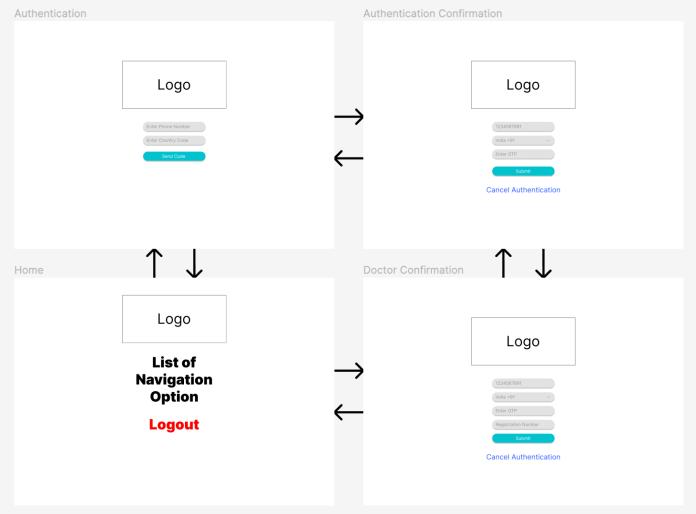
1:WireframesforAuthenticationof Doctors
• PharmacyStores
Pharmacies can register by providing their phone numbers and licenses. To get started, the store must wait for a couple of business days for verification. We must perform the authentication manually due to the fact that there is no registry where the validity of pharmaciescanbeconfirmed.
• Patients
To get started, patients must sign up with the mobileappusingtheirmobilenumbers.Patientsmustalso provide proof of identification, such as a government ID. WewillusetheAadhaarCardforthisresearch,whichisa 12-digit person-identifying number issued by the Unique IdentifyingAuthorityofIndiaonbehalfoftheGovernment of India. After signing up, patients must enter their home addresses in order for their orders to be executed. They will also be provided an option to delete their account or logout
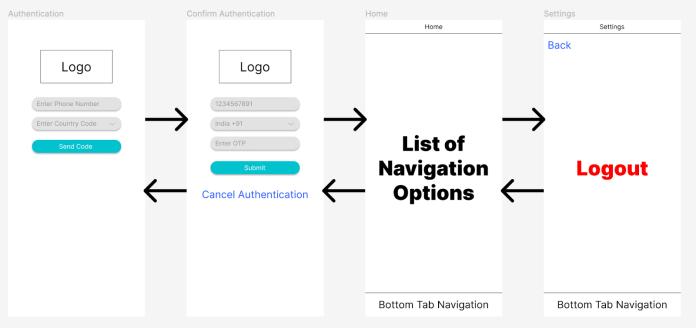
2:WireframesforAuthenticationofUsers
Fig.
Fig.
Volume: 12 Issue: 09 | Sep 2025 www.irjet.net
3. Design
The suggested system's implementation includes the frontend, backend, cache, and database. The backend will contain all API endpoints beginning with api/v1. The front end will then perform CRUD (Create, Read,Update,andDelete)callstothesebackendAPIs.
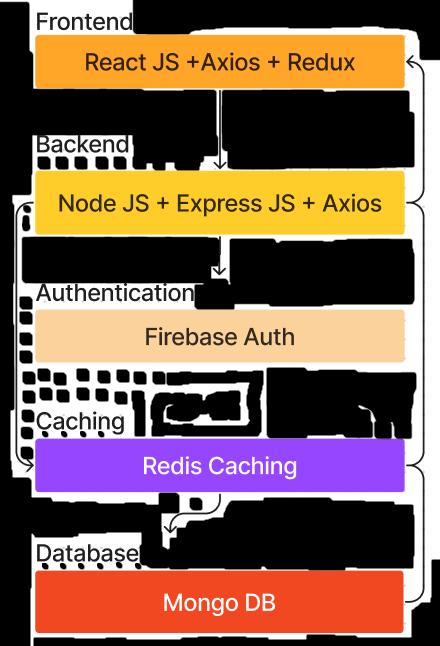
React JS will be the framework used on the front end for this project, along with enablers including Axios JS for calling APIs (Application Programming Interfaces) from thebackendandReduxJSforstatemanagement.
WeaimtoleverageNode.jswithExpressJSinthebackend todevelopanddeliverAPIs.Axios JSwillalsobeessential in the implementation of third-party APIs. Firebase Auth will be used to manage user authentication via phone numbersoremailforusers.
Forcaching,wewillbeincorporatingRedisCacheinorder to not make unnecessary database queries. By adding Redis Cache, it will make it possible for the entire system torunfaster.
MongoDB is the database that we want to use. It is an open-source, cross-platform, document-oriented NoSQL database. It uses JSON-like documents with schemas that
are optional. We will use Mongoose, an object data modelling library, to integrate MongoDB with NodeJS and ExpressJS.
4. Implementation
The implementation includes the patient seeing a doctor, who writes up the prescription on the proposed system's web/mobile app and saves it in order togenerateanewmedicalprescriptionwithaQRCodefor the patient. The prescription is subsequently reflected on thepatient'sphone.
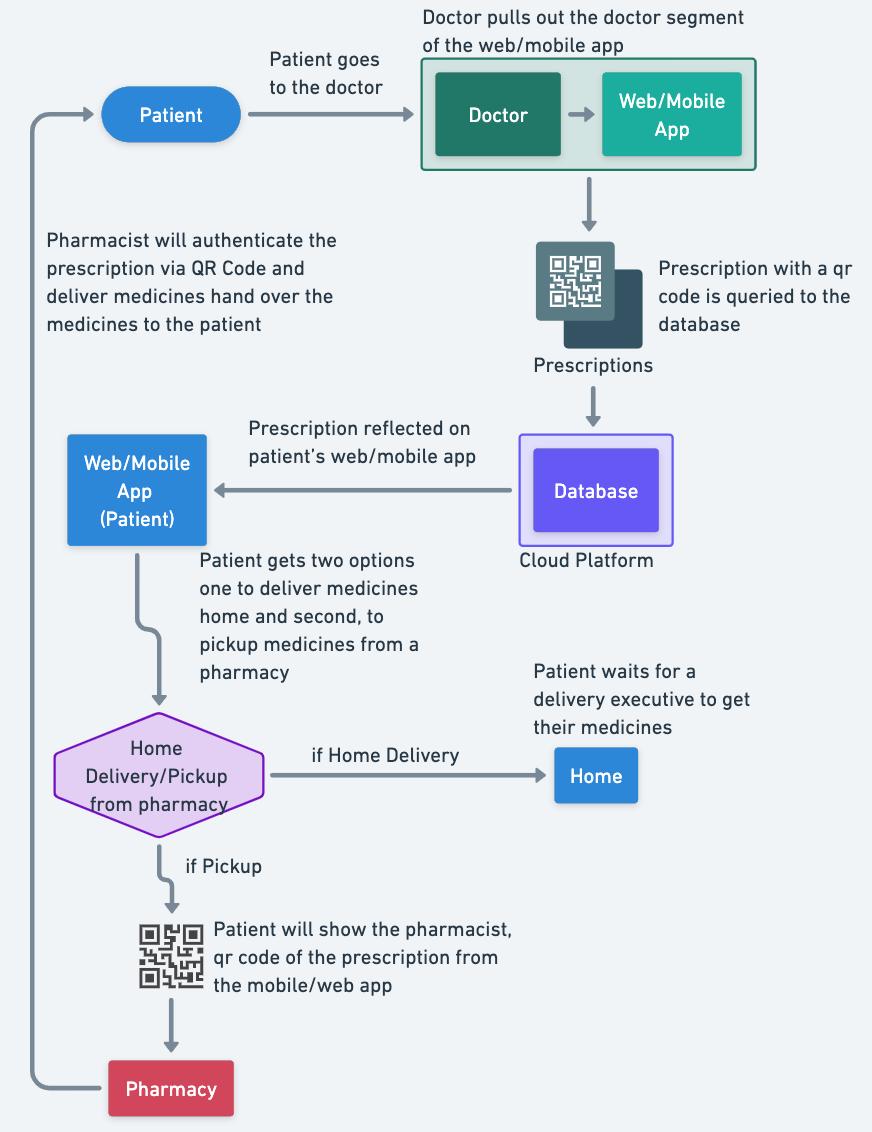
Fig.4:FullFlowoftheProposedSystem
Once the patient has received the prescription, they get two options on the mobile app/website. First, it will send the prescription to a pharmacist and keep the medicines ready. Second, it will deliver medicines to the patient's homeviaadeliveryexecutive.
Byclicking onthe pickupoptions, theuser will begivena list ofmedical stores within a ten-kilometre radius.These stores will be sorted based on the availability and cost of medicines, aswellastheclosenessofthemedicalstoreto the user ’ s current location. The user can then select a desired medical store and tap the authorise button to confirmpayment.Alltheuserhastodonowistogotothe pharmacy, show their prescription’ s QR code from the
Fig.3:TechStackusedintheproposedsystem
International Research Journal of Engineering and Technology (IRJET) e-ISSN: 2395-0056
Volume: 12 Issue: 09 | Sep 2025 www.irjet.net p-ISSN: 2395-0072
mobile app to the pharmacist and pick up the medicines. Notethatthepharmacistwillusethemobileappinterface oftheproposedsysteminordertoscanandvalidateeach prescription’ sQRcode.
By selecting the home delivery option, our systems will locatethemedicalstoresnearesttothepatient'sresidence that provide the best pharmaceutical prices to the customer. Thechemist will automatically getthe patient's prescription by this time. They may simply validate the prescription and send it to the patient via a delivery executiveusingthis method. All theuserhas to donow is tap on the authorise button, go home and wait for medicines.
Ultimately, the online pharmacy with QR codes for prescriptions was implemented through a rigorous process of requirements gathering, design, programming, testing, deployment, and maintenance. The final platform wascreatedtofulfilthemedicationmanagementdemands ofpatients andhealthcareproviders whilealsoprotecting patientdataconfidentialityandprivacy.
Not only does the app's patient segment provide a convenient platform for users to effortlessly monitor and manage their dosages, but it also empowers patients to actively participate in their healthcare journey. By meticulously keeping track of their medication intake through this intuitive feature, individuals gain invaluable insightsintotheirtreatmentprogress,fosteringasenseof ownership and responsibility. Furthermore, this comprehensive data repository serves as a valuable resourceforhealthcareproviders,enablingthemtoassess the level of commitment and adherence displayed by patients toward their prescribed medications. With this enhanced understanding, doctors can make informed decisions, tailor treatment plans, and offer personalised guidance to optimise patient outcomes and overall wellbeing.
E. Deployment
The suggested system design comprises the frontend, backend, cache, and database layer. Where the front end will be containerised using Docker, a development operations tool. This makes shipping the frontendcontainerasaserverlessfunctionabreeze.
The backend will also be containerised using Docker and delivered as a serverless function for seamless container maintenanceandupdates.
The Redis cache layer will be hosted on a cloud server, while the front end and back end will be deployed as serverless services. It is not a good idea to distribute the cachelayerwiththebackendcontainersinceitwillcreate
issues when making modifications or upgrading the server.
Thedatabasewillalsobehostedonaremotecloudserver foreffectiveadministrationandmaintenanceofMongoDB, whichisaNo-SQLorDocument-baseddatabase.
4. CONCLUSION
The creation of an online pharmacy that accepts prescriptions with QR codes has the potential to revolutionise how patients handle their medication. By utilising a QR code, patients can easily access their prescriptions and swiftly collect their medications at the pharmacy.Thisinnovativeplatformalsofeaturesarobust patient segment, empowering individuals to actively monitor and manage their dosages, promoting adherence and treatment efficacy. The user-friendly interface fosters a sense of control and engagement, encouraging patients to take ownership of their healthcare. Additionally, the comprehensive data collected within the patient segment provides valuable insights to healthcare providers, enabling them to make informed decisions, tailor treatmentplans,andoptimisepatientoutcomes.Alongside the convenience of QR code-based prescription retrieval, the platform facilitates online prescription orders and offers delivery options, enhancing accessibility for those preferring home delivery. This seamless integration of technology and pharmaceutical services reshapes medicationmanagement, empowering patients toactively participate in their treatment journey while supporting healthcare providers in delivering personalised care and informeddecision-making.
REFERENCES
[1] XuehuYanandYuliangYu,“ApplyingQRCodeto Secure Medical Management” in 2018 9th International Conference on Information TechnologyinMedicineandEducation.
[2] Shervin Asgari, Arash Moradi, and Tacha Serif, “A Jini-Based Solution for Electronic Prescriptions” in IEEE TRANSACTIONS ON INFORMATION TECHNOLOGY IN BIOMEDICINE, VOL 10,NO.4,OCTOBER2006.
[3] Nurul Fatina Yusni, Nur Farah Hanani Mohd Zaim, Siti Khairul Niza Sukri, Noreha Che Sidik, Shamsul Jamel Elias and Zanariah Idrus, “Quick Response Code: Medication Prescription” in 5th IEEE International Conference on Recent Advances and Innovations in EngineeringICRAIE2020.
International Research Journal of Engineering and Technology (IRJET) e-ISSN: 2395-0056
Volume: 12 Issue: 09 | Sep 2025 www.irjet.net p-ISSN: 2395-0072
[4] EttoreSettanni,TomásSeosamhHarringtonand Jagjit Singh Srai, “Pharmaceutical supply chain models: A synthesis from a systems view of operationsresearch”
[5] Mohamad Ali Sadikin and Septia Ulfa Sunaringtyas, “Implementing Digital Signature fortheSecureElectronicPrescriptionUsing QRCode Based on Android Smartphone” in 2016 International Seminar on Application for TechnologyofInformationandCommunication
[6] IrvinVictorMejiaTejada,AlvaroAntonioDuclos Flores and Jimmy Armas Aguirre, “Medical prescriptionmodelbasedonaWebApplication” in 2021 IEEE 1st International Conference on Advanced Learning Technologies on Education &Research(ICALTER).
[7] Sebastian-Vlad Ionescu, “E-prescription using blockchain technology” in 2022 IEEE International Conference on Blockchain, Smart Healthcare and Emerging Technologies (SmartBlock4Health)
[8] Roger Achkar, Khodor Ghayad, Rayan Haidar, Sawsan Saleh and Rana Al-Hajj, “Medical Handwritten Prescription Recognition Using CRNN” in 2019 International Conference on Computer, Information and Telecommunication Systems(CITS)
[9] Etidal-Mihaela Manoliu-Hamwi, Cristina Gena Dascalu, Elena Mihaela Carausu, Georgeta Zegan and Catalina Daniela Stan, “Patient Satisfaction with Online Pharmacy Services” in 2022 EHealthandBioengineeringConference(EHB)
[10] Vassilya Uzun and Sami Bilgin, “Evaluation and implementation of QR Code Identity Tag system forHealthcareinTurkey” .