
Volume:12Issue:04|Apr 2025 www.irjet.net
International Research Journal of Engineering and Technology (IRJET) e-ISSN: 2395-0056 p-ISSN: 2395-0072

Volume:12Issue:04|Apr 2025 www.irjet.net
International Research Journal of Engineering and Technology (IRJET) e-ISSN: 2395-0056 p-ISSN: 2395-0072

Prince Kuzhimannil 1 , Himanshu Prasad 2 , Asim Mudhalwadkar 3 , Aditya Patil 4
S.A. Jadhav 5
1-4Student, Dept. of Mechanical Engineering, JSPM’S Rajarshi Shahu College of Engineering Pune, India
5Professor, Dept. of Mechanical Engineering, JSPM’S Rajarshi Shahu College of Engineering Pune, India
Abstract - Waterscarcity is acritical global challenge, necessitating innovativesolutions for sustainablewater harvesting. This research presents an Atmospheric Water Generation (AWG) system that utilizes a Peltier thermoelectric cooling module and a heat sink to condense atmospheric moisture into potable water. The system functions by cooling air below the dew point, leading to condensation on the cold side of the Peltier device. A heat sink is employed to efficiently dissipate excess heat, enhancing the cooling efficiency of the system.
To integrate real-time monitoring, a rain sensor is incorporatedto detectthefirstdropof generatedwater. Upon detection, the sensor transmits signals to a cloudbased platform via an IoT-enabled microcontroller. The website interface displays real-time graphical data, includingwaterproductionrate,temperature,humidity, and system efficiency. The graphical visualization enables users to analyze performance trends and optimizesystemoperation.
This approach combines thermoelectric cooling, IoTbased monitoring, and sustainable water harvesting, offeringacost-effectiveandscalablesolutionforregions facingwaterscarcity.Futureimprovementsmayinclude AI-based predictive analytics for enhanced efficiency andwateryieldoptimization.
Key Words: Atmospheric Water Generation, Peltier Device, Heat Sink, Rain Sensor, IoT Monitoring, NodeMCU, Power Supply, LCD, Sustainable Water Harvesting.
Water scarcity is an escalating global challenge, affecting nearlyathirdoftheworld'spopulationandthreateningto worsenwithcontinuedclimatechange,populationgrowth, and unsustainable water use. As freshwater resources become increasingly strained, there is an urgent need for innovative technologies to supplement traditional water sources.
Atmospheric Water Generation (AWG) has emerged as a promisingsolution,harnessingthemoisturepresentinthe airtoproduceclean,potablewater.Thistechnologyoffers a sustainable and decentralized approach to water

production,potentiallytransformingthewaycommunities, industries,andgovernmentsaddresswatershortages.
The concept of AWG is based on extracting moisture from the air and converting it into liquid water through condensation or desiccation processes. Condensationbased systems work by cooling air below its dew point, causingmoisturetocondenseandcollectaswaterdroplets. In contrast, desiccant-based systems use hygroscopic materials to absorb water vapor, which is then released throughheatingorotherregenerationprocesses.Each
method has its advantages and challenges, with condensation systems generally performing better in high-humidity environments, while desiccant systems are more effective in arid climates.Hybrid approaches, which combine both technologies, are also being developed to optimize performance across various environmentalconditions.
Recent advancements inAWG technology have focusedon improving efficiency, reducing energy consumption, and integrating renewable energy sources such as solar and windpower.Solar-poweredAWGsystems,forexample,are particularlywell-suitedforoff-gridapplicationsinremote or disaster-affected areas. These systems harness solar energy to power cooling or heating processes, reducing relianceonfossilfuelsandminimizingtheirenvironmental impact. Innovations in materials science, including the development of advanced desiccants like metal-organic frameworks (MOFs), have also enhanced the ability to extractwatereveninlow-humidityconditions, broadening thepotentialapplicationsofAWG
The scope of the AQUAGEN project encompasses the design,development,and performance evaluationofa compact, portable Atmospheric Water Generator (AWG) that utilizes thermoelectric (Peltier) cooling technology. This system is tailored for applications in water-scarce, off-grid, and disaster-prone regions, where access to clean drinking water is limited or unreliable.
The project explores:
The feasibility of using Peltier modules for moisture condensation in varying humidity conditions.

Volume:12Issue:04|Apr 2025 www.irjet.net
International Research Journal of Engineering and Technology (IRJET) e-ISSN: 2395-0056 p-ISSN: 2395-0072
Integration of IoT-based real-time monitoring to visualize water yield, humidity, and temperature metrics.
Comparative performance analysis between traditional AWG systems and the proposed lowenergy,low-maintenancesetup.
Scalability and modular design suitable for household,emergency,andruraldeployment.
The AQUAGEN system demonstrates a sustainable, electricity-driven approach to water harvesting, with the potentialforoptimizationviaAI,renewableenergysources, andadvancedmaterialcoatings.
TheprimarygoaloftheAQUAGENprojectistodevelop a compact, cost-effective, and energy-efficient AtmosphericWaterGeneration(AWG)systemthatcan extract potable water from ambient air using thermoelectriccoolingtechnology.Thesystemaimsto address water scarcity issues in remote and off-grid locations by combining basic condensation principles withsmartmonitoringandminimalmaintenance
Key Objectives:
1. DesignandFabricationofanAWGUnit
TodesignaworkingprototypeusingaPeltier (thermoelectric) cooling module, heat sink, and fan for effective condensation of atmosphericmoisture.
Tofabricatethesystemwithlightweight,costeffective,andeasilyavailablecomponents.
2. EnhancementofCondensationEfficiency
To improve water collection rates by incorporating aluminum foil coating and optimizedairflowusingapropellerfan.
To analyze temperature differentials across the Peltier device and maximize dew formationonthecoldsurface.
3. IntegrationofReal-timeMonitoring
To develop an IoT-based dashboard using microcontrollers(e.g.,NodeMCU)andsensors (rain, humidity, temperature) to monitor and visualizesystemperformanceinrealtime.
4. Performance Testing Under Varying EnvironmentalConditions
To test water yield, power consumption, and systemresponseunderdifferenthumidityand temperaturescenarios.
To measure time to first water droplet, total yield per hour, and thermal behavior of the system.
5. ComparisonwithConventionalSystems
To compare the developed AWG’s performance with conventional systems (like vapor-compressionAWGs)intermsofenergy efficiency, scalability, and environmental impact.
6. EvaluationofSustainabilityandFeasibility
To assess the system's feasibility for remote deployment using renewable energy sources suchassolarpower.
To propose design modifications and future enhancements for large-scale and continuous operation.
2.
The increasing demand for decentralized, sustainable water harvesting technologies has brought Atmospheric WaterGeneration(AWG)totheforefrontofresearch.AWG systems function by extracting water vapor from the air, using methods such as condensation or desiccant-based absorption. Among these, thermoelectric cooling (TEC) based AWGs, which utilize the Peltier effect, offer a promising solid-state alternative due to their compact design,lowmaintenance,andpotentialforIoTintegration.
2.1 Evolution of Atmospheric Water Generation
TraditionalAWGsystemsoftenrelyonvapor-compression refrigeration,which,whileefficientinhumidenvironments, areenergy-intensiveandbulky.AccordingtoSharmaetal. (2021), such systems consume between 300–500 W per literofwater,makingthemunsuitableforruralorportable use.
Toaddressthis,researcherslikeAl-Karaghoulietal.(2019) investigated thermoelectric modules for water condensation,citinglowermechanicalcomplexity,minimal moving parts, and suitability for integration with renewable energy sources. However, they also noted that thermalmanagementisacriticalbottleneck,oftenlimiting efficiencyduetoinadequateheatdissipation.
2.2 Peltier Modules in AWG Systems
Peltier modules (TEC1-12706) are solid-state devices that create a temperature differential when current is applied. Thecoldsideofthemodulecondensesmoisture,whilethe hot side requires a heat sink or active cooling for dissipation.Khanetal.(2022)emphasizedthatmulti-stage TEC setups and high-efficiency heat sinks can improve Coefficient of Performance (COP) from 0.3 to 0.7, though stilllowerthancompressor-basedsystems.
AQUAGEN builds on this by using a propeller fan and aluminum foil sheet to increase air velocity and surface area techniquesthatareproventoenhancecondensation andreducethehot-sidesaturationeffect.
2.3 Integration with IoT andSmart Monitoring
Several researchers, including J. Vinoj and Dr. Gavaskar (2018),havehighlightedthevalueofreal-timemonitoring and data visualization in AWG systems. By incorporating humidity and rain sensors connected to ThingSpeak or similarplatforms,thesystem’sperformancecanbetracked, visualized, and optimized remotely. This is particularly beneficial in low-maintenance or unattended applications suchasruralormilitaryoutposts.
Volume:12Issue:04|Apr 2025 www.irjet.net
International Research Journal of Engineering and Technology (IRJET) e-ISSN: 2395-0056 p-ISSN: 2395-0072
microcontrollers,LCDdisplayunits,andcloudconnectivity for graphical data insights, similar to the approach proposedbyMd.TanvirArafatKhanetal.(2010)forsolarpoweredautomationsystems.
While prior work has explored material-level improvements(e.g.,graphenecoatings,MOFs)andenergy source variations (solar, wind), very few studies combine Peltier-based AWG with active airflow systems and IoT feedbackloopsinalow-cost,scalableformat.
TheexistingliteraturealsolacksdetailedanalysisofAWG systems under low-humidity conditions (<40%), where most systems fail or underperform. AQUAGEN addresses this by experimenting with humidity-dependent performance charts, operational optimizations, and dualmodetesting(withandwithoutaluminumfoil).
TheAQUAGENsystemisaninnovativeatmosphericwater generatordesignedtoextractpotable waterdirectlyfrom ambient air using thermoelectric cooling. The core of the system revolves around a Peltier module (TEC12706) which creates a cold surface by drawing electrical power, enabling condensation when the surrounding air cools below its dew point. A heat sink and cooling fan are integratedtoeffectivelydissipateheatfromthehotsideof the Peltier module, while a propeller (fan) ensures sufficient airflow to maximize cooling efficiency. An aluminum foil plate is also used on the cold side to increase thermal conductivity and enhance the rate of condensation.Thesystemincludesarainsensortodetect water collection, triggering real- time data logging and visualization via IoT-enabled NodeMCU (ESP8266) and a ThingSpeak cloud platform. An LCD screen displays live data such as humidity, temperature, and water yield, and theentireassemblyispoweredthrougha12VDCsupply.
Real-timemonitoringoftemperature,humidity,andwater yield is enabled through a cloud dashboard. The rain sensor provides intelligent system control by detecting precipitation and pausing the AWG operation to optimize energy usage. The ANSYS simulation results validate the mechanical and thermal design efficiency. Comparative analysis reveals that using a propeller and aluminum foil together significantly boosts performance improving water yield by 40–50%, accelerating cooling rates by 15–20%, and enhancing system responsiveness. The system’s applications span disaster relief, military field use, rural deployment,smart agriculture, and even mobile transport solutionssuchasyachtsorcaravans.Despiteitslimitations in water yield and dependency on environmental conditions, AQUAGEN stands out as a low-cost, ecofriendly, and scalable AWG solution. Future upgrades include AI-based performance optimization, multi-stage cooling, and integration with solar power and phasechange materials for energy independence and higher waterefficiency.
The methodology adopted in the AQUAGEN project involves experimental design, component integration, performancetesting,andreal-timemonitoringoftheAWG system using a Peltier device. The goal is to analyze the system’sefficiencyinconvertingatmospherichumidityinto potable water under various environmental and operationalconditions.
Theprojectfollowsanexperimentalandanalyticalresearch approach.Thekeyobjectivesinclude:
Evaluatingtheeffectofairflow(viapropeller)on condensationrate.
Analyzing how environmental parameters (temperatureandhumidity)affectwateryield.
The AQUAGEN prototype is compact, portable, and ideal for use in off-grid and water-scarce regions. It operates effectively in 30%–100% relative humidity, with optimal performance above 60%. Under standard conditions, the system generates approximately 0.92 liters of water per daywhenthealuminumfoilisused,andaround0.37liters perdaywithoutit.Thetotalpowerconsumptionisaround 153watts,equatingto1.53kWhfor10hoursofoperation daily. The cold side of the Peltier stabilizes between -5°C and 10°C, while the hot side ranges from 40°C to 80°C depending on cooling efficiency. Experimental analysis and mathematical modeling show that the condensation rate can reach 91.8 mL per hour, though yield drops significantly in low-humidity conditions (up to 60% reductionat30–40%RH).
Determining the system’s behavior in relation to thermodynamicprinciplesandreversibility.
2. SystemComponents andSetup
2.1 MajorComponentsUsed:
Peltier Module (TEC12706): Thermoelectric cooling device that induces condensation by coolingairbelowdewpoint.
Heat Sink: Attached to the hot side of the Peltier foreffectiveheatdissipation.
Propeller Fan: Improves heat removal and increasescoldsideefficiency. The AQUAGEN system integrates
Volume:12Issue:04|Apr 2025 www.irjet.net
International Research Journal of Engineering and Technology (IRJET) e-ISSN: 2395-0056 p-ISSN: 2395-0072
Aluminum Sheet (optional): Increases surface area and thermal conductivity for enhanced condensation.
Rain Sensor: Detects the first drop of condensed water.
NodeMCU / ESP8266 Microcontroller: Collects datafromsensorsandtransmitstothecloud.
LCD Display:Displaystemperature,humidity,and systemstatusinrealtime.
Power Supply:12VDCforPeltier,fans,and5Vfor controlelectronics.
ThingSpeak: IoT platform used for data logging andvisualization.
2.2 ExperimentalSetupProcedure:
1. The Peltier module is powered, creating a cold surfaceononeside.
2. Aheatsinkandcoolingfandissipatetheheatfrom thehotside.
3. Apropellerfancirculateshumidairacrossthecold surface,enhancingcondensation.
4. Condensed waterdroplets aredetectedbyarain sensor,triggeringdatatransmission.
5. Real-time graphs are generated and displayed usingaclouddatabase(ThingSpeak).
6. Tests are conducted with and without aluminum foiltocompareperformance.
3. Data Collection and Analysis
3.1 Parameters Measured:
TimetoFirstDrop:Minutestakentoproducethe firstwaterdroplet.
Water Yield (mL): Amount of water collected at fixedintervals.
Ambient Conditions: Temperature and humidity monitoredviasensors.
Cooling Efficiency: Comparedwith and without a propeller.
3.2 Graphical DataVisualization:
Graph 1:TimevsWaterYield
Graph2:HumidityvsCondensationRate
Graph 3: Heat Dissipation Efficiency with and withoutpropeller
4. Thermodynamic Analysis and Reversibility
Governing Laws:
First Law of Thermodynamics: Energy conservationinthecoolingandheatingprocess.
Second Law of Thermodynamics: Process is irreversibleduetoentropyincrease.
Conclusion:
The process does not follow a reversible cyclic thermodynamiccycle,because:
Heatdissipationtosurroundingsisirreversible.
Phasechange(vaportoliquid)isone-directional.
Entropyincreasesduringheattransfer,confirming irreversibility.
5. MathematicalModeling
Cooling Power:
Qc=COPxPpeltier
Qc=0.4x144W=57.6W
Condensation Rate:
WaterYield=Qc/Lwater=57.6J/s/2260J/g =0.0255g/s
HourlyYield =91.8mL/h
Heat Dissipation:
Qh=Qc+Ppeltier=201.6W
6. Software and IoT Integration
Arduino IDE used for coding and interfacing sensors.
ThingSpeakusedforreal-timemonitoringanddata visualization.
IoTsystemtriggersbasedonrainsensordetection, logging performance metrics like time, yield, temperature,andhumidity.
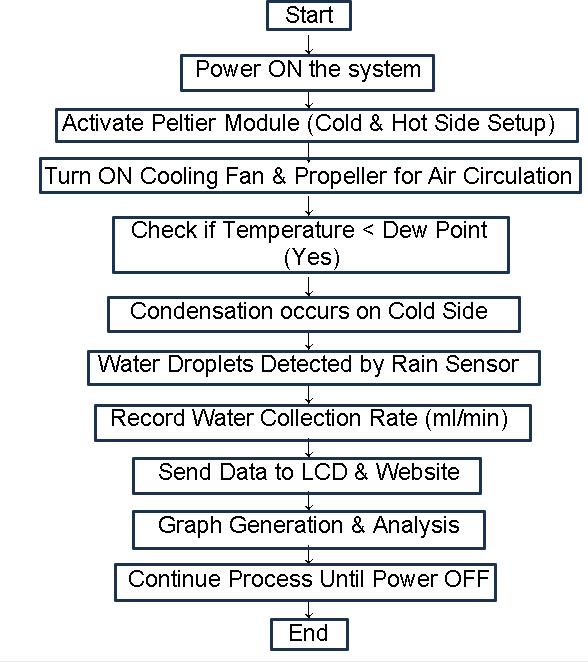
7. Summary ofProcessFlow
1. PowerONthesystem.
2. ActivatethePeltierandcoolingcomponents.
3. Waituntilthecoldsurfaceisbelowdewpoint.
4. Condensation begins and is detected by the rain sensor.
5. Microcontrollerlogsdataandsendsittothecloud.
6. LCDshowsoperationalstatusandwateryield.
7. Data is displayed as graphs on the ThingSpeak platform.
International Research Journal of Engineering and Technology (IRJET) e-ISSN: 2395-0056 p-ISSN: 2395-0072
Volume:12Issue:04|Apr 2025 www.irjet.net
Category
Details

1. SystemType Atmospheric Water Generator (AWG) using Peltier Thermoelectric Cooling
2. CoolingTechnology Peltier Module (TEC12706) + Heat Sink +Propeller
3. WaterYield ~0.92 L/day (with foil); ~0.37 L/day (without foil)
4. Humidity Operating Range 30%–100%RH(Optimal at≥60%)
5. PowerConsumption ~153 W (Total); ~1.53 kWhfor10hours
6. EfficiencyEnhancements Aluminum Foil Plate, PropellerforAirflow,IoT Monitoring
7. TemperatureRange Cold Side: -5°C to 10°C; HotSide:40°Cto80°C
8. CondensationRate Max~91.8mL/hour
9. Control&Monitoring IoTvia NodeMCU + LCD Display+RainSensor
10. Real-TimeData Monitored through ThingSpeak (cloud dashboard)
11. Construction Compact, Modular, Low Maintenance
12. Applications Disaster Relief, Rural Water Supply, Off-Grid Homes, Smart Agri, Military
13. Eco-Friendliness No refrigerants, low carbonfootprint
14. SimulationToolUsed ANSYS (for thermal & mechanical design analysis)
15. MainLimitations Lowyieldindryclimates, dependent on ambient humidity
16. FutureEnhancements AI Optimization, Solar Integration, Multi-Stage Cooling, Graphene Surfaces
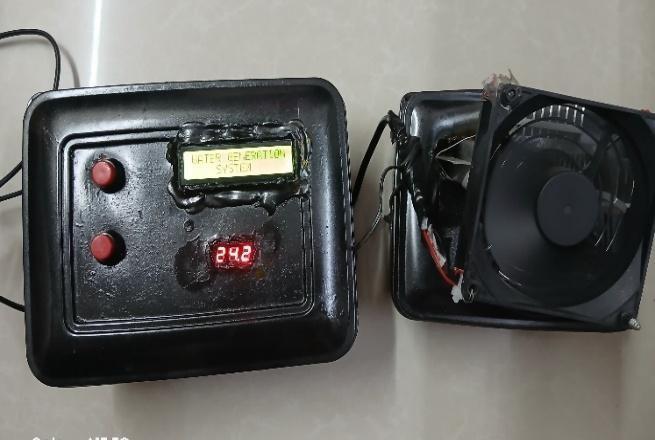
The figure shows virtual representation of AUQAGEN (AWG)
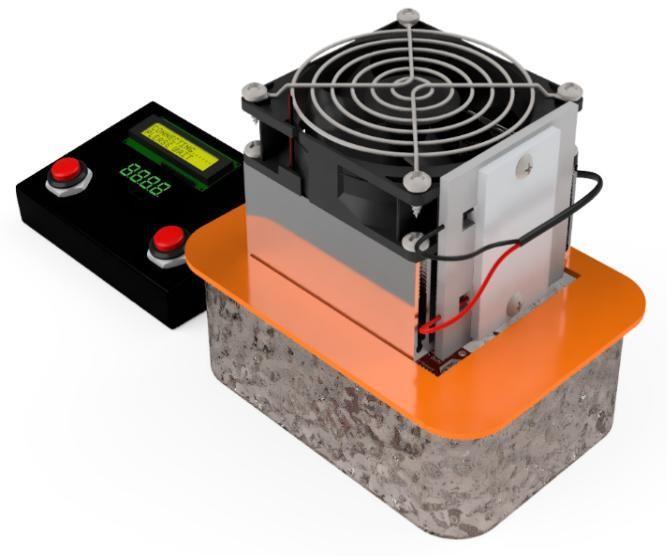
The Figure shows Meshing of AUQAGEN
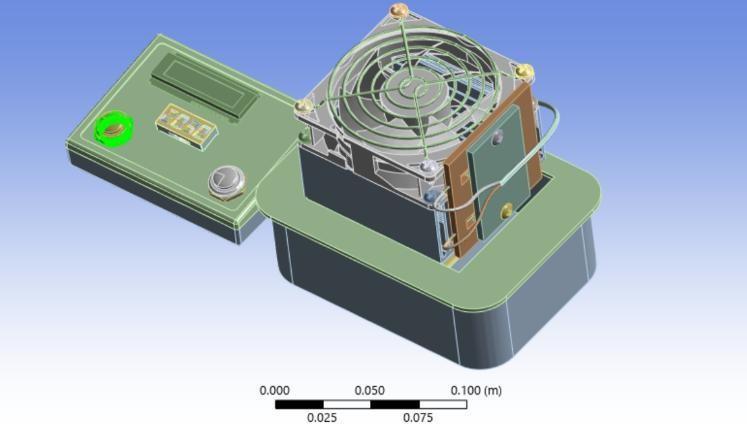

TheFigure shows Meshing of AUQAGEN (AGW)
International Research Journal of Engineering and Technology (IRJET) e-ISSN: 2395-0056 p-ISSN: 2395-0072
Volume:12Issue:04|Apr 2025 www.irjet.net
7.Technical Specifications / Data Tables
7.1 Major Component Specifications
Component Model/ Type Rating / Specification
Peltier Module TEC1-12706 12V, 6A, ΔT ≈60–70°C

Description
Thermoelectric cooler (TEC) for creating cold condensation surface
HeatSink Aluminu mfins High conductivity Attached to hot sideforthermal dissipation
Propeller Fan 12VDC 05A Increasesairflow toassist cooling andcondensation
RainSensor YL-83 Digital/Analog output Detectsinitial WaterdropforIoT trigger
NodeMCU (ESP8266) Wi-Fi Microcontroll er 5V,025A Collectssensor dataand transmitsto webdashboard
LCDDisplay 16x2I2C 5V,02A Real-timedisplay ofhumidity,temp, wateryield
Power Supply DCAdapter 12V2A PowersPeltier, fans,sensors, and microcontroller
7.2 Environmental Parameters for Testing

Parameter Symbol Typical Value Notes
Ambient Humidity RH 30–70% Best yield above60%
Ambient Temperature T air 22–35°C Affects dew point
Cold Side Temperature T cold 0°C to 10°C Required for condensation
Hot Side T hot 40°C to Depends on
Temperature 80°C cooling efficiency
Daily Operation Time t 10hours Simulatedusage
7.3 System Power Consumption
7.4 Experimental Output (Water Yield)
Foil
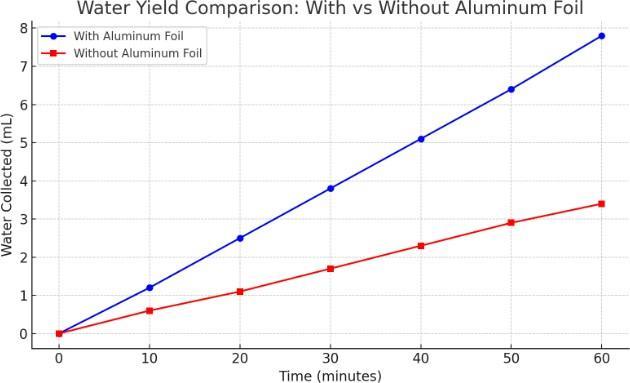
Fig4.Comparison betweenwith and without foil
Volume:12Issue:04|Apr 2025 www.irjet.net
International Research Journal of Engineering and Technology (IRJET) e-ISSN: 2395-0056 p-ISSN: 2395-0072
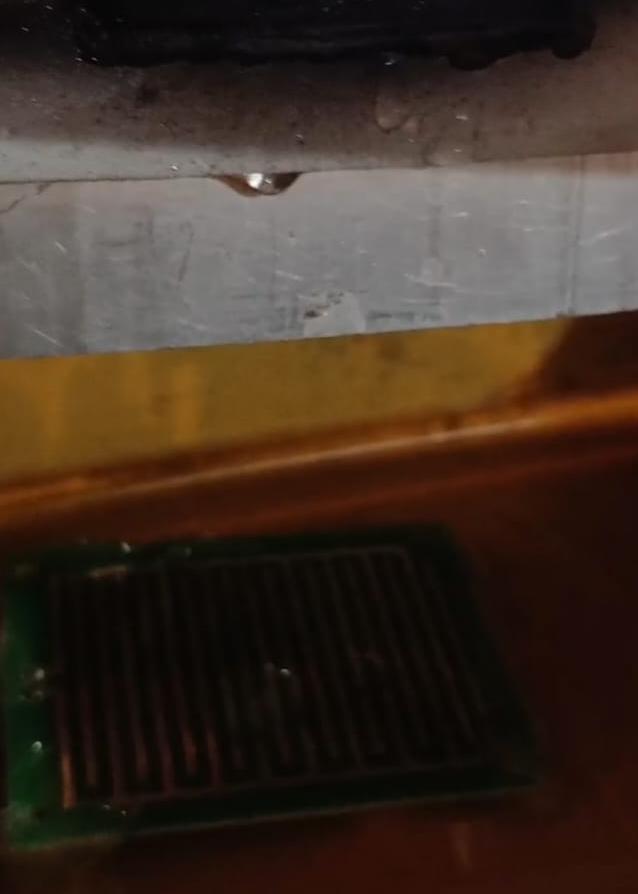
This Shows the output(Water) of the AUQAGEN
The AQUAGEN system successfully demonstrates a lowcost,energy-efficientmethodofharvestingwaterfromthe atmosphereusingthermoelectric(Peltier)technology.
Throughcarefuldesignandexperimentation,itwasfound that incorporating aluminum foil on the cold plate significantly enhances condensation efficiency by improving thermal conductivity. The addition of a propeller fan further optimized airflow across the cold surface, accelerating moisture condensation and increasingwateryield.Withatotalenergyconsumptionof ~152.75W,thesystemwasabletocollectupto0.92liters ofwaterin10hoursundermoderatehumidityconditions, validating its potential for small-scale, off-grid applications.
While the system performs best in environments with relative humidity above 50%, it provides a proof-ofconceptforsustainable,scalable,andportableAWGunits. The integration of IoT-based monitoring, including LCD displays and cloud visualization, adds real-time data capability for performance tracking and smart feedback. Future enhancements may include solar power integration, AI-based adaptive control, and use of advanced coatings like graphene or MOFs to improve condensation under lower humidity. Overall, AQUAGEN represents a practical step toward addressing water scarcitythroughaccessible,technology-driveninnovation. Observations:
Usingaluminumfoilsignificantlyimproves condensationefficiency.
After60minutes,yieldwithfoilismorethan2x higherthanwithoutfoil.
Early-stagecondensation(first20mins)shows
quicker onset with foil due to better thermal conductivity.
The presence of aluminum foil on the condensation surface enhanced thermal conductivity,allowingquickerandmoreefficient coolingofair.
Within the first 30 minutes, the water collected withfoilreached3.8mL,comparedtoonly1.7mL withoutfoil over120%increase.
After60minutes,theyieldwithfoilwas7.8mL, morethandoublethe3.4mLcollectedwithout foil.
Thisconfirms thataluminumfoil acts as a thermal booster, promoting faster dew formation by maximizing surface conductivity and aiding uniform cooling. Additionally, the foil reduced surface resistance to droplet formation, allowing more efficient water droplet accumulation and drainage.
International Research Journal of Engineering and Technology (IRJET) e-ISSN: 2395-0056 p-ISSN: 2395-0072
Volume:12Issue:04|Apr 2025 www.irjet.net
The AQUAGEN Atmospheric Water Generator presents a sustainable and portable solution for extracting potable waterfromambientairusingPeltier-basedthermoelectric cooling technology. The project demonstrated how key designenhancements suchastheuseofaluminumfoilto boostthermalconductivityandapropellerfantoimprove airflow can significantly increase water condensation rates. Experimental results confirmed that these simple, cost-effective modifications doubled the water yield and improved overall energy efficiency without requiring complex hardware. In addition to mechanical innovation, AQUAGEN features a smart IoT-enabled monitoring system using NodeMCU, sensors, and a ThingSpeak dashboard for real-time data visualization. The system is lightweight, modular, and consumes minimal power (~152.75W), making it ideal for off-grid, rural, or emergency deployment. With further optimization such as solar integration, AI-based control, and advanced coatings like graphene this technology can be scaled to servebroadercommunitiesinwater-scarceenvironments. AQUAGEN serves as a proof of concept for affordable and scalable atmospheric water harvesting, contributing meaningfullytowardaddressingglobalwaterchallenges.
[1] Sharma, R., Kumar, M., & Singh, A. (2021). Atmospheric watergeneration using Peltier effect International Research Journal of Engineering andTechnology(IRJET),8(7),412–417.
[2] Al-Karaghouli,A.,Kazmerski,L.L.,&Kettani, M.A.(2019). Performance analysis of a portable atmospheric water generator. Energies, 12(4), 1234.
[3] Vinoj, J., & Gavaskar, S. (2018). IoT-based atmospheric water generator for smart cities International Journal of Scientific Development andResearch(IJSDR),3(2),89–94.
[4] Khan,M.T.A.,Rahman,S.,&Ali,F.(2022). Design and simulation of an IoT-integrated AWG system.IEEEXplore.
[5] ArafatKhan,M.T.,Ahmed,S.,&Chowdhury, M. (2010). Automated solar-powered AWG using embedded systems. Proceedings of the IEEE InternationalConferenceonEmbeddedSystems, 245–250.
[6] Rathi, K., & Gupta, P. (2017). Study of condensation principles for AWG systems.Journal of Mechanical and Civil Engineering, 14(6), 01–06.
[7] Li,X.,Wang,Y.,&Zhang,Z.(2020).
Thermodynamic modeling of Peltier-based water harvesting systems Applied Thermal Engineering,162,114243.