
International Research Journal of Engineering and Technology (IRJET) e-ISSN: 2395-0056
Volume: 13 Issue: 03 | Mar 2026 www.irjet.net p-ISSN: 2395-0072
DEVELOPMENT AND PERFORMANCE EVALUATION OF A PASSIVE MODE
GREENHOUSE SOLAR DRYER WITH PEBBLES AND SAND BED ENERGY STORAGE SYSTEM
Awua Justin Tarka1, Ibrahim Jacob Sunday2, Abdulkadir Musa Jaji3
1,2.3Department of Mechanical Engineering, College of Engineering Joseph Sarwuan Tarka University, Makurdi, Nigeria ***
Abstract - A passive solar greenhouse dryer incorporating a combined sand and pebble bed as a thermal energy storage medium was designed, fabricated, and experimentally evaluated using locallysourcedmaterials. The dryingchamber measured 1.0 m × 0.758 m × 0.5 m (length, height, and width) and was developed specifically for vegetable dehydration. Air circulation within the system relied entirely on natural convection. Fresh okra (Abelmoschus esculentus) servedas the drying material. Representative samples were randomly selected to determine initial moisture levels, while post-drying moisture content was established through the standard ovendrying procedure. Drying experiments were performed concurrently in the solar greenhouse dryer and under direct sun exposure. Equal starting weights were maintained for both methods to ensure valid comparison. Greenhouse drying was conducted from 9:00 to 13:00 h, while open sun drying continued until 14:00 h to achieve comparable final moisture content. Observations and measurements were recorded at one-hour intervals. The greenhouse dryer achieveda reduction in okra moisture content from 86% to 10% (wet basis) within four hours. The system recorded a mean drying efficiency of 79% under average solar irradiance values of 1255.33 W/m² on the first day and 993.17 W/m² on the second day. Drying rates inside the greenhouse averaged 23.50 g/h and44.84 g/h across the two days, whereas corresponding open sun drying rates were slightly lower at 23.09 g/h and 38.88 g/h. Thermal performance analysis showed that, on the first day, the heat utilization factor varied between 1.63 and 5.68, while the coefficient of performance (COP) ranged from −0.63 to −4.68. Average values were 3.12 and −2.12, respectively. On the second day, heat utilization factors extended from 1.06 to 13.36, and COP values ranged from −1.79 to −2.68, producing mean values of 13.09 and −2.18. The accelerated moisture removal observed in the greenhouse system confirms its superior drying capability compared to traditional open sun drying. Efficient harnessing of solar energy contributed to shorter drying periods and improved process reliability. In addition, the dried okra retained a more desirable color, indicating better quality preservation. Reducedexposure time also minimizes contamination risks and post-harvest losses These findings highlight the suitability of the developed passive solar greenhouse dryer as an effective and sustainable solution for vegetable drying in sun-rich regions.
Key Words: Greenhouse solar dryer; Passive solar drying;Thermalenergystorage;Okradrying;Drying efficiency;post-harvestpreservation
1. INTRODUCTION
Drying is one of the earliest and most widely applied methods for preserving agricultural commodities, yet it is inherently energy demanding. Rising fuel prices and the depletion of fossil resources have intensified interest in renewable energy alternatives for agro-processing. Solar energy,inparticular,offersasustainableoptionforreducing theenvironmentalfootprintofcropdryingoperations.The drying of agricultural produce involves coupled heat and masstransferprocessesandisrecognizedasoneofthemost energy-consumingstagesinpost-harvesthandling.Although traditionalsundryinghasbeenpracticedforcenturiesdue toitssimplicity,thegrowingglobalpopulationhasincreased pressure on food systems and consequently on energy consumption throughout the supply chain [1],[2]. Projections indicate that worldwide energy demand may increaseby40–50%by2030tomeetfoodproductionand processing needs [3],[4]. Therefore, improving drying technologies with respect to energy efficiency, exergy utilization, cost-effectiveness, and environmental performancehasbecomeincreasinglyimportant[5].
Solardryersarecommonlyclassifiedbasedontheircollector configuration,withcabinetandchimney-typedryersbeing amongthemostprevalent.Incabinetdryers,solarradiation passesthroughatransparentcoverandisabsorbedwithin thedryingchamberitself.Chimney-typedryers,ontheother hand,separatethecollector from the dryingchamber and incorporateaverticalchimneytointensifybuoyancy-driven airflow. This arrangement enhances ventilation and often produceshigherinternaltemperatures.Additionally,theuse of multiple trays allows more effective use of space. For these reasons, many recent studies have favored designs withexternallypositionedcollectors[6].
Freshvegetablesarehighlyperishableduetotheirelevated metabolicactivity,whichlimitstheirstoragelife.Postharvest deterioration leads to both quality and quantity losses, ultimately reducing market value. In Nigeria, significant
International Research Journal of Engineering and Technology (IRJET) e-ISSN: 2395-0056
Volume: 13 Issue: 03 | Mar 2026 www.irjet.net p-ISSN: 2395-0072
portions of fruits and vegetables are lost before reaching consumers, with postharvest handling accounting for a substantial share of these losses. Such losses may occur duringharvesting,transportation,storage,andprocessing. Theymanifestasnutritionaldegradation,reducededibility, and physical damage arising from pests, rodents, or microbialspoilage[7].
Despite its low cost, open sun drying remains inefficient because a considerable fraction of available heat is not effectivelyutilized,resultinginslowmoistureremovaland prolonged drying times [8],[9]. The method is also highly weather-dependentandexposesproducetocontamination by dust, insects, birds, and rodents. Inadequate control of dryingconditionscanencouragefungalgrowthandincrease the likelihood of food-borne illnesses [10]. Consequently, there is a pressing need for reliable, small-scale drying technologiesthatenhancefoodsecurityandfarmerincome indevelopingregions.
Thisstudyaddressestheseconcernsbydevelopingapassive solargreenhousedryersuitablefortheclimaticconditionsof Makurdi. The system emphasizes operational simplicity, energy efficiency, and sustainability through the use of passive solar heating, guided airflow, and thermal mass storage. Okra (Abelmoschus esculentus), a warm-season vegetablebelongingtotheMalvaceaefamily,wasselectedas thetestcropduetoitseconomicandnutritionalimportance. Okra pods are widely consumed fresh and are frequently dried for off-season use. Nutritionally, okra provides carbohydrates, protein, fibre, essential minerals, and vitaminsAandC[11].Itscharacteristicmucilaginoustexture arisesfromglycans,whichcontributetodesirableculinary properties[12].Giventhehighdemandandperishabilityof okra, improving its post-harvest preservation through efficientsolardryingtechnologiesisbotheconomicallyand nutritionallybeneficial.
2. MATERIALS AND METHODS
2.1 Materials
2.1.1 Experimental Setup and Design
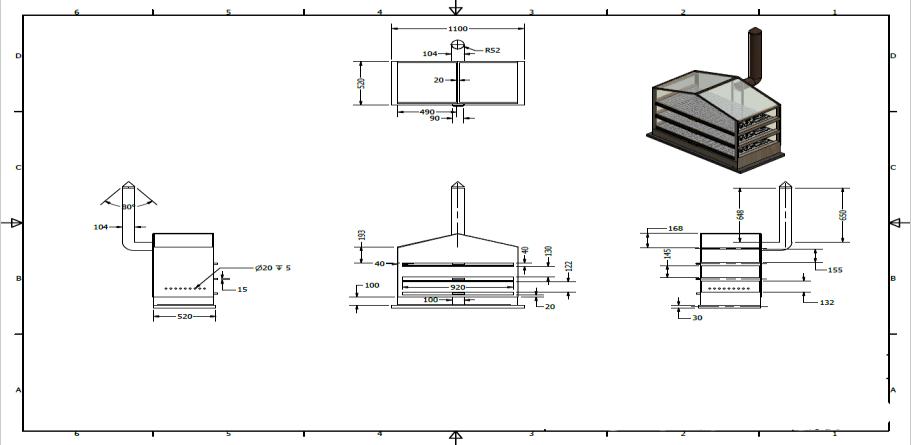
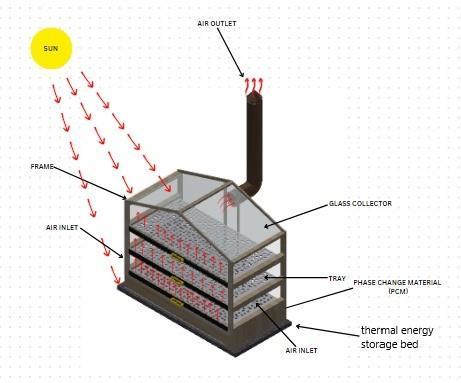
Figure1illustratestheschematiclayoutanddetaileddesign ofthesolargreenhousedryerusedinthisstudy.Aseriesof experimentaltrialswereconductedinApril2024toassess boththeperformanceof thesolarcollectorandthedrying behaviorofokra(Abelmoschusesculentus).Eachexperimental runinvolveda10kgbatchoffreshokrasourcedfromalocal marketinMakurdi,BenueState,Nigeria.
2.1.2 Solar Dryer Design and Fabrication
The dryer was designed following an extensive review of previousstudiesonsolardryingsystems,whichguidedthe
selection of a flat-plate collector configuration for this experimental investigation. Critical design parameters includingtheeffectivecollectorareaandairmassflowrate werecalculatedtooptimizedryingefficiency.Basedonthese calculations, the solarcollector wassizedat 1.6 m², which wassufficienttohandlea10kgbatchofokra.Thedryerwas fabricated using locally available materials, ensuring practicalityandreplicabilityinsimilarresource-constrained settings.
Beechwood(Gmelina arborea)waschosenforconstructing the frame of the solar greenhouse dryer due to its combination of lightweight, high strength, durability, low cost,andlocalavailability,makingitanidealmaterialforthis application. The dryer’s body was covered with clear polyvinylchloride(PVC)filmof0.34mmthickness,selected for its excellent transparency, high UV stabilization, mechanical strength, and resistance to aging, water, and abrasion.PVCisalsonon-toxicandprovidesgoodthermal insulation, enabling it to effectively trap heat and solar radiationwithinthedryingchamber.InadditiontothePVC film,4mmthicktransparentglasswasusedastheprimary solar collector to enhance solar energy absorption. The chimneywasfabricatedfromPVC,chosenforitsdurability, thermal insulation properties, and resistance to environmental factors such as weathering, chemical degradation, corrosion, and mechanical impact. These materialselectionsensuredthatthedryercouldwithstand outdoorconditionswhilemaintainingoptimalperformance.
International Research Journal of Engineering and Technology (IRJET) e-ISSN: 2395-0056
Volume: 13 Issue: 03 | Mar 2026 www.irjet.net p-ISSN: 2395-0072
2.2 Methods
2.2.1 Drying Procedure
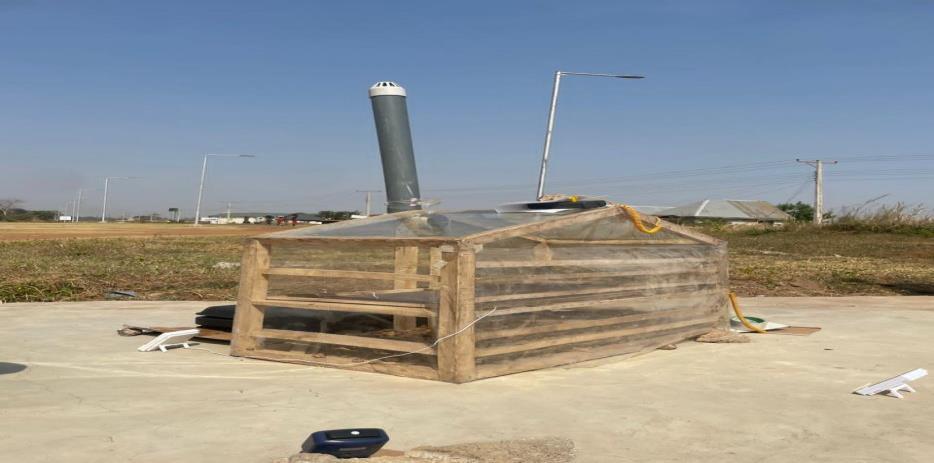
Afterfabrication,thesolargreenhousedryerswereinstalled in an open, sun-exposed area to ensure maximum solar irradiation. For optimal performance, the dryers were positionedontheterraceofthefacility.Freshokrasamples werepreparedbymeasuringtheirinitialmass,with4kgof okra placed in each dryer. Parallel drying trials were conductedunderopensunconditionstoprovideareference forperformancecomparisonbetweenthesolardryersand traditionalsundrying.
During the drying process, key environmental and operational parameters including air temperature, solar irradiance,relativehumidity,airvelocity,andthemassofthe food material were recorded at regular intervals. These measurementsenabledadetailedassessmentofthethermal performanceanddryingkineticsofeachsystem.Precautions weretakentoprotectthedryersfromrainandstrongwinds, ensuringconsistentexperimentalconditions.Dryinginside the greenhouse dryers also provided protection from
external contaminants such as dust, bacteria, and atmospheric pollutants. Subsequent nutritional analysis confirmedthatokradriedwithinthesolardryersretained higher nutrient content compared to open sun-dried samples.Theexperiments were conductedusingdifferent thermalmassbedconditions(pebblesandcoarsesand)to evaluatetheireffectondryingperformance.Alltrialswere carriedoutinJanuary2024,underclearskyconditions,at theDepartmentofMechanicalEngineering,JosephSarwuan Tarka University, Makurdi, Nigeria (latitude 7.74°N, longitude8.37°E).Dryingoperationswereperformeddaily from 09:00 to 14:00 hours for two consecutive days. To maximize solar energy absorption, the greenhouse dryers were oriented along the East–West axis (South–North alignment), consistent with the local latitude being below 40°.
2.2.2 Determination of Angle of Inclination
Theinclinationangleofasolarcollectorplaysacritical role in maximizing solar energy absorption and is typicallyrelatedtothelatitude(ϕ)oftheinstallation site,assumingthecollectorisalignedalongthesouth–northaxis.Foraflat-platesolarcollector,theoptimal tilt angle (β) can be determined using the method proposedbyOguntola et al. (2010)[13]byemploying equation1.
β=ϕ+10 (1) Were,
βisangleofinclination
ϕisLatitudeofexperimentallocation
2.2.3 Determination of Solar Collector Efficiency
Theefficiencyofthesolarenergycollectorisakeyindicator of the dryer’s thermal performance. It quantifies the proportionofincidentsolarradiationthatisconvertedinto usableheatforairheatingwithinthesystem.Heatlossesdue to convection and radiation also occur and must be accountedfor.Thecollectorefficiency(ηc)canbeexpressed mathematicallyas:
SolarEnergyCollectorEfficiency, (2)

Where,
��–airmassflowratekg/s
Cp -Specificheatcapacityofair,kJ/kg°C
Ic -Insolationradiationonthecollectorsurface,W/m2
Ac -CollectorArea,m2
2.2.4
Drying Efficiency
Drying efficiency (ηd) represents the effectiveness of the dryer in utilizing the supplied heat to remove
International Research Journal of Engineering and Technology (IRJET) e-ISSN: 2395-0056
Volume: 13 Issue: 03 | Mar 2026 www.irjet.net p-ISSN: 2395-0072
moisturefromtheproduct.Itisdefinedastheratioof the energy required to evaporate moisture from the wetmaterial to the totalthermalenergyprovidedto the drying system [14]. This parameter provides a measure of the system’s thermal performance and takesintoaccountfactorssuchasthetypeandquantity of the material being dried, the internal air temperature, and the airflow within the dryer. The dryingefficiencycanbeexpressedmathematicallyas: (3)
Where:
��w isthemassof water to be removed(kg); ��is the latent heat of vaporization of water at the drying temperature(kJkg⁻¹);��cisthesolarradiationincident onthecollector(Wm⁻²);��cisthecollectorarea(m²); andtisthedryingtime(s).
2.2.5
Determination of Drying Rate
The drying rate is defined as the amount of moisture removedfromtheproductperunittime,providinginsight intothekineticsofthedryingprocess[14].Itreflectshow quickly the dryer can reduce the moisture content of the materialundergivenoperatingconditions.Thedryingrate (DR)canbeexpressedmathematicallyas:
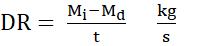
Mi –massofthesamplebeforedrying(kg)
Md –massofthesampleafterdrying(kg) t–dryingtime(s)
The moisture removal rate (moisture loss) is given by Equation (4), as reported by Rajesh and Karuppasamya (2016).
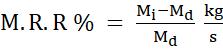
2.2.6
Determination of Moisture Content

(6)
Themassofmoistureremovedfrommkgofmoistproduct havinginitialmoisturecontentMi whenitisdriedtoafinal moisturelevelofMfisobtainedfromthefollowingequation.
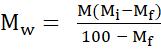
2.2.7
Heat Utilization Factor (H.U.F.)
The Heat Utilization Factor (H.U.F.) quantifies the effectivenessofthedryingsystemintransferringheatfrom the air to the product. It is defined as the ratio of the temperature drop due to air cooling during the drying processtothetemperatureriseachievedthroughairheating withinthedryer.Thisfactorprovidesanindicationofhow efficientlythesystemutilizestheabsorbedthermalenergy formoistureremoval.Mathematically,itcanbeexpressedas:
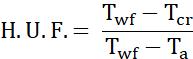
Where,
Twf isworkingfluid(air)temperature, Tcr iscroptemperatureand Ta isambienttemperature.
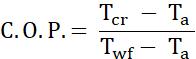
2.2.8 Coefficient of Performance (C.O.P.).
C.O.P.ofdryingsystemcanbegivenasbelow:
3. Results and Discussion
3.1 Effect of Solar Radiation on Thermal Performance
Moisturecontent(MC)isakeyparameterforassessingthe performanceofadryingsystem,representingtheproportion ofwaterpresentintheproductrelativetoitstotalweight.It canbeexpressedonawetbasis(w.b.)oradrybasis(d.b.), dependingonthereferencechosen.Accuratedetermination of moisture content is essential for evaluating drying efficiency, drying rate, and overall system performance. FollowingFudholi et al. (2011)[15],themoisturecontenton awetbasiscanbecalculatedas: (5)

��–Weightofwetsamplematerial,kg
��–Weightofdrysamplematerial,kg
MoistureContentonthedrybasishasbeengivenbyMercer, (2008)as:
Solarradiationwastheprimaryfactorgoverningthethermal behaviorofthepassivegreenhousesolardryer.Asdepicted in Charts 1 and 2, increases in global solar irradiance corresponded with simultaneous rises in both ambient temperature and the internal temperature of the drying chamber,forthesandbedondayoneandthepebblebedon day two, respectively. Conversely, decreases in solar radiationintensityledtoadeclineininternaltemperatures, confirmingthatthedryer’sthermalperformanceisstrongly dependentonincidentsolarenergyunderpassiveoperating conditions.
Throughout the drying period, the greenhouse dryer maintainedinternaltemperaturesconsistentlyhigherthan the ambient environment. On the first day, the chamber reachedamaximumtemperatureof52.6°C,comparedwith
International Research Journal of Engineering and Technology (IRJET) e-ISSN: 2395-0056
Volume: 13 Issue: 03 | Mar 2026 www.irjet.net p-ISSN: 2395-0072
anambientpeakof45.7°C(Figure4).Onthesecondday,the chambertemperaturepeakedat49.6°Cagainstanambient temperature of 43.9 °C (Chart 2). These elevated temperatureshighlighttheeffectivenessofthetransparent coverandthesolarcollectorincapturingandretainingheat while minimizing convective losses, thereby creating favorableconditionsforefficientdrying.
3.2 Influence of Thermal Energy Storage Beds
Theimprovedthermalperformanceofthegreenhousedryer canbeattributedtothecombinedeffectofthesolarcollector and the integrated thermal energy storage beds. Both the sandandpebblebedsactedassensibleheatstoragemedia, absorbingexcessheatduringperiodsofhighsolarradiation and gradually releasing it as irradiance decreased. This moderatedinternaltemperaturefluctuations,asreflectedin therelativelystablechambertemperatureprofilesshownin Charts1and2.
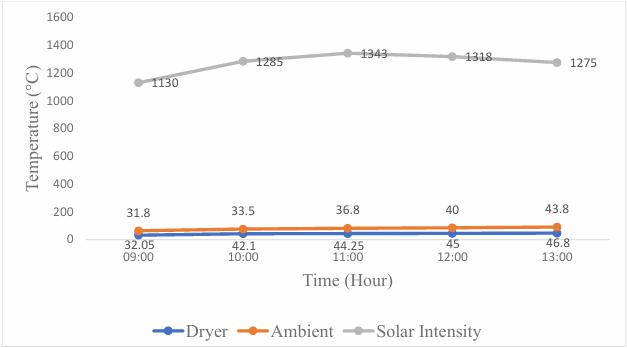
Chart -1:Chartofdryer,ambienttemperatureandsolar radiationagainsttimefordayone(Sandbed)
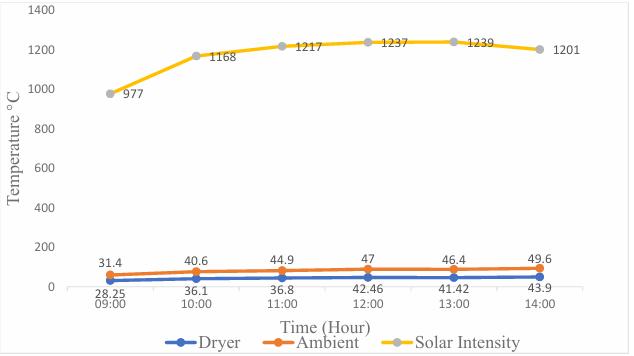
Chart-2:Chartofdryer,ambienttemperatureandsolar radiationagainsttimefordaytwo(Pebblebed)
Thesandbedexhibitedslightlyhigheraveragetemperatures comparedtothepebblebed,suggestingmaterial-dependent differences in heat storage and release characteristics. Nevertheless, both storage media effectively maintained
elevated drying temperatures, which are essential for efficientmoistureremoval.
3.3 Moisture Content Reduction and Drying Kinetics
Theevolutionofokramoisturecontentovertimeforboth thegreenhousedryerandopensundryingispresentedin Chart 3. A rapid reduction in moisture content occurred during the initial stages of drying, particularly within the first hour, due to the high surface moisture of the fresh samples.
Throughoutbothexperimentaldays,thegreenhousedryer consistentlyremovedmoisturefasterthanopensundrying. Okrasamplesinsidethegreenhousereachedafinalmoisture content of approximately 10% (wet basis) by 13:00 h, whereasopensundryingrequiredupto14:00htoachieve thesamelevel,demonstratingatimesavingofroughlyone hour.Thehigherdryingratesobservedinthe greenhouse system(Chart4)canbeattributedtotheelevatedinternal temperaturesandlowerrelativehumidity,whichincreased the vapor pressure gradient between the product surface andthesurroundingair.
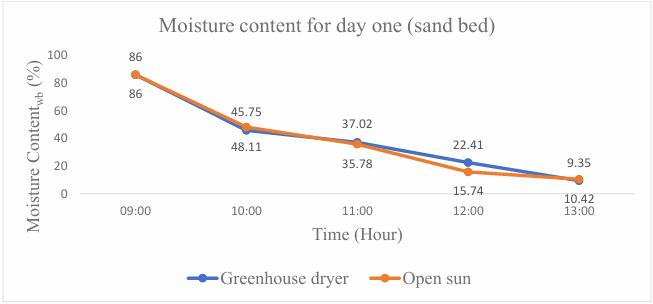
Chart -3: Moisturecontentofgreenhousedryerandopen sunagainsttimefordayone
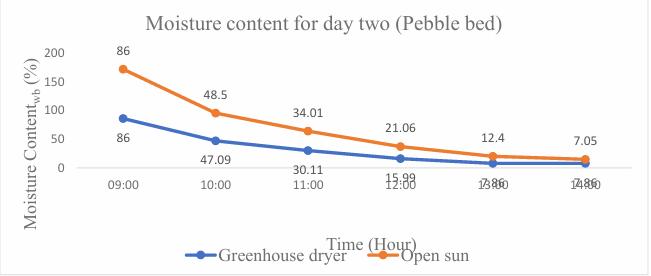
Chart -4:Moisturecontentofgreenhousedryerandopen sunagainsttimefordaytwo
International Research Journal of Engineering and Technology (IRJET) e-ISSN: 2395-0056
Volume: 13 Issue: 03 | Mar 2026 www.irjet.net p-ISSN: 2395-0072
3.4 Role of Airflow and Chimney Effect
The incorporation of a chimney significantly enhanced naturalconvectionwithinthedryer.Thechimneyinduceda continuousupwardairflow,efficientlyremovinghumidair from the drying chamber and preventing moisture accumulationaroundtheproduct.Thisfacilitatedconsistent dryingratesandimprovedtemperatureregulation. As a result, the greenhouse dryer maintained a more controlledandfavorabledryingenvironmentcomparedto opensundrying,whereairflowandtemperaturearelargely uncontrolled.Thebenefitsofthechimney-assistedairflow arereflectedintheimprovedmoisturereductionpatterns showninCharts3and4
3.5 Relative Humidity Characteristics
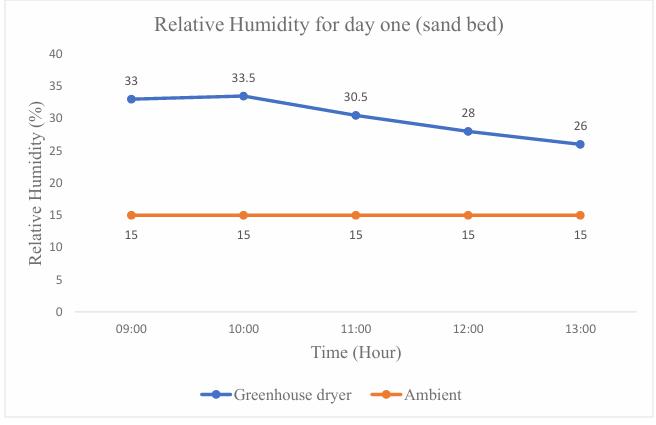
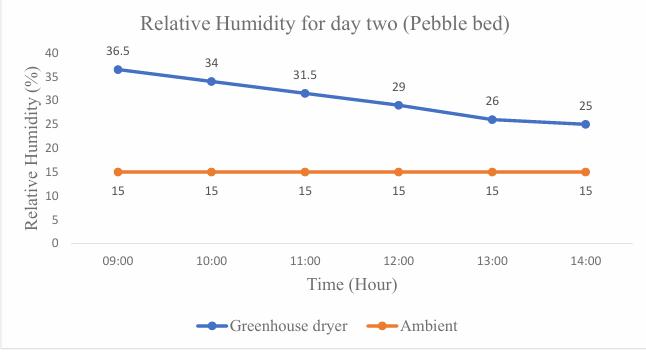
Charts 5 and 6 illustrates the relative humidity profiles of bothambientairandthegreenhousedryingchamber.While ambient relative humidity remained nearly constant at approximately 15%, the internal relative humidity of the dryer varied inversely with temperature. Lower relative humidity levels were observed during periods of peak chambertemperature,particularlyintheafternoonhours. The reduction in internal relative humidity enhanced the drying potential of the air, promoting faster evaporation from the okra samples. Controlled humidity conditions withinthegreenhousethuscontributedsignificantlytoits superiordryingperformancerelativetoopensundrying.
3.6 Energy Utilization and System Performance Indicators
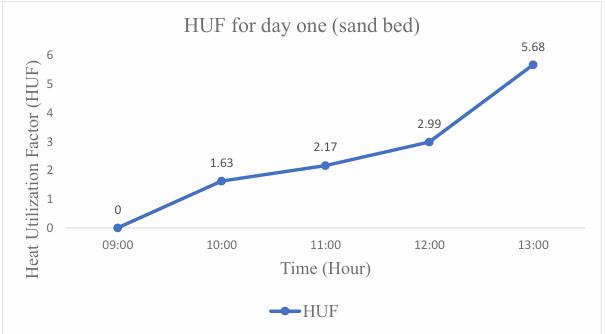
The heat utilization factor (H.U.F.) and coefficient of performance (COP) provide quantitative insights into the energetic efficiency of the drying system. Temporal variationsofH.U.F.andCOPforbothexperimentaldaysare presentedincharts7,8,9and10.TherelativelyhighH.U.F. valuesindicateefficientconversionofabsorbedsolarenergy intoheatformoistureremoval,particularlyduringperiods ofpeaksolarradiation. Although the COP values were negative, this behavior is typical for drying systems, where energy input primarily supportslatentheatofevaporationratherthanmechanical work.ThehigheraverageH.U.F.observedonthesecondday suggestsimprovedthermalutilizationwiththepebblebed, likely due to its favorable heat storage and release characteristics. The heat energy gained by the drying air shown in Figure 14, further confirms that substantial thermalenergywasavailablethroughoutthedryingperiod, supportingcontinuousandefficientdrying
International Research Journal of Engineering and Technology (IRJET) e-ISSN: 2395-0056
Volume: 13 Issue: 03 | Mar 2026 www.irjet.net p-ISSN: 2395-0072
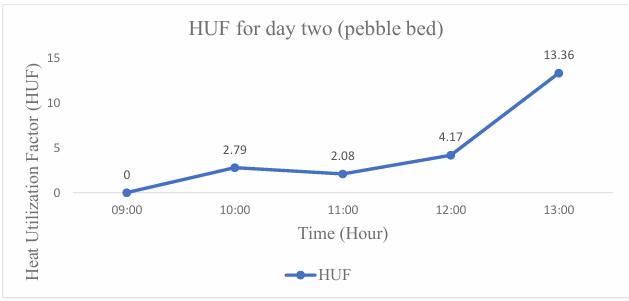
Chart -8:Heatutilizationfactorfordaytwo
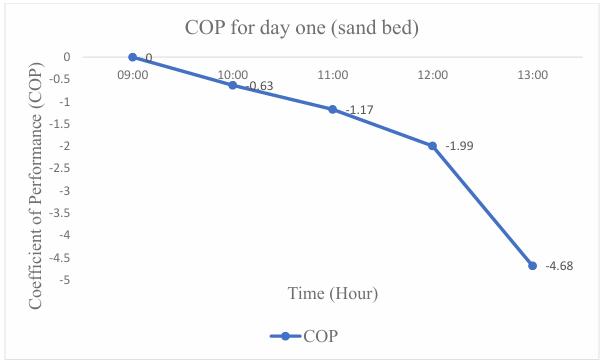
Chart -9:Coefficientofperformancefordayone
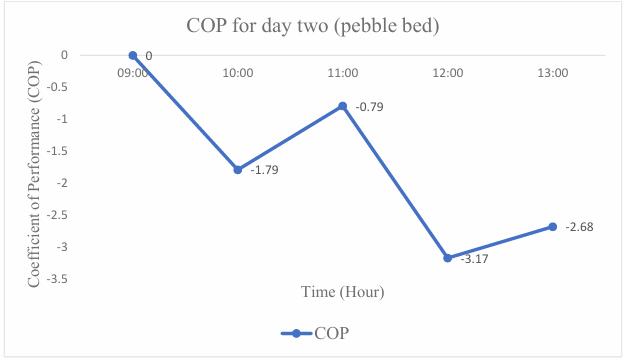
Chart -10:Coefficientofperformancefordaytwo
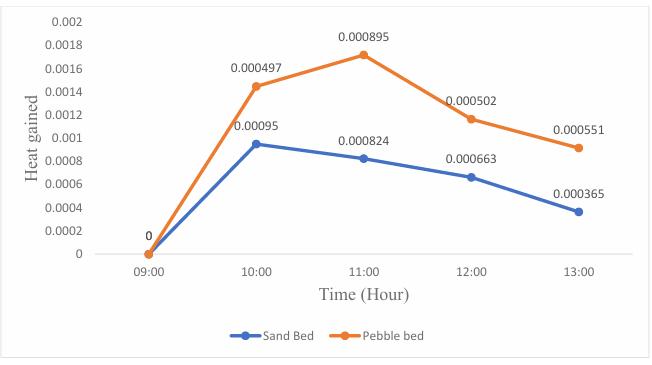
Chart -11:Heatenergygainedagainsttimefordayone andtwo
3.7 Energy Utilization and System Performance Indicators
Overall,theresultsdemonstratethatthepassivegreenhouse solar dryer outperformed open sun drying in terms of temperatureelevation,moistureremovalrate,andreduction of drying time. The integration of thermal energy storage beds and chimney-assisted airflow created a controlled drying environment, enhancing heat retention, lowering relativehumidity,andacceleratingmoisturediffusionfrom theproduct.
Thesefindingsindicatethatthedevelopedgreenhousesolar dryerisaneffective,energy-efficientsolutionforvegetable dryingundertropicalconditions.Ithasstrongpotentialto reduce post-harvest losses, improve product quality, and supportsmall-scaleagriculturalproduction.
3.7 Drying Rate
The recorded drying rates presented in charts 12 and 13, highlighttheperformanceadvantageofthesolargreenhouse dryerovertraditionalopensundrying.Duringthetwo-day experiment, the average drying rates of the greenhouse dryer were 23.50 g/h and 44.84 g/h, whereas the correspondingvaluesforopensundryingwere23.09g/h and38.88g/h,respectively.Thehigherdryingratesinthe greenhouse dryer can be attributed primarily to elevated internal air temperatures and reduced relative humidity, which together increased the vapor pressure gradient betweentheproductsurfaceandthesurroundingair.This gradient is the main driving force for moisture diffusion duringdrying.Thepresenceofsandandpebblebedthermal storagealsocontributedbystoringexcessheatduringpeak radiation periods and releasing it when solar intensity declined,therebysustainingmoistureremovalevenunder fluctuatingsolarinput.
International Research Journal of Engineering and Technology (IRJET) e-ISSN: 2395-0056
Volume: 13 Issue: 03 | Mar 2026 www.irjet.net p-ISSN: 2395-0072
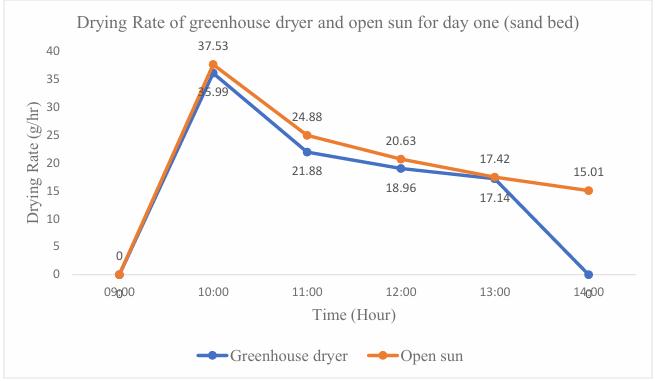
Chart -12:Dryingratefordayone
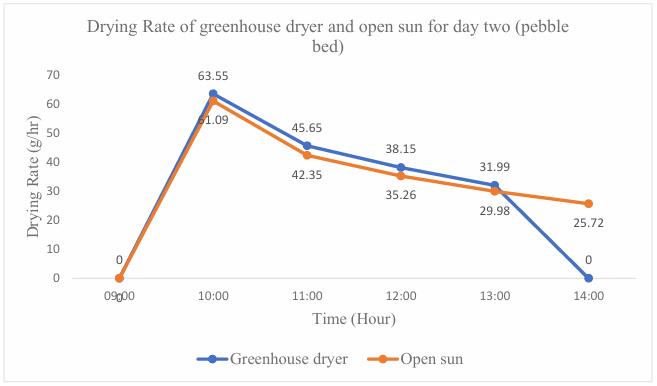
Chart -13:Dryingratefordaytwo
3. CONCLUSIONS
This study presented the design, construction, and experimental assessment of a passive greenhouse solar dryer incorporating sand and pebble bed thermal energy storage,developedusinglocallyavailableandcost-effective materials. The system was conceived as an alternative to traditionalopensundrying,whichisoftenassociatedwith prolonged drying periods, product contamination, and inconsistent quality. Experimental trials conducted under the climatic conditions of Makurdi, Nigeria, confirmed the practicalityandeffectivenessofthesystemfordryinghighmoisture vegetables such as okra. The greenhouse dryer maintained temperatures consistently above ambient conditions,reachingpeakvaluesof52.6°Cand49.6°Cfor thesandandpebblebedconfigurations,respectively.These elevatedtemperaturesresultedfromthesynergisticaction of the transparent enclosure, solar energy collection, and sensible heat storage within the thermal beds. The integration of sand and pebble media contributed to heat retentionandmoderatedtemperaturefluctuations,thereby ensuring a relatively stable drying environment under
naturalconvection.Enhancedthermalconditionswithinthe dryer translated into improved drying performance comparedwithopensundrying.Okrasamplesdriedinthe greenhouseattainedafinalmoisturecontentofabout10% (wet basis) within four hours, reducing drying time by approximatelyonehour.Higherdryingrateswereobserved, particularlyattheearlystageofdrying,duetoincreasedair temperature and lower relative humidity inside the chamber.
Fromanenergyperspective,thesystemachievedanaverage drying efficiency of approximately 79%, demonstrating effective conversion of solar energy into useful heat for moisture evaporation. Heat utilization factor values indicated meaningful use of the captured thermal energy, whilethecoefficientofperformancetrendsalignedwiththe energydemandsassociatedwithlatentheatremovalduring drying.Performancedifferencesbetweensandandpebble bedsindicatethatbothmaterialsareviablethermalstorage options,withpebblebedsshowingfavorableheatutilization undercertainconditions.
Insummary,thepassivegreenhousesolardryerdeveloped inthis study offers a sustainable and efficientsolution for small-scalecropdrying.Itscapacitytoshortendryingtime, improve energy use, and maintain product quality underscoresitspotentialtomitigatepost-harvestlossesand supportfoodsecurityindevelopingregions.Furtherstudies are recommended to evaluate long-term performance, conduct techno-economic analysis, optimize storage materials, and examine the nutritional and sensory attributesofdriedproductstofacilitatewideradoptionof thetechnology.
REFERENCES
[1] Kagande,L.(2012).Designandperformanceevaluation of solar tunnel dryer for tomato Fruit drying in Zimbabwe.IOSRJ.Eng.,2,1–7.
[2] Gorjian,S.,Singh,R.,Shukla,A.andMazhar,A.R.(2020). On-farm applications of solar PV systems. In Photovoltaic Solar Energy Conversion; Gorjian, S., Shukla,A.,Eds.;Elsevier:Amsterdam,TheNetherlands, pp.147–190.
[3] Walsh,M.J.,Gerber,V.D.,L.,Shete,N.,Prakash,A.and Salim,U.(2018).FinancialTradeoffsofEnergyandFood UsesofAlgalBiomassunderStochasticConditions.Appl. Energy,(210),591–603.
[4] Fayose, F and Huan, Z. (2016). Heat Pump Drying of FruitsandVegetables:PrinciplesandPotentialsforSubSaharanAfrica.Int.J.FoodSci.,9673029.
[5] Anugra,S.andSarvasindhu,M.(2016).ProjectReport onSolarDryer.Availableat:
International Research Journal of Engineering and Technology (IRJET) e-ISSN: 2395-0056
Volume: 13 Issue: 03 | Mar 2026 www.irjet.net p-ISSN: 2395-0072
https://www.slideshare.net/AnugrahSoy1/projectreport-on-solar-dryer?
[6] Pimpan, P., Siwalak, P. and Prasertsak, P. (2021). FabricationandTestingofDouble-SidedSolarCollector Dryer for Drying Banana. Case Studies in Thermal Engineering, [online]27,pp.101335101335.doi:https://doi.org/10.10 16/j.csite.2021.101335.
[7] Bolarin,F.MandS.O.Bosa(2015).Post-HarvestLosses: ADilemmainEnsuringFoodSecurityinNigeria.Journal ofNaturalSciencesResearch,5(7):151-154.
[8] Singh, P. L. (2011). Silk Cocoon Drying In Forced ConvectionTypeSolarDryer.Appl.Energy,(88),1720–1726.
[9] Azaizia,Z.,Kooli, S., Hamdi, I.,Elkhal,W.,Guizani, A.A. (2020).ExperimentalStudyofaNewMixedModeSolar GreenhouseDryingSystemwithandwithoutThermal EnergyStorageforPepper.Renew.Energy,145,1972–1984.
[10] Sharma,A.,Chen,C.R.,Vu,L.N.(2009).Solar-Energy Drying Systems: A Review. Energy Rev., (13), 1185–1210.
[11] Pendre,N.K.,Nema,P.K.,Sharma,H.P.,Rathore,S.S. andKushwah,S.S.(2012).EffectofDryingTemperature and Slice Size on Quality of Dried Okra (Abelmoschus Esculentus (L.) Moench). J Food Sci Technol, 49: 378381.
[12] Falade,K.O.,Omojola,B.S.(2010).EffectofProcessing MethodsonPhysical,Chemical,Rheological,andSensory Properties of Okra (Abelmoschus Esculentus). Food Bioprocess Technol,3:387-394.
[13] Oguntola,J.A.,Collins,N.N.andOlayyinka,A.(2010). Design and Construction of a Domestic Passive Solar FoodDryer.LeonardoJournalofSciences,6:71-82.
[14] Fudholi, A. H. M. A. D., Othman, M. Y., Ruslan, M. H., Yahya, M., Zaharim, A. and Sopian, K. (2011). TechnoeconomicAnalysisofSolarDryingSystemforSeaweed inMalaysia.InProc.ofthe7thIASME/WSEASInt.Conf. on Energy, Environment, Ecosystems and Sustainable Development(EEESD,11)(pp.89-95).
© 2026, IRJET | Impact Factor value: 8.315 | ISO 9001:2008 Certified Journal | Page1234