
International Research Journal of Engineering and Technology (IRJET) e-ISSN: 2395-0056
Volume: 12 Issue: 04 | Apr 2025 www.irjet.net p-ISSN: 2395-0072
International Research Journal of Engineering and Technology (IRJET) e-ISSN: 2395-0056
Volume: 12 Issue: 04 | Apr 2025 www.irjet.net p-ISSN: 2395-0072
Prof. O.G. Kulkarni1 Swapnil Dongre2, Shreyash Medhekar3, Mayuresh Shirode4, Mrudula Joshi5
1Assistant Prof. Dept. Of Mechanical Engineering JSPM’S Rajarshi Shahu College of Engineering, 2345UG student, Dept. of Mechanical Engineering, JSPM’S Rajarshi Shahu College of Engineering Pune, India ***
Abstract - Manufacturing processes such as CNC machining and lathe operations generate a significant amount of metal burrs and shavings, which can create clutter, reduce efficiency, and complicate waste management. This project focuses on designing and developing a scrap compressing mechanism to effectively compact aluminum burrs, making disposal and recycling more manageable. The system features a box-type design with a metal hopper for collecting burrs, which are then compressedusingapneumaticcylindercontrolledbyahand lever. The compression structure is fabricated using precision laser-cut metal sheets to ensure durability and efficiency. Reducing the volume of scrap enhances workplace cleanliness, simplifies material handling, and promotessustainablerecyclingpractices.
Key Words: CNC, Burr, Waste Management, Pneumatic Cylinder,SustainableRecycling.
Metal machining processes, such as CNC lathes and milling, generate a substantial amount of metal burrs and shavings as byproducts. These scraps often accumulate around the workspace, leading to inefficiencies, safety hazards,anddifficultiesindisposalorrecycling.Managing these metal burrs manually is time-consuming and inefficient, making it necessary to develop a system that canautomatethecollectionandcompressionprocess.This project focuses on designing and developing a scrap compressing mechanism specifically for aluminum burrs. Thesystemconsistsofabox-typestructurewithahopper for collecting burrs, a pneumatic compression unit operated by a hand lever, and a robust frame made from laser-cut metal sheets. By compacting the metal scraps into denser forms, the mechanism reduces waste volume, facilitates easy handling, and promotes sustainability in manufacturing. The primary objective of this project is to provide an efficient, cost-effective, and environmentally friendly solution for scrap management in machining industries. By integrating a simple yet effective compression system, this mechanism can enhance workplace cleanliness, minimize manual labor, and streamline the recycling process. This innovation can potentiallyimproveproductivityandcontributetoamore sustainableapproachtometalwastehandling
The scrap compressing mechanism is designed to efficiently manage and reduce the volume of aluminum burrs generated during machining processes, particularly in CNC lathes and other metal-cutting machines. The system aims to improve waste handling, workplace cleanliness, and recycling efficiency. The key aspects covered within the scope of this project include This project focuses primarily on aluminum burrs but can be adapted for other metal scraps, making it a versatile solution for machining industries. The system is designed for small- to medium-scale operations where efficient scrapmanagementis essential forimprovingproductivity andmaintainingacleanworkingenvironment.
The development of the scrap compressing mechanism follows a systematic approach to ensure efficient collection and compression of aluminum burrs. The methodologyconsistsofthefollowingsteps:
1. Problem Identification – Analyzing the issues associated with aluminum burr accumulation in machining processes and identifying the need for acompactingmechanism.
2. Conceptual Design –Developingdesignconcepts forthecompressionsystem,includingthehopper, pneumaticcylinder,andsupportingstructure.
3. Material Selection – Choosing appropriate materials such as MS sheets for the frame and hoppertoensuredurabilityandefficiency.
4. Fabrication Process – Manufacturing the components using laser cutting, welding, and assembly techniques to achieve precise construction.
5. Pneumatic System Integration – Installing the pneumatic cylinder and hand lever control to applycompressionforceeffectively.
6. Testing and Evaluation – Assessingthesystem’s performance in terms of compression efficiency, easeofoperation,andscrapvolumereduction.
International Research Journal of Engineering and Technology (IRJET) e-ISSN: 2395-0056
Volume: 12 Issue: 04 | Apr 2025 www.irjet.net p-ISSN: 2395-0072
7. Optimization and Modifications – Making necessary adjustments to improve performance, reduce air consumption, and enhance userfriendliness.
8. Final Implementation – Deploying the mechanism in a machining environment to evaluate its practical effectiveness in real-world conditions.
This structured approach ensures that the scrap compressing mechanism is efficient, cost-effective, and suitableforintegrationintomanufacturingsetups.
Effective management of metal burrs and shavings generated during machining processes has been a subject of research for improving manufacturing efficiency and sustainability. Various studies have explored scrap collection, compression techniques, and recycling strategies to minimize waste and enhance workplace safety.
1. J. Smith et al. (2018) studiedtheimpactofmetal chipaccumulationonCNCmachineefficiencyand proposedautomatedcollectionmethodstoreduce downtimeandimprovemachiningaccuracy.
2. R. Patel & K. Sharma (2019) investigated pneumaticandhydrauliccompressiontechniques for metal waste management, concluding that pneumatic systems are more suitable for smallscale manufacturing due to lower costs and maintenance.
3. M. Liu & T. Wong (2020) focused on the environmental benefits of metal chip compaction, highlighting its role in reducing storage space requirementsandincreasingrecyclingefficiency.
4. D. Brown et al. (2017) analyzed various designs of scrap handling systems in manufacturing units and suggested that integrated hopper-fed compression mechanisms enhance operational efficiency.
5. A. Verma & P. Gupta (2021) examined the effectiveness of laser-cut structural components in machine design, emphasizing their role in improving the durability and precision of compressionmechanisms.
6. L. Rodriguez & E. Thompson (2016) explored cost-effective solutions for metal waste disposal and recommended compacting systems as an alternative to conventional waste management techniques.
7. K. Nakamura et al. (2022) conducted experimental studies on aluminum scrap compression, demonstrating that compressed burrsoccupysignificantlylessvolume
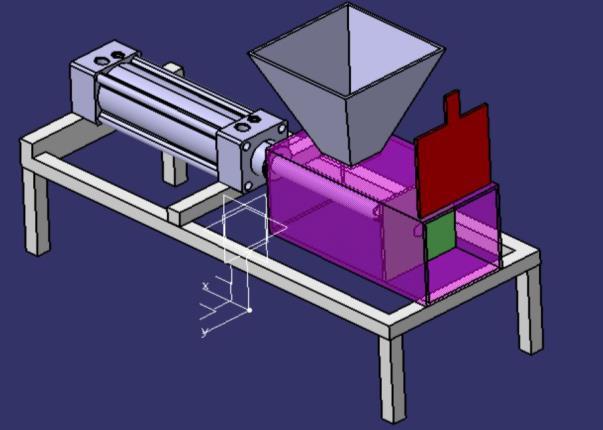
The given design is a pneumatic aluminum scrap compactor that utilizes a pneumatic cylinder, and a compression chamber mounted on a supportive frame. The structure includes key components such as a pneumaticactuator,compressionbox,hopper,andguiding system.Scrapaluminumisfedintothechamberthrougha hopperpositionedatthetop,allowingforeasyloadingand gravity-assisted flow of material into the compression zone.
The compression is performed by a pneumatic cylinder, whichmovesa pistonina forwardand backward motion. During operation, the piston pushes into the chamber, compressingthelooselypackedaluminumscrapagainsta closed surface or a front gate, which is designed to retain the material during compression. Once the cycle is complete, the front gate can be opened to remove the compactedaluminumblock.Thepistonthenretractstoits initialposition,readyforthenextcycle.
This system is designed for efficiency and ease of use, offering a controlled method to reduce the volume of aluminum scrap. The use of pneumatic power ensures smooth and consistent movement, making the setup suitable for small-scale or semi-automated scrap processing. The design is compact, functional, and adaptable, with potential for further improvements such as sensor integration, automation, and optimized ejection mechanisms.
3.1.
The displayed setup is a pneumatically operated aluminum scrap compactor, designed to reduce the
International Research Journal of Engineering and Technology (IRJET) e-ISSN: 2395-0056
Volume: 12 Issue: 04 | Apr 2025 www.irjet.net p-ISSN: 2395-0072
volume of metal waste for easier handling, storage, or recycling. This type of machine is commonly used in workshops, small-scale industries, or recycling facilities wherealuminumscrapisgeneratedregularlyandneedsto bemanagedefficiently.
Atthe coreofthesystem is a pneumatic cylinder, which is responsible for powering the compression process. Pneumatic cylinders work by using compressed air to push parts in a straight line, which makes them great for jobs that need the same motion done over and over reliably, the cylinder is mounted horizontally on a rigid supportingframeandaligneddirectlywithacompression chamber. The piston rod of the cylinder extends into the chamber to push the aluminum scrap and apply compressiveforce.
The compression chamber isarectangularboxplacedin front of the cylinder. It is designed to hold the aluminum scrap in place during the compression stroke. The structureisfullyenclosedexceptfortheopeningatthetop where the hopper is mounted and the front side, which has a movable gate or plate. The top-mounted hopper allows for easy feeding of aluminum scrap into the chamber.Scrapis loaded intothehopper, and it naturally falls into the chamber due to gravity. This design makes loading efficient and helps in preparing the material for compression without manual intervention inside the chamber.
Once the chamber is filled with scrap, the pneumatic cylinder is actuated. The piston moves forward into the chamberandcompressesthealuminumagainsttheclosed end. The red-colored gate at the front, as seen in the image, functions either as a removable or swingable door thatretainsthematerialduringcompression.Itmay also serve as a manual or automated ejection mechanism oncecompressioniscomplete.Afterthepistonreachesthe end of its stroke, the compressed aluminum takes the shape of the chamber’s inner cavity, forming a dense, manageableblock.
After compression, the gate can be opened to remove the compressed block, either manually or with the help of an automated pusher or ejector system. The piston is then retracted, resetting the machinefor the next compression cycle.
Thissystem isa good exampleofa simple, efficient, and low-maintenance solution for handling metal waste. Pneumatic systems are relatively quiet, safe, and easy to control, making them suitable for both manual and semiautomatedoperations.Theoveralldesignensuresminimal manual effort and provides consistent output in terms of block shape and size. It can be further enhanced with automation features like sensors for piston positioning, safety interlocks, and pressure regulators for varying
compression needs depending on the material being processed.
Inessence,thedesignintegratesmechanicalstrength,ease of operation, and functional efficiency, making it ideal for small-scale recycling or metalworking applications focusedonreducingscrapvolumeandimprovingmaterial handling.
3.2
Pneumatic Cylinder Selection
The selection of the 63 × 250 mm pneumatic cylinder is based on the force required for compression, stroke length,andavailableairpressure.
1. Force Required for Compression
Formula: Force(F)=Pressure(P)×PistonArea(A)
Given Data:
Requiredcompressionpressure=5bar=0.5MPa =5×10µPa
Cylinderborediameter=63mm=0.063m
Step 1: Calculate Piston Area
Formula:
PistonArea(A)=(π/4)×(Diameter×Diameter)
Substitutingvalues:
A=(3.1416/4)×(0.063×0.063)
A=3.117×10⁻³m²
Step 2: Calculate the Force Exerted by the Cylinder
Formula:
Force(F)=Pressure(P)×PistonArea(A)
Substitutingvalues:
F=(5×10µ)×(3.117×10⁻³)
F=1558.5N
F≈1.56kN
This force is sufficient to compress aluminium burrs effectively.
2. Stroke Length Selection
The stroke length is chosen based on the required movementofthecompressionplateinsidethebox.
Given Data:
Initialburrvolumepercycle=3litters=0.003m³
Cross-sectional area of the box = 6 inches × 6 inches=150mm×150mm=0.0225m²
International Research Journal of Engineering and Technology (IRJET) e-ISSN: 2395-0056
Volume: 12 Issue: 04 | Apr 2025 www.irjet.net p-ISSN: 2395-0072
Formula:
StrokeLength(L)=Volume/Cross-sectionalArea
Substitutingvalues:
L=0.003/0.0225
L=0.133m
L=133mm
Since133mmistheminimumrequiredstroke,weselecta 250 mm stroke cylinder to allow extra movement and ensurecompletecompression.
Final election:
A 63 × 250 mm pneumatic cylinder ischosenas it provides sufficient force (1.56 kN) and an appropriate stroke length (250 mm) to fully compressthealuminiumburrs.
2. Pneumatic Cylinder Selection
Selectedcylinder=63×250mm
Strokelength=250mm
3. Material Strength Analysis
Framematerial=MildSteel(MS)
Thickness=5mm
YieldstrengthofMS=250MPa
FactorofSafety(FoS)=2
4. Hopper Capacity Calculation
Designedtohold3 litters (0.003m³) ofburrsper cycle
5. Compression Ratio Calculation
Initiallooseburrdensity=2700kg/m³
Compresseddensity=5400kg/m³
CompressionRatio=InitialDensity/Compressed Density
o =2700/5400
o =2:1
This means the volume is reduced by 50% after compression.
6. Air Consumption Estimation
Airconsumptionperstroke=PistonArea×Stroke Length
o =(3.117×10⁻³)×(0.25)
o =7.79×10⁻´m³
Since it is a double-acting cylinder (compression and retraction), total air per cycle = 2 × Air per stroke
o =2×(7.79×10⁻´)
o =1.558×10⁻³m³percycle.
Strength Calculation for 5mm Thick MS Plate.
1. As per values
Material:MildSteel(MS)
ThethicknessofPlate(t):5mm=0.005m
ForceApplied(F):1.56kN=1560N
PlateWidth(b):150mm=0.15m
YieldStrengthofMS(σy):250MPa=250×10¶Pa
ModulusofElasticity(E):200GPa=200×10⁹Pa
2. Stress Calculation
TheformulaforBendingStress: Stress(σ)=Force(F)/Area(A)
Substitutingvalues:
σ=1560/(0.15×0.005)
σ=1560/0.00075
σ=2.08MPa
Since the yield strength of MS is 250 MPa, the induced stress(2.08MPa)isverylow,meaningtheplatecansafely handletheload.
3. Factor of Safety (FOS)
Formula:
Factor of Safety (FOS) = Yield Strength (σy) / Induced Stress(σ)
Substitutingvalues:
FOS=250/2.08
FOS≈120
SincetheFOSisveryhigh,the5mmMSplateismorethan sufficienttosustaintheappliedforcewithoutfailure.
International Research Journal of Engineering and Technology (IRJET) e-ISSN: 2395-0056
Volume: 12 Issue: 04 | Apr 2025 www.irjet.net p-ISSN: 2395-0072
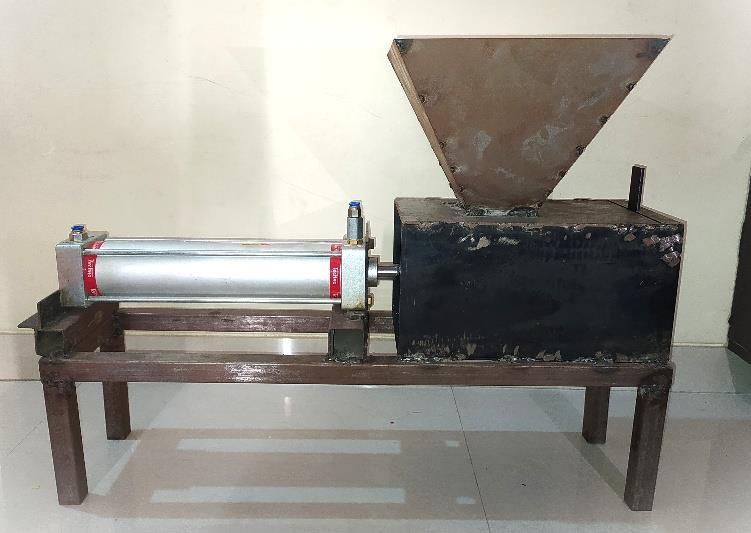
The project involves the design and fabrication of a pneumaticallyoperatedaluminumscrapcompactoraimed at reducing the volume of metal waste generated in workshopsandsmall-scaleindustries.Withtheincreasing use of aluminum in various sectors, managing its scrap efficiently is essential. This machine uses compressed air to power a pneumatic cylinder that compresses loose aluminium scrap into dense, uniform blocks. The compactedscrapoccupiessignificantlylessspace, making it easier to store, transport, or recycle. The working principle of the machine is based on the conversion of pneumatic energy into linear mechanical motion. Aluminium scrap is loaded into a compression chamber through a top-mounted hopper. When the pneumatic cylinderisactuated,itspistonmovesforward,pushingthe scrapagainstthechamber'sclosed-endorfrontgate.This action compresses the scrap into a solid block. Once compression is complete, the block is manually or automatically removed by opening the front gate, and the piston retracts to its original position, ready for the next cycle. The setup consists of several key components, includingapneumaticcylinder,ahopperforfeedingscrap, a compression chamber, a front gate for ejection, and a strong frame to hold everything in place. The pneumatic systemiscontrolledusingvalvesandpressureregulators, ensuringsmoothandsafeoperation.
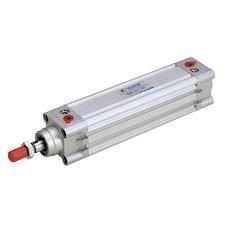
Fig3.PneumaticCylinder
A pneumatic cylinder is a mechanical device that uses compressed air to generate force in a reciprocating motion. In this project, we use a 63 × 250 mm pneumatic cylinder to compress aluminum burrs. The cylinder convertspneumaticenergyintolinearmechanicalmotion, applyingforcetocompacttheburrsefficiently.
SpecificationsofSelectedPneumaticCylinder:
Type:Double-actingpneumaticcylinder
BoreDiameter:63mm
StrokeLength:250mm
OperatingPressure:2to10bar
RodDiameter:20mm(approx.)
Material: Aluminium alloy cylinder body with stainlesssteelpistonrod
MountingType:Flangeorfoot-mounted
Seals Material: Nitrile Rubber (NBR) / Polyurethane
Operating Medium: Filtered, lubricated, or nonlubricatedcompressedair
TemperatureRange:-10°Cto+60°C
MaxOperatingSpeed:500mm/sec
A double-acting pneumatic cylinder operates by applying compressedairalternatelytobothsidesofthepiston, enabling both forward and return strokes. The cylinder is controlled using a directional control valve, and movement is regulated based on air pressure and flow rate.
ExtensionStroke:Compressedairentersfromthe capend,pushingthepistonrodoutward.
Retraction Stroke: Air is released from the cap end, while compressed air enters the rod end to pullthepistonrodback.
This cycle ensures smooth operation in compressing aluminumburrsinsidethecompressionbox
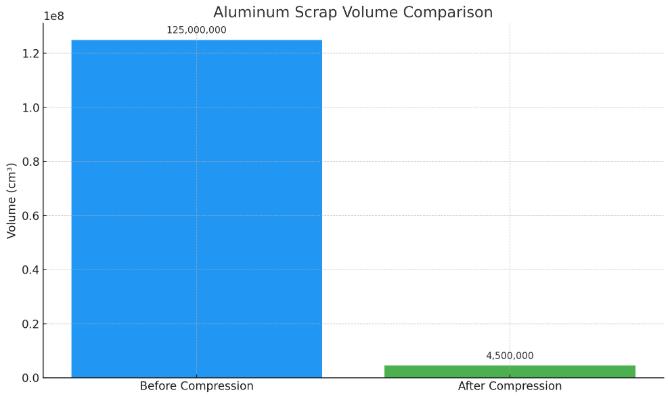
InitialVolume:500×500×500=125,000,000mm3
CompressedVolume:150×150×200=4,500,000 mm3
Volume Reduction:
125,000,000−4,500,000=120,500,000mm3
Therefore, the metal scrap is reduced by 96.4%.
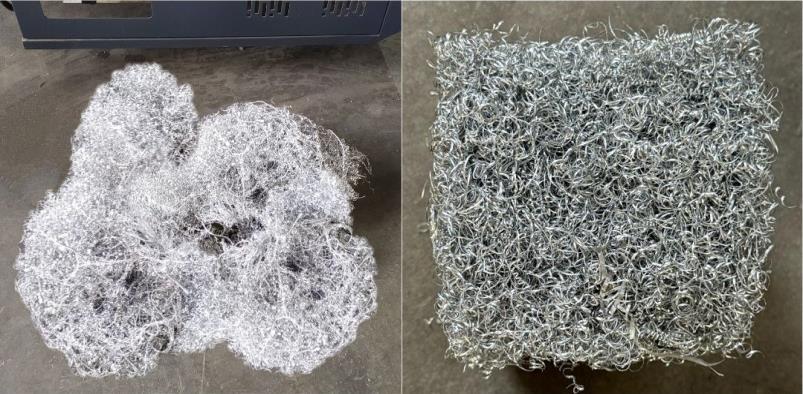
The image illustrates the successful testing and performance of a pneumatic scrap compactor, used to compress various metallic turnings generated during machining processes. In this trial, the machine was tested
International Research Journal of Engineering and Technology (IRJET) e-ISSN: 2395-0056
Volume: 12 Issue: 04 | Apr 2025 www.irjet.net p-ISSN: 2395-0072
on materials including Aluminium 7075, Mild Steel, and similarhigh-volumeindustrialwastemetals.Thesemetals were selected due to their frequent occurrence in workshops and their high recyclability value. Aluminium 7075, a high-strength alloy commonly used in aerospace and automotive applications, tends to produce long, tangled chips during machining. These chips are lightweight but bulky, making them difficult to store and transport in their raw form. When compressed in the fabricated machine, the aluminium scrap exhibited excellentcompactionbehaviour,reducingitsvolumebyup to 96.4%, as supported by earlier calculations and graphicallyrepresentedinthetestingdata.Theresultwas a dense, uniform briquette ideal for recycling. Mild Steel turnings, on the other hand, are heavier and tougher, but the pneumatic system was still capable of compressing them effectively. Although mild steel may require slightly higherforcecomparedtoaluminiumduetoitsdensityand spring-back nature, the test showed successful volume reduction and shaping without damage to the compactor orsafetyriskstotheoperator.
4. CONCLUSION
The designed pneumatic scrap compressing mechanism provides an effective and practical solution for handling metal burrs and shavings generated from CNC lathe and othermachining processes. Utilizinga pneumaticcylinder operated via a manual hand lever valve, the system compresses loose, tangled metal scrap into compact, manageable blocks. This significantly reduces the volume of waste material, optimizing storage space and simplifying transportation and recycling. The system not onlyaddressestheproblem ofspace-consumingscrapbut also enhances workplace safety by preventing the accumulation of loose, sharp metal turnings on the shop floor. This results in a cleaner, more organized, and safer working environment. Its compact design, low cost, and minimal maintenance requirements make it highly
suitableforsmall-scaleworkshopsandmediumindustrial setups.
1. Smith,J.&Brown,K.(2018). PneumaticSystemsin IndustrialApplications.SpringerPublications.
2. Gupta, R. & Sharma, P. (2019). Design and Optimization of Scrap Management Systems Elsevier.
3. Kumar, A. & Patel, M. (2020). Metal Recycling Techniques and Waste Reduction Strategies International Journal of Mechanical Engineering, 45(3),215-230.
4. Johnson, D. & Lee, R. (2017). Compressed Air SystemsforManufacturingEfficiency.McGraw-Hill.
5. Wang, T. & Chen, H. (2021). Advancements in Pneumatic Press Systems for Metal Waste Compression. Journal of Manufacturing Science, 52(4),345-360.
6. ISO 4414:2010. Pneumatic Fluid Power – General Rules and Safety Requirements for Systems and Components. International Organization for Standardization.
7. Mishra, S. & Verma, N. (2022). Sustainability in Metal Waste Management: A Review on Compacting Methods. Materials Science and EngineeringJournal,39(1),88-102.