
International Research Journal of Engineering and Technology (IRJET) e-ISSN: 2395-0056
Volume: 13 Issue: 03 | Mar 2026 www.irjet.net p-ISSN: 2395-0072
International Research Journal of Engineering and Technology (IRJET) e-ISSN: 2395-0056
Volume: 13 Issue: 03 | Mar 2026 www.irjet.net p-ISSN: 2395-0072
Dr.Shubhangi Gondane1, Anuj Bankar2, Hitesh Thakare 3, Pratik Chaudhari4
1Project Guide, Department of Mechanical Engineering, PVG College of Engineering, Technology and Management Pune– 411009 2, 3, 4 Students, Department of Printing and Packaging Technology, PVG College of Engineering, Technology and Management Pune – 411009 ***
Abstract – Foodsafety is nowa major concern worldwide, especially for foods that go bad quickly or are high in protein,likemeat,fish,andchicken.Mostpackagingtodayis made from petroleumbased based material that only protect food physically and do not break down easily, leading to plastic waste. Creating a film using biodegradable materials like Polylactic Acid (PLA), Polypropylene Carbonate (PPC), and a natural colour indicator Curcumin[1]. Curcumin is a color from turmeric and changes color depending on the pH level, which can signal when food is going bad. It also has antimicrobial properties, which means it can help prevent the growth of harmful bacteria [4]. When mixed into PLA/PPC films, it helps detect spoilage by reacting to certain chemicals, like ammonia, dimethylamine, and trimethylamine, which are releasedasproteinrichfoodsstarttorot[3].
Key Words: Cur cumin, Food Spoilage Detection, PLA, PPC, Smart Packaging
1. INTRODUCTION
Protein-basedfoods,likechicken,beef,andfish,canbreak down with bacteria during storage, producing chemicals like ammonia, dimethylamine, and trimethylamine. These substances not only make the food less appealing but can also be harmful to health. In regular packaging, people only check the expiration date, not how fresh the food reallyis.
Films made from biopolymers, which come from natural sources, have become popular because they break down easily, are not harmful, and can be modified for extra functions. PLA, a type of biodegradable plastic, is widely studied because it is strong and clear. However, it is not very flexible and doesn't block gases well, so it isn't good for use in flexible packaging. PPC, a different biodegradablepolymer,ismoreflexibleandblocksoxygen well. Combining PLA and PPC gives a material that is strong,flexible,andcanbreakdowneasily.
Curcumin, a natural coloring compound from the plant Curcuma longa, changes color depending on the pH. It looks yellow in neutral conditions but turns orange or reddish-browninbasicenvironments,makingitusefulfor showing if food has gone bad. When added to a PLA/PPC
film, curcumin can detect the volatile amines that come out when proteins start to break down, letting the film changecolortoshowifthefoodisstillfresh.
This review aims to compare different studies on PLA/PPC/Curcumin films, explain how they are made, look at how they sense spoilage and fight bacteria, and discuss the difficulties and future possibilities for these smart,eco-friendlymaterials.
Protein-rich foods like meat, fish, eggs, and dairy are extremely perishable due to their high moisture content, nutrientdensity,andneutralpH,whichpromotemicrobial and enzymatic activity. These conditions accelerate deterioration in texture, odor, and color. Even under refrigeration, spoilage organisms such as Pseudomonas and Lactobacillus thrive, producing volatile amines and other compounds that shorten shelf life. This high perishability causes significant post-harvest losses, highlightingtheneedforpackagingthatcanbothpreserve freshness and detect early spoilage in protein-based products.
1.Development and detailed structural characterization of polymer–curcumin composite biodegradable films for smartapplications.
2.Preparation of varied polymer–curcumin formulations and evaluation of mechanical, thermal, antioxidant, antimicrobialproperties.
3.Application of standard laboratory techniques for comprehensive preparation and characterization of compositefilms.
4.Investigation of solvent–polymer interactions influencing film stability, performance, and potential packagingapplications.
5.Systematicexecutionofcompositefilmresearchwithina structurednine-monthprojecttimeline.
International Research Journal of Engineering and Technology (IRJET) e-ISSN: 2395-0056
Volume: 13 Issue: 03 | Mar 2026 www.irjet.net p-ISSN: 2395-0072
The process for creating and testing a biodegradable spoilage sensor for protein-based foods, using polylactic acid(PLA),polypropylenecarbonate(PPC),andcurcumin, followsaseriesofconnectedsteps.Thewholeprocesswas divided into stages: choosing the right materials, making the films, checking their properties, and evaluating how well they work. The goal was to make a reliable, easy-toreplicate,andpracticalsmartpackagingsolution[1].
The main materials were chosen based on how well they perform, their impact on the environment, and whether they are safe to be in contact with food. The main biodegradable polymers, PLA and PPC, were bought in pellet form, while curcumin, which is both an antimicrobialandacolorindicator,waspurchasedinhighquality powder form (>95% pure) [4]. Analytical-grade solvents such as chloroform or dichloromethane were usedformakingthefilms,andtheywereselectedfortheir safetyandhowquicklytheyevaporate.
4.2.Solution Casting of PLA-PPC-Curcumin Composite Films
Dissolution and Blending: PLA and PPC were weighed in the right amounts to get the desired mechanical and functional properties, usually in a 75:25 weight ratio [1].The polymers were mixed in a certain amount of the selectedorganicsolvent,withcontinuousstirringatroom temperature. Once the polymers had fully dissolved, curcumin was added in a specific amount, generally between1%and5%ofthetotalpolymerweight[3].
Film Casting: The mixture was spread onto a flat, nonreactive surface like a glass plate or a Teflon tray using either gravity or a calibrated doctor blade to control and ensure an even thickness. The thickness was usually kept between50to150micrometres[1].
Solvent Evaporation: Once the solution was spread, the films were left to dry at room temperature or in a gentle vacuumoven(notmorethan40°C)for24to48hours[4].
Physical and Mechanical Properties: Thickness
Measurement: Several spots on the film were measured with a digital micrometer to check if the thickness was even. Tensile Strength Testing: Standard strips were tested to determine how strong they are, how much they stretch before breaking, and how rigid they are. The resultsusuallyshowedtensilestrengthbetween30and45 MPa, elongation at break between 50 and 150%, and a Young'smoduluswithinexpectedranges[1].
Chemical and Functional Analysis: FTIR: This technique was used to check if the curcumin interacted with the polymer matrix [4]. Thermal Analysis (DSC/TGA): These tests helped understand how the films behave when heated, which is important for their stability over time. DPPH Radical Scavenging Assay: This test measured how wellthecurcumininthefilmscanneutralizefreeradicals, showingitsantioxidantability[3].
The films were placed in a sealed chamber with different levelsofammoniagasandthecolorchangesweretracked over time. The results showed that the films responded quicklytoammoniaatapHrangeof6to9[3].
The films were tested against bacteria like *Salmonella*, *E. coli*, and *Listeria* in lab conditions. After 24 to 48 hours at 37°C, the results showed that the films reduced bacterialgrowthby70to90%[4].
Eachexperimentwascarriedoutthreetimes,andthedata was analyzed to ensure consistent results and to find the bestmixofpolymerandcurcumin[1].
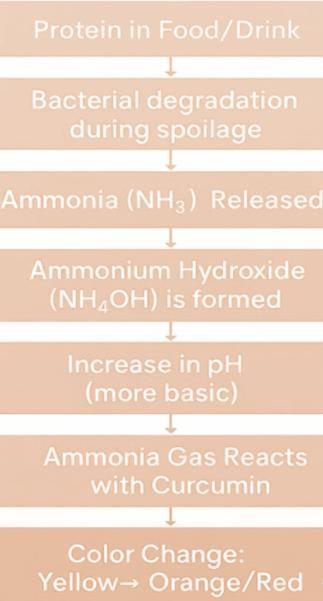
Foods high in protein break down with the help of microorganisms while they are stored. This process releases certain gases called volatile amines, like ammonia, trimethylamine (TMA), 6 and dimethylamine (DMA) [1]. These chemicals make the area around the packaging slightly more alkaline, or basic. When the environmentbecomesmorealkaline,curcuminchangesits structurefromenoltoketoform,whichcausesitscolorto shiftfromyellowtoreddish-brown[3].
International Research Journal of Engineering and Technology (IRJET) e-ISSN: 2395-0056
Volume: 13 Issue: 03 | Mar 2026 www.irjet.net p-ISSN: 2395-0072
This table compares biopolymer-based smart films, showing active compounds, sensitivity type, and key functionalproperties.
Table no.1 ComparisonofBiopolymer-BasedSmart IndicatorFilmSystems
Biopolymer System Active Compound Sensitivity Type Key Properties
PLA/PPC + Curcumin Curcumin pH/Ammonia Color change, antimicrobial
Chitosan + Anthocyanin Anthocyanin pH Natural dye, antioxidant
Gelatin + Curcumin Curcumin pH/Temp Flexible, edible
PVA + Turmeric Extract Curcumin analogs pH Transparent, lowcost
This table presents the mechanical, antimicrobial, pHresponsive, and biodegradation properties of the compositefilms.
Table no.2 Properties of PLA/PPC/Curcumin Composite Films
Parameter Observed Range Description
TensileStrength 30–45MPa Comparable to plasticfilms
ElongationatBreak 50–150% Enhanced flexibility due to PPC
ColorSensitivity pH6–9 Rapid visual response to ammonia
Antimicrobial Efficiency
70–90%inhibition AgainstE.coli,S. aureus
Biodegradation Time 45–60days Fully decomposes undercomposting
PLA/PPC/curcumin biodegradable films show good strength and flexibility, effective pH-based color change for spoilage detection, strong antimicrobial and antioxidant activity, adequate thermal stability, and completebiodegradationwithin45–60days,makingthem suitable,smartandsustainablefoodpackagingmaterials.
ThisreviewpointsoutthatfilmsmadefromPLA,PPC,and Curcumin are good options for biodegradable smart packaging that helps keep protein-rich foods fresh [1]. When these materials are combined, PLA provides strength, PPC adds flexibility, and Curcumin offers colorimetric and antimicrobial properties, making the composite material able to detect spoilage in real time [4][3].
The authors express sincere gratitude to Dr. Shubhangi Gondane, Guide, Department of Mechanical Engineering, for her valuable guidance and continuous support throughoutthisstudy.SpecialthanksareextendedtoProf Madhura Mahajan, HOD of department of Printing and Packaging Technology and Dr. Varsha Chaware, Project Coordinator of department of Printing and Packaging Technology, for there encouragement and assistance in aligning the research direction. The team also acknowledges PVG’s College of Engineering and Technology & Management for providing laboratory facilitiesandacademicresources.
[1] M. Cvek et al., “Biodegradable films of PLA/PPC and curcumin as packaging materials and smart indicators of food spoilage,” *ACS Applied Materials & Interfaces*, vol. 14,no.12,pp.14654-14667,2022.PubMed+2dev.nlk.cz+2
[2] “Curcumin as Bioactive Agent in Active and Intelligent Food Packaging Systems” (Review), *Int. J. Biological Macromolecules*,retrievedviaPMC.PMC+1
[3] “Edible Bioactive Film with Curcumin: A Potential ‘Functional-Film’ for Food Packaging,” *Food Packaging andShelfLife*,2023.PMC+1
[4]S. Roy & J-W. Rhim, “Curcumin incorporated poly(butylene adipate-co-terephthalate) film with improvedwatervaporbarrierandantioxidantproperties,” *Materials(Basel)*,vol.13,no.19,4369,2020.PMC
[5]“SmartPackagingBasedonPolylacticAcid:TheEffects of…”*Polymers*vol.15,no.20,4103,2023.MDPI
International Research Journal of Engineering and Technology (IRJET) e-ISSN: 2395-0056
Volume: 13 Issue: 03 | Mar 2026 www.irjet.net p-ISSN: 2395-0072
[6]“Curcumin-ABio-basedPrecursorforSmartandActive FoodPackaging Systems:A Review,” *Journal of Polymers andtheEnvironment*,2022,vol.6,pp.2177-2208.OUCI
[7] “Monitoring food quality – effect of curcumin in the development of …” published via Wiley, 2023. 4spepublications.onlinelibrary.wiley.com
[8]“Preparation of bioactive functional poly(lactic acid)/curcumin composite film for food packaging application,” *Int. J. Biological Macromolecules*, 2020. PubMed
[9]“Edible films based on starch/potato/κcarrageenan/poly(vinyl alcohol) and curcumin: Biodegradable hydrogel films,” *Biomedical Engineering Online*,2025.BioMedCentral
[10]“Development of intelligent food packaging from turmeric (Curcuma longa),” *Int. J. Engineering Advanced Technology(IJEAT)*,2019.ResearchGate
[11]“Active and/or intelligent packaging materials containing curcumin: A patent view,” World Patent WO2023212742A1,2023.GooglePatents
[12]Ma,Y.,Yang,W.,Xia,Y.,Xue,W.,Wu,H.,Li,Z.,... &Fu, C. (2022). Properties and applications of intelligent packagingindicatorsforfoodspoilage.Membranes,12(5), 477.
[13]Duan,M.,Yu,S.,Sun,J.,Jiang,H.,Zhao,J.,Tong,C.,…& Wu, C. (2021). Development and characterization of electrospun nanofibers based on pullulan/chitin nanofibers containing curcumin and anthocyanins for active-intelligent food packaging. International journal of biologicalmacromolecules,187,332-340.11
[14] Mathew, M., Paroly, S., & Athiyanathil, S. (2025). Biopolymer-based electrospun nanofiber membranes for smart food packaging applications: a review. RSC advances,15(27),21742-21779.
[15] Deshmukh, R. K., & Gaikwad, K. K. (2024). Natural antimicrobial and antioxidant compounds for active food packaging applications. Biomass Conversion and Biorefinery,14(4),4419-4440.
[16] Dainelli, D., Gontard, N., Spyropoulos, D., Zondervanvan den Beuken, E., & Tobback, P. (2008). Active and intelligent food packaging: legal aspects and safety concerns.TrendsinFoodScience&Technology,19,S103S112.
[17] Pourjavaher, S., Almasi, H., Meshkini, S., Pirsa, S., & Parandi, E. (2017). Development of a colorimetric pH indicator based on bacterial cellulose nanofibers and red cabbage (Brassica oleraceae) extract. Carbohydrate polymers,156,193-201.
[18] Balbinot-Alfaro, E., Craveiro, D. V., Lima, K. O., Costa, H. L. G., Lopes, D. R., & Prentice, C. (2019). Intelligent packaging with pH indicator potential. Food engineering reviews,11(4),235-244.
[19] Choi, I., Lee, J. Y., Lacroix, M., & Han, J. (2017). Intelligent pH indicator film composed of agar/potato starchandanthocyaninextractsfrompurplesweetpotato. Foodchemistry,218,122-128.
[20] Zhang, J., Zou, X., Zhai, X., Huang, X., Jiang, C., & Holmes, M. (2019). Preparation of an intelligent pH film based on biodegradable polymers and roselle anthocyanins for monitoring pork freshness. Food chemistry,272,306-312.
2026, IRJET | Impact Factor value: 8.315 | ISO 9001:2008